
Understanding North Korea
Analyzing social engineering through domestic propaganda & official mythology
Written and Photographed by Nile Bowie
Editor’s note by Nile Bowie: After years of fascination, I had the opportunity to spend eight days in North Korea in September 2011. At the moment, it is only possible to visit North Korea through a highly organized government-sanctioned tour. Perhaps the most incredible thing about my time there was the genuine authenticity of the emotions displayed in ordinary people towards their leaders, who are viewed with the utmost piety. The degree to which the Korean people are motivated and inspired by the State’s official media and mythology is unparalleled in contrast to any other country. I wrote this article in an attempt to define their worldview as I have come to understand it, because it remains one of the world’s least understood (and most fascinating) societies.
by Nile Bowie
NileBowie.blogspot.com
December 28, 2011
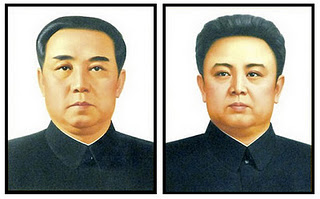
These portraits of the Great Leader, Kim il Sung and the Dear Leader, Kim Jung il are required to be hung in the home of every Korean by law.
The recent political transition in North Korea has once again focused the world’s attention towards the least accessible society on earth. Its epitaphic spectacle of mourning for the Father Leader, the Great General Kim Jung il, has invited a torrent of conjecture and analysis from the peering spectators of the outside world. While the majority of experts speak of issues such as the possibility of a failed succession, followed by a military coup d’état or a “Pyongyang Spring”, it becomes apparent that so few outlets take the domestic North Korean worldview into account. While all parties exchange wild rhetoric, Washington’s insistent stance on denuclearization is a clear demonstration of its incoherency in diffusing tension, reaching a common resolution with Pyongyang and most importantly, understanding how the regime views itself.
While the country is referred to as the twenty first century’s last bastion of Stalinism, the internal propaganda to which the domestic population is exposed suggests an antipodal ideology intrinsically irreconcilable with the worldview of Karl Marx and Vladimir Lenin. Under the surface of immense concrete monuments espousing Communism and the rambling doctrine of Juche Thought, North Korea’s domestic propaganda suggests that its identity is derived from a staunchly race-based brand of nationalism, at times channeling a rhetoric of ethnic superiority, similar to that claimed by the Nazis. While the propaganda designated to foreign scrutiny dryly champion’ principles of self-reliance in vague humanistic themes, as found within the Juche doctrine, the least accessible propaganda intended for internal consumption is a uniquely Korean brand of racist orthodoxy.
 |
|
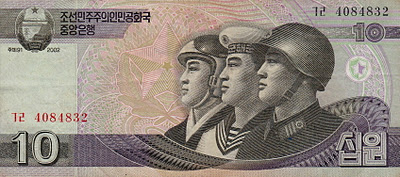
Image: “The Korean people are too pure-blooded and therefore too virtuous, to survive in this evil world without a great parental leader.”The servicemen depicted on this Korean banknote share identical physical characteristics; great pride is taken in the homogenous & mono-ethnic features of the Korean race.
|
CLICK HERE TO READ THE FULL ARTICLE…
————————
(hat tip: Land Destroyer Report)

 PN
PN 
Leave a comment