
VIDEO — Inventor of ADHD Confesses it’s a Made-Up Disease
The Truther Girls
May 23, 2013
Psychiatrist Leon Eisenberg confessed months before his death that his ADHD is a’ made-up disease’. But does that mean there is no problem and the symptoms are not real? Or is something else going on. TrutherGirl investigates!
‘I Read It On The Internet’ T-Shirt available at http://thetruthergirls.spreadishirt.com
Please like my FB page: http://facebook.com/thetruthergirls
Links:
http://www.worldpublicunion.org/2013-…
http://health.nytimes.com/health/guid…
BBC Documentary on ADHD:
https://www.youtube.com/watch?v=JpX7R…
http://www.forbes.com/sites/alicegwal…
http://www.psychologytoday.com/blog/s…
http://health.howstuffworks.com/menta…
http://www.thelancet.com/journals/lan…
Nuclear regulators acknowledge fault below Tsuruga reactor is active
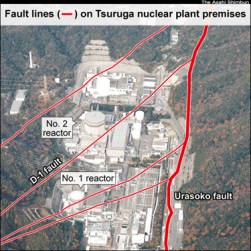
via NewsOnJapan.com / May 23, 2013 /
The Nuclear Regulation Authority accepted on Wednesday an assessment that a reactor at the Tsuruga plant in western Japan is sitting above an active fault, making it increasingly difficult for the facility to resume operation.
It is the first time Japan’s regulatory authorities have acknowledged an existing reactor is located above a fault feared to move in the future, according to an NRA official. The judgment may leave plant operator Japan Atomic Power Co. with no option but to scrap the No. 2 reactor.
“We have received a report from a panel of experts that said there is an active fault…I think there is a need to accept the conclusion sincerely,” NRA Chairman Shunichi Tanaka said at a meeting attended by other commissioners to discuss the panel’s conclusion.
Electromagnetic Fields (EMFs), Extremely Low-Frequency (ELF) and Radiofrequency (RF): What are the Health Impacts?
 Global Research
May 20, 2013
by Alex Quinn
Particularly now that wireless communications are so closely integrated into our daily lives, electromagnetic fields (EMFs) are all around us.
Our cities, especially the larger ones, are perpetually shrouded in an invisible electrosmog, a ‘sea’ of EMFs through which we swim every day.
But does this momentous development in civilisation come with health effects – and if so, can we do anything to reduce them?
What is ELF-EMF and what are its sources?
It’s important to realise that there are two main forms of EMF: radiofrequency (RF)-EMF and extremely low-frequency (ELF)-EMFs. The frequency range of ELF-EMF is 1–300 Hz, and the Earth’s natural geomagnetic field strength varies from around 60 μT (microtesla) at the magnetic poles to around 30 μT at the equator.
Many man-made sources of ELF-EMF exist. Prime among these artificial sources are power lines and electronic appliances, with vacuum cleaners, electric can-openers, microwave ovens, shavers and hair dryers among the most powerful. These appliances emit ELF-EMF at field intensities ranging from 17.44 to 164.75 μT, measured from 5 cm away. Since the intensity of magnetic fields decreases dramatically with increased distance from the source, the corresponding range of magnetic field intensities at 50 cm is 0.12–1.66 μT.
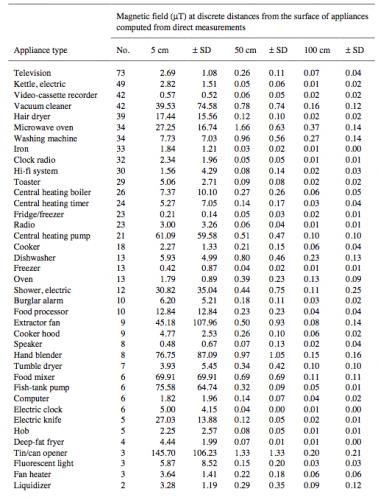
 Table 1. ELF-EMFs produced by domestic appliances. Taken from IARC Monograph Volume 80 (2002).
The International Commission on Non-Ionizing Radiation Protection (INCIRP) has set limits of 1 mT (millitesla) for occupational exposure to ELF-EMF, and 200 μT for general public exposure. While these limits are not breached by individual man-made sources, additive effects must also be considered, as we shall see.
What is RF-EMF and what are its sources?
The frequencies of RF-EMFs are considerably higher than ELF-EMFs, ranging from 100 kHz to 300 GHz. As its name suggests, the main uses of RF-EMF are in broadcasting information. In today’s data-driven world, this means that RF-EMF is constantly around us: it is produced by things such as mobile phone base stations, cordless phones, utility ‘smart’ meters, remote control toys, wireless networks, radar and baby monitors. In addition, there are various natural sources of RF-EMF, including the Earth, the Sun and other black body radiators.
Here’s a shocking statistic: did you know that having a cordless phone base station in your house can expose you to the same level of RF-EMFs as having a mobile phone mast in your back garden?
Do EMFs pose health problems?
The mainstream view is that the only potential danger from EMFs stems from their heating effects on tissue, in the case of RF-EMF, or of electrical currents induced in the body for ELF-EMF. However, there is strong evidence to suggest that the athermal effects of ELF- and RF-EMFs also contribute to various health problems.
 Childhood leukaemia
According to the BioInitiative report, evidence indicates that risk of childhood leukaemia in young boys doubles when they are exposed to ELF-EMF levels of 1.4 mG (milligauss), while other studies indicate that leukaemia risks begin at 2, 3 and 4 mG. This occurs in the context of an ICNIRP limit of 1000 mG.
The BioInitiative report also found that ELF-EMFs interfered with recovery from childhood leukaemia: if a child was exposed to levels of ≥2 mG during recovery, their risk of death increased by 300%, while at levels of ≥4 mG that risk increased to 450%.
Alzheimer’s disease
ELF-EMF has also been found to increase the risk of Alzheimer’s disease by increasing levels of a protein called amyloid beta, a leading risk factor for Alzheimer’s.
Melatonin
EMFs have also been found to decrease the levels of melatonin in the body. Melatonin is produced in the pineal gland of the brain, which produces melatonin when it directly or indirectly detects low light levels. EMFs may interfere with this mechanism because the brain confuses them with light waves, thus suppressing the pineal gland’s melatonin production. Melatonin is an absolutely vital hormone. It acts as a powerful antioxidant, and has been found to aid in the prevention of Alzheimer’s, depression, cardiovascular diseases, insomnia, mood disorders, tinnitus and various cancers.
Brain and auditory nerve cancers
RF-EMFs have been given a 2B classification – possibly carcinogenic – by the International Agency for Research on Cancer (IARC). They have been found to be possible causes of acoustic neuromas and brain tumours called gliomas. Studies have shown that using cordless phones, which produce RF-EMFs, can increase the risk of brain tumours by up to 470% after ≥10 years of use when habitually used on one side of the head. Mobile phones, in the same scenario, can increase the risk by up to 200%. Both mobiles and cordless phones can trigger reactions in people who suffer from electrohypersensitivity.
What about interactions between EMFs and other factors?
Of course, EMFs don’t affect us in isolation: everyone living in a city, for example, is bombarded by numerous chemical toxins and other environmental pollutants, and many of them take multiple pharmaceutical drugs – in addition to constant EMF exposure. We are at an early stage of investigating and defining these complex interactions, but existing research indicates that these combinations can have both beneficial and adverse effects. For example, in vitro DNA damage was caused by a 7 mT magnetic field in combination with ferrous chloride, but not with either agent alone. Other combinations of EMFs and agents enhanced analgesia and neural performance.
Call to action: Reduce your EMF exposure!
Thus, you should take as many steps as possible to reduce your exposure to EMFs. Suggested strategies include:
- Using fibre-optic cables for your broadband
- Using wired connections whenever possible
- Keeping mobile and cordless phones away from your body
- Using wired baby monitors: children are more effected by EMFs than adults
- Keeping wireless routers or cordless phones out of regularly used bedrooms or children’s bedrooms
- Reducing time spent in calls when using mobile or cordless phones
- Reducing children’s exposure to wireless devices as much as possible
- Avoiding using microwave oven
- Avoiding placing wireless computers on your lap
- Avoiding allowing your children to use remote-control toys for long periods of time, if at all
ANH Europe Homepage
ANH EMR campaign page

Related content:
-

Electromagnetic radiation (EMR): The most pervasive environmental exposures
BioInitiative Report: A Rationale for a Biologically-based Public Exposure Standard for Electromagnetic Fields (ELF and RF) September 18, 2007 – BioInitiative Report / Complete 610 pp (pdf) From http://www.bioinitiative.org/report/index.htm I. SUMMARY FOR THE PUBLIC A. Introduction You cannot see it,…
-

Smart Meter Dangers: The Health Hazards of Wireless Electromagnetic Radiation Exposure
Over the past two years, there has been mounting medical and scientific evidence of the grave biological dangers to humans from so-called “Smart” Meters exposure that are being installed by the hundreds of thousands all over North America and Europe.…
-

Brain interactions with RF/microwave fields generated by mobile phones
Neither radiofrequency (30 kHz-300MHz) nor microwave fields (300-3000 MHz) exist as significant components of the natural terrestrial electromagnetic environment. In consequence, our human generation is the first to voluntarily expose itself to artificial RF/microwave fields that cover a wide spectrum…

Disclaimer: The contents of this article are of sole responsibility of the author(s). The Centre for Research on Globalization will not be responsible for any inaccurate or incorrect statement in this article. The Center of Research on Globalization grants permission to cross-post original Global Research articles on community internet sites as long as the text & title are not modified. The source and the author’s copyright must be displayed. For publication of Global Research articles in print or other forms including commercial internet sites, contact: publications@globalresearch.ca
www.globalresearch.ca contains copyrighted material the use of which has not always been specifically authorized by the copyright owner. We are making such material available to our readers under the provisions of “fair use” in an effort to advance a better understanding of political, economic and social issues. The material on this site is distributed without profit to those who have expressed a prior interest in receiving it for research and educational purposes. If you wish to use copyrighted material for purposes other than “fair use” you must request permission from the copyright owner.
For media inquiries: publications@globalresearch.ca
VIDEO — The March Against Monsanto – History In The Making!
Press For Truth
May 15, 2013
The March Against Monsanto global demonstrations are gearing up to be a ground breaking event that will be history in the making! Today on Press For Truth TV we are joined by Emilie Rensink who is a co-organizer of the global rallies which are set to take place this Saturday May 25th!
Visit the March-Against-Monsanto website:
http://www.march-against-monsanto.com/
Visit the March Against Monsanto Facebook Group:
https://www.facebook.com/MarchAgainst…
Find a March Against Monsanto rally near you:
http://www.march-against-monsanto.com…
Support independent media by contributing to the PFT Fundraiser: http://www.gofundme.com/2sghd4
or
Donate through Paypal: https://www.paypal.com/cgi-bin/webscr…
Syria ends 1st phase of Qusayr operation
Press TV
May 23, 2013

The Syrian army has successfully concluded the first phase of its operation in the western city of Qusayr. (File photo)
The Syrian army has successfully concluded the first phase of its operation in the strategic western city of Qusayr.
According to reports from the city, an unknown number of security agents from different foreign countries have been detained or killed during the operation.
Syrian forces have inflicted major losses on the militants in Qusayr, destroying their weaponry and equipment.
The Syrian army has also found several caches of weapons, mostly containing Israeli-made ammunition.
Qusayr, which is located in the central province of Homs, has been the scene of fierce clashes between Syrian forces and militants over the past few days.
The senior commander of the terrorist group al-Nusra Front, Abu Omar, was among those killed in battle on May 21.
The crisis in Syria began in March 2011.
Syrian President Bashar al-Assad said on May 18 that militants from 29 different countries were fighting against the government in different parts of the country.
President Assad also said in April that the situation in Syria was improving as the army enjoyed people’s support in the fight against terrorism.
The Syrian army said in a statement issued on May 21 that it had destroyed an Israeli military vehicle that drove toward the village of Bir Ajam, located in the Israeli-occupied Syrian territory of the Golan Heights.
MR/HSN
VIDEO — The March Against Monsanto (and GMO Foods) This Saturday
Mark Dice
May 22, 2013
The March Against Monsanto is This Saturday, May 25th, Everywhere.
Subscribe to http://www.YouTube.com/MarkDice
http://www.Facebook.com/MarkDice
http://www.Twitter.com/MarkDice
Dandelion Benefits: Healing with the Root, Flowers, and Leaves
 by Elizabeth Renter
Natural Society
May 22, 2013
Dandelion is likely the most abundant and most identifiable edible flower in the country. For those people who seek to keep a lush, “weed”-less yard, dandelions are a thorn in their side. They are tough plants and though they aren’t native to the United States, they’ve certainly made themselves at home. But whether growing up through cracks in the sidewalk or all over your lawn, dandelions offer some healthful and tasty benefits. Read on to learn about dandelion benefits and how this over-looked edible can help you.
History of Dandelions
Dandelion use goes back centuries, when it was used in ancient Egypt and Arabia. They’ve been used in traditional Chinese medicine as well as Indian Ayurvedic healing. It’s believed the plant was brought over on the Mayflower intentionally specifically for its healing powers. Some sources say it was brought to provide food for honeybees. Once here, however, the plant spread like a “weed”.
The plant received its name from the shape of its leaves. Derived from the French dent de lion, dandelion literally means “teeth of the lion.” Cool, huh?
Nutritional Value
Dandelion leaves, or “greens” are perhaps more nutritionally potent than the lettuce you have in your crisper. They contain just as much iron as spinach, and four times as much vitamin A (beta carotene) as the popular salad green. One cup of dandelion also contains 535% of the recommended daily allowance of vitamin K and is a good source of vitamin C, calcium, iron, fiber, and potassium.
Medicinal Uses
There are many uses for dandelions, most of which involve the leaves. Historically and to this day, the leaves are most widely recognized as a promoter of liver health, as they stimulate the production of bile and work to detoxify the blood. One study, from the University of Annunzio Chieti-Pasaca in Italy found dandelion extract to significantly reduce oxidative stress and inflammation in rats with liver damage.
The plant is also a known diuretic, working to increase the amount of urine the body produces, and can be valuable in reducing water weight or blood pressure. It also has digestive benefits, working as a mild appetite stimulant and an upset stomach soother.
Another promising study, published in the Journal of Ethnopharmacology, indicated dandelion root tea was able to kill leukemia cells. Researchers said the active compounds worked to eliminate cancer cells while keeping healthy cells alive. They called it a “novel” non-toxic anti-cancer agent.
The University of Maryland indicates that some studies have shown dandelion to be an effective blood sugar regulator as well. They say it may also work to reduce “bad” cholesterol while increasing “good” cholesterol.
Harvest and Preparation
When harvesting any edibles, be certain they have not been treated with pesticides or “weed killers.”
How you prepare dandelion depends on what parts you are using. Always harvest when the plant is healthy and alive. If you are digging up roots, waiting until after a rain could make the effort easier. When you cut the leaves from the stem or root system, you will see a milky sap. This is where the medicinal properties of the dandelion leaves and roots lie.
- Flowers – A good source of antioxidants; choose the full and bright yellow blossoms.
- Leaves – Used in teas, tinctures, and meals; choose a mixture of young and older leaves.
- Roots – Used in liver tonics, teas, and tinctures; choose the fullest and largest root systems on the most developed plants.
As with most herbals, the easiest way to experience the healing properties of dandelions is with a tea or a tincture. But, because these plants are edible and often included in salads and recipes, you don’t have to stop there.
Both leaves and flowers can be thrown in nearly any salad. The leaves are slightly bitter, so keep this in mind when you are thinking of what to include in your dandelion salad. You can also make a pesto out of dandelion leaves, and freeze what you don’t use. You can add it to soups, sauté it with some garlic, or eat it right out of the ground (we suggest washing it first).
Dandelions are the plants that homeowners despise and children love. But when you consider their healing and nutritional properties (and the cost of prepared dandelion greens), it makes far more sense to harvest the plants than to pull them or treat them with chemicals.
Quick and Brief FAQ
- Common name?: Dandelion
- Scientific name?: Taraxacum officinale
- Growing regions?: Throughout U.S.
- Appearance?: Multi-toothed, hairless leaves, bright yellow flowers
- Edible parts?: Roots, leaves and flowers
- Safe for pets? Yes
[Potent News Editor’s note: Just make sure that the dandelions you use don’t have 2 heads like some of these ones that we covered back in Potent News Blast #7.]


