
Roots of the Zionist Genocide in Gaza Palestine [video]
Syrian Girl
November 18, 2012
I briefly comment about the history of Palestine and her stolen land, leading into this war , and then some political analysis of the situation. How the Muslim brotherhood and Egypts Morsi are trying to win political points from the war.
Stupid comments will be removed.
Canadians Rally Outside Halifax War Conference To Uphold Principles Of Sovereignty And Self-Determination [video - PN Blast #9]
by Amir Alwani
PotentNews.com
November 19, 2012
The Halifax International Security Forum was recently held at the Westin hotel for three days. On the second day, 100-200 protestors stood outside the hotel in solidarity with Palestine, Syria and Iran while denouncing Israel’s behaviour and boldly calling for Canada to exit NATO.
-intro video recorded Nov. 18, 2012
-raw footage of protest recorded Nov. 17, 2012
show notes:
- Gaza and the Politics of “Greater Israel”
- NATO Terrorists to Target Syria’s Civilian Airports
- Israel and FSA Jointly Attack Syria
related links:
Details for WEEKLY HALIFAX PICKETS can be found here.
Amir Alwani is a musician and the founding editor of PotentNews.com. Feel free to donate dollars or bitcoins to support his work.
China will force peaceful solution to Syrian crisis on West: German pundit
nsnbc
November 14, 2012
 By Kourosh Ziabardi – Tehran Times – A German political pundit says China will use its soft power to find a peaceful solution to the Syrian crisis and force it on the U.S., the UK, France, and Germany. “I am also rather confident that China will give the United States, the United Kingdom, Germany, France, and other important European governments economic incentives to find a peaceful resolution to the (Syrian) crisis,” Christof Lehmann said in an interview with the Tehran Times on Tuesday.
“One could compare it with a soft power carrot and stick strategy where the policy of Turkey ultimately is dependent on decisions which are made in Europe and the USA,” he added.
Lehmann went on to say that he is “very confident that a peaceful resolution to the crisis is possible as long as the root causes are being addressed and as long as Russia and China maintain a responsible role with regard to preventing further abuse of international law.”
Lehmann is a political author and consultant as well as a clinical psychologist and psycho-traumatologist.
He has been advisor to many high-ranking political leaders across the world, and writes for a number of political news and analysis websites, such as The 4th Media.
Following is the text of the interview:
Q: You have closely followed the political development in China and the 18th National Congress of the Communist Party of China, and the recent political developments in Turkey. What political developments do you expect with regard to the situation in Syria?
A: The 18th National Congress of the Communist Party of China has embraced a new, highly motivated generation of politicians on all levels of China’s central and regional governments. Political, social and economic reforms will continue but with more prudence and China will work toward a wealth distribution that will bring moderate prosperity also to the not so developed regions. This consolidation provides a strong basis for a more self-confident China which is likely to use the Chinese soft power strategy to assert its policy, also with respect to Syria.
I am confident that China will back Russia at playing a more confident, assertive and responsible role in the Middle East and Syria by supporting Russian initiatives for the deployment of Russian, Armenian and other UN peace keeping forces to Syria in the first or second quarter of 2013.
I am also rather confident that China will give the United States, the United Kingdom, Germany, France, and other important European governments economic incentives to find a peaceful resolution to the crisis. One could compare it with a soft power carrot and stick strategy where the policy of Turkey ultimately is dependent on decisions which are made in Europe and the USA.
Speaking in general terms I am very confident that a peaceful resolution to the crisis is possible as long as the root causes are being addressed and as long as Russia and China maintain a responsible role with regard to preventing further abuse of international law of the kind we have witnessed when NATO overstepped the provisions of UNSC Resolution 1973 (2011) on Libya.
The approach Russia and China have adopted is the approach of international law as a basis for preventing and resolving disputes and conflicts. According to the Charter of the United Nations, the adoption of a resolution of the Security Council requires the concurrent vote of all permanent members. However, since UNSC Resolution 4 (1946) on Spain it has become common practice that an abstention does not prevent the implementation of a resolution even though it has not been formally adopted by a concurrent vote of all permanent Security Council members. This practice was considered as a soft veto, that is, that the nations which did not adopt a resolution would not prevent the others from implementing it, provided that the authorizations granted by the text of the resolution were not significantly overstepped or violated.
When NATO abused UNSC Resolution 1973 (2011) on Libya to become a belligerent party and to bring about regime change in Libya both Russia and China became concerned that the same strategy would be attempted to bring about regime change in Syria. When the two highest ranking NATO commanders prior to NATO’s 25th Summit in Chicago in 2012 wrote that NATO’s intervention in Libya was “a teachable moment and model for future interventions” it became clear for Russia and China that they could not risk that NATO would also abuse a soft veto to initiate an aggression against Syria.
Another important feature in the Russian and Chinese approach to the conflict is that they oppose NATO’s condescending and neo-colonialist approach to national sovereignty. According to the provisions of the Treaty of Westphalia and the Charter of the United Nations it is not allowed to interfere into the internal affairs of sovereign nations. However, constructs such as humanitarian intervention and a responsibility to protect violate both the provisions of the Treaty of Westphalia and the UN Charter. Their adoption was and remains highly controversial and both Russia and China are realizing that NATO will continue to abuse them unless they are opposed at the Security Council.
A very good example for Western neo-colonialist thought is Dr. Henry Kissinger who contemplates whether most Arab countries could at all be protected by the principles of Westphalia. Kissinger speculates that because their borders have been arbitrarily drawn by former colonial powers they are not real nation states and thus they may not fall under the Treaty of Westphalia. Dr. Kissinger however, fails to be consequent in his thinking. Was he consequent he should have said most Arab nations and Israel?
Q: Will the U.S., EU, Turkey and the Persian Gulf states of Qatar and Saudi Arabia accept that President Assad should remain in power and it’s an appropriate solution for ending the 19-month-long crisis in the Arab country?
A: Since the failure of the Free Syrian Army to secure Aleppo as seat for a transitional government in June and July 2012 both the political and the military foreign backed opposition have fallen literally apart. An attempt to compensate militarily by massively importing Wahabi and Salafi organizations and fighters, many of them with ties to Al-Qaeda, has even made it more difficult to unite a politically or militarily credible foreign backed opposition. The recent meeting in Doha and the establishment of a new political opposition is not much more than a recycling of a failed strategy.
Taking into account that the attempt to build a credible and presentable foreign backed opposition, combined with the fact that we will most likely see increased pressure from China and Russia to begin negotiating and cooperating with the genuine political parties and organizations inside Syria, including the Baath Party and President Assad, I am confident that both the USA, the UK, Germany and eventually also France will have to get involved in real politic and begin working at resolving the crisis rather than aggravating it.
If the USA and NATO accept a peaceful resolution the Persian Gulf states will have to go along. In the end it is mostly a question of a lack of convergence in energy and security needs of two cartels. A resolution to which Europe can agree will most likely also satisfy the needs of the Persian Gulf states.
Q: Why Turkey has been siding with the U.S., France and Britain in pressuring the government of President Assad and supporting the Free Syrian Army?
A: Turkey has been siding with the United States because it was pressured into it. That is, the AKP and Prime Minister Recep Tayyip Erdogan were more than willing to cooperate, but their cooperation was not possible before they succeeded at arresting and imprisoning more than 29 high ranking military officers and countless members of the opposition. What we witness in Turkey is a de facto coup d’etat supported by the USA and NATO. The comparison with Ottoman ambitions may reflect the delusions of grandeur of Prime Minister Erdogan but not real politic. What we witness in Turkey is an attempt to implement the American Greater Middle East Project which was developed by the RAND Corporation in 1996. That is, the planned balkanization of Turkey into small states along ethnic and religious divisions. That is hardly a basis for a new Ottoman Empire.
Q: In one of your articles, you pointed out that the massive rallies in different cities of Turkey on October 29, the national day of independence in the country, angered the government of Erdogan since thousands of people protested at the government’s attempts to join the U.S.-NATO illegal war on Syria. Would you please explain more about that? Is the Turkish public against the government’s position on Syria?
A: On 29 October 1924, the Turkish Revolution won over imperialism and its proxies. Since then the day was the most important of all Turkish holidays with millions of people celebrating it in the streets every year. The AKP government of Erdogan outlawed the celebrations, erected police barricades and banned demonstrations. However, millions turned out and removed the police barricades. This year the 29th of October turned into a new revolution against the new imperialism and its proxy, Prime Minister Erdogan. I am confident that the AKP has made a historic mistake by attempting to rewrite Turkey’s history. After this massive humiliation I find it unlikely that the AKP will win another election any time soon.
Q: Would you please explain about the role of Salafists in the escalation of conflict in Syria? How have they entered Syria from Saudi Arabia in such great numbers?
A: Syria experienced a massive influx of Salafist militants after the Free Syrian Army was decisively defeated in its attempt to conquer Aleppo as seat for a transitional government in June and July 2012. The plan was to emulate the strategy that has been used successfully in Libya, where the seat of the transitional government was the Al-Qaeda or LIFG stronghold Benghazi.
The main sponsors of Salafists in terms of finances and weapons are Saudi Arabia and to a lesser degree Qatar. Militants are imported from Bangladesh, Afghanistan, Libya, Indonesia and elsewhere. Especially Saudi Arabia is maintaining a world-wide network of Salafist organizations, many of them with ties to the Al-Qaeda network like the HuJI (Harkat-ul-Jihad al-Islami) in Bangladesh.
These organizations are often funded through charities and supervised through liaisons into the Saudi Ministry of the Interior. The Free Syrian Army never succeeded in establishing a general command and that was its weakness from day one. Since the influx of Salafits we witness calls for the establishment of a Syrian Caliphate while small factions are fighting each other. The common denominator is greed, extremism, money and weapons from abroad.
It is a self defeating strategy because it caused many Free Syrian Army commanders and troops as well as members of the non militant foreign backed opposition and the people of Syria to realign themselves with the Syrian military, the Syrian government and the genuine reform movements in Syria.
Q: Somewhere I read you saying that the war on Syria is a war for natural resources, especially the vast gas reserves of Persian Gulf and East Mediterranean. Would you please tell us more about that? Do you want to imply that Syria possesses gas reserves which the regional and foreign opponents of the government of President Assad want to take over on?
A: The principle cause of the Syrian crisis is a lack of convergence in the energy and security needs of two cartels. In 2007 major resources of natural gas were discovered in the Persian Gulf between Qatar and Iran and in the Eastern Mediterranean, in the so-called Levanthine Basin. These reserves can cover the consumption of natural gas in the EU and the Middle East for the next 100 – 120 years. There are two proposed pipeline projects or cartels, which are, Iran, Iraq, Syria, Russia, and to a lesser degree Lebanon and Palestine, and the other consists of Qatar, the EU, Israel, Turkey, Greece, and to a lesser degree the USA.
At the present time Russia provides approximately 22 % of the natural gas that is consumed by the EU. This percentage will increase when the North Sea pipeline from Russia to Germany will go online. Because of the USA’s push for dominance over Russia and China the prospect that Russia also will control the gas supplies from the Middle East and the Mediterranean raises grave security concerns in Europe. That is the main cause for the conflict. However, I believe that a solution can be brokered if Russia and the EU increase their interdependency in economic and political terms.
Q: How does Israel benefit from conflict and unrest in Syria? Is it that with the weakening of Syria and the overthrowing of the government of President Assad, it would be more comfortable for Israel to confront Iran and even launch a military strike against Iran?
A: Syria is the sole Arab nation which has consequently and consistently supported the Palestinian cause. To weaken Syria would be beneficial for Israel in terms of the Palestinian issue and in terms of weakening Syria militarily and politically. As far as I am informed Israel has plans to permanently annex the occupied Syrian Golan, parts of Southern Lebanon, East Jerusalem and the greater part of the West Bank. Syria is the main obstacle preventing this plan. Israel’s solution for the Palestinian problem would be the establishment of a Hamas controlled Palestinian micro state in the Gaza Strip in the recognition of that state. A weakened Syria and Hezbollah or Lebanon will also make it more feasible for Israel and the USA to attack Iran and thus gain dominance over the oil and gas resources of the entire region.
Damascus pays tribute to Press TV’s correspondent Maya Nasser [video]
Press TV
November 14, 2012
A tribute was paid at the ministry of information in Damascus for Press TV’s correspondent Maya Nasser who lost his life reporting on Syria’s events. The event comes forty days after foreign backed armed men shot Maya dead near the chief of staff office in the Omawiyeen square in the Syrian capital.
Press TV’s Mohamad Ali reports from Damascus.
Follow our Facebook on: http://www.facebook.com/presstvchannel
Follow our Twitter on: http://twitter.com/presstv
Follow our Tumblr on: http://presstvchannel.tumblr.com
MUST SEE DOCUMENTARY: Manufacturing Dissent: The Truth About Syria [video]
Land Destroyer
November 7, 2012
For more information:
- US Army Special Forces Unconventional Warfare Doctrine (2000)
- Color Revolution’s Mystery Gunmen : Explains how opposition militants are used to stage violence against unarmed protesters to further expand violence and destabilize a targeted government.
- London Telegraph: “BBC News uses ‘Iraq photo to illustrate Syrian massacre’“
- Syria: Game Over for Western Propaganda: Syrian Activists Caught Lying, Syrian Rebels Caught Committing Atrocities.
- “Syria, Waco, Occupy, and Los Angeles”: Examples of US using deadly force in riots, protests, and against armed groups inside the United States.
- “BBC Rides with Al Qaeda in Aleppo, Syria“: More on BBC’s role in deceiving the world regarding Syria.
- “NATO Using Al Qaeda Rat Lines to Flood Syria With Foreign Terrorists“: Where the terrorists in Syria are coming from, and who is really behind them.
Syria, Teachable Moments and Conflict Resolution
nsnbc
August 27, 2012
 Christof Lehmann – After more than 18 months of belligerent action against the government de jure of the Syrian Arab Republic it is still maintaining relative stability and security. A peaceful resolution however, becomes increasingly illusive while the potentially catastrophic regional and global consequences of the failure to broker a peaceful resolution seem to be a harbinger of a return to global barbarism, anarchy and unspeakable human suffering.
NATOS´s Victory and Teachable Moments in Libya.
In an article, published in Foreign Affairs March/April 2012 edition which was published prior to NATO´s 25th Summit in Chicago, Ivo H. Daalder, the U.S. Permanent Representative to NATO, and James G. Stavridis, Supreme Allied Commander and Commander of the U.S. European Command, gave a a clear indication of what NATO has in mind for Syria.
Daalder and Stavridis described NATO´s Operation Unified Protector in Libya as ” NATO´s Victory in Libya. The Right Way to Run and Intervention” and as “A Teachable Moment“. (1) What was so “teachable” about Libya, and what is “The Right Way to Run an Intervention” ? An analysis of NATO´s post 25th Summit doctrine and the consequences for security and stability in the Middle East points to a two tiered NATO strategy which combines low cost, low intensity, illegitimate warfare with an aggressive nuclear posture. (2)
There are in fact numerous teachable moments in the phenomena that is euphemized under the name “The Arab Spring”: The successful political manipulation of Turkey; The successful implementation of plans developed by the RAND Corporation which already in 1996 advised that Turkey should be governed by Gül in the office of President and R. Tayyip Erdogan in the office of Prime Minister, as a precondition for a successful implementation of a comprehensive solution for the Middle East; The successful transformation of the Turkish High Command from a bastion of secularism into a High Command that would cooperate with Muslim Brothers and Al-Qaeda mercenaries in preparation of the division of both Syria and Turkey along ethnic lines; The successful manufacturing of a crisis as precondition for the successful abuse of a UN Security Council resolution, as a precondition for the successful implementation of regime change.
A UN Security Council resolution is adopted when it has the concurrent vote of all permanent members. However, since resolution #4 (1948) on Spain it has become practice that abstentions are interpreted as a passive or quasi-concurrent vote. This practice implied that the members who propose the resolution are not overstepping the resolutions authorizations to a significant degree.
When Russia and China abstained on UNSC resolution # 1973 (2011) on Libya it was implicitly understood that Russia and China expected that NATO would adhere to the letter of the resolution and not overstep it in any significant degree. It should be added here, that the fact that the UNSC has adopted a resolution does not necessarily make it legitimate.
What Daalder and Stavridis also found “teachable” was that NATO or its allies could disregard the Convention against the Use of Mercenaries and use the Al Qaeda associated Libyan Islamic Fighting Group as infantry, while abusing resolution 1973 to wage an aerial war against the Libyan military.
Special Forces on the ground would function as liaison within a joint command while NATO could enjoy “plausible deniability”. The Libyan government de jure was ousted, the head of state murdered in cold blood, an independent investigation into his death could be prevented, a proxy government could be installed.
It is not surprising that Daalder and Stavridis proclaim a NATO Victory in Libya. From a NATO perspective it was in deed a victory and a teachable moment. It was also a moment that has taught both Russia and China that NATO will abuse an abstention at the Security Council to implement wars of aggression.
The UN Security Council has since been frozen in a deadlock between NATO members on one hand and China and Russia on the other. The deadlock has brought the necessity of structural changes within the United Nations into focus. The United Nations is rapidly loosing its residual credibility and functionality as an instrument for conflict resolution while security and stability in the Middle East are deteriorating. Negotiating a peaceful resolution of the conflict in Syria, for the brewing conflict between NATO, Israel, the GCC member states on one hand, and Iran, Russia, China on the other at the UN seems increasingly implausible, if not impossible.
NATO´s victory in Libya has not only brought about regime change, it has also devastated the countries infrastructure, divided the country along tribal and ethnic lines, resulted in a weak and split national government that is unable to maintain internal as well as external stability and security. What is most worrying about Daalder´s and Stavridis interpretations of Libya as victory and teachable moment is, that it implies that the achievement of the destabilization of Syria, Lebanon, Iran, and subsequently Turkey are likely to be perceived as victories and teachable moments too.
The cost of further NATO victories in terms of regional and global stability and security, in terms of the economies of Syria, Lebanon, Iran, Turkey and the global economy, the cost in terms of a deterioration of international law and a return to barbarism and anarchy in conflict and conflict resolution, and the cost in terms of human suffering are staggering.
Peaceful Resolution of Syria Crisis only Possible with Good Faith.
The primary precondition for a peaceful resolution to the crisis in Syria is that all parties are negotiating and acting in good faith.
An immediate withdrawal of all NATO and GCC member states special forces and other military personnel from Syria is a minimum precondition for showing good faith.
An immediate adherence to the Convention against the Use of Mercenary Forces and other international bodies of law by NATO and GCC member states, Jordan, Lebanon or major political players in Lebanon such as Saad Hariri and Walid Jumblatt, Israel, Libya and any other nation that is currently involved in financing, training, arming or other support of insurgents and the armed opposition.
An immediate establishment of strict controls of refugee camps in Turkey, Lebanon and Jordan. Particularly the refugee camps in Turkey are being systematically abused to recruit, train, arm and deploy insurgents into Syria. Strict controls would include that entrance into and exit from the camps is strictly monitored by Turkish police or military personnel, eventually with the participation of military observers from one or several non NATO or GCC member states.
The close monitoring of all Syrian borders by neighboring countries military forces to stop the illegal flow of weapons, troops and the deployment of military observers from non NATO, GCC member states.
The blatant violations of international law in particular by Turkey and Jordan, who not only offer their territory for infiltration by foreign fighters, but who actively take part in organizing the subversion, and all logistical and other support of insurgents must halt immediately.
The new joint UN – Arab League envoy Ladhkah Brahmini should be given the full support of all UN member states. His role is, however not likely to be perceived as that of a neutral or fair broker, as long as the Arab League upholds the dispensation of Syria´s membership. Ladhkah Brahmini will be facing an insurmountable challenge as long as Saudi Arabia and Turkey, who together with Iran and Egypt form the Contact Group, are violating international law and sponsoring the insurgency and subversion.
Initiatives by the Arab League to politically, diplomatically, economically and otherwise isolate Syria which are inherently opposed to the Charter of the Arab League and its purported function do not create preconditions for negotiations in good faith. Illegitimate initiatives, such as the one to pressure Arabsat and Nilesat to stop broadcasting Syrian Radio and TV satellite signals in order to facilitate absolute image and media control by nations who are taking part in the attempted subversion must cease. A dialog in good faith is not facilitated by one-sided, strongly biased propaganda. The Organization of the Islamic Conference must recall the dispensation of Syria. The abuse of this organization is dangerous and risks to aggravate a religious dimension of the conflict and to further aggravate the abuse of Sunni – Shia conflicts world wide.
Organizations such as the “Friends of Syria” group, which is a de facto subversive alliance must be abandoned as instruments for finding a resolution to the conflict. The Friends of Syria group is a de-facto cartel of nations who meet to organize systematic violations of international law in an attempt to bring about regime change in Syria.
Iran is to host a conference of 120 nations to work towards a peaceful resolution of the crisis. It is a positive initiative that should be supported, but it is not likely to bring about a peaceful resolution unless Turkey, Saudi Arabia, Qatar, and the U.A.E. will take part in good faith.It is a positive initiative that should be supported, but it risks to further aggravate the conflict unless Turkey, Jordan, Saudi Arabia, Qatar and the United Arab Emirates are taking part and are willing to play a constructive role, which is unlikely.
In the absence of NATO and GCC member states, Jordan´s, Israel´s, Libya´s and others good faith in negotiating a peaceful resolution, the Iranian initiative may in fact be part of the only viable alternative. If it is supported by Russia and China it may have a chance to succeed.
The second best solution to an all inclusive solution that embraces the armed political opposition and the nations who are supporting it would be the establishment of a multilateral group that protects Syria from the consequences of a continued aggression.
Such an alternative solution could include the following initiatives:
Countering the consequences of attempts to diplomatically, politically, economically and otherwise isolate the government de jure of Syria by reinforcing diplomatic and political relations, by trade agreements that help alleviate the devastating consequences of sanctions, and to diversify the one sided international discourse about Syria.
Even though political parties in Syria are legitimate, and even though one opposition party is holding a ministerial post in the unity government, there is a lack of party infrastructure that makes opposition parties equal competitors to the Arab Socialist Baath Party. Selective support of the one or the other political party at building a party infrastructure can be problematic and invites unwarranted foreign interference.
A model for developing a democratic culture and multi-party infrastructure projects could facilitate a pluralistic political process which could to remedy the consequences of decades of government under emergency laws.
When organizing those projects, it must be taken into consideration that Syria, because of its de-facto state of war with Israel has had heightened security needs which have not decreased since the onset of the attempted subversion. As a long term strategy of delegating political influence and responsibilities to multiple political parties is the best strategy to discourage from attempts to use violence and for strengthening national coherence.
In the case that the UN fails as an instrument to safeguard the national sovereignty and security of Syria while the subversive alliance continues the illegitimate support of armed insurgents, it must be considered to add a military dimension to finding a peaceful resolution of the conflict.
The government de jure of the Syrian Arab Republic has the right to sign treaties with friendly, non hostile nations and deploy foreign military troops on Syrian territory. Failure by Turkey and Jordan to secure that insurgents are not using their territories as bases of operations for transgressions in Syria could be countered by the deployment of international troops along the borders to help repel insurgents. Further failure of Turkey, Jordan, Saudi Arabia, as well as NATO member states to halt the illegitimate support could warrant diplomatic and other sanctions.
Sadly, in the light of sustained aggression, the most viable way to secure peace and stability is to aid Syria by establishing diplomatic, political, economical and military credibility against a foreign aggression.
At closing this article, I would like to reiterate that war crimes will be committed as long as they can be committed with utter impunity. The current state of affairs, where NATO and allied nations instrumentalize the ICC and special tribunals for political show trials and victors justice, with an ICC that in and on itself has no legitimacy in international law on one hand, and a Kuala Lumpur War Crimes Tribunal that has no other than moral authority, it is unlikely that the international regression into barbarism can be halted.
Those nations who wish to facilitate a peaceful resolution of the crisis in Syria and who want to prevent future aggressions, would be well advised to establish international jurisdiction for the most serious crimes to limit war criminals ability to act with impunity.
Christof Lehmann
27.08.2012
Notes:
1) Daalder Ivo H, Stavridis James G. (2012) ”NATO´s Victory in Libya. The Right Way to Run an Intervention“. Foreign Affairs March/April 2012 pp 2-7
2) Lehmann Christof (2012) “NATO`s 25th Summit in Chicago in Preparation of Global Full Spectrum Dominance, Interventionism, Possible Preparations for A Regional War Directed against Russia and China, and Developments in Global Security.” nsnbc, May 20 2012. http://nsnbc.wordpress.com/2012/05/20/natos-25th-summit-in-chicago-in-preparation-of-global-full-spectrum-dominance-interventionism-possible-preparations-for-a-regional-war-directed-against-russia-and-china-and-developments-in-global/
US Desperation Surfaces in Syria
Obama’s bizarre threats indicative of losing strategy and increasing desperation.
by Tony Cartalucci
August 21, 2012 – US-led NATO forces armed, funded, trained, and even provided air support for Libyan terrorists emanating out of Libya’s eastern Cyrenaica region – most notably Benghazi which had served as the premier international terrorist recruiting ground in the world, according to the US Army’s Combating Terrorism Center, producing a percentage per capita of militants outstripping even that of Saudi Arabia.
Operating under the banner of the “Libyan Islamic Fighting Group” (LIFG), a US State Department, British Home Office, and United Nations-listed international terrorist organization, and officially merged with Al Qaeda in 2007, its commanders including Abdul Hakim Belhaj and Mahdi al-Harati led NATO’s military proxy forces on the ground as US, French, and British planes destroyed the nation from the air.
These very same commanders of this very same listed-terrorist organization would then turn its cash, weapons, and fighters on Syria, as early as November 2011, arriving on the Turkish-Syrian border to enjoy yet another NATO safe haven and logistical networks overseen by Western intelligence along with US funding and arms laundered through Gulf Cooperative Council (GCC) members such as Qatar and Saudi Arabia.

Image: Libyan Mahdi al-Harati of the US State Department, United Nations, and the UK Home Office (page 5, .pdf)-listed terrorist organization, the Libyan Islamic Fighting Group (LIFG), addressing fellow terrorists in Syria. Harati is now commanding a Libyan brigade operating inside of Syria attempting to destroy the Syrian government and subjugate the Syrian population. Traditionally, this is known as “foreign invasion.”
In essence, just as Al Qaeda had served as an “Arab Foreign Legion” for the US in Afghanistan in the 1980’s during its inception, it once again is serving as a foreign legion inside Syria, fighting Washington’s proxy war against the Syrian government.
It appears however that unlike in Afghanistan where Al Qaeda fought alongside a sizable indigenous force against foreign Soviet troops, the tactical environment is revered – where Washington’s proxy terrorist forces are foreigners facing a highly motivated, well organized, and better armed indigenous Syrian Army.
US Machinations Unraveling – Shareholders Face Liquidation
Coordinated attempts by NATO and its proxy forces to invade and overrun the cities of Damascus and Aleppo in July and early August have failed, with proxy forces being expelled after suffering sizable loses. An attempt to decapitate Syria’s leadership in a bombing in central Damascus also fell flat, with high ranking officials quickly replaced, followed quickly by a cohesive military counter offensive.
The bombing was also followed by the mysterious disappearance of Saudi Arabia’s Bandar “Bush” Bin Sultan, who if confirmed assassinated, may indicate that NATO’s plans are suffering at even the highest levels of organization.
Compounding the West’s attempts to overthrow the government of Syria, is the increasing support Syria has been receiving due to Iranian efforts to assemble international forums representing half of the world’s population, condemning the support of foreign interference and promoting alternatives to the violent destabilization being carried out by the West. A 30 member conference was held ahead of the annual Non-Aligned Movement (NAM) meeting in Tehran, Iran – and another meeting will be held again on the sidelines of NAM toward the end of August.
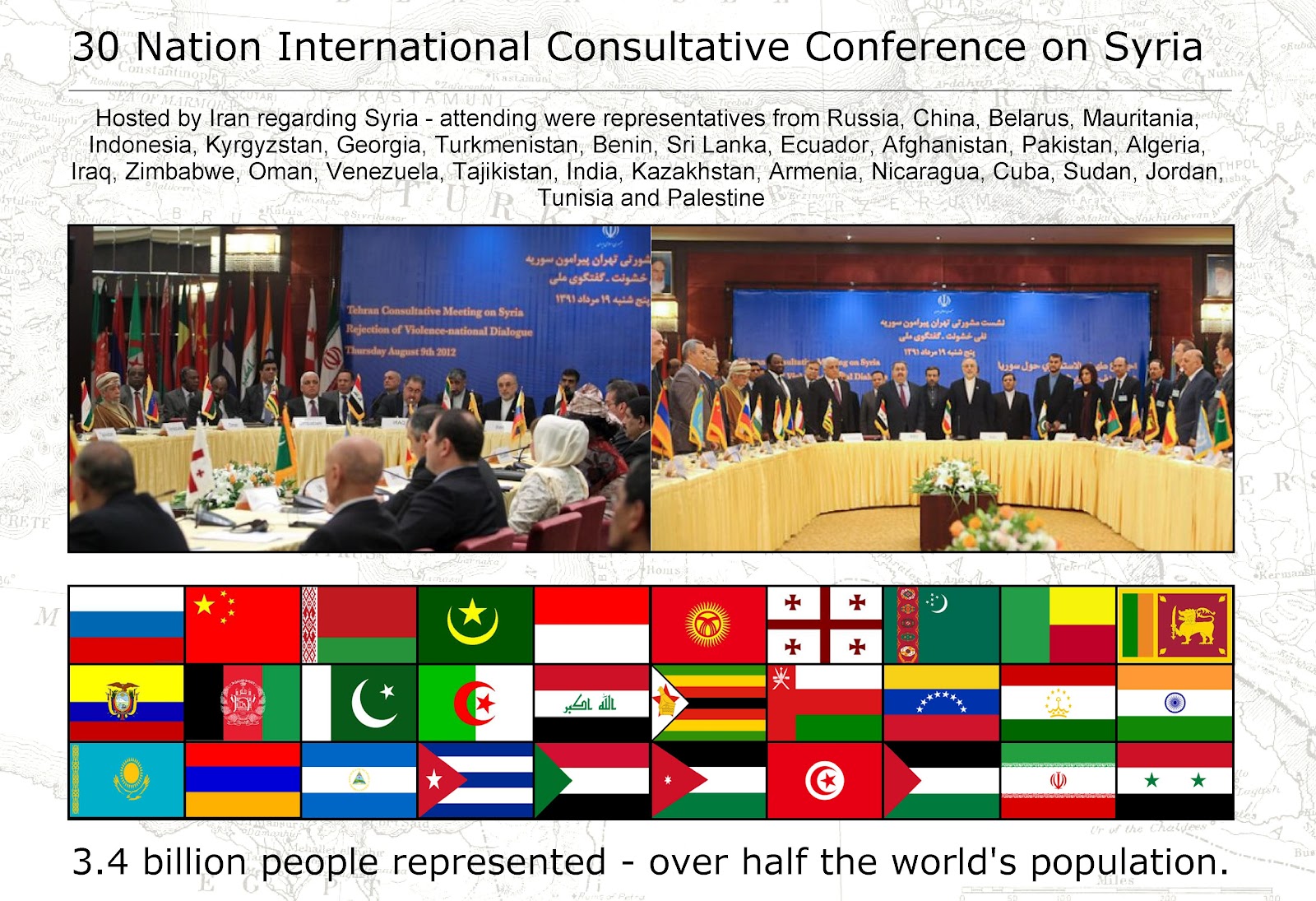
Image: An impressive counter to the so-called “Friends of Syria” confabs held by Wall Street and London corporate-financier interests in an attempt to sway global opinion toward a repeat of Libya’s destruction at NATO’s hands, the International Consultative Conference hosed by Iran seeks to end the flow of foreign arms into militant hands and resolve political differences through more civilized means.
With the tactical situation inside Syria deteriorating for Western proxies and international consensus shifting in unprecedented directions against Washington and London, shareholders in the West’s latest adventure appear to be making tacit moves to divest their support and protect their own interests, lest they be left with the ignominious results of an increasingly compounding failure.
Obama’s Recent Threats
With this in mind, the US has been making increasingly unhinged “Bush-esque” remarks regarding “weapons of mass destruction” in Syria and attempting to expand the pretexts under which it could “militarily intervene.” Even the very “movement” of Syria’s “unconventional weapons” in a “threatening manner,” US President Barack Obama claimed in a recent statement, would constitute a “red line.”
Obama claims that the US “fears” Syria’s unconventional weapons “falling into the hands of the wrong people.” If the US is willfully arming, funding, and threatening to back militarily, listed Al Qaeda terrorist organizations, then whose hands is the US referring to? And while the US struggles to foment victory in Syria, it seems to have stretched its support for terrorism all the way to Russia’s Caucasus Mountains, reigniting violence there, linked to Al Qaeda as well.

Image: The Washington Consensus’ shrinking legitimacy is proportionally matched to its increasingly untenable perpetuation. Its unjustified, disastrous military adventure in Libya seems to have resulted in a Pyrrhic victory, hobbling the institutions and legitimacy it needed to likewise undermine and overthrow the Syrian government in a timely fashion. Overstretched, it appears the West is even trying to strike at Russia with terrorist proxies that now span from North Africa all the way to the Caucasus Mountains.
To say that the US is overstretched is an understatement. It is overstretched politically, economically, and tactically. It risks a historically unprecedented collapse that would destroy all shareholders invested in its increasingly unhinged and transparently illegitimate ambitions. Nations, in particular GCC members, are beginning to realize with acute alarm that their support of Washington’s agenda is now threatening their very self-preservation. A victory even at this point would still likely be Pyrrhic.
No matter how well Syria goes for the West from this point on, the mechanisms it has used to get here, including its “Responsibility to Protect” doctrine, the legitimacy of the UN, the West’s so-called commitment to “human rights,” and the narrative of the so-called “War on Terror” have been undermined beyond salvage.
One can only imagine the mountains Washington is promising to move in order to keep its allies lined up behind them, particularly the ruling governments of Turkey and the GCC. For an elitist clique that has prided itself in “realist” political discourse, it has become increasingly surrealist. Whether or not Washington’s allies mirror this surrealism all the way to their own demise, remains to be seen.

 PN
PN 