
Syria teeters on Obama’s “Red Line”
by Nile Bowie
NileBowie.blogspot.ca
March 21, 2013
The pages of history tell us that beautiful civilizations emerged and prospered in the ancient cities of Damascus and Aleppo, some of the oldest continually inhabited cities on earth. The harrowing circus of brutality that is the Syrian conflict, now in its third year, will soil and blacken those pages indefinitely. No matter the political outcome of this horrible war, a once tolerant and diverse state has been shattered and terror itself has eaten into the destiny of Syria’s people, inexorably changing the courses of their lives forever. Children have been orphaned; parents have faced the loss of their children – and by uncompromising means. Infants have been beheaded, the fates of innocent men and women have been sealed through summary executions, and families have been torn apart or destroyed all together. Recent developments in Syria are alarming.
Spokesmen of the Assad government recently accused foreign-backed militants of launching scud missiles containing chemical weapons in the city of Aleppo, killing dozens. Witnesses claim to have seen powder emanate from the rocket, causing those who inhaled the substance to suffocate or require immediate medical attention. An unnamed chemical weapons expert cited by Al-Jazeera claimed that the causalities were not consistent with Syria’s reputed stockpile of chemical agents, stating, “If it’s a chemical warfare agent, it’s not working very well.” Syria’s ambassador to the UN, Bashar Ja’afari, called on the UN Secretary-General to form an independent technical mission to investigate the use of chemical weapons by terrorist groups operating in Syria.
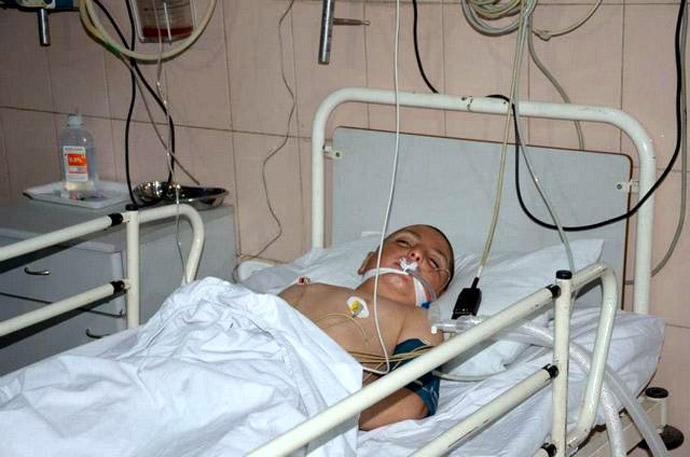
There are a myriad of reasons why Bashar al-Assad must go in the eyes of policy makers in Washington and Tel Aviv, and the destruction of his tenure could not have been possible without the financial muscle of Saudi Arabia and Qatar’s wretchedly opulent Sunni Monarchs. These glittering kingdoms of disaster-capitalism are not only responsible for supplying weapons and cash; a major incentive of theirs is exporting the Wahhabist and Salafist ideologies that many of Syria’s imported jihadists subscribe to, a warped and primal interpretation of Islam that has fueled the sectarian nature of the Syrian conflict and deepened social divisions to their most dangerous point – in a country that was once renowned for its tolerance of religious diversity. These Gulf kingdoms, which are more-or-less given a trump card to commit deplorable human rights violations institutionally, are also responsible for propping up the political arm of their militant foot soldiers, and that comes in the form of the Muslim Brotherhood.
Syria’s opposition coalition, which is itself entirely a creation of foreign powers, has recently elected its own interim prime minister – enter, Ghassan Hitto, a virtually unknown political novice with a US passport and a computer science degree from Purdue University. Hitto is an Islamist Kurd with strong ties to the Muslim Brotherhood. The Muslim Brotherhood has politically dominated the Syrian National Council since its creation, in addition to organizing tactical elements of the insurgency. The backbone of the Brotherhood’s relationship with the medieval monarchies of the Persian Gulf is grounded in a firm opposition to Shi’a Islam, as extolled by clerical leaders in Iran and Lebanon’s Hezbollah; Assad himself is also an Alawite, an offshoot of Shi’a Islam. It should be clear enough by now how enflaming sectarian divisions in the region was a prerequisite for those bank-rolling the insurgency, aimed at demolishing the secular Syrian state.
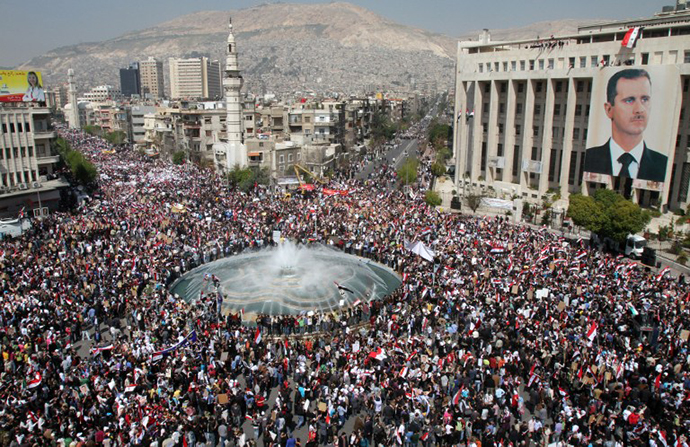
Several high-profile members of Syria’s opposition coalition boycotted the vote for interim prime minister, citing what they viewed as a foreign-backed campaign to elect Hitto. Kamal Labwani, a veteran opposition campaigner, was reported as saying, “We don’t want what happened in Egypt to happen in Syria. They hijacked the revolution.” Those who abstained from the vote accuse Hitto of being a puppet of the Muslim Brotherhood, and that the SNC’s decisions were being dictated from the outside. Walid al-Bunni, another senior figure in the opposition, stated, “The Muslim Brotherhood, with the backing of Qatar, have imposed their prime minister candidate. We will keep away if the coalition does not reconsider its choice.” Let’s just get this straight – Assad, a leader whose presence today is a testament to the fact that he continues to enjoy majority popular support, is considered to have lost his legitimacy. On the other hand, Hitto, a man with no political experience who received 35 votes out of 49 ballots cast during a Syrian National Coalition meeting, is supposed to be legitimate representative of the Syrian people?

Western states want to install proxy leaders who will grovel to their multinationals and swallow IMF medicine, Gulf states seek unfettered hegemony in their own backyards, and they all want to see the Shi’a resistance smashed to pieces. Following the news of chemical weapons being used in Syria, the most immediate conclusion of this observer is that foreign-backed militants, who have used every opportunity to call for more material and support, employed the use of a smuggled chemical weapon of poor quality to bring about direct military intervention in their favor. Right on cue, Senators Lindsey Graham and John McCain are frothing at the mouth, urging President Obama to “take immediate action” and consider deploying troops. Graham was quoted as saying, “If the choice is to send in troops to secure the weapons sites versus allowing chemical weapons to get in the hands of some of the most violent people in the world, I vote to cut this off before it becomes a problem.” There is no surer sign of a pathological mind than when one credits others with the blood on their own hands.
Nile Bowie is an independent political analyst and photographer based in Kuala Lumpur, Malaysia. He can be reached at nilebowie@gmail.com
NATO nurturing Syria contingency plan – top US commander
End the Lie – Independent News
March 20, 2013

NATO Supreme Allied Commander Europe (SACEUR) U.S. Navy Admiral James Stavridis.(Reuters / Tobias Schwarz)
NATO forces are focusing on a “wide range of operations” in Syria, the US top commander in Europe told the US Senate. If called upon, the international coalition is ready to engage on the same level and in same way as it did in Libya.
Speaking to the Senate’s Armed Services Committee, Commander of the US European Command (USEUCOM) Admiral James Stavridis told lawmakers that NATO’s member governments were currently discussing “a variety of operations.”
He said the alliance has taken the position that it will follow the same sequence used in Libya. “We are prepared, if called upon, to be engaged as we were in Libya,” the 58-year-old admiral assured the country’s political elites.
It means that prior to the NATO involvement there would first be a resolution at the UN Security Council, a regional agreement and consensus among the 28 NATO member states.
Two years of fierce fighting between the Syrian army and the foreign-backed insurgency have been marked by the failure of either side to fully win. The bitter results of Syria’s civil war are well-known in Washington.
“The Syrian situation continues to become worse and worse and worse: 70,000 killed, a million refugees pushed out of the country, probably two and a half million internally displaced. No end in sight to the vicious civil war,” Stavridis told the Senate’s Committee.
In Washington’s eyes, the shortest way to end the bloody is to get rid of the government of President Bashar Assad. Helping to oust Assad could be done simultaneously in several directions: by imposing a no-fly zone along the Turkish-Syrian border with the help of NATO’s Patriot PAC-3 air defense complexes recently deployed there and by supplying rebels with arms or by ensuring an arms embargo on Damascus.
Shooting down Syrian aircraft in that zone would become a “powerful disincentive” to keep Syrian Air Force pilots out of the area, Stavridis promised Arizona Senator John McCain.
In addition to that, Armed Services Chairman Carl Levin got a positive answer to his question as to whether the US military is considering targeting Syrian air defenses.
Diplomacy with no teeth
While the Kremlin insists on a diplomatic solution to the bloody conflict, the Obama administration does not believe the conflict can be resolved by diplomats.
“It’s hard to imagine a peaceful outcome with Assad in power,” stated Anne Richard, the assistant secretary of state for Population, Refugees, and Migration, speaking at another Capitol Hill hearing on Syria.
Meanwhile, the fact that one million refugees have fled Syria – half of them in the last two months – has significantly affected the country’s neighbors. Up to 10 per cent of the Lebanese population now consist of Syrian refugees. People are also fleeing to refugee camps in Jordan and Turkey.
With no end in sight, the conflict is pushing members of the US Senate to take action – by helping the Syrian insurgency.
Expanding sanctions against the Central Bank of Syria has always been within the powers of the American legislatures. Yet other steps imply direct meddling into Syria’s internal affairs.
Senators Bob Casey and Marco Rubio advocate non-lethal aid to Syrian opposition groups. The move, supported by both Democrats and Republicans, would mean providing the rebels with body armor and communications equipment.
Still, the option of simply arming the rebels is also on the table.
“Down the road we may make another determination,” Casey acknowledged.
On Monday, Congressman Eliot Engel presented legislation enabling the US to train Syrian opposition groups.
Source: RT
Chemical Weapon Attack kills 25 and injures 100 in Aleppo. Syria Crisis Explodes International Law into Anarchy and Barbarism
nsnbc international
March 19, 2013

Most of the more than 100 injured in chemical weapon attack are in critical condition. Photo SANA
Insurgents and Syrian Government blaming each other for the Escalation with Chemical Weapon Attack.
Christof Lehmann (nsnbc).- A rocked with chemical substances, fired from the Da´el area, exploding in the Khan al-Asal area near the Syrian capital Damascus today, killed at least 25 and injured 100. The majority of the injured are reported to be in critical a condition. The Syrian government and insurgents are blaming each other for the escalation of the violence.
While the Syrian government possesses chemical weapons, several factors make it unlikely beyond reasonable doubt, that a rocket with weaponized chemical substances has been fired by Syrian military forces. Like in every other regular military force, the chemical weapons under control of the Syrian military are closely monitored, registered, and easily to be accounted for.
The UN´s independent commission of inquiry recently suggested to refer Syria to the international criminal court. A spokesperson for the Russian Foreign Ministry called the report biased and unbalanced, and the suggestion to refer Syria to the ICC as futile and ill timed. (1 Escalating the conflict by using chemical weapons would be political suicide from experienced politicians who know better than bringing Russia into a diplomatic quagmire. With the national dialog making steady progress, the use of chemical weapons would be equivalent to the Syrian government derailing the national dialog which it facilitates.
While these and many other factors make it more than unlikely that the rocket was fired by Syrian military forces, the opposite is the case with the foreign backed insurgents. The strongest circumstantial evidence however, until an investigation has eventually has yielded material evidence, is the fact that the foreign backed insurgents themselves have published video recordings, in which they were demonstrating how they are producing chemical substances which can be weaponized in small laboratories. The small laboratories have been provided for the insurgents by Saudi-Arabia.
Syria´s Information Minister Omran al-Zoubi has held the countries that are arming the ´opposition` responsible for the crime in Khan al-Asal and stressed, that the government of Turkey´s Prime Minister Erdogan and the government of Qatar bear legal, moral and political responsibility for the attack that killed 25 and wounded more than 100.
Al-Zoubi condemned the Arab League on a ministerial level for its decision to support the armed insurgency, saying “whoever got involved and announced direct and public military support to the terrorists, whether he is an emir, a minister or a prime minister, must be held accountable for the crime”. He stressed the fact, that the terrorists used an internationally banned weapon and called upon the international community and the countries which are funding and arming the terrorists to assume their responsibility for the crime. He added, that the escalation of the violence by use of internationally banned weapons against civilians is a dangerous shift in the course of the events in Syria with regard to security in general, and with regard to the military situation.
Minister Al-Zoubi added, that the government of the Syrian Arab Republic has the right to act in accordance with international law and file a lawsuit against the countries which are arming the opposition, including internationally outlawed terrorist organizations such as Jabhat al-Nusra with internationally banned weapons.
Today´s escalation of terrorism with an internationally banned weapon is also likely to even further deteriorate diplomatic ties between Russia and the USA. One of the factors that has contributed to the rapid deterioration in diplomatic relations over Syria was the fact that the USA rejected a Russian resolution at the United Nations Security Council which would have condemned all forms of terrorism.
The US veto at the UN Security Council, against the condemnation of the attack and terrorism in all of its forms, prompted Russian Foreign Minister Sergei Lavrov to voice the Russian governments frustration over the fact, that the UNSC standards, according to which all nations, without exclusion, would condemn terrorism, regardless of the perpetrator, place or motives, was no longer upheld. Lavrov stated, “Russia sees in the American position the use of double standards and a dangerous approach in terms of the Americans moving away from the main principle of condemning terrorism in all its forms”. (2
According to information by Syrian authorities, the toxic gasses that have been involved in today´s rocket attack cause immediate fainting, quiver and death, prompting Syria´s Information Minister al-Zoubi to state, that “this shift in the type and manner of arming the terrorists embodied in using weapons imported from outside Syria across the border with some neighboring countries means that all allegations made by some countries, such as France, UK, Qatar and Turkey on providing logistic and “non-lethal” weapons to the armed terrorist groups in Syria are mere talk to sell the media.”
The escalation of the violence with a chemical weapon constitute a serious escalation in willful and systematic breeches and a further step toward an explosion of international law into anarchy and barbarism.
Since 2001, the USA, together with NATO and allies, have systematically dismantled the progress in international law that has been made since 1945 and the end of the second world war. The political, military and financial support of Jahbat al-Nusra and other militia who are involved in the attempted subversion of Syria constitute a breech against the Convention against the Use of Mercenaries. Also the use of so-called private military contractors to fulfill military duties in conflict areas constitutes a breech of the Convention against the Use of Mercenaries. International lawyer Christopher Black pointed out the irony of calling mercenaries private contractors, saying ” private contractors, as if the were construction workers”. (3
Saudi-Arabia´s and Turkey´s documented use of convicts for military service in Syria constitutes a willful and systematic breech of the Geneva Conventions, which regulate the war times rights of both civilian and military prisoners. (4 -(5 Military interventions under the pretext of humanitarian interventions or the principle of the responsibility to protect, which was used by the USA and NATO to bring about regime change in Libya, constitutes a violation of the Charter of the United Nations and the principles enshrined in the Treaty of Westphalia, which is one of the root principles of the UN Charter.
The list of systematic explosions of international law by the USA, NATO and allies continues with breeches against the Convention against Torture by re-branding torture as enhanced interrogation methods, breeches against UN resolutions by blocking Syrian radio and TV channels access to international satellites, (6 and it could be continued ad infinitum.
Today´s use of a chemical weapon by US/NATO and allied backed mercenary forces, and failure of the USA, EU, NATO and allies to unequivocally condemn it as an act of terrorism and a war crime, constitutes but one more explosion of international law into anarchy, barbarism and despotism.
Syria´s Information Minister al-Zoubi elicited the bearing of this aggravation when he stressed that the terrorist crime committed in Aleppo is “an exceptional case, compared to the events in the world at least over the last fifty years” Exceptional, because an internationally banned weapon was being used publicly from an area where Western and Turkish intelligence are operating along side Jahbat al-Nusra members”.
Notes:
1) Permafrost; Russian Foreign Minister Lavrov Blasts USA and Allies for Arming Syria´s Opposition.
2) Lavrov: US Veto of UNSC Resolution to Condemn Damascus Blasts Indicates Double Standards
3) South East China Sea; A Perfect Crisis for the International Crisis Group.
4) Saudi Arabia commits War Crime by Forced Use of Prisoners in Syria Insurgency.
6) The Dynamics of the Crisis in Syria. Conflict Versus Conflict Resolution. (Part 2/6)
About the Author

Christof Lehmann – Dr. Christof Lehmann is the founder and editor of nsnbc. He is a psychologist and independent political consultant on conflict and conflict resolution and a wide range of other political issues. His work with traumatized victims of conflict has led him to also pursue the work as political consultant. He is a lifelong activist for peace and justice, human rights, Palestinians rights to self-determination in Palestine, and he is working on the establishment of international institutions for the prosecution of all war crimes, also those committed by privileged nations. On 28 August 2011 he started his blog nsnbc, appalled by misrepresentations of the aggression against Libya and Syria. In March 2013 he turned nsnbc into a daily, independent, international on-line newspaper.
US help might see Syrian rebels form alternate govt
by Nile Bowie
NileBowie.blogspot.ca
March 7, 2013
The long-term US funding of anti-government programs in Syria has raised questions about the types of groups being supported, and the benefits and arms supplied to militant groups; establishing political stability requires considered dialogue.
It appears that the US State Department under John Kerry will soon shift its focus to helping the rebels establish a full-fledged alternative government on Syrian territory and recognize it as the legal government of Syria. Such a move would legitimize the transfer of heavy weaponry and would allow the US to directly employ air strikes or Patriot anti-missile batteries against Assad’s forces.
Some would argue that these moves could help to marginalize the notable al-Qaeda presence among rebel forces. Pumping more arms and heavier weapons into Syria is unconscionable at this point, and continuing to do so will inevitably bolster the muscle and reach of jihadi and Salafist fighters. The argument that the US and its allies have only armed the “moderate” rebels is a deeply flawed one; weapons are in high demand by all rebel factions and there is little means to effectively prevent arms from gravitating toward hardcore Al-Qaeda fighters.
In his famous 1962 description of irregular warfare operations, US President John F. Kennedy alluded to “another type of warfare,” one that is “new in its intensity, ancient in its origin—war by guerrillas, subversives, insurgents, assassins; war by ambush instead of by combat, by infiltration instead of aggression, seeking victory by eroding and exhausting the enemy instead of engaging him. It preys on unrest.”
After two harrowing years of division, senseless killing and civil war, the scared Syrian nation and its people are well acquainted with these unconventional methods of warfare denounced over 50 years ago.
Yet Western and Gulf states have proven their double standards by enabling radicals elsewhere – lest we forget the presence of Libyan military commander Abdulhakim Belhadj, former leader of the militant Libyan Islamic Fighting Group (officially designated as a terrorist organization by the US State Department), who was sent to Syria to aid the Free Syrian Army on orders of the entity formerly known as the Libyan National Transition Council (NTC). The track record of allied Western and Gulf states shows that they are more interested in enabling terrorism for their own purposes rather than preventing it.
Since the eruption of violence in March 2011, Syria has endured targeted assassination campaigns, ceaseless suicide bombings and shelling, and massacres where infants have had their throats slit to the spine – the time has come for the opposition to engage the Assad government in dialogue and finally bring about a ceasefire and the total cessation of violence and insurgency.
From the reports of third-party sniper-fire targeting both protesters and security personnel in the southern city of Daraa at the very onset of the conflict, to the horrendous attacks on the students of Aleppo University in January 2013 – those who have critically monitored the situation from the beginning are under no illusions – the influx of armament and mercenary elements from abroad into Syria has brought the situation to where it is today. Western capitals have provided logistics, coordination, political support, and non-lethal aid, Gulf states such as Saudi Arabia and Qatar have openly provided weapons and monthly salaries for rebel fighters, and Turkey has allowed rebel fighters to receive training and arms from the US Central Intelligence Agency (CIA) in the southeastern part of the country, allowing militants to pass into Syria freely.
There are those who say that Syria is the subject of an internal revolution that is brutally repressed by a malicious dictator, and those who say instead that Syria is being attacked by foreign powers who have deployed mercenaries and extremist fighters from abroad to engage in the destruction of infrastructure and conduct targeted assassinations to bring about an end to the Assad regime. Despite Washington’s concerns of heavy weapons falling into the hands of Al-Qaeda-linked militants, the US-backed campaign to coax regime change in Damascus has from the very onset enabled militants who justify their acts of terror in the name of a perverted interpretation of Islam. Reports in the Washington Post indicate that US support for anti-government groups in Syria began in 2005, transcending two presidential administrations:
“The U.S. money for Syrian opposition figures began flowing under President George W. Bush after he effectively froze political ties with Damascus in 2005. The financial backing has continued under President Obama, even as his administration sought to rebuild relations with Assad. Syrian authorities ‘would undoubtedly view any U.S. funds going to illegal political groups as tantamount to supporting regime change,’ read an April 2009 cable signed by the top-ranking U.S. diplomat in Damascus at the time. ‘A reassessment of current U.S.-sponsored programming that supports anti-[government] factions, both inside and outside Syria, may prove productive,’ the cable said. The cables report persistent fears among U.S. diplomats that Syrian state security agents had uncovered the money trail from Washington.”The article describes how Washington funnelled about $12 million to anti-government programs in Syria between 2005 and 2010 to recipients affiliated with the Syrian Muslim Brotherhood. Israel, which is now illegally conducting exploratory drilling in the occupied Golan Heights, and the US view the toppling of Damascus as a means of extinguishing the critical conduit between Iran and Hezbollah, the political and militant Shi’a organization centered in Southern Lebanon, in addition to helping isolate the Palestinian resistance.
The non-violent route: Laying aside differences
Both the incumbent Syrian authorities and the opposition must find strength to come to a mutually acceptable compromise. These parties have no other option than to search for a solution, lay down an agreeable constitutional basis for elections, and face each other in international monitored polls once the situation stabilizes. The Syrian people must not have democracy imposed on them, and the victor of this war should not be decided on the battlefield, but by the ballot box.
To gain the confidence of the electorate, election observers from the US, Qatar, Russia, and Iran could be sent to monitor the transition process – if the people of Syria want Assad to remain in power, then the rule of majority must be honored. Militant groups comprised of mostly hard line foreign fighters such as Jabhat al-Nusra and the Islamist Ahrar al-Sham cannot be expected to participate in a ceasefire, so the true test of a short-term alliance between Assad and the SNC would be in its ability to cooperate in quelling radical militants and restoring stability – such is a perquisite for any kind of transition.
Former US Secretary of State Hilary Clinton once threatened Russia and China that they would “pay a price” for their position on the Syrian issue. It should be noted that these powers maintained a balanced approach throughout and advocated dialogue from the start, in addition to stringently adhering to former UN Envoy Kofi Annan’s six point peace plan. Iran should also be given due credit for hosting an International Consultative Conference in August 2012, which brought together representatives of thirty nations to call for ending the flow of foreign arms into terrorist hands inside Syria, proposals to broker a meaningful ceasefire, the coordination of humanitarian aid, and support for Syrian people’s right to reform without foreign interference.
Accommodating diversity in Syrian society
Iranian Foreign Minister Ali Akbar Salehi was quoted in the Washington Post stating,“Syrian society is a beautiful mosaic of ethnicities, faiths and cultures, and it will be smashed to pieces should President Bashar Assad abruptly fall. The idea that, in that event, there would be an orderly transition of power is an illusion. Abrupt political change without a roadmap for managed political transition will lead only to a precarious situation that would destabilize one of the world’s most sensitive regions.” It is clear that the Assad government is more stable than many Western states anticipated, and it continues to enjoy popular support.
Hezbollah leader Sheikh Hassan Nasrallah recently warned against sectarian infighting in Lebanon related to the Syrian civil war, arguing that outsiders are pushing Lebanon “toward civil and religious strife, and specifically Sunni-Shia strife.” Iraqi PM Nouri al-Maliki also warned that a victory for rebels would “create a new extremist haven and destabilize the wider Middle East.” The Syrian regime will not imminently collapse but if it is brought down by military intervention, the consequences could lead to a highly unpredictable situation where match and tinder can meet at any moment with debilitating consequences for the region. It is time for both parties to convene. It is time to end this war.
Selective support
Reports published in 2007 in the New Yorker by veteran journalist Seymour Hersh detail how the US, Israel and Saudi Arabia supported a regional network of extremist fighters and terrorists affiliated with al-Qaeda with the aim of stomping out Hezbollah and Syria’s Assad in a bid to isolate Iran, who is viewed as an existential threat to the US and its allies in the region. A principal component of this policy shift was the bolstering of Sunni extremist groups, hence the ever-deepening sectarian nature of the Syrian conflict:“To undermine Iran, which is predominantly Shiite, the Bush Administration has decided, in effect, to reconfigure its priorities in the Middle East. In Lebanon, the Administration has cooperated with Saudi Arabia’s government, which is Sunni, in clandestine operations that are intended to weaken Hezbollah, the Shiite organization that is backed by Iran. The U.S. has also taken part in clandestine operations aimed at Iran and its ally Syria. A by-product of these activities has been the bolstering of Sunni extremist groups that espouse a militant vision of Islam and are hostile to America and sympathetic to Al Qaeda.”
While the CIA has purportedly claimed to distribute arms only to “secular” and “moderate”rebel forces, Washington insiders from various academic and think-tank circles have openly endorsed bizarre positions in favor of integrating terrorists into Syria’s rebel forces. “Al-Qaeda’s Specter in Syria,” penned by Council on Foreign Relations senior fellow Ed Husain, argues in favor of Al-Qaeda terrorists and their inclusion in the Free Syrian Army, stating, “The influx of jihadis brings discipline, religious fervour, battle experience from Iraq, funding from Sunni sympathizers in the Gulf, and most importantly, deadly results. In short, the FSA needs al-Qaeda now.” Foreign Policy’s, “Two Cheers for Syrian Islamists,” penned by Gary Gambill of the heavily neo-conservative Middle East Forum, argues in favor of Al-Qaeda, “Islamists — many of them hardened by years of fighting U.S. forces in Iraq — are simply more effective fighters than their secular counterparts. Assad has had extraordinary difficulty countering tactics perfected by his former jihadist allies, particularly suicide bombings and roadside bombs.”
While many Western media outlets once likened Syria’s rebels to pro-democracy freedom fighters, it has become more challenging to view them as anything other than Salafist radicals – the former’s existence was amplified specifically to provide cover and legitimacy for the violence and subversion of the latter. As a result of a foreign-backed insurgency, the Assad regime resorted to tactics of shelling and conducing air strikes on rebel strongholds, which were mostly in densely populated urban areas. It should not be denied that these heavy-handed tactics have also led to a substantial and regrettable loss of life.
The Friends of Syria group recently convened in Rome, where the US State Department has pledged $60 million to help the opposition maintain “the institutions of the state” in areas under their control, such as establishing terms of governance, the rule of law, and police forces. Reports have also claimed that the US is also deliberating more open engagement in Syria under newly appointed US Secretary of State John Kerry, however Washington has stopped short of openly providing arms and military training. American and western officials have told the New York Times that Saudi Arabia has recently financed a large purchase of infantry weapons from Croatia and funnelled them to Syrian rebel groups. Although the United States is not credited with providing arms to rebel forces, the New York Times has reported the presence of CIA operatives in southern Turkey since June 2012, who are distributing weapons with the Obama administration’s blessing. US spokesperson Jay Carney was quoted as saying, “We will continue to provide assistance to the Syrian people, to the Syrian opposition, we will continue to increase our assistance in the effort to bring about a post-Assad Syria.”
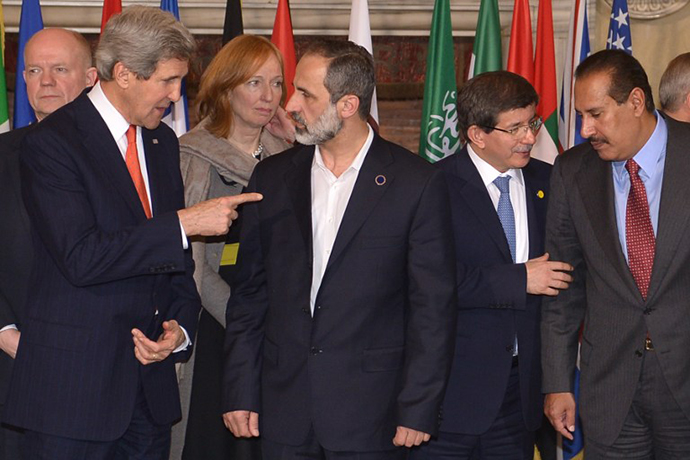
The Syrian Ambassador to the UN Bashar al-Jaafari has urged the Friends of Syria states to convince the Syrian opposition to sit down for an unconditional national dialogue, which al-Khatib has expressed his willingness to take part in. One could surmise that al-Khatib’s shift toward dialogue indicates that the SNC is feeling less secure and more wary of a possible military defeat or rivalry with radical factions. Such a dialogue would undoubtedly represent a step in the right direction. Despite political differences and two years of deep conflict, these two parties must establish a genuine ceasefire and partnership to restore a climate of normality throughout the country. In this context, both parties must be able to agree on coordinating aid distribution to all parts of the country.
International recognition of a provisional SNC government would only create further divisions at a time when national unity is most needed. Although rebel-held areas are badly isolated and in need of humanitarian supplies, the delivery of aid must be facilitated through direct talks and partnership between Moaz al-Khatib’s Syrian National Council and Bashar Al-Assad’s government.
Nuclear War Through North Korean Eyes
Nile Bowie
March 13, 2013
There is little doubt that civilians on both sides of the Korean Demilitarized Zone (DMZ) are weighed down with anxiety as both countries carry out provocative large-scale military drills amid threats of nuclear war. North Korea has recently announced that it will no longer abide by the UN-brokered armistice that ended the Korean War with a ceasefire in 1953 and authorities have severed its communications hotline with the South, the only diplomatic channel of contact between the two countries. Pyongyang has imposed no-fly and no-sail zones off both its coasts as part of comprehensive military drills that may see the test firing of short-to-medium range missiles. The US-South Korea joint command forces have launched their Foal Eagle field training exercises that will be ongoing until end of April. 200,000 South Korean troops and 10,000 US troops will take part in the exercise, which will include land, air, sea, and special operation drills. North Korea’s state newspaper, Rodong Sinmun, has reported that the North’s army, navy, air force, and anti-aircraft units were “just waiting for the final order to attack.”
Following Pyongyang’s recent threats that it would engage preemptive nuclear strikes against any aggressor, Seoul shot back with its strongest rhetoric yet, stating, “If North Korea attacks South Korea with a nuclear weapon, then by the will of the Republic of Korea and humanity, the Kim Jong-un regime will perish from the Earth.” South Korea’s newly inaugurated President Park Geun-hye has been in office for less than one month and in the current scenario, it has become politically impossible for her to stick to her campaign pledges of taking a softer line on North Korea. Most of the time, the substance of North Korea’s threats do not materialize, much like last month’s pledge to take an immediate “physical response” to a barrage of UN sanctions. While talk of taking “second and third countermeasures” are thrown around pretty liberally in North Korean state media, the North Korean foreign ministry has not announced any specific actions – such as a nuclear weapons test or rocket launch – in response to harsh UN resolutions or the ongoing US-ROK drill offensive.
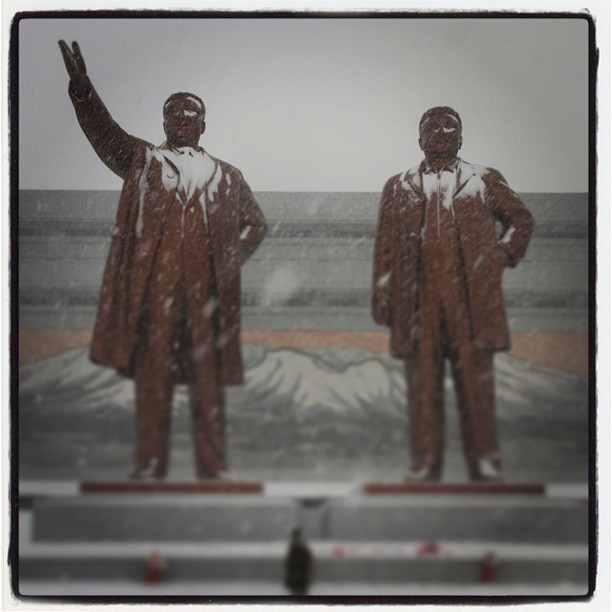
North Korea invokes a brutal historical narrative of war with the United States to legitimize its conduct in the present day – and indeed, North Korea is a victim of war crimes. Washington and its allies rained napalm over North Korea, destroying nearly all its cities and thousands of villages. A staggering four million Koreans and one million Chinese soldiers were killed – US military sources confirm that 20 percent of North Korea’s population was killed off, even that being a highly conservative figure. In the fallout of North Korea’s third nuclear test, state media has invoked several English-language editorials that reflect on the overlooked historical back-story of the US stockpiling nuclear weapons in South Korea. The statement released by the Rodong Sinmun reads:
“In the 1980s the U.S. spurred the modernization of the nuclear hardware of its forces in south Korea. Member of the U.S. House of Representatives Ronald, speaking at a parliament, confessed that the U.S. shipped more than 1,000 nuclear weapons to south Korea and deployed 54 airplanes for carrying nuclear bombs. South Korea turned into the world’s biggest nuclear outpost with the stockpile of nuclear weapons such as bombs, shells, warheads, land mines and carrier means as well as nuclear bases and arsenals. The U.S. nuclear threats were vividly manifested in its open declaration to use nuclear weapons in Korea.”
For all intents and purposes, this is an accurate account. If we fast-forward toward the present-day, the Bush administration’s Doctrine for Joint Nuclear Operations issued in 2005 established the circumstances under which the US could preemptively invoke the use of nuclear weapons. The document states:
“The lessons of military history remain clear: unpredictable, irrational conflicts occur. Military forces must prepare to counter weapons and capabilities that exist in the near term even if no immediate likely scenarios for war are at hand. To maximize deterrence of WMD use, it is essential US forces prepare to use nuclear weapons effectively and that US forces are determined to employ nuclear weapons if necessary to prevent or retaliate against WMD use.”
The North Korean Foreign Ministry’s recent statement, “Second Korean War Is Unavoidable”, argues that the DPRK reserves the right to a preemptive nuclear attack and the Foal Eagle joint military exercises are akin to Washington lighting a fuse for a nuclear war. The document also acknowledges the Obama administration’s pivot to the Asia-Pacific region, and that the US “seeks a way out of a serious economic crisis at home in unleashing the second Korean War.” Many analysts throughout the alternative media have acknowledged North Korea’s history as a victim and have defended their acquisition of a nuclear deterrent. While the historical context of abuse warrants one to be empathetic toward Pyongyang in this respect, many of these commentators fail to necessitate the primacy that inter-Korean dialogue should hold in their writings. It should also be noted that when official figures, such as Jon Yong-nam of the Kim Il-sung Socialist Youth League, utter phrases like, “We vow to plant the flag of the central military command and the North Korean flag on Halla Mountain on Jeju Island [South Korea]”, it makes the deterrent argument far less convincing.
In recent times, the North has provided slight openings for foreign media to enter the country and speak to its citizens, and undercover testimony has been smuggled out. Recent reports published by Radio Free Asia (RFA) detail the intellectual insecurity of North Korean civilians, who in consuming copious amounts of state media in the absence of any other source, deeply fear the threat of strikes or an invasion from foreign powers. RFA quotes a resident of North Korea’s Yanggang Province who has allegedly said, “The authorities said if we have nuclear weapons, we can scare off anyone we meet, but on the contrary even though we have nuclear weapons and we’re shouting that we might launch a preemptive strike, I’m worried it seems we might receive a preemptive strike.” Another resident in resident in Hamgyong Pronvince said, “If we shoot off a nuclear weapon, are the Americans going to stay motionless? In any case, if nuclear weapon is launched everyone dies, so I feel there’s no use for training or anything.”
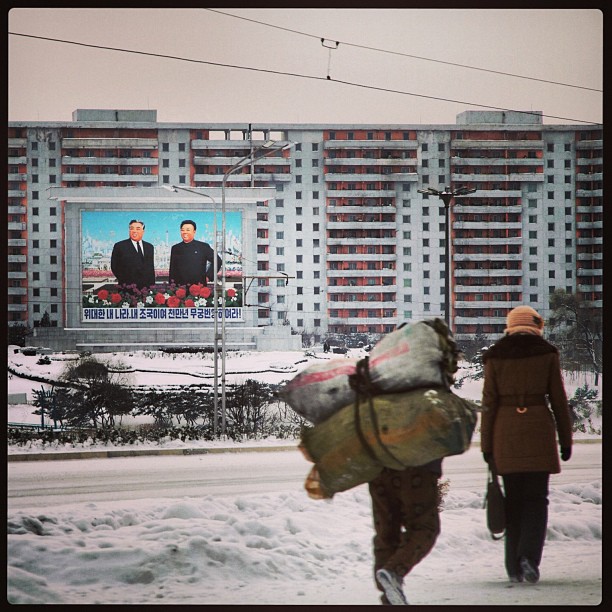
Although these anonymous testimonies, appearing on the US State Department-run RFA, likely serve as some form of propaganda, it highly plausible that a percentage of the North Korean population feels quite uneasy about the current state of affairs. One could offer their rhetorical support for North Korea’s acquisition of nuclear weapons as a deterrent, but what will become of some 10.5 million innocent civilians in Seoul if the North attempts to proliferate its nuclear arsenal? Likewise, 3.2 million souls in Pyongyang would be extinguished if the US employed its preemptive nuclear doctrine. The potential death toll should not be limited to those in capital cities, the reemergence of conflict on the Korean Peninsula immediately endangers the 70 million people living there. For all the firery rhetoric exchanged between the two Koreas, the fact that the hardline Lee Myung-bak regime, incumbent President Park’s predecessor, did not retaliate when the North shelled Yeonpyeong island in 2010 demonstrates the extent to which restraint has been exercised for the sake of stability.
The only thing keeping the situation from deteriorating is the fact that North would probably not come out victorious if it went to war with South Korea and the United States. While the North boasts larger manpower, more submarines, and more fighter jets, the South possesses highly sophisticated weaponry and modern defense technology by comparison – for this reason, Pyongyang has put more focus on the development of ICBMs and nuclear warheads. Military experts say North Korea is years away from developing a long-range missile and a nuclear warhead to attack the US mainland; however the damage it could do to South Korea and Japan has the potential to amass high civilian causalities and shouldn’t be under-estimated. One could argue that the case has never been stronger for the withdrawal of the 28,500 US troops stationed in South Korea. Such a move that would satisfy civilians in both Koreas and yield higher chances of provoking a positive response from Pyongyang during this tense period; however, that simply isn’t going to happen. As the Pentagon pivots to the Asia-Pacific, North Korea is a godsend in its ability to provide Washington with a legitimate pretext to bolster its forces in China’s backyard.
As tensions increase on the Korean Peninsula, the only power that has any influence to broker an agreement that could de-escalate hostilities is China. Following North Korea’s third nuclear test, many Chinese citizens took part in a historically unprecedented outbreak of anti-North Korea protests, and both China’s state-run media and various policy experts are becoming more vocal in their criticism of Beijing’s North Korean policy. China partnered with the United States to co-author recent UN resolutions against Pyongyang, exhibiting new heights of Beijing’s disapproval with the Kim dynasty. An editorial in China’s Global Times newspaper reads, “If North Korea engages in further nuclear tests, China will not hesitate to reduce its assistance to North Korea.” The editorial went on to say that if the US, Japan and South Korea “promote extreme U.N. sanctions on North Korea, China will resolutely stop them and force them to amend these draft resolutions.”
Kim Jong-un has demonstrated his willingness to go against the wishes of his main allies in Beijing, which has visibly frustrated those on the Chinese side, who have for years attempted to nudge Pyongyang into implementing meaningful economic reform. China should do more to denounce unnecessary and provocative military drills that have the potential to lead to fire exchange and inter-Korean turbulence. More likely than not, these threats will not materialize and tensions will deescalate in time. China hosted tri-lateral talks in Beijing with Pyongyang and Washington in attendance a decade ago in April 2003 – at the time North Korea withdrew from the nuclear Non-Proliferation Treaty, fired a short-range missile into the Sea of Japan, violated South Korean airspace with a fighter jet, and threatened to abandon the 1953 Armistice Agreement. The present day scenario is highly unpredictable and it’s clear that Beijing must take the initiative to deescalate this situation and bring all parties together to the negotiating table to work out a new agreement – one that establishes meaningful inter-Korean security assurances that lead to both sides scaling back military drills and provocative muscle flexing – such is a prerequisite for any kind of normalization of relations.
This article appeared on Counterpunch.
Nile Bowie is an independent political analyst and photographer based in Kuala Lumpur, Malaysia. He has travelled extensively to North and South Korea and can be reached at nilebowie@gmail.com.
Russian Security Council Emergency Meeting, Russian Warships in Syria
 nsnbc international
March 16, 2013
Christof Lehmann (nsnbc).- Russia´s President Vladimir Putin has called and held an emergency meeting of the permanent members of Russia´s Security Council to discuss the deteriorating situation in Syria and the deteriorating diplomatic relations between Russia, the USA, EU and allies over the crisis. Meanwhile, four Russian Battleship Destroyers which had stopped in Lebanon, have been transferred to the Russian auxiliary naval base in the Syrian city Tartous.
Dmitri Peskov, adviser to Russia´s President Vladimir Putin has informed media, that the participants of the Security Council meeting have discussed and exchanged their views on international issues with focus on the situation in Syria and the Middle East. The Security Council Meeting was attended by the Chairman of the Russian Parliament, the State Duma, the Russian Federation Council, the Presidency Council, the Security Council and the Ministers of Foreign Affairs, of the Interior, and the Minister of Defense, as well as the Director of the Russian Foreign Intelligence Service.
President Putin´s Special Envoy to the Middle East, Deputy Foreign Minister Bogdanov, has met the Syrian Ambassador to Russia, Riyad Hadded in Moscow, to discuss the developments in Syria and Russian – Syrian relations. According to a statement, issued by the Russian Ministry of Foreign Affairs, Deputy Foreign Minister Bogdanov and Ambassador Hadded have discussed the situation in the light of the latest contacts between Russia and representatives of the Syrian opposition as well as Western countries representatives in the attempt to start a dialog and to halt the violence by adhering to the Geneva Statement.
The situation between Russia and the USA, EU, NATO, as well as the allied Gulf Arab states Qatar and Saudi Arabia has been rapidly deteriorating over the last weeks, after a Russia EU Summit over the third EU Energy Packet failed to solve energy security problems at the root of the Syria crisis, after strong statements by Russia´s Ambassador to NATO, the USA´s rejection to condemn acts of terrorism at the UN Security Council, and US Secretary and European governments assurances that they would continue financing the political and armed “opposition”.
The referral of Russia´s Deputy Foreign Minister and Special Middle East Envoy Bogdanov to contacts between Russia and the Opposition as well as western partners, is likely to allude to the latest Friends of Syria meeting in Doha, Qatar, where Bogdanov was present. Shortly after the meeting, a member of the General Secretariat of the National Party of Kuwait had gone public with information about a secret contract that had been signed among other, between the Foreign Mister of Qatar, Hamad Bin Jassim Al-Thani, the Turkish Foreign Minister Ahmad Dauvutoglu, Abdulla bin Zayid Al Nahyan, the US Ambassador Robert Ford, the opposition member Riyad Saif, and the representative of the council of Istanbul´s Muslim Brotherhood organization Mohammed Riad Shaqfeh. The contract is detailing the division of Syria into smaller states and the installment of “moderate Islamist regimes”.
After the secret contract was leaked, Russian – US as well as European relations have deteriorated into a deep freeze. At the European Union, debates whether to stop providing weapons to insurgents in Syria have so far not yielded tangible results. Turkey on the other hand, has protested over the fact that the European Council discusses the end to arms deliveries.
While the situation continued deteriorating, the Russian Navy has positioned four Battleship Destroyers closer to Syria first and then to Lebanon. Today the Russian warships were deployed to the Russian auxiliary naval base in Tartous in Syria. So far there has been no official response from either the USA nor the EU, and it is unknown whether eventual military action will be taken. It is not unlikely, that the Russian naval presence will be tasked with preventing further arms shipments through Lebanon or Turkey and into Syria.
Related articles:
Permafrost; Russian Foreign Minister Lavrov Blasts USA and Allies for Arming Syria´s Opposition.
Russia – E.U. Meeting in Brussels: Risk of Middle East and European War increased.
Syria, Turkey, Israel and a Greater Middle East Energy War
Russia´s Top Diplomats signal increased assertiveness regarding Syria, Africa and NATO
Kerry after Friends of Syria Meeting clarifies, US determined to initiate World War III in Syria
US – Russian Relations deteriorating as Kuwaiti Whistle Blower Discloses Secret Syria War-Plan
Italian Peace Movement Criticizes Report of International Commission on Syria
Massive Blast Near Baath Party Headquarters kills Scores, FSA threatens Hezbollah
Lavrov: US Veto of UNSC Resolution to Condemn Damascus Blasts Indicates Double Standards
About the Author
UN Special Rapporteur for Indigenous Peoples Blocked from Visiting Canada [video]
Globalization Since 1492
March 14, 2013
The UN special rapporteur for the Rights of Indigenous Peoples, James Anaya, claims he is being prevented by the Harper government from entering Canada to evaluate the conditions of Canadian aboriginals. To enter Canada the UN official requires an official invitation by the Canadian government. In February 2012 Anaya requested this invite and yet he claims to be still waiting for a response. In recent months international Human Rights observers have slammed the Canadian government’s mistreatment of First Nations peoples. Joshua Blakeney updated Press TV viewers. Interview conducted on March 15, 2013.

 PN
PN 