
Cyprus-Style Bank Raids Coming to Canada, Rest of EU [video]
The Truther Girls
April 3, 2013
EU Politicians are calling for bank account raiding to be the new model for bailouts, while the Canadian government submits an ‘Economic Action Plan 2013’ BEFORE Cyprus announced their bailout plans. This can only mean one thing- this ‘new model’ has been in the plans of the globalists all along and Cyprus is only the first to get a taste of it. What can you do to protect your savings? I don’t know- you tell me!
TrutherGirls T-shirts available here: http://thetruthergirls.spreadshirt.com
Links:
http://www.spiegel.de/international/e…
http://www.globalresearch.ca/the-conf…
http://www.zerohedge.com/news/2013-03…
http://www.zerohedge.com/news/2012-12…
http://www.taipeitimes.com/News/biz/a…
http://www.guardian.co.uk/business/20…
The Confiscation of Bank Savings to “Save the Banks”: The Diabolical Bank “Bail-In” Proposal
by Prof Michel Chossudovsky
Global Research
April 2, 2013
 Is the Cyprus Bank “Bail-in” a “dress rehearsal” for things to come?
Is a “Savings Heist” in the European Union and North America envisaged which could result in the outright confiscation of bank deposits?
In Cyprus, the entire payments system has been disrupted leading to the demise of the real economy.
Pensions and wages are no longer paid. Purchasing power has collapsed.
The population is impoverished.
Small and medium sized enterprises are spearheaded into bankruptcy.
Cyprus is a country with a population of one million.
What would happen if similar ‘hair cut” procedures were to be applied in the U.S. or the European Union?
According to the Washington based Institute of International Finance (IIF) (right) which represents the consensus of the global financial establishment, “the Cyprus approach of hitting depositors and creditors when banks fail, would likely become a model for dealing with collapses elsewhere in Europe.” (Economic Times, March 27, 2013).
It should be understood that prior to the Cyprus onslaught, the confiscation of bank deposits had been contemplated in several countries. Moreover, the powerful financial actors who triggered the bank crisis in Cyprus, are also the architects of the socially devastating austerity measures imposed in the European Union and North America.
Does Cyprus constitute a “model” or scenario?
Are there “lessons to be learned” by these powerful financial actors, to be applied elsewhere, at some later stage, in the Eurozone’s banking landscape?
 According to the Institute of International Finance (IIF), “hitting depositors” could become the “new normal” of this diabolical project, serving the interests of the global financial conglomerates.
This new normal is endorsed by the IMF and the European Central Bank. According to the IIF which constitutes the banking elites mouthpiece, “Investors would be well advised to see the outcome of Cyprus… as a reflection of how future stresses will be handled.” (quoted in Economic Times, March 27, 2013)
“Financial Cleansing”. Bail-ins in the US and Britain
What is at stake is a process of “financial cleansing” whereby the “too big to fail banks” in Europe and North America (e.g. Citi, JPMorgan Chase, Goldman Sachs, et al ) displace and destroy lesser financial institutions, with a view to eventually taking over the entire “banking landscape”.
The underlying tendency at the national and global levels is towards the centralization and concentration of bank power, while leading to the dramatic slump of the real economy.
Bail ins have been envisaged in numerous countries. In New Zealand a “haircut plan” was envisaged as early as 1997 coinciding with Asian financial crisis.
There are provisions in both the UK and the US pertaining to the confiscation of bank deposits. In a joint document of the Federal Deposit Insurance Corporation (FDIC) and the Bank of England, entitled Resolving Globally Active, Systemically Important, Financial Institutions, explicit procedures were put forth whereby “the original creditors of the failed company “, meaning the depositors of a failed bank, would be converted into “equity”. (See Ellen Brown, It Can Happen Here: The Bank Confiscation Scheme for US and UK Depositors,Global Research, March 2013)
What this means is that the money confiscated from bank accounts would be used to meet the failed bank’s financial obligations. In return, the holders of the confiscated bank deposits would become stockholders in a failed financial institution on the verge of bankruptcy.
Bank savings would be transformed overnight into an illusive concept of capital ownership. The confiscation of savings would be adopted under the disguise of a bogus “compensation” in terms of equity.
What is envisaged is the application of a selective process of confiscation of bank deposits, with a view to collecting debt while also triggering the demise of “weaker” financial institutions. In the US, the procedure would bypass the provisions of the Federal Deposit Insurance Corporation (FDIC) which insures deposit holders against bank failures:
No exception is indicated for “insured deposits” in the U.S., meaning those under $250,000, the deposits we thought were protected by FDIC insurance. This can hardly be an oversight, since it is the FDIC that is issuing the directive. The FDIC is an insurance company funded by premiums paid by private banks. The directive is called a “resolution process,” defined elsewhere as a plan that “would be triggered in the event of the failure of an insurer . . . .” The only mention of “insured deposits” is in connection with existing UK legislation, which the FDIC-BOE directive goes on to say is inadequate, implying that it needs to be modified or overridden. (Ibid)
Because depositors are provided with a bogus compensation, they are not eligible to the FDIC deposit insurance.
Canada’s Deposit Confiscation Proposal
The most candid statement of confiscation of bank deposits as a means to “saving the banks” is formulated in a recently released document of the Canadian government entitled “Jobs, Growth and Long Term Prosperity: Economic Action Plan 2013″.
The latter was submitted to the House of Commons by Canada’s Minister of Finance Jim Flaherty on March 21 as part of a so-called “pre-budget” proposal.
A short section of the 400 report entitled “Risk Management Framework for Domestic Systemically Important Banks” identifies bail-in procedure for Canada’s chartered banks. The word confiscation is not mentioned. Financial jargon serves to obfuscate the real intent which essentially consists in stealing people’s savings.
Under the Canadian “Risk Management” project:
The Government proposes to implement a ‘bail-in’ regime for systemically important banks.
This regime will be designed to ensure that, in the unlikely event that a systemically important bank depletes its capital, the bank can be recapitalized and returned to viability through the very rapid conversion of certain bank liabilities into regulatory capital.”
This will reduce risks for taxpayers. The Government will consult stakeholders on how best to implement a bail-in regime in Canada.
What this signifies is that if one or more banks (or credit unions) were obliged to “systemically deplete their capital” to meet the demands of their creditors, the banks would be recapitalized through “the conversion of certain bank liabilities into regulatory capital.”
The “certain bank liabilities” pertains (in technical jargon) to the money they owe their customers, namely to their depositors, whose bank accounts would be confiscated in exchange for shares (equity) in a “failing” banking institution.
“This will reduce risks for taxpayers” is a nonsensical statement. What this really means is that the government will not provide funding to compensate depositors who are victims of a failed banking institution, nor will it come to rescue of the failed institution.
Instead the depositors will be obliged to give up their savings. The money confiscated will then be used by the bank to meet their liabilities contracted with major financial creditor institutions. In other words, this entire scheme is “a safety net” for too big to fail banks, a mechanism which enables them as creditors to overshadow lesser banking institutions including credit unions, while precipitating either their collapse or their takeover.
Canada’s Financial Landscape
The Risk Management Bail in initiative is of crucial significance for Canadians across the land: once it is adopted by the House of Commons as part of the budget package, the Bail-in procedures could be applied.
The Conservative government has a parliamentary majority. There is a good likelihood that the Economic Action Plan 2013″ which includes the Bail-in procedure will be adopted.
While Canada’s Risk Management Framework intimates that Canada’s banks “are at risk”, particularly those which have accumulated large debts (as a result of derivative losses), a generalised across the board application of the “Bail in” is not contemplated.
 The likely scenario in the foreseeable future is that Canada’s “big five” banks, Royal Bank of Canada, TD Canada Trust, Scotiabank, Bank of Montreal and CIBC (all of which have powerful affiliates operating in the US financial landscape) will consolidate their position at the expense of lesser (provincial level) banks and financial institutions.
The Government document intimates that the Bail-in could be used selectively “in the unlikely event that one [bank] becomes non-viable.” What this suggests is that at least one or more of Canada’s “lesser banks” could be the object of a bail-in. Such a procedure would inevitably lead to a greater concentration of bank capital in Canada, to the benefit of the larger financial conglomerates.
Displacement of Provincial Level Credit Unions and Cooperative Banks
There is an important network of over 300 provincial level credit unions and cooperative banks including the powerful Desjardins network in Quebec, the Vancouver City Savings Credit Union (Vancity) and the Coastal Capital Savings in British Columbia, Servus in Alberta, Meridian in Ontario, the caisses populaires in Ontario (affiliated to Desjardins), among many others, which could be the target of selective “Bail-in” operations.
In this context, what is likely to occur is a significant weakening of provincial level cooperative financial institutions, which have a governance relationship to their members (including representative councils) and which, in the present context, offer an alternative to the Big Five chartered banks. According to recent data, there are more than 300 credit unions and caisses populaires in Canada which are members of the “Credit Union Central of Canada”.
New Normal: International Standards Governing the Confiscation of Bank Deposits
 Canada’s Economic Action Plan 2013″ acknowledges that the proposed Bail-in framework “will be consistent with reforms in other countries and key international standards”. Namely, the proposed pattern of confiscating bank deposits as described in the Canadian government document is consistent with the model contemplated in the US and the European Union. This model is currently a “talking point” (behind closed doors) at various international venues regrouping central bank governors and finance ministers.
The regulatory agency involved in these multilateral consultations is the Financial Stability Board (FSB) based in Basel, Switzerland and hosted by the Bank for International Settlements (BIS) (image right). The FSB happens to be chaired by the governor of the Bank of Canada, Mark Carney, who was recently appointed by the British government to head the Bank of England starting in June 2013.
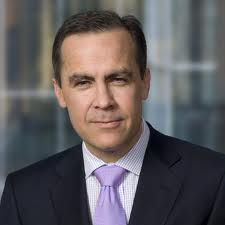 Mark Carney, as Governor of the Bank of Canada, was instrumental in shaping the provisions of the Bail-in for Canada’s chartered banks. Before his career in central banking, he was a senior executive at Goldman Sachs, which has played a behind the scenes role in the implementation of the bank bailouts and austerity measures in the EU.
The FSB’s mandate would be to coordinate the bail-in procedures, in liaison with the “national financial authorities” and “international standard setting bodies” which include the IMF and the BIS. It should come as no surprise: the deposit confiscation procedures in the UK, the US and Canada examined above are remarkably similar.
Bank “Bail-ins” vs. Bank “Bail-outs”
The bailouts are “rescue packages” whereby the government allocates a significant portion of State revenues in favor of failed financial institutions. The money is channeled from the coffers of the State to the banking conglomerates.
In the US in 2008-2009, a total of $1.45 trillion was channeled to Wall Street financial institutions as part of the Bush and Obama rescue packages.
These bailouts were considered as a De facto government expenditure category. They required the implementation of austerity measures. Together with massive hikes in military expenditure, the bailouts were financed through drastic cuts in social programs including Medicare, Medicaid and Social Security.
In contrast to the Bailout, which is funded from the public purse, the “Bail-in” requires the (in-house) confiscation of bank deposits. The bail-ins are implemented without the use of public funds. The regulatory mechanism is established by the central bank.
At the outset of Obama’s first term in January 2009, a bank bailout of the order of $750 billion was announced by Obama, which was added on to the 700 billion dollar bailout money allocated by the outgoing Bush administration under the Troubled Assets Relief Program (TARP).
The total of both programs was a staggering 1.45 trillion dollars to be financed by the US Treasury. (It should be understood that the actual amount of cash financial “aid” to the banks was significantly larger than $1.45 trillion. In addition to this amount defence allocations to fund Obama’s war economy (FY 2010) was a staggering $739 billion. Namely the bank bailouts plus defence combined ($2189 billion) eat up almost the totality of the federal revenues which in FY 2010 amounted to $2381 billion.
Concluding remarks
What is occurring is that the bank bailouts are no longer functional. At the outset of Obama’s Second term, the coffers of the state are empty. The austerity measures have reached a deadlock.
The bank bail-ins are now being contemplated instead of the “bank bailouts”.
The lower and middle income groups which are invariably indebted will not be the main target. The appropriation of bank deposits would essentially target the upper middle and upper income groups which have significant bank deposits. The second target will be the bank accounts of small and medium sized firms.
This transition is part of the evolution of the global economic crisis and the impasse underlying the application of the austerity measures.
The purpose of the global financial actors is to wipe out competitors, consolidate and centralize bank power and exert an overriding control over the real economy, the institutions of government and the military.
Even if the bail-ins were to be regulated and applied selectively to a limited number of failing financial institutions, credit unions, etc, the announcement of a program of confiscation of deposits could potentially lead to a generalized “run on the banks”. In this context, no banking institution would be regarded as safe.
The application of Bail-in procedures involving deposit confiscation (even when applied locally or selectively) would create financial havoc. It would interrupt the payments process. Wages would no longer be paid. Purchasing power would collapse. Money for investment in plant and equipment would no longer be forthcoming. Small and medium sized businesses would be precipitated into bankruptcy.
The application of a Bail-In in the EU or North America would initiate a new phase of the global financial crisis, a deepening of the economic depression, a greater centralization of banking and finance, increased concentration of corporate power in the real economy to the detriment of regional and local level enterprises.
In turn, an entire global banking network characterized by electronic transactions (which govern deposits, withdrawals, etc), –not to mention money transactions on the stock and commodity markets– could potentially be the object of significant disruptions of a systemic nature.
The social consequences would be devastating. The real economy would plummet as a result of the collapse in the payments system.
The potential disruptions in the functioning of an integrated global monetary system could result in a a renewed global economic meltdown as well as a drop off in international commodity trade.
It is important that people across the land, in the European Union and North America, nationally and internationally, forcefully act against the diabolical ploys of their governments –acting on behalf of dominant financial interests– to implement a selective process of bank deposit confiscation.
ORDER DIRECTLY FROM GLOBAL RESEARCH

The Global Economic Crisis: The Great Depression of the XXI Century
Michel Chossudovsky and Andrew Gavin Marshall, Editors$16.00
Save 38%
About the author:
Michel Chossudovsky is an award-winning author, Professor of Economics (emeritus) at the University of Ottawa, Founder and Director of the Centre for Research on Globalization (CRG), Montreal and Editor of the globalresearch.ca website. He is the author of The Globalization of Poverty and The New World Order (2003) and America’s “War on Terrorism”(2005). His most recent book is entitled Towards a World War III Scenario: The Dangers of Nuclear War (2011). He is also a contributor to the Encyclopaedia Britannica. His writings have been published in more than twenty languages. He can be reached at crgeditor@yahoo.com
Articles by: Prof Michel Chossudovsky
Related content:
-

The Confiscation of Savings in Canada? Cyprus-Style “Bail-Ins” Proposed by Ottawa Government
The politicians are coming after your bank accounts. Ottawa’s “Economic Action Plan 2013″ which the Harper government has submitted to Parliament, proposes a ‘bail-in’ regime which allows “the conversion of certain bank liabilities into regulatory capital.”
-

The Cyprus Bank Battle: The Long-planned Deposit Confiscation Scheme
“If these worries become really serious, . . . [s]mall savers will take their money out of banks and resort to household safes and a shotgun.” — Martin Hutchinson on the attempted EU raid on private deposits in Cyprus banks…
-

It Can Happen Here: The Bank Confiscation Scheme for US and UK Depositors
Confiscating customer deposits in Cyprus banks was not a one-off, desperate idea, a joint paper by the US Federal Deposit Insurance Corporation and the Bank of England dated December 10, 2012, shows that these plans have been long in the making
-

A previous article called them the new normal. Bad ideas spread fast. Canada endorses Cypriot harshness. Its “Jobs Growth and Long-Term Prosperity: Economic Action Plan 2013″ says so. On March 21, it was submitted. It endorsed depositor haircuts. It did…
Complementary Currencies: A Beginner’s Guide [video]
GlobalResearchTV
April 3, 2013
As the Cyprus fiasco focuses attention once again on the faltering Euro, the public is finally questioning the value of the money in their wallets and bank accounts. But as the issue of monetary reform gains currency amongst the public, a vast array of complimentary currencies are already helping people facilitate transactions without the central bank administered fiat money. Find out more in this week’s GRTV Backgrounder on Global Research TV.
TRANSCRIPT AND SOURCES: http://www.corbettreport.com/?p=7219
‘Cyprus precedent set, will be repeated in bleeding Europe, America’ [video]
Russia Today
April 3, 2013
Enough is enough for the Cypriot finance minister – Michalis Sarris has handed in his notice, after securing the 10-billion-euro bailout that will see savers in two major banks pay the bill. The finger-pointing’s far from over though – as the island tries to establish who’s to blame for the country’s economic meltdown.
Financial journalist Clem Chambers believes other Eurozone countries will follow the sad example of Cyprus.
RT LIVE http://rt.com/on-air
Subscribe to RT! http://www.youtube.com/subscription_c…
Like us on Facebook http://www.facebook.com/RTnews
Follow us on Twitter http://twitter.com/RT_com
Follow us on Google+ http://plus.google.com/+RT
RT (Russia Today) is a global news network broadcasting from Moscow and Washington studios. RT is the first news channel to break the 500 million YouTube views benchmark.
Final Push for a Canada-EU CETA and the Coming NAFTA-EU Free Trade Zone
by Dana Gabriel
Be Your Own Leader
March 25, 2013
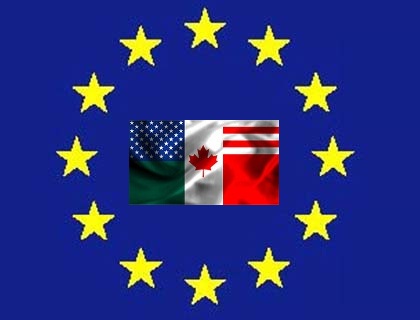
Pressure is mounting on Canada to finish up a long-delayed trade deal with the EU. Despite outstanding issues that still must be settled, there is a final push to try and complete an agreement this summer. If both sides are able to secure a deal, it would lay the groundwork for the proposed U.S.-EU trade pact. There is the possibility that the U.S.-EU transatlantic trade talks could also include the other NAFTA partners and maybe even other countries. Mexico has already shown interest in joining and if Canada can’t put the final touches on their own agreement with the EU, they might also be part of the negotiations. This would facilitate plans for a coming NAFTA-EU free trade zone and the formation of a transatlantic economic union.
After almost four years, negotiations between Canada and the European Union (EU) on a Comprehensive Economic and Trade Agreement (CETA) are bogged down in the final stages. Both sides have missed numerous deadlines to wrap things up. There is uncertainty when or if CETA will even get done. Prime Minister Stephen Harper recently tried to boost trade talks. He acknowledged that considerable progress towards a free trade deal has already been achieved, but admitted that there are still important issues that need to be resolved before any agreement can be finalized. Harper also explained that it would be to Canada’s advantage to sign a deal with Europe before the U.S. does. He made the comments while meeting with French Prime Minister Jean-Marc Ayrault who was in Ottawa for an official visit. As part of a joint statement, both leaders said they looked forward to a successful conclusion to CETA negotiations. Before his trip to Canada, Ayrault was sent a letter by civil society groups voicing opposition to CETA and the investor protection chapter that would grant corporations the power to challenge government policies that restrict their profits.
There are key issues which remain stumbling blocks and are preventing Canada and the EU from reaching an agreement. Academic researcher and law professor Michael Geist argued that, “with the EU the stronger of the two parties, it doesn’t see any urgency to compromise. In fact, with a growing number of EU negotiations (including talks with the U.S.), compromise with Canada may undermine its position in more economically important deals.” He also laid out different possibilities for the future of CETA. This includes Canada continuing to hold out hope for a compromise which thus far has failed. They could cave to the EU demands, but this might hurt the Conservatives chances in the 2015 election. Geist pointed out another scenario which would involve Canada joining the U.S.-EU talks and CETA being replaced by the Transatlantic Free Trade Area (TAFTA). He noted, “The argument for TAFTA would be that Canada is consolidating its negotiations into major agreements covering the Pacific (TPP) and Atlantic (TAFTA) to ensure that it is part of two potential large trading blocks. The danger with this approach is that Canada becomes a bit player in both negotiations with even less leverage to promote Canadian interests.”
During a speech given in November of last year, EU Trade Commissioner Karel De Gucht called on Mexico and the EU to modernize their existing trade agreement. Glyn Moody of techdirt recently reported that Mexico is now looking to join the U.S.-EU transatlantic deal. This would be one way for the EU and Mexico to upgrade trade relations. Moody emphasized that the U.S. strategy is to, “make TPP the defining international agreement for the entire Pacific region. TAFTA obviously aims to do the same for the Atlantic. As well as establishing the U.S. as the key link between the giant TPP and TAFTA blocs, this double-headed approach would also isolate the main emerging economies — Brazil, Russia, India and above all China.” Just like the U.S. dominated Trans-Pacific Partnership (TPP), Mexico and Canada could also be a part of the Transatlantic Trade and Investment Partnership talks. This would make it a true NAFTA-EU trade bloc-level negotiations. There might be an opportunity for other countries to join as Turkey is also pushing to be included in the trade deal.
In a recent article, Maude Barlow of the Council of Canadians described how CETA negotiations have laid the groundwork for a U.S.-EU free trade zone. She insisted that it would be a mistake for all three NAFTA countries to be a part of a transatlantic agreement. Barlow warned about some of the same dangers found in CETA that the U.S. could face in their own trade deal with the EU. She stressed how opening up local procurement to the EU should be of great concern to U.S. states and municipal governments. In Canada, a number of municipalities have passed motions demanding that they be excluded from the procurement rules in CETA which would restrict local hiring and purchasing initiatives. Barlow also cautioned that an investor protection chapter like the one in CETA would allow European multinationals to sue for any potential profit losses related to U.S. government policies and regulations. This would be worse than NAFTA’s Chapter 11 and as a result, the U.S. would lose more sovereign rights. The Australian government has already stopped the practice of including investor-state dispute resolution procedures in trade agreements and now it’s time for other countries follow suit.
In Canada, opposition to CETA continuous to grow. There are deep concerns over the expansion of NAFTA-like investor rights, the dismantling of supply management in agriculture and the negative impact that CETA would have on local public procurement. It could also serve to further empower Big Pharma by extending monopoly drug patents which would lead to higher costs. Just like any of the other so-called next-generation trade and investment deals, CETA is based on the failed NAFTA model with the same false promises. These secretive and binding international agreements are not really about trade, but are in fact designed to reshape regulatory and policy frameworks to further increase the rights of corporations and investors.
Whatever happens with CETA will greatly affect how the U.S. and EU approach their own trade deal. Moving forward, the merging transatlantic partnership will eventually culminate in the creation of a NAFTA-EU free trade zone. With the push for deeper international economic integration, the U.S. is positioning itself to become the lynchpin between the world’s largest trading blocs.
Related articles by Dana Gabriel:
Deepening the U.S.-EU Transatlantic Trade Partnership
Growing Opposition to the Canada-EU Trade Agreement
Spreading NAFTA’s Love Across the Atlantic
U.S.-EU Trade Deal is the Foundation For a New Global Economic Order
Dana Gabriel is an activist and independent researcher. He writes about trade, globalization, sovereignty, security, as well as other issues. Contact: beyourownleader@hotmail.com Visit his blog at Be Your Own Leader
[hat tip: Intellihub]
US Weapons Deliveries to “Terrorists in Syria” a Systematic Violation of the Convention against the Use of Mercenaries
nsnbc international
March 26, 2013
 Christof Lehmann (nsnbc),- A New York Times article reveals CIA involvement in weapons deliveries to the Syrian insurgents. Weapons which among other end up in the hands of the Syrian Al-Qaeda branch Jabhat al-Nusra.
The article reveals that deliveries by planes have taken place since 2012. The USA, Turkey, Qatar, Saudi-Arabia and others however, have directly and indirectly provided weapons for Muslim Brotherhood and Al-Qaeda associated insurgents since early 2011.
Special forces liaisons and special operations combat troops have been on the ground in Syria since 2011, taking among other, part in the spectacular kidnapping of the attorney general of Hama, Adnan Bakkur, in which helicopter gunships were involved.
The financing of the subversion began as early as 2007, when the government of Qatar sent USD 10 billion to the Turkish Foreign Minister Davotoglu. The arming of terrorists is not a one off scandal, but official NATO doctrine and a systematic violation of the Convention against the Use of Mercenaries.
As much as the New York Times (NYT) may want to portray arms shipments by plane as spectacular incident, it hardly touches the surface of the criminal attempt of the USA and NATO allies, Saudi-Arabia, Qatar, Israel, post-coup Libya and other, to systematically manufacture a low intensity conflict with the help of well financed and armed proxies, and with the purposes to prevent the completion of the PARS gas-pipeline, to balkanize Syria and Iraq, create a Kurdish Corridor, and to create the precondition for a war on Iran and other conflicts along the soft, resource rich underbelly of Russia and China.
The New York Times article correctly states, that Turkey and Arab governments, with the help of the CIA, over the recent months have increased their military aid to “Syrian opposition fighters”. The New York Times article further states, that the airlift began on a small scale in early 2012, continued intermittently through last fall, and expanded into a much heavier flow in late 2012. According to the NYT, it has grown to include more than 160 cargo flights by Jordanian, Saudi-Arabian and Qatari military-style cargo planes, landing at Esenboga Airport near Ankara, and, to a lesser degree, other Turkish and Jordanian airports.
The importance of the NYT article lies in the fact, that it is for the first time, that a major US-American newspaper recognizes, and to a degree documents the fact, that a US intelligence service was involved in delivering weapons to insurgents in Syria, albeit US-President Obama publicly refused to provide more than “non-lethal” aid. The NYT also reports, that officers from US-Intelligence Services have used “secret offices” to help Arab governments shop for weapons, including a large procurement from Croatia. The NYT also reports that American officials, on the condition of anonymity, have stated, that US-Intelligence Officers have vetted rebel commanders and groups to determine, who should receive weapons as they arrive (1
The article in the NYT on 25 March was not the first to report about the airlift of arms from Croatia. Already on 8 March The London Telegraph reported about a 3,000 Ton airlift of weapons by Jordan and NATO member Turkey which passed through the Croatian city Zagreb. (2 Subsequently, on 9 March, LandDestroyer and nsnbc published a comprehensive article about the airlift, detailing that the weapons, among other, were being delivered to the Syrian Al-Qaeda militia Jabhat al-Nusra. (3
Reportedly, the CIA has declined to comment about the statements by members of the intelligence community, that the CIA vetted the terrorist groups who received the weapons. However, there are numerous reports which substantiate the direct involvement of the CIA and other NATO member states, Saudi-Arabian, Qatari and other intelligence services, and that, long before March 2013.
US – Special Forces Officer blows the whistle. Already in August 2011 an officer of the United States Special Forces at Ft. Bragg, North Carolina, reports to nsnbc on the condition of anonymity, that US Special Forces had been operating in both Libya and Syria for months already, cooperating with predominantly Muslim Brotherhood and Al-Qaeda associated militia. (4
The same officer also verified that a training circular for special forces and “foreign students” which were trained by US special forces, the TC 18-01, Special Forces, Unconventional Warfare, from 2010, was a genuine document and reflected the model according to which the US Administration, US-Special Forces, US-Intelligence Services and their allies in Syria were organizing the subversion of the country. February 2012, the TC 18-01 was published in full by nsnbc. (5 No western mainstream media reported about the whistle blower or the TC 18-01.
September 2011 – Helicopter Gunships involved in the Kidnapping of Hama Attorney General Adnan Bakkur. In early September 2011 the attorney general of Hama, Syria, Adnan Bakkur was kidnapped. According to western mainstream media, the attorney general had defected. A video with the attorney general reading a statement that he had defected because of the violent crackdown of the Syrian government against peaceful protesters, was aired on several western mainstream media channels or used as evidence for the attorney general´s defection. The video shows clearly, that Adnan Bakkur “read” his statement under duress.
A reporter for nsnbc in Damascus reported, that the attorney general had been kidnapped and added further detail to the evidence, reporting, that eyewitnesses have seen the kidnappers drive in several cars, including a white Toyota pickup with a heavy machine gun mounted on it. The convoy with the kidnapped attorney general was then met by waiting helicopter gunships. Although the whereabouts of Adnan Bakkur were unknown, it was suspected, that he had been taken across the border to Turkey, where NATO Special Operations forces were training and arming Muslim Brotherhood fighters. (6
Although no independent, international investigation into this high profile kidnapping of the Hama attorney general Adnan Bakkur was conducted it was bearing all the signs of being a Military Intelligence Support Operation (MISO), also known as a PSYOP or psychological operation. Moreover, it is very unlikely that the helicopter gunships were not provided by a NATO member states military.
US Troops from Iraq redeployed to Jordan. Recruitment Center and Intelligence Operations Room in Mekka Street, Amman, Jordan. In December 2012 the blog of the US-American whistle blower Sibel Edmonds, Boilingfrogpost, reported that an unspecified number of US troops which had been withdrawn from Iraq, had been redeployed to airbases in Jordan and to the Jordanian border town Al-Mafraq, near the Syrian border. (7
On 17 February nsnbc reported, that the Jordanian military, together with US troops, had established a “buffer zone” at the Jordanian – Syrian border near al-Mafraq and reported that a source close to the former Jordanian Prime Minister Marouf Bakhit had announced the presence of an estimated 43,000 fighters.
At least 20,000 of these fighters, so the former Jordanian prime Minister´s confident, were fighters of the Libyan Al-Qaeda organization, the Libyan Islamic Fighting Group (LIFG), also known under the name “Tripoli Brigades”, under the command of the known Al-Qaeda terrorist Abdelhakim Belhadj and his second in command Harati. The transport of the many NATO mercenaries has reportedly taken place under the cover of medical transports or transports of wounded Libyan “rebels” to Jordan. (8
According to the former Spanish Prime Minister Aznar, who referred to Spanish intelligence services reports, Abdelhakim Belhadj, who also is known under the names Hasadi, Hasidi and other alias, was the mastermind behind the 2004 Madrid train bombings which secured that the Spanish parliament continued deploying Spanish troops to Afghanistan.
After the NATO led conquest of the Libyan capital Tripoli, Belhadj became the military governor of Tripoli, Al-Qaeda´s Libyan Islamic Fighting Groups became the Tripoly Military Council and the Tripoli Brigades. Abdelhakim Belhadj was installed in the position with the knowledge and aid of the US/NATO intelligence services and military, and with the full knowledge of the administration of US President Obama. ( 9
Also from a source close to the former Jordanian Prime Minister Marouf Bakhit, came the information that the Turkish (NATO) military intelligence service had opened an intelligence and operations room and a recruitment center in Mekha Street, in the Jordanian capital Amman. (ibid.)
Shiploads of Weapons including shoulder fired Surface to Air Missiles, arriving in Turkey, are distributed to insurgents in Syria. One fact that makes statements by the US administration, that it only provides non-lethal aid particularly deceitful is the fact that the Obama administration failed to respond to a report, according to which an entire shipload of weapons which had arrived to Turkey from Libya, and which contained large numbers of shoulder fired SAM-7 and Stinger Surface to Air Missiles, which were then distributed to insurgents in Syria by Turkish, that is NATO military officers. In September 2012 The Times, SANA and nsnbc reported about this largest yet documented shipload of weapons delivered to Syrian insurgents. (11
The “non-lethal aid ” will constitute a considerable threat to international air safety for the foreseeable future, and it is neither unlikely that one or more of the surface to air missiles will be used in a genuine terrorist attack by Islamist radicals against a civilian airliner, or that one or more of them will be used by a radical / double agent posing as a radical Islamist in a false flag terror attack.
The re-opening of the old smuggling route at the Saudi – Iraqi border and US Secretary of State´s warning to Iraq´s Prime Minister Nouri al-Malaki. On 26 December 2012 nsnbc international reported about the reopening of an old smuggling route at the border between Saudi-Arabia and Iraq. The smuggling route, was previously being used for transporting various types of weapons, ammunition bombs,military equipment and not least drugs to Iraq, begins in Al-Nakhib in the western Al-Anbar province, near the Ar´ar border crossing. The smuggling route has been reactivated to provide a variety of terrorist organizations in Syria, including the Jabhat al-Nusra, with weapons and other equipment. (12
Weapons and other equipment from Saudi-Arabia, smuggled along this route however, is not exclusively being funneled to Syria. Iraq has since the last quarter of 2012 again become a target of terrorism and sectarian violence, instigated, financed and armed by Saudi-Arabia. In December 2012 a senior Iraqi legislator issued a warning against plots which are being hatched by Turkey, Qatar and Saudi-Arabia against Iraq, calling on citizens of Iraq to be vigilant. Earlier in 2012 Iraq´s Prime Minister Nouri Malaki warned, that Saudi Arabia and Qatar are attempting to carry out an Syria-style plot against Iraq in an attempt to topple the government by deploying terrorists.
In an interview with the Lebanese al-Mayyadeen satellite network earlier in 2012, P.M. Nouri al-Malaki stated: ” Qatar and Saudi Arabia which are meddling to topple the Syrian government are now doing the same meddling to topple the Iraqi regime. Their goal is overthrowing the Iraqi government. Their goal is overthrowing the Iraqi ruling system and not overthrowing me”.
Earlier in 2012 the prominent Iraqi legislator, Al-Sayhood, issued the warning that much of the strategy which is being financed and carried out by Saudi Arabia and Qatar is in fact masterminded by Israel in an attempt to destabilize the sole Arab nation which so far has stood firm against imperialism and which consequently and consistently has backed the Arab and Palestinian cause. Iraq has over the course of the last four months been subject to several high profile terrorist attacks and assassinations which most likely originated from Saudi-Arabia. (ibid.)
On a surprise visit to Iraq and Iraq´s Prime Minister Nouri al-Malaki by US Secretary of State John Kerry however, Kerry demanded that Iraq stops the flow of arms to the Syrian military and the Syrian government. The demand has widely been discredited as hypocritical and many analysts, the scribe included assess Kerry´s statement as part of preparations for a larger media campaign and a campaign of destabilization and terrorism against Iraq. (14
NATO´s Discount Warfare Strategy, Arms Deliveries to “Terrorist Organizations” or systematic Violations of the Convention against the Use of Mercenaries – The deliveries of weapons and the funding of terrorist organizations, the interface of terrorist organizations with civilian and military intelligence services and western governments attempts to distance themselves as much as possible from terrorism in the view of the western citizens are symptoms of a new NATO military doctrine which was adopted at the 25th NATO Summit in Chicago 2012. (15
Prior to the formal adoption of the doctrine, which could be described as a discount low-intensity warfare model by means of mercenaries, who can be used as either friend or foe, which ideally should result in the procurement of NATO via the UNSC, but which will function as terrorist war of attrition if a UNSC resolution cannot be secured, was first officially endorsed by the two top NATO chiefs Ivo H. Daalder and James G. Stavridis when they called NATO´s intervention in Libya “a teachable moment and model for future intervention”. At NATO´s 25th Summit the model was officially adopted.
The NYT article, although it discloses some of the illegal deliveries of weapons is problematic and misleading to the extend that a correct name for the arms deliveries would be “Arms Deliveries to NATO mercenaries”.
The “terrorist” narrative is no longer viable and it eventually prevents the general public from understanding that the USA/NATO, Qatar, Turkey, Saudi-Arabia, EU and other “Friends of Syria” are systematically violating the Convention Against the Use of Mercenaries.
Christof Lehmann 26.03.2013
Notes:
Arms Airlift to Syria Rebels Expands, With Aid from C.I.A., New York Times, 25. March 2013 published online at http://www.nytimes.com/2013/03/25/world/middleeast/arms-air-lift-to-syrian-rebels-expands-with-cis-aid.html?pagewanted=all&_r=1&
2) US and Europe in ‘major airlift of arms to Syrian rebels through Zagreb’. The London Telegraph, 08 March 2013, published online at http://www.telegraph.co.uk/news/worldnews/middleeast/syria/9918785/US-and-Europe-in-major-airlift-of-arms-to-Syrian-rebels-through-Zagreb.html
3) US-British Al Qaeda Airlift: 3,000 Tons of Weapons Fuel Syria’s Destruction , LandDestroyer, 09 March 2013, also published online by nsnbc international at http://nsnbc.me/2013/03/09/us-british-al-qaeda-airlift-3000-tons-of-weapons-fuel-syrias-destruction/
4) Arabian Summer or NATO´s Fall, Christof Lehmann, 29. August 2011, published online at nsnbc at http://nsnbc.me/2011/08/29/arabian-summer-or-nato%C2%B4s-fall/
5) SPECIAL FORCES UNCONVENTIONAL WARFARE – TC 18-01, published by nsnbc online at http://nsnbc.files.wordpress.com/2011/10/special-forces-uw-tc-18-01.pdf
6) Syria – Hama: Driver and Bodyguard of Kidnapped General Attorney Confirm Kidnapping. Christof Lehmann, 05 September 2011, published on nsnbc, online at http://nsnbc.me/2011/09/05/syria-hama-driver-and-bodyguard-of-kidnapped-general-attorney-confirm-kidnapping/
7) Foreign Troops Begin to Spread Near the Villages of Al-Mafraq. Sibel Edmonds, Boilingfrogspost, published in nsnbc on 13 December 2011 online at http://nsnbc.me/2011/12/13/foreign-troops-begin-to-spread-in-syria/
8) Attack on Syria likely before March? Christof Lehmann, nsnbc, 17 February 2012, published online at http://nsnbc.me/2012/02/17/attack-on-syria-likely-before-march/
9) Abdelhakim Belhadj The Mask Behind The Many Men, Christof Lehmann, nsnbc, 25 September 2011, published online at http://nsnbc.me/2011/09/25/abdelhakim-belhadj-the-mask-behind-the-many-men/
10) ibid.
11) Largest Shipload of Libyan Weapons Heading to Armed Groups in Syria, SANA, published on nsnbc on 15 September 2012, online at http://nsnbc.me/2012/09/15/largest-shipload-of-libyan-weapons-heading-to-armed-groups-in-syria/
12) Saudi Smuggling Route to Syria Disclosed. Christof Lehmann, nsnbc, 26. December 2012, published online at http://nsnbc.me/2012/12/26/saudi-smuggling-route-to-syria-disclosed-2/
13) ibid.
14) Kerry Demands Iraq Stop “Arms Flow” to Syria even as US Arms/Funds Al Qaeda, LandDestroyer, 25 March 2013, published on nsnbc international at http://nsnbc.me/2013/03/25/kerry-demands-iraq-stop-arms-flow-to-syria-even-as-us-armsfunds-al-qaeda/
15) NATO`s 25th Summit in Chicago in Preparation of Global Full Spectrum Dominance Christof Lehmann, nsnbc, 20 May 2012, published online at http://nsnbc.me/2012/05/20/natos-25th-summit-in-chicago-in-preparation-of-global-full-spectrum-dominance-interventionism-possible-preparations-for-a-regional-war-directed-against-russia-and-china-and-developments-in-global/
About the Author

Thousands gather in Damascus for funeral of assassinated Syrian cleric
End the Lie – Independent News
March 23, 2013

The coffins of Sunni Muslim cleric Mohamed Saeed al-Bouti and his grandson Ahmed al-Bouti, who both died in a suicide bomb attack, are carried during their funeral ceremony on March 23, 2013 at the Omayyad mosque in Damascus, Syria. (AFP Photo)
Thousands of Syrians have gathered for the funeral of a pro-Assad cleric who was killed in a blast at a mosque earlier this week. Saturday has been declared a day of mourning in the Arab country.
Mohammed Saeed Ramadan Al-Bouti, his grandson, and 49 others were killed when a suicide bomber detonated a bomb inside a mosque where he was delivering a sermon on Thursday.
The cleric was Imam of the Omayyad Mosque, a Damascus landmark. He is the most senior religious figure to be killed in the Syrian conflict to date.
During the funeral, mourners carried 84-year-old Mohammad Said Ramadan al-Bouti’s coffin on their shoulders while shouting “God is Great.”
The cleric was buried on grounds beside the tomb of the Saladin, regarded as a heroic warrior in Islam. The move angered opposition activists, who turned to social media to express their fury. “Burying Buti next to Saladin is a deliberate insult,” activist Waleed al-Akrat wrote on Twitter.
Syrian President Bashar Assad was being represented at the funeral by one of his cabinet ministers, according to state TV. On Friday, the Syrian leader vowed to “cleanse” his country of “extremists,” whom he accused of being behind the attack.
“I swear to the Syrian people that your blood, and that of your grandson and all the martyrs of the homeland, will not be spilled in vain because we will be faithful to your ideas by destroying their extremism and ignorance until we have cleansed the country,” Assad said in an official statement.
The slain cleric had been a vocal supporter of the Syrian regime since the days of Assad’s father and predecessor. In a speech earlier this month, al-Bouti said it was “a religious duty to protect the values, the land and the nation” of Syria. He previously referred to Assad’s opponents as “scum.”
According to journalist Abdullah Mawazini, it was those statements that prompted the opposition to carry out the attack.
“We believe the opposition is responsible for this. We have Islamist extremist groups – jihadis – who are fighting against the government. Mr. al-Bouti, before he was killed, in his last speech on Friday, said we should fight with the Syrian army and not the opposition groups so this raised a lot of controversy…and discussion in Syrian society and led to this killing,” he told RT.
But the opposition has also condemned the attack, pointing the finger at the Assad regime. The current head of the National Syrian Coalition, Moaz Alkhatib, said on his Facebook page that only the Syrian government could be behind the attack, stressing the importance that places of worship and clerics not be targeted.
“The killing of Doctor al-Bouti is a crime in every sense of the word,” he wrote. “No matter the differences that clerics in Syria may have in their view of the situation, this does not allow for the merciless killing of Muslims or the defilement of mosques.”

People take part in the funeral ceremony of Sunni Muslim cleric Mohamed Saeed al-Bouti, who died in a suicide bomb attack, on March 23, 2013 at the Omayyad mosque in the Syrian capital Damascus. (AFP Photo)
A ‘biased and imbalanced’ UN
Also on Saturday, Assad’s regime said it rejected a UN Human Rights Council decision to continue an investigation of “alleged violations of international human rights law.” An unnamed official told SANA news agency that the group’s work is “biased and imbalanced.”
The comment comes a day after the UN Human Rights Council passed the resolution, which the official said doesn’t take into account “the unethical role played by states that sponsor terrorism in Syria, which fund, train, arm and send terrorists and mercenaries” into the country.
He added that the resolution reflects “a policy of double standards practiced by some countries that claim to defend human rights.”
The resolution was adopted with 41 votes in favor, one against, and five countries abstaining. It strongly condemned violence on both sides, but noted that those “committed by anti-government armed groups did not reach the intensity and scale of the violations committed by the government forces and its affiliated militia.”
Meanwhile, European Union Foreign Policy chief Catherine Ashton says there is a real sense of urgency to ensure political progress in Syria.
The comment came during a meeting of EU foreign ministers at Dublin Castle. The two-day talks failed to find a common position on the future of the EU’s Syrian arms embargo.
France and Britain believe that lifting the embargo would raise pressure on Assad to negotiate an end to the civil war, which has led to the deaths of an estimated 70,000 people.
Other EU countries disagree, saying that lifting the embargo would lead to weapons falling into the hands of Islamist militants, as well as fuel regional conflict and encourage Assad’s backers to step up arms supplies to the leader.
The EU has until June 1 to decide whether to renew or amend its sanctions on Syria. Changing the arms ban needs the backing of all 27 EU states.

The coffin of Sunni Muslim cleric Mohamed Saeed al-Bouti, who died in a suicide bomb attack, is carried outside the Omayyad mosque after his funeral ceremony on March 23, 2013 in the Syrian capital Damascus. (AFP Photo)

People pray in the Omayyad mosque courtyard during the funeral ceremony of Sunni Muslim cleric Mohamed Saeed al-Bouti, who died in a suicide bomb attack, on March 23, 2013 in the Syrian capital Damascus. (AFP Photo / Louai Beshara)

People pray in the Omayyad mosque courtyard during the funeral ceremony of Sunni Muslim cleric Mohamed Saeed al-Bouti, who died in a suicide bomb attack, on March 23, 2013 in the Syrian capital Damascus. (AFP Photo / Louai Beshara)

 PN
PN 