
Canada Officially Joins Pacific Trade Talks
 by Terry Wilson
CanadianAwareness.org
October 10, 2012
Less than a week after a “gala” event, celebrating the 25th anniversary of the free trade agreement between Canada and America. That took place in Toronto Ont. on Wednesday October 3 2012. Canada has now officially joined talks aimed at achieving a Pacific free-trade deal.
The pacific free trade deal now has 11 countries signed on, in the talks. Australia, Brunei, Canada, Chile, Malaysia, Mexico, New Zealand, Peru, Singapore, the United States and Vietnam.
The advocates of the pacific deal say it could prove a useful way of counteracting the growing clout of China in regional trade and be extremely beneficial to average Canadians. Boosting the Canadian middle class.
This is the same type of rhetoric that was said when when the FTA was signed, and ultimately NAFTA a few years later. How true was the advocates hype with the FTA and NAFTA?
In a report from the Toronto Sun, published on the university of Toronto’s website. The numbers show how free trade has severely hurt Canadians.
“Diversification in Canada’s industrial base has been disappointing, said Campbell, with the average unemployment rate in the last 15 years remaining about the same as the previous 15 years. Big business, though, has done well. A study of 40 non-financial member companies of the Canadian Council of Chief Executives found their combined revenues jumped 105 per cent between 1988 and 2002 while their overall workforce shrank by 15 per cent.
The wealth hasn’t trickled down, said Campbell, despite steady productivity growth in the Canadian economy. “If free trade was supposed to usher in a new era of rising living standards, reversing the sluggishness of the 1980s, the record reveals quite the opposite.”
Annual growth in average personal income per capita was at 1.55 per cent a year in the 1980s but slid to 0.63 per cent a year between 1989 and 2005. Meanwhile, Americans were enjoying a personal income growth rate of almost twice that during the same period. Massive cuts to Canadian social programs haven’t helped, said Campbell, and tax cuts and transfers didn’t offset the difficulties as
they did in the past.
Federal non-military spending cuts in the second half of the 1990s were the largest in Canadian history, bringing spending down to the level of the late 1940s. “Growing wealth and income inequality and a shrinking Canadian social state have been hallmarks of the free trade era,” Campbell said.
The bottom 20 per cent of families saw incomes fall by 7.6 per cent during 1989 to 2004, while incomes of the top 20 per cent rose 16.8 per cent. While the average Canadian wage increased eight per cent between 1990 and 2000, the top one per cent of wage earners made 64 per cent more. “The first free trade decade saw overall income inequality increase for the first time since the 1920s,” said Campbell.
Continue Reading
Since this report, things have not improved. This was published just today: Canada must move on income inequality
“What’s concerning is that inequality is getting worse instead of better, and while Canada has the financial means to turn this around, those steps aren’t being taken”
As we can see the only Canadians benefiting from North American free trade are the rich. Or as the occupy movement dubbed them the “1%”. The rest of us got the shaft after being told it would be amazing! (big surprise)
Will this new trade deal be legit? Will it help common Canadians? I wouldn’t count on it! This trade deal along with many others including CETA (Canadian and European trade agreement), which is also being negotiated at this moment. Is only furthering the globalized consolidation of wealth into the hands of a few billionaires.
And for those who like to pin all of our woes on Stephen Harper or the Conservative party. Stop before you even try to blame them solely for this. Conservatives began the FTA and NAFTA, Liberals continued them and started the negotiations for CETA, and now the conservatives are continuing CETA and starting this new Pacific deal. You see an emerging trend? It does not matter which politician or party is in office. The same agenda continues. Harper, Martin, Chretien, Mulroney all puppets doing the bidding of their corporate masters.
FLASHBACK: Spreading NAFTA’s Love Across the Atlantic
by Dana Gabriel
BE YOUR OWN LEADER
August 26, 2012
(Originally published in October of 2008)
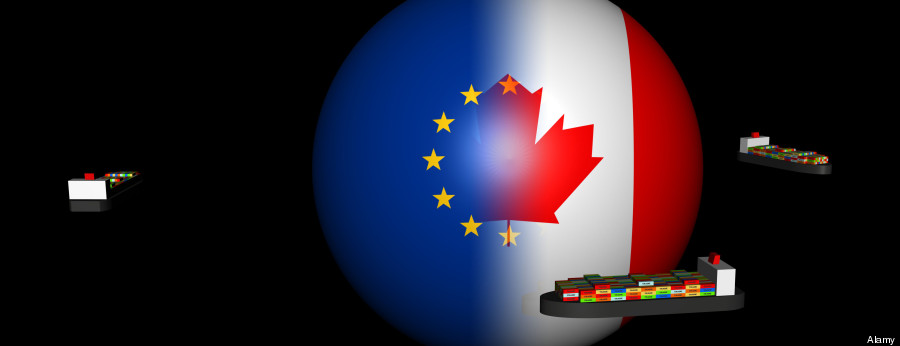
Canada and the European Union (EU) are set to begin preliminary discussions on deeper economic integration a mere three days after the election. It has been reported that the proposed trade deal will far exceed NAFTA. Some see this as an opportunity to possibly update the 15 year-old accord. Stephen Harper is busy telling Canadians that only a Conservative majority government will be able to bring confidence back and stabilize the economy. That is why I find it a little strange that this has not become a pillar of the Conservatives economic platform. Harper has decided not to release the full text of the draft proposal until after the election on October 14. The reality is that such an agreement with the EU will be no different than NAFTA in the sense that it will be used to further advance corporate interests.
For the past several months, Canadian officials have been hard at work negotiating with EU representatives. They have compiled a detailed study that will be unveiled after the election. Talks could begin as early as October 17 at a summit in Montreal , with formal negotiations set to begin in 2009. Just as the case with the Security and Prosperity Partnership (SPP) labour, citizen groups and the public at large have been excluded from any discussions. Many support this trade initiative because they wish to lessen Canada’s dependency on the American economy. This agreement has a better chance of succeeding if Harper is re-elected Prime Minister. There still remains much secrecy surrounding trade talks with the EU, and up to this point, Harper appears to be reluctant to make this an election issue.
French and current rotating EU president Nicolas Sarkozy has said that he wishes economic integration with Canada to be part of his lasting legacy. Europe sees Canada’s energy resources as a possible solution to easing their dependency on Russian oil and gas. In a commentary that appeared in the Globe and Mail, Alan Alexandroff, co-author of the C.D. Howe Institute paper titled Still Amigos, writes, “If the EU and Canada can forge an accord that covers services, government procurement and skilled labour that could well set the table for reviving the original NAFTA.” He went on to say, “If the EU and Canada join hands, the U.S. and Mexico will be eager to join the party.” Some believe that such an agreement will further advance North American integration while spreading NAFTA to Europe. A Canada-EU trade deal could be used as the model for future bilateral accords and as a way to further renew U.S.-EU relations.
There are calls to further deepen the U.S.-EU partnership with a new sense of multilateralism in areas of trade, climate change, and fighting terrorism. In April of 2007, it was announced with very little fanfare that the U.S.-EU had reached a deal on a new Trans-Atlantic Economic Partnership. They agreed to set up an economic council and further boost trade and investment by harmonizing services, business takeovers, and intellectual property. They also agreed to continue working towards eliminating non-tariff barriers to trade, which could eventually lead to a U.S.-EU single market.
Economic integration was a first step in the creation of the EU, and a similar stealth approach is being used to advance a North American Union. EU Commission President Jose Manuel Barroso recently said in a speech, “We have to make room at the top table for others, because that is the only way we can consolidate and strengthen a stable, multilateral world, governed by internationally agreed rules.” He also stated, “the time has come to start thinking of an Atlantic Agenda for Globalisation.” With the further erosion of national sovereignty and continued economic, social, cultural and environmental integration, we are on an undeniable path towards world government.
With the collapse of the WTO talks, more bilateral trade agreements will be used in advancing the New World Order’s agenda. The global elite, pushing for world government, are using the current financial turmoil to acquire more wealth and power. Economic uncertainty could also be used to usher in a North American Union with its own currency. A Canada-EU trade deal is yet another incremental step towards global governance.
Dana Gabriel is an activist and independent researcher. He writes about trade, globalization, sovereignty, security, as well as other issues. Contact: beyourownleader@hotmail.com Visit his blog at Be Your Own Leader
Trans-Pacific Partnership: Agenda 21 Meets Global Corporate Takeover
Red Ice Creations
July 31, 2012
By Susanne Posel | OccupyCorporatism.com
 The Trans-Pacific Partnership (TPP) “is a key trade initiative” that the Obama administration claims is “seeking to support jobs for American workers by boosting American exports to the dynamic Asia-Pacific region, promote manufacturing, innovation, and entrepreneurship, and at the same time, reflect in the agreement important values on key issues such as worker rights and the environment.”
However, the agenda of the TPP is a securitization of customs and border patrol services, telecommunications, corporate competition policy that directly effects immigration, corporate investments, and the addition of intellectual property rights with focus on copyright limitations.
The TPP, held in secret, is in actuality a multi-national trade agreement that seeks to extend intellectual property rights across the globe; creating an international enforcement scheme.
In a White House statement , Obama seeks to incorporate America with Canada and the other TPP countries in a “next-generation regional agreement that liberalizes trade and investment.” The press release explains that TPP will build upon “the commitments of NAFTA.”
The TPP defines intellectual property as:
• Copyright
• Trademarks
• Patents
• Geopolitical indicators
 The leaked document drafted as the US TPP Intellectual Property Rights Chapter clearly states that negotiators for Obama are actively pushing for the adaptation of copyright measures that further restrict that is outlined in the Anti-Counterfeiting Trade Agreement (ACTA) and other similar international treaties.
There is an initiative to control global IP enforcement by the UN under signatory treaty wherein nations will be mandated to enact domestic laws that have been worded to reflect the provisions in the TPP agreement.
As in the Digital Millennium Copyright Act of 1998 (DMCA), that places federal agencies in control of digital “locks” and enforcement of over=blown statutory damages on claims of copyright infringement; as well as restricting the US Congress from altering existing IP governances as changes in technology and innovation demands such elasticity.
The restrictive nature of the TPP is evidenced in such obligations as:
Strict punishment over temporary use of copyrighted material without the holder’s authorization
Import bans on “parallel goods” from foreign nations wherein copyright authorization is required
Extend copyright terms beyond 70 years as agreed in the 1994 Agreement on Trade-Related Aspects of IP
Enact laws that treat copyright violation and technological protection measures as separate offences regardless of proof that copyright infringement has occurred
Classify copyright infringement as a criminal offense
Complete adaptation of the DMCA Internet Intermediaries copyright safe harbor regime
[…]
Read the full article at: occupycorporatism.com
Related Articles
Mexico and Canada Invited to Join the Secret TPP Negotiations
TPP and what it means for New Zealand and the world (Videos)
Using the TPP to Renegotiate and Expand NAFTA
by Dana Gabriel
Be Your Own Leader
June 25, 2012
Both Canada and Mexico have been invited to join the U.S., along with other countries already engaged in negotiations which will deepen trade and economic ties within the Asia-Pacific region. Such a deal would surpass NAFTA in size and scope. The U.S. led talks which have been criticized for their secretive nature, could be used to update aspects of existing trade pacts among member nations. This would provide the perfect opportunity for a backdoor renegotiation of NAFTA without officially having to open it back up.
After expressing interest in joining trade talks back in November 2011, NAFTA partners have been invited to join the U.S. backed Trans-Pacific Partnership (TPP) which also includes Australia, Brunei, Chile, Malaysia, New Zealand, Peru, Singapore and Vietnam. U.S. Trade Representative Ron Kirk welcomed both Mexico and Canada into the TPP fold. He noted that, “Mexico has assured the United States that it is prepared to conclude a high-standard agreement that will include issues that were not covered in the North American Free Trade Agreement (NAFTA).” He added, “Inviting Canada to join the TPP negotiations presents a unique opportunity for the United States to build upon this already dynamic trading relationship. Through TPP, we are bringing the relationship with our largest trading partner into the 21st century.” A joint statement by the U.S. and Canada acknowledged that, “The TPP presents an opportunity to conclude a high standard agreement that will build on the commitments of NAFTA.”
The Council of Canadians who continue to be vocal opponents of NAFTA and other trade deals that follow the same flawed template, are strongly against Canada’s entry into the TPP. Its national chairperson, Maude Barlow warned that this, “could force Canada to change its drug policies, its copyright policies, its environmental and public health rules – all without going through the normal parliamentary process.” The organization cautioned how, “TPP negotiations could mean up-front concessions in a number of areas, including intellectual property rights, where the U.S. is making considerable demands on TPP member countries that will undermine access to essential medicines so that its multinational drug firms can increase profits.” They also emphasized that, “Supply management, which guarantees fair wages and stable prices for farmers in non-exporting sectors, is too valuable to Canada to sacrifice on a negotiating table.” Others have pointed out that it is important as a buy-local program, as well as key to Canada’s food security and food sovereignty. The Council of Canadians maintains that, “the TPP is by and large a NAFTA renegotiation but on U.S. President Obama’s terms.”
Not surprisingly, the Canadian Council of Chief Executives, an organization that lobbies the government on behalf of the country’s largest corporations, welcomed the announcement that Canada has been invited to join the TPP talks. Its President and CEO John Manley stated that, “By signing on to the TPP, the federal government has taken an historic leap toward securing Canada’s long-term strategic interests in the Asia-Pacific region.” The U.S. Chamber of Commerce have also applauded Canada and Mexico’s entry into the TPP. Its President and CEO Thomas Donohue argued that, “negotiating the TPP together is an excellent strategic decision for North America.” Back in January, the Council of the Americas explained how, “it makes little sense for the United States to enter into potentially significant trade arrangements with countries in the Pacific region without our NAFTA partners.” They view the TPP as a “promising vehicle to support the updating of our bilateral and trilateral trading relationships within North America to the high standards of twenty-first century free-trade agreements.”
In his article, Will invitation to join TPP talks lead to NAFTA 2.0?, Peter Clark one of Canada’s leading international trade strategists concluded that, “A successful TPP would allow NAFTA to essentially be re-opened without the optics of it actually being re-opened.” He went on to say, “The business leaders in all three NAFTA countries, as strong supporters of TPP invitations to Canada and Mexico, understand that after nearly 20 years, modernization of NAFTA is needed. For rules of origin, supply chain management and manufacturing integration.” Clark stressed that, “All Canadians should be clear about this – TPP is the negotiation of NAFTA 2.0 and it could have major implications for Canada-USA trade relations.” Meanwhile, both countries are implementing the Beyond the Border Perimeter Security and Economic Competitiveness Action Plan which has been described as the most significant steps forward in U.S.-Canada cooperation since NAFTA. Christopher Sands of the Hudson Institute observed how, “The TPP negotiating agenda is at once similar to the bilateral agenda that Canada and the United States are pursuing, and also more ambitious and multilateral.”
In May, the TPP held its twelfth round of negotiations with the next set of talks scheduled to take place in San Diego, California from July 2-10. So far, there has been a real lack of transparency, but what is clear is that the TPP seeks to go beyond other trade agreements. According to a leaked text by Public Citizen, it would expand on the investor privileges found in NAFTA, granting corporations more power and further threatening the sovereign rights of member nations. In the meantime, the U.S. continues to spearhead TPP negotiations as a way of countering growing Chinese influence. The door is open for other countries to join which is why it is considered to be a stepping stone to a larger free trade area of the Asia-Pacific and an important part of the international corporate globalization agenda.
Trade deals such as NAFTA and now the TPP are being used to smuggle through a new set of transnational corporate rights, trapping nations in a web of treaties that further trump their own laws. All too often, these agreements fail to deliver on the promise of prosperity and only serve to accelerate the path towards economic enslavement. Globalization has meant sacrificing self-sufficiency and sovereignty for foreign dependency which is a sure path to world government.
Related Articles By Dana Gabriel
Canada and Mexico to Join U.S. in NAFTA of the Pacific
Building Blocks Towards an Asia-Pacific Union
NAFTA Partners Take Steps to Boost Trilateral Relationship
U.S. Economic, Political and Military Expansion in Asia-Pacific
Dana Gabriel is an activist and independent researcher. He writes about trade, globalization, sovereignty, security, as well as other issues. Contact: beyourownleader@hotmail.com Visit his blog at beyourownleader.blogspot.com
[hat tip: Activist Post]
Canadian Government Moves to Outlaw Masks at Demos
by Kurt Nimmo
Infowars.com
May 7, 2012
It may soon be a crime to wear a mask in Canada. The Harper government supports a bill proposed by Conservative backbencher Blake Richards that would slam protesters in prison for five years if they wear a mask during a demonstration.
 The legislation is supported by the Conservative majority and will likely become law.
Richards said the bill will give the police more power to prevent property damage. “I think it strengthens the right for peaceful protest. It’s only when individuals engage in criminal activity or become violent where this law would apply.”
It will also allow the police to more easily photograph demonstrators and identify and target them.
Richards’ bill follows a tuition hike protest in Montreal that turned violent last month. A student federation said the riot was caused by the police after they “quickly and brutally” intervened in the protest. The police said they were responding to vandals attacking the Montreal Convention Center.
Canadian police have a documented history of inserting agents provocateurs in demonstrations and then using their behavior as an excuse to attack non-violent protesters. In 2007, police “anarchists” were caught staging violence in Montebello during a NAFTA summit.
Similar/Related Articles
- MAYHEM IN MONTREAL: Cops use percussion bombs as student protest turns violent
- Canadian Cops Used Facial Recognition at G20
- Spanish protesters cheer for ‘world revolution’ as demos banned
- Unvaccinated hospital employees required to wear face masks during flu season
- Canadian Bill May Outlaw Natural Health Food Products
- French Cops Infiltrated Anti-government Demos
- Hispanic ad agency produces “Gringo Masks” in response to Arizona law
- Mask-wearing protestors in D.C. can now be arrested
- Violent Montreal student protest nets 10 arrests
- Why do the police need masks?
- 10 wounded in north Iraq demos
- Neocons and Neoliberals: Two Masks, One Face
Canada’s Economic Collapse and Social Crisis: Class War and the College Crisis, Part 5
by Andrew Gavin Marshall
TheIntelHub.com
April 24, 2012
Part 1: The “Crisis of Democracy” and the Attack on Education
Part 2: The Purpose of Education: Social Uplift or Social Control?
Part 3: Of Prophets, Power, and the Purpose of Intellectuals
Part 4: Student Strikes, Debt Domination, and Class War in Canada
What are the Spending Priorities of the Government?
In the debate raging over increased costs of tuition in Quebec, increased debt loads of the federal and provincial governments, the need to reduce costs – impose “fiscal austerity” – and find “solutions” to these problems, very little context is given.
As students fight back against increased fees, the counter argument simply states that people must pay for their education, that governments must reduce their deficits, and therefore, cuts in spending and increases in tuition are necessary, though undesirable. But how necessary are they? Where is the government putting its money?
The question really comes down to one of priorities and approach. What are the spending priorities of the government, for people in need or for the benefit of the rich? What is the government’s approach to spending in terms of addressing a major social and economic crisis, to treat symptoms or address the cause?
A great deal is revealed about the moral, ethical and humanitarian considerations of a state in terms of how and where it spends its money. Canada is no exception.
First, let’s start with Canada’s debt. In October of 2011, it was reported that Canada’s combined federal and provincial debt equaled roughly $1.1 trillion. This raised calls from the business community in Canada stating that, “It’s time for governments across Canada to get more serious about controlling and reducing debt.”
In other words: time for fiscal austerity! (i.e., cutting social spending and increasing costs and taxes) This debt load amounts to roughly 58% of government GDP (that is, 58% of yearly tax revenues), as opposed to Greece, with a debt-to-GDP ratio of 160%.[1]
An interesting issue to note is that the Bank of Canada (Canada’s central bank) was created in 1934 as a private bank, and it was transformed into a government-owned bank in 1938, and was then able to lend to the government without interest, and thus, “the Bank is ultimately owned by the people of Canada.”
The job of the Bank is to manage monetary policy, by issuing the currency and setting interest rates. Canada had a unique central bank, as most other central banks were founded and maintained as private banks (responsible to private shareholders), such as the Bank of England (1694), the Bank of France (1801), and the Federal Reserve Bank of the United States (1913).
It was responsible for financing Canada’s war machine during World War II, railways, the St. Lawrence seaway, the TransCanada Highway, schools, hospitals, healthcare, pensions, and social security, all with no interest attached. Between 1940 and 1974, Canada had a national debt below $18 billion. In 1974, all of this changed as Canada sunk into its neoliberal abyss, when private banks (the “big five” in Canada) essentially took over the function of lending to the government, and at high interest rates, with Canada paying over $61 billion per year on interest to private banks alone.
Between 1981 and 1995, the Canadian government collected $619 billion in income tax, but because the debt was owed to private banks, instead of being interest-free with the Bank of Canada, during that same period of time, the Canadian government paid the private banks $428 billion in interest payments.[2]
Interest payments on Canada’s debt account for roughly 15% of Canada’s revenues. Statistics Canada provides information up until 2009 on the Canadian government’s expenditures and revenues. In 2009, the federal government’s expenditures amounted to $243 billion, with $26 billion spent on health care, $88 billion on social services, $5.8 billion on education, and $18.6 billion on debt charges.[3]
So, while cuts are being made to social programs and education (fiscal austerity), they are increasing dramatically to the military, defense, and police. In 2000, Canada spent $10 billion on defense, and that rose to $21.8 billion in 2011. In 2008, Canada’s Conservative government set out a plan to increase defense spending over the following 20 years, setting the goal at $490 billion in total defense spending over that period.
Included in the plans are the purchase of 65 F-35 fighter jets from Lockheed Martin, the American war profiteering corporation, to a possible dollar amount of $30 billion or more.[4] So there is money for the war machine, to support an increasingly imperialistic foreign policy, and as the ever-present appendage lap-dog to the American Empire to the south.
And since Canada has its lowest crime rate since the 1970s, naturally the ever-pragmatic Conservative government is seeking to rapidly accelerate the construction of prisons and expansion of police forces. The government’s proposed changes to the criminal system seek to “create a flood of Canadians into the prison system.”[5] The government identified prisons, police, and the purposely-Orwellian classification of “public safety” as the biggest winners in increased budget allocations for 2011, seeking to build more prisons and hire hundreds more police officers.[6] At the same time, the government is slashing benefits to seniors and old-age pensioners. According to the Parliamentary Budget Office, prison costs are expected to rise from $4.4 billion in 2011 to $9.5 billion in 2015-16.
When the Conservatives came to power in 2006, prison costs amounted to $1.6 billion per year.[7] So while the government spends billions on corporate tax cuts, fighter jets, police and prisons, it is simultaneously planning on cutting spending for old age pensioners and social security programs.[8]
As the government cuts between 11-22,000 federal public sector jobs, the Canadian Forces (military), RCMP (police), and the overall ‘national security’ establishment will not suffer such cuts, and in fact, will gain employees. Ultimately, under the plans of the Conservative government, between 60,000 and 70,000 jobs could vanish across the country to implement $8 billion in spending cuts.[9]
While spending on health care exceeded $200 billion in 2011, it amounted to $5,800 per person in Canada. While this system – of what is often called ‘socialized healthcare’ – is portrayed by Americans as costly and wasteful, it is far cheaper than the American corporatized – or privatized – health “care” system.
The average spending on health care for OECD countries – as a percentage of GDP – is 9.5%: Canada spent 11.4% of its GDP on healthcare in 2009, compared to the United States, which spent 17.4% of its GDP on healthcare; with the Netherlands spending at 12% of GDP, France at 11.8% and Germany at 11.6%. In terms of spending per capita (that is, the cost of healthcare spread out evenly to each individual within the country), Canada spends $4,363 (U.S. dollars) per person on healthcare, with the OECD average at $3,223, and compared to the United States at $7,960 per capita. The irony here, of course, is that a for-profit health system is far more costly than a ‘socialized’ healthcare system, despite the common claims to the contrary.[10]
So naturally, the Federal Government, in the midst of – and on the precipice of a far greater – economic crisis, decides that the best courses of action are to increase unemployment by firing tens of thousands of people, reduce social spending so that they are left with less support in their newfound poverty, and continue to privatize everything. Of course, this inevitably leads to social unrest, protests, even rebellion. Quebec is a great example, as it seems that the anti-tuition strikes and protests are getting more dramatic with each passing week. As the reality of our situation settles in over the course of the next year and years, the protests and resistance will exacerbate and grow nation-wide (along with the development of similar movements around the world).
Thus, we may properly understand the impetus of the government to increase spending on police, the military, “public safety” (national security/police state) and prisons: as typical state responses to social crises, throw money at the systems, structures and institutions of oppression so that when the people begin to rise up, the state may have the force available to push them down, oppress them, and imprison them.
The Government of Quebec, which is doubling tuition costs over the next five years, has a current debt of $184 billion or 55.5% of GDP. Quebec’s current budget, released in March of 2012, projects spending of $70.9 billion, with 42.5% of the budget allocated to healthcare and social services, 22.5% on education and culture, 11.6% on debt servicing, 3.5% on families and seniors, and 19.9% on “other.”
Total expenditures on education, leisure, and sports amount to less than $16 billion, with $1.3 billion being allocated to Quebec’s corporations, $5 billion going to manufacturing, while $8.2 billion of the budget is going to pay the interest on the debt. Meanwhile, the government was announcing major investments in mining, aiming to produce a surplus, with $1 billion in investments in mining and hydrocarbon industries, as part of Quebec’s ‘Plan Nord,’ The Plan includes the creation of Resources Québec, a new Crown corporation that will oversee a $1.2-billion equity portfolio, designed to “help develop the north and exploit the province’s abundant mineral resources.”
The government, in turn, is expecting $4 billion in mining royalties over the next decade. The forestry, tourism, and agribusiness industries are also getting support from the government, creating partnerships between big business, government, and unions. Quebec provides a great deal of corporate welfare. In 2007, Quebec ranked first among Canadian provinces in how much corporate welfare was doled out, at $6 billion, followed by Ontario at $2.1 billion, Alberta at $1.2 billion, and British Columbia at over $1 billion.[11] So, there’s no more money for education, but there’s plenty of money to throw at multi-billion dollar corporations.
For all the screaming and wailing governments engage in over the costs of social programs and benefits for the public, there’s very little discussion over the expenditures of governments which go to corporations, not to mention, tax cuts. Beginning in 2000, under Prime Minister Jean Chrétien, the Canadian federal government began implementing massive corporate tax cuts, which “allowed Canadian companies to amass some $477 billion in cash reserves,” with corporate taxes going from 28% in 2000, to 21% when the Conservatives came to power in 2006, to 15% at the beginning of 2012.
While the tax cuts were supposedly to encourage job creation, in reality, the cuts “allowed companies to hoard cash, pay out larger dividends to shareholders and beef up executive salaries.” For each percentage point in a decrease of corporate taxes, the federal government loses $2 billion in potential revenue. Thus, the total loss from the tax cuts beginning in 2000 amount to $26 billion. A report from the Canadian Labour Congress explained, “The government has been borrowing money to pay for its corporate tax giveaways. Now, to pay for tax breaks, the government is planning to make massive cuts to public services, such as meat inspection, that are essential to Canadians.”[12]
So while students, seniors, and the poor suffer, Canadian corporations are doing marvelously well. Reports from Statistics Canada show that Canadian corporations are “sitting on more than $583 billion in Canadian currency and deposits, and more than $276 billion in foreign currency.”
The cash reserves of these companies have climbed 27.3% since 2007, back when Canada’s economy was “booming,” and 9% of the increase in reserves was since last year. Not including financial corporations and banks, Canadian companies saw their cash reserves increase by $33 billion in the last quarter of 2011. While Canadian household debt has doubled since 1990, corporate taxes have been cut almost in half in the same amount of time. Canadian provinces have been lowering corporate taxes as well. Back in 2000, Canada’s combined federal and provincial corporate tax rate was the highest of the OECD countries, at 43%.
Today, it’s around the world average of 26%. So while Canadian corporations sit on hundreds of billions of unused dollars, the Canadian government is continuing to give them more money to put in their bank accounts, which then reduces the government budget by billions each year, and the Canadian people are then expected to pay for this corporate welfare through reduced social services, loss of public sector jobs, increased tuition costs and increased debt.[13]
Corporate welfare is dolled out by provincial governments as well. In 2011, the Province of Quebec and Quebec City each provided $200 million to build a new hockey arena for a for-profit hockey team. Ontario is also a corporate welfare haven, as between 2003 and 2005, the province gave $422 million to GM, Ford, Toyota and Chrysler, and in 2009, the province participated in a Canada-Ontario $15.3 billion bailout of GM and Chrysler.
The last year that government statistics are available, in 2008, Ontario spent $2.7 billion on corporate welfare, while Quebec spent $6 billion.[14] Between 1991 and 2009, the government of Ontario gave $27.7 billion in tax dollars to corporations.[15] Meanwhile, the Government of Quebec increased taxes in 2010, and the provincial sales tax increased by 2% since then, along with an increased gas tax, and of course, tuition increases.[16]
This system is, by definition, corporatist. A corporatist system (alternatively referred to as “corporate socialism” or “economic fascism”) is one in which profit is privatized and risk is socialized. In other words, the state ensures that corporations profit and become more powerful and dominant, while the people have to foot the bill and suffer for it.
As Benito Mussolini reportedly stated, “Fascism should more appropriately be called corporatism, for it is the merger of state and corporate power.” It is no surprise then, that as the state becomes more supportive to the suckling-pig-like-corporate cancers of our society, they also become more oppressive and totalitarian. The very circumstances demand it.
The Big Five Banks Declare War on the People
In early March of 2012, it was reported that Canada’s big five banks (Royal Bank, CIBC, TD, Scotiabank, Bank of Montreal) have recorded “sky-high profits” of $7 billion in the first quarter alone (from November 2011 to January 2012), an average increase of 5.8% since last year. Much of the profits, especially for CIBC, “were mostly due to higher volumes of personal and commercial loans,” or, in other words: debt for people and corporations.[17] Canadian banks are, on the whole, doing better than ever. They are consistently rated as the “world’s soundest” banks by the World Economic Forum, and are even adding some jobs, while U.S. banks cut theirs.[18]
A recent report released by CIBC stated that corporate Canada is as “fit as a fiddle,” as “a health check on Canada’s corporate sector shows businesses across the country passing with flying colours.” In fact, according to economists from CIBC, Canada’s corporate sector has never been better. The major indices of corporate ‘health’ are: “debt-to-equity ratios, cash to credit ratios, profit margins, returns on equity, returns on capital.”
The economists concluded that, “even with public sector retrenchment under way, and indications that consumers may not have the same appetite to spend as earlier in the recovery, corporate Canada could be positioned to pick up the mantle and drive economic growth in the years ahead.”[19] So naturally while Canada’s corporations are as “fit as a fiddle” and the public at large is dominated by debt, the government – both federal and provincial – seek to extend more benefits to corporations (tax cuts and state subsidies), while extending hardships to the majority of Canadians (increased taxes, reduced social spending, increased costs). Again, it’s about priorities.
The banking sector in Canada itself is becoming two-tiered, where the big five banks are vacating the inner cities, and so-called “fringe banks” are becoming the choice banks for poor and low-income Canadians. Professor Jerry Buckland wrote that, “There is something ethically troublesome about a situation where low-income people are paying high fees for low-quality services and middle-income people are paying low fees for high-quality services.”
Unexpected fees, bad banking hours, lack of ID, and other constraints have pushed lower income groups away from the big five and toward the ‘fringe banks’ which also charge big fees but are more accessible. However, the combination of the big five leaving the inner cities and the fringe banks charging high fees and interest rates, “exacerbate poverty and create a two-tiered banking system.”[20]
Canada’s big five banks are rolling in money. CIBC reported $835 million in profits for the first quarter, up 9.4% from last year; Royal Bank reported first quarter profits of $1.86 billion; TD Bank had profits of $1.48 billion; Scotiabank had first quarter profits of $1.44 billion, a 15.2% increase from last year; and the Bank of Montreal recorded profits of $1.11 billion, up 34.5% from last year.[21]
So why are Canada’s banks doing so well? It’s simple: because people are in debt, and getting deeper into debt. As the Globe and Mailreported, “Mortgages and credit card spending have fuelled bank profits for years.”[22] So now what? Well, Royal Bank of Canada and TD both announced in March of 2012 that they will begin to increase their interest rates on mortgages, which means that they are seeking to further sap the wealth and deflate the future potential of the average Canadian household. But the increase in interest rates will increase bank profits, so it’s a good thing for Royal Bank and TD, never mind that it’s bad for everyone else. The other major Canadian banks will likely follow suit in raising their interest rates.
The chief economist at TD Bank estimated that, “more than one million Canadian households, or about 10 per cent of those that currently have debt, will have to devote 40 per cent or more of their income to making their monthly debt payments if rates rise by two-to-three points to more normal levels.”[23]
A Bubble Waiting to Burst?
So what is the Canadian mortgage and housing market doing? Well, it’s replicating the disaster seen in the United States just prior to the 2008 crash. Canada’s banking regulator, the Office of the Superintendent of Financial Institutions warned that Canadian banks were offering mortgages very similar to the U.S. subprime loans and that these pose an “emerging risk” to Canadian banks. Now the regulator didn’t just come out and say this, because that might be helpful. Instead, this information was released to Bloomberg news via a Freedom of Information law request, which revealed that Canadian mortgages “have some similarities to non-prime loans in the U.S. retail lending market.”
In 2009, Canada’s housing market began to soar with record-low interest rates on mortgages. This is one of the primary reasons why Bank of Canada governor (and former Goldman Sachs executive) Mark Carney warned that household debt is the greatest threat to Canada’s economic stability.[24]
The state of the Canadian population is abysmal. The average debt for a Canadian household is over $100,000, and the average Canadian household spends 150% of their income. This means that for every $1,000 earned, $1,500 is owed. These debt figures are primarily made up of mortgages, but also student debt, credit card debt, and other lines of credit. A 2011 report indicated that, “17,400 households were behind in their mortgage payments by three or more months in 2010, up by 50 per cent since the recession began. Credit card delinquencies and bankruptcy rates also remain higher than before the recession.”[25]
In March of 2012, the Bank of Canada warned that household debt “remains the biggest domestic risk” to Canada’s economy. While part of the Bank’s role is to set interest rates, it has kept interest rates very low (at 1%) in order to encourage lending (and indeed, families have become more indebted as a result). Yet, the Bank says, interest rates will have to rise eventually. Economists at Canada’s major banks (CIBC, RBC, BMO, TD, and ScotiaBank) naturally support such an inevitability, as one BMO economist stated, “while rates are unlikely to increase in the near term, the next move is more likely to be up rather than down, and could well emerge sooner than we currently anticipate.”
The chief economist at CIBC stated that, “markets will pick up on the slightly improved change in tone on the economy, and might move forward the implied date for the first rate hike.” This translates into: the economy is doing well for the big banks, therefore they will demand higher interest rates on debts, and plunge the Canadian population into poverty; the “invisible hand of the free market” in action.[26]
The Canadian housing market is in a major bubble, “with a run-up in prices, high ownership rates and overbuilding.” A majority of Canadian mortgages are financed through the Canada Mortgage and Housing Corporation (CMHC), the equivalent of Fannie Mae and Freddie Mac in the United States (which both went bust in the 2008 crash). The CMHC has an outstanding balance of $132 billion in mortgage-backed securities, $202 billion in Canada Mortgage Bonds, and last year issued a debt of $41.3 billion (compared to $6.5 billion in 2001). The big five banks generally provide the remaining mortgages (again, just like in the U.S.).
A spokeswoman for the Canadian Bankers Association, however, reassured those who somehow still trust bankers that Canadian banks “carefully manage risk in their mortgage portfolios.” Home sales are increasing – another indication of the growing bubble – by 9.5% last year alone, while home prices increased by 7.2%. CIBC reported that Canadian homes are overvalued (that is, their prices are artificially inflated) by 10%, and the heads of the Bank of Montreal and Royal Bank both warned in late 2011 that, “condominium markets in Toronto and Vancouver are at risk of correction,” which is to say, a crash.[27]
The problem is especially large in Vancouver, which was recently rated as the most expensive city to live in across North America, followed Los Angeles and New York. Vancouver is now the 37th most expensive city in the world, whereas just last year it was ranked as 72nd.
The average price for a detached bungalow in Vancouver increased by 17% from the previous year to $1.02 million. The average cost of a condominium in Vancouver rose 5.1% to $513,500 and the “average priced home in Vancouver is now 11.2 times the average family income, a figure many economists call unsustainable.”[28] In certain areas of Vancouver, such as Richmond, West Vancouver and the West End, housing prices have soared nearly 80% in the past five years, and 27% just in the past year alone. This has been raising fears of a housing bubble in Vancouver, and indeed it should be.[29]
In January of 2012, Bank of Canada governor warned – in very subtle and vague terms – that Canada’s property market is “probably overvalued,” meaning that it is heavily overvalued. Canadian Finance Minister Jim Flaherty also hinted that something is rotten in the state of Denmark, stating, “We watch the housing market carefully and we are prepared to intervene if necessary.” So is it a bubble? Yes!
In fact, the Bank of Nova Scotia recently reported that, “At 13 years and counting, Canada’s current housing boom is one of the longest-lasting in the world.” The price of Canadian homes has increased by over 85% since 1998, with a slight stagnant period in 2008, and then continued to rise in 2009, growing by a further 20%. It is no coincidence that household debt has increased as well, with the debt burden of Canadian families at 153% of their income, which is “almost as much debt as American households had at the peak of their bubble.”
In fact, theEconomist magazine estimated that the Canadian housing market is overvalued by more than 70% (which is to say, it’s probably much higher than that). One of the major American banks, Merrill Lynch, issued a report indicating that the Canadian housing market is rife with “overvaluation, speculation and over supply.” According to an international survey of housing affordability, Vancouver is the second-least affordable city in the world.[30]
It seems that 2012 will be the year the housing market bubble begins to pop, with the economy slowing down, unemployment rising, and job creation has virtually stalled, according to CIBC, which explained that, “the job market is currently weaker than any non- recessionary period.” Canada is not alone, of course, as the United States and Ireland were just the beginning. It is expected that the U.K., Australia, Belgium, France, New Zealand, Spain, and Sweden are all set to follow suit.
Within Canada, however, British Columbia and Ontario will be the most affected. But don’t worry, the Canadian banking sector will survive the pop, because it is actually the Canadian government which owns 75% of the mortgages, meaning that this will then pass to Canadian taxpayers, not the poor disadvantaged millionaire and billionaire bankers.[31] Besides, the risk they have will probably be bailed out by our government. As our Finance Minister stated, “we are prepared to intervene if necessary,” which means that they will take all the bad debts of the banks, and then hand them to YOU.
An economist at the Bank of Montreal said not to worry, however, because Canada’s housing market isn’t a bubble, “it’s a balloon,” and therefore, she predicted, “Canada’s housing market is expected to deflate slowly rather than pop.”[32] The argument, however, is one based upon faith: faith that the banks won’t increase interest rates by too much, faith that Canadian household debt won’t inflict as much harm as American household debt, and faith that one can compete in verbal and mental gymnastics in such a way as to convincingly refer to a bubble as a “balloon.” It should be noted that up until the burst of the American housing bubble, all the major players were denying that a bubble even existed.
Patti Croft, a recently retired chief economist from the Royal Bank of Canada warned the Canadian Parliament in January of 2012 that, “the risk of a housing bubble was among Canada’s biggest issues.” The Bank of Canada’s extremely low interest rate (of 1%) has stimulated this growth, just as the Federal Reserve in the United States helped stimulate the housing bubble there through historically low interest rates. The result of such low rates is an excess of speculative actions in the housing market, driving prices up. Croft warned that, “the greater concern is the looming housing bubble that we see, particularly in cities like Toronto and Vancouver, because I think that is where the speculative excesses lie.”[33]
In March, TD Bank warned that Canada’s housing bubble posed a “clear and present danger” to Canada’s economy, and singled out Vancouver as “the market with the greatest risk of a housing price correction.”[34] The effects of the bubble are already evident, as British Columbia is increasingly losing people who are moving to other provinces due to the high cost of living.[35]
It should be noted that, even though this housing bubble in Canada has been inflated since the late 1990s, it is only being talked about, admitted as even existing (though some make absurd claims about magical “balloons”), and acknowledged NOW. This is dangerous.
The fact that it is now being acknowledged by top banks, the finance minister, the Bank of Canada and other major international organizations and banks, implies that they are now preparing for it to burst, and are thus positioning themselves to profit from the coming collapse. Remember, this is not a strange idea: during the housing bubble collapse in the United States, all the big banks which helped create it then bet against the market and profited off of its collapse, not to mention, they were then rewarded by the federal government with trillions of dollars in bailouts for their outstanding accomplishments in causing the crisis in the first place. Criminals are rewarded, and victims are punished. That is for a simple reason: government is organized crime.
Canada’s youth are in a major crisis. The youth unemployment rate in Canada is at 14.7%, compared to an overall unemployment rate of 7.4%, with 27,000 less jobs for young Canadians than last year. As one economist explained, “In addition to the fact that youths are facing competition from their own age cohorts, they are now facing competition from people who just lost their jobs during the recession and have 20 years of experience in the workforce.” Further, the economist added, “the whole process of trying to get to where you wanted to be when you got out of university takes years longer than it used to.
Taking a lower wage than you were initially expecting has significant repercussions for your long-term career.” A one percent increase in unemployment rates leads to a six-to-seven percent decrease in salary, and thus, “It can take anywhere from 10 upwards to 15 years to close that gap of reduced wages. So your lifetime earnings are substantially lower, for the simple fact that you graduated at the wrong time.” The real rates of unemployed are actually much higher than the stated 14% “because a lot of young people aren’t collecting Unemployment Insurance or welfare.” Thus, it is 14% of Canadian youths who are on Unemployment Insurance or welfare, and the statistics don’t include the rest of the unemployed youth population of Canada.[36]
As for the net unemployment rate of Canadians at 7.4%, this too is misleading, because the statistics don’t include the number of Canadians who have simply given up on the job search, amounting to 38,000 Canadians in the past year. The province of Manitoba created 600 new jobs in 2011, while cutting 10,000 jobs in the same amount of time. The Canadian economy has cut 37,000 jobs just since October of 2011, and it’s only going to get worse. While there are 27,000 less jobs for Canadian youth than there were last year, this number grows to 300,000 less jobs for youth than there were in 2008.[37]
The Canadian federal budget, released in late March, set out the government’s priorities for the coming year. Students and youth, who are among the most in need of help, were basically left out of the budget, naturally, since they are not multinational corporations, bankers, or billionaires. What money is going to schools is marked for industry-related research (i.e., a corporate subsidy), and as Finance Minister Jim Flaherty explained, “The plan’s measures focus on the drivers of growth: innovation, business investment, people’s education and skills that will fuel the new wave of job creation.” Again, it’s important to note that when politicians use the terms “jobs” or “job creation,” what they actually mean is “profit” and “profit creation,” invariably for corporations and banks. In regards to education:
The Conservatives placed a clear emphasis on partnerships between businesses and universities when it came to research funding: among their plans, they intend to dedicate $14 million over two years to double the Industrial Research and Development Internship Program, which currently supports 1,000 graduate students in conducting research at private-sector firms.[38]
While the Canadian government announced funding of “$500 million over five years to support modernization of research infrastructure on campuses through the Canada Foundation for Innovation,” as well as through other research granting councils, the funding will actually be reallocated from other areas of education financing, what are deemed “lower-priority programs,” which means that they do not directly support corporate or industrial profit-making potential. The government will also cut 19,200 jobs from the public sector.[39]
The federal government’s budget estimates a $5.2 billion cut in spending, as well as increasing the limit on Old Age Security from 65 to 67, meaning that older people will have to work longer before getting any benefits.[40] That will give the government just enough time to steal everyone’s pension and hand them to corporations before the people actually need them. So while the government cuts social spending, ignores the needs of Canada’s youth, and fires tens of thousands of workers – this is what economists call “fiscal austerity” – it simultaneously is increasing its spending and support to Canada’s corporations (who are already as “fit as a fiddle”), with “direct spending and incentives to help firms expand, invest and export, as well as measures designed to shed some of the shackles on their growth.”
The chief economist at TD Bank stated, “They are trying to create a favourable environment in which businesses can grow.” So while the government provides a meager $50 million to help students find jobs, it hands out billions to corporations. The increased funding for research at universities is also specifically designed to produce products to go onto the market; so again, education funding is being further railroaded into merging business and higher education.[41]
These moves are obviously not taken on the initiative of government alone, but are lobbied for by the corporate and financial elite, whether directly through interest groups, or indirectly through think tanks. The Canadian Council of Chief Executives (CCCE) – formerly the Business Council on National Issues (BCNI) – is an interest group made up of the top 150 CEOs in Canada, and which directly lobbies the government to serve their interests. They played a major role in the efforts to create NAFTA and to pursue the agenda of North American integration, as well as a plethora of other free trade deals. However, their “interests” extend beyond trade, and they seek to lobby the government to serve their interests across the whole society.
The current President and CEO of the CCCE is John P. Manley, former Deputy Prime Minister of Canada, former Minister of Finance, Industry, and Foreign Affairs. He was the co-chair of a Council on Foreign Relations Task Force on the Future of North America (which set the agenda for the Security and Prosperity Partnership and North American integration). He is also on the board of directors of CIBC and a number of other corporations and non-profits. The Vice Chairman of the board of directors of the CCCE is of course, Paul Desmarais Jr. (of the powerful Desmarais family, who essentially OWN Canada’s politicians and Prime Ministers), and other board members include: William A. Downe, CEO of BMO Financial Group; Gordon Nixon, CEO of Royal Bank of Canada; and a number of other leading corporate executives.
The CEOs of the following companies and business organizations are all represented in the CCCE: Air Canada, Astral Media, Barrick Gold Corporation, BCE Inc and Bell Canada, BMO Financial group, BNP Paribas (Canada), Bombardier, the Canadian Chamber of Commerce, Canadian Manufacturers and Exporters, Canadian Oil Sands Limited, Canadian Pacific Railway, Canfor Corporation, Cargill Limited, Chevron Canada, CIBC, CN, Deloitte & Touche LLP, Desjardins Group, Dow Chemical Canada, E.I. du Pont Canada Company, Encana Corporation, Ford Motor Company of Canada, GE Canada, GlaxoSmithKline, the Great-West Life Assurance Company, HSBC Bank Canada, Hudson’s Bay Company, IBM Canada, Imperial Oil Limited, Manulife Financial Corporation, McCain Foods Limited, Microsoft Canada, National Bank of Canada, Pfizer Canada, Power Corporation of Canada, Power Financial Corporation, Royal Bank of Canada, Scotiabank, SNC-Lavalin Group, Standard Life Assurance Company, Sun Life Financial, Suncor Energy, TD Bank Group, TELUS, TransCanada Corporation, The Woodbridge Company Limited, among many others.
Back in October of 2010, John Manley spoke to the Association of Universities and Colleges of Canada on the issue of making Canada “a leader in the knowledge economy.” Manley stated that Canada needed to ensure that “more of our academic discoveries successfully ‘cross the chasm’ to commercial success,” referring to the need to market what is done in university laboratories. Manley stated that, “there is a need for closer collaboration between post-secondary education institutions and the business community,” as, he explained: “Business-university collaboration is key to Canada’s ability to compete more effectively, to enhance our quality of life and to provide better opportunities for tomorrow’s graduates.” Manley elaborated:
All of us have an interest in achieving stronger partnerships between post-secondary institutions and the private sector, and in overcoming the barriers to commercialization of university research – barriers ranging from “hard” issues of funding and intellectual property ownership, to less tangible considerations such as differences in expectations, culture and behaviour between academia and the private sector.[42]
With the release of the Canadian federal budget for 2012, the CCCE of course praised the budget as “taking steps to promote job creation and business investment.” John Manley stated, “By restraining the growth in public spending, reducing regulatory overlap, improving Canada’s immigration system and enhancing support for business-driven research, the government is helping to build a stronger and more competitive Canadian economy.”[43]
Economists from Canada’s major banks had a good deal to say about the budget. Economists from TD Bank explained that, “When combined, the various measures included in today’s budget are aimed at improving productivity and boosting private sector growth, at a time when public spending is being constrained,” and that, of course, this is a good thing.
An economist at CIBC praised “the path towards fiscal balance,” as “the 2012 budget was as much about Canada’s longer term prospects as it was about squeezing spending.” Economists at the National Bank of Canada praised the budget’s decision to raise the old age security pension eligibility from 65 to 67 years, “While it is a step in the right direction, it could have been implemented earlier.” Economists at Royal Bank of Canada stated that the Canadian government “has delivered on its promise of guiding the Canadian economy towards improved fiscal performance in what are generally difficult economic times globally.” Meanwhile, the National Pensioner and Senior Citizens Federation declared that, “Today’s budget tabled by Finance Minister Flaherty confirmed the worst for our children and grandchildren… This government has attacked the retirement security of future generations as it looks years ahead for dollars to finance other priorities… There was nothing for seniors, not even a discarded penny for the poorest living in poverty.”[44]
But then, that’s the point, isn’t it? Why would you seek to help the elderly and the poor and needy when you can help the multinational corporations and global banks, and thus, when you leave government, get a secure position on their boards (as John Manley did), and live the rest of your days as a jet-setting, globe-trotting, high-rolling elite? As a politician, you get no personal benefit or profit from supporting or serving the poor or the majority, you must only serve a tiny elite, and then your place is ensured among them.
Make no mistake: Canada’s Big Five Banks, the corporations they control, and the federal and provincial governments, which they collectively OWN, have declared class war on the people of Canada. The agenda is simple: get the population of Canada indebted, which is to say, enslaved; then, increase interest rates, cut social spending, increase unemployment, increase tuition, increase consumer costs, increase taxes, and at the same time, give more support and money to corporations and banks, and decrease their taxes. Then, build prisons, fund the military and the police and the police state apparatus of surveillance and control, so that when the people wake up to the fact that their future is being stolen from them, you can put them in their place: under the boot.
So the question for Canadian is this: will you acknowledge the class war taking place against you, your friends, and your families and fellow brothers and sisters, and then seek to fight back; or, will you continue to go into credit card debt, further into student debt, get mortgages and passively accept subservience to a system which treats you like a slave, sub-human degenerates, and superfluous, that is, useless and expendable. It is a question of passive acceptance of an evil system, or active resistance to forge ahead and creatively construct a humane society. The question is for all; the answer is yours alone.

Andrew Gavin Marshall is an independent researcher and writer based in Montreal, Canada, writing on a number of social, political, economic, and historical issues. He is also Project Manager of The People’s Book Project. He also hosts a weekly podcast show, “Empire, Power, and People,” on BoilingFrogsPost.com.
Notes
[1] Rachel Mendleson, “Canada’s Public Debt Hits $1.1 Trillion, But That May Not Be As Bad As It Sounds,” The Huffington Post, 3 October 2011:
http://www.huffingtonpost.ca/2011/10/03/canada-debt-cfib-road-to-greece_n_992480.html
[2] Bill Woollam And Will Abram, Bank of Canada the answer to tax, debt issue, The Citizen, 23 March 2012:
http://www.canada.com/Bank+Canada+answer+debt+issue/6347095/story.html
[3] StatsCan, Federal government revenue and expenditures, Statistics Canada:
http://www40.statcan.ca/l01/cst01/govt49b-eng.htm
[4] Brian Stewart, “$30B fighter jets just the start of defence-spending boom,” CBC News, 6 April 2011:
http://www.cbc.ca/news/canada/story/2011/04/06/f-vp-brian-stewart-navy.html
[5] Editors, “A tough-on-crime bill that goes too far,” Maclean’s, 25 August 2011:
http://www2.macleans.ca/2011/08/25/a-tough-on-crime-bill-that-goes-too-far/
[6] David Akin, Prisons, police top feds’ spending priorities, Toronto Sun, 1 March 2011:
http://www.torontosun.com/news/canada/2011/03/01/17455551.html
[7] Barbara Yaffe, Prison spending trumps seniors for Harper government, The Vancouver Sun, 29 February 2012:
http://www.vancouversun.com/news/Prison+spending+trumps+seniors+Harper+government/6227615/story.html
[8] Les Whittington, “Federal Budget 2012: Government not backing down on plan for cuts to Old Age Security,” The Star, 2 February 2012:
[9] Kathryn May, At least 11,000 local PS jobs on line, study argues, Ottawa Citizen, 23 January 2012:
[10] OECD, OECD Health Data 2011: How Does Canada Compare? Organisation for Economic Cooperation and Development.
[11] Rhéal Séguin, “Hobbled by debt, Quebec to table budget amid rising public anger,” The Globe and Mail, 19 March 2012:
Canadian Press, “Quebec 2012-2013 Budget: Read the full document here,” Global Montreal, 20 March 2012:
http://www.globalmontreal.com/Pages/Story.aspx?id=6442604662
Corinne Smith, “Quebec budget curbs spending, explores mining,” CBC News, 20 March 2012:
http://www.cbc.ca/news/business/story/2012/03/19/quebec-budget-2012-2013.html
Quebec budget analysis, CBC News, 20 March 2012:
http://www.cbc.ca/news/canada/montreal/story/2012/03/19/quebec-2012-budget-analysis.html
Roberto Rocha, “Quebec budget highlights,” Montreal Gazette, 22 March 2012:
http://www.montrealgazette.com/travel/Highlights+2012+Quebec+budget/6331845/story.html
Tasha Kheiriddin, “The new ‘Quebec model,’ same as the old,” The National Post, 22 March 2012:
http://www.nationalpost.com/opinion/columnists/Quebec+model+same/6340173/story.html
[12] Daniel Tencer, “Canada’s Corporate Tax Cuts Prompt Companies To Hoard Cash, Not Hire, CLC Says,” The Huffington Post, 25 January 2012:
[13] Canadian Press, “Businesses Getting Billions In Tax Cuts Despite Rising Corporate Cash Reserves,” The Huffington Post, 4 January 2012:
http://www.huffingtonpost.ca/2012/01/01/tax-cuts-corporations-canada_n_1178382.html
[14] Mark Milke, “How corporate welfare undermines core services,” Troy Media, 25 February 2011:
http://www.troymedia.com/blog/2011/02/25/how-corporate-welfare-undermines-core-services/
[15] Mark Milke, “Corporate welfare is a costly shell game,” Financial Post, 28 December 2011:
http://opinion.financialpost.com/2011/12/28/corporate-welfare-is-a-costly-shell-game/
[16] Rhéal Séguin, “Hobbled by debt, Quebec to table budget amid rising public anger,” The Globe and Mail, 19 March 2012:
[17] Grant Robertson, “CIBC joins big banks’ profit parade,” The Globe and Mail, 8 March 2012:
http://www.theglobeandmail.com/globe-investor/cibc-joins-big-banks-profit-parade/article2362579/
[18] Sean B. Pasternak and Ilan Kolet, “Canadian Banks Gain Jobs, Profit as U.S. Lenders Cut Back,” Bloomberg, 20 March 2012:
[19] Tim Kiladze, “Corporate Canada’s finances ‘fit as a fiddle’,” The Globe and Mail, 27 March 2012:
[20] Mary Agnes Welch, “’Unbanked’ residents of inner-cities paying price, author finds,” The Montreal Gazette, 19 March 2012:
[21] “How Canada’s Big Five banks stack up,” The Globe and Mail, 8 March 2012:
http://www.theglobeandmail.com/globe-investor/how-canadas-big-five-banks-stack-up/article2363455/
[22] Grant Robertson, “Lending is a bright spot for Canadian banks,” The Globe and Mail, 4 March 2012:
[23] CBC, “RBC, TD hike 5-year mortgage rates,” CBC News, 26 March 2012:
http://www.cbc.ca/news/business/story/2012/03/26/rbc-mortgage-rate.html
[24] Andrew Mayeda, “Canada’s Subprime Crisis Seen With U.S.-Styled Loans: Mortgages,” Bloomberg, 30 January 2012:
[25] CTV News Staff, “Average Canadian family debt hits $100,000,” CTV News, 17 February 2011:
http://www.ctv.ca/CTVNews/Canada/20110217/family-debt-110217/
[26] Gordon Isfeld, “Bank of Canada says household debt ‘biggest risk’ to economy,” The Leader Post, 9 March 2012:
[27] Andrew Mayeda, “Canada’s Subprime Crisis Seen With U.S.-Styled Loans: Mortgages,” Bloomberg, 30 January 2012:
[28] Peter Meiszner, “Vancouver now the most expensive city in North America,” Global News, 14 February 2012:
[29] CTV, “Is Vancouver’s housing bubble about to burst?,” CTV BC, 26 September 2011:
[30] Erica Alini, “What happens when Canada’s housing bubble pops?” Maclean’s, 26 January 2012:
http://www2.macleans.ca/2012/01/26/what-happens-when-canadas-housing-bubble-pops/
[31] Ibid.
[32] Robert Hiltz, “Housing bubble is really a balloon: BMO’s Sherry Cooper,” The Vancouver Sun, 30 January 2012:
http://www.vancouversun.com/business/Housing+bubble+really+balloon+Sherry+Cooper/6073335/story.html
[33] Derek Abma, “Under-used labour, pending housing bubble, problems for Canada: panel,” Vancouver Sun, 26 January 2012:
[34] CBC, “Housing bubble a danger to economy, TD says,” CBC News, 16 March 2012:
http://www.cbc.ca/news/canada/ottawa/story/2012/03/16/td-overvaluation-debt.html
[35] Wendy Stueck, “Storm clouds forming over Vancouver’s real-estate market,” The Globe and Mail, 16 March 2012:
[36] Claire Penhorwood, “Canada’s youth face job crunch,” CBC News, 26 March 2012:
http://www.cbc.ca/news/canada/story/2012/03/19/f-canada-youth-unemployment.html
[37] Julian Beltrame, “Jobless picture in Canada grim,” Winnipeg Free Press, 10 March 2012:
http://www.winnipegfreepress.com/business/jobless-picture-in-canada-grim-142188733.html
[38] Emma Godmere, “Students largely left out of federal budget,” Canadian University Press, 29 March 2012:
http://cupwire.ca/articles/52529
[39] Ibid.
[40] Tamsin McMahon, “Top five things you need to know about the budget,” Maclean’s, 29 March 2012:
http://www2.macleans.ca/2012/03/29/top-five-things-you-need-to-know-about-the-budget/
[41] Julian Beltrame, “Federal budget passes the stimulus baton from government to business,” Winnipeg Free Press, 29 March 2012:
[42] John Manley, “Notes for an Address by the Honourable John Manley,” The Association of Universities and Colleges of Canada, 27 October 2010.
[43] CCCE, “Fiscally responsible 2012 budget includes targeted measures to improve Canadian competitiveness, CEOs say,” Canadian Council of Chief Executives, 29 March 2012:
[44] Michael Babad, “Jim Flaherty’s budget: Pennywise or attack on our kids’ pensions?,” The Globe and Mail, 30 March 2012:
————————————————————————————————
Source – http://theintelhub.com/2012/04/24/canadas-economic-collapse-and-social-crisis-class-war-and-the-college-crisis-part-5/
NAFTA Partners Take Steps to Boost Trilateral Relationship
by Dana Gabriel
BE YOUR OWN LEADER
April 9, 2012

While bilateral initiatives have dominated North American issues over the last couple of years, the trilateral relationship has suffered. With a series of high-level meetings, the U.S., Canada and Mexico are taking steps to boost the NAFTA partnership. First, the defense ministers met to discuss shared continental security threats. This was followed by a leaders summit which pledged to deepen trade, regulatory, energy and security cooperation. The recent meetings have caused some to once again take notice of the incremental efforts to merge all three countries into a North American Union.
In what was hailed as an historic event, U.S. Secretary of Defense Leon Panetta, Canadian Defense Minister Peter MacKay, Mexican Secretary of National Defense Guillermo Galvan, and Mexican Secretary of the Navy Mariano Mendoza recently held the Inaugural Meeting of North American Defense Ministers. As part of a framework they agreed to, “ Develop a joint trilateral defense threat assessment for North America to deepen our common understanding of the threats and challenges we face. Explore ways to improve our support to the efforts of civilian public security agencies in countering illicit activities in our respective countries and the hemisphere, such as narcotics trafficking. Explore how we can collaborate to increase the speed and efficiency with which our armed forces support civilian-led responses to disasters. Continue to work together to strengthen hemispheric defense forums.” The ministers also committed to enhancing cooperation in the fight against transnational criminal organizations. The trilateral defense meeting is part of the ongoing efforts to establish a fully integrated North American security perimeter.
On April 2, President Barack Obama hosted Canadian Prime Minister Stephen Harper and Mexican President Felipe Calderon for the sixth North American Leaders Summit. In a joint statement they reaffirmed their, “commitment to further develop our thriving political and economic partnership with a consistent and strategic long-term vision.” The leaders acknowledged that, “continued North American competitiveness requires secure supply chains and efficient borders. We remain committed to achieving this through co-operative approaches.” With respect to regulatory initiatives, they agreed to move forward trilaterally in areas such as “vehicle emission standards, railroad safety, the Globally Harmonized System of Classification and Labeling of Workplace Chemicals, and aligning principles of our regulatory approaches to nanomaterials.” They also announced the creation of the North American Plan for Animal and Pandemic Influenza. Following the leaders summit, U.S. Trade Representative Ron Kirk engaged in discussions with Canadian Trade Minister Ed Fast and Mexico’s Secretary of the Economy Bruno Ferrari, as part of the NAFTA Commission Meeting.
In their joint communique, the leaders recognized, “the growing regional and federal cooperation in the area of continental energy, including electricity generation and interconnection and welcome increasing North American energy trade.” They emphasized the need to deepen, “cooperation to enhance our collective energy security, including the safe and efficient exploration and exploitation of resources.” There was no mention of the Keystone XL Pipeline Project which would carry oil from western Canada to the Texas gulf coast. President Obama has blocked the plan pending further environmental review. While speaking at the Woodrow Wilson Center following the leaders summit, Prime Minister Harper made it clear that even if the pipeline is approved, Canadian oil will be heading for Asian markets. Meanwhile, the U.S. has been pushing Mexico to further open up its oil sector to private investment. In February, they signed an agreement regarding, “the development of oil and gas reservoirs that cross the international maritime boundary between the two countries in the Gulf of Mexico.”
The leaders joint statement also noted that, “The Trans-Pacific Partnership (TPP) provides an opportunity to further deepen our trade relationship and create jobs. The United States welcomes Canada’s and Mexico’s interest in joining the TPP.” During a press conference with his NAFTA counterparts, Obama confirmed that, “Consultations with our TPP partners are now underway on how new members can meet the high standards of this trade agreement, which could be a real model for the world.” The U.S. is spearheading TPP negotiations which also include Australia, Brunei, Chile, Malaysia, New Zealand, Peru, Singapore and Vietnam. Japan has also expressed interest in being part of the TPP process. The door is also open for other countries to join which is why many consider it to be a building block for an Asia-Pacific free trade zone.
Robert Pastor who has been a leading advocate for deeper North American integration described the TPP as a flawed strategy. He explained Canada and Mexico’s decision to join, “as a defensive measure to ensure that they protect what they gained from NAFTA.” Pastor warned how, “the TPP will divert scarce political capital and attention from North America.” In contrast, the Council of the Americas are of the opinion that it would boost the integrated North American economy. They view the TPP as a “promising vehicle to support the updating of our bilateral and trilateral trading relationships within North America to the high standards of twenty-first century free-trade agreements.” While on a visit to the U.S. in March, Canadian Trade Minister Ed Fast proclaimed that, “As neighbours and friends, we can and should build the TPP together. As like-minded allies, we can ensure that high standards are included in the TPP on such issues as investment, regulatory cooperation, state-owned enterprises and labour provisions.” If Canada and Mexico are accepted into the TPP fold, it could be used to renegotiate and expand NAFTA.
The U.S., Canada and Mexico have also agreed to launch a consolidated Central America Integration System-North America Security Dialogue to deepen regional coordination and cooperation. This includes working closer together in the fight against transnational organized crime, arms trafficking and money laundering. During the leaders joint news conference, President Obama praised Mexico’s courage in standing up to the drug cartels, and added, “today each of us reaffirmed our commitment to meeting this challenge together — because that’s the only way that we’re going to succeed.” President Calderon went on to say, “The security of North America is absolutely tied to each of its member states.” The Merida Initiative has expanded the U.S.-Mexico security partnership. It has provided military equipment, training, infrastructure development, along with border security and information technology enhancement. At the 2009 North American Leaders Summit, Prime Minister Harper announced Canadian support for Mexico’s fight against drug trafficking and transnational organized crime.
Mexico’s drug war is increasingly being seen as a continental problem that requires continental solutions which is further pushing the NAFTA partnership into a common security front. This is escalating the militarization of the borders, integration in areas of law enforcement and the military, as well as advancing the development of a North American security perimeter.
Related articles by Dana Gabriel
Canada and Mexico to Join U.S. in NAFTA of the Pacific
Pretext for a North American Homeland Security Perimeter
Indoctrinating a New Generation to Think North American
The North American Leaders Summit and Reviving Trilateral Integration
Dana Gabriel is an activist and independent researcher. He writes about trade, globalization, sovereignty, security, as well as other issues. Contact: beyourownleader@hotmail.com Visit his blog at beyourownleader.blogspot.com

 PN
PN 