
Canada bans small weed ops for ‘enormous’ commercial profits
 by Rady Ananda
Activist Post
October 1, 2013
Medical marijuana patients in Canada can expect a 50-100% increase in the cost of medication next year, all so that large commercial interests can monopolize the habilitative herb, CBC News reports.
Health Canada has banned private-dwelling production of this 34-million-year-old plant, because the Mounties complained about missing out on taxes for weed sold outside the licensed market. Actually, they called the activity “criminal” because, after all, no matter that the plant is safer and more effective than many lab-drugs, the government criminalized it.
The 4,200 small growers, who are limited to selling to only two patients, must close down all operations by March 2014, or apply for licensing under the new regime which has much stronger security protocols, necessitating serious infrastructure upgrades and paperwork protocols.
Users will be required to buy only from the large-scale factory farms, because – we all know – factory farms are so much better for the environment and the local economy.
In June, Canada passed new regulations banning pot “home grown” by cannabis patients, and bowed to pharmacist refusal to sell the herb, The Province reports, referring to the potential for break-ins and theft. It’s okay to sell highly addictive and destructive oxycontin, barbiturates and amphetamines, and, lawd knows, no pill head would ever break into a pharmacy for these drugs.
Over two-thirds of Canada’s 37,359 approved medical marijuana users grow their own under a license, some for as low as $1 a gram. (Mail order buyers pay around $5 a gram.) Home production is being criminalized so that major corporations can overcharge the sick and dying at the rate of $7.60 – $10 a gram.
The CBC News report characterized the profit potential under Canada’s new weed regime as “enormous” for the big companies, estimating a $1.3 billion business in 2014. No doubt. It’s easy to get rich when you criminalize your competition.
Genetically modified strains can also be sold without notice to patients, since Canada lacks a right-to-know policy regarding GM products. The new policy deliberately defeats the “know your farmer” notion, so patients will be stuck ingesting whatever is engineered into the plant.
Though small ops are being wiped out, Canada will allow cannabis imports. Nice to know the nation is doing so well economically that small-time growers don’t need the income. And we can be sure that creative inventions like the one below will fall prey to pesticide laden plants in factory labs:
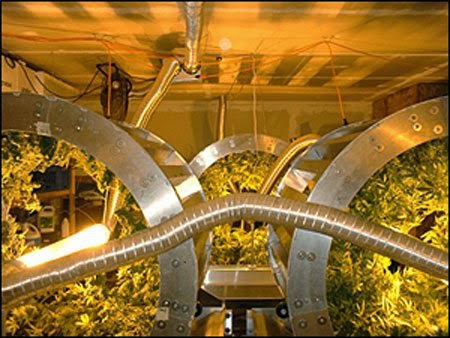
A Tacoma, WA man got 15 years (!) in prison for designing and operating eight of these ‘Ferris Wheel’ growers that rotated over 1,500 plants under grow lights while periodically spraying them with a nutrient solution.
Heaven forbid cost-effective treatment for a wide variety of illnesses could be manufactured in the home, naturally, organically and safely. No, no, Big Pharma and the biotech industry would lose profits, and predatory capitalism as featured in the West doesn’t allow anyone to be independent of it. These are the real criminals in all of this, along with their crony regulators.
We would expect nothing less from Health Canada who fired its food safety scientists for exposing the dangers of genetically modified bovine growth hormone.
Rady Ananda is the creator of Food Freedom News and COTO Report, Rady Ananda’s work has appeared in several online and print publications, including four books. With a B.S. in Natural Resources from Ohio State University’s School of Agriculture, Rady tweets @geobear7 and @RadysRant .
Recent articles by Rady Ananda:
Martial Law and the Economy: Is Homeland Security Preparing for the Next Wall Street Collapse?
 by Ellen Brown
Global Research
October 7, 2013
[Potent News editor’s note: Here is a video of Charlie McGrath talking about this article.]
Reports are that the Department of Homeland Security (DHS) is engaged in a massive, covert military buildup. An article in the Associated Press in February confirmed an open purchase order by DHS for 1.6 billion rounds of ammunition. According to an op-ed in Forbes, that’s enough to sustain an Iraq-sized war for over twenty years. DHS has also acquired heavily armored tanks, which have been seen roaming the streets. Evidently somebody in government is expecting some serious civil unrest. The question is, why?
Recently revealed statements by former UK Prime Minister Gordon Brown at the height of the banking crisis in October 2008 could give some insights into that question. An article on BBC News on September 21, 2013, drew from an explosive autobiography called Power Trip by Brown’s spin doctor Damian McBride, who said the prime minister was worried that law and order could collapse during the financial crisis. McBride quoted Brown as saying:
If the banks are shutting their doors, and the cash points aren’t working, and people go to Tesco [a grocery chain] and their cards aren’t being accepted, the whole thing will just explode.
If you can’t buy food or petrol or medicine for your kids, people will just start breaking the windows and helping themselves.
And as soon as people see that on TV, that’s the end, because everyone will think that’s OK now, that’s just what we all have to do. It’ll be anarchy. That’s what could happen tomorrow.
How to deal with that threat? Brown said, “We’d have to think: do we have curfews, do we put the Army on the streets, how do we get order back?”
McBride wrote in his book Power Trip, “It was extraordinary to see Gordon so totally gripped by the danger of what he was about to do, but equally convinced that decisive action had to be taken immediately.” He compared the threat to the Cuban Missile Crisis.
Fear of this threat was echoed in September 2008 by US Treasury Secretary Hank Paulson, who reportedly warned that the US government might have to resort to martial law if Wall Street were not bailed out from the credit collapse.
In both countries, martial law was avoided when their legislatures succumbed to pressure and bailed out the banks. But many pundits are saying that another collapse is imminent; and this time, governments may not be so willing to step up to the plate.
The Next Time WILL Be Different
What triggered the 2008 crisis was a run, not in the conventional banking system, but in the “shadow” banking system, a collection of non-bank financial intermediaries that provide services similar to traditional commercial banks but are unregulated. They include hedge funds, money market funds, credit investment funds, exchange-traded funds, private equity funds, securities broker dealers, securitization and finance companies. Investment banks and commercial banks may also conduct much of their business in the shadows of this unregulated system.
The shadow financial casino has only grown larger since 2008; and in the next Lehman-style collapse, government bailouts may not be available. According to President Obama in his remarks on the Dodd-Frank Act on July 15, 2010, “Because of this reform, . . . there will be no more taxpayer funded bailouts – period.”
Governments in Europe are also shying away from further bailouts. The Financial Stability Board (FSB) in Switzerland has therefore required the systemically risky banks to devise “living wills” setting forth what they will do in the event of insolvency. The template established by the FSB requires them to “bail in” their creditors; and depositors, it turns out, are the largest class of bank creditor. (For fuller discussion, see my earlier article here.)
When depositors cannot access their bank accounts to get money for food for the kids, they could well start breaking store windows and helping themselves. Worse, they might plot to overthrow the financier-controlled government. Witness Greece, where increasing disillusionment with the ability of the government to rescue the citizens from the worst depression since 1929 has precipitated riots and threats of violent overthrow.
Fear of that result could explain the massive, government-authorized spying on American citizens, the domestic use of drones, and the elimination of due process and of “posse comitatus” (the federal law prohibiting the military from enforcing “law and order” on non-federal property). Constitutional protections are being thrown out the window in favor of protecting the elite class in power.
The Looming Debt Ceiling Crisis
The next crisis on the agenda appears to be the October 17th deadline for agreeing on a federal budget or risking default on the government’s loans. It may only be a coincidence, but two large-scale drills are scheduled to take place the same day, the “Great ShakeOut Earthquake Drill” and the “Quantum Dawn 2 Cyber Attack Bank Drill.” According to a Bloomberg news clip on the bank drill, the attacks being prepared for are from hackers, state-sponsored espionage, and organized crime (financial fraud). One interviewee stated, “You might experience that your online banking is down . . . . You might experience that you can’t log in.” It sounds like a dress rehearsal for the Great American Bail-in.
Ominous as all this is, it has a bright side. Bail-ins and martial law can be seen as the last desperate thrashings of a dinosaur. The exploitative financial scheme responsible for turning millions out of their jobs and their homes has reached the end of the line. Crisis in the current scheme means opportunity for those more sustainable solutions waiting in the wings.
Other countries faced with a collapse in their debt-based borrowed currencies have survived and thrived by issuing their own. When the dollar-pegged currency collapsed in Argentina in 2001, the national government returned to issuing its own pesos; municipal governments paid with “debt-canceling bonds” that circulated as currency; and neighborhoods traded with community currencies. After the German currency collapsed in the 1920s, the government turned the economy around in the 1930s by issuing “MEFO” bills that circulated as currency. When England ran out of gold in 1914, the government issued “Bradbury pounds” similar to the Greenbacks issued by Abraham Lincoln during the US Civil War.
Today our government could avoid the debt ceiling crisis by doing something similar: it could simply mint some trillion dollar coins and deposit them in an account. That alternative could be pursued by the Administration immediately, without going to Congress or changing the law, as discussed in my earlier article here. It need not be inflationary, since Congress could still spend only what it passed in its budget. And if Congress did expand its budget for infrastructure and job creation, that would actually be good for the economy, since hoarding cash and paying down loans have significantly shrunk the circulating money supply.
Peer-to-peer Trading and Public Banks
At the local level, we need to set up an alternative system that provides safety for depositors, funds small and medium-sized businesses, and serves the needs of the community.
Much progress has already been made on that front in the peer-to-peer economy. In a September 27th article titled “Peer-to-Peer Economy Thrives as Activists Vacate the System,” Eric Blair reports that the Occupy Movement is engaged in a peaceful revolution in which people are abandoning the established system in favor of a “sharing economy.” Trading occurs between individuals, without taxes, regulations or licenses, and in some cases without government-issued currency.
Peer-to-peer trading happens largely on the Internet, where customer reviews rather than regulation keep sellers honest. It started with eBay and Craigslist and has grown exponentially since. Bitcoin is a private currency outside the prying eyes of regulators. Software is being devised that circumvents NSA spying. Bank loans are being shunned in favor of crowdfunding. Local food co-ops are also a form of opting out of the corporate-government system.
Peer-to-peer trading works for local exchange, but we also need a way to protect our dollars, both public and private. We need dollars to pay at least some of our bills, and businesses need them to acquire raw materials. We also need a way to protect our public revenues, which are currently deposited and invested in Wall Street banks that have heavy derivatives exposure.
To meet those needs, we can set up publicly-owned banks on the model of the Bank of North Dakota, currently our only state-owned depository bank. The BND is mandated by law to receive all the state’s deposits and to serve the public interest. Ideally, every state would have one of these “mini-Feds.” Counties and cities could have them as well. For more information, see http://PublicBankingInstitute.org.
Preparations for martial law have been reported for decades, and it hasn’t happened yet. Hopefully, we can sidestep that danger by moving into a saner, more sustainable system that makes military action against American citizens unnecessary.
Ellen Brown is an attorney, president of the Public Banking Institute, and author of twelve books, including the best-selling Web of Debt. In The Public Bank Solution, her latest book, she explores successful public banking models historically and globally. Her 200-plus blog articles are at EllenBrown.com.
Related content:
-
The Real Economy Versus the Make-Believe World of Wall Street and the Fed
In the real economy, unemployment is at Depression-era levels (see this, this and this). In the real economy, bank loan loss rates will be higher than the Depression. In the real economy, government revenue is at its lowest level since…
-

Collapse in the Wake of the Fed’s Wall Street Bubble?
“History records that the money changers have used every form of abuse, intrigue, deceit, and violent means possible to maintain their control over governments by controlling money and it’s issuance.”James Madison The Fed’s Wall Street bubble, as we forecast…
-

Timeline of Financial Collapse on Wall Street
We live in the United States of Amnesia and selective memory. As we debate the breaking news, we easily forget the sequence of events that broke the bank and left us broke. Three years ago, when the idea of an…
-

Lessons from the Collapse of Wall Street
The ongoing collapse of the stock market and the loss of hundreds of billions of dollars managed by Wall Street investment banks illustrate the pitfalls and danger of free market capitalism facing the entire working population of the United States.…
Disclaimer: The contents of this article are of sole responsibility of the author(s). The Centre for Research on Globalization will not be responsible for any inaccurate or incorrect statement in this article. The Center of Research on Globalization grants permission to cross-post original Global Research articles on community internet sites as long as the text & title are not modified. The source and the author’s copyright must be displayed. For publication of Global Research articles in print or other forms including commercial internet sites, contact: publications@globalresearch.ca
www.globalresearch.ca contains copyrighted material the use of which has not always been specifically authorized by the copyright owner. We are making such material available to our readers under the provisions of “fair use” in an effort to advance a better understanding of political, economic and social issues. The material on this site is distributed without profit to those who have expressed a prior interest in receiving it for research and educational purposes. If you wish to use copyrighted material for purposes other than “fair use” you must request permission from the copyright owner.
For media inquiries: publications@globalresearch.ca
Reports are that the Department of Homeland Security (DHS) is engaged in a massive, covert military buildup. An article in the Associated Press in February confirmed an open purchase order by DHS for 1.6 billion rounds of ammunition. According to an op-ed in Forbes, that’s enough to sustain an Iraq-sized war for over twenty years. DHS has also acquired heavily armored tanks, which have been seen roaming the streets. Evidently somebody in government is expecting some serious civil unrest. The question is, why?
Recently revealed statements by former UK Prime Minister Gordon Brown at the height of the banking crisis in October 2008 could give some insights into that question. An article on BBC News on September 21, 2013, drew from an explosive autobiography called Power Trip by Brown’s spin doctor Damian McBride, who said the prime minister was worried that law and order could collapse during the financial crisis. McBride quoted Brown as saying:
If the banks are shutting their doors, and the cash points aren’t working, and people go to Tesco [a grocery chain] and their cards aren’t being accepted, the whole thing will just explode.
If you can’t buy food or petrol or medicine for your kids, people will just start breaking the windows and helping themselves.
And as soon as people see that on TV, that’s the end, because everyone will think that’s OK now, that’s just what we all have to do. It’ll be anarchy. That’s what could happen tomorrow.
How to deal with that threat? Brown said, “We’d have to think: do we have curfews, do we put the Army on the streets, how do we get order back?”
McBride wrote in his book Power Trip, “It was extraordinary to see Gordon so totally gripped by the danger of what he was about to do, but equally convinced that decisive action had to be taken immediately.” He compared the threat to the Cuban Missile Crisis.
Fear of this threat was echoed in September 2008 by US Treasury Secretary Hank Paulson, who reportedly warned that the US government might have to resort to martial law if Wall Street were not bailed out from the credit collapse.
In both countries, martial law was avoided when their legislatures succumbed to pressure and bailed out the banks. But many pundits are saying that another collapse is imminent; and this time, governments may not be so willing to step up to the plate.
The Next Time WILL Be Different
What triggered the 2008 crisis was a run, not in the conventional banking system, but in the “shadow” banking system, a collection of non-bank financial intermediaries that provide services similar to traditional commercial banks but are unregulated. They include hedge funds, money market funds, credit investment funds, exchange-traded funds, private equity funds, securities broker dealers, securitization and finance companies. Investment banks and commercial banks may also conduct much of their business in the shadows of this unregulated system.
The shadow financial casino has only grown larger since 2008; and in the next Lehman-style collapse, government bailouts may not be available. According to President Obama in his remarks on the Dodd-Frank Act on July 15, 2010, “Because of this reform, . . . there will be no more taxpayer funded bailouts – period.”
Governments in Europe are also shying away from further bailouts. The Financial Stability Board (FSB) in Switzerland has therefore required the systemically risky banks to devise “living wills” setting forth what they will do in the event of insolvency. The template established by the FSB requires them to “bail in” their creditors; and depositors, it turns out, are the largest class of bank creditor. (For fuller discussion, see my earlier article here.)
When depositors cannot access their bank accounts to get money for food for the kids, they could well start breaking store windows and helping themselves. Worse, they might plot to overthrow the financier-controlled government. Witness Greece, where increasing disillusionment with the ability of the government to rescue the citizens from the worst depression since 1929 has precipitated riots and threats of violent overthrow.
Fear of that result could explain the massive, government-authorized spying on American citizens, the domestic use of drones, and the elimination of due process and of “posse comitatus” (the federal law prohibiting the military from enforcing “law and order” on non-federal property). Constitutional protections are being thrown out the window in favor of protecting the elite class in power.
The Looming Debt Ceiling Crisis
The next crisis on the agenda appears to be the October 17th deadline for agreeing on a federal budget or risking default on the government’s loans. It may only be a coincidence, but two large-scale drills are scheduled to take place the same day, the “Great ShakeOut Earthquake Drill” and the “Quantum Dawn 2 Cyber Attack Bank Drill.” According to a Bloomberg news clip on the bank drill, the attacks being prepared for are from hackers, state-sponsored espionage, and organized crime (financial fraud). One interviewee stated, “You might experience that your online banking is down . . . . You might experience that you can’t log in.” It sounds like a dress rehearsal for the Great American Bail-in.
Ominous as all this is, it has a bright side. Bail-ins and martial law can be seen as the last desperate thrashings of a dinosaur. The exploitative financial scheme responsible for turning millions out of their jobs and their homes has reached the end of the line. Crisis in the current scheme means opportunity for those more sustainable solutions waiting in the wings.
Other countries faced with a collapse in their debt-based borrowed currencies have survived and thrived by issuing their own. When the dollar-pegged currency collapsed in Argentina in 2001, the national government returned to issuing its own pesos; municipal governments paid with “debt-canceling bonds” that circulated as currency; and neighborhoods traded with community currencies. After the German currency collapsed in the 1920s, the government turned the economy around in the 1930s by issuing “MEFO” bills that circulated as currency. When England ran out of gold in 1914, the government issued “Bradbury pounds” similar to the Greenbacks issued by Abraham Lincoln during the US Civil War.
Today our government could avoid the debt ceiling crisis by doing something similar: it could simply mint some trillion dollar coins and deposit them in an account. That alternative could be pursued by the Administration immediately, without going to Congress or changing the law, as discussed in my earlier article here. It need not be inflationary, since Congress could still spend only what it passed in its budget. And if Congress did expand its budget for infrastructure and job creation, that would actually be good for the economy, since hoarding cash and paying down loans have significantly shrunk the circulating money supply.
Peer-to-peer Trading and Public Banks
At the local level, we need to set up an alternative system that provides safety for depositors, funds small and medium-sized businesses, and serves the needs of the community.
Much progress has already been made on that front in the peer-to-peer economy. In a September 27th article titled “Peer-to-Peer Economy Thrives as Activists Vacate the System,” Eric Blair reports that the Occupy Movement is engaged in a peaceful revolution in which people are abandoning the established system in favor of a “sharing economy.” Trading occurs between individuals, without taxes, regulations or licenses, and in some cases without government-issued currency.
Peer-to-peer trading happens largely on the Internet, where customer reviews rather than regulation keep sellers honest. It started with eBay and Craigslist and has grown exponentially since. Bitcoin is a private currency outside the prying eyes of regulators. Software is being devised that circumvents NSA spying. Bank loans are being shunned in favor of crowdfunding. Local food co-ops are also a form of opting out of the corporate-government system.
Peer-to-peer trading works for local exchange, but we also need a way to protect our dollars, both public and private. We need dollars to pay at least some of our bills, and businesses need them to acquire raw materials. We also need a way to protect our public revenues, which are currently deposited and invested in Wall Street banks that have heavy derivatives exposure.
To meet those needs, we can set up publicly-owned banks on the model of the Bank of North Dakota, currently our only state-owned depository bank. The BND is mandated by law to receive all the state’s deposits and to serve the public interest. Ideally, every state would have one of these “mini-Feds.” Counties and cities could have them as well. For more information, see http://PublicBankingInstitute.org.
Preparations for martial law have been reported for decades, and it hasn’t happened yet. Hopefully, we can sidestep that danger by moving into a saner, more sustainable system that makes military action against American citizens unnecessary.
Ellen Brown is an attorney, president of the Public Banking Institute, and author of twelve books, including the best-selling Web of Debt. In The Public Bank Solution, her latest book, she explores successful public banking models historically and globally. Her 200-plus blog articles are at EllenBrown.com.
Reports are that the Department of Homeland Security (DHS) is engaged in a massive, covert military buildup. An article in the Associated Press in February confirmed an open purchase order by DHS for 1.6 billion rounds of ammunition. According to an op-ed in Forbes, that’s enough to sustain an Iraq-sized war for over twenty years. DHS has also acquired heavily armored tanks, which have been seen roaming the streets. Evidently somebody in government is expecting some serious civil unrest. The question is, why?
Recently revealed statements by former UK Prime Minister Gordon Brown at the height of the banking crisis in October 2008 could give some insights into that question. An article on BBC News on September 21, 2013, drew from an explosive autobiography called Power Trip by Brown’s spin doctor Damian McBride, who said the prime minister was worried that law and order could collapse during the financial crisis. McBride quoted Brown as saying:
If the banks are shutting their doors, and the cash points aren’t working, and people go to Tesco [a grocery chain] and their cards aren’t being accepted, the whole thing will just explode.
If you can’t buy food or petrol or medicine for your kids, people will just start breaking the windows and helping themselves.
And as soon as people see that on TV, that’s the end, because everyone will think that’s OK now, that’s just what we all have to do. It’ll be anarchy. That’s what could happen tomorrow.
How to deal with that threat? Brown said, “We’d have to think: do we have curfews, do we put the Army on the streets, how do we get order back?”
McBride wrote in his book Power Trip, “It was extraordinary to see Gordon so totally gripped by the danger of what he was about to do, but equally convinced that decisive action had to be taken immediately.” He compared the threat to the Cuban Missile Crisis.
Fear of this threat was echoed in September 2008 by US Treasury Secretary Hank Paulson, who reportedly warned that the US government might have to resort to martial law if Wall Street were not bailed out from the credit collapse.
In both countries, martial law was avoided when their legislatures succumbed to pressure and bailed out the banks. But many pundits are saying that another collapse is imminent; and this time, governments may not be so willing to step up to the plate.
The Next Time WILL Be Different
What triggered the 2008 crisis was a run, not in the conventional banking system, but in the “shadow” banking system, a collection of non-bank financial intermediaries that provide services similar to traditional commercial banks but are unregulated. They include hedge funds, money market funds, credit investment funds, exchange-traded funds, private equity funds, securities broker dealers, securitization and finance companies. Investment banks and commercial banks may also conduct much of their business in the shadows of this unregulated system.
The shadow financial casino has only grown larger since 2008; and in the next Lehman-style collapse, government bailouts may not be available. According to President Obama in his remarks on the Dodd-Frank Act on July 15, 2010, “Because of this reform, . . . there will be no more taxpayer funded bailouts – period.”
Governments in Europe are also shying away from further bailouts. The Financial Stability Board (FSB) in Switzerland has therefore required the systemically risky banks to devise “living wills” setting forth what they will do in the event of insolvency. The template established by the FSB requires them to “bail in” their creditors; and depositors, it turns out, are the largest class of bank creditor. (For fuller discussion, see my earlier article here.)
When depositors cannot access their bank accounts to get money for food for the kids, they could well start breaking store windows and helping themselves. Worse, they might plot to overthrow the financier-controlled government. Witness Greece, where increasing disillusionment with the ability of the government to rescue the citizens from the worst depression since 1929 has precipitated riots and threats of violent overthrow.
Fear of that result could explain the massive, government-authorized spying on American citizens, the domestic use of drones, and the elimination of due process and of “posse comitatus” (the federal law prohibiting the military from enforcing “law and order” on non-federal property). Constitutional protections are being thrown out the window in favor of protecting the elite class in power.
The Looming Debt Ceiling Crisis
The next crisis on the agenda appears to be the October 17th deadline for agreeing on a federal budget or risking default on the government’s loans. It may only be a coincidence, but two large-scale drills are scheduled to take place the same day, the “Great ShakeOut Earthquake Drill” and the “Quantum Dawn 2 Cyber Attack Bank Drill.” According to a Bloomberg news clip on the bank drill, the attacks being prepared for are from hackers, state-sponsored espionage, and organized crime (financial fraud). One interviewee stated, “You might experience that your online banking is down . . . . You might experience that you can’t log in.” It sounds like a dress rehearsal for the Great American Bail-in.
Ominous as all this is, it has a bright side. Bail-ins and martial law can be seen as the last desperate thrashings of a dinosaur. The exploitative financial scheme responsible for turning millions out of their jobs and their homes has reached the end of the line. Crisis in the current scheme means opportunity for those more sustainable solutions waiting in the wings.
Other countries faced with a collapse in their debt-based borrowed currencies have survived and thrived by issuing their own. When the dollar-pegged currency collapsed in Argentina in 2001, the national government returned to issuing its own pesos; municipal governments paid with “debt-canceling bonds” that circulated as currency; and neighborhoods traded with community currencies. After the German currency collapsed in the 1920s, the government turned the economy around in the 1930s by issuing “MEFO” bills that circulated as currency. When England ran out of gold in 1914, the government issued “Bradbury pounds” similar to the Greenbacks issued by Abraham Lincoln during the US Civil War.
Today our government could avoid the debt ceiling crisis by doing something similar: it could simply mint some trillion dollar coins and deposit them in an account. That alternative could be pursued by the Administration immediately, without going to Congress or changing the law, as discussed in my earlier article here. It need not be inflationary, since Congress could still spend only what it passed in its budget. And if Congress did expand its budget for infrastructure and job creation, that would actually be good for the economy, since hoarding cash and paying down loans have significantly shrunk the circulating money supply.
Peer-to-peer Trading and Public Banks
At the local level, we need to set up an alternative system that provides safety for depositors, funds small and medium-sized businesses, and serves the needs of the community.
Much progress has already been made on that front in the peer-to-peer economy. In a September 27th article titled “Peer-to-Peer Economy Thrives as Activists Vacate the System,” Eric Blair reports that the Occupy Movement is engaged in a peaceful revolution in which people are abandoning the established system in favor of a “sharing economy.” Trading occurs between individuals, without taxes, regulations or licenses, and in some cases without government-issued currency.
Peer-to-peer trading happens largely on the Internet, where customer reviews rather than regulation keep sellers honest. It started with eBay and Craigslist and has grown exponentially since. Bitcoin is a private currency outside the prying eyes of regulators. Software is being devised that circumvents NSA spying. Bank loans are being shunned in favor of crowdfunding. Local food co-ops are also a form of opting out of the corporate-government system.
Peer-to-peer trading works for local exchange, but we also need a way to protect our dollars, both public and private. We need dollars to pay at least some of our bills, and businesses need them to acquire raw materials. We also need a way to protect our public revenues, which are currently deposited and invested in Wall Street banks that have heavy derivatives exposure.
To meet those needs, we can set up publicly-owned banks on the model of the Bank of North Dakota, currently our only state-owned depository bank. The BND is mandated by law to receive all the state’s deposits and to serve the public interest. Ideally, every state would have one of these “mini-Feds.” Counties and cities could have them as well. For more information, see http://PublicBankingInstitute.org.
Preparations for martial law have been reported for decades, and it hasn’t happened yet. Hopefully, we can sidestep that danger by moving into a saner, more sustainable system that makes military action against American citizens unnecessary.
Ellen Brown is an attorney, president of the Public Banking Institute, and author of twelve books, including the best-selling Web of Debt. In The Public Bank Solution, her latest book, she explores successful public banking models historically and globally. Her 200-plus blog articles are at EllenBrown.com.
VIDEO — Introduction to Bizarro Economics – The Geneva Business Insider
Geneva Business Insider
October 2, 2013
David L. Smith of the Geneva Business Insider blog joins for our monthly conversation on world events. This month we discuss Smith’s article on JP Morgan’s manipulations and dissect the bizarro economics of our quantitative easing era. We also touch on the unfolding Euro crisis.
VIDEO — Total Despair: Teachers strike for over 40 days, hit with tear gas in Brazil
RT
October 1, 2013
Clashes broke out in Rio de Janeiro’s busy downtown business district on Tuesday as police skirmished with striking schoolteachers. Teachers pressing for better pay had gathered in front of City Hall, where a vote on Mayor Eduardo Paes’ salary proposal was expected. The strikers oppose the proposal, which they say doesn’t go far enough to addressing their demands. Chaos broke out in late afternoon when police officers set off deafening percussion grenades and fired rubber bullets in this densely frequented commercial district. Negotiations between the city and the teachers’ unions have been acrimonious, and Tuesday was the strike’s 46th day.
RT LIVE http://rt.com/on-air
Subscribe to RT! http://www.youtube.com/subscription_c…
Like us on Facebook http://www.facebook.com/RTnews
Follow us on Twitter http://twitter.com/RT_com
Follow us on Instagram http://instagram.com/rt
Follow us on Google+ http://plus.google.com/+RT
RT (Russia Today) is a global news network broadcasting from Moscow and Washington studios. RT is the first news channel to break the 1 billion YouTube views benchmark.
MUST READ — Was it a Psyop? Nairobi Mall Deceit Abets Israeli-Western Pipeline Wars to Oust Asian Rivals
by Yoichi Shimatsu
Global Research
October 1, 2013
 The gratuitous violence and spectacular overkill by a mysterious gang of supposed “terrorists” does nothing to further the aims of either Somali nationalism or sharia law, as espoused by the original Al-Shabaab movement, which seeks the withdrawal of Kenya forces from Somalia .
As the events at the Westgate shopping mall in Nairobi unfolded, it became clear that the bloody spectacle was staged by a shadowy entity, which the Kenya foreign minister described as “Al Qaeda”. Her statement was based on the presence of other foreign assailants, including passport holders of the U.S. and Britain , under the command of a Western woman believed to be the so-called “White Widow”.
The obvious outcome of this bloody spectacle is not Kenyan military withdrawal from Somalia as desired by Al Shabaab rebels, but quite the opposite effect of hardening support for intervention by a majority of Kenyans who were previously opposed to cross-border troop stationing. It took a televised massacre to overturn the East African public’s aversion to military cooperation with former colonial masters and the Israelis.
The net effect of the conflicting reports from the mall and suspect photos raises troubling questions: What powerful elite group has the money to organize such an elaborate ruse to sway public opinion? Who can control a secret network inside the Kenyan military and the mass media? What is their motive? How do they benefit?
Primal Motives
From the onset of the police-military siege of Westgate, Israeli intelligence agencies assumed a key advisory role to the Kenyan police and directed the public-information releases, according to news reporters on the scene. As in many sensitive police-intelligence operations, information releases to the media are “strategic”, a euphemism for psychological operations.
Psy-ops are aimed at controlling the options for the criminals and shaping public attitudes about the event’s causes and outcomes.
Israeli experts were pre-positioned inside the mall, being in charge of the private security company whose plainclothesmen posed for “action shots”. The perfectly lit photos were taken during a lengthy power blackout in the nearly windowless mall. The viewer is led to believe as in Hollywood movies that a handgun is a match against automatic rifles. A large force of Mossad agents was still stationed inside Nairobi since the investigation of a mystery fire that had destroyed the capital’s Jomo Kenyatta Airport on August 8.
Nairobi , due to its logistical position and concentration of Jewish business interests, is the Israeli regional intelligence center for East Africa . Despite the 2002 terrorist attacks on an Israel plane over Kenya and hotel in Mombasa , the primary interest is not solely terrorism.
The two priorities for Israeli operations in East Africa are:
to open a second military front against Iranians, who allegedly channel aid, including weapons, to Hamas via Sudan ;
and in league with Western energy corporations to oust Asian oil companies from South Sudan by building an alternative pipeline to a proposed mega-port on Kenya’s Indian Ocean coast,
Pipeline Wars
Prior to the independence of South Sudan in July 2011, the U.S. and Europe imposed sanctions against the central government in Khartoum while financing and covertly arming separatist forces in the southern districts neighboring Kenya and the Darfur region bordering Chad. The sanctions-based exclusion of Western energy corporations provided a rare opportunity for Asian oil companies to win bids for exploration rights and production in the vast reserves of southern Sudan .
The dominant foreign petroleum operators are China National Petroleum Corporation (CNPC), Sinopec, Petronas of Malaysia, and India ’s Oil and Natural Gas Corporation (ONGC). The state companies of Egypt and Yemen also hold stakes in Sudanese oil. The exploration and extraction operations are usually run as consortiums – such as Dar, Greater Nile and Sudd – that include several players in partnership with Sudapet ( Sudan state oil) and, since independence Nilepet ( South Sudan ). The crude oil flows through the Greater Nile Oil Pipeline, constructed by CNPC started in the late 1980s and since expanded over a distance of 1,300 kilometers to Port Sudan on the Red Sea .
The creation of the Republic of South Sudan , with its capital Juba , was the game-changer. The Heglig and Bamboo oil fields are well inside its boundaries and the borderline Abyei reserve remains contested and is likely to be divided between the uneasy neighbors. South Sudan now controls 80 percent of Sudanese oil reserves, estimated by BP at 6.6 billion barrels. Another noteworthy point underlying Western support of the breakaway insurgencies is that the petroleum belt stretches along a northwesterly axis into the heart of the Darfur region.
Israel Makes Its Move
The Foreign Ministry in Juba posted this January 18, 2013, report on its New Delhi embassy website, titled “South Sudan signs oil deal with Israel ”:
“ South Sudan says it has signed an agreement with several Israeli oil companies, a potentially significant strategic move that will consolidate the Jewish state’s relations with the fledgling, oil-rich East African state. South Sudan’s petroleum and mining minister, Dhieu Dau, announced the oil deal last week after he returned from a visit to Israel.
It will also bolster Israeli moves to counter Iranian inroads into the Red Sea and a major gunrunning route from the Revolutionary Guards base at Bandar Abbas in the Persian Gulf to the Gaza Strip via Sudan . Sudan has become a battleground in the mostly clandestine war between Israel and the Islamic Republic, which funnels missiles and other arms for Palestinian militants in the Gaza Strip through the Red Sea.
South Sudan, which became independent of Arab-ruled Sudan in July 2011 after a decades-long civil war, is locked in a frequently violent confrontation over its oil reserves with the military-run Khartoum regime, an ally of Iran , under President Omar al-Bashir.”
The bilateral deal can be summarized as: Israel will form a military alliance with South Sudan against Khartoum and Tehran , to be repaid with Sudanese oil exports to be controlled by Israeli energy companies.
Infrastructure Intrigues
Although unnamed so far, the Israeli oil companies with key technologies include pipeline operator Zion Oil and exploration company Shemen Oil, which conducts drilling in the former Rothschild-owned fields on Azerbaijan ’s Caspian Sea coast. Israeli companies, by themselves, lack the scale of financial and technical resources necessary for a proposed $3 billion mega-project that will include a 1,000-kilometer pipeline and railways from Juba to Lamu on the Kenya coast, along with docks for supertankers and a massive portside refinery.
The ambitious Juba-Lamu project was launched by former Kenyan President Mawai Kibaki, whose administration was beset by corruption allegations. Environmental groups have raised objections to a petroleum port and refinery near the UNESCO heritage site of Lamu Island , brushed off by officials as a small matter when billions of dollars are at stake. The Westgate Mall attack has surely convinced Kibaki’s successor, President Uhuru Kenyatta, to drop any objections and go with the flow.
A top figure in East African infrastructure construction is Joseph Schwartzman, owner of the H. Young engineering company and business leader of Nairobi ’s Israeli community.
Schwartzman, closely allied with business interests in South Africa and Israel , is an outspoken opponent of the Chinese role in African infrastructure projects. His neoconservative old-school instincts were expressed in a 2009 remark, reported in The Nation ( Nairobi ):
“Chinese companies’ presence in Kenya is not beneficial to the country. Their presence has only one purpose: transfer of hard currency back to China .”
In an unintended way, he is correct. In contrast with more beloved homelands, Beijing has zero to gain from charitable projects like waging proxy wars and staging false-flag massacres inside shopping centers.
U.S. Leads From Behind
Israel ’s African oil dreams gain muscle from the participation of heavyweights like the Vitol energy trading company, which has signed aboard for the Juba-Lamu pipeline. Despite the arms-length appearance of this Europe-based trading house, it is an asset for the American corporate-and-state power structure. The Israeli-U.S. alliance is so widely distrusted worldwide, based on a proven record of misdeeds and skullduggery, their agents have to operate under the cover of sock-puppet companies.
Vitol, the world’s largest independent oil trader, is a Geneva-headquartered holding company that owns a string of oil terminals, including Rotterdam , the world center for spot-market trading. Founded in 1966 by two Dutchmen, the firm is now run by an English CEO named Ian Roper Taylor and American-born corporate president Miguel “Mike” Loya. Oxford graduate Taylor worked for Shell Oil, a firm linked with the Rothschild group, prior to joining Vitol, while Harvard MBA Loya was an executive at ExxonMobil.
Earning notoriety as the oil trader for rogue states, Vitol took a lead role in the Iraq oil-for-food deal and defied U.N. sanctions against Serbian energy imports. More recently during the Libya insurrection against the Gadhafi regime, Vitol transported the first shipment of light crude out of insurgent-controlled Tobruk, aboard a tanker that somehow managed to pass through a NATO blockade. It also delivered $1 billion in gasoline and diesel for the rebel convoys during the assault on Tripoli . None of this derring-do is remotely possible unless the company acted on orders from the CIA.
Taylor personally became embroiled in a lawsuit against a collective of Scottish artists, who accused him of being the main Tory financier of advertising campaigns and lobbyists opposed to Scotland independence. Britain ’s North Sea oilfields are located in the territorial waters of Scotland . When and if independence is achieved, Shell and BP, now protected by the Crown Estate, would be forced to pay a fair price to the government of free Scotland , which would be a full EU member. For an apolitical rogue trading company, Vitol takes on many high-risk positions on behalf of the Anglo-American elite, thus acting more like a privateer than a pirate.
A Different Nigerian Fraud
Vitol’s position in Africa, anchored at a refinery in Mombasa , is strengthened by a partnership with Helios Investment Partners in the joint acquisition of Shell-BP retail fuel stations across the African continent. Although only a minor consumer of the crude output from South Sudan , local filling stations are important for influencing the logistics and transportation sector, which is influential in infrastructure policy.
Ostensibly a long-awaited pan-African investment fund, Helios is just another Oreo cookie from the old bag of neocolonialist tricks. The two principals holding together this confection are Nigerians, while the sweet filling comes from Dallas , Texas . Tope Lawani and Babatunda Soyoye are both former employees of the London branch of Texas Pacific Group (tpg), headquartered in Dallas and San Francisco.
Tope and Baba were trained in takeovers and buyouts by TPG boss David Bonderman, a Los Angeles-born business attorney who studied Arabic language in Cairo . A corporate raider who targets troubled companies, Bonderman finances his hostile takeovers with help from the likes of Goldman Sachs, Carlyle and Blackstone. His acquisitions of Asian firms are done through the subsidiary Newbridge Capital. Bonderman also serves on the board of the American Himalayan Foundation, a project of Richard Blum, the husband of Senate foreign-intelligence queen Dianne Feinstein.
The Helios takeovers of African telecom firms and cell-phone networks are funded by prominent investors including Lord Jacob Rothschild, Madeleine Albright, the World Bank’s IFC division and the U.S. government’s Overseas Private Investment Corporation. Globalist financial power, aligned with Zionism, is being focused on a still-fledgling African economy, with all eyes now staring at the South Sudan-Kenya pipeline.
Whatever the PR hype about New Africa’s potential, the underlying motivation of the U.S. foreign-policy establishment and Israeli elite is to deny African resources to the rising Asian industrial centers. Sudan offered China its first major oil exploration contract, and since then India ’s state petroleum firm has teamed up with Chinese companies there. As a Muslim-predominant oil-producing country at the center of Asia, Malaysia with its technology-adept Petronas oil firm is a target of Israeli and American political subversion and even a proxy invasion.
The surest method of curtailing Asian industrial and military strength is through the “Asian premium”, an added fee for every barrel of oil that passes through the Strait of Malacca . The steady stream of tankers is watched over by the Israel-U.S. agents posted in Singapore . An Israeli nuclear ally, Japanese Prime Minister Shinzo Abe has quietly pushed Toyota Tsusho, the giant carmaker’s holding company, to enter talks with South Sudan on the Juba-Lamu pipeline deal. (The term nuclear ally refers to the presence of Israeli technicians and security staff from Dimona at the Fukushima No.1 plant at the time of the March 2011 meltdowns.) The Zionist-neocolonialist stranglehold on Asia’s energy jugular must be broken, and place to do it is Kenya.
Children of Ham
Beyond the twin objectives of countering Iran and controlling African petroleum output, Israeli policymakers harbor a third ambition of a visionary nature: to establish a Hamitic-controlled region stretching from the Horn at Somalia across Ethiopia and agriculture-rich Uganda and into the mineral resources of Central Africa.
No nation on Earth is today more race-conscious than Israel , which seeks to establish an alliance of so-called Lost Tribes and descendants of Ham, the country cousins of the Semitic people. Whenever an expansionist power conjures up ancient ancestral memories, it is a sure-fire formula for aggression and massacres. Africa , be warned.
The Old Testament myth of Noah’s sons – Seth, founder of the Semites; Ham, of related peoples in Africa; and Japhet in Asia – is being used as a mirror image of the Aryan beliefs of another modern racial-obsessed cult. DNA studies of questionable authenticity are being used by Israeli geneticists to justify political footholds in Judeo-Christian Ethiopia and to churn out propaganda support for the “superior” herding Tutsi versus the “inferior” peasant Hutu in Rwanda and Eastern Africa. By stressing a common heritage, intelligence agents assigned to Jewish-funded charities for Somali, Iraqi and Afghan refugees in, say, Minnesota , London or Marseilles can selectively recruit naïve young Muslim immigrants for penetrating Islamist movements.
Just months before the Kenyan mall attack, according to a Guardian report by Simon Tisdall, a hardline faction led by Ahmed Abdi Godane assassinated the founders of Al Shabaab known by the noms de guerre Al-Afghani and Burhan. By design and certainly not accident, all Israelis inside the Westgate Mall were allowed to leave unharmed – while even Kenyans of Muslim faith were butchered. In the Syrian conflict, too, the more brutal foreign fighters are closely cooperating with the Israeli Defense Force against moderate rivals.
The Westgate Mall hostage crisis was a overblown spectacle in the vein of “Texas Chainsaw Massacre” or a Quentin Tarantino blood-fest. The so-called White Widow, so reminiscent of Patty Hearst, is a clone of the vengeful female assassins from “Kill Bill” and “Inglorious Bastards”. The initial 30 assailants are now whittled down to eight suspects, with the remainder mysteriously gone as in “Ocean’s Eleven” or “Mission Impossible”. The smokescreen caused by bombs that collapsed the parking garage, and the gallons of red liquid on the floors were Hollywood special effects, as if blood never coagulates nor change color. Every detail from the siege demands forensic reexamination for slip-ups in fakery. Westgate was not West End . Nairobi was a bad show, poorly scripted, sloppily directed and clumsily acted. A much more convincing performance should be expected from the CIA and Mossad. It would be a slapstick comedy if not for the fact that so many innocent bit actors were murdered in cold blood by the intelligence services.
A Hard Road to Peace
On the road to development and cooperation, the weak link has been the lack of a security arrangement between the African Union and Asia ’s regional groupings, including SAARC, the Shanghai Cooperation Organization and ASEAN. Western military advisory groups and intelligence agencies, which create more terrorism and conflict than they can ever suppress, must be uprooted from every inch of Africa . In their stead, competent and professional law enforcement and security forces should be financed and trained under a cross-continent program to protect the resources of Africa for the benefit of African people and to carry forth the worldwide struggle against the systemic deprivation that causes impoverishment and injustice.
Today the only viable path ahead, against the incessant wars, horrendous crimes and dirty tricks perpetrated by the Western neocolonialists and their Zionist allies, is to remain faithful to the spirit of the 1955 Bandung Conference, as reaffirmed at 2005 Bandung 2 with the drafting of the New Asian-African Strategic Partnership (NAASP). Those past promises must be transformed from mere words on paper into real deeds on the soil, seas and skies of Mother Africa.
Author: Yoichi Shimatsu, a Hong Kong-based science writer, is former editor of the Japan Times Weekly in Tokyo and earlier with the Pacific News Service in San Francisco .
Related content:
-

Nairobi Westgate Mall Attack Death Toll Continues to Rise as FBI Deploys Agents to Kenya
The death toll from last Saturday’s attack on Nairobi’s Westgate mall by members of Somalia’s Al Shabab militia has risen to at least 72, with dozens more reported missing. The attack was launched by a unit of 10 to 15…
-

Kenya: Islamist Militia Attacks Nairobi’s Westgate Mall, Killing 68
Gunmen assaulted the upscale Westgate mall in the Kenyan capital of Nairobi over the weekend, killing 68 and wounding 200 in an attack claimed by Somalia’s Al Qaeda-linked Al Shabab militia. Kenyan security forces surrounded and repeatedly attacked the gunmen,…
-

Nairobi Westgate Mall Attack: Canada’s Contribution to Violence in Africa
There are no shades of grey, no nuance or even cause and effect in the simplistic world view proclaimed by the current Canadian government. The Conservatives’ response to the horrific attack in Nairobi’s Westgate Mall has been to thump their…
-
Turkish, Israeli, Indian Officials Meet In Ankara Over Med Stream Pipeline
Turkish, Israeli and Indian officials met in Ankara this week over the Med Stream, a multi-purpose offshore pipeline project to connect Turkey and Israel via the Mediterranean Sea. Turkey and Israel have reaffirmed their full support earlier for an energy…
Disclaimer: The contents of this article are of sole responsibility of the author(s). The Centre for Research on Globalization will not be responsible for any inaccurate or incorrect statement in this article. The Center of Research on Globalization grants permission to cross-post original Global Research articles on community internet sites as long as the text & title are not modified. The source and the author’s copyright must be displayed. For publication of Global Research articles in print or other forms including commercial internet sites, contact: publications@globalresearch.ca
www.globalresearch.ca contains copyrighted material the use of which has not always been specifically authorized by the copyright owner. We are making such material available to our readers under the provisions of “fair use” in an effort to advance a better understanding of political, economic and social issues. The material on this site is distributed without profit to those who have expressed a prior interest in receiving it for research and educational purposes. If you wish to use copyrighted material for purposes other than “fair use” you must request permission from the copyright owner.
For media inquiries: publications@globalresearch.ca
VIDEO — Silk Road Shutdown, Fukushima Fast Food, Exercise Pills – New World Next Week
New World Next Week
October 3, 2013
Welcome to http://NewWorldNextWeek.com — the video series from Corbett Report and Media Monarchy that covers some of the most important developments in open source intelligence news. This week:
Story #1: FBI Seizes Silk Road, an Online Drug Market, and Makes Arrest
http://ur1.ca/ftqeo
Feds Raid Online Drug Market Silk Road
http://ur1.ca/ftqew
Agorism: Revolutionary market anarchism
http://agorism.info/
Flashback Video: How to buy drugs like DMT and CHANGA on the Silk Road – Adam Kokesh
http://youtu.be/1Moi5ogGV7M
Story #2: Popular Fast Food Chain Yoshinoya To Grow Food 60 Miles From Fukushima Plant
http://ur1.ca/ftqfv
Former Japanese PM Koizumi Calls for End to Nuclear Power
http://ur1.ca/ftqg5
Story #3: Exercise ‘Can Be As Good As Pills’
http://ur1.ca/ftqgb
Previous Episode: Alexis Psyop, School Sucks, Panera Cares
http://www.corbettreport.com/?p=8027

 PN
PN 