
VIDEO — The Overnight Brazilian Revolution – Brazilian Man
108morris108
June 20, 2013
Brazil is the powerhouse of South America, if and when Brazil falls the rest of South America is likely to follow. The spirit of the youth is strong but there is no particular ideology guiding them, just disgust with the Government.
I do not share the interviewees feelings on many issues, personally I respect Chavez’ and Fidel’s revolution
VIDEO — Brazil Boiling: brutal clashes as country gripped by protests
RT
June 20, 2013
Violent clashes have erupted in the northern city of Fortaleza in the hours leading to a Confederations Cup match with Mexico. Dozens were hurt as riot police unleashed tear gas and barrage of rubber bullets at a crowd of some 30,000 Brazilian protesters. Protests and clashes continued in other cities as well. READ MORE: http://on.rt.com/89f5mm
RT LIVE http://rt.com/on-air
Subscribe to RT! http://www.youtube.com/subscription_c…
Like us on Facebook http://www.facebook.com/RTnews
Follow us on Twitter http://twitter.com/RT_com
Follow us on Google+ http://plus.google.com/+RT
RT (Russia Today) is a global news network broadcasting from Moscow and Washington studios. RT is the first news channel to break the 1 billion YouTube views benchmark.
VIDEO — Manipulated, Drugged Up. Dumbed Down, and Spied on #n3
Wide Awake News
June 20, 2013
Important Links
http://www.wideawakenews.com/
http://www.seedsnow.com/products/mega…
http://www.rense.com/
http://www.austinrarecoins.com/
http://nextnewsnetwork.com/
“attached”
http://atlanta.cbslocal.com/2013/06/1…
VIDEO — Police Brutality Against Blocupy Frankfurt Protest Makes Headlines
The Real News
June 15, 2013
What began as a protest against the ECB, German banks and the German government turned into a protest against police brutality
See more videos at: http://therealnews.com
[hat tip: Nik Press]
VIDEO — Brazil Protests Over Crony Capitalism – Sao Paolo Resident
108morris108
June 18, 2013
Triggered From A Bus Fare Rise, People are fed up with corruption and absurd appropriations of money for unnecessary projects. Social Media and the example of the Mediterranean unrest has helped organise the protests.
Brazil sees largest protests in decades
Nik Press
June 18, 2013
Brazil sees largest protests in decades as unrest hits second week
 By RT
By RT
Mass protests continued throughout Brazil on Monday, with hundreds of thousands of demonstrators converging in Sao Paulo, Rio de Janeiro, Belo Horizonte, the capital of Brasilia and other cities.
Protests initially began last week following a government announcement of an increase in public transportation costs, which brought out students and young workers and led to more than 250 arrests.
According to reports by Brazilian media such as Jornal do Dia, the initially peaceful demonstrations last week became heated, and led to clashes with Brazil’s riot police that left at least 100 injured in the major cities of Brasilia, Sao Paulo, Rio de Janeiro and Belo Horizonte.
Though the protests initially began following the announcement of bus fare increases, they have evolved to include a wide range of groups that have grown dissatisfied over everything from government corruption and income inequality, as well as to outrage over the police’s harsh response to protesters last week.
In a sign that public dissatisfaction was still simmering, soccer fans booed president Dilma Rousseff on Monday during the opening of a two-week tournament at a stadium in the capital Brasilia. The heckling only intensified when the president of the global soccer body, FIFA, reprimanded the crowed for failing to show the president “respect.”

Though Rousseff was able to ride on her predecessor’s popularity, Brazil’s economic growth has slowed considerably since she took over from Luiz Inacio Lula da Silva, who is widely credited with lifting 40 million Brazilians out of poverty. Brazil’s economy has posted its worst two-year performance in over a decade, and inflation rose to 6.5 per cent in May.
At least 20,000 Brazilians were expected to demonstrate in Sao Paulo on Monday, with organizers placing the figure closer to 30,000.


Canada Being Assimilated Into a U.S. Dominated North American Security Perimeter
by Dana Gabriel
BE YOUR OWN LEADER
June 17, 2013
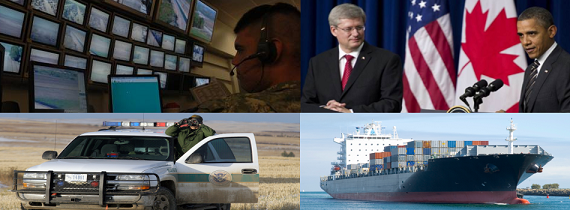
Canada’s prime minister recently addressed the CFR, a globalist think tank who have been a driving force behind the push towards deeper North American integration. The U.S. and Canada are now further advancing this agenda through the Beyond the Border agreement. Both countries are increasing bilateral border transportation and infrastructure coordination. This includes a common approach to border management, security and control. They are also integrating an information sharing system that would be used to track everyone crossing the U.S.-Canada border and entering or leaving the continent. Without much fanfare and seemingly little resistance, Canada is being assimilated into a U.S. dominated North American security perimeter.
In May, the Conservative government highlighted the benefits of the U.S.-Canada Beyond the Border action plan which was announced back in 2011. The deal, “focuses on addressing security threats at the earliest point possible and facilitating the lawful movement of people, goods, and services into Canada and the United States, and creates a long-term partnership to improve the management of our shared border.” The goal is to further increase, “security, economic competitiveness and prosperity through numerous measures, including reducing border wait times and improving infrastructure at key crossings to speed up legitimate trade and travel.” The Beyond the Border Executive Steering Committee recently met to discuss the objectives that have already been achieved and the work that still needs to be done. Another important facet of the economic and security perimeter agreement is the Regulatory Cooperation Council action plan. A stakeholder dialogue session is planned for June 20, which will review its implementation progress and will seek further input regarding the next stage of U.S.-Canada regulatory integration.
Last month, the Canada Border Services Agency (CBSA) and the Department of Homeland Security (DHS) released a joint report on the findings of Phase I of the Entry/Exit Information System. The program included collecting and exchanging biographic information at four selected land border ports of entry. In a news release, U.S. Customs and Border Protection (CBP) Acting Commissioner Thomas Winkowski stated that, “The results of Phase I demonstrate the capacity of the United States and Canada to increase information sharing capabilities.” He added, “This kind of cooperation epitomizes the Beyond the Border Action Plan.” The next phase of the entry/exit initiative is set to begin at the end of this month. It will involve exchanging the data collected from third-country nationals and permanent residents of Canada and the U. S. at all common ports of entry. Both countries are further merging databases and are expanding surveillance and intelligence gathering operations. In 2014, they will also start sharing biometric information at the border. This will further advance the creation of a North America security perimeter where all travellers will be tracked and traced in real time.
As part of the commitment made under the Beyond the Border deal, both countries have announced the Border Infrastructure Investment Plan which was, “developed to establish a mutual understanding of recent, ongoing and potential border infrastructure investments. It outlines the approach that Canada and the United States will take to coordinate plans for physical infrastructure upgrades.” In June 2012, Canada reached an agreement with the State of Michigan to build a second bridge between Detroit and Windsor, Ontario. This was followed by a presidential permit issued in April of this year that officially paved the way for construction of the project. A U.S. State Department press release explained that, “Consistent with the bilateral Beyond the Border Initiative, this permit contributes to ensuring that our border infrastructure supports increased competitiveness, job creation, and broad-based prosperity in the United States and Canada.” It went on to say that the new bridge, “will help to meet future capacity requirements in a critical travel corridor, promote cross-border trade and commerce, and advance our vital bilateral relationship with Canada.”
In March, DHS Secretary Janet Napolitano and Canada’s Minister of Public Safety Vic Toews signed a memorandum of understanding which established a truck cargo pre-inspection pilot project. The joint undertaking is another component of the Beyond the Border agreement and would shift inspections and clearances away from the actual border crossing. The first phase, “will test the concept of conducting U.S. CBP primary cargo inspection in Canada, and will be implemented at the Pacific Highway crossing between Surrey, British Columbia and Blaine, Washington.” The second phase, “will further test how pre-inspection could enhance border efficiency and reduce wait times to facilitate legitimate trade and travel, and will be implemented at the Peace Bridge crossing between Fort Erie, Ontario and Buffalo, New York.” The perimeter security deal is laying the foundation for a future U.S.-Canada binational organization that would jointly manage and control the border.
The CBSA is also testing additional technology at the Morses Line, Quebec and Piney, Manitoba ports of entry. Under the remote traveller pilot project, people entering either location after regular hours of service, “will be processed by a border services officer located at a remote processing centre through a two-way audio and one-way video kiosk. Cameras will be installed to provide the officer with the ability to see the traveller and the vehicle.” The program which could later be expanded to other areas , “is part of the Small and Remote Ports of Entry Initiative, one of the deliverables under the Beyond the Border Action Plan.” NAUNEWZ pointed out that, “Although a lot of this technology is already installed and being utilized in limited ways at most of the main Canada-U.S. border crossing points, these smaller border crossings are ideal testing grounds for their ‘no borders’/NAU agenda.”
On May 16, Canadian Prime Minister Stephen Harper participated in question and answer session before the Council on Foreign Relations (CFR). The conversation centered around economic growth, foreign investment and the role of the G20 with regards to global governance. Other issues focused on Canada-U.S. relations. Harper lobbied for approval of the controversial Keystone XL pipeline which would carry oil from western Canada to the Texas gulf coast. He dismissed environmental issues associated with the project and argued that it would be a step towards North American energy independence. The Obama administration is expected to make a final decision on the pipeline sometime this year. Harper also acknowledged the Beyond the Border and the Regulatory Cooperation Council action plans. He blamed sovereignty concerns and the continued negativity surrounding NAFTA as the main obstacles to even deeper continental integration. Prime Minister Harper used his audition in front of the CFR as an opportunity to demonstrate to the U.S. political and corporate elite that he is committed to defending the interests of big business and further pushing plans for a North American Union (NAU).
The Beyond the Border action plan is the most significant step forward in U.S.-Canada cooperation since NAFTA. It provides the framework for future North American integration. When fully implemented, the agreement can be expanded and updated. So far, the agenda has quietly slipped under the radar. By incrementally incorporating various pilot projects and excluding Mexico from the process, it has managed to avoid the controversy of past initiatives. The perimeter security deal is being sold as vital to improving the flow of trade and travel across the border. In order to appease U.S. fears, Canada has made numerous concessions with no guarantees that it will lessen border restrictions. As part of a North American security perimeter, Canada will always be at the mercy of any new U.S. security measures, regardless of the dangers they may pose to privacy and civil liberties.
Related articles by Dana Gabriel:
U.S.-Canada Harmonizing Border Security and Immigration Measures
Taking the U.S.-Canada Partnership to the Next Level
Merging U.S.-Canada Arctic Foreign Policy
The Return of ACTA: U.S. Dictating Canada’s Intellectual Property Laws
Dana Gabriel is an activist and independent researcher. He writes about trade, globalization, sovereignty, security, as well as other issues. Contact: beyourownleader@hotmail.com Visit his blog at Be Your Own Leader

 PN
PN 