
The Cashless Society is Almost Here – And With Some Very Sinister Implications [video included]
 by Patrick Henningsen
21st Century Wire
November 29, 2012
Among the long list of items bundled by consensus reality merchants under the banner of ‘conspiracy theory’, is a world without cash – where technocrats rule over the populace, and everything and anything is exchanged via plastic and RFID chips.
In this sterile and controlled Orwellian hi-tech society, the idea of cash being passed from hand to hand would be as archaic as the thought of carrying around a rucksack of tally sticks today.
Still, despite the incredible penetration of credit and debit card transactions into economic aggregate, and the boom in internet shopping, few will comfortably admit that a cashless society is nearly upon us. In part, it’s a natural denial by many fueled by the idea of our society is indeed on a collision course with the sort of dystopic impersonal future like that depicted in the 1970′s sci-fi film classic, ‘Logan’s Run’.

Cashless money is here, and growing rapidly.
Cashless money is here, and growing rapidly.Over the years, futurists and commentators alike seemed to agree that a cashless society would be a slow creep, and cash would automatically phase itself in simply by virtue of the sheer volume of electronic transactions that would gradually make paper less available and more costly to redeem and exchange. This is still true for the most part. What few counted on, however, was how the final push would take place, and why. Some will be surprised by these new emerging mechanisms, and the political and sinister implications they will ultimately lead to.
What’s the time frame on all this? Difficult to say, but what is certain is that the initial phases are already in motion…
Introduction of Parallel Currencies
There has been a lot made about the ‘cashless society’ in media, but this cannot fully happen until there is a cashless currency.
Every revolution needs a good crisis in order to germinate its seed. The cashless revolution is no different. It should be abundantly clear by now that the global financial meltdown has been engineered at every juncture of its unfolding by the very private central banks who expand and contract the money supply. A dollar or euro collapse will trigger a global economic crisis, which is a prime opportunity to introduce the next phase.
In the summer of 2012, at the height of the European Central Bank (ECB) ritualistic raping of the Greek economy, financial expert Max Keiser, alongside Mexican billionaire Hugo Salinas Price, traveled to Athens to promote the idea of a silver Drachma as a parallel currency to the ever-failing euro. In theory and in practice, this parallel currency was ‘sound money’ for individual Greeks and would allow them to retain some say in their financial destiny, and also allow them to accumulate real wealth. It should have caught on. But this great idea did not go down well with media moguls and technocratic elites loyal to their overlords in the ECB, Wall Street and the City of London. Still, too many people remain unaware of how money is created, entered into circulation and how their private central banks control inflation, and Greece is no different.
Watch this clip from Greek television:
The US dollar is pure fiat, but it does have a theoretical backer. It is an oil-backed currency – and for better of for worse, it’s on its way to losing its long-lived status as the world’s reserve currency. There are signals that China is moving towards a gold-backed currency and has already agreed to buy the majority of its oil supply from Russia off of the US dollar peg. This could mean two things: the US could be forced to fight a war to maintain dollar supremacy, or the dollar will begin to drop as the top dog. This shift will open up a window of opportunity for money masters to insert not only a brand new global currency, but also its universal cashless attributes as well.
Common sense and free market wisdom would expect to see a sound money option replace the current fiat disaster, but as we saw in Greece, a great solution was not taken up and straddled with the dysfunctional euro, that society will continue to pay the cost of that reality.
The euro crisis was a great opportunity to throw out the euro in favour of something that could create wealth, rather than debt. As the fiat currencies continue to slide downhill, globalist are preparing their solution behind closed doors.
Enter the Cashless Currency…
It’s arguable that we approaching the cusp of that US Dollar collapse, and perhaps a Euro implosion on the back end of it. Risks of hyper inflation are very real here, but if you control the money supply might already have a ready-made solution waiting in the wings, you will not be worrying about the rift, only waiting for the chaos to ensue so as to maximise your own booty from the crisis.
Many believed that the global currency would be the SDR unit, aka Special Drawing Rights, implemented in 2001 as a supplementary foreign exchange reserve asset maintained by the International Monetary Fund (IMF). SDRs were not considered a full-fledged currency, but rather a claim to currency held by IMF member countries for which they may be exchanged for dollars, euros, yen or other central bankers’ fiat notes.
 With the SDR confined to the upper tier of the international money launderette, a new product is still needed to dovetail with designs of a global cashless society.
Two new parallel currencies are currently being used exclusively within the electronic, or cashless domain – Bitcoin and Ven.
Among the many worries Ben Bernanke listed in his speech at the New York Economic Club last week was the emergence of Bitcoin. But don’t believe for a second that these digital parallel currencies are not being watched over and even steered by the money masters. Couple this latest trend with done deals by most of the world’s largest mobile networks this month to allow people to pay via a mobile ‘wallet’, and you now have the initial enabler for a new global electronic currency.
These new parallel cashless currencies could very quickly end up in pole position for supremacy when the old fiat notes fade away as a result of the next planned economic dollar and euro crisis.
Both Bitcoin and Ven appear on their surface to be independent parallel digital money systems, but the reality is much different. In April 2011, Ven announced the first commodity trade priced in Ven for gold production between Europe and South America. Both of these so-called ‘digital alternatives’ are being backed and promoted through some of the world’s biggest and most long-standing corporate dynasties, including Rothschild owned Reuters as an example, which should be of interest to any activist who believes that a digitally controlled global currency is a dangerous path to tread down.
The Electronic Deutsche Mark
Much is made of Germany’s prominent financial position within the EU, with a popular talking point being that, “Germany is carrying the majority of the load in ‘bailing out’ countries such as Greece in the south”. If the Euro is ‘heading south’ as many a financial commentator are claiming, then how would a country like Germany – or even the US Federal Reserve for that matter, hedge their bets with an impending currency collapse looming just over the horizon?
Economics professor Miles Kimball from the University of Michigan thinks he knows the answer:
“In short, for a smooth transition, a reintroduced mark needs to be an electronic mark. I recently made the case for the electronic dollar in a previous Quartz column, “E-Money: How paper currency is holding the US recovery back.” The trouble with paper money is that the rate of interest people earn on holding paper money puts a floor on the interest rate they are willing to accept in doing any other lending. For the US, I proposed making the electronic dollar the “unit of account” or economic yardstick for prices and other economic values, and having the Federal Reserve control the exchange rate between electronic dollars and paper dollars to make paper dollars gradually fall in value relative to electronic dollars during periods of time when the Fed wants room to make the interest rate negative.
In the case of Germany, there would be no need to reintroduce a paper mark along with the electronic mark, since the euro itself could continue in its current role as a “medium of exchange” for making purchases in Germany, alongside the electronic mark. A “crawling peg” exchange rate could be used to let the electronic mark gradually go up in value relative to the euro, without causing a huge rush into the mark, since with no paper mark other than the euro itself, interest rates in Germany could be close to zero when measured in euros, which would make them strongly negative in terms of marks.”
A dollar or euro crash could be the perfect storm for the introduction of a major global digital currencies, and this will do nothing but fast-track our entry into the new cashless society.
Contactless Payments
This past year’s Summer Olympic was a beta testing exercise for a number of new programs. We witnessed troops deployed en mass for the first time to marshal the international sporting event and new facial recognition technology tested to monitor its attendees. One of the chief sponsors of London 2012 Olympic was VISA, used the event as a springboard to launch its new ‘contactless payment’ technology, acclimatising the international public to making routine payments via smartphones. VISA now predicts that this new method will carry 50 per cent of its transaction volume by the year 2020.
Mastercard has also rolled out its own version called Paypass, and Barclaycard has already implemented its own mobile phone payment chip in 2011. It conceivable here, that a bank like Barclays could one day takeover a major mobile service provider in order to streamline the endless profits it could accrue from monopolising cashless payment facilities for its customers. A recent edition of Marketing Week further explains how this is program is being rolled out:
“Barclays launched Pingit this year, a mobile payment service that allows customers to send and receive money with a mobile phone number, which has sparked The Payments Council to work on a similar project. And the three leading mobile operators in the UK – EE, Vodafone and O2 – are working on a joint project under the name Weve, one of the aims of which is to develop standardised technology for ‘digital wallets’ on mobile.
These industry innovations reflect the changing attitude and behaviour by consumers to cashless payments. Barry Clark, account director at Future Foundation, which identified the trend towards a cashless society in its recent report into the changing face of payments, explains that this move towards digital is a “banking nirvana” for brands, since replacing cash with electronic payments takes high costs out of the system.”
These mobile enablers will effectively cover the small services and contractor’s market for the cashless society. In addition, digital payment terminals like iZettle and Square (created by Twitter co-founder Jack Dorsey), have brought in most small traders, including taxi drivers, plumbers etc, and street side retailers – meaning that the barrier for entry into the new cashless society has been effectively dissolved.
The Socialist ‘Oyster’
 The darker aspect of a cashless society, is one which few are debating or discussing, but is actually the most pivotal in terms of scial engineering and transforming communities and societies. In London, the electronic touch payment Oyster Card was introduced in 2003, initially for public transport, and since that time the card has been co-opted to be used for other functions, as the UK beta tests the idea of an all-in-one cashless lifestyle solution.
Ironically, and alongside biometric chipping now in India, it’s the United States, supposedly the birthplace of modern capitalism, who is beta testing its own socialist technocracy. As the ranks of the poor and unemployed grow and dollar inflation rises in America, more and more people are dependent on traditional ‘Food Stamp’ entitlements in order to feed their families. The US has now introduced its own socialist ‘Oyster’ to replace the old Food Stamp program. It’s called the ‘EBT’, which stands for “Electronic Benefit Transfer“, as a means of transferring money from the central government to people living below the poverty line. Advocate Mike Adams for Natural News describes it another way:
“EBT benefits have more than doubled during the Obama administration’s last four years, creating tens of millions of new dependents who now vote based almost entirely on who gives them the most handouts.
The purchase of vitamins is specifically prohibited by the EBT program. This is done as a way to keep EBT recipients sick and diseased while suffering from nutritional deficiencies, which is precisely what the federal government wants.
EBT cards create high-profit handouts to corporations, too: Pharmaceutical companies and the sick-care industry; Big Government which gets re-elected based on entitlement handouts; global banks which earn a percentage off every swipe; and even the processed junk food industry which preys upon nutritional ignorance of the poor.
In fact, for every dollar’s worth of food handed out to EBT recipients under the program, at least 50 cents is driven right into the profit coffers of wealthy corporations.”
Adams has pointed out the endgame here. Where collectivist technocrats are concerned, a global digital currency is not only a means for a centrally controlled economy, but also a centrally controlled society. And as Adams also pointed out, they can even control what you eat.
There’s also the small matter of the Verichip, or ‘class 2′ implantable medical devise, an RFID chip already set to be implemented through Obamacare. It will transmit medical records, bank accounts, keyless entry and much more. The technology could be a $100 Trillion industry over the coming decade.
Bottom line: We’ve got a big problem when the state can – and will cut-off your electronic financial lifeline should you fall foul of the system. No negotiations, no gray areas – and definitely no place for a free individual in this type of globalist system.
Social Networks Gradually Supplanting Real Communities
In 2011 Facebook launched its own virtual currency, which was taken up immediately by the games developer industry. Facebook created it’s own internal digital market overnight. If customers didn’t like it, they had two choices – jump ship, or stay in the biggest market place. That’s a lot of power to wield, and you can wield it if you have the big numbers.
A severe lack of choice in the world of online communities has unwittingly(or not) positioned Facebook to play the roles of not only data collector, but also as banker, retailer, archivist and governor.
As 2012 comes to a close, many people have certainly become, in one way or another, sans border citizens of the Facebook Nation. In the future, one corporation or cartel’s success in capturing a near global monopoly of membership to a particular online platform might give it the ability to dictate a digital economic mandate to both producers and consumer.
The digital data industry now claims in a recent study by fast.MAP, that consumer confidence in sharing personal information has risen. But the reality is that most people do not know which data is being used and to who it is being shared or sold to. Most users are unknowingly trading “access” to networks, as well convenient speed of registration – for data privacy. We do this on a daily basis now.
It’s a question of speculation at this point how deeply the new digital currencies will be integrated into social networking giants like Facebook, or Second Life – where users are already buying virtual property with virtual currency, but few can deny that the potential for consolidation in the early 21st century is already there.
History Will Repeat Itself
Whenever the status quo is seen as a failure, the architects of society will rarely allow the whole show to come to a grinding halt, for fear that new and non-centrally controlled organic systems of organisation will emerge. The ruling establishment will spare no opportunity to tell society this, over and over, making people truly believe that it is in their best interest to adopt whatever alternative is handed down to them. This is why, when faced with a crisis, society will almost always seek to implement a parallel alternatives, rather than rethink the whole system.
In 2008, the public had an opportunity to collapse the predatory banking system that has been trading insolvent and gambling on thin air. But the very same ruling establishment who engineered the crisis to begin with, masterfully presented their own solution as the remedy by establishing the precedent of the state bailing out any gambling losses incurred by the banking community.
In the end society relented, and with help of pro-banking political leadership on both sides of the Atlantic, they adopted the pre-packaged belief that a cluster of bloated and corrupt financial institutions were simply too big to fail. Aside from being a massive redistribution of wealth upwards into the hands of the speculative elite classes, this was merely a test by the establishment to see how far they could go in robbing the public, pushing up inflation, hoovering up real assets, robbing pension funds and enslaving taxpayers to generations of debt the bankers created – all in one swoop.
It has long been the dream of collectivists and technocratic elites to eliminate the semi-unregulated cash economy and black markets in order to maximise taxation and to fully control markets. If the cashless society is ushered in, they will have near complete control over the lives of individual people.
The financial collapse which began in 2007-2008 was merely the opening gambit of the elite criminal class, a mere warm-up for things to come. With the next collapse we may see a centrally controlled global digital currency gaining its final foothold.
The cashless society is already here. The question now is – how far will society allow it to penetrate and completely control each and every aspect of their day to day lives?
….
Solutions for the Economic Collapse [audio/video]
Corbett Report
October 11, 2012
Corbett Report Radio #235
Everyone knows the gravity of the situation. Our civilization is poised on the edge of a giant derivatives-fueled debt bubble that is threatening to take the entire global economy down with it when it pops. Governments are throwing funny money at the problem hand over fist in coordinated quantitative easing campaigns to kick the can down the road a while longer. The end is inevitable: we are heading toward the collapse of our current monetary system. The question, as always, is what can we do about it. Join James tonight on Corbett Report Radio as he breaks down the problem and offers his solutions.
DOCUMENTATION: http://www.corbettreport.com/?p=5876
Imminent Monetary System Collapse – Sheik Imran Hosein [video]
108morris108
November 8, 2012
Quantative Easing cannot work – it is all hocus pocus
There is no way under the sun that the US$ can survive – its gone finished
The paper and plastic money is a carefully constructed vehicle for the enslavement of the masses
Without the support of the scholars of Islam there is little hope of establishing a Usury free economy.
The money we are using is bogus
The Prophet Mohammed refused to accept price controls – instead he believed in a free trade economy. So much so that it is permitted to trade with the enemy so long as there are no weapons involved.
Sanctions are forbidden in Islam and are particularly evil.
There is no brotherhood in trade
This is the final part of this 4 part interview.
Stop Imperialism – Episode 50 [audio]
by Eric Draitser
Stop Imperialism
November 29, 2012

In today’s (50th) episode:
- 1. Syria (On the Ground) – Syrian internet goes dark
- 2. Syria (International) – The war for Syria is also a war for Iraq
- 3. Iraq – Iraq bombings target Shi’ite areas
- 4. Congo – Congolese M23 rebels say leaving positions in Goma
- 5. Under the Radar – Argentine bonds rally as U.S. ruling quells default fears
 Standard Podcasts [01:53:14m]: Download | Embeddable Player
[hat tip: Land Destroyer]
Syria’s Internet Outage & the Future of Information Warfare
by Tony Cartalucci
Land Destroyer
December 1, 2012
December 1, 2012 (LD) – It’s not that Syria’s government didn’t prepare for war. They perhaps, simply prepared for the wrong kind of war.
This week when sweeping outages in Syria’s communication networks were reported, the Western media immediately accused the Syrian government of being behind the move. However, it should be noted that NATO-backed terrorists operating inside of Syria have been openly given advanced communication equipment (also here and here) by Western nations, including the United States, allowing militants to create their own, independent communication networks. This includes radio, satellite, and cell networks, as well as the under-reported existence of “suitcase Internets” (also here and here).
The reason a communications blackout in Syria would not effect NATO’s primary proxy forces is because any node or bottleneck in Syria controlled by the government has already long since been circumvented, either through independent networks, or satellite links.
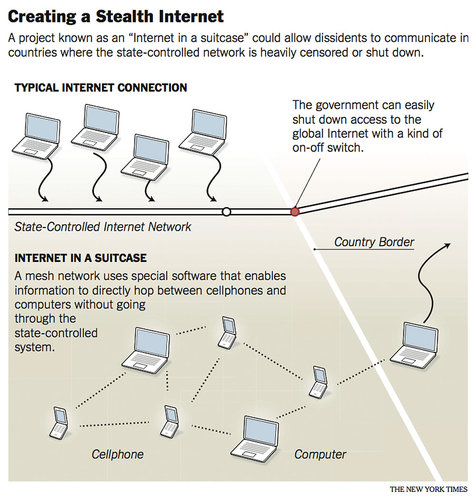
Image: New York Times depicts what is called a “mesh network,” or an independent internet that uses computers and phones not only as interfaces, but as actual nodes to create the network Imagine in this case, that the “country border” is that of Turkey and Syria. Such networks can be set up virtually anywhere, and the development of methods and software to do so have been the subject of US State Department funding and implementation.
The New York Times in their article, “U.S. Underwrites Internet Detour Around Censors,” stated in June, 2011 that:
The Obama administration is leading a global effort to deploy “shadow” Internet and mobile phone systems that dissidents can use to undermine repressive governments that seek to silence them by censoring or shutting down telecommunications networks.
The effort includes secretive projects to create independent cellphone networks inside foreign countries, as well as one operation out of a spy novel in a fifth-floor shop on L Street in Washington, where a group of young entrepreneurs who look as if they could be in a garage band are fitting deceptively innocent-looking hardware into a prototype “Internet in a suitcase.”
Therefore, the Syrian government would gain very little by shutting off the Internet to neutralize networks working entirely independent of infrastructure within state control. Conversely, if NATO has shut the Internet off at nodes leading into Syria, as appears to be the case, NATO and their proxies operating inside of Syria can begin spreading false information, uncontested, via radio, SMS, and even ad hoc WiFi networks.
With NATO’s proxies possessing their own communication networks, their own ability to co-opt and control signals in and near their areas of operation, in particular along the borders where NATO forces themselves are directly involved in disrupting and controlling communications, according to Reuters, a disruption in Syria’s communication networks would only serve to blind, hinder, and disrupt the government and the vast majority of Syria’s civilians.
The control of information, the ability to communicate and coordinate one’s forces, whether they are forces of a military or economic nature, is essential to the survival and prosperity of any nation. The neglect of improving and protecting the means of communication and the control of information within one’s borders is the modern equivalent of letting a castle’s walls crumble, its moat dry up, and to leave its towers without archers.
Syria is not entirely unprepared, however, and its ally Iran is actively building a model that could serve as an example for other nations to follow in securing their information and communication networks. Additionally, the measures used by NATO to subvert sovereign nations in their pursuit of corporate-financier motivated regime change across the planet, can just as easily boomerang back at these very corporations and financial institutions, slaying them with their own sword.
Countermeasures and Defensive Initiatives.
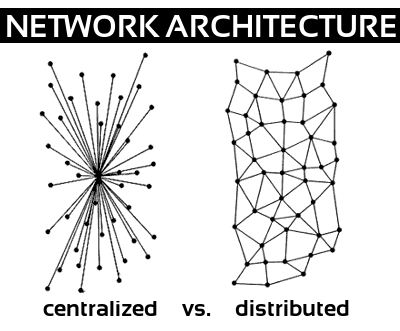
One of the many considerations and motivations behind the very creation of the Internet was its decentralized nature, and its ability to survive catastrophic attacks and still function. A subject of study by the RAND Corporation, the distributed nature of the Internet was seen as being superior to that of conventional, centralized communication architectures. However, the utility of such a network is still determined by who controls the flow of information at nodes and bottlenecks within the system.
Iran has been working on the creation of a nationwide intranet, independent of the Internet, in a bid to break the monopoly the West has been increasingly building over the years. By developing an indigenous network, Iran has the ability to isolate the country from attempts to use the Internet to undermine the nation politically and economically and control the nodes and bottlenecks within its borders.
While the Western media portrays Iran’s move as unreasonable, Western tech-firms are confirmed to be openly collaborating with Western governments in their bid to manipulate, undermine, and overthrow targeted nations, especially Iran. When we consider the disingenuous reasons behind the West’s confrontation with Iran, best articulated in Washington’s own policy think-tank, the Brookings Institution and their “Which Path to Persia?” report, the danger Iran truly faces becomes all the more obvious.
Image: Movements.org’s 2011 sponsor page. Since then, Google and the US State Department have since removed mention of their involvement, but Movements’ own annual reports (2008, 2009, 2010) still retain mention their sponsorship and role over the years.
Internet giant Google, for instance, has been openly working with the US State Department in their corporate-financier motivated interventions around the world, from Egypt to Tunisia, from Libya to Syria. It was revealed that as early as 2008, Google, along with AT&T, Howcast, and Facebook were collaborating with the US State Department via Movements.org to train, equip, and organize protesters ahead of the “Arab Spring” in 2011. The West’s governments and media would feign ignorance and surprise when widespread unrest finally swept the Arab World, when in reality it had been meticulously planned for years.
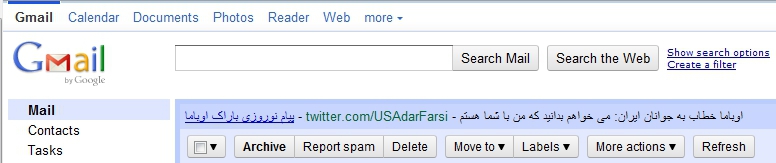
Image: The US State Department has used Google Ads to spread propaganda. This ad featured (in Farsi) the Twitter account @USAdarFarsi of the “Virtual Embassy of the United States” and reads, “Obama to the Iranian youth: I want you to know that I’m with you.” (click image to enlarge)
The US State Department regularly uses Google Ads to target Farsi speaking readers with messages to undermine the Iranian government – the modern equivalent of US Army Psychological Operations broadcasting propaganda over loudspeakers in a US theater of war, or the US State Department’s Voice of America for decades broadcasting propaganda via radio.
Additionally, Israel has openly admitted to waging “consistent and relentless” cyber warfare, just days after accusations were leveled against it regarding attacks on Iran’s infrastructure, both physical and digital.
Iran’s move, seen in this context, is not only reasonable, but would indicate negligence on the Iranian government’s part had it not begun taking more drastic measures to secure, defend, and isolate networks under constant, verifiable attack.
While Iran works to build technical solutions to adapt and overcome Western efforts to use the Internet as a weapon against them, Syria appears to be fighting with a much more hastily assembled defense, the Syrian Electric Army, to counteract torrents of propaganda emanating from similar organizations put together by the Pentagon, the Israeli IDF, as well as Saudi and Qatari propaganda machines.
The true story behind the Internet blackout in Syria may never be known, but simply countering propaganda online may not be enough to combat the full-spectrum warfare waged by NATO upon Syria, including cyber warfare. And surely such measures will not win the wars of the future. Iran’s approach, involving infrastructure as well as countering Western propaganda with their own professional, international news agency PressTV, provides nation-states with a model for confronting foreign hegemonic ambitions on and within their borders.
US State Department’s “Suitcase Internet” – a Double Edged Sword.
It is difficult to say what sort of people were actually behind the US State Department’s “Suitcase Internet.” There is Sascha Meinrath of the corporate-financier foundation-funded New America Foundation, who despite his affiliations and his role in facilitating American hegemonic ambitions across the Arab World, claims to promote “community wireless networks.” In this case, his deeds and the company he keeps, certainly don’t match his alleged desires. (read Meinrath’s US State Department RFERL interview here)
It is clear by now, with the so-called revolutions in Libya, Egypt, and Syria turning out to be textbook cases of “color revolutions” premeditated and carried out by and exclusively for a myriad of Western organizations, corporations, and institutions for the sole purpose of installing more obedient (not more democratic nor more humane) client regimes, that all those involved, along with their good intentions, were simply exploited.
Most likely, this technology will be outlawed or regulated into extinction across the West, even as it is used to overrun nations across the rest of the world.
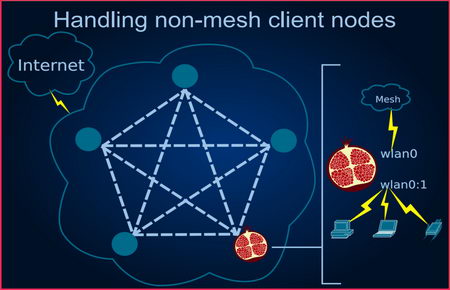
Image: A visual depiction of Project Byzantium’s ad-hoc wireless mesh network. More information can be found on their website here. Such networks have been used by corporate-financier interests, acting through the US State Department and couching their intentions behind “democracy” and “freedom” to execute the so-called “Arab Spring.” By doing so, they have managed to co-opt the talent and intentions of people to accomplish the very opposite of their stated goal. Instead of freeing nations, they’ve only been burdened with worse oppressors with infinitely stronger backers – Wall Street and London.
Software similar to what is described as being used for the “Internet Suitcase,” also known as an ad-hoc wireless mesh network, can be found at Project Byzantium, and was produced by Washington D.C.-based hackerspace, HacDC. It is described as being made specifically with “activists” in mind. While hackerspaces and local innovation stand the greatest chance at leveling the playing field, reducing both disparity and the exploitation it invites, it appears that in this case, special interests have leveraged this phenomenon to its advantage.
But the concept of mesh networks themselves, along with the work of HacDC are like any tool or weapon – everything depends on whose hands it is in, and how it is used.
Across the Arab World, these mesh networks have allowed proxies of US corporate-financier interests (wittingly and unwittingly) to undermine and overthrow the governments of sovereign nation-states and have lead to the ascent of tyrannies not only many magnitudes worse, but their true nature concealed by a complicit Western media and diplomatic corps. But what if these mesh networks (combined with locally implemented broadband lines to guard against threats like these) were used to set up permanent networks in local communities, with permanent links between communities – and other locally produced and maintained solutions for connecting groups of communities in one country, with those in another?
The potential for upsetting telecommunications monopolies with open source, local networks, independent of both corporate and government control, rules and regulations is precisely how this sword cuts the other way. Local telephone networks, like those created and deployed by the US State Department against targeted and occupied nations could also likewise be deployed against the very corporate-financier interests using these tools today to achieve their geopolitical objectives.
Localizing these networks, and connecting them as local initiatives would not only supplant large, centralized corporate-financier interests, but in the process of supplanting them, would distribute the vast amounts of unwarranted wealth and influence they’ve accumulated, across thousands, perhaps millions of local entrepreneurs – in other words, wealth redistribution through innovation and local entrepreneurship – the eradication of monopolizing special-interests by globally boycotting them, and locally replacing them.
Syria and 4th Generation Warfare.
In Syria’s case, and any sovereign nation-state wishing to stave off the threats wars of the future will bring, a careful study of today’s technology and how it can be implemented as weapons tomorrow should form the driving force behind the formation of defense strategies – not just past successes and today’s current threats. Having both electronic armies and professional international media agencies communicating a nation’s interests to the world, as well as developing and deploying indigenous communications, manufacturing, and defense infrastructure are, and will continue to be, the keys to successfully defending a nation against 4th generation warfare.
Conventional armies and nuclear forces both still serve a valuable role as deterrents, but large contingents of counter-terrorism/counterinsurgency special forces in combination with serious telecommunication and information warfare strategies are essential. The forces of Wall Street-London corporate-financier capital have made it clear they favor 4th generation warfare to build their modern empire. Those that are being targeted must then prepare to fight 4th generation wars.
CBS News 8 – Mark Dice Heckles Black Friday Shoppers with Megaphone [video]
Mark Dice
November 24, 2012
CBS News 8 in San Diego interviews Mark Dice about why he ridiculed shoppers in line on Thanksgiving night with a megaphone, calling them zombies. See Mark’s video here: http://youtu.be/qxyrBwhTo48
US-Created “Syrian Opposition” Led by Big Oil Rep [video included]
by Tony Cartalucci
 Land Destroyer
As in Libya, Syrian “opposition” is led by long-time servants of Western corporate-financiers.
November 26, 2012 (LD) – A year ago, it was reported that Libya’s new NATO-installed prime minister, Abdurrahim el-Keib, was in fact a long-time US resident, having taught at the University of Alabama and was formally employed by the Petroleum Institute, based in Abu Dhabi, UAE and sponsored by British Petroleum (BP), Shell, France’s Total, the Japan Oil Development Company, and the Abu Dhabi National Oil Company. El-Keib is listed as a “Professor and Chairman” in his Petroleum Institute profile which also describes extensive research conducted by him sponsored by various US government agencies and departments over the years.
His long history of serving and working in coordination with Western governments and corporations made him and his collaborators the ideal candidates to prepare Libya for its place within the Wall Street-London international order.
Now it is revealed that the US-handpicked opposition, announced in Doha, Qatar earlier this month, is led by a similarly compromised figure, Moaz al-Khatib. The corporate-financier-funded Carnegie Endowment for International Peace reported of al-Khatib that:
Moaz al-Khatib, an oil sector engineer and former imam of the Umayyad Mosque in Damascus, has garnered substantial praise since his designation, while Riad Seif and Suhair al-Atassi bring their own credibility to the coalition. They have now set up shop in Cairo and have received the full endorsement of France, Italy, the United Kingdom, Turkey, and the members of the Gulf Cooperation Council as the “sole representative” of the Syrian opposition. The European Union and the United States have endorsed the group in a more general fashion.
Even more importantly, from Syrian citizens of various affiliations with whom I have met recently, it is clear that al-Khatib and his associates seem to draw praise for their opposition to the regime—as an imam, al-Khatib refused to follow the speeches imposed by the regime and was imprisoned—their resistance, and their tolerance. These endorsements are a first achievement, but a number of steps are necessary before Moaz al-Khatib becomes the real head of the Syrian opposition and enters into a substantive relationship with EU leaders.
However, this resounding praise should be kept in the context that among the Carnegie Endowment’s sponsors are in fact many “oil sector” giants including British Petroleum (BP), Chevron, Exxon, and Shell.
VoltarieNet’s Thierry Meyssan reported in an article titled, “The many faces of Sheikh Ahmad Moaz Al-Khatib” that:
Completely unknown to the international public only a week ago, Sheikh Moaz al-Khatib has been catapulted to the presidency of the Syrian National Coalition, which represents pro-Western opposition in the Damascus government. Portrayed by an intense public relations campaign as a highly moral personality with no partisan or economic attachments, he is in truth a member of the Muslim Brotherhood and an executive of the Shell oil company.
Indeed, al-Khatib had worked at the al-Furat Petroleum Company for six years, according to the BBC, which is partnered with Shell Oil. Al-Khatib is also said to have lobbied for Shell in Syria between 2003-2004, and has likewise taught classes in both Europe and the United States, this according to his biography featured on his own website.
Video: The smirking crypto-sectarian extremist, and new Western proxy of the recently re-contrived “Syrian National Council,” Moaz al-Khatib admits that he’s been promised legitimacy and weapons despite openly declaring his intention of overthrowing the secular nation-state of Syria, and installing an “Islamic state.” Qatari state propaganda walks al-Khatib through the all-too-familiar talking points repeated by the US, UK, EU, Turkey and their Persian Gulf collaborators. Qatar’s minister of state for foreign affairs sells the “legal” argument for circumventing the United Nations Security Council.
While the global public is repeatedly told that the violence in Syria is the result of “pro-democratic” forces fighting against the “brutal regime” of President Bashar al-Assad, it is Moaz al-Khatib himself who inexplicably states that two certified autocracies, those of Saudi Arabia and Qatar, are propping him up and that it is an “Islamic state” he hopes to create upon the rubble of a destroyed Syria.
Qatari state media front, Al Jazeera, credits the Qatari minister of state for foreign affairs for the very creation of al-Khatib’s new “opposition coalition. Al-Khatib, in an Al Jazeera interview, counts the two absolute monarchies of Qatar and Saudi Arabia as his “friends,” and admits – that while he cannot say who – “friends” have promised him weapons as he embarks on the creation of this “Islamic state.” Despite his assurances that his planned “Islamic state” will exhibit tolerance, festering extremist regimes such as Libya and Egypt, created with the same Western-backed formula now at work in Syria, have already proven such assurances are merely rhetoric aimed at placating public opinion long enough for Syria’s secular institutions to be irrevocably disfigured.
Already in Syria, al-Khatib’s “freedom fighters” are exposed as both foreign extremists – affiliates of Al Qaeda, as well as sectarian-driven Muslim Brotherhood militants that have plagued Syria’s sociopolitical landscape for decades. Clearly, al-Khatib has played a role in perpetuating this plague, clearly he plans to continue well into the foreseeable future – this time with Western, Turkish, Qatari and Saudi support.

 PN
PN 