
Government criminalizes rainwater collection from your own property – outrageous assault on freedom [video]
Natural News TV
September 2, 2012
Collectivism is spreading like a cancer across America, where a private property owner in Oregon is now in jail for the “crime” of collecting rainwater that falls on his own property!
According to the government, all property owners must obtain a PERMIT to collect their own rainwater! But the state revoked this man’s permit, and then sentenced him to 30 days in jail.
America is rapidly devolving into a collectivist / socialist / communist police state, where the government controls all natural resources and private property, while individual citizens have no liberties or freedoms.
Read this highly popular article on this subject at:
http://www.naturalnews.com/036615_Oregon_rainwater_permaculture.html
Free Energy – Pentagon Conspiracy to Cover up [video]
YouTube — FreeGlobalEnergy
August 6, 2012
Stanley Meyer and many others. Always the same story. The Pentagon wants to see your idea and tell you how they would like to use your invention. You demonstrate your device proving to them that it works, then they block all of your efforts and end up killing you. The only way to get a free energy device out to the public is to foget about patents, distribute underground, sell it to EV enthusiests with the plans and encourage them to travel around and do as you are, you then have created a non interlinked underground distribution system that will spread to the general populous and it will spread like wild fire, it will be un-stoppable.
Help Stop The Suppression Of Inventions
http://www.panacea-bocaf.org/newsletter/newsletter.htm
Is There Going To Be A Stock Market Crash In The Fall?
The Intel Hub
August 29, 2012
 Is the stock market going to crash by the end of this year? Are we on the verge of major financial chaos on a global scale? Well, this is the time of the year when investors start getting nervous.
We all remember what happened during the fall of 1929, the fall of 1987 and the fall of 2008. However, it is important to keep in mind that we do not see a stock market crash in the fall of every year.
Some years the stock market cruises through the months of September, October, November and December without any problems whatsoever. But this year conditions certainly seem to be right for a “perfect storm” to develop.
Technical indicators are screaming that a stock market decline is imminent and sources in the financial industry all over the world are warning that a massive crisis is on the way.
What you are about to read should alarm you. But it is not a guarantee that anything will or will not happen.
When Ben Bernanke gives his speech at the Jackson Hole summit on Friday he could announce to the rest of the world that the Federal Reserve has decided to launch QE3 and that the Fed will be printing up trillions of new dollars.
If that happened global financial markets would leap for joy. So it is always a dangerous thing when anyone out there tries to tell you that they can “guarantee” what is about to happen in the financial world.
There are just so many moving parts. But if we do not see major intervention by the governments of the world or by global central banks a major financial crisis could rapidly develop this fall. The conditions are certainly right for a stock market collapse, and we could easily see a repeat of what happened back in 2008.
The truth is that the second half of 2012 looks a little bit more like the second half of 2008 with each passing day.
Just check out what Bob Janjuah of Nomura Securities has been saying….
Based on the reasons set out earlier and also covered in my two prior notes, over the August to November period I am looking for the S&P500 to trade off down from around 1400 to 1100/1000 – in other words, I expect over the next four months to see global equity markets fall by 20% to 25% from current levels and to trade at or below the lows of 2011! US equity markets, along with parts of the EM spectrum, will I think underperform eurozone equity markets, where already very little hope resides.
Others are issuing similar warnings. For example, the following is what a couple of Bank of America analysts said in a report the other day….
Our strategists see an unusually high number of macro catalysts over the next 3-6 months that could take markets lower. We expect economic growth to disappoint in the second half of the year in anticipation of the fiscal cliff. This would exacerbate any slowdown from the deepening recession in Europe and decelerating growth in emerging markets. There is also the ongoing tension in the Middle East, the potential for a US credit downgrade and accelerating downward analyst estimate revisions. To top it off, September is seasonally the weakest month of the year for stock price returns.
There has been an unusual amount of chatter in the financial world about the September to December time frame.
That could mean something or it could mean nothing.
But is is very interesting to watch what some top financial insiders are doing with their stocks right now.
Dennis Gartman, the publisher of the Gartman Leter, has dumped all of his stocks at this point.
As I have written about previously, George Soros has dumped all of his stock in banking giants JP Morgan, Citigroup and Goldman Sachs.
Are they just being paranoid?
Or do they know something that we do not?
If you are looking for the next “Lehman Brothers moment” in the United States, you might want to watch Morgan Stanley. Morgan Stanley was heavily involved in the Facebook IPO disaster, earlier this year their credit rating was downgraded, and now there are persistent rumors that Morgan Stanley is in big trouble and that it will be allowed to fail. You can check out some of these rumors for yourself here, here and here.
But of course as I have said all along the center of the coming crisis is going to be in Europe, and many analysts agree with me. For example, the following is what the chairman of Casey Research, Doug Casey, had to say during a recent interview….
Europe is a full cycle ahead of the U.S. Its governments and its banks are both bankrupt. It’s a couple of drunks standing on the street corner holding each other up at this point. Europe is in much worse shape than the U.S. It’s highly regulated, highly taxed and much more socially unstable.
Europe is going to be the epicenter of the coming storm. Japan is waiting in the wings, as is China. This is going to be a worldwide phenomenon. Of course, the U.S. will be in it, too. We’re going to see this all over the world.
Much of southern Europe is already experiencing depression-like conditions. Unemployment in both Greece and Spain is well above 20 percent and both economies are steadily shrinking.
Money is flowing out of Spanish banks at an unprecedented rate right now. Just take a look at these charts. The only thing that is going to keep the Spanish banking system from totally collapsing is outside intervention.
But the truth is that all of Europe is in big trouble. Even German companies are slashing job right now. For example, check out what Siemens is up to….
German engineering conglomerate Siemens (SIEGn.DE) is in early internal talks to cut thousands of jobs in response to a weakening economy, particularly in Europe, a German newspaper reported.
Decisions could be made in October or November, according to daily Boersen-Zeitung, which did not specify its sources.
A Siemens spokesman declined to comment.
We are living in the greatest debt bubble in the history of the world, and at some point that bubble is going to burst in a very messy way.
It is vital that people understand that our system is not even close to sustainable.
Knowing exactly when it will collapse is not nearly as important as understanding that a collapse is absolutely inevitable.
I think what former World Bank economist Richard Duncan had to say recently is very helpful….
“The explosion in credit drove economic growth in the U.S. and around the world, and now that’s the only thing that’s keeping us from collapsing in a debt/deflation spiral,” he said. “[What] I think everybody needs to understand is that the kind of economy that we have now, it’s not capitalism. It has very little in common with capitalism. Capitalism was an economic system in which the government played very little role …. Under capitalism, gold was money and the government had nothing to do with it. Now the central bank creates the money and manipulates its value.”
And he is very right.
We aren’t seeing a failure of capitalism.
What we are witnessing is the failure of debt-based central banking.
And if you think that the global elite are not aware of what is happening then you have not been paying attention.
This summer the global elite have been preparing very hard. Either they are getting very paranoid or they know things that we do not.
If you want to catch up on what the global elite have been up to recently, check out these three articles that I have published previously….
-”Are The Government And The Big Banks Quietly Preparing For An Imminent Financial Collapse?”
-”Jacob Rothschild, John Paulson And George Soros Are All Betting That Financial Disaster Is Coming”
If you are waiting for the nightly news to tell you what to do, then you have not learned anything.
Did anyone in the mainstream media warn you about what was about to happen back in 2008?
Of course not.
The “authorities” insisted that everything was going to be just fine and many average Americans were absolutely wiped out.
So don’t expect someone to come along and nicely inform you that your retirement savings are about to be absolutely devastated.
In this day and age it is absolutely critical for people to learn to think for themselves.
Barack Obama is not going to save you.
Mitt Romney is not going to save you.
The U.S. Congress is not going to save you. They are too busy living the high life at taxpayer expense.
The system is not looking out for you. Nobody is really going to care if your financial planning gets turned upside down. This is a cold, cruel world and you need to understand how the game is played. The financial insiders are looking out for themselves and most of them usually are able to avoid financial disaster.
Average folks like you and I are normally not so fortunate.
There are lots of warning signs that indicate that this fall could be a very turbulent time for global financial markets.
Ignore them at your own peril.
Growing Opposition to the Canada-EU Trade Agreement
by Dana Gabriel
BE YOUR OWN LEADER
August 29, 2012
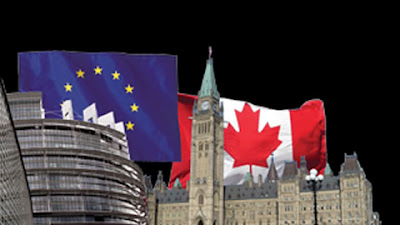
With the final rounds of negotiations sessions planned for September and October, Canada and the EU are closing in on a free trade deal that would go far beyond the reach of NAFTA. Meanwhile, there is growing opposition to the agreement as the whole process has lacked openness, transparency and any public consultations. In Canada, there are concerns over the threat it poses to local democracy. This includes fears of deregulation and privatization, as well the expansion of corporate investor rights. There are also warnings that the deal could be used as a backdoor means to implement ACTA which was rejected by the European Parliament in July.
As the Canada-European Union (EU) Comprehensive Economic and Trade Agreement (CETA) talks near their end, the Council of Canadians continue to voice their opposition to the deal. While I don’t agree with their position on some different issues, they have been championing the fight against CETA. In an effort to counter misleading statements made by the Conservative government regarding the trade pact, they have released the report, the CETA Deception. Trade campaigner, Stuart Trew explained how this is an effort to, “challenge the government’s reassurances that its EU trade deal will not affect public health or environmental regulations, will not allow foreign corporations to challenge public policy, will not undermine public services or municipal democracy, will not increase drug prices or hurt Canada’s supports for arts and culture. In each case, the government’s position is either misleading or demonstrably false.” As a result of the threat CETA poses to local sovereignty, a growing number of Canadian municipalities have passed resolutions seeking more information and a greater say in negotiations with some also requesting to be excluded from the agreement.
In her recent visit to Canada, German Chancellor Angela Merkel pledged support for the Canada-EU free-trade pact and promised to see to it that talks come to a speedy conclusion. The endorsement was seen as a much needed boost for Prime Minister Stephen Harper who is eager to get a deal signed before the end of the year. The Conservative government maintains that deeper trade with the EU will create jobs, economic growth and long-term prosperity. They have also tried to convince the public that CETA has been one of the most transparent trade negotiations in Canadian history. In an article for iPolitics, Stuart Trew stressed that, “If CETA and agreements like it are supposed to be 21st century or ‘next-generation’ free trade deals, they should be negotiated in 21st century ways ― openly, transparently, and with broad public input. Failure to do so in the ACTA negotiations led to that agreement’s demise in the European Parliament. The same fate could easily await CETA on both sides of the Atlantic.”
Last month, after mounting public pressure, the European Parliament rejected the Anti-Counterfeiting Trade Agreement (ACTA). The vote was the result of, “unprecedented direct lobbying by thousands of EU citizens who called on it to reject ACTA, in street demonstrations, e-mails to MEPs and calls to their offices. Parliament also received a petition, signed by 2.8 million citizens worldwide.” The U.S., Canada, Australia, Japan and New Zealand, as well as other countries have also signed on to ACTA, but have yet to ratify the deal. ACTA poses a serious risk to internet freedom and privacy. It would also give an unfair advantage to patented medicines and limit access to affordable generic options. Academic researcher and law professor Michael Geist warned that, “In the coming weeks and months, we can expect new efforts to revive the agreement within Europe and to find alternative means to implement its provisions.” It now appears that EU negotiators are trying to use CETA to sneak in ACTA.
Just days after ACTA was defeated, Michael Geist reported that leaked documents show the, “EU plans to use the Canada-EU Trade Agreement (CETA), which is nearing its final stages of negotiation, as a backdoor mechanism to implement the ACTA provisions.” He noted that, “The European Commission strategy appears to be to use CETA as the new ACTA, burying its provisions in a broader Canadian trade agreement with the hope that the European Parliament accepts the same provisions it just rejected with the ACTA framework.” After initially refusing to comment on the leak, the European Commission issued the statement, CETA is not ACTA in which they claimed that, “The accusations are unfounded since they rely on outdated and incomplete information.” In a recent update, Geist reaffirmed that the, “concerns that CETA may replicate ACTA appear to be very real despite the denials from the European Commission.” This whole issue has caused an uproar across Europe and in Canada and has brought much needed attention to CETA.
In their article, A trade deal that sets a bad precedent, Stuart Trew and Blair Redlin emphasized other CETA dangers besides ACTA which may threaten European policy and interests. They pointed out that CETA will be the first EU-wide investor-rights treaty covering all member states. Trew and Redlin posed the question, “What difference would a new treaty with Canada make? It is important to keep in mind the deep integration of the North American economy. The same U.S. firms that have taken Canada before investor-state panels under the North American free-trade agreement (NAFTA) 17 times will be able to challenge EU policy through their Canadian investments.” As far as NAFTA rules go, any rights granted to EU corporations as part of CETA would also apply to North American companies. CETA is being used to bridge the NAFTA and EU trade models. Ultimately, what happens with CETA will affect how the U.S. and EU move forward with their own future free trade plans.
According to legal analysis by international trade and public interest lawyer, Steven Shrybman, CETA would expand NAFTA investor rights and protections. He acknowledged that, “With CETA, Canada is proposing to accord EU investors and services providers far more expansive rights than those accorded (to) their U.S. and Mexican counterparts. Canada would therefore be required to provide this ‘most-favoured’ treatment to its NAFTA partners, even though neither is making reciprocal commitments.” Shrybman also described how the trade deal will give European corporations new rights at the expense of provincial powers. He cautioned that, “CETA represents a dramatic expansion of the application of international rules to spheres of provincial and local governance.” He went on to say, “policy and regulatory options of provincial, territorial and municipal governments will be curtailed to a much greater extent than has been the case under these earlier free trade agreements.” Modeled in the same fashion as NAFTA’s Chapter 11, the investor-state dispute process in CETA would give EU corporations the right to challenge government policies that restrict their profits.
As negotiations enter their final stretch, it is imperative to get the word out on how CETA could further jeopardize our political and economic sovereignty. A NAFTA-style free trade agreement with Europe that gives corporations further powers to influence Canadian laws would be dangerous and destructive. Considering the deepening economic crisis in Europe and the real possibility that the Eurozone could break up, this is also the wrong time for Canada to be entering into this trade deal with the EU.
Related articles by Dana Gabriel
Advancing the Transatlantic Agenda
Using the TPP to Renegotiate and Expand NAFTA
From NAFTA to CETA: Canada-EU Deep Economic Integration
Spreading NAFTA’s Love Across the Atlantic
Dana Gabriel is an activist and independent researcher. He writes about trade, globalization, sovereignty, security, as well as other issues. Contact: beyourownleader@hotmail.com Visit his blog at Be Your Own Leader
Russian Expert Predicts Obama Will Declare Martial Law in America by End of 2012
By Susanne Posel
theintelhub.com
August 27, 2012
Igor Panarin, dean of the Russian Foreign Ministry School for future diplomats, believes that President Obama will announce martial law by the end of 2012.
He explains: “There’s a 55-45% chance right now that disintegration will occur.”
In 2009, Panarin lectured at the Diplomatic Academy where he stated that he believes that the US will begin to collapse in 2010.
He compared America to Nazi Germany and blamed the US for the global financial crisis that destroyed the Russian economy.
Panarin said that American society is in decline, referencing school shootings like Columbine. Combined with the banker bailouts in 2008 as proof that the US is no longer the global dominating economy, Paranrin believes that the American dream is over.
He asserts that mass immigration, economic decline, and moral degradation will plunge America into a civil war that will center on the collapse of the US dollar.
 Panarin created a map of how he perceived the US would be divided. He asserted that parts of the US would be taken over by foreign interests.
Considering the social climate emerging in America, Panarin’s words seem prophetic.
Lubbock County Judge Tom Head said on a local FOX affiliate station that he is convinced that Obama’s re-election would spawn civil unrest which would justify the US government’s use of martial law to quell the public.
Head is seeking an increase in local taxes to “beef up” the Lubbock County Sheriff’s office and district attorney’s office.
Head expressed concern that Obama would deploy UN NATO troops onto US soil should civil unrest be declared.
Head said:
“He’s going to try to hand over the sovereignty of the U.S. to the United Nations, what’s going to happen when that happens?
I’m thinking worst case scenario. Civil unrest, civil disobedience, civil war maybe…we’re not just talking a few riots or demonstrations.”
In March of 2012, Obama signed the National Defense Resources Preparedness (NDRP) executive order that declared peacetime marital law. Obama granted himself authority over all domestic energy, production, transportation, food and water, all in the name of National Security.
The NDRP has roots in the Defense Production Act of 1950 wherein the US government was empowered to dispense “national resources” in the event of a national emergency that would define any or all Americans as a challenge to the government.
Control over all US citizens would be required to maintain continuity of government.
The president and advisors would be able to use this directive as they saw fit if the situation warranted it.
It was no mistake that the National Defense Authorization Act (NDAA) declared the domestic US a “battlefield”. The ability to detain any American citizen without charge or trial, solely on suspicion is key to the power of the NDAA.
As defined in the NDRP, the President allocated control over American resources to specific federal agencies to oversee their dispensation.
- The Secretary of Defense has power over all water resources
- The Secretary of Commerce has power over all material services and facilities, including construction materials
- The Secretary of Transportation has power over all forms of civilian transportation
- The Secretary of Agriculture has power over food resources and facilities, livestock plant health resources, and the domestic distribution of farm equipment
- The Secretary of Health and Human Services has power over all health resources
- The Secretary of Energy has power over all forms of energy
 Under Nazi-controlled Germany, the beginning of Totalitarian control was evidenced in May of 1942 when freezing of food prices led to national rationing in 1943.
With the Nazis controlling resource dispersion, all citizens needed ration cards to obtain food, gas, and even a vacation pass that allotted the restriction of movement.
Between the NDAA and NDRP, a Nazi-model of control over the general population in America is laid out.
The Executive Branch, having been given the power to control all resources that are necessary to sustain all citizens, have forced Americans to become completely subservient to the US government.
The executive order is not permitted by the US Constitution which states:
“All legislative powers herein granted shall be vested in a Congress of the United States, which shall consist of a Senate and House of Representatives.”
The advent of executive orders completely circumvents the power of the Congress and gives the Executive Branch unilateral power. The use of executive orders has become popular as a way to control America in wartime and advent of national emergencies.
Obama has set a precedent by announcing the pre-cursor to suspension of the US Constitution during peacetime.
The first suspension of the US Constitution and Bill of Rights was performed by Abraham Lincoln during the US Civil War. This enabled Lincoln to authorize the unlawful detainment of “political prisoners” without Congressional approval.
The second declaration of unconstitutional detainment of US citizens was ordered by President FDR in 1941 with the roundup of Japanese-Americans who were sent to detainment camps to be held without charge during WW II.
For the past 30 years, plans for the takeover of America have been laid in a long line of executive orders.
By stifling Congressional approval, the Executive Branch has been empowered to detain any and all US citizens, suspend all media, and restrict any and all Americans in any and all ways deemed appropriate by the President.
We are in the midst of a Fascist takeover of our Constitutional Republic.
Susanne Posel is the Chief Editor of Occupy Corporatism Our alternative news site is dedicated to reporting the news as it actually happens; not as it is spun by the corporate-funded mainstream media. You can find us on our Facebook page.
Canadian church defends decision to boycott Israeli products [video]
Press TV
August 26, 2012
The United Church of Canada has defended its decision to promote a boycott of Israeli products produced in illegal settlements. The church has found itself being criticized by pro-Israel media pundits in Canada who denounced the Church’s decision as one-sided. Church leaders say their decision to pass motions which endorse a boycott aligns them with the international legal consensus on the settlements.
Press TV’s Joshua Blakeney reports from Calgary.
Follow our Facebook on: https://www.facebook.com/presstvchannel
Follow our Twitter on: http://twitter.com/presstv
‘Egyptian leader heads to China, Iran to find non-Western cash flow’
Russia Today
August 28, 2012
Egyptian President Mohammed Morsi is set to kick off his first visit to China, shortly followed by a historic trip to Tehran. Middle East history professor Lawrence Davidson believes Cairo wants to diversify its economic relations.
The Egyptian President, who took office in June, will hold talks with his Chinese counterpart Hu Jintao on Tuesday. His visit is expected to largely focus on economic cooperation, which is why Morsi is accompanied by a number of Egyptian businessmen.
On Thursday, the Egyptian president will visit Iran to attend the Summit of the Non-Aligned Movement, which Tehran is hosting. The trip, which is expected to last for only a few hours, will nevertheless be a historic occasion, as diplomatic relations between the two countries largely deteriorated following the 1979 Islamic revolution in Iran. This will be the first visit by an Egyptian head of state since that date.
RT: President Morsi and his Chinese counterpart are expected to hold talks on boosting bilateral relations and attracting more investment. How will this impact Cairo’s geopolitical interests with the country still dependent on Washington’s aid?
Lawrence Davidson: I think what the Egyptians are trying to do is diversify their source of assistance, particularly economic assistance and so if they can find financial and other sources of resources outside the United States or the World Bank, then they’re going to do it. So that causes a sort of leaning not only towards China, but also maybe Russia and Saudi Arabia and the Gulf. So Morsi is catering to that area because of financial need. And we saw that just recently with Egypt’s refusal to let a Bahraini activist into the country. So I think that Egyptian policies and actions are going to essentially align to their economic needs.
RT: President Morsi then heads to Iran, which is seen as an unprecedented move, given the tensions over Tehran’s controversial nuclear program. Is it possible that his visit will bolster Iran’s standing?
LD: I think so, particularly in the Arab world. If the Egyptians and Iranians are seen to put forth common interests, common goals and boost trade or something like that, I think that that’s going to bode very well for the Iranians. Ironically, the Saudis are probably not going to like that. But I have a feeling that Morsi will then go and say nice things to the Saudis to keep the money flowing from the Gulf.
RT: The Muslim Brotherhood, Morsi’s former party, has called this upcoming visit to Tehran a demonstration of Egypt’s newly elected leader’s independence from the US. What kind of message does this trip convey to Washington?
LD: I don’t think it’s going to upset the Americans that much. Actually, I think the American government really doesn’t want to jack up the tension in Iran and that region. They really want to calm things. And so they’re not going to get upset about these sorts of maneuvers. The real tensions that are pushing the Americans towards conflict with Iran are centered domestically. And so, to the extent that Obama feels that he’s got a real good shot at re-election, I think we are going to see a more independent kind of behavior on the part of the US government vis-à-vis Iran.

 PN
PN 