
Wal-Mart recalls donkey meat tainted with fox meat from stores in China
 by Rebecca Winters
Natural News
Jan 10, 2014
(NaturalNews) As if anyone even needs yet another reason to be wary of the food coming out of China, Reuters is reporting that Wal-Mart customers there are outraged to learn that their donkey meat was recently found to contain “the DNA of other animals,” including fox.
Wal-Mart issued an apology and has announced that customers who purchased “Five Spice” donkey meat will be reimbursed. Confoundedly, Reuters went on to note, “The scandal could dent Wal-Mart’s reputation for quality in China’s $1 trillion food and grocery market….” Really?
China and Wal-Mart: an inimitable combination to say the least
Wal-Mart has been involved in everything from child labor scandals and mislabeling organic products to being fined over $80 million earlier this year for violating EPA regulations on improperly disposing hazardous waste. Currently, the company is under a Department of Justice investigation over possible Foreign Corrupt Policies Act violations regarding some $24 million in bribes to build 19 stores in Mexico and other alleged misconduct in Brazil, India and, again, China. Closer to home, the media was splashed around the holidays by reports that Wal-Mart stores across the U.S. were setting up donation boxes for employees to give Thanksgiving food… to other Wal-Mart employees who couldn’t afford a decent Thanksgiving dinner, because apparently they don’t earn enough.
China’s food and drug scandals read like a House of Horrors checklist. Babies dying from industrial chemical-tainted infant formula? Check. Rat meat sold as lamb meat? Check. Some 600 dogs dropping dead after eating pet jerky treats made in China? Check. Glow-in-the-dark blue “Avatar” pork? Check. “Gutter oil” scavenged from drains beneath Chinese restaurants being using to cook one of every ten meals in Chinese restaurants? Check. Farmed, powdered cockroaches being sold to pharmaceutical companies as medicine? Check. The list goes on and on.
But China has perhaps become most well-known lately for its vast amounts of air, soil and water pollution. Shanghai recently suffered what the media dubbed an “airpocalypse” – choking, toxic smog so heavy and thick that it closed down major airports, roadways and public schools for over a week. A deputy minister of China’s Ministry of Land and Resources has also just announced that 3.3 million hectares of Chinese farmland is so polluted, it is literally unsafe to grow crops on it. Estimates are that a whopping 90 percent of groundwater supplying China’s cities is severely contaminated, to the point that Chinese people reportedly do not even trust the bottled water sold there. NGOs, Chinese media and academics have estimated that China is home to over 450 “cancer villages” – residential areas built up around power, chemical or pharmaceutical plants where people are riddled with above-average levels of illness and disease. The Chinese Ministry of Environmental Protection even mentioned these villages in one of its latest reports.
There are no limits on how close crops can be grown to chemical plants or how much pollution the water spayed on crops can contain in China. All of that toxic runoff and pollution finds its way into rivers and soil used to grow Chinese crops and feed livestock. The food and water is ingested by the Chinese people, and that food is exported to the rest of the world as well.
Chinese food failures coming to a grocery store near you?
As Natural News has reported before, you may be eating more food imported from China than you think. Back in 2007, CNN declared that avoiding Chinese food ingredients is nearly impossible. The U.S. imports billions in food from China every year.
Just a few months ago, the USDA announced its intention to allow processed, cooked chicken from China to be exported to the U.S., as the agency determined that China’s poultry inspection process is “equivalent to that of the United States”.
The “certified organic” label has also come under scrutiny (and rightfully so) after it was revealed that the USDA was licensing organic certifiers to operate in China as well. These certifiers may have rules about whether or not added petroleum-based fertilizers, pesticides or synthetic hormones in the case of animal feed are allowed; they are not required to test for limits on toxic heavy metals like arsenic, mercury, lead or cadmium – heavy metals found contaminating the food grown in China all the time. The FDA wouldn’t know anyway, considering that the agency inspects less than 2 percent of the food imported from China.
Stories like fox-tainted donkey meat just continue to highlight the fact that, if its marked “Made in China,” it’s a safe bet you don’t know what’s in it.
Sources for this article include:
http://science.naturalnews.com
[h/t: DavidIcke]
VIDEO — Jeff Rense & Yoichi Shimatsu – Food Chain Devastation
Rense
Jan 10, 2014
Clip from January 6, 2014 – guest Yoichi Shimatsu on the Jeff Rense Program. Full program available in Archives at http://www.renseradio.com/signup.htm
Food stamps won’t buy marijuana cookies in Colorado
RT
Jan 10, 2014

Marijuana laced cookies for sale at a medical marijuana “club” (AFP Photo / Robyn Beck)
A new bill that’s been introduced before the Colorado General Assembly will make sure residents there won’t be able to use their food stamp benefits to buy legal weed or marijuana-infused products sold in dozens of new state-sanctioned dispensaries.
Reports have yet to surface indicating that Coloradoans have used government-provided EBT cards to purchase pot products under new state laws, but lawmakers there want to make sure that won’t become a reality.
Under state law, residents can’t use their electronic benefit transfer accounts in liquor stores, casinos, gun shops and similar establishments. With recreational marijuana now legal for adults to buy and use in Colorado, though, state officials fear some of the new dispensaries may let customers cash out with their EBT cards.
“We need this bill, if for nothing else, as a statement,” State Rep. Jared Wright (R-Grand Junction) told the Associated Press this week.
“We shouldn’t be enabling anyone to buy a substance that is banned under federal law. It’s not a good use of taxpayer money,” he said.
Wright is intent on changing that, and is now proposing an amendment to state law that would add weed dispensaries to the list of establishments where EBT cards can’t be used.
Fukushima Aftermath? 98 Percent Of The Pacific Ocean Floor Covered By Dead Sea Creatures
by Michael Snyder
Activist Post
Dec 16, 2013
According to an absolutely shocking study that has just been released, one area of the Pacific Ocean floor was 98 percent covered by decomposing sea creatures in July 2012. But in March 2012, only 1 percent of that same section of the Pacific Ocean floor was covered by dead sea creatures.
This study has been going on for 24 years, and the scientists that are running this study say that during “the past 2 years” they have seen “the biggest amounts of this detritus by far”. In other words, the scientists that are studying this section of the ocean floor have never seen anything quite like this before.
And when you consider this in conjunction with all of the other reports that have been coming in of sea creatures dying all over the Pacific Ocean, it is only natural to start asking some hard questions. Could radiation from Fukushima be responsible for all of this death?
National Geographic recently published a very interesting article about this study of the Pacific Ocean floor. The scientists running the study cannot really explain the very strange changes that they have observed since 2011…
In March 2012, less than one percent of the seafloor beneath Station M was covered in dead sea salps. By July 1, more than 98 percent of it was covered in the decomposing organisms, according to the study, published this week in the Proceedings of the National Academy of Sciences.
The major increase in activity of deep-sea life in 2011 and 2012 weren’t limited to Station M, though: Other ocean-research stations reported similar data.
Although climate change is a leading contender for explaining the major increases in 2011 and 2012, Huffard says that these spikes could be part of a longer-term trend that scientists haven’t yet observed.
Even though they do not have a “scientific explanation” for what is happening, the scientists are admitting that they have never seen a die-off of this magnitude in the 24 years that this study has been going on…
“In the 24 years of this study, the past 2 years have been the biggest amounts of this detritus by far,” said study leader Christine Huffard, a marine biologist at the Monterey Bay Aquarium Research Institute in California.
Could this phenomenon possibly be related to what has been going on at Fukushima?
It should be a fair question to ask. Especially in light of all of the other sea creature deaths that have been happening all over the Pacific. The following is a short excerpt from a recent CNN article…
“One of my favorite sayings right now is we may be experiencing global weirding,” Jim Covel at the Monterey Bay Aquarium said.
The Pacific recently has seen its fair share of weird. Last year, there was an invasion of Humboldt squid around coastal California and sea lion dying off in worrying numbers.
And in recent weeks, disturbingly, sea stars – from Alaska to San Diego are wasting away, literally melting.
So what in the world would cause sea stars to begin “literally melting”?
Once again, scientists do not have an answer.
But clearly, something definitely appears to be significantly affecting life throughout the Pacific Ocean. In fact, one very experienced Australian adventurer has stated that he felt as though “the ocean itself was dead” as he journeyed from Japan to San Francisco recently…
The next leg of the long voyage was from Osaka to San Francisco and for most of that trip the desolation was tinged with nauseous horror and a degree of fear.
“After we left Japan, it felt as if the ocean itself was dead,” Macfadyen said.
“We hardly saw any living things. We saw one whale, sort of rolling helplessly on the surface with what looked like a big tumour on its head. It was pretty sickening.
“I’ve done a lot of miles on the ocean in my life and I’m used to seeing turtles, dolphins, sharks and big flurries of feeding birds. But this time, for 3000 nautical miles there was nothing alive to be seen.”
In place of the missing life was garbage in astounding volumes.
“Part of it was the aftermath of the tsunami that hit Japan a couple of years ago. The wave came in over the land, picked up an unbelievable load of stuff and carried it out to sea. And it’s still out there, everywhere you look.”
Shouldn’t someone out there be trying to put all of the pieces together and asking if Fukushima could somehow be responsible for all of this?
For much more on the epidemic of death that we have been witnessing in the Pacific Ocean lately, please check out some of my previous articles about Fukushima…
– 28 Signs That The West Coast Is Being Absolutely Fried With Nuclear Radiation From Fukushima
– Something Is Killing Life All Over The Pacific Ocean – Could It Be Fukushima?
– What Is Happening To Alaska? Is Fukushima Responsible For The Mass Animal Deaths?
And this is a crisis that is not going away any time soon. In fact, it just keeps getting worse. The Japanese government has estimated that approximately 300 tons of highly radioactive water is pouring into the Pacific Ocean from the destroyed Fukushima nuclear facility every single day, and according to a recent RT article, outdoor radiation levels at Fukushima recently hit a new all-time high…
Outdoor radiation levels have reached their highest at Japan’s Fukushima nuclear plant, warns the operator company. Radiation found in an area near a steel pipe that connects reactor buildings could kill an exposed person in 20 minutes, local media reported.
So the total amount of radioactive material that has been released into the Pacific Ocean is constantly going up, and considering the fact that some of these radioactive particles have a half-life of about 30 years, all of this nuclear material is going to be sitting in the Pacific for a very, very long time.
And guess what? Even more highly radioactive water may soon be released into the Pacific Ocean. The Japanese are running out of places to store the radioactive water that they have been able to capture, and the IAEA is actually recommending that the “storage problem” should be solved by dumping the water into the ocean…
In an attempt to solve the storage problem the International Atomic Energy Agency (IAEA) proposed on Wednesday to consider dumping toxic water into the ocean after lowering the level of radioactive materials.
It is almost as if they consider the Pacific Ocean to be a giant trash dumpster.
And the mainstream media has been greatly misleading the public as to the true nature of the disaster at Fukushima.
According to nuclear expert Mycle Schneider, the lead author of the World Nuclear Industry status reports, the rest of the world should be very alarmed by what is happening…
It is much worse than we have been led to believe, much worse.
But the mainstream media in the United States really doesn’t talk much about Fukushima anymore.
They seem to believe that it isn’t a crisis worth talking about anymore.
Meanwhile, dangerous radiation levels are being measured all over the country.
NETC, an independent organization that collects and monitors radiation data from locations all over America, recently issued an alert for Austin, Texas and Grand Junction, Colorado…
RADCON 5 Alerts have been reported in both Austin, Texas as well as Grand Junction, Colorado as shared in the screenshots below from the Nuclear Emergency Tracking Center – NETC. Radiation levels are also way above normal background levels in St. George, Utah and Augusta, Georgia.
Posted below is a picture of what the NETC map looked like when those alerts were issued…
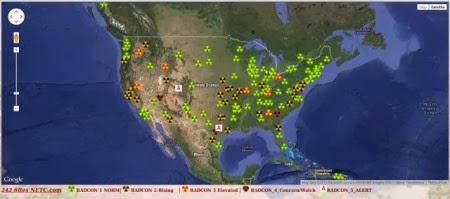
Over the past couple of years, radiation levels have been abnormally high in the U.S. – especially in the western half of the country.
So why isn’t the mainstream media talking about this?
And is all of this something that we should be deeply concerned about?
Please feel free to share what you think by posting a comment below…
About the author: Michael T. Snyder is a former Washington D.C. attorney who now publishes The Truth. His new thriller entitled “The Beginning Of The End” is now available on Amazon.com.
VIDEO — Tour of Permaculture Farm In Auroville
108morris108
Dec 21, 2013
The first part of a tour by Krishna (An Englishman originally) on a thriving permaculture farm in Auroville ( http://www.auroville.org/ ) South India. Natural farming based on the principles of permaculture and Masanobu Fukuoka’s vision.
http:///www.aurovillepermaculture.com.
Part 2 is here: http://www.youtube.com/watch?v=OC6J9q…
20 Applied Uses for Coke…Proofs that it Has No Place in the Human Body
TunedBody
Dec 23, 2013

Those who consume sodas such as Coca Cola have a 48% increase in heart attack and stroke risk, compared to people who do not drink the sodas at all or did not drink them every day. A study published in the journal Respirology reveals that soft drink consumption is also associated with lung and breathing disorders including asthma and chronic obstructive pulmonary disease (COPD).
The carbonation in Coke causes calcium loss in the bones through a 3-stage process:
- The carbonation irritates the stomach.
- The stomach “cures” the irritation the only way it knows how. It adds the only antacid at its disposal: calcium. It gets this from the blood.
- The blood, now low on calcium, replenishes its supply from the bones. If it did not do this, muscular and brain function would be severely impaired.
But, the story doesn’t end there. Another problem with most Coke is it also contain phosphoric acid (not the same as the carbonation, which is carbon dioxide mixed with the water). Phosphoric acid also causes a draw-down on the body’s store of calcium.
So Coke softens your bones (actually, makes them weak and brittle) in 3 ways:
- Carbonation reduces the calcium in the bones.
- Phosphoric acid reduces the calcium in the bones.
- The beverage replaces a calcium-containing alternative, such as milk or water. Milk and water are not excellent calcium sources, but they are sources.
Esophageal cancer was very rare two generations ago — now, it’s common. The basic mechanism works as follows:
- Mechanical damage to cells is a huge risk factor for cancer. It’s why asbestos particles, for example, cause lung cancer.
- All soft drinks cause acid reflux (stomach acid rising up past the esophageal valve). This is more pronounced when the body is horizontal (as in sleeping), but the sheer volume of Coke and soft drinks consumed in the USA means the acid reflux is well past the danger point. Any time you ingest a gassy drink, you are going to get belching–and acid into the esophagus. How much is too much? The research doesn’t say where the limit is–it only shows that most of us are far, far, far past it.
- tomach acid dissolves tissue — that’s its purpose. The stomach lining does not extend into the esophagus, so the lower esophagus gets damaged by acid far more frequently in soft drink users than in non soft drink users. This results in a radical increase in cell mutations, along with a far higher level of free radicals.
20 Practical Uses For Coke
Coke acts as an acidic cleaner. The amount of acid in soda is enough to wear away at the enamel of your teeth, making them more susceptible to decay. In tests done on the acidity levels of soda, certain ones were found to have PH levels as low as 2.5. To put that into perspective, consider that battery acid has a pH of 1 and pure water has a pH of 7.
To prove Coke does not belong in the human body, here are 20 practical ways you can use Coke as a domestic cleaner:
- Removes grease stains from clothing and fabric
- Removes rust; methods include using fabric dipped in Coke, a sponge or even aluminum foil. Also loosens rusty bolts
- Removes blood stains from clothing and fabric.
- Cleans oil stains from a garage floor; let the stain soak, hose off.
- Kills slugs and snails; the acids kills them.
- Cleans burnt pans; let the pan soak in the Coke, then rinse.
- Descales a kettle (same method as with burnt pans)
- Cleans car battery terminals by pouring a small amount of Coke over each one.
- Cleans your engine; Coke distributors have been using this technique for decades.
- Makes pennies shine; soaking old pennies in Coke will remove the tarnish.
- Cleans tile grout; pour onto kitchen floor, leave for a few minutes, wipe up.
- Dissolves a tooth; Use a sealed container…takes a while but it does work.
- Removes gum from hair; dip into a small bowl of Coke, leave a few minutes. Gum will wipe off.
- Removes stains from vitreous china.
- Got a dirty pool? Adding two 2-liter bottles of Coke clears up rust.
- You can remove (or fade) dye from hair by pouring diet Coke over it.
- Remove marker stains from carpet. Applying Coke, scrubbing and then clean with soapy water will remove marker stains.
- Cleans a toilet; pour around bowl, leave for a while, flush clean.
- Coke and aluminum foil will bring Chrome to a high shine.
- Strips paint off metal furniture. Soak a towel in Coke and lay it on the paint surface.
Now can you imagine what is does to your stomach lining?
Who needs the ‘household and cleaning’ section at the hardware store when we have Coke.
Source: “20 Establish Uses For Coca Cola Proves Itt Does Not Belong In The Human Body”, from preventdisease.com by John Summerly
VIDEO — Government Attacks Church Groups Feeding Homeless
Natural Society
Dec 6, 2013
A special and disturbing message from Anthony Gucciardi, regarding the attack on church groups from law enforcement in regards to feeding the homeless.

 PN
PN 