
8 Signs that Fukushima Radiation is Blasting the Oceans and U.S.
by Elizabeth Renter
Natural Society
November 20, 2013
If you listen to Tepco and Japanese officials, you are bound to be confused about how bad Fukushima’s lasting effects really are. One moment they say everything is under control at the Fukushima nuclear plant, and the next they’re admitting radiation levels are 95% higher than originally stated. One would have to be awfully trusting or awfully ignorant to think the radioactive water spilling into the ground and eventually the sea wouldn’t spread throughout the world. The West Coast of Canada and the US is already seeing some effects.
Each day, 300 tons of radioactive water is spilling into the Pacific Ocean. The amount in the ocean and the global water supply is growing every single day, and ultimately impacting wildlife and our food supply. Whether you live on the West Coast or in the middle of the country, this should concern you as it will eventually affect us all.
Here are just a few signs that Fukushima radiation is here:
1. Tuna caught off the coast of California are contaminated with radiation. One test that studied 15 tuna found that all 15 had radiation contamination above and beyond what is normal for that area. Cesium-134 and cesium-137, which the fish were contaminated with, does not sink to the ocean floor, but rather contaminates the sea at all levels where fish swim through it, ingest it, or eat organisms that have already ingested it. Interestingly, the scientists who tested the fish didn’t expect to find contamination, and were sadly proven wrong.
2. Something is causing herring to bleed from their gills, bellies, and eyeballs, according to Canada.com. It’s believed these symptoms could be a sign of viral hemorrhagic septicemia that could be spread into salmon and other fish varieties. While not proven to be linked to Fukushima radiation, there is little doubt the radiation could be impacting immune function of the fish, leading to higher rates of disease.
3. Sockeye salmon populations at historic lows. Recreational and non-aboriginal fisheries in an area of British Columbia have been shut down due to record low numbers of sockeye salmon. Fukushima radiation may be to blame.
4. Radiation off West coast is expected to double in coming years. Projections from German oceanographers estimate radiation levels from Fukushima will cause continued increases in West coast contamination over the next 5 to 6 years.
5. Fish imported from Japan is already contaminated. The Vancouver Sun tested fish imports from Japan and found cesium-137 at alarming rates, contaminating 73% of mackerel, 91% of halibut, 92% of sardines, 93% of tuna, 94% of cod and anchovies, and 100% of the carp, seaweed, shark and monkfish.
6. Radioactive plume expected to reach U.S. coastal waters soon. A large plume of radiation is expected to begin flowing into the coastal waters in the beginning of 2014 and continue throughout 2016. If we’re only thus far seeing the tip of the iceberg, what’s to come could be truly frightening.
7. There is an epidemic of sea lion deaths along the California coastline.
At island rookeries off the Southern California coast, 45 percent of the pups born in June have died, said Sharon Melin, a wildlife biologist for the National Marine Fisheries Service based in Seattle. Normally, less than one-third of the pups would die. It’s gotten so bad in the past two weeks that the National Oceanic and Atmospheric Administration declared an “unusual mortality event.”
VIDEO — Feds Bury Radioactive Waste on Military Base
Infowars
November 7, 2013
U.S. Air Force official Steve Mayer is bothered by California’s refusal to inherit the radioactive waste dump he’s building outside Sacramento, he doesn’t show it.
He’s plowing ahead with plans at the old McClellan Air Force Base to entomb soil contaminated with radium-226, a glow-in-the-dark substance that can cause cancer, and pass ownership of it to the city of Sacramento.
The California Department of Public Health has made it clear that state laws don’t permit the move. Even if they did, Sacramento’s city manager says he wants nothing to do with the dump.
But Mayer’s playing the long game. By 2019, when the military wants to hand over the arena-sized dump to the city, he’s hoping he won’t have to deal with the current crop of state regulators and city officials balking at his plans.
https://twitter.com/ImaLeatherface
Stay in the know – Follow Alex on Twitter: https://twitter.com/RealAlexJones
‘Like’ Alex on FACEBOOK – https://www.facebook.com/AlexanderEme…
http://www.infowars.com/
http://www.prisonplanet.com/
http://www.infowars.net/
http://www.prisonplanet.tv
VIDEO — Jeff Rense & Michel Chossudovsky – Dangerous Irradiated Exports
Rense
November 6, 2013
Clip from November 4, 2013 – guest Michel Chossudovsky on the Jeff Rense Program. Full program available in Archives at http://www.renseradio.com/signup.htm
VIDEO — “I don’t know how Japan thinks they are going to pull this off”
Rad Rick
November 7, 2013
RadChick on RT 11.7.2013
in regards to upcoming fuel removal
from reactor #4 and the melted corium
underground.
Well, they cut out what I said about 1)Tepco being incompetent, 2)NRC FOIA docs reveal pool may be far more compromised than what we have been told, and 3)just leave the fuel where it is and fill the damn buildings with sand, boron, molten lead & concrete asap because there is no way they can do this without effing it up…oh well. Didn’t really say effing but I wanted to…
Fukushima: Debris Island the Size of Texas Heading to the US Coast
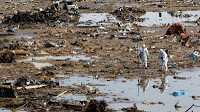
Reuters: Kim Kyung-Hoon
by Chris Carrington
Activist Post
November 6, 2013
Experts at NOAA are becoming increasingly concerned not just about the debris from Fukushima that is arriving on our shores, but with the non-native bugs, germs and even sea life that is arriving with it.
“At first we were only thinking about objects like the floating docks, but now we’re finding that all kinds of Japanese organisms are growing on the debris,” John Chapman of the Marine Science Center at Oregon State University told Fox News.
“We’ve found over 165 non-native species so far,” he continued.”One type of insect, and almost all the others are marine organisms … we found the European blue mussel, which was introduced to Asia long ago, and then it grew on a lot of these things that are coming across the Pacific … we’d never seen it here, and we don’t particularly want it here.” (source)
Guam faced the same problem with brown tree snakes that were inadvertently taken to the island on an American ship some 60 years ago. Dead mice laced with acetaminophen were dropped onto the island in an attempt to wipe out the infestation. You can read more here.
Scientists are concerned that non-native species will alter the ecosystem and reduce or wipe out some native species. As big a worry would be viruses and germs getting into the United States that have not been a problem here before.
Although they are playing down the risk of radioactive contamination, it’s logical to assume that some of the debris is contaminated. The days of beachcombing for washed up treasure is sadly gone. Anything washed up along the California coast should be treated with suspicion and reported to the appropriate authorities so that it can be removed.
Chris Carrington is a writer, researcher and lecturer with a background in science, technology and environmental studies. Chris is an editor for The Daily Sheeple, where this first appeared. Wake the flock up!
VIDEO — Fuku Emergency Documentary Coming Soon Ebisu Studios
Rad Chick
November 5, 2013
Watch for it ~~ November 24, 2013
Fukushima Fraud and Corruption: Japanese Organized Crime Involved in Recruitment of “Specialized Personnel”
by Prof Michel Chossudovsky
Global Research
October 25, 2013

What prevails is a well organized camouflage. The public health disaster in Japan, the contamination of water, agricultural land and the food chain, not to mention the broader economic and social implications, have neither been fully acknowledged nor addressed in a comprehensive and meaningful fashion by the Japanese authorities.
The crisis in Japan has been described as “a nuclear war without a war”. In the words of renowned novelist Haruki Murakami:
“This time no one dropped a bomb on us … We set the stage, we committed the crime with our own hands, we are destroying our own lands, and we are destroying our own lives.”
Several Global Research reports and background articles have outlined the dangers of Worldwide radiation resulting from the Fukushima disaster.
This disaster is now being sustained and aggravated by the incompetence of TEPCO as well as political camouflage by the Abe government.
Fukushima and the Yakuza
There is another dimension: The coordination of the multibillion dollar Fukushima decontamination operation relies on Japan’s organized crime, the Yakusa, which is actively involved in the recruitment of “specialized” personnel for dangerous tasks.
“The complexity of Fukushima contracts and the shortage of workers have played into the hands of the yakuza, Japan’s organized crime syndicates, which have run labor rackets for generations.” (Reuters, October 25, 2013)
The Yakuza labor practices at Fukushima are based on a corrupt system of subcontracting, which does not favor the hiring of competent specialized personnel. It creates an environment of fraud and incompetence, which in the case of Fukushima could have devastating consequences. The subcontracting with organized crime syndicates is a means for major corporations involved in the clean-up to significantly reduce their labor costs.

 PN
PN 