
VIDEO — Philladelphia Smokedown Prohibition V The Full Story
Adam VS The Man
June 13, 2013
This is definitive video of what went down at the Philly Smoke Down Prohibition 5.
Buy agorist! Get your metals from http://agoristmetals.com
Please address love mail to adam@adamvstheman.com
Donate Bitcoin: 1BWeuWdgjrP8PFAwBwgwU9BUqJNewScouy
Get your AVTM shirts here:
http://adamvstheman.com/gear
Invest here to support ADAM VS THE MAN!
http://adamvstheman.com/invest
Cannabis Provides Dramatic Benefit for Chronic Diseases
 by Elizabeth Renter
Natural News
June 8, 2013
Marijuana research is not new; nor is the research finding a link between marijuana use and improved health. And while users of the plant have been doing their own “case studies” for centuries (or more), I’m referring to the lab research that the scientific and medical communities seem to opt for. Scientists have been studying the plant for some time, but only recently has marijuana research become such a front-page issue. Now, as nearly 20 states currently have medical marijuana laws in place and two have even gone so far as to legalize recreational marijuana, the studies of this once-counter-culture “party drug” have taken on a new legitimacy.
We’ve seen studies linking cannabis to the annihilation of cancer cells, to those that show it has useful applications in the treatment of epilepsy, chronic pain conditions, and even in the treatment of ADHD and Alzheimer’s. Considering many of these diseases and conditions are top revenue-generators for Big Pharmaceutical companies, one has to wonder what kind of hit their pockets would take if legalization ever occurred.
Such potential damage to these powerful corporations could have something to do with the fact that many cannabis studies are buried or discredited for not being scientifically valid, and the fact that these researchers have a far more difficult time getting funding for their work than those researchers looking to develop the next money-making pill.
One such study that you may have missed—with truly amazing findings—involved a group of elderly residents at an Israeli nursing home.
Researchers with Tel Aviv University evaluated 19 patients, between the ages of 69 and 101 for a period of one year. Prior to the study, these men and women suffered from chronic pain, muscle spasms, tremors and lack of appetite. Some were underweight and some were overweight; they experienced health concerns common to the typical aging population. But unlike the rest of the aging populous, the participants were given cannabis three times a day, either through smoking, oil, powder, or vapor.
Of the 19 participants, 17 achieved a healthy weight within the year, losing or gaining weight as needed. Pain symptoms and inflammation decreased while mobility and fluidity increased. The patients experienced fewer muscle spasms and less dramatic tremors. Nearly all of them slept better and had a decreased incidence of nightmares and PTSD flashbacks.
Perhaps most notable of all, “By the end of the study, 72 percent of participants were able to reduce their drug intake by an average of 1.7 medications a day.” The patients were previously on medications for a variety of concerns, and the study resulted in a decline in the use of drugs for Parkinson’s, pain, and mood stabilizers and anti-psychotics.
If the results of this study were able to be recreated on a massive scale, imagine how that would affect Big Pharma. Imagine their loss. Now, ask yourself why the federal government is so resistant to ending the prohibition of this healing plant.
Additional Sources:
MUST SEE — History… Debate: Larken Rose vs. Tom Willcutts (Anarchy vs. Authority)
Tragedy and Hope
March 7, 2013
History… So It Doesn’t Repeat: A debate on the concepts of “authority”, “government”, and the “state”, featuring author Larken Rose vs. attorney Tom Willcutts. After the debate, visit http://www.LarkenRose.com to learn more about “The Most Dangerous Superstition”. Would you like to Know More? http://www.TragedyandHope.com & http://www.PeaceRevolution.org watch our films, download and listen to our podcasts, grow in the light direction!
Would You Like to Know More?
MORE EPISODES of HISTORY… http://www.youtube.com/playlist?list=…
USEFUL LINKS
T&H dot com: http://www.TragedyandHope.com
T&H online Research & Development community: https://www.tragedyandhope.com/subscr…
Follow on Twitter: http://twitter.com/TragedyandHope
Watch on YouTube: http://www.youtube.com/TragedyandHopeMag
Subscribe to the Peace Revolution podcast produced by T&H: http://www.PeaceRevolution.org
Like on Facebook: https://www.facebook.com/TragedyandHo…
Also on Facebook: https://www.facebook.com/theultimateh…
Screen The Ultimate History Lesson: http://www.youtube.com/playlist?list=…
Link to Richard’s brain model: https://www.tragedyandhope.com/the-br…
ABOUT TRAGEDY AND HOPE: SUMMARY, PURPOSE, FORM, AND FUNCTION
Tragedy and Hope provides a portal through which individuals can discover, identify, and integrate useful tools, resources, and activities which stimulate and fortify Cognitive Liberty, providing primary sources, research, and educational methods which facilitate consciousness.
Tragedy and Hope’s purpose is to enable individuals to research and form groups of independent thinkers to solve humanity’s most pressing problems, by identifying the etiology (study of the cause-and-effect origins) and thus understanding our way toward the solutions we seek.
Tragedy and Hope’s form and function (free to the public) enables hundreds-of-thousands of people around the world, to experience open-source education without upper-limits, and it is therein where the solutions are discovered- by making the problems truly known and understood at a root-cause level.
Tragedy and Hope creates, produces, and publishes educational content to help adults understand the world they live in and thereby, develop true self-confidence and serenity of mind; our content focuses on history, philosophy, economics, anthropology, science, communications, and every topic which pertains to learning how to survive and thrive in this world.
Tragedy and Hope is funded by those who tune-in to our productions, and the members of the Tragedy and Hope online critical thinking and research community, who subscribe after witnessing the value provided, and voluntarily deciding to contribute in a way to ensure we can continue producing educational media with integrity and consistency. Sacrifice the Tragedy, Preserve the Hope.
https://www.tragedyandhope.com/th-ori…
#N3
VIDEO — Our Elections Are Not Fairer Than Iran’s – Mahdi Nazemroaya
108morris108
June 16, 2013
When Iran is compared to other countries, its democracy looks more balanced than others.
VIDEO — What Iranians want from next president
PressTV
June 16, 2013
What Iranians want from next president
The new president in Iran will take office in a few weeks and naturally will make some changes both in domestic and international policies. Experts believe the new administration should be seen by other countries as a chance for resetting ties with Iran. Ordinary people say, under any circumstances Iran must keep its principle and at the same time efforts must be made to remove or ease the unilateral sanctions of the west. Meanwhile, other experts believe improving relations with the international community could help Iran’s economy see better days.
Ehsane Keyvani, Press TV, Tehran
Follow our Facebook on: https://www.facebook.com/presstv
Follow our Twitter on: http://twitter.com/presstv
Follow our Tumblr on: http://presstvchannel.tumblr.com
Turkey Protests: Government Targets Doctors Who Treated Injured Demonstrators
Doctors who treated protesters wounded in clashes with riot police in Turkey are to be investigated by the government in a move likely to inflame tensions further.
 By Timur Moon
IBTimes
June 17, 2013
The Health Ministry had demanded a list of the names of all doctors who treated demonstrators from the Turkish Medical Association (TBB), the association said on Friday 14 June.
The TBB estimates that 7,500 people have been injured in the unrest, the overwhelming number suffering from teargas exposure.
The association said it was ordered to “immediately” give up the names of medical workers and their patients, but had vowed not to co-operate.
“We were notified that an investigation has been launched into the improvised clinics that treated the protesters,” said Osman Öztürk of the TBB.
The authorities also signalled they would take steps to close down media outlets that broadcast images of demonstrations last week.
Turkey’s state television regulator shut down one channel that offered continuous live coverage of the protests. Hayat TV went off air “for broadcasting from abroad without a licence”, the Radio and Television Supreme Council said.
On Tuesday, the regulator fined Hayat TV and three stations that ran extensive coverage of the protests for “encouraging people to violence”.
On Friday night, the BBC suspended its partnership with NTV after the private channel refused to air the Turkish version of the World Agenda programme.
However, the government was forced to back down on plans to redevelop Gezi park in Istanbul, which sparked the protests last month. Police were criticised for the heavy-handedness of their response to the initial protests.
Recep Tayyip Erdogan, the prime minister, agreed to abide by a court decision on his plan to uproot Gezi Park. He said he would hold a referendum if the court rules in favour of it.
“If judiciary in the end allows the project we’ll still apply the public vote,” he said. “It won’t be a military barracks but a city museum – 80% of trees will be within the city museum, the rest will be planted around the complex.”
Taksim Solidarity, one group representing the protesters, hailed the move as “positive”.
The government also turned its sights on Twitter, demanding the company set up a local division as “they receive advertising revenue without paying a penny in tax”.
Police have arrested a number of people who are accused of stirring up protests by posting messages on the site, including information on the position of police lines.
Related Articles You Might Like:
- Turkey’s Taksim Square Drenched in Blood as 900 Protesters Are Arrested (Extremely Graphic …
- Turkey: Protesters Drive Bulldozer to Prime Minister Erdogan’s Office (Video)
- Photos: Turkey Media Shows Cooking, Pet Shows as 1+ Million Protest
- Activists in Turkey Present Their List of Demands
- Turkish Police Arrest Dozens of Social Media Users For Posting About Protests
- Istanbul’s Skies ‘Filled with Teargas’ as Thousands of Police Storm Square
- Timeline of Events in Turkey: Police Escalate Attacks, Including on Healthcare Workers and Doctors
- Police to Consider Protesters in Istanbul’s Taksim Square “Terrorists”
Canada Being Assimilated Into a U.S. Dominated North American Security Perimeter
by Dana Gabriel
BE YOUR OWN LEADER
June 17, 2013
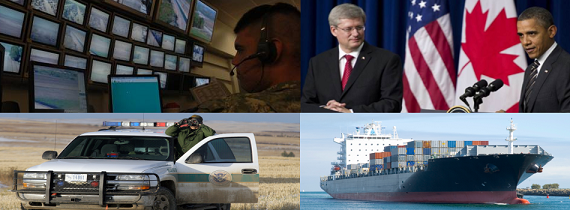
Canada’s prime minister recently addressed the CFR, a globalist think tank who have been a driving force behind the push towards deeper North American integration. The U.S. and Canada are now further advancing this agenda through the Beyond the Border agreement. Both countries are increasing bilateral border transportation and infrastructure coordination. This includes a common approach to border management, security and control. They are also integrating an information sharing system that would be used to track everyone crossing the U.S.-Canada border and entering or leaving the continent. Without much fanfare and seemingly little resistance, Canada is being assimilated into a U.S. dominated North American security perimeter.
In May, the Conservative government highlighted the benefits of the U.S.-Canada Beyond the Border action plan which was announced back in 2011. The deal, “focuses on addressing security threats at the earliest point possible and facilitating the lawful movement of people, goods, and services into Canada and the United States, and creates a long-term partnership to improve the management of our shared border.” The goal is to further increase, “security, economic competitiveness and prosperity through numerous measures, including reducing border wait times and improving infrastructure at key crossings to speed up legitimate trade and travel.” The Beyond the Border Executive Steering Committee recently met to discuss the objectives that have already been achieved and the work that still needs to be done. Another important facet of the economic and security perimeter agreement is the Regulatory Cooperation Council action plan. A stakeholder dialogue session is planned for June 20, which will review its implementation progress and will seek further input regarding the next stage of U.S.-Canada regulatory integration.
Last month, the Canada Border Services Agency (CBSA) and the Department of Homeland Security (DHS) released a joint report on the findings of Phase I of the Entry/Exit Information System. The program included collecting and exchanging biographic information at four selected land border ports of entry. In a news release, U.S. Customs and Border Protection (CBP) Acting Commissioner Thomas Winkowski stated that, “The results of Phase I demonstrate the capacity of the United States and Canada to increase information sharing capabilities.” He added, “This kind of cooperation epitomizes the Beyond the Border Action Plan.” The next phase of the entry/exit initiative is set to begin at the end of this month. It will involve exchanging the data collected from third-country nationals and permanent residents of Canada and the U. S. at all common ports of entry. Both countries are further merging databases and are expanding surveillance and intelligence gathering operations. In 2014, they will also start sharing biometric information at the border. This will further advance the creation of a North America security perimeter where all travellers will be tracked and traced in real time.
As part of the commitment made under the Beyond the Border deal, both countries have announced the Border Infrastructure Investment Plan which was, “developed to establish a mutual understanding of recent, ongoing and potential border infrastructure investments. It outlines the approach that Canada and the United States will take to coordinate plans for physical infrastructure upgrades.” In June 2012, Canada reached an agreement with the State of Michigan to build a second bridge between Detroit and Windsor, Ontario. This was followed by a presidential permit issued in April of this year that officially paved the way for construction of the project. A U.S. State Department press release explained that, “Consistent with the bilateral Beyond the Border Initiative, this permit contributes to ensuring that our border infrastructure supports increased competitiveness, job creation, and broad-based prosperity in the United States and Canada.” It went on to say that the new bridge, “will help to meet future capacity requirements in a critical travel corridor, promote cross-border trade and commerce, and advance our vital bilateral relationship with Canada.”
In March, DHS Secretary Janet Napolitano and Canada’s Minister of Public Safety Vic Toews signed a memorandum of understanding which established a truck cargo pre-inspection pilot project. The joint undertaking is another component of the Beyond the Border agreement and would shift inspections and clearances away from the actual border crossing. The first phase, “will test the concept of conducting U.S. CBP primary cargo inspection in Canada, and will be implemented at the Pacific Highway crossing between Surrey, British Columbia and Blaine, Washington.” The second phase, “will further test how pre-inspection could enhance border efficiency and reduce wait times to facilitate legitimate trade and travel, and will be implemented at the Peace Bridge crossing between Fort Erie, Ontario and Buffalo, New York.” The perimeter security deal is laying the foundation for a future U.S.-Canada binational organization that would jointly manage and control the border.
The CBSA is also testing additional technology at the Morses Line, Quebec and Piney, Manitoba ports of entry. Under the remote traveller pilot project, people entering either location after regular hours of service, “will be processed by a border services officer located at a remote processing centre through a two-way audio and one-way video kiosk. Cameras will be installed to provide the officer with the ability to see the traveller and the vehicle.” The program which could later be expanded to other areas , “is part of the Small and Remote Ports of Entry Initiative, one of the deliverables under the Beyond the Border Action Plan.” NAUNEWZ pointed out that, “Although a lot of this technology is already installed and being utilized in limited ways at most of the main Canada-U.S. border crossing points, these smaller border crossings are ideal testing grounds for their ‘no borders’/NAU agenda.”
On May 16, Canadian Prime Minister Stephen Harper participated in question and answer session before the Council on Foreign Relations (CFR). The conversation centered around economic growth, foreign investment and the role of the G20 with regards to global governance. Other issues focused on Canada-U.S. relations. Harper lobbied for approval of the controversial Keystone XL pipeline which would carry oil from western Canada to the Texas gulf coast. He dismissed environmental issues associated with the project and argued that it would be a step towards North American energy independence. The Obama administration is expected to make a final decision on the pipeline sometime this year. Harper also acknowledged the Beyond the Border and the Regulatory Cooperation Council action plans. He blamed sovereignty concerns and the continued negativity surrounding NAFTA as the main obstacles to even deeper continental integration. Prime Minister Harper used his audition in front of the CFR as an opportunity to demonstrate to the U.S. political and corporate elite that he is committed to defending the interests of big business and further pushing plans for a North American Union (NAU).
The Beyond the Border action plan is the most significant step forward in U.S.-Canada cooperation since NAFTA. It provides the framework for future North American integration. When fully implemented, the agreement can be expanded and updated. So far, the agenda has quietly slipped under the radar. By incrementally incorporating various pilot projects and excluding Mexico from the process, it has managed to avoid the controversy of past initiatives. The perimeter security deal is being sold as vital to improving the flow of trade and travel across the border. In order to appease U.S. fears, Canada has made numerous concessions with no guarantees that it will lessen border restrictions. As part of a North American security perimeter, Canada will always be at the mercy of any new U.S. security measures, regardless of the dangers they may pose to privacy and civil liberties.
Related articles by Dana Gabriel:
U.S.-Canada Harmonizing Border Security and Immigration Measures
Taking the U.S.-Canada Partnership to the Next Level
Merging U.S.-Canada Arctic Foreign Policy
The Return of ACTA: U.S. Dictating Canada’s Intellectual Property Laws
Dana Gabriel is an activist and independent researcher. He writes about trade, globalization, sovereignty, security, as well as other issues. Contact: beyourownleader@hotmail.com Visit his blog at Be Your Own Leader


