On July 9, the FBI is shutting down servers put in place following the end of “Operation Ghost Click”, an investigation into a ‘click fraud’ ring out of Estonia, and thousands of Canadians could be affected.
All computers that still use these servers will meet a virtual brick wall on July 9 and be unable to connect to the internet until their computers are cleared of the associated ‘DNSChanger’ virus.
The shutdown of the temporary DNS servers by U.S. authorities is the last stage in Operation Ghost Click, a two-year international investigation that officially ended in November 2011.
The FBI, in association with international law enforcement, managed to track and apprehend six Estonians using an ostensibly legitimate front company who had organized a sophisticated system of false DNS servers.
Think again, think seven times again before you leap
and start construction of new nuclear power plants.
Mikhail Gorbachev June 2006
Fukushima radiation has traveled the globe. Much of the fallout follows the atmospheric jet stream and has blanketed Alaska, Canada, the U.S. Pacific northwest, U.S. west coast and U.S. mid-west.
A fallout map, based only on one of the six reactors melting down, shows the widespread deposition of nuclear particles across a huge geographic region.
Chronological Graphs on Concentration in the Air [aCi/m3]
Plutonium 239 in California (past 20 years)
Uranium 234 in Alaska (past 20 years)
Uranium 238 in Hawaii (past 20 years)
Such sudden increase of radioactive materials, as indicated in the above graphs, are a direct result of Fukushima. These regions where increased amount of plutonium and uranium were detected are downwind of Japan.
The closest places are Guam, Hawaii, Alaska and California. If you compare the numbers after March 11 between California (8700 km = 5400 miles from Japan) and Guam (2500 km = 1550 miles from Japan), Guam has detected 78 times higher plutonium 239, 6 times higher uranium 234, 16 times higher uranium 235 and 13 times higher uranium 238 than California.
Radiation fallout patterns have long taught us that the closer one is to the source of contamination the higher the radiation exposure. Heavy nuclear particles fall to the ground quite quickly thus thinning quickly as the distances open up.
Being downwind of an atomic explosion or nuclear meltdown is not healthy, for people in close proximity will absorb that many more radioactive particles from the air, water and food.
It is only getting worse
TEPCO, the operator of Japan’s crippled Fukushima nuclear plant, said Wednesday record amounts of radiationhad been detected in the basement of reactor number 1, further hampering clean-up operations.
TEPCO took samples from the basement after lowering a camera and surveying instruments through a drain hole in the basement ceiling. Radiation levels above radioactive water in the basement reached up to 10,300 millisievert an hour, a dose that will kill humans within a short time after making them sick within minutes.
The annual allowed dose for workers at the stricken site is reached in only 20 seconds.
“Workers cannot enter the site and we must use robots for the demolition,” said TEPCO. The Fukushima operator said that radiation levels were 10 times higher than those recorded at the plant’s two other crippled reactors, number two and three
. This was due to the poor state of the nuclear fuel in the reactor compared to that in the two others.
Radioactive material released from Fukushima was detectable all across the northern hemisphere 12-15 days after the accident. An official monitoring station in Iceland detected radioactive isotopes indicating that the plume had reached Europe on March 20.
But now we hear from Chris Busby, who says he is monitoring, that no radiation has reached England where he is. Is this possible? (A client of mine had personal communications with him. This information needs to be verified.)
For the first four weeks, the radioactive materials remained confined to the northern hemisphere but by April 13 radioactive isotopes were detected at stations located in Australia, Fiji, Malaysia and Papua New Guinea indicating that it had reached the southern hemisphere.
Within two weeks the whole northern atmosphere was affected. The radioactive plume next travelled to eastern Russia (March 14) and then crossed the Pacific towards the North American continent to Europe and to Central Asia.
The dominant radionuclides were xenon isotopes and especially Xe-133 together with I-131, Cs-134, and Cs-137, and further short-lived radionuclides like Te-132 and I-132 were also detected. Sadly, plutonium has been detected indicating early on the meltdown of spent-fuel assemblies.
According to the Nuclear Information Resource Center (NIRS), this plutonium-uranium fuel mixture is far more dangerous than typical enriched uranium—a single milligram (mg) of MOX is as deadly as 2,000,000 mg of normal enriched uranium.
On March 14, Unit 3 of the Fukushima reactor exploded, sending a huge smoke plume into the air. This particular reactor, of course, contains the rods fueled with MOX.
The MOX plan was a key component of the Japanese nuclear cycle and was supposed to allow reuse of spent fuel, resulting in a self-contained cycle.
However, reprocessing has turned out to be more expensive than simply disposing of spent fuel by burying it, and the process itself has encountered numerous technical difficulties and public opposition.
Japan currently has 35 tons of plutonium stored worldwide, and hopes to produce another half-ton within the next nine months, raising global concerns that terrorists might obtain some of it and produce nuclear bombs.
This is all pure insanity setting the stage for the fulfillment of Hal Lindsey’s book, The Late Great Planet Earth.
The Late, Great Planet Earth was the first Christian prophecy book to be picked up by a secular publisher (Bantam, 1973) and sold 28 million copies by 1990.
I read this book during my first year at Northeastern University in 1974 and was deeply disturbed by it. The feelings were not related to the specifics but to a general feeling that from two thousand years ago biblical authors were already previewing trends that were already visible in the early 70s.
The New York Times called it the “No. 1 non-fiction bestseller of the decade.” For Christians and non-Christians of the 1970s, Hal Lindsey’s blockbuster served as a wake-up call on events soon to come and events already unfolding.
The planet Earth may indeed be close to “late” simply because we have failed to face the real problems that confront us in a reasonable way.
The book portrays much that has been true for decades, stories about famine, pollution and the destructive potential of our war machines, but the Japanese and the Americans, who built most of the Japanese nuclear industry, went over the top with MOX fuel, which is banned in most countries around the world that use nuclear power.
In 20 years it has become clear that not tens, hundreds or
thousands, but millions of people in the Northern hemisphere
have suffered and will suffer from the Chernobyl catastrophe.
Dr. Alexey V. Yablokov
Russian Academy of Sciences
More than a third of Britain is still contaminated by radioactivity from the Chernobyl disaster two decades ago, and children are getting cancer as a result.
An investigation published in London on April 22, 2006, shows that at least 34% of the country will remain radioactive for centuries as the result of the accident.
In Britain, about 81,000 sq km (31,000 sq miles)—mainly in Northern Ireland, Scotland, Wales and the west of England—were contaminated above 4,000 bequerels per square metre. The report says the radioactive caesium—and the doses of radiation it gives Britons—will only “decline slowly over the next few hundred years.”
One type of contamination reinforces and strengthens the other so medical treatments need to simultaneously address both chemical toxicity and radiation poisoning.
Exposure to radiation causes a cascade of free radicals that wreak havoc on the body. Radiation also decimates the body’s supply of glutathione, thus allowing free radicals to run rampant through our tissues and organs.
The Chernobyl incident was a major humanitarian disaster resulting in a plethora of health problems that are still far from being fully recognized.
Most studies analyzing the medical consequences of this catastrophe have so far focused on diseases such as thyroid cancer, leukemia, immune and autoimmune pathology[1],[2] even though an increase in the incidence of type 1 diabetes mellitus, a disorder involving the immune system, was observed within the residential population of Hiroshima among survivors of the atom bomb detonation.[3]
Studies have also shown that thymectomy and a sub-lethal dose of gamma radiation induces type 1 diabetes in rats.[4]
Public health officials across the board tend to grossly underestimate the dangers[5] and medical officials are out there claiming, as usual, that toxic substances are actually good for your children. They say that about mercury and they say that about radiation.
Dr. Herman Muller, who has received a Nobel Prize for his work, has shown how the human race’s continuous exposure to so-called “low-level” radiation is causing a gradual reduction in its ability to survive, as successive generations are genetically damaged.
“The spreading and accumulation of even tiny genetic mutations pass through family lines, provoking allergies, asthma, juvenile diabetes, hypertension, arthritis, high blood cholesterol conditions, and muscular and bone defects.”
Special Note—If you think there is nothing to worry about consider the fact that the cooling system for the spent fuel pool at the crippled Fukushima Daiichi power plant’s No. 4 reactor automatically shut down Saturday the 30th of June.
Temperatures began to rise but fortunately, according to reports, they reestablished cooling on Sunday. I have written that humanity is hanging by a thread in terms of our vulnerability to building number four coming down.
Radiation at the plant continues to increase so it is possible the day will arrive that no repairs can be made and the fuel pool will overheat to the point where it will all go up in flames.
[1] Kuzmenok O, Potapnev M, Potapova S et al. (2003) Late effects of the Chernobyl radiation accident on T-cell-mediated immunity in cleanup workers. Radiat Res 159: 109-116
[2] Lomat L, Galburt G, Quastel MR, Polyakov S, Okeanov A, Rozin S (1997) Incidence of childhood disease in Belarus associated with the Chernobyl accident. Environ Health Perspect [Suppl 105] 6:1529-1532
[3] Ito C (1994) Trends in the prevalence of diabetes mellitus among Hiroshima atomic bombsurvivors. Diabetes Res Clin Pract [Suppl]:S29-S35
[4] Ramanathan S, Bihoreau MT, Paterson AD, Marandi L, Gauguier D, Poussier P (2002) Thymectomy and radiation-induced type 1 diabetes in nonlymphopenic BB rats. Diabetes 51:2975-2981
[5] It could be possible, for instance, that a mere .001 rise in the rem could generate an increase globally in sickness. And the proximity of the source of rem increase may be less relevant than we think. Long-term exposure to >0.001 increased rem overall may be actually be quite profound. Our knowledge of the effects of radiation derives primarily from groups of people who have received high doses, so in reality medical science knows and understands very little about low-level risks.
As some 500 000 Haitians still live in displaced camps, five star hotels are being built amid shanty towns.
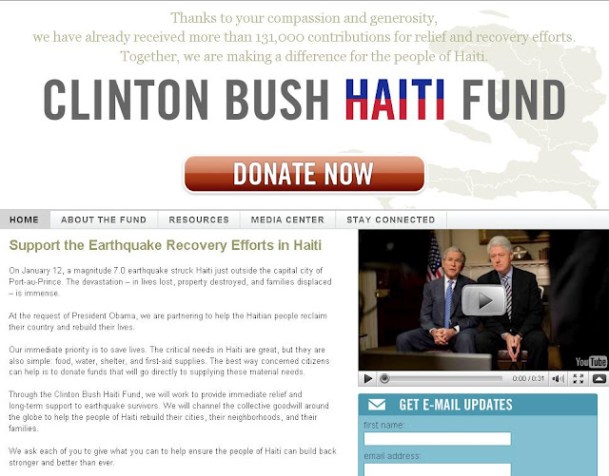
As part of the country’s “Reconstruction”, The Clinton-Bush Haiti Fund recently invested $2 million in the Royal Oasis Hotel, a deluxe structure to be built in a poverty-stricken metropolitan area “filled with displaced-persons camps housing hundreds of thousands”. Royal Oasis belongs to a Haitian investment group (SCIOP SA) and will be managed by the Spanish chain Occidental Hotels & Resorts.
AP reported in April that funds raised by the former US Presidents to help the neediest Haitians are now being used to build a hotel for “rich foreigners” including tourists as well many foreign NGO “aid workers” currently in Haiti. (Daniel Trenton, AP: New hotels arise amid ruins in Haitian capital, Clinton Bush Haiti Fund, April 29, 2012)
It is worth noting that Western governments have insisted that aid money for Haiti be given to NGOs and foundations rather than to the Haitian government, which they consider to be “corrupt”.
In the aftermath of the January 2010 earthquake, people in the US, Canada and the EU, who made donations to those humanitarian organisations and NGOs did not realize that their contribution to Haiti’s reconstruction would be channeled towards the building of five star hotels to house foreign businessmen. Their expectation was that the money would be used to provide food and housing for the Haitian people.
The Royal Oasis as well as other hotel projects totalling over $100 million are, according to AP, “raising hopes that thousands of [foreign] investors will soon fill their air-conditioned rooms looking to build factories and tourist infrastructure” (emphasis added)
The “10-story building […] will include an art gallery, three restaurants, a commercial bank and high-end shops. Construction on the Royal Oasis began before the earthquake and is expected to finish by the end of the year.” The earthquake was therefore a blessing for the hotel promoter and contractors, bringing $2 million dollars originally raised to “go directly to supplying these material needs [food, water, shelter, first-aid supplies]” (see add below). Among the companies involved in the construction of the Royal Oasis two are Haitian, one is Canadian (Montreal) and the other American (Miami).
Foreign Aid: Who Benefits?
Foreign “aid” often benefits NGOs of the donor country as well as the local business elites in the recipient country. The Council on Hemispheric Affairs has blamed both Bill Clinton as well previous U.S. presidents for having maintained Haiti in conditions of “endemic poverty through a self-serving U.S. rice export policy […] By 2003, approximately 80% of all rice consumed in Haiti was imported from the United States.” (Leah Chavla,Bill Clinton’s Heavy Hand on Haiti’s Vulnerable Agricultural Economy: The American Rice Scandal, Council on Hemispheric Affairs, April 13, 2010.)
Last January iWatch News reported:
According to [U.S] government figures, 1,537 contracts had been awarded [to U.S. Companies] for a total of $204,604,670, as of last fall. Only 23 of the contracts went to Haitian companies, totaling $4,841,426. (Marjorie Valbrun, Haitian firms few and far between on reconstruction rosters, iWatch News, January 11, 2012.)
The International Finance Corporation (IFC), a division of the World Bank, has also invested $7.5 million in the project, claiming it will “create employment, generate business opportunities for small businesses and promote sustainable development.” Since 2006, $68.6 millions have been invested by IFC in the Haitian private sector. Despite those investments, the per capita GDP in Haiti has seen very little improvement during that period. There is a fine line between slavery and an average $2 a day salary, which ousted president Jean Bertrand Aristide wanted to abolish prior to his overthrow in a US-French-Canadian sponsored Coup d’Etat. (La Société Financière Internationale (IFC) investit dans un projet hôtelier en Haiti pour supporter les efforts de reconstruction, IFC, June 30, 2010.)
“The good news” is that the project will create jobs for Haitians. The Oasis foundation has also created a program to train workers for the tourism industry. The project promoter, Jerry Tardieu told AP “the new hotels will help more people get out of the camps by giving them jobs to pay for rent on homes being rehabilitated by government and non-profit organizations.” He says 600 people have been employed for the hotel’s construction and once open and running, 250 to 300 new jobs will be created. On top of the $2 million invested in the hotel, a modest grant of $264,000 goes to the “Oasis Hotel’s nonprofit arm, the Oasis Foundation […] bolstering the hospitality sector by reopening l’École Hôtelière Haitienne (the Haiti Hotel School) […] (Clinton Bush Haiti Fund, Programs: Oasis). Basically those funds are used to make comfortable hotel rooms, lounges and cafes for foreigners and “train Haitians to serve them ” in a congenial five star environment.
While, Haiti was lacking in hotel rooms in the wake of the earthquake and job creation is a key to poverty reduction, a majority of the population still live in makeshift shelters of cardboard, scrap metal and old bed sheets. People struggle to have water to drink and food on their table — and in many cases they do not have a table. Meanwhile, the construction of luxury hotels for foreigners is a number one priority, in comparison to “housing for the locals”.
Tourism Minister Stephanie B. Villedrouin “said all of those [850] hotel rooms [destroyed in the earthquake] will have been replaced by the end of the year […] Villedrouin said Port-au-Prince officially has a 60 percent occupancy rate but many of the hotels are too rustic for international travelers [including the NGO, World Bank and USAID staff on mission to Haiti].”(AP, op cit, emphasis added)
The “international travelers” are the unspoken victims of rudimentary and rustic hotel accomodation when on mission to Haiti, according to Mariott’s executive Alejandro Acevedo. “Marriott International, …is building a $45 million, 174-room hotel [in Haiti] in partnership with mobile phone company Digicel Group.” Marriott’s Acevedo complained that “even he had to share a room with his boss on a recent visit because of the dearth of hotel space.”
Camp near Royal Oasis (AP Photo/Ramon Espinosa)
Meanwhile, most Haitians live in overcrowded camps such as Champ de Mars camp in Port-au-Prince, “densely packed with shacks made from bed sheets, tarpaulin and scrap metal, which provide flimsy shelter for some 17,000 people.” Forced evictions also take place regularly, according to AlertNet. (Anastasia Moloney, Haiti‘s homeless face housing lottery, AlertNet, February 23, 2012.)
The AP report confirms that the International Federation of Red Cross and Red Crescent Societies (IFRC) bought land for $10.5 million and are also thinking of building a hotel: “The money came from donations raised by national Red Cross agencies for quake recovery, causing some to wonder if the money would be better used to house displaced people rather than aid workers.” (AP, op. cit, emphasis added).
Where did the money come from? Where did that money go?
Millions of people in the US, Canada and Western Europe donated part of their savings to their local Red Cross, which was then channeled to the IFRC, the world’s largest humanitarian umbrella organization. The IFRC claims to be “providing assistance without discrimination as to nationality, race, religious beliefs, class or political opinions.” (See IFRC website, emphasis added)
This land purchase by IFRC not only violates its humantiarian mandate but also the trust of its constituent Red Cross and Red Crescent organizations worldwide. Red Cross donations should have supported the IFRC’s stated mandate pertaining to “shelter recovery and settlement planning”, in a post-disaster environment as clearly stated on the IFC website:
“Most people who have lost their homes through a disaster want to repair or rebuilt their homes as soon as possible. Many start the reconstruction process immediately after a disaster, whenever circumstances and resources permit. Shelter assistance provided by the International Federation of Red Cross and Red Crescent Societies (IFRC) recognises this, and where appropriate prioritises the provision of materials, tools, cash and technical assistance to support the process.” (emphasis added)
Haiti’s Comeback
According to the AP report: “Signs of Haiti‘s comeback can also be seen in the 105-room Best Western hotel being built within blocks of shanty-covered hillsides.” The five star Best Western project is worth $15.7 million and is located in the plush city of Petionville. The “first US hotel in Haiti” is funded by local investors but will be managed by a Dallas firm and is expected to create 150 jobs. (Ibid.)
While several hotels are being built to provide “room and board” for potential foreign investors, very few homes are being built for locals and “the vast majority of construction has been temporary shelters with a life span between two, maximum five years”, according to Gerardo Ducos from Amnesty International. (AlertNet, op. cit.)
In order to shut down the Champ de Mars camp, which would be tantamount to the expulsion of more than 17,000 people, a controversial Haitian government program funded by Canada has been offering 500$ to dwellers who leave and find a home elsewhere. In practice this project leads to the de facto expropriation of slum dwellers in high value central downtown area of Port-au-Prince. While the amount is enough to pay the rent for a year, Ducos wonders: “What happens to the people when their rent money runs out in a year?” (Ibid.).
Will there be enough jobs for them in the hotel industry?
Will the salaries be high enough to pay the rent?
A lot of unanswered questions remain.
Julie Lévesque is a journalist and researcher with the Centre for Research on Globalization (CRG), Montreal. She was among the first independent journalists to visit Haiti in the immediate wake of the January 2010 earthquake.
Warns Syria about defending its own borders – brazen act of war, crime against world peace ignored by feckless United Nations. by Tony Cartalucci
June 29, 2012 – After losing a fighter jet earlier this month while conducting a high-speed, low altitude invasion of Syria’s airspace, Turkey has now pledged to treat any Syrian operation along its borders as a military threat.
“Turkey’s warning could tilt the dynamic along the border, which has become an incubator for Syrian antigovernment rebels who are seeking increased levels of international support. Turkey’s pledge to respond to aggression from Syrian forces could help the rebel Free Syrian Army by deterring Syrian forces from attacking—or else result in Turkish retaliation for cross-border attacks on rebels,” reported the Wall Street Journal in their article, “Turkey Warns of Retaliation Against Syria.” This encapsulates the brazen warping of logic applied by NATO aggressors as they seek to perpetuate the bloodbath and destabilization caused by their own proxy forces, primarily harbored, armed, and deployed from NATO member Turkey.
Syrian Rebels are Al Qaeda Terrorists
By US officials’ own admissions, since 2007 a combined US-Israeli-Saudi effort to assemble and deploy against Syria and Iran an army of sectarian extremists drawn from the ranks of Al Qaeda and its affiliates has been underway. In Seymour Hersh’s 2007 New Yorker article, “The Redirection,” he reported, “The U.S. has also taken part in clandestine operations aimed at Iran and its ally Syria. A by-product of these activities has been the bolstering of Sunni extremist groups that espouse a militant vision of Islam and are hostile to America and sympathetic to Al Qaeda.”
Within Hersh’s report, not only is this army of fanatical terrorists described as being fully backed by the West in order to create a sectarian bloodbath to be used to achieve Western foreign policy objectives, but it was fully anticipated that this army would commit abhorrent atrocities, particularly against ethnic and religious minorities throughout the region. In particular former CIA agent Robert Baer in Lebanon warned about the fate of Christians located in the region.
Also mentioned was the Syrian chapter of the Muslim Brotherhood, who by 2007 was already receiving significant backing from the West and Israel to destabilize Syria – despite its feigned anti-Western, anti-Israeli rhetoric.
As clandestine military operations became larger in scale and more difficult for the complicit Western media to obfuscate, it was announced that hundreds of fighters as well as torrents of weapons and cash began flowing into Syria from NATO-armed terrorists in Libya. The Al Qaeda affiliated Libyan Islamic Fighting Group (LIFG) (a US State Department listed terrorist organization – #28) led by Abdul Hakim Belhaj, spearheaded efforts to bolster what is essentially a foreign terrorist operation in Syria beginning as early as November 2011, according to the London Telegraph.
In addition to LIFG terrorists admittedly entwined with the so-called “Free Syrian Army” (FSA), more recent reports indicate that Iraqi terrorists have also joined their ranks. Reuters in their article, “Outgunned Syria rebels make shift to bombs,” admit that not only is the FSA conducting a terrorist bombing campaign against the people of Syria, but that it is facilitated by rebels who “fought with Al Qaeda elements in Iraq” and learned their bombing skills while attacking both sectarian Iraqi targets as well as Western troops.
Ironic indeed, that the US in particular is backing entirely terrorist forces that thousands of Americans have shed their blood allegedly fighting in the “War on Terror.” It appears that Al Qaeda, admittedly a creation of the CIA in the 1980’s to draw in and fight Soviets in Afghanistan, is still patronized by the West and used as both a convenient casus belli as well as a terrorist proxy force against enemies of Western foreign policy.
Turkey is Helping
According to the New York Times, “a small number of C.I.A. officers are operating secretly in southern Turkey, helping allies decide which Syrian opposition fighters across the border will receive arms to fight the Syrian government, according to American officials and Arab intelligence officers.” While the Times article attempts but fails to allay fears that the FSA is in fact a terrorist front, the real significance of the article is that it confirms Turkey is serving as a willing conduit to harbor, arm, and deploy terrorist forces against neighboring Syria – a crime against world peace.
The Gulf States, which provided the bulk of the “hijackers” allegedly behind the September 11, 2001 attacks on the World Trade Center and the Pentagon, are now the primary weapons and cash suppliers for the FSA, with Saudi Arabia leading the way – as Seymour Hersh reported they would be in 2007. These weapons, according to the UK Independent, are being transferred to terrorists via Turkey. It is also reported that the Syrian Muslim Brotherhood then distributes the weapons once they make their way into Syria – belying the narrative that the unrest is anything but an foreign-facilitated extremist terror campaign.
Perhaps most disturbing is a report published by Michael Weiss of the Neo-Con corporate-financier funded (beginning on page 18, .pdf) Henry Jackson Society, titled, “Syrian rebels say Turkey is arming and training them.” In the report, Weiss claims that, “rebel sources in Hatay told me last night that not only is Turkey supplying light arms to select battalion commanders, it is also training Syrians in Istanbul. Men from the unit I was embedded with were vetted and called up by Turkish intelligence in the last few days and large consignments of AK-47s are being delivered by the Turkish military to the Syrian-Turkish border.”
Weiss can hardly be considered a reliable source, and is just as likely fabricating his entire narrative for the purpose of psychologically targeting Syria. However, Turkey has made no attempts to refute such claims, made more frequently and by an increasing number of sources. Turkey is admittedly serving as a conduit for weapons, and is most likely participating in a more direct role to train, arm, fund, and support terrorists operating along the Turkish-Syrian border.
And despite all of this, the United Nations has remained mute over these transgressions, acts of war, and crimes against world peace. While it feigns outrage over the violence in Syria, it has failed categorically to identify the driving forces behind it – namely the unending torrent of weapons, cash, and foreign fighters flowing over Syria’s borders – supplied by NATO and its Gulf State partners.
Turkey Plays Pivotal Role in Psychologically Breaking Syria
Turkey is clearly harboring a terrorist front within its borders and facilitating their violent-subversive actives within Syrian borders. While the US and NATO hypocritically use a similar narrative to justify cross-border raids into Pakistan, it is attempting to tie Syria’s hands from even operating up to and along its own border to stem very real, admitted terrorist networks maintained by NATO and their Gulf State partners.
The goal of NATO is to create enough chaos in Syria, long enough, to shake the Syrian people’s faith in their government and their armed forces by dividing and destroying Syria’s national institutions. Just as in Libya, such divisions brought on by unwarranted panic will accelerate, not stem the violence. The stated goal by Western policy makers is to create divisions, doubt, and defections – and they are trying to achieve this through a combination of propaganda, economic sanctions, and overt Western-backed terrorism. They pursue this course of action because a full-scale military operation is untenable, as is the prospect of their terrorist proxies achieving any meaningful tactical victory. Syria, by remaining united and exhibiting perseverance will defeat NATO aggression.
Libya proves that capitulation is not an option, with sectarian genocide the result, subjecting capitulators, defectors, and even NATO’s hand-picked proxies to post-Qaddafi violence and mayhem. There is no option but to continue resisting.
At a July 6th, 2011 meeting of the Friends of Syria conference in Paris, the United States and its European Partners led calls for the implementation of new sanctions on Syrian President Bashar al-Assad’s government, with US Secretary of State Hilary Clinton threatening Russia and China for their stance on the issue. French Foreign Minister Laurent Fabius called on the UN to invoke Chapter 7 of the UN Charter, mandating economic sanctions, an arms embargo, and potentially, military force. UN Envoy to Syria Kofi Annan admitted his six point peace plan had not succeeded and later criticized those nations undermining the plan by providing arms and assistance to Syria’s rebel fighters. Assad would not rule out direct negotiations with Washington and stated, “as long as you offer any kind of support to terrorists, you are partner. Whether you send them armaments or money or public support, political support in the United Nations, anywhere.”
It is the Tribes that make Libya what it is. Without them the culture will disappear. The tribal elders have hitherto managed conflicts and resolutions.