
Canada Being Assimilated Into a U.S. Dominated North American Security Perimeter
by Dana Gabriel
BE YOUR OWN LEADER
June 17, 2013
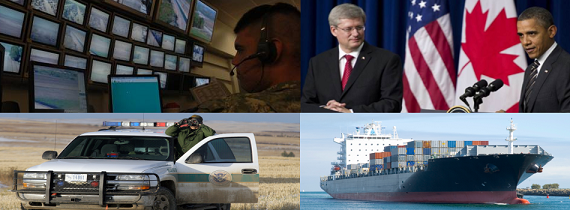
Canada’s prime minister recently addressed the CFR, a globalist think tank who have been a driving force behind the push towards deeper North American integration. The U.S. and Canada are now further advancing this agenda through the Beyond the Border agreement. Both countries are increasing bilateral border transportation and infrastructure coordination. This includes a common approach to border management, security and control. They are also integrating an information sharing system that would be used to track everyone crossing the U.S.-Canada border and entering or leaving the continent. Without much fanfare and seemingly little resistance, Canada is being assimilated into a U.S. dominated North American security perimeter.
In May, the Conservative government highlighted the benefits of the U.S.-Canada Beyond the Border action plan which was announced back in 2011. The deal, “focuses on addressing security threats at the earliest point possible and facilitating the lawful movement of people, goods, and services into Canada and the United States, and creates a long-term partnership to improve the management of our shared border.” The goal is to further increase, “security, economic competitiveness and prosperity through numerous measures, including reducing border wait times and improving infrastructure at key crossings to speed up legitimate trade and travel.” The Beyond the Border Executive Steering Committee recently met to discuss the objectives that have already been achieved and the work that still needs to be done. Another important facet of the economic and security perimeter agreement is the Regulatory Cooperation Council action plan. A stakeholder dialogue session is planned for June 20, which will review its implementation progress and will seek further input regarding the next stage of U.S.-Canada regulatory integration.
Last month, the Canada Border Services Agency (CBSA) and the Department of Homeland Security (DHS) released a joint report on the findings of Phase I of the Entry/Exit Information System. The program included collecting and exchanging biographic information at four selected land border ports of entry. In a news release, U.S. Customs and Border Protection (CBP) Acting Commissioner Thomas Winkowski stated that, “The results of Phase I demonstrate the capacity of the United States and Canada to increase information sharing capabilities.” He added, “This kind of cooperation epitomizes the Beyond the Border Action Plan.” The next phase of the entry/exit initiative is set to begin at the end of this month. It will involve exchanging the data collected from third-country nationals and permanent residents of Canada and the U. S. at all common ports of entry. Both countries are further merging databases and are expanding surveillance and intelligence gathering operations. In 2014, they will also start sharing biometric information at the border. This will further advance the creation of a North America security perimeter where all travellers will be tracked and traced in real time.
As part of the commitment made under the Beyond the Border deal, both countries have announced the Border Infrastructure Investment Plan which was, “developed to establish a mutual understanding of recent, ongoing and potential border infrastructure investments. It outlines the approach that Canada and the United States will take to coordinate plans for physical infrastructure upgrades.” In June 2012, Canada reached an agreement with the State of Michigan to build a second bridge between Detroit and Windsor, Ontario. This was followed by a presidential permit issued in April of this year that officially paved the way for construction of the project. A U.S. State Department press release explained that, “Consistent with the bilateral Beyond the Border Initiative, this permit contributes to ensuring that our border infrastructure supports increased competitiveness, job creation, and broad-based prosperity in the United States and Canada.” It went on to say that the new bridge, “will help to meet future capacity requirements in a critical travel corridor, promote cross-border trade and commerce, and advance our vital bilateral relationship with Canada.”
In March, DHS Secretary Janet Napolitano and Canada’s Minister of Public Safety Vic Toews signed a memorandum of understanding which established a truck cargo pre-inspection pilot project. The joint undertaking is another component of the Beyond the Border agreement and would shift inspections and clearances away from the actual border crossing. The first phase, “will test the concept of conducting U.S. CBP primary cargo inspection in Canada, and will be implemented at the Pacific Highway crossing between Surrey, British Columbia and Blaine, Washington.” The second phase, “will further test how pre-inspection could enhance border efficiency and reduce wait times to facilitate legitimate trade and travel, and will be implemented at the Peace Bridge crossing between Fort Erie, Ontario and Buffalo, New York.” The perimeter security deal is laying the foundation for a future U.S.-Canada binational organization that would jointly manage and control the border.
The CBSA is also testing additional technology at the Morses Line, Quebec and Piney, Manitoba ports of entry. Under the remote traveller pilot project, people entering either location after regular hours of service, “will be processed by a border services officer located at a remote processing centre through a two-way audio and one-way video kiosk. Cameras will be installed to provide the officer with the ability to see the traveller and the vehicle.” The program which could later be expanded to other areas , “is part of the Small and Remote Ports of Entry Initiative, one of the deliverables under the Beyond the Border Action Plan.” NAUNEWZ pointed out that, “Although a lot of this technology is already installed and being utilized in limited ways at most of the main Canada-U.S. border crossing points, these smaller border crossings are ideal testing grounds for their ‘no borders’/NAU agenda.”
On May 16, Canadian Prime Minister Stephen Harper participated in question and answer session before the Council on Foreign Relations (CFR). The conversation centered around economic growth, foreign investment and the role of the G20 with regards to global governance. Other issues focused on Canada-U.S. relations. Harper lobbied for approval of the controversial Keystone XL pipeline which would carry oil from western Canada to the Texas gulf coast. He dismissed environmental issues associated with the project and argued that it would be a step towards North American energy independence. The Obama administration is expected to make a final decision on the pipeline sometime this year. Harper also acknowledged the Beyond the Border and the Regulatory Cooperation Council action plans. He blamed sovereignty concerns and the continued negativity surrounding NAFTA as the main obstacles to even deeper continental integration. Prime Minister Harper used his audition in front of the CFR as an opportunity to demonstrate to the U.S. political and corporate elite that he is committed to defending the interests of big business and further pushing plans for a North American Union (NAU).
The Beyond the Border action plan is the most significant step forward in U.S.-Canada cooperation since NAFTA. It provides the framework for future North American integration. When fully implemented, the agreement can be expanded and updated. So far, the agenda has quietly slipped under the radar. By incrementally incorporating various pilot projects and excluding Mexico from the process, it has managed to avoid the controversy of past initiatives. The perimeter security deal is being sold as vital to improving the flow of trade and travel across the border. In order to appease U.S. fears, Canada has made numerous concessions with no guarantees that it will lessen border restrictions. As part of a North American security perimeter, Canada will always be at the mercy of any new U.S. security measures, regardless of the dangers they may pose to privacy and civil liberties.
Related articles by Dana Gabriel:
U.S.-Canada Harmonizing Border Security and Immigration Measures
Taking the U.S.-Canada Partnership to the Next Level
Merging U.S.-Canada Arctic Foreign Policy
The Return of ACTA: U.S. Dictating Canada’s Intellectual Property Laws
Dana Gabriel is an activist and independent researcher. He writes about trade, globalization, sovereignty, security, as well as other issues. Contact: beyourownleader@hotmail.com Visit his blog at Be Your Own Leader
VIDEO — Canada spies on Canadians
PressTV
June 13, 2013
The Canadian government has been spying on its people by monitoring their telephone records and Internet data, Press TV reports.
Canadian newspaper The Globe and Mail reported on June 10 that Defense Minister Peter MacKay had approved a “metadata” surveillance program in 2011 that tracks online activity and phone calls in search of suspicious activities.
However, in response to a question whether the Ottawa government was monitoring the phone and email records of the Canadian people, MacKay claimed that the “program is specifically prohibited from looking at the information of Canadians.”
“This program is very much directed at activities outside the country, foreign threats in fact,” he added.
The program, introduced by the former Liberal government in 2005, was put on hold on account of concerns that it could lead to warrantless surveillance of Canadians.
But according to the daily, the program was quietly reinstated in 2011, after MacKay signed a ministerial directive, which is not subject to parliamentary scrutiny.
VIDEO — Hamilton Police Killed A Citizen— Upper Wentworth, Licoln Alexander Embankment UPDATE
 by Frankie Gotz
Canadian Awareness Network
June 13, 2013
Hamilton Spectator
By Bill Dunphy
….
“Police had responded to calls for a man walking into traffic on the Lincoln Alexander Expressway near Upper Wentworth. He was ordered off the highway, complied and climbed up the embankment towards his townhouse.
The officers followed him behind a berm where, shortly thereafter, witnesses heard between three and eight rapid-fire gunshots.”
Continue Reading… (thespec.com)
For previous article on this topic which shows when police are allowed to use legal force and also exposes the Special Investigations Unit , click HERE.
Just as promised in previous article I told you we’d keep you updated. The man who got shot on June 7th 2013 is known as Steve Mesic, who has a child on the way with his wife that he left behind. While Warren, Rob and I were doing street activism and raising awareness downtown Hamilton about these issues, we sychronisitically ran into one of Steve’s friends who described Steve as a non violent person who never got into trouble with police. At the exact same time another of one Steve friends driving in vehicle stopped and told us Steve was one of the best guys in the world. From the sounds of it Steve was a good guy and it comes as a shock to the people that know him, that police would perceive him as a threat.
On the day of the shooting Steve just checked himself out of the hospital after voluntarily admitting himself for a 72 hour assessment. No known details as to what his problem was or how he was feeling when he left. He was found walking home on the highway which is unusual. The police were called because of complaint of Steve walking on the highway and shortly after he was shot dead.
In all fairness, in my opinion Steve was temporarily mentally ill, speculating he had some type of depression which could’ve been the reason why he checked himself into the hospital. Now I could be wrong but all there is left is speculation because no one from the family will talk. I only found his name out accidentally by running into his friends on the street.
Chief of Hamilton Police, Glenn De Caire, at a community meeting, stated that when dealing with mentally ill people police are trained to defuse the situation and to get the person the help they need. He also stated the police are only allowed to use lethal force in accordance with the Use Of Force Model. It seems like these officers did not exercise and execute the training they were taught. When I called De Caire up to confront and tell him he should hold the officers accountable for their actions, his secretary informed me that he went on a couple week vacation. Did he go on vacation to avoid people that would like to talk to him about this matter? Or maybe he’s on vacation spending $44,410 in donations from Enbridge Pipelines Inc. They say it’s for equipment but you never know, wouldn’t be hard to pocket a few thousand.
The officers names have not been released by Hamilton Police or the SIU and will only be released if they are convicted of a crime. If they are not convicted we will be left in the dark until someone exposes it.
This has got to end. Not all police officers are corrupt, power hungry and have psychopathic tendencies. But you’d be a fool to believe that there is no such thing as corrupt, power hungry psychopathic cops. They exist and they should be tried for their crimes like the rest of us. Proper filtration systems need to be put into the hiring process to prevent psychopaths from being hired onto police services.
For full news report on Steve Mesic incident please click play below, includes interviews with his friends and recorded conversations with Hamilton Police and SIU:
Click HERE for video report exposing Ryan Tocher, Hamilton Police officer who has killed unarmed citizens.
Brutal attack on Ottawa inmate cited in scathing report on Ontario jail guards
by Sean McKibbon
Metro
June 11, 2013

Ombudsman Andre Marin is seen at the Ontario legislature in Toronto on Tuesday, June 11, 2013 following the release of his report into jail guard brutality. Marin said some correctional staff are beating prisoners, then falsifying reports or otherwise covering up their actions. (Image credit: THE CANADIAN PRESS/Colin Perkel)
A mentally ill inmate was the victim of a violent attack by a the Ottawa Carleton Detention Centre, according to the Ontario’s ombudsman, who is warning that the province’s jail guards are brutalizing inmates and then covering up the abuse.
In a report released today, Andre Marin slams what he calls the “code of silence” around the problem.
His report says some correctional staff have committed “brazen acts of violence.”
Hamilton cops still mum on shooting death

A 45-year-old man was shot and killed by Hamilton police Friday morning in the area of Upper Wentworth and the Lincoln Alexander Parkway.
by Bill Dunphy
TheSpec.com
June 11, 2013
When a 45-year-old Hamilton man died in a rapid burst of gunfire last Friday morning only three people were present. One of them is dead and the other two aren’t talking.
The province’s Special Investigations Unit confirmed late Monday afternoon that, 3½ days after the shooting, their investigators have not yet been able to interview the two police officers on scene when the distraught man was shot multiple times.
Police had responded to calls for a man walking into traffic on the Lincoln Alexander Expressway near Upper Wentworth. He was ordered off the highway, complied and climbed up the embankment towards his townhouse.
The officers followed him behind a berm where, shortly thereafter, witnesses heard between three and eight rapid-fire gunshots.
[hat tip: Frankie Gotz]
Growing medical marijuana at home to be illegal in 2014: Health Canada
by Joe Lofaro
Metro
June 10, 2013

A marijuana grow-op is pictured in this file photo.
Sweeping changes to the ways Canadians will be able to access medical marijuana are on the horizon.
It will be illegal for Canadians to grow medical marijuana in their homes as of April 1, 2014, Federal Health Minister Leona Aglukkaq announced Monday. By then, Health Canada will no longer sell and distribute marijuana for medical purposes and it will only be accessible through a licensed provider approved by the federal government.
The number of Canadians under the Marijuana Medical Access Program has surged from 500 in 2001 to more than 30,000 today, Aglukkaq said.
[hat tip: Emmanuel Buckshi]
Anti-fracking arrests continue on highway 126

Patles taken into custody. [Photo: M. Howe]
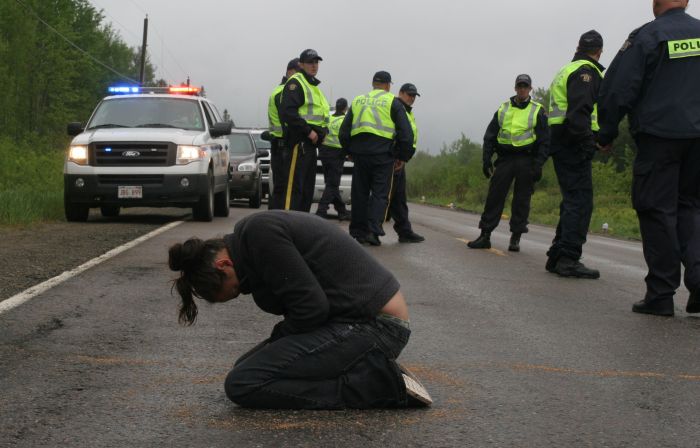
Susanne Patles in prayer, as New Brunswick RCMP confer. [Photo: M. Howe]
Halifax Media Co-op
June 9, 2013
ELSIPOGTOG, NEW BRUNSWICK – About 25 RCMP officers in uniform, along with about a dozen police cruisers, today continued to flank equipment owned by gas exploration company SWN Resources Canada as they proceeded with their seismic testing of highway 126 in Kent County, New Brunswick.
Pushing the scattered crowd of Indigenous and non-Indigenous people back “50 metres distance” from the southward approaching seismic trucks – or ‘thumpers’ – the RCMP first arrested one demonstrator and chased another into the woods before arresting Susanne Patles.
Patles, a Mi’kmaq woman, had scattered a line of tobacco between herself and the approaching police, then proceeded to draw a circle of tobacco in the highway, where she then knelt and began to pray. After about two minutes, the police proceeded to arrest Patles. An officer Bernard noted that she was being charged with mischief.
[hat tip: Louise Koster]

RCMP arrest Patles. [Photo: M. Howe]

 PN
PN 
