
The Confiscation of Bank Savings to “Save the Banks”: The Diabolical Bank “Bail-In” Proposal
by Prof Michel Chossudovsky
Global Research
April 2, 2013
 Is the Cyprus Bank “Bail-in” a “dress rehearsal” for things to come?
Is a “Savings Heist” in the European Union and North America envisaged which could result in the outright confiscation of bank deposits?
In Cyprus, the entire payments system has been disrupted leading to the demise of the real economy.
Pensions and wages are no longer paid. Purchasing power has collapsed.
The population is impoverished.
Small and medium sized enterprises are spearheaded into bankruptcy.
Cyprus is a country with a population of one million.
What would happen if similar ‘hair cut” procedures were to be applied in the U.S. or the European Union?
According to the Washington based Institute of International Finance (IIF) (right) which represents the consensus of the global financial establishment, “the Cyprus approach of hitting depositors and creditors when banks fail, would likely become a model for dealing with collapses elsewhere in Europe.” (Economic Times, March 27, 2013).
It should be understood that prior to the Cyprus onslaught, the confiscation of bank deposits had been contemplated in several countries. Moreover, the powerful financial actors who triggered the bank crisis in Cyprus, are also the architects of the socially devastating austerity measures imposed in the European Union and North America.
Does Cyprus constitute a “model” or scenario?
Are there “lessons to be learned” by these powerful financial actors, to be applied elsewhere, at some later stage, in the Eurozone’s banking landscape?
 According to the Institute of International Finance (IIF), “hitting depositors” could become the “new normal” of this diabolical project, serving the interests of the global financial conglomerates.
This new normal is endorsed by the IMF and the European Central Bank. According to the IIF which constitutes the banking elites mouthpiece, “Investors would be well advised to see the outcome of Cyprus… as a reflection of how future stresses will be handled.” (quoted in Economic Times, March 27, 2013)
“Financial Cleansing”. Bail-ins in the US and Britain
What is at stake is a process of “financial cleansing” whereby the “too big to fail banks” in Europe and North America (e.g. Citi, JPMorgan Chase, Goldman Sachs, et al ) displace and destroy lesser financial institutions, with a view to eventually taking over the entire “banking landscape”.
The underlying tendency at the national and global levels is towards the centralization and concentration of bank power, while leading to the dramatic slump of the real economy.
Bail ins have been envisaged in numerous countries. In New Zealand a “haircut plan” was envisaged as early as 1997 coinciding with Asian financial crisis.
There are provisions in both the UK and the US pertaining to the confiscation of bank deposits. In a joint document of the Federal Deposit Insurance Corporation (FDIC) and the Bank of England, entitled Resolving Globally Active, Systemically Important, Financial Institutions, explicit procedures were put forth whereby “the original creditors of the failed company “, meaning the depositors of a failed bank, would be converted into “equity”. (See Ellen Brown, It Can Happen Here: The Bank Confiscation Scheme for US and UK Depositors,Global Research, March 2013)
What this means is that the money confiscated from bank accounts would be used to meet the failed bank’s financial obligations. In return, the holders of the confiscated bank deposits would become stockholders in a failed financial institution on the verge of bankruptcy.
Bank savings would be transformed overnight into an illusive concept of capital ownership. The confiscation of savings would be adopted under the disguise of a bogus “compensation” in terms of equity.
What is envisaged is the application of a selective process of confiscation of bank deposits, with a view to collecting debt while also triggering the demise of “weaker” financial institutions. In the US, the procedure would bypass the provisions of the Federal Deposit Insurance Corporation (FDIC) which insures deposit holders against bank failures:
No exception is indicated for “insured deposits” in the U.S., meaning those under $250,000, the deposits we thought were protected by FDIC insurance. This can hardly be an oversight, since it is the FDIC that is issuing the directive. The FDIC is an insurance company funded by premiums paid by private banks. The directive is called a “resolution process,” defined elsewhere as a plan that “would be triggered in the event of the failure of an insurer . . . .” The only mention of “insured deposits” is in connection with existing UK legislation, which the FDIC-BOE directive goes on to say is inadequate, implying that it needs to be modified or overridden. (Ibid)
Because depositors are provided with a bogus compensation, they are not eligible to the FDIC deposit insurance.
Canada’s Deposit Confiscation Proposal
The most candid statement of confiscation of bank deposits as a means to “saving the banks” is formulated in a recently released document of the Canadian government entitled “Jobs, Growth and Long Term Prosperity: Economic Action Plan 2013″.
The latter was submitted to the House of Commons by Canada’s Minister of Finance Jim Flaherty on March 21 as part of a so-called “pre-budget” proposal.
A short section of the 400 report entitled “Risk Management Framework for Domestic Systemically Important Banks” identifies bail-in procedure for Canada’s chartered banks. The word confiscation is not mentioned. Financial jargon serves to obfuscate the real intent which essentially consists in stealing people’s savings.
Under the Canadian “Risk Management” project:
The Government proposes to implement a ‘bail-in’ regime for systemically important banks.
This regime will be designed to ensure that, in the unlikely event that a systemically important bank depletes its capital, the bank can be recapitalized and returned to viability through the very rapid conversion of certain bank liabilities into regulatory capital.”
This will reduce risks for taxpayers. The Government will consult stakeholders on how best to implement a bail-in regime in Canada.
What this signifies is that if one or more banks (or credit unions) were obliged to “systemically deplete their capital” to meet the demands of their creditors, the banks would be recapitalized through “the conversion of certain bank liabilities into regulatory capital.”
The “certain bank liabilities” pertains (in technical jargon) to the money they owe their customers, namely to their depositors, whose bank accounts would be confiscated in exchange for shares (equity) in a “failing” banking institution.
“This will reduce risks for taxpayers” is a nonsensical statement. What this really means is that the government will not provide funding to compensate depositors who are victims of a failed banking institution, nor will it come to rescue of the failed institution.
Instead the depositors will be obliged to give up their savings. The money confiscated will then be used by the bank to meet their liabilities contracted with major financial creditor institutions. In other words, this entire scheme is “a safety net” for too big to fail banks, a mechanism which enables them as creditors to overshadow lesser banking institutions including credit unions, while precipitating either their collapse or their takeover.
Canada’s Financial Landscape
The Risk Management Bail in initiative is of crucial significance for Canadians across the land: once it is adopted by the House of Commons as part of the budget package, the Bail-in procedures could be applied.
The Conservative government has a parliamentary majority. There is a good likelihood that the Economic Action Plan 2013″ which includes the Bail-in procedure will be adopted.
While Canada’s Risk Management Framework intimates that Canada’s banks “are at risk”, particularly those which have accumulated large debts (as a result of derivative losses), a generalised across the board application of the “Bail in” is not contemplated.
 The likely scenario in the foreseeable future is that Canada’s “big five” banks, Royal Bank of Canada, TD Canada Trust, Scotiabank, Bank of Montreal and CIBC (all of which have powerful affiliates operating in the US financial landscape) will consolidate their position at the expense of lesser (provincial level) banks and financial institutions.
The Government document intimates that the Bail-in could be used selectively “in the unlikely event that one [bank] becomes non-viable.” What this suggests is that at least one or more of Canada’s “lesser banks” could be the object of a bail-in. Such a procedure would inevitably lead to a greater concentration of bank capital in Canada, to the benefit of the larger financial conglomerates.
Displacement of Provincial Level Credit Unions and Cooperative Banks
There is an important network of over 300 provincial level credit unions and cooperative banks including the powerful Desjardins network in Quebec, the Vancouver City Savings Credit Union (Vancity) and the Coastal Capital Savings in British Columbia, Servus in Alberta, Meridian in Ontario, the caisses populaires in Ontario (affiliated to Desjardins), among many others, which could be the target of selective “Bail-in” operations.
In this context, what is likely to occur is a significant weakening of provincial level cooperative financial institutions, which have a governance relationship to their members (including representative councils) and which, in the present context, offer an alternative to the Big Five chartered banks. According to recent data, there are more than 300 credit unions and caisses populaires in Canada which are members of the “Credit Union Central of Canada”.
New Normal: International Standards Governing the Confiscation of Bank Deposits
 Canada’s Economic Action Plan 2013″ acknowledges that the proposed Bail-in framework “will be consistent with reforms in other countries and key international standards”. Namely, the proposed pattern of confiscating bank deposits as described in the Canadian government document is consistent with the model contemplated in the US and the European Union. This model is currently a “talking point” (behind closed doors) at various international venues regrouping central bank governors and finance ministers.
The regulatory agency involved in these multilateral consultations is the Financial Stability Board (FSB) based in Basel, Switzerland and hosted by the Bank for International Settlements (BIS) (image right). The FSB happens to be chaired by the governor of the Bank of Canada, Mark Carney, who was recently appointed by the British government to head the Bank of England starting in June 2013.
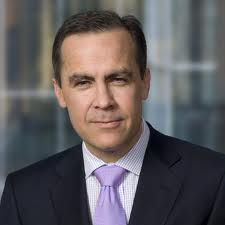 Mark Carney, as Governor of the Bank of Canada, was instrumental in shaping the provisions of the Bail-in for Canada’s chartered banks. Before his career in central banking, he was a senior executive at Goldman Sachs, which has played a behind the scenes role in the implementation of the bank bailouts and austerity measures in the EU.
The FSB’s mandate would be to coordinate the bail-in procedures, in liaison with the “national financial authorities” and “international standard setting bodies” which include the IMF and the BIS. It should come as no surprise: the deposit confiscation procedures in the UK, the US and Canada examined above are remarkably similar.
Bank “Bail-ins” vs. Bank “Bail-outs”
The bailouts are “rescue packages” whereby the government allocates a significant portion of State revenues in favor of failed financial institutions. The money is channeled from the coffers of the State to the banking conglomerates.
In the US in 2008-2009, a total of $1.45 trillion was channeled to Wall Street financial institutions as part of the Bush and Obama rescue packages.
These bailouts were considered as a De facto government expenditure category. They required the implementation of austerity measures. Together with massive hikes in military expenditure, the bailouts were financed through drastic cuts in social programs including Medicare, Medicaid and Social Security.
In contrast to the Bailout, which is funded from the public purse, the “Bail-in” requires the (in-house) confiscation of bank deposits. The bail-ins are implemented without the use of public funds. The regulatory mechanism is established by the central bank.
At the outset of Obama’s first term in January 2009, a bank bailout of the order of $750 billion was announced by Obama, which was added on to the 700 billion dollar bailout money allocated by the outgoing Bush administration under the Troubled Assets Relief Program (TARP).
The total of both programs was a staggering 1.45 trillion dollars to be financed by the US Treasury. (It should be understood that the actual amount of cash financial “aid” to the banks was significantly larger than $1.45 trillion. In addition to this amount defence allocations to fund Obama’s war economy (FY 2010) was a staggering $739 billion. Namely the bank bailouts plus defence combined ($2189 billion) eat up almost the totality of the federal revenues which in FY 2010 amounted to $2381 billion.
Concluding remarks
What is occurring is that the bank bailouts are no longer functional. At the outset of Obama’s Second term, the coffers of the state are empty. The austerity measures have reached a deadlock.
The bank bail-ins are now being contemplated instead of the “bank bailouts”.
The lower and middle income groups which are invariably indebted will not be the main target. The appropriation of bank deposits would essentially target the upper middle and upper income groups which have significant bank deposits. The second target will be the bank accounts of small and medium sized firms.
This transition is part of the evolution of the global economic crisis and the impasse underlying the application of the austerity measures.
The purpose of the global financial actors is to wipe out competitors, consolidate and centralize bank power and exert an overriding control over the real economy, the institutions of government and the military.
Even if the bail-ins were to be regulated and applied selectively to a limited number of failing financial institutions, credit unions, etc, the announcement of a program of confiscation of deposits could potentially lead to a generalized “run on the banks”. In this context, no banking institution would be regarded as safe.
The application of Bail-in procedures involving deposit confiscation (even when applied locally or selectively) would create financial havoc. It would interrupt the payments process. Wages would no longer be paid. Purchasing power would collapse. Money for investment in plant and equipment would no longer be forthcoming. Small and medium sized businesses would be precipitated into bankruptcy.
The application of a Bail-In in the EU or North America would initiate a new phase of the global financial crisis, a deepening of the economic depression, a greater centralization of banking and finance, increased concentration of corporate power in the real economy to the detriment of regional and local level enterprises.
In turn, an entire global banking network characterized by electronic transactions (which govern deposits, withdrawals, etc), –not to mention money transactions on the stock and commodity markets– could potentially be the object of significant disruptions of a systemic nature.
The social consequences would be devastating. The real economy would plummet as a result of the collapse in the payments system.
The potential disruptions in the functioning of an integrated global monetary system could result in a a renewed global economic meltdown as well as a drop off in international commodity trade.
It is important that people across the land, in the European Union and North America, nationally and internationally, forcefully act against the diabolical ploys of their governments –acting on behalf of dominant financial interests– to implement a selective process of bank deposit confiscation.
ORDER DIRECTLY FROM GLOBAL RESEARCH

The Global Economic Crisis: The Great Depression of the XXI Century
Michel Chossudovsky and Andrew Gavin Marshall, Editors$16.00
Save 38%
About the author:
Michel Chossudovsky is an award-winning author, Professor of Economics (emeritus) at the University of Ottawa, Founder and Director of the Centre for Research on Globalization (CRG), Montreal and Editor of the globalresearch.ca website. He is the author of The Globalization of Poverty and The New World Order (2003) and America’s “War on Terrorism”(2005). His most recent book is entitled Towards a World War III Scenario: The Dangers of Nuclear War (2011). He is also a contributor to the Encyclopaedia Britannica. His writings have been published in more than twenty languages. He can be reached at crgeditor@yahoo.com
Articles by: Prof Michel Chossudovsky
Related content:
-

The Confiscation of Savings in Canada? Cyprus-Style “Bail-Ins” Proposed by Ottawa Government
The politicians are coming after your bank accounts. Ottawa’s “Economic Action Plan 2013″ which the Harper government has submitted to Parliament, proposes a ‘bail-in’ regime which allows “the conversion of certain bank liabilities into regulatory capital.”
-

The Cyprus Bank Battle: The Long-planned Deposit Confiscation Scheme
“If these worries become really serious, . . . [s]mall savers will take their money out of banks and resort to household safes and a shotgun.” — Martin Hutchinson on the attempted EU raid on private deposits in Cyprus banks…
-

It Can Happen Here: The Bank Confiscation Scheme for US and UK Depositors
Confiscating customer deposits in Cyprus banks was not a one-off, desperate idea, a joint paper by the US Federal Deposit Insurance Corporation and the Bank of England dated December 10, 2012, shows that these plans have been long in the making
-

A previous article called them the new normal. Bad ideas spread fast. Canada endorses Cypriot harshness. Its “Jobs Growth and Long-Term Prosperity: Economic Action Plan 2013″ says so. On March 21, it was submitted. It endorsed depositor haircuts. It did…
Canadian Deposits As Safe As Cypriot Deposits
 by Jeff Berwick
Activist Post
April 1, 2013
Rest easy, Canadians, for your bank accounts are going to be made as safe as those bank accounts in Cyprus. Just take a look at the Canadian government’s budget plan for 2013, particularly pages 144 and 145 of Economic Action Plan 2013. There the Canadian government promises to use Canadian deposits to save “systematically important” banks (emphasis ours).
The Government proposes to implement a “bail-in” regime for systemically important banks.This regime will be designed to ensure that, in the unlikely event that a systemically important bank depletes its capital, the bank can be recapitalized and returned to viability through the very rapid conversion of certain bank liabilities into regulatory capital. This will reduce risks for taxpayers. The Government will consult stakeholders on how best to implement a bail-in regime in Canada. Implementation timelines will allow for a smooth transition for affected institutions, investors and other market participants.
Those bank liabilities that will be allowed to be converted into regulatory capital? Those include customer accounts. Apparently bailing “out” banks with tax money is too 2012. Now bail “ins” with customer money are all the rage.
When a bank deemed “systematically important” finds itself in trouble, taxpayers won’t be on the hook to provide the funds to rescue the bank from its bad decisions. Instead the bank will get to look inward, toward its own customers and the funds in their accounts. The Cypriot model is catching on.
The report says “in the unlikely event” that one of the banks becomes “non-viable.” How do you think not having to worry about losses will affect the bankers’ attitude toward risk, however? We’d say that this government-guaranteed ability to raid deposits will make the banks act more recklessly and also guarantee that the deposits will raided. The big banks in Canada will get to take on enormous risks in pursuit of greater profits for themselves without having to worry about their losses. After all, any losses will now be covered by the bank customers money that they put in their with the crazy notion that it would be safe from theft.
Before you chuckle at the silly Canucks who thought they’d be safe, ask yourself if your bank account is really safe too. Because this legal right for the banks to steal deposits is becoming the new normal all across the Western World. It’s well on its way to becoming the law in Europe as early as 2015. The European Commission has already written a draft of the law which will protect deposits under 100,000 euros, but which will treat deposits over that amount as capital that can be “bailed in”, i.e. stolen to make up losses.
Personally, I cannot understand how anyone in Canada, the US or anywhere in the Western World could think even for a second that their money is safe in a bank, especially these days as The End Of The Monetary System As We Know It (TEOTMSAWKI) is forcing the governments and banks to show their true colors and just outright take people’s money. They aren’t even bothering to hide their larceny with inflation or borrowing anymore. The banks are the first line in the government-corporate offensive against individuals. Keeping your money in the bank at this point is like giving the keys to your house to a family of kleptomaniacs with pyromaniac tendencies. Don’t be surprised if all your stuff ends up getting swiped and your house is burned to ground.
Also, due to recent legislative reform, Canadian securities held by those with domicile in Canada can no longer be traded in accounts held in other parts of the world. Non-Canadian banks have been sending letters to their Canadian customers to inform them that they must sell or transfer any Canadian securities held in their accounts by an April 5 deadline. Canadians can’t even transact with an offshore broker who isn’t registered in their specific PROVINCE. Even US slaves are a bit freer in this regard as they only have to file with the SEC. Of course, the best of all worlds is to unslave yourself entirely by getting a passport in a freer country so you can let go of your US or Canadian slave card. The barriers for doing business outside their nation-state’s borders will only increase for Americans and Canadians.
We believe that there will be a lot more slaves from the Western World fleeing out of their currencies into Bitcoin. Europeans, particularly the Spanish, are leading the way, but Americans and Canadians will be forced to start running too.
You can also be part of the vanguard who is using technology to avoid the government-banking-fiat currency system altogether by switching from fiat currency accounts to the decentralized digital currency realm with Bitcoin. If you must have a bank account, don’t keep it in one of the kleptomaniac banks of the Western World. Instead get the account in a safer, less indebted country.
See how TDV can help you with offshore banking options here.
Anarcho-Capitalist. Libertarian. Freedom fighter against mankind’s two biggest enemies, the State and the Central Banks. Jeff Berwick is the founder of The Dollar Vigilante, CEO of TDV Media & Services and host of the popular video podcast, Anarchast. Jeff is a prominent speaker at many of the world’s freedom, investment and gold conferences as well as regularly in the media.
Response to Justin Trudeau’s Conspiracy Theory Statements [videos included]
by Frankie Gotz
Canadian Awareness Network
March 31, 2013
As some of you may know the Canadian Awareness crew a long with Press for Truth have asked Justin Trudeau on Oct 27 2012 some very important questions, which he gave answers to. Click HERE to view video.
We asked him if he thinks fluoride should be taken out of tap water. Trudeau told us that he hasn’t seen convincing evidence that fluoride is a health problem.
We also asked him if he would restore the Bank of Canada to fix his father’s wrong doings, since it was his father who ultimately changed our banking system and gave the power to private banks. He replied to us that he trusts the former Governor of Bank of Canada, Mark Carney- who is known Bilderberg attendee.
And lastly we asked him if he would attend the Bilderberg meeting if he was ever invited since his father was an attendee. He told us that he’s never been invited and never really answered the question.
On a separate date, which was February 7 2013, we decided to give Trudeau another visit to ask him some more questions. As we went up to him he remembered us from last time and automatically cut each of us off from asking a question and said something similar to this: “they are all conspiracy theories, I haven’t seen convincing evidence of fluoride yet, I’m not going to Bilderberg any time soon and I trust Mark Carney with what he’s doing with Bank of Canada.” The funny thing is, at the moment of time during that statement Mark Carney was no longer the Governor of BOC, he moved his position to England.
Click HERE to view the above mentioned video.
RESPONSE
– He called fluoride a conspiracy theory. Harvard University published an article titled Impact of fluoride on neurological development in children where it states that fluoride lowers IQ and that “Fluoride seems to fit in with lead, mercury, and other poisons that cause chemical brain drain…The effect of each toxicant may seem small, but the combined damage on a population scale can be serious, especially because the brain power of the next generation is crucial to all of us.”
– For those of you who do not know what the Bilderberg Group is, The Bilderberg Group is a Club that create meetings that are invite-only once a year each time randomly picked in any part of the world with up to 140 guests from North America and Western Europe and the people attending are people that have a lot of influence and dominance over the world. Royal families attend, presidents, prime minsters, premiers, bankers, media and monster CEO’s and employee’s of corporate tycoons. About one-third are from government and politics, and two-thirds from finance, industry, labour, education and communications. All the meetings are done behind closed doors and things decided are not in the best interest of the people.
Bilderberg Group is no conspiracy theory. Stephen Harper has attended before and Michael Ignatieff (head of Liberal Party in 2011) denounced secrecy of Bilderberg Group when the Canadian Awareness crew confronted him on April 7 2011.
Click HERE to view above mentioned video and Click HERE to view a documentary on Bilderberg Group.
– Trudeau called restoring the Bank of Canada a conspiracy theory. In 1974 Pierre Trudeau, his father, changed the policies of the Bank of Canada so that private foreign banks can have control over the Canadian currency. Banks like CIBC, RBC, TD Bank, Scotia Bank, HSBC etc are the ones that create the money and get a bank note company to print the paper currency. The Bank of Canada does not create the populations currency, they contract the work out to BA International (which announced on Jan 1 2013 they are stopping the production of making paper currency). The Bank of Canada can create the economy’s money for free instead of charging the public compounded interest on every dollar that is created. Because of this there is a federal lawsuit against the Bank of Canada because it’s not being used properly. Click HERE for Bank of Canada lawsuit, and Click HERE for a short film on the Crime of Canadian banking system.
For a full video response please click play on video below:
Police In Small Nova Scotia Town Receive Tank From DND
 by Terry Wilson
Canadian Awareness Network
March 27, 2013
With a population of 9,562 (2011 census) the town of New Glasgow, Nova Scotia is truly a picturesque eastern Canadian township. A quaint looking town, with a beautiful river running through the middle of it, surrounded by beautiful countrysides, and a long and rich history. Definitely not a place that one would look at and say “WOW” the crime rates must be crazy there!
Apparently the New Glasgow police and the department of national defense do not see it that way.
New Glasgow police force gets armoured vehicle
thechronicleherald.ca
“the New Glasgow Police Service is the province’s first force to get its hands on an armoured military vehicle.
Defence Minister Peter MacKay, the Central Nova MP, dropped off the Cougar Light Armoured Vehicle, stripped of its weaponry, on the weekend.
“It may never be used, but if it’s needed, we will have the capability,” said Const. Ken Macdonald, spokesman for the police service, on Monday.
“It will be employed with our emergency response team. Its main purpose will be as a defensive tool, in case we need to go into a hostile situation to rescue fellow officers or victims.”
According to the Canadian American Strategic Review, Canada took delivery of its first Cougar in 1977. The six-wheeled vehicles, boasting a turret capable of firing high-explosive shells, saw service on Canadian peacekeeping missions to Somalia and the Balkans. The vehicles are no longer in active service with the military.”
Continue Reading
Here is a photo of the vehicle the New Glasgow police received.

In comparison here is the tank in military service.

What business does a police force have using a military tank? Especially when it is such a small town? They don’t! When I see stories like this one, it just makes me wonder how far down the (police state) rabbit hole this country is going to fall. Before people start to actually realize what is happening around them.
The Province Now Decides Who is Married In B.C.
by Terry Wilson
Canadian Awareness Network
March 20, 2013
 Ending a long term common law relationship can be a trying and difficult time, but no where near as painful as the process of getting a divorce. This is probably a large reason why Canadians are opting out of marriage and taking the route of common law relationships.
In British Columbia the rate of common law relationships is growing three times faster than marriages, and this of course is cutting into the pocket books of the courts, lawyers, and various other professions. In response to this loss of income, the province has now passed new legislation, that allows the provincial government to decide who is married.
The law has now pronounced you husband and wife
By: Andrea Woo
theglobeandmail.com
“on Monday, Ms. Spenrath, 26, and Mr. Eerbeek, 28, will be married – in virtually every legal sense. That’s when B.C.’s new Family Law Act comes into effect, granting couples who have lived together for two or more years the same rights and regulations as married couples. So while no ink has hit a marriage certificate, one partner’s new car suddenly becomes “family property”; student debt accrued by the other during the course of the relationship becomes “family debt.”
“The biggest issue I have is how it puts you in a marriage-like relationship without consent,” Ms. Spenrath said. “It’s more of an automatic process, that’s based arbitrarily on a two-year time period, rather than a more proactive stance. If I wanted the rights of a married couple, I would get married.”
Grace Choi, a partner at Canadian law firm Davis LLP, calls the new legislation a “wholesale, dramatic, landscape shift” from the existing Family Relations Act, which, until now, had not been comprehensively reviewed since it took effect in 1979.
“Society has changed greatly in that time period,” said Ms. Choi, who presented on the matter to B.C.’s Court of Appeal justices. “I think the government, along with pressure from different groups of people, has tried to bring into account different considerations and bring the act into more of a modern time.”
theglobeandmail.com
After speaking to a few people that I know who are living n common law relationships. I was rather surprised that they all thought that this is what common law relationships already where. In fact most quoted a time frame of three to six months of living together, for when it took effect. This is not true at all!
In the Ontario Family Law Act, spouse is defined as a person who is married or thinks they are married as well as:
Either of two persons who are not married to each other and have cohabited,
(a) continuously for a period of not less than three years, or
(b) in a relationship of some permanence, if they are the natural or adoptive parents of a child
“A common misunderstanding is that common law partners share property upon relationship breakdown the same way that married people do upon marriage breakdown. There are two very important distinctions in this regard that you should be aware of if you are living common law. Firstly, the home that common law partners reside in together is not considered to be a “matrimonial home”, and as a result a party does not have an automatic right to share in the equity of that home or possession of the home under Part II of the Family Law Act if he she is not a legal owner (i.e. registered on title). Furthermore, there is no automatic right to share in any of the property of the other person upon relationship breakdown unless you have a legal ownership interest in the property.
When two people are legally married and their marriage breaks down, their property is “equalized” by virtue of s.5(1) of the Family Law Act which states that, “when a divorce is granted or a marriage is declared a nullity, or when the spouses are separated and there is no reasonable prospect that they will resume cohabitation, the spouse whose net family property is the lesser of the two net family properties is entitled to one-half the difference between them” . Equalization of Net Family Property is a process whereby a person’s net worth (i.e. assets – debts) at date of separation is compared to their net worth (assets – debts) at date of marriage. The change in each person’s net worth as of date of separation is their “Net Family Property”. The person who’s net worth has increased the most over the span of the marriage is ordered to pay half of the difference of the parties’ net worth’s as an equalization payment. However, the definition of spouse in Part I and II of the Family Law Act that deals with property and matrimonial homes, includes only persons who are legally married, or who thought that they were legally married. It does not include common law partners. This is why there is no automatic right for common law partners to share in the value of the other’s property upon relationship breakdown.
The fact that common law partners are treated differently than married partners when it comes to property division was challenged by a women in Nova Scotia, (where they have very similar family legislation that does not include common law partners in the property provisions) as being contrary to s.15(1) of the Charter of Rights and Freedoms that guarantees equality under the law. The Supreme Court of Canada surprised everyone by finding that the differential treatment was not discriminatory. The reasoning given for this is that:
Although the courts and legislatures have recognized the historical disadvantages suffered by unmarried cohabiting couples, where legislation has the effect of dramatically altering the legal obligations of partners, choice must be paramount. The decision to marry or not is intensely personal. Many opposite sex individuals in conjugal relationships of some permanence have chosen to avoid marriage and the legal consequences that flow from it. To ignore the differences among cohabiting couples presumes a commonality of intention and understanding that simply does not exist. This effectively nullifies the individual’s freedom to choose alternative family forms and to have that choice respected by the state.
Nova Scotia (Attorney General) v. Walsh, [2002] 4 S.C.R. 325, 2002 SCC 83″
Source
People are opting out of marriage because of the heartache and costs. Now the state is overstepping their bounds with a total disregard of personal choice. The outcome of this? Could be many things. But in my opinion it will further destroy what is left of many families. Why enter a common law relationship, live together, etc. If the state is going to have the final say in your personal matters?
Final Push for a Canada-EU CETA and the Coming NAFTA-EU Free Trade Zone
by Dana Gabriel
Be Your Own Leader
March 25, 2013
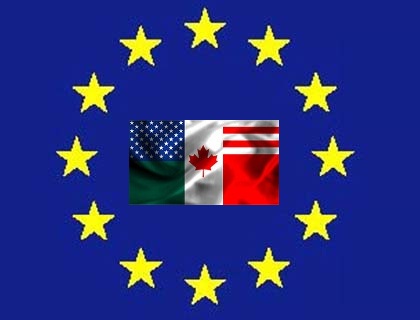
Pressure is mounting on Canada to finish up a long-delayed trade deal with the EU. Despite outstanding issues that still must be settled, there is a final push to try and complete an agreement this summer. If both sides are able to secure a deal, it would lay the groundwork for the proposed U.S.-EU trade pact. There is the possibility that the U.S.-EU transatlantic trade talks could also include the other NAFTA partners and maybe even other countries. Mexico has already shown interest in joining and if Canada can’t put the final touches on their own agreement with the EU, they might also be part of the negotiations. This would facilitate plans for a coming NAFTA-EU free trade zone and the formation of a transatlantic economic union.
After almost four years, negotiations between Canada and the European Union (EU) on a Comprehensive Economic and Trade Agreement (CETA) are bogged down in the final stages. Both sides have missed numerous deadlines to wrap things up. There is uncertainty when or if CETA will even get done. Prime Minister Stephen Harper recently tried to boost trade talks. He acknowledged that considerable progress towards a free trade deal has already been achieved, but admitted that there are still important issues that need to be resolved before any agreement can be finalized. Harper also explained that it would be to Canada’s advantage to sign a deal with Europe before the U.S. does. He made the comments while meeting with French Prime Minister Jean-Marc Ayrault who was in Ottawa for an official visit. As part of a joint statement, both leaders said they looked forward to a successful conclusion to CETA negotiations. Before his trip to Canada, Ayrault was sent a letter by civil society groups voicing opposition to CETA and the investor protection chapter that would grant corporations the power to challenge government policies that restrict their profits.
There are key issues which remain stumbling blocks and are preventing Canada and the EU from reaching an agreement. Academic researcher and law professor Michael Geist argued that, “with the EU the stronger of the two parties, it doesn’t see any urgency to compromise. In fact, with a growing number of EU negotiations (including talks with the U.S.), compromise with Canada may undermine its position in more economically important deals.” He also laid out different possibilities for the future of CETA. This includes Canada continuing to hold out hope for a compromise which thus far has failed. They could cave to the EU demands, but this might hurt the Conservatives chances in the 2015 election. Geist pointed out another scenario which would involve Canada joining the U.S.-EU talks and CETA being replaced by the Transatlantic Free Trade Area (TAFTA). He noted, “The argument for TAFTA would be that Canada is consolidating its negotiations into major agreements covering the Pacific (TPP) and Atlantic (TAFTA) to ensure that it is part of two potential large trading blocks. The danger with this approach is that Canada becomes a bit player in both negotiations with even less leverage to promote Canadian interests.”
During a speech given in November of last year, EU Trade Commissioner Karel De Gucht called on Mexico and the EU to modernize their existing trade agreement. Glyn Moody of techdirt recently reported that Mexico is now looking to join the U.S.-EU transatlantic deal. This would be one way for the EU and Mexico to upgrade trade relations. Moody emphasized that the U.S. strategy is to, “make TPP the defining international agreement for the entire Pacific region. TAFTA obviously aims to do the same for the Atlantic. As well as establishing the U.S. as the key link between the giant TPP and TAFTA blocs, this double-headed approach would also isolate the main emerging economies — Brazil, Russia, India and above all China.” Just like the U.S. dominated Trans-Pacific Partnership (TPP), Mexico and Canada could also be a part of the Transatlantic Trade and Investment Partnership talks. This would make it a true NAFTA-EU trade bloc-level negotiations. There might be an opportunity for other countries to join as Turkey is also pushing to be included in the trade deal.
In a recent article, Maude Barlow of the Council of Canadians described how CETA negotiations have laid the groundwork for a U.S.-EU free trade zone. She insisted that it would be a mistake for all three NAFTA countries to be a part of a transatlantic agreement. Barlow warned about some of the same dangers found in CETA that the U.S. could face in their own trade deal with the EU. She stressed how opening up local procurement to the EU should be of great concern to U.S. states and municipal governments. In Canada, a number of municipalities have passed motions demanding that they be excluded from the procurement rules in CETA which would restrict local hiring and purchasing initiatives. Barlow also cautioned that an investor protection chapter like the one in CETA would allow European multinationals to sue for any potential profit losses related to U.S. government policies and regulations. This would be worse than NAFTA’s Chapter 11 and as a result, the U.S. would lose more sovereign rights. The Australian government has already stopped the practice of including investor-state dispute resolution procedures in trade agreements and now it’s time for other countries follow suit.
In Canada, opposition to CETA continuous to grow. There are deep concerns over the expansion of NAFTA-like investor rights, the dismantling of supply management in agriculture and the negative impact that CETA would have on local public procurement. It could also serve to further empower Big Pharma by extending monopoly drug patents which would lead to higher costs. Just like any of the other so-called next-generation trade and investment deals, CETA is based on the failed NAFTA model with the same false promises. These secretive and binding international agreements are not really about trade, but are in fact designed to reshape regulatory and policy frameworks to further increase the rights of corporations and investors.
Whatever happens with CETA will greatly affect how the U.S. and EU approach their own trade deal. Moving forward, the merging transatlantic partnership will eventually culminate in the creation of a NAFTA-EU free trade zone. With the push for deeper international economic integration, the U.S. is positioning itself to become the lynchpin between the world’s largest trading blocs.
Related articles by Dana Gabriel:
Deepening the U.S.-EU Transatlantic Trade Partnership
Growing Opposition to the Canada-EU Trade Agreement
Spreading NAFTA’s Love Across the Atlantic
U.S.-EU Trade Deal is the Foundation For a New Global Economic Order
Dana Gabriel is an activist and independent researcher. He writes about trade, globalization, sovereignty, security, as well as other issues. Contact: beyourownleader@hotmail.com Visit his blog at Be Your Own Leader
[hat tip: Intellihub]
The Age Of The Drones [video]
Press For Truth
March 26, 2013
Unmanned aerial vehicles are becoming the norm as we are witnessing more and more drones filling up the skies in the unfolding Orwellian nightmare!
Canada’s air force eyes drones for maritime and Arctic patrols:
http://www.thestar.com/news/canada/20…
Support Press For Truth and help us to continue by donating at http://www.pressfortruth.ca/donatebec…
Get updates like this everyday and support independent media by joining Press For Truth TV: http://pressfortruth.tv/register/
We rely on you the viewer to help us continue to do this work. With your help I can continue to make videos and documentary films for youtube in an effort to raise awareness all over the world. Please support independent media by joining Press For Truth TV!
As a Press For Truth TV subscriber you’ll have full access to the site’s features and content including Daily Video Blogs on current news from the PFT perspective and High Quality Downloads of all Press For Truth Films, Music and Special Reports! Subscribe to Press For Truth TV:
http://pressfortruth.tv/register/
For more information visit:
http://pressfortruth.tv/
You can also support Press For Truth and help us continue to do this work by donating or becoming a sponsor at pressfortruth.ca
http://www.pressfortruth.ca/donatebec…
http://www.facebook.com/PressForTruth
http://www.youtube.com/weavingspider
https://twitter.com/PressForTruth
http://twitter.com/#!/DanDicksPFT

 PN
PN 
