
VIDEO — French Whine: Crowds flood Paris to decry Hollande
Russia Today
May 6, 2013
Angry crowds have flooded the streets of Paris piling the pressure on the French president, exactly a year after he was elected. Tens of thousands gathered to denounce Francois Hollande’s austerity drive. According to opinion polls, he’s now the most unpopular French leader for decades at a time of record unemployment and a shrinking economy – READ MORE http://on.rt.com/6i5e4j
RT LIVE http://rt.com/on-air
Subscribe to RT! http://www.youtube.com/subscription_c…
Like us on Facebook http://www.facebook.com/RTnews
Follow us on Twitter http://twitter.com/RT_com
Follow us on Google+ http://plus.google.com/+RT
RT (Russia Today) is a global news network broadcasting from Moscow and Washington studios. RT is the first news channel to break the 500 million YouTube views benchmark.
UK invites Syria’s foreign-backed opp. members ahead of G8 meeting
PressTV
April 10, 2013

British Foreign Secretary William Hague
British Foreign Secretary William Hague has invited the leaders of Syria’s foreign-backed opposition coalition to London in a latest instance of foreign meddling in the domestic affairs of the Arab country.
Hague said on Tuesday that senior members of the foreign-backed opposition, the so-called Syrian National Coalition, will attend meetings with top diplomats from the G8 leading industrial states ahead of a formal summit of the group.
The individuals, including Ghassan Hitto, George Sabra and Soheir Atassi, are expected to ask for further support from the Western governments in their fight against the government of President Bashar al-Assad.
The move by the British foreign secretary to invite members of the foreign-backed Syrian opposition, who are not considered representatives of the Syrian people, is considered the latest attempt by Western governments and their allies to interfere in the domestic affairs of Syria.
Meanwhile, US Secretary of State John Kerry has said he would meet with Syria’s foreign-backed opposition leaders in the British capital, adding that the US administration is looking at possible ways to help the militants in Syria.
Foreign ministers from eight countries – Britain, France, Germany, Canada, Russia, Italy, Japan and the United states – will hold formal talks on Thursday.
The ministers will discuss the issues of Syria and North Korea.
Hague also said that Britain and France would continue efforts to facilitate the arming of the militants in Syria.
In another act of foreign meddling, the Arab League handed Syria’s seat to the so-called National Coalition during a two-day summit held in the Qatari capital, Doha, on March 26.
Damascus condemned the move, saying the League has “forgotten that it is the people who grant the powers and not the emirs of obscurantism and sand.”
Syria has been experiencing unrest since March 2011. Many people, including large numbers of Syrian army and security personnel, have been killed in the violence.
SAB/PR/HJL
Europe’s cocaine supply disrupted by war in Mali
21stCenturyWire.com
March 16, 2013
France’s intervention in northern Mali against Islamist extremists has disrupted the supply of cocaine to Europe, reported Middle East Online. In January, France sent in troops to combat al-Qaeda linked extremists who controlled the northern swathe of the country for nine months and were threatening to extend their reach southwards towards the capital Bamako.
 Extremist groups have long engaged in the lucrative drug running business as a means to secure funding. A common practice was to levy taxes upon smugglers running drugs sourced in Latin America, via Mali, to feed Europe’s growing market.
The lack of any real government or police presence in the north of Mali facilitated the drug-trade.
Typically, drugs are shipped to the Gulf of Guinea or flown directly in from Venezuela into Mauritania or Mali where they are stored and eventually transported to the Mediterranean’s southern shores.
This route is commonly referred to as “Highway 10,” in reference to the line of latitude which cuts through Columbia, Venezuela, Guinea and Nigeria; the 10th parallel.
The U.N.’s office on Drugs and Crime released a recent report that stated around 10 percent of the 172 tons of pure cocaine that found its way to Europe in 2010, transited through West Africa.
France’s military intervention in Mali has “totally disrupted the trafficking of drugs, weapons and migrants in the region, smashing up all the networks transiting through northern Mali,” French researcher Mathieu Guidere was quoted by Middle East Online as saying.
French special forces pressured some of the jihadist groups’ most remote bases, “this has sent everyone scurrying away but they are all trying to set up new routes,” Guidere said.
Alain Rodier, head of France’s CF2R intelligence research center, said regional smuggling networks had already been disturbed by Arab Spring revolutions in Tunisia and Libya.
“Traffickers however are continuing their business by using other routes, which demonstrates their ability to adapt,” he said.
Smugglers have always adapted to new situations, said criminologist Xavier Raufer, who pointed out that the supply of cocaine from Latin America to Europe has never once broken in 40 years.
“You can never draw accurate maps of cocaine trafficking because the routes have already changed by the time the ink dries up,” he explained.
Bashar Al-Assad’s Interview with The Sunday Times
Voltairnet.org
March 3, 2013
 Sunday Times: Mr. President your recent offer of political dialogue was qualified with a firm rejection of the very groups you would have to pacify to stop the violence: the armed rebels and the Syrian National Coalition, the main opposition alliance.
So in effect you are only extending an olive branch to the loyal opposition, mostly internal, that renounce the armed struggle, and who effectively recognizes the legitimacy of your leadership, who are you willing to talk to, really?
President Assad: First of all, let me correct some of the misconceptions that have been circulating and that are found in your question in order to make my answer accurate.
Sunday Times: Okay.
President Assad: Firstly, when I announced the plan, I said that it was for those who interested in dialogue, because you cannot make a plan that is based on dialogue with somebody who does not believe in dialogue. So, I was very clear regarding this.
Secondly, this open dialogue should not be between exclusive groups but between all Syrians of every level. The dialogue is about the future of Syria. We are twenty three million Syrians and all of us have the right to participate in shaping the country’s future. Some may look at it as a dialogue between the government and certain groups in the opposition – whether inside or outside, external or internal -actually this is a very shallow way of looking at the dialogue. It is much more comprehensive. It is about every Syrian and about every aspect of Syrian life. Syria’s future cannot be determined simply by who leads it but by the ambitions and aspirations of all its people.
The other aspect of the dialogue is that it opens the door for militants to surrender their weapons and we have granted many amnesties to facilitate this. This is the only way to make a dialogue with those groups. This has already started, even before the plan, and some have surrendered their weapons and they live now their normal life. But this plan makes the whole process more methodical, announced and clear.
If you want to talk about the opposition, there is another misconception in the West. They put all the entities even if they are not homogeneous in one basket – as if everything against the government is opposition. We have to be clear about this. We have opposition that are political entities and we have armed terrorists. We can engage in dialogue with the opposition but we cannot engage in dialogue with terrorists; we fight terrorism. Another phrase that is often mentioned is the ‘internal opposition inside Syria’ or ‘internal opposition as loyal to the government.’ Opposition groups should be loyal and patriotic to Syria – internal and external opposition is not about the geographic position; it is about their roots, resources and representation. Have these roots been planted in Syria and represent Syrian people and Syrian interests or the interests of foreign government? So, this is how we look at the dialogue, this is how we started and how we are going to continue.
Sunday Times: Most have rejected it, at least if we talk about the opposition externally who are now the body that is being hailed as the opposition and where the entire world is basically behind them. So, most of them have rejected it with the opposition describing your offer as a “waste of time,” and some have said that it is “empty rhetoric” based on lack of trust and which British Secretary William Hague described it as “beyond hypocritical” and the Americans said you were “detached from reality.”
President Assad: I will not comment on what so-called Syrian bodies outside Syria have said. These bodies are not independent. As Syrians, we are independent and we need to respond to independent bodies and this is not the case. So let’s look at the other claims.
Firstly, detached from reality: Syria has been fighting adversaries and foes for two years; you cannot do that if you do not have public support. People will not support you if you are detached from their reality. A recent survey in the UK shows that a good proportion British people want “to keep out of Syria” and they do not believe that the British government should send military supplies to the rebels in Syria.
In spite of this, the British government continues to push the EU to lift its arms embargo on Syria to start arming militants with heavy weapons. That is what I call detached from reality–when you are detached from your own public opinion! And they go further in saying that they want to send “military aid” that they describe as “non-lethal.” The intelligence, communication and financial assistance being provided is very lethal. The events of 11th of September were not committed by lethal aids. It was the application of non-lethal technology and training which caused the atrocities.
The British government wants to send military aid to moderate groups in Syria, knowing all too well that such moderate groups do not exist in Syria; we all know that we are now fighting Al-Qaeda or Jabhat al-Nusra which is an offshoot of Al-Qaeda, and other groups of people indoctrinated with extreme ideologies. This is beyond hypocritical! What is beyond hypocrisy is when you talk about freedom of expression and ban Syrian TV channels from the European broadcasting satellites; when you shed tears for somebody killed in Syria by terrorist acts while preventing the Security Council from issuing a statement denouncing the suicide bombing that happened last week in Damascus, and you were here, where three hundred Syrians were either killed or injured, including women and children – all of them were civilians. Beyond hypocrisy when you preach about human rights and you go into Iraq, Afghanistan and Libya and kill hundreds of thousands in illegal wars. Beyond hypocrisy is when you talk about democracy and your closest allies are the worst autocratic regimes in the world that belong to the medieval centuries. This is hypocrisy!
Sunday Times: But you always refer to the people fighting here as terrorists, do you accept that while some are from the Jabhat al-Nusra and those affiliated to Al-Qaeda but there are others such as the FSA or under the umbrella of the FSA? That some of them are the defectors and some of them are just ordinary people who started some of the uprising. These are not terrorists; these are people fighting for what they believe to be the right way at the moment.
President Assad: When we say that we are fighting Al-Qaeda, we mean that the main terrorist group and the most dangerous is Al-Qaeda. I have stated in many interviews and speeches that this is not the only group in Syria. The spectrum ranges from petty criminals, drugs dealers, groups that are killing and kidnapping just for money to mercenaries and militants; these clearly do not have any political agenda or any ideological motivations. The so-called “Free Army” is not an entity as the West would like your readers to believe. It is hundreds of small groups – as defined by international bodies working with Annan and Al-Ibrahimi – there is no entity, there is no leadership, there is no hierarchy; it is a group of different gangs working for different reasons. The Free Syrian Army is just the headline, the umbrella that is used to legitimize these groups.
This does not mean that at the beginning of the conflict there was no spontaneous movement; there were people who wanted to make change in Syria and I have acknowledged that publically many times. That’s why I have said the dialogue is not for the conflict itself; the dialogue is for the future of Syria because many of the groups still wanting change are now against the terrorists. They still oppose the government but they do not carry weapons. Having legitimate needs does not make your weapons legitimate.
Sunday Times: Your 3-staged plan: the first one you speak of is the cessation of violence. Obviously there is the army and the fighters on the other side. Now, within the army you have a hierarchy, so if you want to say cease-fire, there is a commander that can control that, but when you offer cessation of violence or fire how can you assume the same for the rebels when you talk about them being so many groups, fragmented and not under one leadership. So, that’s one of the points of your plan. So, this suggests that this basically an impossible request. You speak of referendum but with so many displaced externally and internally, many of whom are the backbone of the opposition; those displaced at least. So, a referendum without them would not be fair, and the third part is that parliamentary elections and all this hopefully before 2014; it is a very tall list to be achieved before 2014. So, what are really the conditions that you are attaching to the dialogue and to make it happen, and aren’t some of the conditions that you are really suggesting or offering impossible to achieve?
President Assad: That depends on how we look at the situation. First of all, let’s say that the main article in the whole plan is the dialogue; this dialogue will put a timetable for everything and the procedures or details of this plan. The first article in my plan was the cessation of violence. If we cannot stop this violence, how can we achieve the other articles like the referendum and elections and so on? But saying that you cannot stop the violence is not a reason to do nothing. Yes there are many groups as I have said with no leadership, but we know that their real leadership are those countries that are funding and supplying their weapons and armaments – mainly Turkey, Qatar and Saudi Arabia.
If outside parties genuinely want to help the process they should be pressuring those countries to stop supplying the terrorists. As with any other sovereign state, we will not negotiate with terrorists.
Sunday Times: Critics say real and genuine negotiations may be the cause of your downfall and that of your government or regime, and that you know this, hence you offer practically impossible scenarios for dialogue and negotiations?
President Assad: Actually, I don’t know this, I know the opposite. To be logical and realistic, if this is the case, then these foes, adversaries or opponents should push for the dialogue because in their view it will bring my downfall. But actually they are doing the opposite. They are preventing the so-called ‘opposition bodies outside Syria’ to participate in the dialogue because I think they believe in the opposite; they know that this dialogue will not bring my downfall, but will actually make Syria stronger. This is the first aspect.
The second aspect is that the whole dialogue is about Syria, about terrorism, and about the future of Syria. This is not about positions and personalities. So, they shouldn’t distract people by talking about the dialogue and what it will or will not bring to the President. I did not do it for myself. At the end, this is contradictory; what they say is contradicting what they do.
Sunday Times: You said that if they push for dialogue, it could bring your downfall?
President Assad: No, I said according to what they say if it brings my downfall, why don’t they come to the dialogue? They say that the dialogue will bring the downfall of the President and I am inviting them to the dialogue. Why don’t they then come to the dialogue to bring my downfall? This is self-evident. That’s why I said they are contradicting themselves.
Sunday Times: Mr. President, John Kerry, a man you know well, has started a tour that will take him this week end to Saudi Arabia, Qatar and Turkey, where he will be talking to them about ways to ‘ease you out.’ In London and Berlin earlier this week, he said that President Assad must go and he also said that one of his first moves is to draft diplomatic proposals to persuade you to give up power. Would you invite him to Damascus for talks? What would you say to him? What is your message to him now given what he said this week and what he plans to say to his allies when he visits them over the weekend? And if possible from your knowledge of him how would you describe Kerry from your knowledge of him in the past?
President Assad: I would rather describe policies rather than describing people. So, it is still early to judge him. It is only a few weeks since he became Secretary of State. First of all, the point that you have mentioned is related to internal Syrian matters or Syrian issue. Any Syrian subject would not be raised with any foreigners. We only discuss it with Syrians within Syria. So, I am not going to discuss it with anyone who is coming from abroad. We have friends and we discuss our issues with friends, we listen to their advice but at the end it is our decision as Syrians to think or to make what’s good for our country.
If anyone wants to ‘genuinely’ – I stress the word genuinely – help Syria and help the cessation of violence in our country, he can do only one thing; he can go to Turkey and sit with Erdogan and tell to him stop smuggling terrorists into Syria, stop sending armaments, stop providing logistical support to those terrorists. He can go to Saudi Arabia and Qatar and tell them stop financing the terrorists in Syria. This is the only thing anyone can do dealing with the external part of our problem, but no one from outside Syria can deal with the internal part of this problem.
Sunday Times: So, what is your message to Kerry?
President Assad: It is very clear: to understand what I said now. I mean, not a message to Kerry but to anyone who is talking about the Syrian issue: only Syrian people can tell the President: stay or leave, come or go. I am just saying this clearly in order not to waste the time of others to know where to focus.
Sunday Times: What role if any do you see for Britain in any peace process for Syria? Have there been any informal contacts with the British? What is your reaction to Cameron’s support for the opposition? What would you say if you were sitting with him now, especially that Britain is calling for the arming of the rebels?
President Assad: There is no contact between Syria and Britain for a long time. If we want to talk about the role, you cannot separate the role from the credibility. And we cannot separate the credibility from the history of that country. To be frank, now I am talking to a British journalist and a British audience, to be frank, Britain has played a famously (in our region) an unconstructive role in different issues for decades, some say for centuries. I am telling you now the perception in our region.
The problem with this government is that their shallow and immature rhetoric only highlight this tradition of bullying and hegemony. I am being frank. How can we expect to ask Britain to play a role while it is determined to militarize the problem? How can you ask them to play a role in making the situation better and more stable, how can we expect them to make the violence less while they want to send military supplies to the terrorists and don’t try to ease the dialogue between the Syrians. This is not logical. I think that they are working against us and working against the interest of the UK itself. This government is acting in a naïve, confused and unrealistic manner. If they want to play a role, they have to change this; they have to act in a more reasonable and responsible way, till then we do not expect from an arsonist to be a firefighter!
Sunday Times: In 2011 you said you wouldn’t waste your time talking about the body leading opposition, now we are talking about the external body, in fact you hardly recognized there was such a thing, what changed your mind or views recently? What talks, if any are already going on with the rebels who are a major component and factor in this crisis? Especially given that your Foreign Minister Muallem said earlier this week when he was in Russia that the government is open to talks with the armed opposition can you clarify?
President Assad: Actually, I did not change my mind. Again, this plan is not for them; it is for every Syrian who accepts the dialogue. So, making this initiative is not a change of mind. Secondly, since day one in this crisis nearly two years ago, we have said we are ready for dialogue; nothing has changed. We have a very consistent position towards the dialogue. Some may understand that I changed my mind because I did not recognize the first entity, but then I recognized the second. I recognized neither, more importantly the Syrian people do not recognize them or take them seriously. When you have a product that fails in the market, they withdraw the product, change the name, change the packing and they rerelease it again – but it is still faulty. The first and second bodies are the same products with different packaging. Regarding what our minister said, it is very clear.
Part of the initiative is that we are ready to negotiate with anyone including militants who surrender their arms. We are not going to deal with terrorists who are determined to carry weapons, to terrorize people, to kill civilians, to attack public places or private enterprises and destroy the country.
Sunday Times: Mr. President, the world looks at Syria and sees a country being destroyed, with at least 70,000 killed, more than 3 million displaced and sectarian divisions being deepened. Many people around the world blame you. What do you say to them? Are you to blame for what’s happened in the country you are leading?
President Assad: You have noted those figures as though they were numbers from a spreadsheet. To some players they are being used to push forward their political agenda; unfortunately that is a reality. Regardless of their accuracy, for us Syrians, each one of those numbers represents a Syrian man, woman or child. When you talk about thousands of victims, we see thousands of families who have lost loved ones and who unfortunately will grieve for many years to come. Nobody can feel this pain more than us.
Looking at the issue of political agendas, we have to ask better questions. How were these numbers verified? How many represent foreign fighters? How many were combatants aged between 20 and 30? How many were civilians – innocent women and children? The situation on the ground makes it almost impossible to get accurate answers to these important questions. We all know how death tolls and human casualties have been manipulated in the past to pave the way for humanitarian intervention. The Libyan government recently announced that the death toll before the invasion of Libya was exaggerated; they said five thousand victims from each side while the number was talking at that time of tens of thousands.
The British and the Americans who were physically inside Iraq during the war were unable to provide precise numbers about the victims that have been killed from their invasion. Suddenly, the same sources have very precise numbers about what is happening in Syria! This is ironic; I will tell you very simply that these numbers do not exist in reality; it is part of their virtual reality that they want to create to push forward their agenda for military intervention under the title of humanitarian intervention.
Sunday Times: If I may just on this note a little bit. Even if the number is exaggerated and not definitely precise, these are numbers corroborated by Syrian groups, however they are still thousands that were killed. Some are militants but some are civilians. Some are being killed through the military offensive, for example artillery or plane attacks in certain areas. So even if we do not argue the actual number, the same applies, they still blame yourself for those civilians, if you want, that are being killed through the military offensive, do you accept that?
President Assad: Firstly, we cannot talk about the numbers without their names. People who are killed have names. Secondly, why did they die? Where and how were they killed? Who killed them? Armed gangs, terrorist groups, criminals, kidnappers, the army, who?
Sunday Times: It is a mix.
President Assad: It is a mix, but it seems that you are implying that one person is responsible for the current situation and all the human casualties. From day one the situation in Syria has been influenced by military and political dynamics, which are both very fast moving. In such situations you have catalysts and barriers. To assume any one party is responsible for all barriers and another party responsible for all the catalysts is absurd. Too many innocent civilians have died, too many Syrians are suffering. As I have already said nobody is more pained by this than us Syrians, which is why we are pushing for a national dialogue. I’m not in the blame business, but if you are talking of responsibility, then clearly I have a constitutional responsibility to keep Syria and her people safe from terrorists and radical groups.
Sunday Times: What is the role of Al-Qaeda and other jihadists and what threats do they pose to the region and Europe? Are you worried Syria turning into something similar to Chechnya in the past? Are you concerned about the fate of minorities if you were loose this war or of a sectarian war akin to that of Iraq?
President Assad: The role of Al-Qaeda in Syria is like the role of Al-Qaeda anywhere else in this world; killing, beheading, torturing and preventing children from going to school because as you know Al-Qaeda’s ideologies flourish where there is ignorance. Ideologically, they try to infiltrate the society with their dark, extremist ideologies and they are succeeding. If you want to worry about anything in Syria, it is not the ‘minorities.’ This is a very shallow description because Syria is a melting pot of religions, sects, ethnicities and ideologies that collectively make up a homogeneous mixture, irrelevant of the portions or percentages. We should be worrying about the majority of moderate Syrians who, if we do not fight this extremism, could become the minority – at which point Syria will cease to exist.
If you worry about Syria in that sense, you have to worry about the Middle East because we are the last bastion of secularism in the region. If you worry about the Middle East, the whole world should be worried about its stability. This is the reality as we see it.
Sunday Times: How threatening is Al-Qaeda now?
President Assad: Threatening by ideology more than the killing. The killing is dangerous, of course, but what is irreversible is the ideology; that is dangerous and we have been warning of this for many years even before the conflict; we have been dealing with these ideologies since the late seventies. We were the first in the region to deal with such terrorists who have been assuming the mantle of Islam. We have consistently been warning of this, especially in the last decade during the invasion and occupation of Afghanistan and Iraq. The West is only reacting to the situation, not acting. We need to act by dealing with the ideology first. A war on terror without dealing with the ideology will lead you nowhere and will only make things worse. So, it is threatening and it is dangerous, not just to Syria but to the whole region.
Sunday Times: US officials recently, in particular yesterday, are quoted as saying that US decision not to arm rebels could be revised. If this was to happen what in your view will the consequences in Syria and in the region? What is your warning against this? Now, they are talking about directly equipping the rebels with armament vehicles, training and body armaments.
President Assad: You know the crime is not only about the victim and the criminal, but also the accomplice providing support, whether it is moral or logistical support. I have said many times that Syria lies at the fault line geographically, politically, socially and ideologically. So, playing with this fault line will have serious repercussions all over the Middle East. Is the situation better in Libya today? In Mali? In Tunisia? In Egypt? Any intervention will not make things better; it will only make them worse. Europe and the United States and others are going to pay the price sooner or later with the instability in this region; they do not foresee it.
Sunday Times: What is your message to Israel following its air strikes on Syria? Will you retaliate? How will you respond to any future attacks by Israel especially that Israel has said that we will do it again if it has to?
President Assad: Every time Syria did retaliate, but in its own way, not tit for tat. We retaliated in our own way and only the Israelis know what we mean.
Sunday Times: Can you expand?
President Assad: Yes. Retaliation does not mean missile for missile or bullet for bullet. Our own way does not have to be announced; only the Israelis will know what I mean.
Sunday Times: Can you tell us how?
President Assad: We do not announce that.
Sunday Times: I met a seven year old boy in Jordan.
President Assad: A Syrian boy?
Sunday Times: A Syrian boy who had lost an arm and a leg to a missile strike in Herak. Five children in his family had been killed in that explosion. As a father, what can you say to that little boy? Why have so many innocent civilians died in air strikes, army shelling and sometimes, I quote, ‘Shabiha shootings?’
President Assad: What is his name?
Sunday Times: I have his name…I will bring it to you later.
President Assad: As I said every victim in this crisis has a name, every casualty has a family. Like 5 year-old Saber who whilst having breakfast with his family at home lost his leg, his mother and other members of his family. Like 4 year-old Rayan who watched his two brothers slaughtered for taking him to a rally. None of these families have any political affiliations. Children are the most fragile link in any society and unfortunately they often pay the heaviest price in any conflict. As a father of young children, I know the meaning of having a child harmed by something very simple; so what if they are harmed badly or if we lose a child, it is the worst thing any family can face. Whenever you have conflicts, you have these painful stories that affect any society. This is the most important and the strongest incentive for us to fight terrorism. Genuine humanitarians who feel the pain that we feel about our children and our losses should encourage their governments to prevent smuggling armaments and terrorists and to prevent the terrorists from acquiring any military supplies from any country.
Sunday Times: Mr. President, when you lie in bed at night, do you hear the explosions in Damascus? Do you, in common with many other Syrians, worry about the safety of your family? Do you worry that there may come a point where your own safety is in jeopardy?
President Assad: I see it completely differently. Can anybody be safe, or their family be safe, if the country is in danger? In reality NO! If your country is not safe, you cannot be safe. So instead of worrying about yourself and your family, you should be worried about every citizen and every family in your country. So it’s a mutual relationship.
Sunday Times: You’ll know of the international concerns about Syria’s chemical weapons. Would your army ever use them as a last resort against your opponents? Reports suggest they have been moved several times, if so why? Do you share the international concern that they may fall into the hands of Islamist rebels? What is the worst that could happen?
President Assad: Everything that has been referred to in the media or by official rhetoric regarding Syrian chemical weapons is speculation. We have never, and will never, discuss our armaments with anyone. What the world should worry about is chemical materials reaching the hands of terrorists. Video material has already been broadcast showing toxic material being tried on animals with threats to the Syrian people that they will die in the same way. We have shared this material with other countries. This is what the world should be focusing on rather than wasting efforts to create elusive headlines on Syrian chemical weapons to justify any intervention in Syria.
Sunday Times: I know you are not saying whether they are safe or not. There is concern if they are safe or no one can get to them.
President Assad: This is constructive ambiguity. No country will talk about their capabilities. Sunday Times: A lot has been talked about this as well: what are the roles of Hezbollah, Iran and Russia in the war on the ground? Are you aware of Hezbollah fighters in Syria and what are they doing? What weapons are your allies Iran and Russia supplying? What other support are they providing?
President Assad: The Russian position is very clear regarding armaments – they supply Syria with defensive armaments in line with international law. Hezbollah, Iran and Russia support Syria in her fight against terrorism. Russia has been very constructive, Iran has been very supportive and Hezbollah’s role is to defend Lebanon not Syria. We are a country of 23 million people with a strong National Army and Police Force. We are in no need of foreign fighters to defend our country. What we should be asking is, what about the role of other countries, – Qatar, Turkey, Saudi Arabia, France, the UK, the US, – that support terrorism in Syria directly or indirectly, militarily or politically.
Sunday Times: Mr. President, may I ask you about your own position? Russian Foreign Minister Lavrov recently said that Lakhdar Ibrahimi complained of wanting to see more flexibility from your regime and that while you never seem to say ‘no’ you never seem to say ‘yes’. Do you think that there can be a negotiated settlement while you remain President, which is a lot of people are asking?
President Assad: Do not expect a politician to only say yes or no in the absolute meaning; it is not multiple choice questions to check the correct answer. You can expect from any politician a vision and our vision is very clear. We have a plan and whoever wants to deal with us, can deal with us through our plan. This is very clear in order not to waste time. This question reflects what has been circulating in the Western media about personalizing the problem in Syria and suggesting that the entire conflict is about the president and his future. If this argument is correct, then my departure will stop the fighting. Clearly this is absurd and recent precedents in Libya, Yemen and Egypt bear witness to this. Their motive is to try to evade the crux of the issue, which is dialogue, reform and combating terrorism. The legacy of their interventions in our region have been chaos, destruction and disaster. So, how can they justify any future intervention? They cannot. So, they focus on blaming the president and pushing for his departure; questioning his credibility; is he living in a bubble or not? is he detached from reality or not? So, the focus of the conflict becomes about the president.
Sunday Times: Some foreign officials have called for you to stand for war crimes at the International Criminal Court as the person ultimately responsible for the army’s actions? Do you fear prosecution by the ICC? Or the possibility of future prosecution and trial in Syria?
President Assad: Whenever an issue that is related to the UN is raised, you are raising the question of credibility. We all know especially after the collapse of the Soviet Union – for the last twenty years – that the UN and all its organizations are the victims of hegemony instead of being the bastions of justice. They became politicized tools in order to create instability and to attack sovereign countries, which is against the UN’s charter. So, the question that we have to raise now is: are they going to take the American and the British leaders who attacked Iraq in 2003 and claimed more than half a million lives in Iraq, let alone orphans, handicapped and deformed people? Are they going to take the American, British French and others who went to Libya without a UN resolution last year and claimed again hundreds of lives? They are not going to do it. The answer is very clear. You know that sending mercenaries to any country is a war crime according Nuremberg principles and according to the London Charter of 1945. Are they going to put Erdogan in front of this court because he sent mercenaries? Are they going to do the same with the Saudis and the Qataris? If we have answers to these questions, then we can talk about peace organizations and about credibility.
My answer is very brief: when people defend their country, they do not take into consideration anything else.
Sunday Times: Hindsight is a wonderful thing Mr. President. If you could wind the clock back two years would you have handled anything differently? Do you believe that there are things that could or should have been done in another way? What mistakes do you believe have been made by your followers that you would change?
President Assad: You can ask this question to a President if he is the only one responsible for all the context of the event. In our case in Syria, we know there are many external players. So you have to apply hindsight to every player. You have to ask Erdogan, with hindsight would you send terrorists to kill Syrians, would you afford logistical support to them? You should ask the Qatari and Saudis whether in hindsight, would you send money to terrorists and to Al-Qaeda offshoots or any other terrorist organization to kill Syrians? We should ask the same question to the European and American officials, in hindsight would you offer a political umbrella to those terrorists killing innocent civilians in Syria?
In Syria, we took two decisions. The first is to make dialogue; the second is to fight terrorism. If you ask any Syrian, in hindsight would you say no to dialogue and yes to terrorism? I do not think any sane person will agree with you. So I think in hindsight, we started with dialogue and we are going to continue with dialogue. In hindsight, we said we are going to fight terrorism and we are going to continue to fight terrorism.
Sunday Times: Do you ever think about living in exile if it came to that? And would you go abroad if it increases the chances of peace in Syria?
President Assad: Again, it is not about the president. I don’t think any patriotic person or citizen would think of living outside his country.
Sunday Times: You will never leave?
President Assad: No patriotic person will think about living outside his country. I am like any other patriotic Syrian.
Sunday Times: How shaken you were you by the bomb that killed some of your most senior generals last summer, including your brother-in-law?
President Assad: You mentioned my brother-in-law but it is not a family affair. When high-ranking officials are being assassinated it is a national affair. Such a crime will make you more determined to fight terrorism. It is not about how you feel, but more about what you do. We are more determined in fighting terrorism.
Sunday Times: Finally, Mr. President, may I ask about my colleague, Marie Colvin, who was killed in the shelling of an opposition media center at Baba Amr on February 22 last year. Was she targeted, as some have suggested, because she condemned the destruction on American and British televisions? Or was she just unlucky? Did you hear about her death at the time and if so what was your reaction?
President Assad: Of course, I heard about the story through the media. When a journalist goes into conflict zones, as you are doing now, to cover a story and convey it to the world, I think this is very courageous work. Every decent person, official or government should support journalists in these efforts because that will help shed light on events on the ground and expose propaganda where it exists. Unfortunately in most conflicts a journalist has paid the ultimate price. It is always sad when a journalist is killed because they are not with either side or even part of the problem, they only want to cover the story. There is a media war on Syria preventing the truth from being told to the outside world.
14 Syrian journalists who have also been killed since the beginning of the crisis and not all of them on the ground. Some have been targeted at home after hours, kidnapped, tortured and then murdered. Others are still missing. More than one Syrian television station has been attacked by terrorists and their bombs. There is currently a ban on the broadcast of Syrian TV channels on European satellite systems. It is also well known how rebels have used journalists for their own interests. There was the case of the British journalist who managed to escape.
Sunday Times: Alex Thompson?
President Assad: Yes. He was lead into a death trap by the terrorists in order to accuse the Syrian Army of his death. That’s why it is important to enter countries legally, to have a visa. This was not the case for Marie Colvin. We don’t know why and it’s not clear. If you enter illegally, you cannot expect the state to be responsible. Contrary to popular belief, since the beginning of the crisis, hundreds of journalists from all over the world, including you, have gained visas to enter Syria and have been reporting freely from inside Syria with no interferences in their work and no barriers to fulfill their missions.
Sunday Times: Thank you.
President Assad: Thank you.
Thousands gather in Damascus for funeral of assassinated Syrian cleric
End the Lie – Independent News
March 23, 2013

The coffins of Sunni Muslim cleric Mohamed Saeed al-Bouti and his grandson Ahmed al-Bouti, who both died in a suicide bomb attack, are carried during their funeral ceremony on March 23, 2013 at the Omayyad mosque in Damascus, Syria. (AFP Photo)
Thousands of Syrians have gathered for the funeral of a pro-Assad cleric who was killed in a blast at a mosque earlier this week. Saturday has been declared a day of mourning in the Arab country.
Mohammed Saeed Ramadan Al-Bouti, his grandson, and 49 others were killed when a suicide bomber detonated a bomb inside a mosque where he was delivering a sermon on Thursday.
The cleric was Imam of the Omayyad Mosque, a Damascus landmark. He is the most senior religious figure to be killed in the Syrian conflict to date.
During the funeral, mourners carried 84-year-old Mohammad Said Ramadan al-Bouti’s coffin on their shoulders while shouting “God is Great.”
The cleric was buried on grounds beside the tomb of the Saladin, regarded as a heroic warrior in Islam. The move angered opposition activists, who turned to social media to express their fury. “Burying Buti next to Saladin is a deliberate insult,” activist Waleed al-Akrat wrote on Twitter.
Syrian President Bashar Assad was being represented at the funeral by one of his cabinet ministers, according to state TV. On Friday, the Syrian leader vowed to “cleanse” his country of “extremists,” whom he accused of being behind the attack.
“I swear to the Syrian people that your blood, and that of your grandson and all the martyrs of the homeland, will not be spilled in vain because we will be faithful to your ideas by destroying their extremism and ignorance until we have cleansed the country,” Assad said in an official statement.
The slain cleric had been a vocal supporter of the Syrian regime since the days of Assad’s father and predecessor. In a speech earlier this month, al-Bouti said it was “a religious duty to protect the values, the land and the nation” of Syria. He previously referred to Assad’s opponents as “scum.”
According to journalist Abdullah Mawazini, it was those statements that prompted the opposition to carry out the attack.
“We believe the opposition is responsible for this. We have Islamist extremist groups – jihadis – who are fighting against the government. Mr. al-Bouti, before he was killed, in his last speech on Friday, said we should fight with the Syrian army and not the opposition groups so this raised a lot of controversy…and discussion in Syrian society and led to this killing,” he told RT.
But the opposition has also condemned the attack, pointing the finger at the Assad regime. The current head of the National Syrian Coalition, Moaz Alkhatib, said on his Facebook page that only the Syrian government could be behind the attack, stressing the importance that places of worship and clerics not be targeted.
“The killing of Doctor al-Bouti is a crime in every sense of the word,” he wrote. “No matter the differences that clerics in Syria may have in their view of the situation, this does not allow for the merciless killing of Muslims or the defilement of mosques.”

People take part in the funeral ceremony of Sunni Muslim cleric Mohamed Saeed al-Bouti, who died in a suicide bomb attack, on March 23, 2013 at the Omayyad mosque in the Syrian capital Damascus. (AFP Photo)
A ‘biased and imbalanced’ UN
Also on Saturday, Assad’s regime said it rejected a UN Human Rights Council decision to continue an investigation of “alleged violations of international human rights law.” An unnamed official told SANA news agency that the group’s work is “biased and imbalanced.”
The comment comes a day after the UN Human Rights Council passed the resolution, which the official said doesn’t take into account “the unethical role played by states that sponsor terrorism in Syria, which fund, train, arm and send terrorists and mercenaries” into the country.
He added that the resolution reflects “a policy of double standards practiced by some countries that claim to defend human rights.”
The resolution was adopted with 41 votes in favor, one against, and five countries abstaining. It strongly condemned violence on both sides, but noted that those “committed by anti-government armed groups did not reach the intensity and scale of the violations committed by the government forces and its affiliated militia.”
Meanwhile, European Union Foreign Policy chief Catherine Ashton says there is a real sense of urgency to ensure political progress in Syria.
The comment came during a meeting of EU foreign ministers at Dublin Castle. The two-day talks failed to find a common position on the future of the EU’s Syrian arms embargo.
France and Britain believe that lifting the embargo would raise pressure on Assad to negotiate an end to the civil war, which has led to the deaths of an estimated 70,000 people.
Other EU countries disagree, saying that lifting the embargo would lead to weapons falling into the hands of Islamist militants, as well as fuel regional conflict and encourage Assad’s backers to step up arms supplies to the leader.
The EU has until June 1 to decide whether to renew or amend its sanctions on Syria. Changing the arms ban needs the backing of all 27 EU states.

The coffin of Sunni Muslim cleric Mohamed Saeed al-Bouti, who died in a suicide bomb attack, is carried outside the Omayyad mosque after his funeral ceremony on March 23, 2013 in the Syrian capital Damascus. (AFP Photo)

People pray in the Omayyad mosque courtyard during the funeral ceremony of Sunni Muslim cleric Mohamed Saeed al-Bouti, who died in a suicide bomb attack, on March 23, 2013 in the Syrian capital Damascus. (AFP Photo / Louai Beshara)

People pray in the Omayyad mosque courtyard during the funeral ceremony of Sunni Muslim cleric Mohamed Saeed al-Bouti, who died in a suicide bomb attack, on March 23, 2013 in the Syrian capital Damascus. (AFP Photo / Louai Beshara)
Syria teeters on Obama’s “Red Line”
by Nile Bowie
NileBowie.blogspot.ca
March 21, 2013
The pages of history tell us that beautiful civilizations emerged and prospered in the ancient cities of Damascus and Aleppo, some of the oldest continually inhabited cities on earth. The harrowing circus of brutality that is the Syrian conflict, now in its third year, will soil and blacken those pages indefinitely. No matter the political outcome of this horrible war, a once tolerant and diverse state has been shattered and terror itself has eaten into the destiny of Syria’s people, inexorably changing the courses of their lives forever. Children have been orphaned; parents have faced the loss of their children – and by uncompromising means. Infants have been beheaded, the fates of innocent men and women have been sealed through summary executions, and families have been torn apart or destroyed all together. Recent developments in Syria are alarming.
Spokesmen of the Assad government recently accused foreign-backed militants of launching scud missiles containing chemical weapons in the city of Aleppo, killing dozens. Witnesses claim to have seen powder emanate from the rocket, causing those who inhaled the substance to suffocate or require immediate medical attention. An unnamed chemical weapons expert cited by Al-Jazeera claimed that the causalities were not consistent with Syria’s reputed stockpile of chemical agents, stating, “If it’s a chemical warfare agent, it’s not working very well.” Syria’s ambassador to the UN, Bashar Ja’afari, called on the UN Secretary-General to form an independent technical mission to investigate the use of chemical weapons by terrorist groups operating in Syria.
There are a myriad of reasons why Bashar al-Assad must go in the eyes of policy makers in Washington and Tel Aviv, and the destruction of his tenure could not have been possible without the financial muscle of Saudi Arabia and Qatar’s wretchedly opulent Sunni Monarchs. These glittering kingdoms of disaster-capitalism are not only responsible for supplying weapons and cash; a major incentive of theirs is exporting the Wahhabist and Salafist ideologies that many of Syria’s imported jihadists subscribe to, a warped and primal interpretation of Islam that has fueled the sectarian nature of the Syrian conflict and deepened social divisions to their most dangerous point – in a country that was once renowned for its tolerance of religious diversity. These Gulf kingdoms, which are more-or-less given a trump card to commit deplorable human rights violations institutionally, are also responsible for propping up the political arm of their militant foot soldiers, and that comes in the form of the Muslim Brotherhood.
Syria’s opposition coalition, which is itself entirely a creation of foreign powers, has recently elected its own interim prime minister – enter, Ghassan Hitto, a virtually unknown political novice with a US passport and a computer science degree from Purdue University. Hitto is an Islamist Kurd with strong ties to the Muslim Brotherhood. The Muslim Brotherhood has politically dominated the Syrian National Council since its creation, in addition to organizing tactical elements of the insurgency. The backbone of the Brotherhood’s relationship with the medieval monarchies of the Persian Gulf is grounded in a firm opposition to Shi’a Islam, as extolled by clerical leaders in Iran and Lebanon’s Hezbollah; Assad himself is also an Alawite, an offshoot of Shi’a Islam. It should be clear enough by now how enflaming sectarian divisions in the region was a prerequisite for those bank-rolling the insurgency, aimed at demolishing the secular Syrian state.
Several high-profile members of Syria’s opposition coalition boycotted the vote for interim prime minister, citing what they viewed as a foreign-backed campaign to elect Hitto. Kamal Labwani, a veteran opposition campaigner, was reported as saying, “We don’t want what happened in Egypt to happen in Syria. They hijacked the revolution.” Those who abstained from the vote accuse Hitto of being a puppet of the Muslim Brotherhood, and that the SNC’s decisions were being dictated from the outside. Walid al-Bunni, another senior figure in the opposition, stated, “The Muslim Brotherhood, with the backing of Qatar, have imposed their prime minister candidate. We will keep away if the coalition does not reconsider its choice.” Let’s just get this straight – Assad, a leader whose presence today is a testament to the fact that he continues to enjoy majority popular support, is considered to have lost his legitimacy. On the other hand, Hitto, a man with no political experience who received 35 votes out of 49 ballots cast during a Syrian National Coalition meeting, is supposed to be legitimate representative of the Syrian people?

Western states want to install proxy leaders who will grovel to their multinationals and swallow IMF medicine, Gulf states seek unfettered hegemony in their own backyards, and they all want to see the Shi’a resistance smashed to pieces. Following the news of chemical weapons being used in Syria, the most immediate conclusion of this observer is that foreign-backed militants, who have used every opportunity to call for more material and support, employed the use of a smuggled chemical weapon of poor quality to bring about direct military intervention in their favor. Right on cue, Senators Lindsey Graham and John McCain are frothing at the mouth, urging President Obama to “take immediate action” and consider deploying troops. Graham was quoted as saying, “If the choice is to send in troops to secure the weapons sites versus allowing chemical weapons to get in the hands of some of the most violent people in the world, I vote to cut this off before it becomes a problem.” There is no surer sign of a pathological mind than when one credits others with the blood on their own hands.
Nile Bowie is an independent political analyst and photographer based in Kuala Lumpur, Malaysia. He can be reached at nilebowie@gmail.com
Chemical Weapon Attack kills 25 and injures 100 in Aleppo. Syria Crisis Explodes International Law into Anarchy and Barbarism
nsnbc international
March 19, 2013

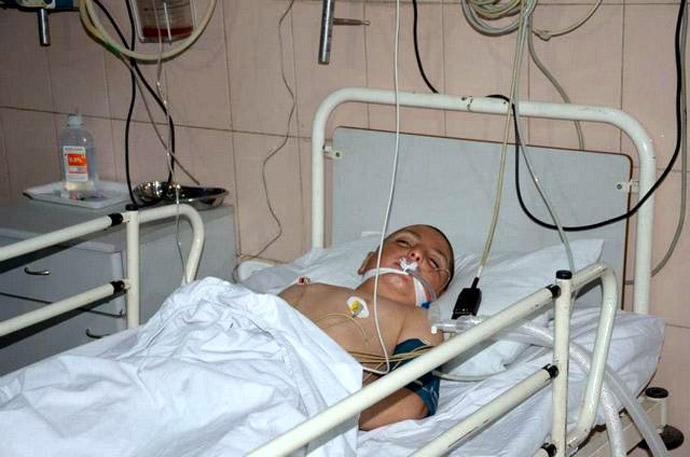
Most of the more than 100 injured in chemical weapon attack are in critical condition. Photo SANA
Insurgents and Syrian Government blaming each other for the Escalation with Chemical Weapon Attack.
Christof Lehmann (nsnbc).- A rocked with chemical substances, fired from the Da´el area, exploding in the Khan al-Asal area near the Syrian capital Damascus today, killed at least 25 and injured 100. The majority of the injured are reported to be in critical a condition. The Syrian government and insurgents are blaming each other for the escalation of the violence.
While the Syrian government possesses chemical weapons, several factors make it unlikely beyond reasonable doubt, that a rocket with weaponized chemical substances has been fired by Syrian military forces. Like in every other regular military force, the chemical weapons under control of the Syrian military are closely monitored, registered, and easily to be accounted for.
The UN´s independent commission of inquiry recently suggested to refer Syria to the international criminal court. A spokesperson for the Russian Foreign Ministry called the report biased and unbalanced, and the suggestion to refer Syria to the ICC as futile and ill timed. (1 Escalating the conflict by using chemical weapons would be political suicide from experienced politicians who know better than bringing Russia into a diplomatic quagmire. With the national dialog making steady progress, the use of chemical weapons would be equivalent to the Syrian government derailing the national dialog which it facilitates.
While these and many other factors make it more than unlikely that the rocket was fired by Syrian military forces, the opposite is the case with the foreign backed insurgents. The strongest circumstantial evidence however, until an investigation has eventually has yielded material evidence, is the fact that the foreign backed insurgents themselves have published video recordings, in which they were demonstrating how they are producing chemical substances which can be weaponized in small laboratories. The small laboratories have been provided for the insurgents by Saudi-Arabia.
Syria´s Information Minister Omran al-Zoubi has held the countries that are arming the ´opposition` responsible for the crime in Khan al-Asal and stressed, that the government of Turkey´s Prime Minister Erdogan and the government of Qatar bear legal, moral and political responsibility for the attack that killed 25 and wounded more than 100.
Al-Zoubi condemned the Arab League on a ministerial level for its decision to support the armed insurgency, saying “whoever got involved and announced direct and public military support to the terrorists, whether he is an emir, a minister or a prime minister, must be held accountable for the crime”. He stressed the fact, that the terrorists used an internationally banned weapon and called upon the international community and the countries which are funding and arming the terrorists to assume their responsibility for the crime. He added, that the escalation of the violence by use of internationally banned weapons against civilians is a dangerous shift in the course of the events in Syria with regard to security in general, and with regard to the military situation.
Minister Al-Zoubi added, that the government of the Syrian Arab Republic has the right to act in accordance with international law and file a lawsuit against the countries which are arming the opposition, including internationally outlawed terrorist organizations such as Jabhat al-Nusra with internationally banned weapons.
Today´s escalation of terrorism with an internationally banned weapon is also likely to even further deteriorate diplomatic ties between Russia and the USA. One of the factors that has contributed to the rapid deterioration in diplomatic relations over Syria was the fact that the USA rejected a Russian resolution at the United Nations Security Council which would have condemned all forms of terrorism.
The US veto at the UN Security Council, against the condemnation of the attack and terrorism in all of its forms, prompted Russian Foreign Minister Sergei Lavrov to voice the Russian governments frustration over the fact, that the UNSC standards, according to which all nations, without exclusion, would condemn terrorism, regardless of the perpetrator, place or motives, was no longer upheld. Lavrov stated, “Russia sees in the American position the use of double standards and a dangerous approach in terms of the Americans moving away from the main principle of condemning terrorism in all its forms”. (2
According to information by Syrian authorities, the toxic gasses that have been involved in today´s rocket attack cause immediate fainting, quiver and death, prompting Syria´s Information Minister al-Zoubi to state, that “this shift in the type and manner of arming the terrorists embodied in using weapons imported from outside Syria across the border with some neighboring countries means that all allegations made by some countries, such as France, UK, Qatar and Turkey on providing logistic and “non-lethal” weapons to the armed terrorist groups in Syria are mere talk to sell the media.”
The escalation of the violence with a chemical weapon constitute a serious escalation in willful and systematic breeches and a further step toward an explosion of international law into anarchy and barbarism.
Since 2001, the USA, together with NATO and allies, have systematically dismantled the progress in international law that has been made since 1945 and the end of the second world war. The political, military and financial support of Jahbat al-Nusra and other militia who are involved in the attempted subversion of Syria constitute a breech against the Convention against the Use of Mercenaries. Also the use of so-called private military contractors to fulfill military duties in conflict areas constitutes a breech of the Convention against the Use of Mercenaries. International lawyer Christopher Black pointed out the irony of calling mercenaries private contractors, saying ” private contractors, as if the were construction workers”. (3
Saudi-Arabia´s and Turkey´s documented use of convicts for military service in Syria constitutes a willful and systematic breech of the Geneva Conventions, which regulate the war times rights of both civilian and military prisoners. (4 -(5 Military interventions under the pretext of humanitarian interventions or the principle of the responsibility to protect, which was used by the USA and NATO to bring about regime change in Libya, constitutes a violation of the Charter of the United Nations and the principles enshrined in the Treaty of Westphalia, which is one of the root principles of the UN Charter.
The list of systematic explosions of international law by the USA, NATO and allies continues with breeches against the Convention against Torture by re-branding torture as enhanced interrogation methods, breeches against UN resolutions by blocking Syrian radio and TV channels access to international satellites, (6 and it could be continued ad infinitum.
Today´s use of a chemical weapon by US/NATO and allied backed mercenary forces, and failure of the USA, EU, NATO and allies to unequivocally condemn it as an act of terrorism and a war crime, constitutes but one more explosion of international law into anarchy, barbarism and despotism.
Syria´s Information Minister al-Zoubi elicited the bearing of this aggravation when he stressed that the terrorist crime committed in Aleppo is “an exceptional case, compared to the events in the world at least over the last fifty years” Exceptional, because an internationally banned weapon was being used publicly from an area where Western and Turkish intelligence are operating along side Jahbat al-Nusra members”.
Notes:
1) Permafrost; Russian Foreign Minister Lavrov Blasts USA and Allies for Arming Syria´s Opposition.
2) Lavrov: US Veto of UNSC Resolution to Condemn Damascus Blasts Indicates Double Standards
3) South East China Sea; A Perfect Crisis for the International Crisis Group.
4) Saudi Arabia commits War Crime by Forced Use of Prisoners in Syria Insurgency.
6) The Dynamics of the Crisis in Syria. Conflict Versus Conflict Resolution. (Part 2/6)
About the Author

Christof Lehmann – Dr. Christof Lehmann is the founder and editor of nsnbc. He is a psychologist and independent political consultant on conflict and conflict resolution and a wide range of other political issues. His work with traumatized victims of conflict has led him to also pursue the work as political consultant. He is a lifelong activist for peace and justice, human rights, Palestinians rights to self-determination in Palestine, and he is working on the establishment of international institutions for the prosecution of all war crimes, also those committed by privileged nations. On 28 August 2011 he started his blog nsnbc, appalled by misrepresentations of the aggression against Libya and Syria. In March 2013 he turned nsnbc into a daily, independent, international on-line newspaper.

 PN
PN 