US “Withdrawal” In Iraq Paves Way for US-Israeli Strike on Iran
Global elite maneuver into position for final leg of Middle East campaign, one year into “Arab Spring,” one step closer to global hegemony.
by Tony Cartalucci
Land Destroyer Report
December 18, 2011
Nearly every option described within the Fortune 500-funded Brookings Institution 2009 “Which Path to Persia?” report in regards to US-initiated regime change in Iran has been carried out to the letter. From proposals to fund and arm terrorist organizations like the Mujahedin-e Khalq (MEK), to fomenting foreign-backed “color revolutions” in the streets of Tehran, to carrying out covert US-Israeli military operations within Iran itself, it is clear that the Brookings Institution either was writing the playbook on conquering Iran or was reading from it when compiling “Which Path to Persia?” The only remaining options left are airstrikes and invasion.
The report extensively details using Israel as a US-proxy in attacking Iran in an attempt to cripple its nuclear program as well as destroy much of its security apparatus while maintaining “plausible deniability” for the attack’s US architects. It is also hoped that the airstrikes incur a sufficient Iranian retaliation (or at least the opportunity to stage a false flag operation in Iran’s name) to allow Israel and the United States to carry out a more extensive follow-up military operation against the Islamic Republic.
The primary hurdle described throughout the report’s examination of using a “unilateral” Israeli strike, however, was a US-occupied Iraq and the complications an Israeli airstrike would cause passing through the nation’s airspace on its way to bombing Iran. However with the US’ recent rushed “exit” from Iraq, this complication is no longer an issue.
“An Israeli air campaign against Iran would have a number of very important differences from an American campaign. First, the Israeli Air Force (IAF) has the problem of overflight transit from Israel to Iran. Israel has no aircraft carriers, so its planes must take off from Israeli air bases. It also does not possess long-range bombers like the B-1 or B-2, or huge fleets of refueling tankers, all of which means that unlike the United States, Israel cannot avoid flying through someone’s air space. The most direct route from Israel to Iran’s Natanz facility is roughly 1,750 kilometers across Jordan and Iraq. As the occupying power in Iraq, the United States is responsible for defending Iraqi airspace. ” Which Path to Persia?-page 105 (.pdf)
“From the American perspective, this negates the whole point of the option—distancing the United States from culpability—and it could jeopardize American efforts in Iraq, thus making it a possible nonstarter for Washington. Finally, Israeli violation of Jordanian airspace would likely create political problems for King Abdullah of Jordan, one of America’s (and Israel’s) closest Arab friends in the region. Thus it is exceedingly unlikely that the United States would allow Israel to overfly Iraq, and because of the problems it would create for Washington and Amman, it is unlikely that Israel would try to fly over Jordan.” Which Path to Perisa?-page 106 (.pdf)
“An Israeli attack on Iran would directly affect key American strategic interests. If Israel were to overfly Iraq, both the Iranians and the vast majority of people around the world would see the strike as abetted, if not authorized, by the United States. Even if Israel were to use another route, many Iranians would still see the attack as American supported or even American orchestrated. After all, the aircraft in any strike would be American produced, supplied, and funded F-15s and F-16s, and much of the ordnance would be American made. In fact, $3 billion dollars in U.S. assistance annually sustains the IDF’s conventional superiority in the region.” Which Path to Persia-page 106 (.pdf)
The US withdrawal from Iraq is being done in tandem with NATO operations to destabilize Syria and in turn disrupt Hezbollah’s capacity to retaliate against Israel in the event of a strike on Iran – a concern also duly noted within the Brookings report.
“…the Israelis may want to hold off until they have a peace deal with Syria in hand (assuming that Jerusalem believes that one is within reach), which would help them mitigate blowback from Hizballah and potentially Hamas. Consequently, they might want Washington to push hard in mediating between Jerusalem and Damascus.” -page 109 (.pdf)
It is quite clear that eliminating Syria entirely as an obstacle has been instead attempted, and with NATO standing by and a continuous influx of foreign fighters being armed and sent across the border to mire Syrian forces in asymmetrical warfare, any coordinated retaliation against Israel by Syria, Iran, and Hezbollah has been at the very least blunted significantly. The significance of Syria’s ability to weather this US-backed destabilization and maintain a coherent deterrence against Anglo-American-Israeli forces in the region has been noted by Russia who has thus far blocked attempts to justify further, more overt intervention by NATO in Syria.
However, Syria will be taken down, as will Iran, at any cost just as was done with Libya, and only a tactical defeat of Wall Street and London’s military forces in the process will prevent this from happening. Attempts to soften Russia’s grip on Syria was recently made as US-funded NGOs began attempting to sow “Arab Spring-style” disarray in the streets of Moscow. While some consider it a sign of madness on behalf of Wall Street and London – it is in reality part of a highly orchestrated global campaign, being executed in sequence, and thus far highly successful in achieving its goals. Throughout each stage, feigned weakness has been exhibited only to result in victory and it would be great folly to underestimate the endurance or will of the West at this juncture.
The Bottom Line
Already, one year into the US-engineered “Arab Spring,” a US-funded “activist leader” has been made president of Tunisia, a British Petroleum (BP), Shell, and Total-funded Petroleum Institute representative made PM of Libya, and other Western puppets are now poised to seize power in Egypt. Wall Street and London have also recently announced via the US State Department that an official campaign of frustrating, encircling, and containing China’s ambitions throughout Asia will be pursued under the title of “America’s Pacific Century.” Already Chinese projects in Myanmar have been canceled while Wall Street stooge Thaksin Shinawatra of Thailand has been maneuvering politically to return to power at an already terrible cost to the Thai people.
Now more than ever, “we the people” must steel ourselves against this immense corporate-fascist empire as it sprawls death, destruction, and domination, militarily and economically, across the planet. We must, our very survival depends on it, boycott and replace entirely the corporate-financier interests that drive this dark, expansive agenda. It has been literally spawned of our apathy, complicity, and ignorance, fueled by us – the very source of corporate fascism’s power – and it must be our activism, resistance, and intellect that brings it to an end.
As far fetched as it may sound, every Pepsi we swig, every day we decide to drink beer and tune into our corporate-sponsored bread and circus, be it the modern day chariot races of NASCAR or the gladiatorial contests of the NFL, we bring inescapable eternal servitude to a corporate-fascist scientific dictatorship one step closer. It is now “do or die” – unlike in the past, mankind now possesses the technology to render the vast majority of the population intellectually inferior through mass medication, food poisoning, GMO crops that rot our bodies and minds from the inside-out, and the martial means of eliminating vast swaths of the population permanently. Not only is this a possibility, it is a reality the global elite have conspired over at great length through texts like Ecoscience penned by current White House science adviser John Holdren and former White House science adviser Paul Ehrlich who openly talk about mass, involuntary medication to forcibly sterilize the population, reduce our numbers and confine us within what they literally call a “planetary regime.”
The End Game approaches.
Lew Rockwell on Iran & Warmongering US Dictatorship (video)
RT
December 16, 2011
Congress passed a more than $662 billion dollar defense authorization bill for 2012. It’s headed for the President’s desk. In it, is a provision that imposes sanctions on Iran’s Central Bank. It bans it from the US financial system and bans anyone who does business with it. These are the harshest measures to date on Iran over its nuclear program. Problem is, this could cause a spike in oil prices. One that would benefit Iran financially. Obama administration officials were warning of this, the White House was pressuring Congress to tone them down for that reason. Analysts were telling us that Iran would not be lacking for a customer: But a spike in oil prices would of course hurt US oil consumers. One lawmaker quoted by the Wall Street Journal said the risk of a crude price spike is worth it to punish Tehran. But what if you don’t believe that? What choice is there? Do the leaders Americans elect to the White House or Congress really make any difference? And do Americans share the blame in that? We speak to Lew Rockwell, chairman of the Ludwig von Mises Institute and author of: “The Left, the Right and the State.”
US court claims Iranian 9/11 link (video)
RT
December 16, 2011
A US court has won a default judgement that Iranian officials, including its supreme leader, Ayatollah Ali Khamenei, provided help to the 9/11 hijackers behind the worst terror attack on American soil. The lawsuit was filed by the families of the atrocity’s victims. There was no Iranian representation in court. RT talks to Michel Chossudovsky, Director of the Center for Research on Globalization.
Lindsey Williams: The Devil’s Messiah (video)
The Alex Jones Show
December 9, 2011
On the Friday edition of the Alex Jones Show, Lindsey Williams provides a follow-up on Iran, oil and the globalists’ plan for war on the Islamic nation.
THE CLOCK IS TICKING: “Shadow War” Heating Up. War With Iran: A Provocation Away?
by Tom Burghardt
Global Research
December 5, 2011
Amid conflicting reports that a huge explosion at Iran’s uranium conversion facility in Isfahan occurred last week, speculation was rife that Israel and the United States were stepping-up covert attacks against defense and nuclear installations.
The Isfahan complex transforms mined uranium into uranium fluoride gas which is then “spun” by centrifuges that enrich it into usable products for medical research and for Iran’s civilian nuclear energy program.
While Iranian officials sought to distance themselves from initial reporting by the semi-official Fars news agency that a “loud explosion” was heard across the city, but that “the sound of the explosion was from [a] military exercise,” has been contradicted by several sources.
Indeed, some Iranian officials have denied that an explosion even took place.
On Tuesday however, The Times reported that “satellite imagery … confirmed that a blast that rocked the city of Isfahan on Monday struck the uranium enrichment facility there, despite denials by Tehran.”
“The images,” Times reporter Sheera Frenkel averred, “clearly showed billowing smoke and destruction, negating Iranian claims yesterday that no such explosion had taken place. Israeli intelligence officials told The Times that there was ‘no doubt’ that the blast struck the nuclear facilities at Isfahan and that it was ‘no accident’.”
Despite clear evidence that Israel and the United States have stepped-up their shadow war against the Islamic Republic, Defense Minister Ehud Barak “played down speculation on Saturday that Israel and U.S.-led allies were waging clandestine war on Iran, saying sanctions and the threat of military strikes were still the way to curb its nuclear program,” Reuters reported.
Proverbial “facts on the ground” however, tell a different tale.
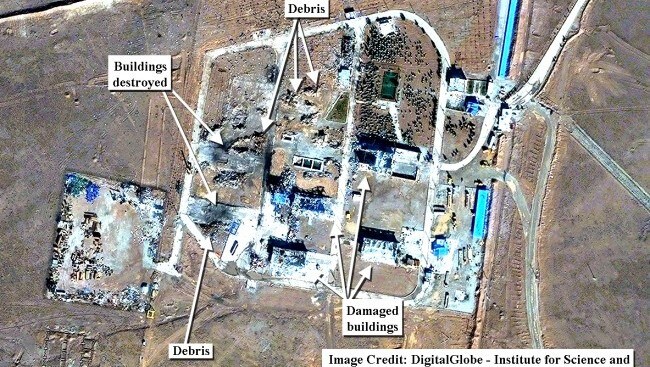
The latest attack on Iran’s civilian nuclear program followed a blast two weeks ago at the sprawling Bid Ganeh missile base 25 miles west of Tehran.
That blast killed upwards of 30 members of the Iran Revolutionary Guard Corps (IRGC), including Major General Hassan Moqqadam, a senior leader of Iran’s missile program.
Satellite imagery shows much of the base in ruins. The attack was described by Time Magazine as the work “of Israel’s external intelligence service, Mossad.”
In a backhanded confirmation that Monday’s blast was the handiwork of Mossad and their terrorist proxies, the Mojahedin-e Khalq (MEK), Frenkel wrote that “Dan Meridor, the Israeli Intelligence Minister, said: ‘There are countries who impose economic sanctions and there are countries who act in other ways in dealing with the Iranian nuclear threat’.”
Frenkel reported that “Major-General Giora Eiland, Israel’s former director of national security told Israel’s army radio that the Isfahan blast was no accident. ‘There aren’t many coincidences, and when there are so many events there is probably some sort of guiding hand, though perhaps it’s the hand of God’,” Eiland said.
The Isfahan blast, as with other recent attacks, were allegedly in response to allegations made last month in a report filed by the International Atomic Energy Agency (IAEA) that Iran may be seeking to develop nuclear weapons.
However, while the “Agency continues to verify the non-diversion of declared nuclear material at the nuclear facilities,” the ginned-up report relied on information provided by “Member states,” presumably Israel and United States in the form of forged computer laptop documents and other “intelligence sources.”
The Agency claims they were “unable to provide credible assurance about the absence of undeclared nuclear material and activities in Iran, and therefore to conclude that all nuclear material in Iran is in peaceful activities.”
Black operations targeting the Islamic Republic aren’t solely the province of America’s “stationary aircraft carrier in the Middle East,” Israel. As Seymour Hersh reported last spring in The New Yorker: “In the past six years, soldiers from the Joint Special Operations Force, working with Iranian intelligence assets, put in place cutting-edge surveillance techniques, according to two former intelligence officers.”
In 2007, ABC News disclosed that “the CIA has received secret presidential approval to mount a covert ‘black’ operation to destabilize the Iranian government.”
Unnamed sources told ABC News that President Bush signed a presidential finding “that puts into motion a CIA plan that reportedly includes a coordinated campaign of propaganda, disinformation and manipulation of Iran’s currency and international financial transactions.”
Congress has appropriated some $300 million for the CIA and the Pentagon’s covert war.
In the intervening years, those programs have turned lethal. Widely applauded by “liberal” Democrats and “conservative” Republicans alike, these programs have continued, indeed expanded under Barack Obama’s “progressive” Democratic administration.
Despite the fact that there “is also constant satellite coverage of major suspect areas in Iran,” The New Yorker reported “that nothing significantly new had been learned to suggest that Iran is pursuing a nuclear weapon.”
‘Shadow War’ Heating Up
Iran’s intelligence services haven’t been sitting idly by watching American, British, and Israeli terror operations.
On Sunday, Al Jazeera reported that the Iranian armed forces “brought down an unmanned US spy plane.”
“Iran’s military has downed an intruding RQ-170 American drone in eastern Iran,” Iran’s Arabic-language Al Alam state television network quoted an unnamed source as saying on Sunday.”
“The semiofficial Fars news agency,” Al Jazeera averred, said “that the plane is now in the possession of Iran’s armed forces. The Fars news agency is close to the powerful Revolutionary Guard.”
“Fars reported that the drone had been brought down through a combined effort by Iran’s armed forces, air defence forces and its electronic warfare unit after the plane briefly violated the country’s airspace at its eastern border.”
An unnamed source, according to AFP, warned that Iran’s armed response would “not be limited to our country’s borders” for the “blatant territorial violation.”
AFP also reported that in June, “Brigadier General Amir-Ali Hajizadeh, the commander of the Guards’ aerospace unit, said Iran had shown Russian experts the US drones in its possession.
“‘Russian experts requested to see these drones and they looked at both the downed drones and the models made by the Guards through reverse engineering,’ he said.”
In a further sign that the “shadow war” is heating up, last week’s occupation of the British embassy in Tehran may have been a warning to the U.K. over sanctioned leaks by the British defense establishment to The Guardian which suggested that “Britain’s armed forces are stepping up their contingency planning for potential military action against Iran.”
“In anticipation of a potential attack,” The Guardian disclosed that “British military planners are examining where best to deploy Royal Navy ships and submarines equipped with Tomahawk cruise missiles over the coming months as part of what would be an air and sea campaign.
The embassy occupation and subsequent downgrade of diplomatic relations between Britain and Iran mean these threats are being taken very seriously indeed.
Asia Times Online reported that Iran’s claim “to have arrested 12 spies working for the United States Central Intelligence Agency (CIA) is potentially a major blow to American intelligence-gathering efforts in Iran and to American intelligence generally.”
Following closely on the heels of last month’s arrest in Lebanon of some 30 CIA operatives by Hezbollah “is suggestive of a major American intelligence defeat, if not a full-blown disaster,” Asia Times analyst Mahan Abedin wrote.
Far from being a high-quality intelligence operation, Abedin averred that the “CIA is operating a lower threshold of quality control in terms of agent recruitment and management” and that this reflects “a scatter-gun approach by the CIA inasmuch as the agency is targeting virtually any Iranian citizen it believes could potentially provide useful information on the CIA’s target set.”
According to Abedin’s Iranian sources, the CIA’s team of “operatives and analysts” appears to have been “embedded within numerous official and unofficial American organizations, including US embassies, multinational corporations, medium-sized commercial organizations, recruitment consultancies, immigration and wider legal services, academic and quasi-academic institutions and reputable (i.e. longstanding) as well as newly set up think tanks.”
In other words, as many researchers have amply documented, efforts by the U.S. secret state to subvert a target nation’s internal defenses prior to full-on “regime change” either through direct warfare (Afghanistan, Iraq, Libya, now Syria) or via an American-brokered “color revolution” (Yugoslavia, Venezuela, Ukraine, Georgia) are not about “freedom and democracy” but to achieve Washington’s geopolitical goals: total economic and political domination.
“But despite clear improvements in counter-espionage capabilities and protective security measures,” Abedin writes, “Iran is still some way away from making it prohibitively costly for Western agencies to operate inside the country. Indeed, all the major West European, North American and Israeli intelligence services are either active inside Iran or work closely with some elements of the Iranian diaspora.”
Describing the “psychological warfare” dimensions of a looming confrontation, Abedin wrote in a subsequent Asia Times Online piece that the covert war operates on two fronts, “one visible and rhetorical and conducted through official and unofficial media and the other secret and centered on sabotage.”
“In so far as the former is concerned Iran has risen to the challenge by superseding tough American and Israeli rhetoric with even tougher rhetoric.”
“However,” Abedin averred, “it is on the sabotage front–where Iran appears to be under attack from several directions–that the Islamic Republic is raising eyebrows even amongst its hardcore supporters by displaying remarkable tolerance in the face of intolerable provocations.”
“More broadly, the Iranians are not paying sufficient attention to the long-term consequences of military confrontation with the United States and her allies.”
That the “long-term consequences” of a Western-led attack will be an unmitigated disaster for the Iranian people, indeed for people across the entire region and for world peace and stability as a whole, doesn’t mean that Washington won’t gamble that a “limited war” could be “contained.”
As analyst William Blum wrote in his Anti-Empire Report: “The secret to understanding US foreign policy is that there is no secret. Principally, one must come to the realization that the United States strives to dominate the world. Once one understands that, much of the apparent confusion, contradiction, and ambiguity surrounding Washington’s policies fades away.”
“Examine a map,” Blum observed. “Iran sits directly between two of the United States’ great obsessions–Iraq and Afghanistan … directly between two of the world’s greatest oil regions–the Persian Gulf and Caspian Sea areas … it’s part of the encirclement of the two leading potential threats to American world domination–Russia and China … Tehran will never be a client state or obedient poodle to Washington. How could any good, self-respecting Washington imperialist resist such a target? Bombs Away!”
Commenting on the Isfahan attack which described Israeli “black ops” as a “route to war,” left-wing analyst Richard Silverstein wrote on the Tikun Olam web site, that “the tragedy of this black ops program is that it will not rattle or deter Iran, as Israeli intelligence believes.”
“Contrary to what Israeli generals believe,” Silverstein wrote, “the Iranians are not pushovers, they can’t be intimidated. They’re willing to die for their country even more than Israelis. They’ve fought defensive wars going back decades and lost millions in conflict. A few explosions, assassinations, and computer viruses will not spook them.”
The drift towards war, which include moves to strangle Iran’s economy prior to a strike, has gained traction on multiple fronts.
On Friday, the U.S. Senate unanimously passed legislation as part of the $644. 3 billion 2012 Defense Authorization Act that “would give the president the power starting July 1 to bar foreign financial institutions that do business with Iran’s central bank from having correspondent bank accounts in the U.S.,” Bloomberg BusinessWeek reported.
Coupled with reports that Germany and other EU member states will “considerably strengthen” sanctions against Iran, the leftist publication German Foreign Policy disclosed that “Berlin is participating in the intensification of western pressure on Teheran.”
Rejecting NATO rhetoric that new punitive economic measures are over “the so-called nuclear dispute,” GFP’s analyst correctly states that the “conflict is, in fact, over hegemony, with the West seeking to defend at all costs its predominance in the Middle Eastern resource-rich regions.”
While “Berlin’s politicians are still divided over Iran … Transatlantic oriented forces are preparing the public for possible military strikes.”
Regarding the strengthening of the West’s sanctions regime, the World Socialist Web Site reported that the EU has “agreed to sanction some 200 Iranian companies, individuals and organisations. European Council President Herman Van Rompuy met with Obama on Monday and issued a joint statement expressing ‘deep concern’ over Iran’s nuclear program, raising the possibility of ‘additional measures’ against the Iranian regime.”
“France,” left-wing critic Oliver Campbell noted, “which is not a major importer of Iranian oil, issued a statement calling for ‘new sanctions on an unprecedented scale,’ including freezing the assets of the Iranian central bank and putting an embargo on Iranian oil.”
“Russia, which has acquiesced in imposing previous sanctions on Iran, has bluntly opposed further punitive measures. Russian foreign ministry spokesman Alexander Lukashevich denounced the latest sanctions as ‘unacceptable’ and ‘contradictory to international law.’ China and Turkey have also opposed additional UN penalties.”
There are new signs that this sharply escalating crisis is fraught with peril.
Last week, Russia Today reported that “Moscow is deploying warships at its base in the Syrian port of Tartus. The long-planned mission comes, providentially, at the very moment when it could help prevent a potential conflict in the strategically important Middle Eastern country.
”The Russian battle group will consist of three vessels led by the heavy aircraft-carrying missile cruiser, Admiral Kuznetsov.”
“Of course, the Russian naval forces in the Mediterranean will be incommensurate with those of the US 6th Fleet, which includes one or two aircraft carriers and several escort ships,” former Chief of Naval Staff Admiral Viktor Kravchenko told Russia Today.
Pointedly, Kravchenko warned, “today, no one talks about possible military clashes, since an attack on any Russian ship would be regarded as a declaration of war with all the consequences.”
Richard Silverstein grimly observed “that Israel knows that black ops will turn Iran more intransigent. It welcomes such Iranian rigidity because it means the day is closer when it will be set loose on the Iranians. Israel’s policy toward Iran is scorched earth.”
The clock is ticking…
Tom Burghardt is a researcher and activist based in the San Francisco Bay Area. In addition to publishing in Covert Action Quarterly and Global Research, he is a Contributing Editor with Cyrano’s Journal Today. His articles can be read on Dissident Voice, The Intelligence Daily, Pacific Free Press, Uncommon Thought Journal, and the whistleblowing website WikiLeaks. He is the editor of Police State America: U.S. Military “Civil Disturbance” Planning, distributed by AK Press and has contributed to the new book from Global Research, The Global Economic Crisis: The Great Depression of the XXI Century.
Tom Burghardt is a frequent contributor to Global Research. Global Research Articles by Tom Burghardt
Iran shows downed US drone: First video of RQ-170 Sentinel (video)
RT
December 8, 2011
Video courtesy: Press TV
Days after the Pentagon first denied and then admitted that it lost touch with a high-tech drone aircraft, authorities in Iran are now saying that they have the plane — and its condition is pristine.
‘Strike on Iran will not stop its nuclear program’ (video)
RT
December 9, 2011
On Thursday, US President Barack Obama said he’s “considering all options on Iran”. RT’s Reema Abu Hamdieh talks to former U.S. State Department spokesman Philip J. Crowley on US military intervention in Iraq and Afghanistan, Iran’s nuclear program and the possibility of US-Iran war.

 PN
PN