
US help might see Syrian rebels form alternate govt
by Nile Bowie
NileBowie.blogspot.ca
March 7, 2013
The long-term US funding of anti-government programs in Syria has raised questions about the types of groups being supported, and the benefits and arms supplied to militant groups; establishing political stability requires considered dialogue.
It appears that the US State Department under John Kerry will soon shift its focus to helping the rebels establish a full-fledged alternative government on Syrian territory and recognize it as the legal government of Syria. Such a move would legitimize the transfer of heavy weaponry and would allow the US to directly employ air strikes or Patriot anti-missile batteries against Assad’s forces.
Some would argue that these moves could help to marginalize the notable al-Qaeda presence among rebel forces. Pumping more arms and heavier weapons into Syria is unconscionable at this point, and continuing to do so will inevitably bolster the muscle and reach of jihadi and Salafist fighters. The argument that the US and its allies have only armed the “moderate” rebels is a deeply flawed one; weapons are in high demand by all rebel factions and there is little means to effectively prevent arms from gravitating toward hardcore Al-Qaeda fighters.
In his famous 1962 description of irregular warfare operations, US President John F. Kennedy alluded to “another type of warfare,” one that is “new in its intensity, ancient in its origin—war by guerrillas, subversives, insurgents, assassins; war by ambush instead of by combat, by infiltration instead of aggression, seeking victory by eroding and exhausting the enemy instead of engaging him. It preys on unrest.”
After two harrowing years of division, senseless killing and civil war, the scared Syrian nation and its people are well acquainted with these unconventional methods of warfare denounced over 50 years ago.
Yet Western and Gulf states have proven their double standards by enabling radicals elsewhere – lest we forget the presence of Libyan military commander Abdulhakim Belhadj, former leader of the militant Libyan Islamic Fighting Group (officially designated as a terrorist organization by the US State Department), who was sent to Syria to aid the Free Syrian Army on orders of the entity formerly known as the Libyan National Transition Council (NTC). The track record of allied Western and Gulf states shows that they are more interested in enabling terrorism for their own purposes rather than preventing it.
Since the eruption of violence in March 2011, Syria has endured targeted assassination campaigns, ceaseless suicide bombings and shelling, and massacres where infants have had their throats slit to the spine – the time has come for the opposition to engage the Assad government in dialogue and finally bring about a ceasefire and the total cessation of violence and insurgency.
From the reports of third-party sniper-fire targeting both protesters and security personnel in the southern city of Daraa at the very onset of the conflict, to the horrendous attacks on the students of Aleppo University in January 2013 – those who have critically monitored the situation from the beginning are under no illusions – the influx of armament and mercenary elements from abroad into Syria has brought the situation to where it is today. Western capitals have provided logistics, coordination, political support, and non-lethal aid, Gulf states such as Saudi Arabia and Qatar have openly provided weapons and monthly salaries for rebel fighters, and Turkey has allowed rebel fighters to receive training and arms from the US Central Intelligence Agency (CIA) in the southeastern part of the country, allowing militants to pass into Syria freely.
There are those who say that Syria is the subject of an internal revolution that is brutally repressed by a malicious dictator, and those who say instead that Syria is being attacked by foreign powers who have deployed mercenaries and extremist fighters from abroad to engage in the destruction of infrastructure and conduct targeted assassinations to bring about an end to the Assad regime. Despite Washington’s concerns of heavy weapons falling into the hands of Al-Qaeda-linked militants, the US-backed campaign to coax regime change in Damascus has from the very onset enabled militants who justify their acts of terror in the name of a perverted interpretation of Islam. Reports in the Washington Post indicate that US support for anti-government groups in Syria began in 2005, transcending two presidential administrations:
“The U.S. money for Syrian opposition figures began flowing under President George W. Bush after he effectively froze political ties with Damascus in 2005. The financial backing has continued under President Obama, even as his administration sought to rebuild relations with Assad. Syrian authorities ‘would undoubtedly view any U.S. funds going to illegal political groups as tantamount to supporting regime change,’ read an April 2009 cable signed by the top-ranking U.S. diplomat in Damascus at the time. ‘A reassessment of current U.S.-sponsored programming that supports anti-[government] factions, both inside and outside Syria, may prove productive,’ the cable said. The cables report persistent fears among U.S. diplomats that Syrian state security agents had uncovered the money trail from Washington.”The article describes how Washington funnelled about $12 million to anti-government programs in Syria between 2005 and 2010 to recipients affiliated with the Syrian Muslim Brotherhood. Israel, which is now illegally conducting exploratory drilling in the occupied Golan Heights, and the US view the toppling of Damascus as a means of extinguishing the critical conduit between Iran and Hezbollah, the political and militant Shi’a organization centered in Southern Lebanon, in addition to helping isolate the Palestinian resistance.
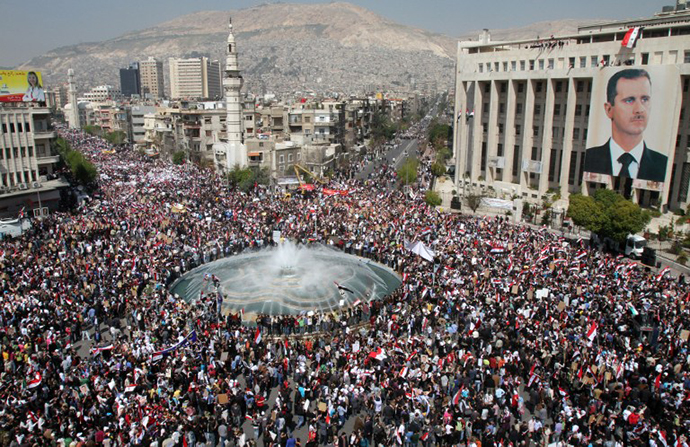
The non-violent route: Laying aside differences
Both the incumbent Syrian authorities and the opposition must find strength to come to a mutually acceptable compromise. These parties have no other option than to search for a solution, lay down an agreeable constitutional basis for elections, and face each other in international monitored polls once the situation stabilizes. The Syrian people must not have democracy imposed on them, and the victor of this war should not be decided on the battlefield, but by the ballot box.
To gain the confidence of the electorate, election observers from the US, Qatar, Russia, and Iran could be sent to monitor the transition process – if the people of Syria want Assad to remain in power, then the rule of majority must be honored. Militant groups comprised of mostly hard line foreign fighters such as Jabhat al-Nusra and the Islamist Ahrar al-Sham cannot be expected to participate in a ceasefire, so the true test of a short-term alliance between Assad and the SNC would be in its ability to cooperate in quelling radical militants and restoring stability – such is a perquisite for any kind of transition.
Former US Secretary of State Hilary Clinton once threatened Russia and China that they would “pay a price” for their position on the Syrian issue. It should be noted that these powers maintained a balanced approach throughout and advocated dialogue from the start, in addition to stringently adhering to former UN Envoy Kofi Annan’s six point peace plan. Iran should also be given due credit for hosting an International Consultative Conference in August 2012, which brought together representatives of thirty nations to call for ending the flow of foreign arms into terrorist hands inside Syria, proposals to broker a meaningful ceasefire, the coordination of humanitarian aid, and support for Syrian people’s right to reform without foreign interference.
Accommodating diversity in Syrian society
Iranian Foreign Minister Ali Akbar Salehi was quoted in the Washington Post stating,“Syrian society is a beautiful mosaic of ethnicities, faiths and cultures, and it will be smashed to pieces should President Bashar Assad abruptly fall. The idea that, in that event, there would be an orderly transition of power is an illusion. Abrupt political change without a roadmap for managed political transition will lead only to a precarious situation that would destabilize one of the world’s most sensitive regions.” It is clear that the Assad government is more stable than many Western states anticipated, and it continues to enjoy popular support.
Hezbollah leader Sheikh Hassan Nasrallah recently warned against sectarian infighting in Lebanon related to the Syrian civil war, arguing that outsiders are pushing Lebanon “toward civil and religious strife, and specifically Sunni-Shia strife.” Iraqi PM Nouri al-Maliki also warned that a victory for rebels would “create a new extremist haven and destabilize the wider Middle East.” The Syrian regime will not imminently collapse but if it is brought down by military intervention, the consequences could lead to a highly unpredictable situation where match and tinder can meet at any moment with debilitating consequences for the region. It is time for both parties to convene. It is time to end this war.
Selective support
Reports published in 2007 in the New Yorker by veteran journalist Seymour Hersh detail how the US, Israel and Saudi Arabia supported a regional network of extremist fighters and terrorists affiliated with al-Qaeda with the aim of stomping out Hezbollah and Syria’s Assad in a bid to isolate Iran, who is viewed as an existential threat to the US and its allies in the region. A principal component of this policy shift was the bolstering of Sunni extremist groups, hence the ever-deepening sectarian nature of the Syrian conflict:“To undermine Iran, which is predominantly Shiite, the Bush Administration has decided, in effect, to reconfigure its priorities in the Middle East. In Lebanon, the Administration has cooperated with Saudi Arabia’s government, which is Sunni, in clandestine operations that are intended to weaken Hezbollah, the Shiite organization that is backed by Iran. The U.S. has also taken part in clandestine operations aimed at Iran and its ally Syria. A by-product of these activities has been the bolstering of Sunni extremist groups that espouse a militant vision of Islam and are hostile to America and sympathetic to Al Qaeda.”
While the CIA has purportedly claimed to distribute arms only to “secular” and “moderate”rebel forces, Washington insiders from various academic and think-tank circles have openly endorsed bizarre positions in favor of integrating terrorists into Syria’s rebel forces. “Al-Qaeda’s Specter in Syria,” penned by Council on Foreign Relations senior fellow Ed Husain, argues in favor of Al-Qaeda terrorists and their inclusion in the Free Syrian Army, stating, “The influx of jihadis brings discipline, religious fervour, battle experience from Iraq, funding from Sunni sympathizers in the Gulf, and most importantly, deadly results. In short, the FSA needs al-Qaeda now.” Foreign Policy’s, “Two Cheers for Syrian Islamists,” penned by Gary Gambill of the heavily neo-conservative Middle East Forum, argues in favor of Al-Qaeda, “Islamists — many of them hardened by years of fighting U.S. forces in Iraq — are simply more effective fighters than their secular counterparts. Assad has had extraordinary difficulty countering tactics perfected by his former jihadist allies, particularly suicide bombings and roadside bombs.”
While many Western media outlets once likened Syria’s rebels to pro-democracy freedom fighters, it has become more challenging to view them as anything other than Salafist radicals – the former’s existence was amplified specifically to provide cover and legitimacy for the violence and subversion of the latter. As a result of a foreign-backed insurgency, the Assad regime resorted to tactics of shelling and conducing air strikes on rebel strongholds, which were mostly in densely populated urban areas. It should not be denied that these heavy-handed tactics have also led to a substantial and regrettable loss of life.
The Friends of Syria group recently convened in Rome, where the US State Department has pledged $60 million to help the opposition maintain “the institutions of the state” in areas under their control, such as establishing terms of governance, the rule of law, and police forces. Reports have also claimed that the US is also deliberating more open engagement in Syria under newly appointed US Secretary of State John Kerry, however Washington has stopped short of openly providing arms and military training. American and western officials have told the New York Times that Saudi Arabia has recently financed a large purchase of infantry weapons from Croatia and funnelled them to Syrian rebel groups. Although the United States is not credited with providing arms to rebel forces, the New York Times has reported the presence of CIA operatives in southern Turkey since June 2012, who are distributing weapons with the Obama administration’s blessing. US spokesperson Jay Carney was quoted as saying, “We will continue to provide assistance to the Syrian people, to the Syrian opposition, we will continue to increase our assistance in the effort to bring about a post-Assad Syria.”
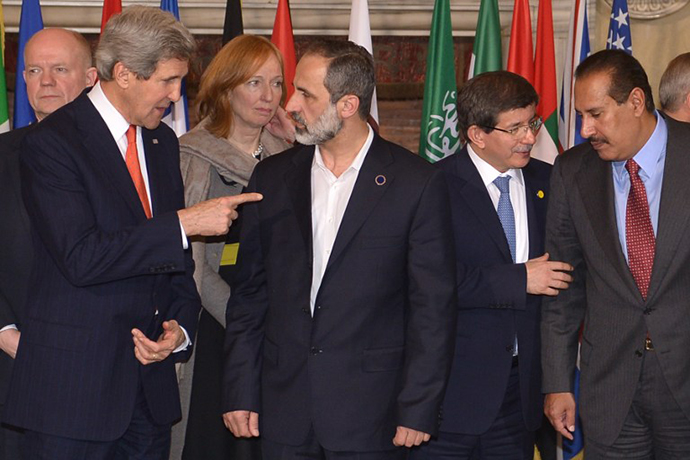
The Syrian Ambassador to the UN Bashar al-Jaafari has urged the Friends of Syria states to convince the Syrian opposition to sit down for an unconditional national dialogue, which al-Khatib has expressed his willingness to take part in. One could surmise that al-Khatib’s shift toward dialogue indicates that the SNC is feeling less secure and more wary of a possible military defeat or rivalry with radical factions. Such a dialogue would undoubtedly represent a step in the right direction. Despite political differences and two years of deep conflict, these two parties must establish a genuine ceasefire and partnership to restore a climate of normality throughout the country. In this context, both parties must be able to agree on coordinating aid distribution to all parts of the country.
International recognition of a provisional SNC government would only create further divisions at a time when national unity is most needed. Although rebel-held areas are badly isolated and in need of humanitarian supplies, the delivery of aid must be facilitated through direct talks and partnership between Moaz al-Khatib’s Syrian National Council and Bashar Al-Assad’s government.
Iran-Pakistan ‘lifeline’: Pipeline aims for global power balance
by Eric Draitser
Russia Today
March 11, 2013

Iranians work on a section of a pipeline linking Iran and Pakistan after the project was launched during a ceremony in the Iranian border city of Chah Bahar on March 11, 2013 (AFP Photo / Atta Kenare)
The pipeline will bring more than simply an economic boost to both countries; it is a crucial guidepost on the path to peace. After generations of conflict, Iran and Pakistan are taking their economic destinies into their own hands – together.
The pipeline, which would bring Iranian gas to Pakistan through its western Balochistan province, will stretch almost 1,000 miles (1,600 km) from Iran’s gas-rich Asalouyeh region into the Pakistani heartland, supplying major cities like Karachi and Islamabad with much needed, reliable energy while carrying a pricetag of roughly $1.5 billion. Similarly, the project is critical for Iran as it struggles to survive and grow amid the hostility of US-European sanctions.
The Benefits for Both Countries
It is against the backdrop of brutal, draconian sanctions initiated by the US and its European partners, that Tehran has taken the countermeasure to develop itself and the region, constructing an economically independent framework of relations not beholden to Western financiers. Undoubtedly, the centerpiece of this strategy of economic independence as a means of anti-imperialist resistance is the Iran-Pakistan pipeline. The project, already nearing completion on the Iranian side of the border, would bring desperately needed Iranian gas to energy-starved Pakistan – a country battling a perpetual energy shortage. Needless to say, the project is critical for the economic survival of both nations.
For Iran, the pipeline means economic stability at a time of tremendous turmoil. While the Islamic Republic often downplays the impact of the sanctions, the reality is inescapable: an inflation rate hovering around 30% , the loss of key regional markets such as India, and the continued shortage of medicines and staple foods among other things . These problems plaguing the Iranian economy require both short-term and long-term solutions. The pipeline conveniently addresses both as it provides Tehran with much needed energy revenue today, while offering the potential for increased revenue and infrastructure expansion in the future. Essentially then, the pipeline is really more of a lifeline, anchoring the Iranian economy for decades to come.

Iran’s President Mahmoud Ahmadinejad (2ndL) and Pakistan’s President Asif Ali Zardari wave during a ceremony marking the start of work on the 780-kilometre (485-mile) pipeline from Iran to Pakistan on March 11, 2013 in the Iranian border city of Chah Bahar (AFP Photo / Atta Kenare))
Like their Iranian neighbors, Pakistan also has had to address glaring economic deficiencies, particularly with regard to the energy sector. A recent poll unsurprisingly showed that energy shortages, along with unemployment, remain the greatest economic issues facing the country. Public anger over the inability of the government to meet the country’s electricity demands has boiled over in the form of riots numerous times, most recently in the summer of 2012 . This type of public unrest over the energy issue serves to delegitimize the government, especially the ruling Pakistan People’s Party (PPP), and weaken their hold on political power.
For Islamabad then, the pipeline means energy security which, in turn, means political stability. Moreover, the project as a whole is, at least in small part, a way of resisting Washington and the Obama administration’s continued violations of Pakistani sovereignty. By pushing forward with the project, in the face of countless threats from Washington, Pakistani president Zardari is walking a fine line between maintaining a working relationship with his US partners and forging new relations from which Pakistan will benefit while the US loses.
A Sectarian Bridge?
One critical aspect of the Iran-Pakistan pipeline is the simple fact that it brings together two countries that, if western imperialists were to have their way, would always remain enemies. Pakistan (a majority Sunni Muslim country) and Iran (a majority Shiite Muslim country), have historically been at odds with one another, choosing rather to align themselves with other Sunni and Shiite countries respectively. This fundamental conflict has, for more than a century, been at the heart of the imperialist/colonialist strategy.
Whether British, French, or American, western powers have long dominated the vast energy resources of the Middle East and Central Asia by dividing the Muslim populations along these sectarian lines, exploiting the differences between them in order to prevent independent economic development. However, the Iran-Pakistan pipeline flies in the face of this “divide and conquer” strategy. Bringing together these two countries through mutually beneficial economic development, the project seems to signal a major change in the Muslim world in the 21st Century. No longer will the imperialists be able to control the destinies of nations in the region by exploiting their differences. Rather, it is the imperial powers themselves who will have to reevaluate their strategy and come to terms with a changing world in which their unchallenged hegemony becomes a relic of the past.
The Geopolitics of the Pipeline
Although the Iran-Pakistan pipeline is economically and politically significant to both nations, it takes on perhaps its greatest importance in the context of world geopolitics. The project fundamentally alters the balance of power in Asia and the world for a number of reasons.
First and foremost, the pipeline links two countries that, each in its own way, seek to undermine US hegemony in the Middle East and South Asia. While Iran has been the implacable foe of Washington since the Islamic Revolution of 1979, Pakistan has maintained relations that at one time made them close allies, but in recent years have deteriorated to the point where the United States is seen as Public Enemy No. 1 in the streets. The pipeline brings the two countries closer together and, in so doing, helps to solidify a relationship united by a common mistrust of the US.

Iranians work on a section of a gas pipeline linking Iran and Pakistan after the project was launched during a ceremony in the Iranian border city of Chah Bahar on March 11, 2013 (AFP Photo / Atta Kenare))
Secondly, the Iran-Pakistan pipeline could quite easily become the Iran-Pakistan-China pipeline if Beijing decides to finally get involved. In this very plausible scenario, China would finally get the “holy grail” it has sought for years: land-based access to energy imports from the Middle East. For China, an energy-starved economy that continues to grow, this would greatly enhance their regional position. It would also transform the balance of power in Asia, as the era of US domination of energy resources in the Middle East would be over. So, were the project to be extended to China, the pipeline would become the focus of a new power paradigm, making it one of the most important economic development projects in the world.
Additionally, the pipeline shows the growing power and influence of international alliances and organizations that represent a counterweight to the imperialist establishment of the West. Iran has taken on the role of leading the Non-Aligned Movement, thrusting itself into the forefront of the anti-imperialist bloc. At the same time, both Iran and Pakistan seek membership in the Shanghai Cooperation Organization (SCO), led by Russia and China, which is showing signs of developing into a full-fledged strategic alliance that provides a check to US-NATO dominance. In this way, the pipeline becomes the tangible link between various organizations and alliances which seek to beat a path independent of US hegemony. It is for this reason, more than anything else, that the United States has vigorously attempted to subvert the development of the pipeline, going so far as to heavily promote the much-touted Turkmenistan-Afghanistan-Pakistan-India (TAPI) pipeline, seen as the main competitor to the Iran-Pakistan project. However, despite the fierce opposition from Washington, the project will go ahead while the TAPI still remains on the drawing board, subject to security concerns in Afghanistan and elsewhere along the route.
When seen from the broadest perspective, the Iran-Pakistan pipeline fundamentally transforms power relations in the Middle East, South Asia, and throughout the world. Not only does it benefit the two nations involved, but all other nations and peoples who have been oppressed, controlled, or otherwise coerced by the Western powers. In this way, the Iran-Pakistan Pipeline represents peace and progress. In short, it is the promise of a better future.

Iranians work on a section of a pipeline (on with are sticked Iranian and Pakistanese national flags) after the project was launched during a ceremony with presidents of Iran and Pakistan on March 11, 2013 in the Iranian border city of Chah Bahar (AFP Photo / Atta Kenare)
The statements, views and opinions expressed in this column are solely those of the author and do not necessarily represent those of RT.

Eric Draitser is an independent geopolitical analyst based in New York City and the founder of StopImperialism.com.
[hat tip: Nile Bowie]
Syrian Situation is a Lunatic Asylum of Conflicts of Interests
21st Century Wire
March 14, 2013
 by Jason Liosatos
21st Century Wire
The chaos in Syria is a plethora of conflicting interests and motives resulting in a predictable and chaotic bloodbath, with various participants inside and outside Syria playing their part overtly and covertly in the horrendous debacle.
Our world has become like a chess board with Government participants and power players using any mistakes and outcomes to further their own interests, which has become almost normal. It is interesting but shocking that it seems almost unbelievable to most people that ethical and moral ideals, and peace and harmony seem impossible globally.
The US and Western governments are sidestepping their own laws and arming desperate, angry men who have little to lose and little to gain when the dust finally settles. We see UK’s warmonger William Hague and Russia’s Sergei Lavrov shaking hands but who are both benefiting from the bloodshed, with Russia being a key weapons supplier for Damascus with current contracts worth around $1.5bn (£950m), with its fear that US and the West are closing in on them. William Hague and UK are also salivating at the prospect of a Syria without Assad with a fortune to be made on rebuilding contracts, and from a foothold in the region, and a fortune being made by arming the rebels if they veto the extension of the arms embargo, though apparently they are already arming the rebels with weapons shipped from Serbia. Add to this the Saudi interests, Iran, Turkey and all the other conflicting or complementary interests and we have a literal lunatic soup with the chefs of each ingredient hell bent on getting the most out of the finished recipe for themselves, be it a recipe of disaster or harmony.
This is the sickness and danger of our world Governments, that almost without exception their interests of greed, gain and control by far outweigh their ethical and moral compass to do the right thing, but instead by doing the thing which benefits them most. The ethical compromises which we see amongst the decisions being made by world leaders are probably our greatest threat as humanity, because of repercussions down the time line, the consequential results, in the as yet unseen future, created by acts without vision and wisdom, their vision blinded by an insatiable lust for power and control, and we are becoming used to it.

NOT ROLLING OVER: Syria has turned out to be one of NATO’s most difficult regime change operations.
In Syria the insanity is endemic within all the fighting factions, be it Assad, the rebels, the religious complications, the US government, al Qaeda, UK, Russia and many others – we are seeing a culmination worldwide of results and outcomes of imbalanced, insane symptoms resulting in a literal sickness of aggression and xenophobia throughout humanity as a whole, as short term greed and fear sweeps its destructive path across continents and the world, with the ultimate destructive god of money and mass manipulation ruling the world and destroying societies and perpetuating war and misery globally.
Our world has definitely become a prime example of how quickly a planet can turn into a lunatic asylum when its psychotic, megalomaniac leaders become seduced by the drug of money and control, turning the planet into a literal war torn casino and hard labor camp where almost everything revolves around money, gain and control, at any cost to human, animal or planet. We only need imagine someone watching us from another planet of peace and stability, and wonder what they would think observing our present and past situation of continual war and conflict spearheaded by insane leadership.
Our inbuilt, ethical and moral alarm bells, though seriously impaired, are still ringing loud and clear that something is dangerously wrong in our system, as we watch people and children, our human brothers and sisters, kill each other and themselves in their fight for freedom, and it is an emergency now that we all put our shoulders to the wheel of change, a change that must come from within each of us if we are to see a change outside of us.
We must also recognize that we are very easily manipulated and controlled, and if we are to live in peace we must all become peace individually and drop our labels of race and religions that cause the problematic divisions among us which are played upon with impunity by our greedy, power mad governments.
Open War Crimes: US and British-Backed Weapons Airlift From Croatia to Terrorists in Syria
 by Patrick Henningsen
21st Century Wire
The evidence is now in, as list of state actors can now be seen openly conspiring to drive the Middle East into full-blown war.
It’s well known by now that NATO and the Gulf States initial plans to overturn the sovereign state of Syria has been running behind schedule since their operation was launched two years ago. They had hoped for the sort of slam dunk which they enjoyed in overturning the country of Libya in late 2011.
This same formula could not be applied again however, so Plan B, a ground war using proxies has meant a longer drawn out conflict. It hasn’t been working fast enough in Syria, and western backed terrorist groups still sustaining heavy losses in their fight to topple the Assad government on behalf of the NATO and its Gulf allies.
The main obstacle with Plan B is that the very idea of directly arming terrorists in Syria is not one which can be sold openly in either the US or Britain. Plan C is to draw in the UN by creating a ‘chemical weapons’ crisis in Syria, and thanks to a prominent online leak of documents relating to UK DOD contractor Britam, the British have been caught brokering a deal transferring ex-Gaddafi stocks from Libya to Syria to be blamed on Assad, and paid for by Qatar. But the WMD threat still remains a hard sell for western voters…
From the NATO Allied corner, something drastic needed to be done.
Whilst politicians in the West, namely those in Washington DC, London and parts of Europe, have been publicly denying that they were helping to organise running arms into Syria and issuing very public pleads for ‘humanitarian aid’ for those they identify as the Syrian Opposition, activity back stage has been furious. The debate in government and the media has been mere window dressing for the real operation being quietly carried out.
NATO Gun-running via Croatia
 It can now be revealed that NATO allied nations were busy using proxy states to drive their war in Syria – putting together one of the biggest international black operation transfers of military supplies in recent history. So it’s official: large caches of hardware from the West have been transferred to the Syrian jihadist mercenary collective known as the ‘Free Syrian Army’ , ‘Syrian Rebels’, or ‘Syrian Opposition’ – depending on who you ask, a brash move which may be vehemently opposed by other UN Security Council members – namely Russia and China.
Multiple media sources reveal the details of this massive airlift comprised of 75 airplanes, and an estimated 3,000 tons of military weaponry on board has left Croatia and has already been delivered… to Syria.
It is also confirmed from these reports that Saudi Arabia has financed a large portion of this purchase secretly transported to al Qaeda and other FSA fighters – who are working with the support of the CIA, MI6 and others, along with other financial and material support of Qatar and Saudi, to further destabilise and overthrow the Assad government in Syria.
Croatia’s daily newspaper Jutarnji List reported:
“From the start of November last year, till February this year, 75 planes flew out from Zagreb Airport with over 3,000 tons of weapons and ammunition bound for Syrian rebels…The newspaper, quoting diplomatic sources, says that besides Croatian weapons the planes were full with weapons from other European countries including the UK. The weapons were organised by the United States of America.
Sources say that the first few flights to leave Croatia bound for Syria with weapons were operated by Turkish Cargo, which is owned by Turkish Airlines. After those flights, Jordanian International Air Cargo took over the flights. The deal to provide arms to the rebels was made between American officials and the Croatian Ambassador to the US.”
In addition to this huge gun-running operation, Croatia also appears to be guilty of either having advanced knowledge, or possibly coordinating with Syrian terrorists as evidenced by their recently withdraw all of troops from the UN observer mission in Golan Heights, indicating that the recent kidnapping by Free Syrian Army Terrorists of at least 20 UNIFIL peacekeepers in the Golan Heights was known in advance by Croatia.
The kidnapping incident may have been designed to test the UN, but also to pull Syria’s southern neighbor, Israel, even closer to the conflict, a development which would almost surely prompt the UN to declare this as trigger to a regional crisis, followed by an authorised military intervention. Pulling Israel in would also risk involving Hezbollah from Lebanon, who are already engaging in assisting Assad in training a new specialist paramilitary force in Syria to deal with urban warfare.
If it was known by Croatia, then one can only conclude that this was also known by US and British operatives as well. Both the US and Britain will naturally claim deniability as their legal out in this case, by deniability through the use of proxies makes no innocent parties when the prospect of a multi-regional war beckons as a result of the west’s financial, logistical, political, and now material involvement in the overthrow of a sovereign state and internationally recognised government.
Much worse, however, is that by employing proxies like Jordan, Croatia, Turkey,and others, the NATO allies have guaranteed long-term retribution down the road, should Syria prevail in this fight. For Syria, it is now known which countries collaborated with the West to dismantle their country. This fact alone will ensure conflict in the region for a generation.
US officials are on record as admitting to helping arrange the weapons airlift, as cited in this Feb 25, 2012 article in the New York Times:
“An official in Washington said the possibility of the transfers from the Balkans was broached last summer, when a senior Croatian official visited Washington and suggested to American officials that Croatia had many weapons available should anyone be interested in moving them to Syria’s rebels.”

Terrorist receive recoilless guns from the former Yugoslavia.
Revelations are not limited to the Croatian news report, as we see the US and Europe’s mainstream media wall of silence has begun to crack, including here a recent report from London’s Daily Telegraph sent across Syria’s borders with Jordan and NATO-member Turkey. The article entitled, “US and Europe in ‘major airlift of arms to Syrian rebels through Zagreb’“goes on to give further details of direct European involvement in illegal weapons running:
“The United States has coordinated a massive airlift of arms to Syrian rebels from Croatia with the help of Britain and other European states, despite the continuing European Union arms embargo, it was claimed yesterday…
Decisions by William Hague, the Foreign Secretary, to provide non-lethal assistance and training, announced in the past week, were preceded by much greater though less direct Western involvement in the rebel cause, according to a Croat newspaper.
The shipments were allegedly paid for by Saudi Arabia at the bidding of the United States, with assistance on supplying the weapons organised through Turkey and Jordan, Syria’s neighbours.
…as from Croatia, weapons came “from several other European countries including Britain”, without specifying if they were British-supplied or British-procured arms.
British military advisers however are known to be operating in countries bordering Syria alongside French and Americans, offering training to rebel leaders and former Syrian army officers…
… The weapons, including rocket launchers, recoil-less guns and the M79 anti-tank weapon, have been seen in rebel hands in numerous videos, and were first spotted by an arms expert Eliot Higgins, who blogs under the name Brown Moses. He traced them moving from Dera’a in the south, near the Jordanian border, to Aleppo and Idlib provinces in the north.”

Hague: Denies Britain’s involvement in gun-running.
It is also no big secret that Britain has deployed a significant contingent of troops and support personnel to Jordan at least as far back as Autumn 2012 as part of its ongoing ‘joint military exercises’ with the Jordan military, but this latest revelation puts into clearer perspective the overwhelming likelihood that high level British military operation have actually been involved in the transfer of arms from Jordan into the hands of the international terrorist confab of mostly foreign fighter running under the west’s media banner of “Syrian Rebels”.
Consequences for Croatia, and Britain
What Britain may be guilty of here, is cynically – and illegally, trying to side-stepping the EU embargo on arms into Syria by using the fledgling EU state of Croatia as their delivery mechanism, because Croatia does not officially join the EU until July 1, and has not implemented any binding EU legislation. This flagrant violation of both EU and international law should mean that Croatia’s entrance into the EU could be appealed by other members states willing to raise an objection, with what are now clear grounds to mount a legal challenge against Croatia.
Regardless of any EU outcomes however, Croatia at least – is guilty of international war crimes.
International and EU Sanctions Against the US, Britain, Turkey, Qatar and Saudi Arabia
As expected, Britain’s Foreign Office denies all of the claims connecting it to the Croatian gun-running program, but if Britain is involved – even indirectly, through a proxy like Croatia, or if British military personnel are aiding and abetting these known terrorist fighters in Syria through the transfer of weaponry, then Britain can also be brought into the international legal framework to answer for what it has done behind the public’s back.
The international war crimes which are now in the public view could test the legal framework of the EU, the UN and the ICC in the Hague. The legal door is now open for charges against state actors including US, Britain, Qatar and Saudi Arabia – for the crimes of illegally arming a force of foreign fighters and known terrorists in Syria – designed to destroy the country from within. Many UN resolutions, including the recent Resolution 1973 applied in Libya by the UN, have been implemented on much more spurious and shaky grounds than the overwhelming evidence available regarding Syria.
Consequences for NATO and the UN
Despite any denials in Brussels, NATO are involved through their member states Turkey and Croatia, as well as US, UK, and France from behind. Any involvement should question these country’s NATO status, or at least it begs the question what is NATO for, or even the UN, if their member states are conspiring together to subvert international law?
Moreover, Israel’s unwarranted airstrike against a Syrian Military Research facility last month was also ignored by the UN, but this is not surprising as Israel has long been allowed to operate outside of international law and norms.
If the international community does not act in this instance, then it opens the door to more brazen criminality sans borders, which could spawn similar illegal operations against Iran, opening the door to a Third World War.
US uniformed Personnel Training Rebels in Jordan
Der Spiegel also reports this week that, despite denials by Washington DC, Americans are definitely training Syrian rebels in neighboring Jordan. The reports goes on:
“It is not clear if the Americans are members of the US armed forces or are part of a private contracting firm, but the trainers wear uniforms, the paper reported.
It added that the training, which also involves Jordanian intelligence officers, had been going on “for some time,” and that the rebels were being taught how to use anti-tank weaponry.”
France sends ‘aid’ for Syria to Jordan
France played an integral part in the destruction of Libya in 2011, and they might also have an interest in their former colonial possessions in Syria, but it’s not clear as yet if France’s commitment to overthrowing the Assad government is on par with the US and Britain’s efforts. Back in August 2012, France had also been sending large shipments designated for Syria via Jordan, claiming that these shipment contained ‘aid and medical supplies’ – intended for Syrian refugees. Real Syrian News reported:
“An Antonov 124 cargo aircraft landed at the Marka military airport in Amman on Saturday. The cargo is said to include a field hospital and medical supplies for the refugees in the Zaatari camp near the Syrian border. An A310 airliner carrying 85 French military staff and medical equipment arrived in Jordan on Thursday.”
After the Croatian airlift, it’s now not a stretch to suspect that other countries could be involved in similar operations under the cover of supplying ‘humanitarian aid’.
Consequences for Jordan
The overwhelming body of evidence proves that Jordan is playing the key role as proxy and facilitator for the West’s wishes and desires to destroy the country of Syria. The consequences for Jordan, should the West’s efforts fail, is that Jordan has now exposed itself as a provocateur and enemy of both Syria, and Lebanon, and indeed Iran also. It is not know how much Jordan has been paid for its services, or what promises have been made to its royal family in exchange for facilitating the Syrian upheaval, but it cannot compensate Jordan for playing the crucial role in possibly fomenting a regional or multi-theatre global war.
Syria Crisis Planned by the US and NATO Allies Before the ‘Arab Spring’
Despite previous denials and avoiding the issue by states persons like Hillary Clinton and William Hague, it is certain that ‘al Qaeda’ terrorists are operating in Syria and receive various kinds of support from the West and their Gulf allies, and that these are many of the same terrorist who are responsible for violence and killing in Iraq. The New York Times confirmed this fact recently:
“Iraqi officials said the extremists operating in Syria are in many cases the very same militants striking across their country. “We are 100 percent sure from security coordination with Syrian authorities that the wanted names that we have are the same wanted names that the Syrian authorities have, especially within the last three months,” Izzat al-Shahbandar — a close aide to the Iraqi prime minister, Nuri Kamal al-Maliki — said in an interview on Tuesday. “Al Qaeda that is operating in Iraq is the same as that which is operating in Syria,” he said.”
Bangkok based analyst, Tony Cartalucci, from Land Destroyer blog, adds another important piece of evidence in this mix, pointing out the fact that the US and its NATO operatives have been engineering the crisis in Syria well before the official ‘uprising’ began in 2011:
“Pulitizer Prize-winning journalist Seymour Hersh, in his 2007 New Yorker report titled, “The Redirection: Is the Administration’s new policy benefiting our enemies in the war on terrorism?“stated explicitly that:
“To undermine Iran, which is predominantly Shiite, the Bush Administration has decided, in effect, to reconfigure its priorities in the Middle East. In Lebanon, the Administration has cooperated with Saudi Arabia’s government, which is Sunni, in clandestine operations that are intended to weaken Hezbollah, the Shiite organization that is backed by Iran. The U.S. has also taken part in clandestine operations aimed at Iran and its ally Syria. A by-product of these activities has been the bolstering of Sunni extremist groups that espouse a militant vision of Islam and are hostile to America and sympathetic to Al Qaeda.”
Cartalucci provides further background to support the west’s own knowledge and involvement is the current crisis:
Is there any doubt that the US has executed this plot in earnest, arming and funding sectarian extremists “sympathetic to Al Qaeda” on both Syria’s northern and southern border? Where else, if not from the West and its regional allies, Israel, Saudi Arabia and Qatar, could extremists be getting their weapons, cash, and logistical support from?And of course, Syria’s borders with Jordan and Turkey have been long-ago identified by the US Army’s own West Point Combating Terrorism Center (CTC) as hotbeds of sectarian extremist/Al Qaeda activity – hotbeds that the West is purposefully funneling thousands of tons of weaponry through, while disingenuously claiming it is attempting to prevent such weapons from falling into the hands of extremists.
The CTC’s 2007 report, “Al-Qa’ida’s Foreign Fighters in Iraq,” identified Syria’s southeastern region near Dayr Al-Zawr on the Iraqi-Syrian border, the northwestern region of Idlib near the Turkish-Syrian border, and Dar’a in the south near the Jordanian-Syrian border, as having produced the majority of fighters found crossing over into Iraq throughout the duration of the Iraq War.
Image: (Left) West Point’s Combating Terrorism Center’s 2007 report, “Al-Qa’ida’s Foreign Fighters in Iraq” indicated which areas in Syria Al Qaeda fighters filtering into Iraq came from during the US invasion/occupation. The overwhelming majority of them came from Dayr Al-Zawr in Syria’s southeast, Idlib in the north near the Turkish-Syrian border, and Dar’a in the south near the Jordanian-Syrian border. (Right) A map indicating the epicenters of violence in Syria indicate that the exact same hotbeds for Al Qaeda in 2007, now serve as the epicenters of so-called “pro-democracy fighters.”
These areas are now admittedly the epicenters of fighting, and more importantly, despite being historical hotbeds of Al Qaeda activity, precisely where the West is flooding with cash, weapons, and military “advisers.”
Just like in Libya where the West literally handed an entire nation to sectarian extremists, we are watching a verbatim repeat in Syria – where we are told Al Qaeda terrorists are “pro-democracy” “freedom fighters” that deserve US cash, weapons, and support, when it couldn’t be any clearer they aren’t.
Not only has the US and UK lied to the world about their policy toward Syria and their current level of support for increasingly overt terrorists committing an array of atrocities – their latest act including the taking of over 20 UN peacekeepers hostage in the Golan Heights – but have revealed once again the manufactured facade that is the “War on Terror…”

Terrorist Groups Currently Active in Syria
Known terrorist groups are operating in Syria and are receiving the full backing of NATO Allies and Gulf states Qatar and Saudi Arabia. They include – but are not limited to, Saudi Intelligence-backed Jabhat al-Nusra or ‘al Nursa Front’, the Libyan Islamic Fighting Group, Abdullah Azzam Brigades and Al Baraa ibn Malik Martyrdom Brigade, the jihadist group Ahrar al-Sham, the PKK (in northeast Syria), Kata’ib Mohadzherin from the Russian Caucus region – to name only a few.
Earlier reports of rogue Russian and Chechen terrorists filtering into Syria appear to be preceded by Salafists killing Sufi leaders in the Russian Federation. The Pakistan Christian Post reports:
“Recently in Dagestan the Sufi spiritual leader Said Efendi Chirkeisky was killed by a suicide bomber along with a few followers. This happened in late August and the closeness to the recent attack against Sufi leaders in Tatarstan is a clear reminder that Salafism is a potent force within parts of the Russian Federation. Therefore, not surprisingly the Russian Federation is extremely alarmed by major Western powers once more working in collusion with the FSA, al-Qaeda and a whole array of Salafi terrorist organizations.”
It’s worth noting also that like Libya’s new militant governor of Tripoli, Abdel Hakim Belhadj, terrorist group Kata’ib Mohadzherin’s leader Airat Vakhitov was also imprisoned at Guantanamo Bay, Cuba, in 2002 after being captured by U.S. forces in Afghanistan. Both were released and filtered back into fighting regions to organise al Qaeda-type Islamist groups – both active in countries which the US and NATO have been actively vying for regime change, in Libya and Syria respectively. You can draw your own conclusions here about what Guantanamo is in reality.
The same New York Times article(above) also mentions terrorists’ theocratic designs of establishing some caliphate in the region:
“One Qaeda operative, a 56-year-old known as Abu Thuha who lives in the Hawija district near Kirkuk in Iraq, spoke to an Iraqi reporter for The New York Times on Tuesday. “We have experience now fighting the Americans, and more experience now with the Syrian revolution,” he said. “Our big hope is to form a Syrian-Iraqi Islamic state for all Muslims…
It’s important to understand that such claims by any shadowy ‘al Qaeda’ figures must also be balance with the reality that these militants have been historically, and are still today, directed and funded at the highest levels of both US and Saudi intelligence, and others. When you see terror spokesman like Ayman al-Zawahri, the alleged leader of Al Qaeda, praise the Syrian fighters by referring to them as “the lions of the Levant,” in messages released exclusively via a known CIA media dissemination outlets like SITE, or INTEL CENTER, then readers should be suspicious of why it’s been released and what political effect it is designed to have.
Now that some of the scope of NATO Allies operation in Syria has been exposed to the public, perhaps political representatives, media journalist, and editors will be able to report more accurately on the Syrian crisis, and demand a withdrawl of NATO, Arab League and others country’s support for the growing and highly dangerous paramilitary and other al Qaeda-linked terrorist groups who are currently working to take power by destabilising the country of Syria.
It’s all happening out in the open now.
Israel: A De Facto Member of NATO
by Prof Michel Chossudovsky
Global Research
March 9, 2013
 NATO Secretary General Anders Fogh Rasmussen received Israel’s president Shimon Peres at NATO headquarters in Brussels on March 7.
The order of the day: to enhance military cooperation between Israel and the Atlantic Alliance focusing on issues of counter-terrorism.
“Israel will be happy to share the knowledge it has gained and its technological abilities with NATO. Israel has experience in contending with complex situations, and we must strengthen the cooperation so we can fight global terror together and assist NATO with the complex threats it faces including in Afghanistan. “
Israel is already involved in covert operations and non-conventional warfare in liaison with the US and NATO.
 This agreement is of particular significance because it deepens the Israel-NATO relationship beyond the so-called “Mediterranean Dialogue”.
The joint statement points to an Israel NATO partnership “in the fight against terror and the search for peace… in the Middle East and the world”.
What this suggests is the participation of Israel in active theater warfare alongside NATO –i.e. as a de facto member of the Atlantic Alliance.
In other words, Israel would be directly involved were US-NATO to launch an outright military operation against Syria, Lebanon or Iran.
Israel offered to assist NATO in counter-terrorism operations directed against Hezbollah and Iran.
“The two agreed during their discussions that Israel and NATO are partners in the fight against terror…the statement said.
President Peres stressed the need to maintain and increase the cooperation between Israel and NATO and Israel’s ability to cooperation and provide technological assistance and knowledge from the vast experience Israel had gained in the field of counter-terrorism.
“Israel will be happy to share the knowledge it has gained and its technological abilities with NATO. Israel has experience in contending with complex situations, and we must strengthen the cooperation so we can fight global terror together and assist NATO with the complex threats it faces including in Afghanistan, ” Peres told Rasmussen.
History of Israel-NATO Military Cooperation
It is worth noting that in November 2004 in Brussels, NATO and Israel signed an important bilateral protocol which paved the way for the holding of joint NATO-Israel military exercises. A followup agreement was signed in March 2005 in Jerusalem between NATO’s Secretary General and Prime Minister Ariel Sharon.
The 2005 bilateral military cooperation agreement was viewed by the Israeli military as a means to “enhance Israel’s deterrence capability regarding potential enemies threatening it, mainly Iran and Syria.”
The ongoing premise underlying NATO-Israel military cooperation is that “Israel is under attack”.
There is evidence of active military and intelligence coordination between NATO and Israel including consultations pertaining to the occupied territories.
“Before Operation Cast Lead was launched in Gaza, NATO was already exchanging intelligence with Israel, sharing security expertise, and organising military drills. …. Former NATO chief Scheffer visited Israel in the midst of Israel’s offensive on Gaza. And NATO officials were at the time of the opinion that cooperation with Israel was essential for their organisation. (Al Ahram, February 10, 2010)
The March 2013 Israel-NATO Brussels bilateral agreement is the culmination of more than ten years of Israel-NATO cooperation.
Does this agreement “obligate” NATO “to come to the rescue of Israel” under the doctrine of “collective security”?
The agreement tightens the ongoing process of US-NATO-Israel military planning and logistics relating to any future operation in the Middle East including an aerial bombing of Iran’s nuclear plants.
The Israeli presidential delegation consisted of several top military and government advisers, including Brigadier General Hasson Hasson, Military Secretary to President Peres (See image below: first from left) and Nadav Tamir, policy adviser to the president of Israel (first right of president Peres).
The text of the Israel NATO agreement following discussions behind closed doors (see image below) was not made public.
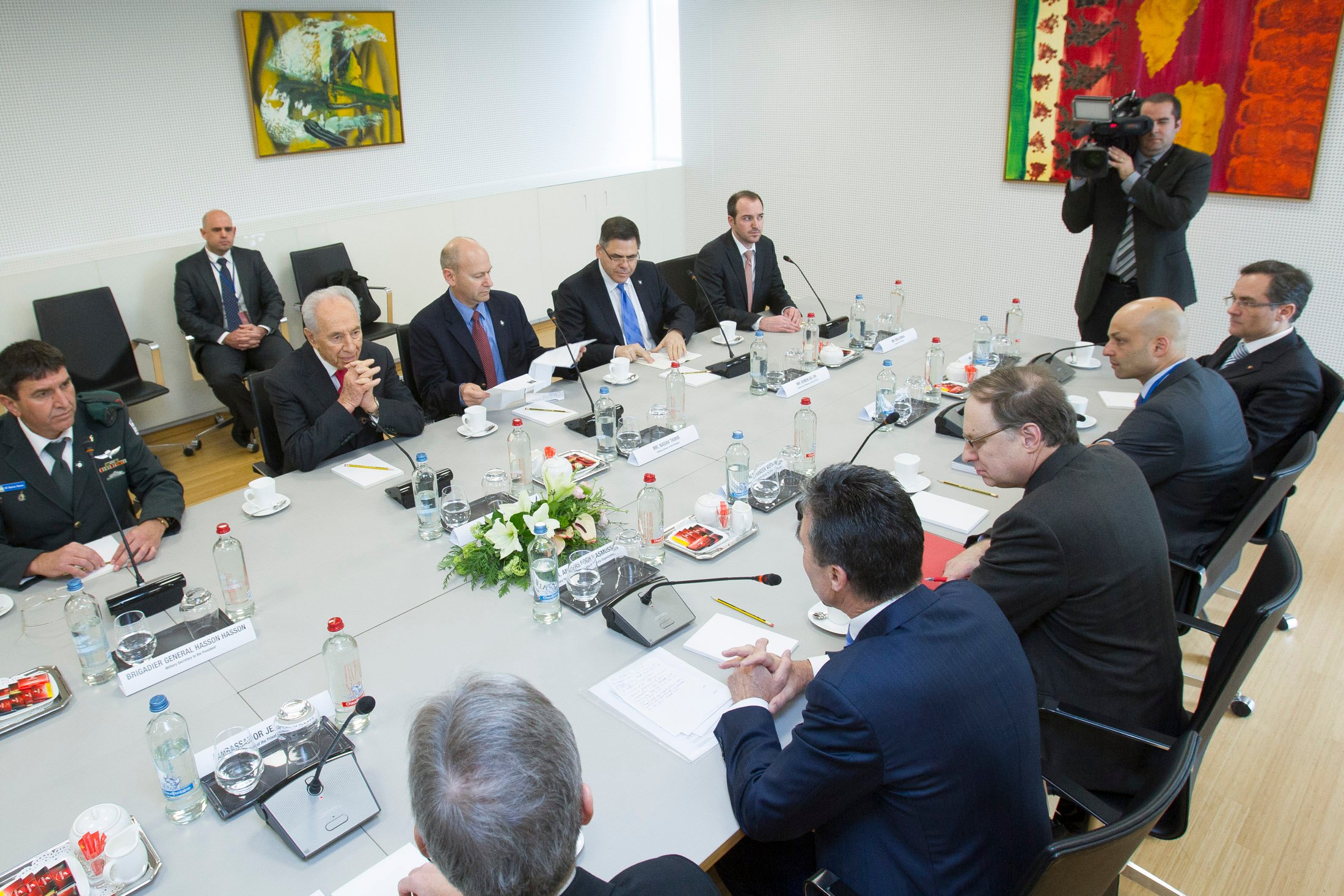
(Click image to enlarge)
Following the meeting, a joint statement was released by NATO. Secretary-General Rasmussen stated in the press report:
“Israel is an important partner of the Alliance in the Mediterranean Dialogue. The security of NATO is linked to the security and stability of the Mediterranean and of the Middle East region. And our Alliance attaches great value to our political dialogue and our practical cooperation. Israel is one of our longest-standing partner countries. We are faced with the same strategic challenges in the Eastern Mediterranean.
And as we face the security threats of the 21st century, we have every reason to deepen our long-standing partnership with our Mediterranean Dialogue countries, including Israel. We all know the regional situation is complex. But the Mediterranean Dialogue remains a unique multilateral forum, where Israel and six Arab countries can discuss together with European and North American countries common security challenges. I see further opportunities for deepening our already close political dialogue and practical cooperation to our mutual benefit.”
Halifax: HANDS OFF SYRIA! HANDS OFF IRAN! — weekly pickets
Hands Off Syria! Hands Off Iran!
Canada Needs an Anti-War Government!
Get Canada Out of NATO!
P5+1 eases nuclear demands on Iran, offers sanctions relief
End the Lie – Independent News
February 28, 2013

Top officials from the United States, France, Germany, Britain, China, Russia and Iran take part in talks on Iran’s nuclear programme in the Kazakh city of Almaty on February 27, 2013 (AFP Photo / Pool / Shamil Zhumatov)
Negotiations between Iran and the P5+1 nations ended with offers of eased demands on the Islamic Republic. While it’s a good start, experts say, the crippling US sanctions on the country are unlikely to be changed as they are written into American law.
A new proposal finalized during the Wednesday meeting in Almaty, Kazakhstan would require Iran to suspend – but not completely close down – operations at its underground uranium enrichment facility in Fordo. It would also create a set amount of 20-per-cent-enriched uranium for Iran to stockpile.
The offer marks a new turn in the long term of negotiations between world powers and Iran, which previously had made stark demands on the Islamic Republic. The P5+1 – the United States, Russia, France, Britain, China and Germany – are now only asking for scaled down operations in Iran’s nuclear program, which some governments allege is aimed at developing a nuclear bomb.
Iran would also now be able to keep enough enriched uranium to produce medical isotopes at a research facility in Tehran.
The group asked Iran to allow International Atomic Energy Agency monitors to visit its facilities more often in exchange for the suspension of selected current sanctions and a moratorium on new ones.
However, Hillary Mann Leverett, CEO of Strategic Energy and Global Analysis, a Washington-based political risk consultancy, told RT this part may be only an empty gesture.
“Everyone knows the United States has very little that it can give on sanctions,” she said. “President Obama essentially ceded his foreign policy on this issue to the US Congress; almost all of those sanctions are written into US law. They are not something President Obama can give away.”
In any case, the European Union’s embargo on Iranian oil was not brought up for negotiation at the meeting, though the P5+1 would reportedly consider easing restrictions on Iran’s gold and petrochemicals trades, as well as those on its banks.
But, after all, it may not matter in the long run, Mann Leverett told RT. “There’s not much the US can give on sanctions, and in the meantime Iran is becoming more and more self-sufficient in a range of issues so that it’s not vulnerable to such sanctions.”
Said Jalili, Iran’s chief negotiator at the meetings, called the talks “positive” in comments to the press in Almaty. He added that some of the offers coming from Western governments looked “more realistic than those presented in the past and made an effort to approach the positions of Iran.”
Mann Leverett explained what Jalili might have been getting at: “The critical issue for the Iranians, and I think this is where they perceived a slight – and I stress slight – movement on the US side, is in the recognition of their rights: their sovereign and their treaty-based rights to enrich uranium.”
Jalili stressed that Tehran saw “no justification” for shutting down the Fordo facility.
Next, Iranian and EU officials are set to meet in Istanbul on March 18 for negotations that will include experts on nuclear technology.
Source: RT

 PN
PN 