
Bashar Al-Assad’s Interview with The Sunday Times
Voltairnet.org
March 3, 2013
 Sunday Times: Mr. President your recent offer of political dialogue was qualified with a firm rejection of the very groups you would have to pacify to stop the violence: the armed rebels and the Syrian National Coalition, the main opposition alliance.
So in effect you are only extending an olive branch to the loyal opposition, mostly internal, that renounce the armed struggle, and who effectively recognizes the legitimacy of your leadership, who are you willing to talk to, really?
President Assad: First of all, let me correct some of the misconceptions that have been circulating and that are found in your question in order to make my answer accurate.
Sunday Times: Okay.
President Assad: Firstly, when I announced the plan, I said that it was for those who interested in dialogue, because you cannot make a plan that is based on dialogue with somebody who does not believe in dialogue. So, I was very clear regarding this.
Secondly, this open dialogue should not be between exclusive groups but between all Syrians of every level. The dialogue is about the future of Syria. We are twenty three million Syrians and all of us have the right to participate in shaping the country’s future. Some may look at it as a dialogue between the government and certain groups in the opposition – whether inside or outside, external or internal -actually this is a very shallow way of looking at the dialogue. It is much more comprehensive. It is about every Syrian and about every aspect of Syrian life. Syria’s future cannot be determined simply by who leads it but by the ambitions and aspirations of all its people.
The other aspect of the dialogue is that it opens the door for militants to surrender their weapons and we have granted many amnesties to facilitate this. This is the only way to make a dialogue with those groups. This has already started, even before the plan, and some have surrendered their weapons and they live now their normal life. But this plan makes the whole process more methodical, announced and clear.
If you want to talk about the opposition, there is another misconception in the West. They put all the entities even if they are not homogeneous in one basket – as if everything against the government is opposition. We have to be clear about this. We have opposition that are political entities and we have armed terrorists. We can engage in dialogue with the opposition but we cannot engage in dialogue with terrorists; we fight terrorism. Another phrase that is often mentioned is the ‘internal opposition inside Syria’ or ‘internal opposition as loyal to the government.’ Opposition groups should be loyal and patriotic to Syria – internal and external opposition is not about the geographic position; it is about their roots, resources and representation. Have these roots been planted in Syria and represent Syrian people and Syrian interests or the interests of foreign government? So, this is how we look at the dialogue, this is how we started and how we are going to continue.
Sunday Times: Most have rejected it, at least if we talk about the opposition externally who are now the body that is being hailed as the opposition and where the entire world is basically behind them. So, most of them have rejected it with the opposition describing your offer as a “waste of time,” and some have said that it is “empty rhetoric” based on lack of trust and which British Secretary William Hague described it as “beyond hypocritical” and the Americans said you were “detached from reality.”
President Assad: I will not comment on what so-called Syrian bodies outside Syria have said. These bodies are not independent. As Syrians, we are independent and we need to respond to independent bodies and this is not the case. So let’s look at the other claims.
Firstly, detached from reality: Syria has been fighting adversaries and foes for two years; you cannot do that if you do not have public support. People will not support you if you are detached from their reality. A recent survey in the UK shows that a good proportion British people want “to keep out of Syria” and they do not believe that the British government should send military supplies to the rebels in Syria.
In spite of this, the British government continues to push the EU to lift its arms embargo on Syria to start arming militants with heavy weapons. That is what I call detached from reality–when you are detached from your own public opinion! And they go further in saying that they want to send “military aid” that they describe as “non-lethal.” The intelligence, communication and financial assistance being provided is very lethal. The events of 11th of September were not committed by lethal aids. It was the application of non-lethal technology and training which caused the atrocities.
The British government wants to send military aid to moderate groups in Syria, knowing all too well that such moderate groups do not exist in Syria; we all know that we are now fighting Al-Qaeda or Jabhat al-Nusra which is an offshoot of Al-Qaeda, and other groups of people indoctrinated with extreme ideologies. This is beyond hypocritical! What is beyond hypocrisy is when you talk about freedom of expression and ban Syrian TV channels from the European broadcasting satellites; when you shed tears for somebody killed in Syria by terrorist acts while preventing the Security Council from issuing a statement denouncing the suicide bombing that happened last week in Damascus, and you were here, where three hundred Syrians were either killed or injured, including women and children – all of them were civilians. Beyond hypocrisy when you preach about human rights and you go into Iraq, Afghanistan and Libya and kill hundreds of thousands in illegal wars. Beyond hypocrisy is when you talk about democracy and your closest allies are the worst autocratic regimes in the world that belong to the medieval centuries. This is hypocrisy!
Sunday Times: But you always refer to the people fighting here as terrorists, do you accept that while some are from the Jabhat al-Nusra and those affiliated to Al-Qaeda but there are others such as the FSA or under the umbrella of the FSA? That some of them are the defectors and some of them are just ordinary people who started some of the uprising. These are not terrorists; these are people fighting for what they believe to be the right way at the moment.
President Assad: When we say that we are fighting Al-Qaeda, we mean that the main terrorist group and the most dangerous is Al-Qaeda. I have stated in many interviews and speeches that this is not the only group in Syria. The spectrum ranges from petty criminals, drugs dealers, groups that are killing and kidnapping just for money to mercenaries and militants; these clearly do not have any political agenda or any ideological motivations. The so-called “Free Army” is not an entity as the West would like your readers to believe. It is hundreds of small groups – as defined by international bodies working with Annan and Al-Ibrahimi – there is no entity, there is no leadership, there is no hierarchy; it is a group of different gangs working for different reasons. The Free Syrian Army is just the headline, the umbrella that is used to legitimize these groups.
This does not mean that at the beginning of the conflict there was no spontaneous movement; there were people who wanted to make change in Syria and I have acknowledged that publically many times. That’s why I have said the dialogue is not for the conflict itself; the dialogue is for the future of Syria because many of the groups still wanting change are now against the terrorists. They still oppose the government but they do not carry weapons. Having legitimate needs does not make your weapons legitimate.
Sunday Times: Your 3-staged plan: the first one you speak of is the cessation of violence. Obviously there is the army and the fighters on the other side. Now, within the army you have a hierarchy, so if you want to say cease-fire, there is a commander that can control that, but when you offer cessation of violence or fire how can you assume the same for the rebels when you talk about them being so many groups, fragmented and not under one leadership. So, that’s one of the points of your plan. So, this suggests that this basically an impossible request. You speak of referendum but with so many displaced externally and internally, many of whom are the backbone of the opposition; those displaced at least. So, a referendum without them would not be fair, and the third part is that parliamentary elections and all this hopefully before 2014; it is a very tall list to be achieved before 2014. So, what are really the conditions that you are attaching to the dialogue and to make it happen, and aren’t some of the conditions that you are really suggesting or offering impossible to achieve?
President Assad: That depends on how we look at the situation. First of all, let’s say that the main article in the whole plan is the dialogue; this dialogue will put a timetable for everything and the procedures or details of this plan. The first article in my plan was the cessation of violence. If we cannot stop this violence, how can we achieve the other articles like the referendum and elections and so on? But saying that you cannot stop the violence is not a reason to do nothing. Yes there are many groups as I have said with no leadership, but we know that their real leadership are those countries that are funding and supplying their weapons and armaments – mainly Turkey, Qatar and Saudi Arabia.
If outside parties genuinely want to help the process they should be pressuring those countries to stop supplying the terrorists. As with any other sovereign state, we will not negotiate with terrorists.
Sunday Times: Critics say real and genuine negotiations may be the cause of your downfall and that of your government or regime, and that you know this, hence you offer practically impossible scenarios for dialogue and negotiations?
President Assad: Actually, I don’t know this, I know the opposite. To be logical and realistic, if this is the case, then these foes, adversaries or opponents should push for the dialogue because in their view it will bring my downfall. But actually they are doing the opposite. They are preventing the so-called ‘opposition bodies outside Syria’ to participate in the dialogue because I think they believe in the opposite; they know that this dialogue will not bring my downfall, but will actually make Syria stronger. This is the first aspect.
The second aspect is that the whole dialogue is about Syria, about terrorism, and about the future of Syria. This is not about positions and personalities. So, they shouldn’t distract people by talking about the dialogue and what it will or will not bring to the President. I did not do it for myself. At the end, this is contradictory; what they say is contradicting what they do.
Sunday Times: You said that if they push for dialogue, it could bring your downfall?
President Assad: No, I said according to what they say if it brings my downfall, why don’t they come to the dialogue? They say that the dialogue will bring the downfall of the President and I am inviting them to the dialogue. Why don’t they then come to the dialogue to bring my downfall? This is self-evident. That’s why I said they are contradicting themselves.
Sunday Times: Mr. President, John Kerry, a man you know well, has started a tour that will take him this week end to Saudi Arabia, Qatar and Turkey, where he will be talking to them about ways to ‘ease you out.’ In London and Berlin earlier this week, he said that President Assad must go and he also said that one of his first moves is to draft diplomatic proposals to persuade you to give up power. Would you invite him to Damascus for talks? What would you say to him? What is your message to him now given what he said this week and what he plans to say to his allies when he visits them over the weekend? And if possible from your knowledge of him how would you describe Kerry from your knowledge of him in the past?
President Assad: I would rather describe policies rather than describing people. So, it is still early to judge him. It is only a few weeks since he became Secretary of State. First of all, the point that you have mentioned is related to internal Syrian matters or Syrian issue. Any Syrian subject would not be raised with any foreigners. We only discuss it with Syrians within Syria. So, I am not going to discuss it with anyone who is coming from abroad. We have friends and we discuss our issues with friends, we listen to their advice but at the end it is our decision as Syrians to think or to make what’s good for our country.
If anyone wants to ‘genuinely’ – I stress the word genuinely – help Syria and help the cessation of violence in our country, he can do only one thing; he can go to Turkey and sit with Erdogan and tell to him stop smuggling terrorists into Syria, stop sending armaments, stop providing logistical support to those terrorists. He can go to Saudi Arabia and Qatar and tell them stop financing the terrorists in Syria. This is the only thing anyone can do dealing with the external part of our problem, but no one from outside Syria can deal with the internal part of this problem.
Sunday Times: So, what is your message to Kerry?
President Assad: It is very clear: to understand what I said now. I mean, not a message to Kerry but to anyone who is talking about the Syrian issue: only Syrian people can tell the President: stay or leave, come or go. I am just saying this clearly in order not to waste the time of others to know where to focus.
Sunday Times: What role if any do you see for Britain in any peace process for Syria? Have there been any informal contacts with the British? What is your reaction to Cameron’s support for the opposition? What would you say if you were sitting with him now, especially that Britain is calling for the arming of the rebels?
President Assad: There is no contact between Syria and Britain for a long time. If we want to talk about the role, you cannot separate the role from the credibility. And we cannot separate the credibility from the history of that country. To be frank, now I am talking to a British journalist and a British audience, to be frank, Britain has played a famously (in our region) an unconstructive role in different issues for decades, some say for centuries. I am telling you now the perception in our region.
The problem with this government is that their shallow and immature rhetoric only highlight this tradition of bullying and hegemony. I am being frank. How can we expect to ask Britain to play a role while it is determined to militarize the problem? How can you ask them to play a role in making the situation better and more stable, how can we expect them to make the violence less while they want to send military supplies to the terrorists and don’t try to ease the dialogue between the Syrians. This is not logical. I think that they are working against us and working against the interest of the UK itself. This government is acting in a naïve, confused and unrealistic manner. If they want to play a role, they have to change this; they have to act in a more reasonable and responsible way, till then we do not expect from an arsonist to be a firefighter!
Sunday Times: In 2011 you said you wouldn’t waste your time talking about the body leading opposition, now we are talking about the external body, in fact you hardly recognized there was such a thing, what changed your mind or views recently? What talks, if any are already going on with the rebels who are a major component and factor in this crisis? Especially given that your Foreign Minister Muallem said earlier this week when he was in Russia that the government is open to talks with the armed opposition can you clarify?
President Assad: Actually, I did not change my mind. Again, this plan is not for them; it is for every Syrian who accepts the dialogue. So, making this initiative is not a change of mind. Secondly, since day one in this crisis nearly two years ago, we have said we are ready for dialogue; nothing has changed. We have a very consistent position towards the dialogue. Some may understand that I changed my mind because I did not recognize the first entity, but then I recognized the second. I recognized neither, more importantly the Syrian people do not recognize them or take them seriously. When you have a product that fails in the market, they withdraw the product, change the name, change the packing and they rerelease it again – but it is still faulty. The first and second bodies are the same products with different packaging. Regarding what our minister said, it is very clear.
Part of the initiative is that we are ready to negotiate with anyone including militants who surrender their arms. We are not going to deal with terrorists who are determined to carry weapons, to terrorize people, to kill civilians, to attack public places or private enterprises and destroy the country.
Sunday Times: Mr. President, the world looks at Syria and sees a country being destroyed, with at least 70,000 killed, more than 3 million displaced and sectarian divisions being deepened. Many people around the world blame you. What do you say to them? Are you to blame for what’s happened in the country you are leading?
President Assad: You have noted those figures as though they were numbers from a spreadsheet. To some players they are being used to push forward their political agenda; unfortunately that is a reality. Regardless of their accuracy, for us Syrians, each one of those numbers represents a Syrian man, woman or child. When you talk about thousands of victims, we see thousands of families who have lost loved ones and who unfortunately will grieve for many years to come. Nobody can feel this pain more than us.
Looking at the issue of political agendas, we have to ask better questions. How were these numbers verified? How many represent foreign fighters? How many were combatants aged between 20 and 30? How many were civilians – innocent women and children? The situation on the ground makes it almost impossible to get accurate answers to these important questions. We all know how death tolls and human casualties have been manipulated in the past to pave the way for humanitarian intervention. The Libyan government recently announced that the death toll before the invasion of Libya was exaggerated; they said five thousand victims from each side while the number was talking at that time of tens of thousands.
The British and the Americans who were physically inside Iraq during the war were unable to provide precise numbers about the victims that have been killed from their invasion. Suddenly, the same sources have very precise numbers about what is happening in Syria! This is ironic; I will tell you very simply that these numbers do not exist in reality; it is part of their virtual reality that they want to create to push forward their agenda for military intervention under the title of humanitarian intervention.
Sunday Times: If I may just on this note a little bit. Even if the number is exaggerated and not definitely precise, these are numbers corroborated by Syrian groups, however they are still thousands that were killed. Some are militants but some are civilians. Some are being killed through the military offensive, for example artillery or plane attacks in certain areas. So even if we do not argue the actual number, the same applies, they still blame yourself for those civilians, if you want, that are being killed through the military offensive, do you accept that?
President Assad: Firstly, we cannot talk about the numbers without their names. People who are killed have names. Secondly, why did they die? Where and how were they killed? Who killed them? Armed gangs, terrorist groups, criminals, kidnappers, the army, who?
Sunday Times: It is a mix.
President Assad: It is a mix, but it seems that you are implying that one person is responsible for the current situation and all the human casualties. From day one the situation in Syria has been influenced by military and political dynamics, which are both very fast moving. In such situations you have catalysts and barriers. To assume any one party is responsible for all barriers and another party responsible for all the catalysts is absurd. Too many innocent civilians have died, too many Syrians are suffering. As I have already said nobody is more pained by this than us Syrians, which is why we are pushing for a national dialogue. I’m not in the blame business, but if you are talking of responsibility, then clearly I have a constitutional responsibility to keep Syria and her people safe from terrorists and radical groups.
Sunday Times: What is the role of Al-Qaeda and other jihadists and what threats do they pose to the region and Europe? Are you worried Syria turning into something similar to Chechnya in the past? Are you concerned about the fate of minorities if you were loose this war or of a sectarian war akin to that of Iraq?
President Assad: The role of Al-Qaeda in Syria is like the role of Al-Qaeda anywhere else in this world; killing, beheading, torturing and preventing children from going to school because as you know Al-Qaeda’s ideologies flourish where there is ignorance. Ideologically, they try to infiltrate the society with their dark, extremist ideologies and they are succeeding. If you want to worry about anything in Syria, it is not the ‘minorities.’ This is a very shallow description because Syria is a melting pot of religions, sects, ethnicities and ideologies that collectively make up a homogeneous mixture, irrelevant of the portions or percentages. We should be worrying about the majority of moderate Syrians who, if we do not fight this extremism, could become the minority – at which point Syria will cease to exist.
If you worry about Syria in that sense, you have to worry about the Middle East because we are the last bastion of secularism in the region. If you worry about the Middle East, the whole world should be worried about its stability. This is the reality as we see it.
Sunday Times: How threatening is Al-Qaeda now?
President Assad: Threatening by ideology more than the killing. The killing is dangerous, of course, but what is irreversible is the ideology; that is dangerous and we have been warning of this for many years even before the conflict; we have been dealing with these ideologies since the late seventies. We were the first in the region to deal with such terrorists who have been assuming the mantle of Islam. We have consistently been warning of this, especially in the last decade during the invasion and occupation of Afghanistan and Iraq. The West is only reacting to the situation, not acting. We need to act by dealing with the ideology first. A war on terror without dealing with the ideology will lead you nowhere and will only make things worse. So, it is threatening and it is dangerous, not just to Syria but to the whole region.
Sunday Times: US officials recently, in particular yesterday, are quoted as saying that US decision not to arm rebels could be revised. If this was to happen what in your view will the consequences in Syria and in the region? What is your warning against this? Now, they are talking about directly equipping the rebels with armament vehicles, training and body armaments.
President Assad: You know the crime is not only about the victim and the criminal, but also the accomplice providing support, whether it is moral or logistical support. I have said many times that Syria lies at the fault line geographically, politically, socially and ideologically. So, playing with this fault line will have serious repercussions all over the Middle East. Is the situation better in Libya today? In Mali? In Tunisia? In Egypt? Any intervention will not make things better; it will only make them worse. Europe and the United States and others are going to pay the price sooner or later with the instability in this region; they do not foresee it.
Sunday Times: What is your message to Israel following its air strikes on Syria? Will you retaliate? How will you respond to any future attacks by Israel especially that Israel has said that we will do it again if it has to?
President Assad: Every time Syria did retaliate, but in its own way, not tit for tat. We retaliated in our own way and only the Israelis know what we mean.
Sunday Times: Can you expand?
President Assad: Yes. Retaliation does not mean missile for missile or bullet for bullet. Our own way does not have to be announced; only the Israelis will know what I mean.
Sunday Times: Can you tell us how?
President Assad: We do not announce that.
Sunday Times: I met a seven year old boy in Jordan.
President Assad: A Syrian boy?
Sunday Times: A Syrian boy who had lost an arm and a leg to a missile strike in Herak. Five children in his family had been killed in that explosion. As a father, what can you say to that little boy? Why have so many innocent civilians died in air strikes, army shelling and sometimes, I quote, ‘Shabiha shootings?’
President Assad: What is his name?
Sunday Times: I have his name…I will bring it to you later.
President Assad: As I said every victim in this crisis has a name, every casualty has a family. Like 5 year-old Saber who whilst having breakfast with his family at home lost his leg, his mother and other members of his family. Like 4 year-old Rayan who watched his two brothers slaughtered for taking him to a rally. None of these families have any political affiliations. Children are the most fragile link in any society and unfortunately they often pay the heaviest price in any conflict. As a father of young children, I know the meaning of having a child harmed by something very simple; so what if they are harmed badly or if we lose a child, it is the worst thing any family can face. Whenever you have conflicts, you have these painful stories that affect any society. This is the most important and the strongest incentive for us to fight terrorism. Genuine humanitarians who feel the pain that we feel about our children and our losses should encourage their governments to prevent smuggling armaments and terrorists and to prevent the terrorists from acquiring any military supplies from any country.
Sunday Times: Mr. President, when you lie in bed at night, do you hear the explosions in Damascus? Do you, in common with many other Syrians, worry about the safety of your family? Do you worry that there may come a point where your own safety is in jeopardy?
President Assad: I see it completely differently. Can anybody be safe, or their family be safe, if the country is in danger? In reality NO! If your country is not safe, you cannot be safe. So instead of worrying about yourself and your family, you should be worried about every citizen and every family in your country. So it’s a mutual relationship.
Sunday Times: You’ll know of the international concerns about Syria’s chemical weapons. Would your army ever use them as a last resort against your opponents? Reports suggest they have been moved several times, if so why? Do you share the international concern that they may fall into the hands of Islamist rebels? What is the worst that could happen?
President Assad: Everything that has been referred to in the media or by official rhetoric regarding Syrian chemical weapons is speculation. We have never, and will never, discuss our armaments with anyone. What the world should worry about is chemical materials reaching the hands of terrorists. Video material has already been broadcast showing toxic material being tried on animals with threats to the Syrian people that they will die in the same way. We have shared this material with other countries. This is what the world should be focusing on rather than wasting efforts to create elusive headlines on Syrian chemical weapons to justify any intervention in Syria.
Sunday Times: I know you are not saying whether they are safe or not. There is concern if they are safe or no one can get to them.
President Assad: This is constructive ambiguity. No country will talk about their capabilities. Sunday Times: A lot has been talked about this as well: what are the roles of Hezbollah, Iran and Russia in the war on the ground? Are you aware of Hezbollah fighters in Syria and what are they doing? What weapons are your allies Iran and Russia supplying? What other support are they providing?
President Assad: The Russian position is very clear regarding armaments – they supply Syria with defensive armaments in line with international law. Hezbollah, Iran and Russia support Syria in her fight against terrorism. Russia has been very constructive, Iran has been very supportive and Hezbollah’s role is to defend Lebanon not Syria. We are a country of 23 million people with a strong National Army and Police Force. We are in no need of foreign fighters to defend our country. What we should be asking is, what about the role of other countries, – Qatar, Turkey, Saudi Arabia, France, the UK, the US, – that support terrorism in Syria directly or indirectly, militarily or politically.
Sunday Times: Mr. President, may I ask you about your own position? Russian Foreign Minister Lavrov recently said that Lakhdar Ibrahimi complained of wanting to see more flexibility from your regime and that while you never seem to say ‘no’ you never seem to say ‘yes’. Do you think that there can be a negotiated settlement while you remain President, which is a lot of people are asking?
President Assad: Do not expect a politician to only say yes or no in the absolute meaning; it is not multiple choice questions to check the correct answer. You can expect from any politician a vision and our vision is very clear. We have a plan and whoever wants to deal with us, can deal with us through our plan. This is very clear in order not to waste time. This question reflects what has been circulating in the Western media about personalizing the problem in Syria and suggesting that the entire conflict is about the president and his future. If this argument is correct, then my departure will stop the fighting. Clearly this is absurd and recent precedents in Libya, Yemen and Egypt bear witness to this. Their motive is to try to evade the crux of the issue, which is dialogue, reform and combating terrorism. The legacy of their interventions in our region have been chaos, destruction and disaster. So, how can they justify any future intervention? They cannot. So, they focus on blaming the president and pushing for his departure; questioning his credibility; is he living in a bubble or not? is he detached from reality or not? So, the focus of the conflict becomes about the president.
Sunday Times: Some foreign officials have called for you to stand for war crimes at the International Criminal Court as the person ultimately responsible for the army’s actions? Do you fear prosecution by the ICC? Or the possibility of future prosecution and trial in Syria?
President Assad: Whenever an issue that is related to the UN is raised, you are raising the question of credibility. We all know especially after the collapse of the Soviet Union – for the last twenty years – that the UN and all its organizations are the victims of hegemony instead of being the bastions of justice. They became politicized tools in order to create instability and to attack sovereign countries, which is against the UN’s charter. So, the question that we have to raise now is: are they going to take the American and the British leaders who attacked Iraq in 2003 and claimed more than half a million lives in Iraq, let alone orphans, handicapped and deformed people? Are they going to take the American, British French and others who went to Libya without a UN resolution last year and claimed again hundreds of lives? They are not going to do it. The answer is very clear. You know that sending mercenaries to any country is a war crime according Nuremberg principles and according to the London Charter of 1945. Are they going to put Erdogan in front of this court because he sent mercenaries? Are they going to do the same with the Saudis and the Qataris? If we have answers to these questions, then we can talk about peace organizations and about credibility.
My answer is very brief: when people defend their country, they do not take into consideration anything else.
Sunday Times: Hindsight is a wonderful thing Mr. President. If you could wind the clock back two years would you have handled anything differently? Do you believe that there are things that could or should have been done in another way? What mistakes do you believe have been made by your followers that you would change?
President Assad: You can ask this question to a President if he is the only one responsible for all the context of the event. In our case in Syria, we know there are many external players. So you have to apply hindsight to every player. You have to ask Erdogan, with hindsight would you send terrorists to kill Syrians, would you afford logistical support to them? You should ask the Qatari and Saudis whether in hindsight, would you send money to terrorists and to Al-Qaeda offshoots or any other terrorist organization to kill Syrians? We should ask the same question to the European and American officials, in hindsight would you offer a political umbrella to those terrorists killing innocent civilians in Syria?
In Syria, we took two decisions. The first is to make dialogue; the second is to fight terrorism. If you ask any Syrian, in hindsight would you say no to dialogue and yes to terrorism? I do not think any sane person will agree with you. So I think in hindsight, we started with dialogue and we are going to continue with dialogue. In hindsight, we said we are going to fight terrorism and we are going to continue to fight terrorism.
Sunday Times: Do you ever think about living in exile if it came to that? And would you go abroad if it increases the chances of peace in Syria?
President Assad: Again, it is not about the president. I don’t think any patriotic person or citizen would think of living outside his country.
Sunday Times: You will never leave?
President Assad: No patriotic person will think about living outside his country. I am like any other patriotic Syrian.
Sunday Times: How shaken you were you by the bomb that killed some of your most senior generals last summer, including your brother-in-law?
President Assad: You mentioned my brother-in-law but it is not a family affair. When high-ranking officials are being assassinated it is a national affair. Such a crime will make you more determined to fight terrorism. It is not about how you feel, but more about what you do. We are more determined in fighting terrorism.
Sunday Times: Finally, Mr. President, may I ask about my colleague, Marie Colvin, who was killed in the shelling of an opposition media center at Baba Amr on February 22 last year. Was she targeted, as some have suggested, because she condemned the destruction on American and British televisions? Or was she just unlucky? Did you hear about her death at the time and if so what was your reaction?
President Assad: Of course, I heard about the story through the media. When a journalist goes into conflict zones, as you are doing now, to cover a story and convey it to the world, I think this is very courageous work. Every decent person, official or government should support journalists in these efforts because that will help shed light on events on the ground and expose propaganda where it exists. Unfortunately in most conflicts a journalist has paid the ultimate price. It is always sad when a journalist is killed because they are not with either side or even part of the problem, they only want to cover the story. There is a media war on Syria preventing the truth from being told to the outside world.
14 Syrian journalists who have also been killed since the beginning of the crisis and not all of them on the ground. Some have been targeted at home after hours, kidnapped, tortured and then murdered. Others are still missing. More than one Syrian television station has been attacked by terrorists and their bombs. There is currently a ban on the broadcast of Syrian TV channels on European satellite systems. It is also well known how rebels have used journalists for their own interests. There was the case of the British journalist who managed to escape.
Sunday Times: Alex Thompson?
President Assad: Yes. He was lead into a death trap by the terrorists in order to accuse the Syrian Army of his death. That’s why it is important to enter countries legally, to have a visa. This was not the case for Marie Colvin. We don’t know why and it’s not clear. If you enter illegally, you cannot expect the state to be responsible. Contrary to popular belief, since the beginning of the crisis, hundreds of journalists from all over the world, including you, have gained visas to enter Syria and have been reporting freely from inside Syria with no interferences in their work and no barriers to fulfill their missions.
Sunday Times: Thank you.
President Assad: Thank you.
Boris Berezovsky is dead! Syrian ‘rebels’ falling apart. Gilad Atzmon in Japan [video]
Ryan Dawson
March 25, 2013
Syria teeters on Obama’s “Red Line”
by Nile Bowie
NileBowie.blogspot.ca
March 21, 2013
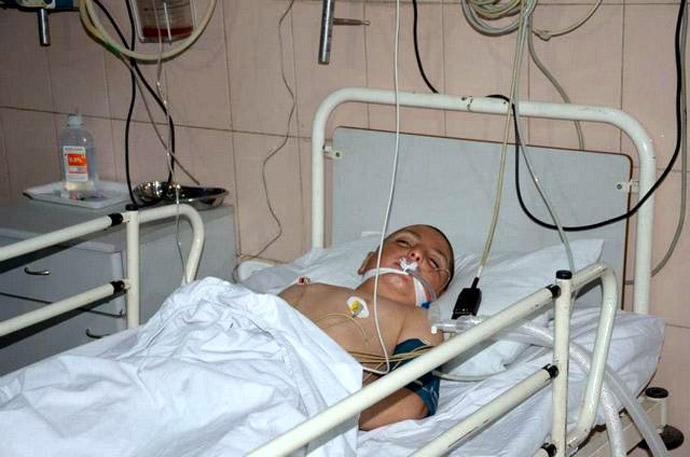
The pages of history tell us that beautiful civilizations emerged and prospered in the ancient cities of Damascus and Aleppo, some of the oldest continually inhabited cities on earth. The harrowing circus of brutality that is the Syrian conflict, now in its third year, will soil and blacken those pages indefinitely. No matter the political outcome of this horrible war, a once tolerant and diverse state has been shattered and terror itself has eaten into the destiny of Syria’s people, inexorably changing the courses of their lives forever. Children have been orphaned; parents have faced the loss of their children – and by uncompromising means. Infants have been beheaded, the fates of innocent men and women have been sealed through summary executions, and families have been torn apart or destroyed all together. Recent developments in Syria are alarming.
Spokesmen of the Assad government recently accused foreign-backed militants of launching scud missiles containing chemical weapons in the city of Aleppo, killing dozens. Witnesses claim to have seen powder emanate from the rocket, causing those who inhaled the substance to suffocate or require immediate medical attention. An unnamed chemical weapons expert cited by Al-Jazeera claimed that the causalities were not consistent with Syria’s reputed stockpile of chemical agents, stating, “If it’s a chemical warfare agent, it’s not working very well.” Syria’s ambassador to the UN, Bashar Ja’afari, called on the UN Secretary-General to form an independent technical mission to investigate the use of chemical weapons by terrorist groups operating in Syria.
There are a myriad of reasons why Bashar al-Assad must go in the eyes of policy makers in Washington and Tel Aviv, and the destruction of his tenure could not have been possible without the financial muscle of Saudi Arabia and Qatar’s wretchedly opulent Sunni Monarchs. These glittering kingdoms of disaster-capitalism are not only responsible for supplying weapons and cash; a major incentive of theirs is exporting the Wahhabist and Salafist ideologies that many of Syria’s imported jihadists subscribe to, a warped and primal interpretation of Islam that has fueled the sectarian nature of the Syrian conflict and deepened social divisions to their most dangerous point – in a country that was once renowned for its tolerance of religious diversity. These Gulf kingdoms, which are more-or-less given a trump card to commit deplorable human rights violations institutionally, are also responsible for propping up the political arm of their militant foot soldiers, and that comes in the form of the Muslim Brotherhood.
Syria’s opposition coalition, which is itself entirely a creation of foreign powers, has recently elected its own interim prime minister – enter, Ghassan Hitto, a virtually unknown political novice with a US passport and a computer science degree from Purdue University. Hitto is an Islamist Kurd with strong ties to the Muslim Brotherhood. The Muslim Brotherhood has politically dominated the Syrian National Council since its creation, in addition to organizing tactical elements of the insurgency. The backbone of the Brotherhood’s relationship with the medieval monarchies of the Persian Gulf is grounded in a firm opposition to Shi’a Islam, as extolled by clerical leaders in Iran and Lebanon’s Hezbollah; Assad himself is also an Alawite, an offshoot of Shi’a Islam. It should be clear enough by now how enflaming sectarian divisions in the region was a prerequisite for those bank-rolling the insurgency, aimed at demolishing the secular Syrian state.
Several high-profile members of Syria’s opposition coalition boycotted the vote for interim prime minister, citing what they viewed as a foreign-backed campaign to elect Hitto. Kamal Labwani, a veteran opposition campaigner, was reported as saying, “We don’t want what happened in Egypt to happen in Syria. They hijacked the revolution.” Those who abstained from the vote accuse Hitto of being a puppet of the Muslim Brotherhood, and that the SNC’s decisions were being dictated from the outside. Walid al-Bunni, another senior figure in the opposition, stated, “The Muslim Brotherhood, with the backing of Qatar, have imposed their prime minister candidate. We will keep away if the coalition does not reconsider its choice.” Let’s just get this straight – Assad, a leader whose presence today is a testament to the fact that he continues to enjoy majority popular support, is considered to have lost his legitimacy. On the other hand, Hitto, a man with no political experience who received 35 votes out of 49 ballots cast during a Syrian National Coalition meeting, is supposed to be legitimate representative of the Syrian people?

Western states want to install proxy leaders who will grovel to their multinationals and swallow IMF medicine, Gulf states seek unfettered hegemony in their own backyards, and they all want to see the Shi’a resistance smashed to pieces. Following the news of chemical weapons being used in Syria, the most immediate conclusion of this observer is that foreign-backed militants, who have used every opportunity to call for more material and support, employed the use of a smuggled chemical weapon of poor quality to bring about direct military intervention in their favor. Right on cue, Senators Lindsey Graham and John McCain are frothing at the mouth, urging President Obama to “take immediate action” and consider deploying troops. Graham was quoted as saying, “If the choice is to send in troops to secure the weapons sites versus allowing chemical weapons to get in the hands of some of the most violent people in the world, I vote to cut this off before it becomes a problem.” There is no surer sign of a pathological mind than when one credits others with the blood on their own hands.
Nile Bowie is an independent political analyst and photographer based in Kuala Lumpur, Malaysia. He can be reached at nilebowie@gmail.com
Israelis divided over IDF conscription for ultra-orthodox [video]
Russia Today
March 17, 2013
Some serve in the army, others study theology. And that’s causing growing frustration among secular Jews in Israel over the ultra-religious refusing to do national service. But the deeply-orthodox say they are playing their part.
RT LIVE http://rt.com/on-air
Subscribe to RT! http://www.youtube.com/subscription_c…
Like us on Facebook http://www.facebook.com/RTnews
Follow us on Twitter http://twitter.com/RT_com
Follow us on Google+ http://plus.google.com/+RT
RT (Russia Today) is a global news network broadcasting from Moscow and Washington studios. RT is the first news channel to break the 500 million YouTube views benchmark.
US help might see Syrian rebels form alternate govt
by Nile Bowie
NileBowie.blogspot.ca
March 7, 2013
The long-term US funding of anti-government programs in Syria has raised questions about the types of groups being supported, and the benefits and arms supplied to militant groups; establishing political stability requires considered dialogue.
It appears that the US State Department under John Kerry will soon shift its focus to helping the rebels establish a full-fledged alternative government on Syrian territory and recognize it as the legal government of Syria. Such a move would legitimize the transfer of heavy weaponry and would allow the US to directly employ air strikes or Patriot anti-missile batteries against Assad’s forces.
Some would argue that these moves could help to marginalize the notable al-Qaeda presence among rebel forces. Pumping more arms and heavier weapons into Syria is unconscionable at this point, and continuing to do so will inevitably bolster the muscle and reach of jihadi and Salafist fighters. The argument that the US and its allies have only armed the “moderate” rebels is a deeply flawed one; weapons are in high demand by all rebel factions and there is little means to effectively prevent arms from gravitating toward hardcore Al-Qaeda fighters.
In his famous 1962 description of irregular warfare operations, US President John F. Kennedy alluded to “another type of warfare,” one that is “new in its intensity, ancient in its origin—war by guerrillas, subversives, insurgents, assassins; war by ambush instead of by combat, by infiltration instead of aggression, seeking victory by eroding and exhausting the enemy instead of engaging him. It preys on unrest.”
After two harrowing years of division, senseless killing and civil war, the scared Syrian nation and its people are well acquainted with these unconventional methods of warfare denounced over 50 years ago.
Yet Western and Gulf states have proven their double standards by enabling radicals elsewhere – lest we forget the presence of Libyan military commander Abdulhakim Belhadj, former leader of the militant Libyan Islamic Fighting Group (officially designated as a terrorist organization by the US State Department), who was sent to Syria to aid the Free Syrian Army on orders of the entity formerly known as the Libyan National Transition Council (NTC). The track record of allied Western and Gulf states shows that they are more interested in enabling terrorism for their own purposes rather than preventing it.
Since the eruption of violence in March 2011, Syria has endured targeted assassination campaigns, ceaseless suicide bombings and shelling, and massacres where infants have had their throats slit to the spine – the time has come for the opposition to engage the Assad government in dialogue and finally bring about a ceasefire and the total cessation of violence and insurgency.
From the reports of third-party sniper-fire targeting both protesters and security personnel in the southern city of Daraa at the very onset of the conflict, to the horrendous attacks on the students of Aleppo University in January 2013 – those who have critically monitored the situation from the beginning are under no illusions – the influx of armament and mercenary elements from abroad into Syria has brought the situation to where it is today. Western capitals have provided logistics, coordination, political support, and non-lethal aid, Gulf states such as Saudi Arabia and Qatar have openly provided weapons and monthly salaries for rebel fighters, and Turkey has allowed rebel fighters to receive training and arms from the US Central Intelligence Agency (CIA) in the southeastern part of the country, allowing militants to pass into Syria freely.
There are those who say that Syria is the subject of an internal revolution that is brutally repressed by a malicious dictator, and those who say instead that Syria is being attacked by foreign powers who have deployed mercenaries and extremist fighters from abroad to engage in the destruction of infrastructure and conduct targeted assassinations to bring about an end to the Assad regime. Despite Washington’s concerns of heavy weapons falling into the hands of Al-Qaeda-linked militants, the US-backed campaign to coax regime change in Damascus has from the very onset enabled militants who justify their acts of terror in the name of a perverted interpretation of Islam. Reports in the Washington Post indicate that US support for anti-government groups in Syria began in 2005, transcending two presidential administrations:
“The U.S. money for Syrian opposition figures began flowing under President George W. Bush after he effectively froze political ties with Damascus in 2005. The financial backing has continued under President Obama, even as his administration sought to rebuild relations with Assad. Syrian authorities ‘would undoubtedly view any U.S. funds going to illegal political groups as tantamount to supporting regime change,’ read an April 2009 cable signed by the top-ranking U.S. diplomat in Damascus at the time. ‘A reassessment of current U.S.-sponsored programming that supports anti-[government] factions, both inside and outside Syria, may prove productive,’ the cable said. The cables report persistent fears among U.S. diplomats that Syrian state security agents had uncovered the money trail from Washington.”The article describes how Washington funnelled about $12 million to anti-government programs in Syria between 2005 and 2010 to recipients affiliated with the Syrian Muslim Brotherhood. Israel, which is now illegally conducting exploratory drilling in the occupied Golan Heights, and the US view the toppling of Damascus as a means of extinguishing the critical conduit between Iran and Hezbollah, the political and militant Shi’a organization centered in Southern Lebanon, in addition to helping isolate the Palestinian resistance.
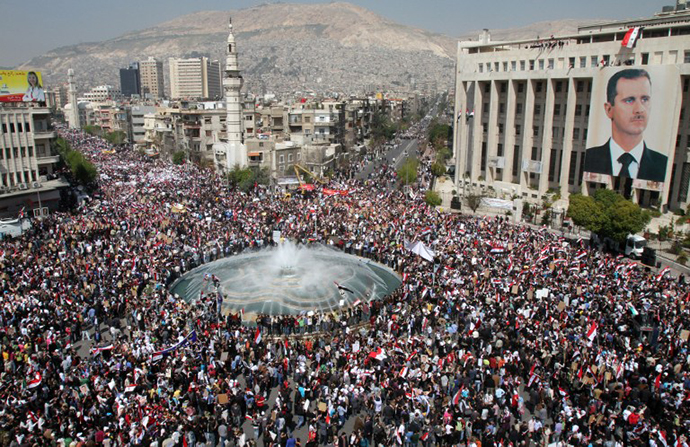
The non-violent route: Laying aside differences
Both the incumbent Syrian authorities and the opposition must find strength to come to a mutually acceptable compromise. These parties have no other option than to search for a solution, lay down an agreeable constitutional basis for elections, and face each other in international monitored polls once the situation stabilizes. The Syrian people must not have democracy imposed on them, and the victor of this war should not be decided on the battlefield, but by the ballot box.
To gain the confidence of the electorate, election observers from the US, Qatar, Russia, and Iran could be sent to monitor the transition process – if the people of Syria want Assad to remain in power, then the rule of majority must be honored. Militant groups comprised of mostly hard line foreign fighters such as Jabhat al-Nusra and the Islamist Ahrar al-Sham cannot be expected to participate in a ceasefire, so the true test of a short-term alliance between Assad and the SNC would be in its ability to cooperate in quelling radical militants and restoring stability – such is a perquisite for any kind of transition.
Former US Secretary of State Hilary Clinton once threatened Russia and China that they would “pay a price” for their position on the Syrian issue. It should be noted that these powers maintained a balanced approach throughout and advocated dialogue from the start, in addition to stringently adhering to former UN Envoy Kofi Annan’s six point peace plan. Iran should also be given due credit for hosting an International Consultative Conference in August 2012, which brought together representatives of thirty nations to call for ending the flow of foreign arms into terrorist hands inside Syria, proposals to broker a meaningful ceasefire, the coordination of humanitarian aid, and support for Syrian people’s right to reform without foreign interference.
Accommodating diversity in Syrian society
Iranian Foreign Minister Ali Akbar Salehi was quoted in the Washington Post stating,“Syrian society is a beautiful mosaic of ethnicities, faiths and cultures, and it will be smashed to pieces should President Bashar Assad abruptly fall. The idea that, in that event, there would be an orderly transition of power is an illusion. Abrupt political change without a roadmap for managed political transition will lead only to a precarious situation that would destabilize one of the world’s most sensitive regions.” It is clear that the Assad government is more stable than many Western states anticipated, and it continues to enjoy popular support.
Hezbollah leader Sheikh Hassan Nasrallah recently warned against sectarian infighting in Lebanon related to the Syrian civil war, arguing that outsiders are pushing Lebanon “toward civil and religious strife, and specifically Sunni-Shia strife.” Iraqi PM Nouri al-Maliki also warned that a victory for rebels would “create a new extremist haven and destabilize the wider Middle East.” The Syrian regime will not imminently collapse but if it is brought down by military intervention, the consequences could lead to a highly unpredictable situation where match and tinder can meet at any moment with debilitating consequences for the region. It is time for both parties to convene. It is time to end this war.
Selective support
Reports published in 2007 in the New Yorker by veteran journalist Seymour Hersh detail how the US, Israel and Saudi Arabia supported a regional network of extremist fighters and terrorists affiliated with al-Qaeda with the aim of stomping out Hezbollah and Syria’s Assad in a bid to isolate Iran, who is viewed as an existential threat to the US and its allies in the region. A principal component of this policy shift was the bolstering of Sunni extremist groups, hence the ever-deepening sectarian nature of the Syrian conflict:“To undermine Iran, which is predominantly Shiite, the Bush Administration has decided, in effect, to reconfigure its priorities in the Middle East. In Lebanon, the Administration has cooperated with Saudi Arabia’s government, which is Sunni, in clandestine operations that are intended to weaken Hezbollah, the Shiite organization that is backed by Iran. The U.S. has also taken part in clandestine operations aimed at Iran and its ally Syria. A by-product of these activities has been the bolstering of Sunni extremist groups that espouse a militant vision of Islam and are hostile to America and sympathetic to Al Qaeda.”
While the CIA has purportedly claimed to distribute arms only to “secular” and “moderate”rebel forces, Washington insiders from various academic and think-tank circles have openly endorsed bizarre positions in favor of integrating terrorists into Syria’s rebel forces. “Al-Qaeda’s Specter in Syria,” penned by Council on Foreign Relations senior fellow Ed Husain, argues in favor of Al-Qaeda terrorists and their inclusion in the Free Syrian Army, stating, “The influx of jihadis brings discipline, religious fervour, battle experience from Iraq, funding from Sunni sympathizers in the Gulf, and most importantly, deadly results. In short, the FSA needs al-Qaeda now.” Foreign Policy’s, “Two Cheers for Syrian Islamists,” penned by Gary Gambill of the heavily neo-conservative Middle East Forum, argues in favor of Al-Qaeda, “Islamists — many of them hardened by years of fighting U.S. forces in Iraq — are simply more effective fighters than their secular counterparts. Assad has had extraordinary difficulty countering tactics perfected by his former jihadist allies, particularly suicide bombings and roadside bombs.”
While many Western media outlets once likened Syria’s rebels to pro-democracy freedom fighters, it has become more challenging to view them as anything other than Salafist radicals – the former’s existence was amplified specifically to provide cover and legitimacy for the violence and subversion of the latter. As a result of a foreign-backed insurgency, the Assad regime resorted to tactics of shelling and conducing air strikes on rebel strongholds, which were mostly in densely populated urban areas. It should not be denied that these heavy-handed tactics have also led to a substantial and regrettable loss of life.
The Friends of Syria group recently convened in Rome, where the US State Department has pledged $60 million to help the opposition maintain “the institutions of the state” in areas under their control, such as establishing terms of governance, the rule of law, and police forces. Reports have also claimed that the US is also deliberating more open engagement in Syria under newly appointed US Secretary of State John Kerry, however Washington has stopped short of openly providing arms and military training. American and western officials have told the New York Times that Saudi Arabia has recently financed a large purchase of infantry weapons from Croatia and funnelled them to Syrian rebel groups. Although the United States is not credited with providing arms to rebel forces, the New York Times has reported the presence of CIA operatives in southern Turkey since June 2012, who are distributing weapons with the Obama administration’s blessing. US spokesperson Jay Carney was quoted as saying, “We will continue to provide assistance to the Syrian people, to the Syrian opposition, we will continue to increase our assistance in the effort to bring about a post-Assad Syria.”
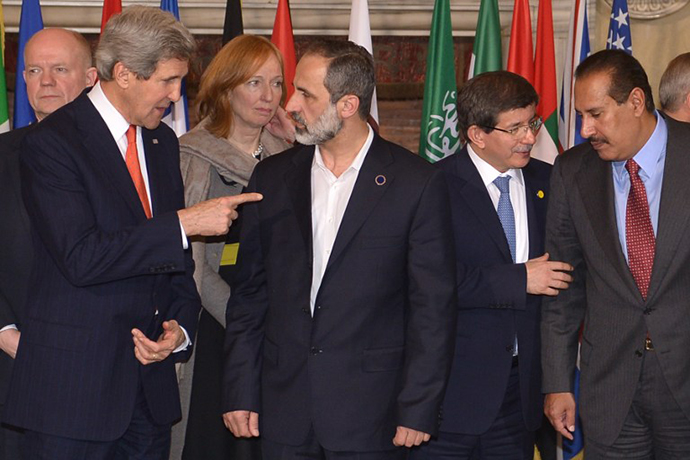
The Syrian Ambassador to the UN Bashar al-Jaafari has urged the Friends of Syria states to convince the Syrian opposition to sit down for an unconditional national dialogue, which al-Khatib has expressed his willingness to take part in. One could surmise that al-Khatib’s shift toward dialogue indicates that the SNC is feeling less secure and more wary of a possible military defeat or rivalry with radical factions. Such a dialogue would undoubtedly represent a step in the right direction. Despite political differences and two years of deep conflict, these two parties must establish a genuine ceasefire and partnership to restore a climate of normality throughout the country. In this context, both parties must be able to agree on coordinating aid distribution to all parts of the country.
International recognition of a provisional SNC government would only create further divisions at a time when national unity is most needed. Although rebel-held areas are badly isolated and in need of humanitarian supplies, the delivery of aid must be facilitated through direct talks and partnership between Moaz al-Khatib’s Syrian National Council and Bashar Al-Assad’s government.
Fredericton postal worker’s trip to Palestine smeared by Conservative MP
by Tracy Glynn
Halifax Media Co-op
March 15, 2013
Fredericton – Conservative MP Mark Adler for the Toronto riding of York Centre accused Fredericton postal worker Ruth Breen and her union, the Canadian Union of Postal Workers (CUPW), of using public funds to pay for her trip to the occupied West Bank in Parliament’s Question Period on March 5th. A brief account of Breen’s trip appeared in the union’s newsletter, The Rose.
Adler said, “Mr. Speaker, constituents from my riding have brought to my attention the latest propagandist newsletter issued by the radical Canadian Union of Postal Workers to its members. This radical political pamphlet outlines Fredericton local member Ruth Breen’s trip to Israel using public funds, while at the same time accusing Canada of committing war crimes through its support for Israel.”
Adler then asked the Minister responsible for Canada Post, Steven Fletcher, to respond. Minister Fletcher’s response: “Mr. Speaker, what the member has raised is awful. Using public funds for radical political trips is wrong. CUPW should apologize for this misuse of public funds and its anti-Israeli rhetoric. Will the Leader of the Opposition continue to support his big union bosses and their radical political views, or will he stand with taxpayers and demand an apology for the misuse of these public funds and to the state of Israel?” The Leader of the Opposition did not respond.
According to Breen, Adler is ill-informed. “I traveled to the West Bank on Atlantic Regional I International Solidarity Funds. I did not travel to the West Bank with public funds as Adler is alleging,” says Breen.
Breen says she is perplexed by Adler’s strong reaction to the use of “war crime” to describe Israel’s actions. She points to information found on federal government websites that support her assertion that Israel is committing war crimes.
[hat tip: Little Sis Media]
Open War Crimes: US and British-Backed Weapons Airlift From Croatia to Terrorists in Syria
 by Patrick Henningsen
21st Century Wire
The evidence is now in, as list of state actors can now be seen openly conspiring to drive the Middle East into full-blown war.
It’s well known by now that NATO and the Gulf States initial plans to overturn the sovereign state of Syria has been running behind schedule since their operation was launched two years ago. They had hoped for the sort of slam dunk which they enjoyed in overturning the country of Libya in late 2011.
This same formula could not be applied again however, so Plan B, a ground war using proxies has meant a longer drawn out conflict. It hasn’t been working fast enough in Syria, and western backed terrorist groups still sustaining heavy losses in their fight to topple the Assad government on behalf of the NATO and its Gulf allies.
The main obstacle with Plan B is that the very idea of directly arming terrorists in Syria is not one which can be sold openly in either the US or Britain. Plan C is to draw in the UN by creating a ‘chemical weapons’ crisis in Syria, and thanks to a prominent online leak of documents relating to UK DOD contractor Britam, the British have been caught brokering a deal transferring ex-Gaddafi stocks from Libya to Syria to be blamed on Assad, and paid for by Qatar. But the WMD threat still remains a hard sell for western voters…
From the NATO Allied corner, something drastic needed to be done.
Whilst politicians in the West, namely those in Washington DC, London and parts of Europe, have been publicly denying that they were helping to organise running arms into Syria and issuing very public pleads for ‘humanitarian aid’ for those they identify as the Syrian Opposition, activity back stage has been furious. The debate in government and the media has been mere window dressing for the real operation being quietly carried out.
NATO Gun-running via Croatia
 It can now be revealed that NATO allied nations were busy using proxy states to drive their war in Syria – putting together one of the biggest international black operation transfers of military supplies in recent history. So it’s official: large caches of hardware from the West have been transferred to the Syrian jihadist mercenary collective known as the ‘Free Syrian Army’ , ‘Syrian Rebels’, or ‘Syrian Opposition’ – depending on who you ask, a brash move which may be vehemently opposed by other UN Security Council members – namely Russia and China.
Multiple media sources reveal the details of this massive airlift comprised of 75 airplanes, and an estimated 3,000 tons of military weaponry on board has left Croatia and has already been delivered… to Syria.
It is also confirmed from these reports that Saudi Arabia has financed a large portion of this purchase secretly transported to al Qaeda and other FSA fighters – who are working with the support of the CIA, MI6 and others, along with other financial and material support of Qatar and Saudi, to further destabilise and overthrow the Assad government in Syria.
Croatia’s daily newspaper Jutarnji List reported:
“From the start of November last year, till February this year, 75 planes flew out from Zagreb Airport with over 3,000 tons of weapons and ammunition bound for Syrian rebels…The newspaper, quoting diplomatic sources, says that besides Croatian weapons the planes were full with weapons from other European countries including the UK. The weapons were organised by the United States of America.
Sources say that the first few flights to leave Croatia bound for Syria with weapons were operated by Turkish Cargo, which is owned by Turkish Airlines. After those flights, Jordanian International Air Cargo took over the flights. The deal to provide arms to the rebels was made between American officials and the Croatian Ambassador to the US.”
In addition to this huge gun-running operation, Croatia also appears to be guilty of either having advanced knowledge, or possibly coordinating with Syrian terrorists as evidenced by their recently withdraw all of troops from the UN observer mission in Golan Heights, indicating that the recent kidnapping by Free Syrian Army Terrorists of at least 20 UNIFIL peacekeepers in the Golan Heights was known in advance by Croatia.
The kidnapping incident may have been designed to test the UN, but also to pull Syria’s southern neighbor, Israel, even closer to the conflict, a development which would almost surely prompt the UN to declare this as trigger to a regional crisis, followed by an authorised military intervention. Pulling Israel in would also risk involving Hezbollah from Lebanon, who are already engaging in assisting Assad in training a new specialist paramilitary force in Syria to deal with urban warfare.
If it was known by Croatia, then one can only conclude that this was also known by US and British operatives as well. Both the US and Britain will naturally claim deniability as their legal out in this case, by deniability through the use of proxies makes no innocent parties when the prospect of a multi-regional war beckons as a result of the west’s financial, logistical, political, and now material involvement in the overthrow of a sovereign state and internationally recognised government.
Much worse, however, is that by employing proxies like Jordan, Croatia, Turkey,and others, the NATO allies have guaranteed long-term retribution down the road, should Syria prevail in this fight. For Syria, it is now known which countries collaborated with the West to dismantle their country. This fact alone will ensure conflict in the region for a generation.
US officials are on record as admitting to helping arrange the weapons airlift, as cited in this Feb 25, 2012 article in the New York Times:
“An official in Washington said the possibility of the transfers from the Balkans was broached last summer, when a senior Croatian official visited Washington and suggested to American officials that Croatia had many weapons available should anyone be interested in moving them to Syria’s rebels.”

Terrorist receive recoilless guns from the former Yugoslavia.
Revelations are not limited to the Croatian news report, as we see the US and Europe’s mainstream media wall of silence has begun to crack, including here a recent report from London’s Daily Telegraph sent across Syria’s borders with Jordan and NATO-member Turkey. The article entitled, “US and Europe in ‘major airlift of arms to Syrian rebels through Zagreb’“goes on to give further details of direct European involvement in illegal weapons running:
“The United States has coordinated a massive airlift of arms to Syrian rebels from Croatia with the help of Britain and other European states, despite the continuing European Union arms embargo, it was claimed yesterday…
Decisions by William Hague, the Foreign Secretary, to provide non-lethal assistance and training, announced in the past week, were preceded by much greater though less direct Western involvement in the rebel cause, according to a Croat newspaper.
The shipments were allegedly paid for by Saudi Arabia at the bidding of the United States, with assistance on supplying the weapons organised through Turkey and Jordan, Syria’s neighbours.
…as from Croatia, weapons came “from several other European countries including Britain”, without specifying if they were British-supplied or British-procured arms.
British military advisers however are known to be operating in countries bordering Syria alongside French and Americans, offering training to rebel leaders and former Syrian army officers…
… The weapons, including rocket launchers, recoil-less guns and the M79 anti-tank weapon, have been seen in rebel hands in numerous videos, and were first spotted by an arms expert Eliot Higgins, who blogs under the name Brown Moses. He traced them moving from Dera’a in the south, near the Jordanian border, to Aleppo and Idlib provinces in the north.”

Hague: Denies Britain’s involvement in gun-running.
It is also no big secret that Britain has deployed a significant contingent of troops and support personnel to Jordan at least as far back as Autumn 2012 as part of its ongoing ‘joint military exercises’ with the Jordan military, but this latest revelation puts into clearer perspective the overwhelming likelihood that high level British military operation have actually been involved in the transfer of arms from Jordan into the hands of the international terrorist confab of mostly foreign fighter running under the west’s media banner of “Syrian Rebels”.
Consequences for Croatia, and Britain
What Britain may be guilty of here, is cynically – and illegally, trying to side-stepping the EU embargo on arms into Syria by using the fledgling EU state of Croatia as their delivery mechanism, because Croatia does not officially join the EU until July 1, and has not implemented any binding EU legislation. This flagrant violation of both EU and international law should mean that Croatia’s entrance into the EU could be appealed by other members states willing to raise an objection, with what are now clear grounds to mount a legal challenge against Croatia.
Regardless of any EU outcomes however, Croatia at least – is guilty of international war crimes.
International and EU Sanctions Against the US, Britain, Turkey, Qatar and Saudi Arabia
As expected, Britain’s Foreign Office denies all of the claims connecting it to the Croatian gun-running program, but if Britain is involved – even indirectly, through a proxy like Croatia, or if British military personnel are aiding and abetting these known terrorist fighters in Syria through the transfer of weaponry, then Britain can also be brought into the international legal framework to answer for what it has done behind the public’s back.
The international war crimes which are now in the public view could test the legal framework of the EU, the UN and the ICC in the Hague. The legal door is now open for charges against state actors including US, Britain, Qatar and Saudi Arabia – for the crimes of illegally arming a force of foreign fighters and known terrorists in Syria – designed to destroy the country from within. Many UN resolutions, including the recent Resolution 1973 applied in Libya by the UN, have been implemented on much more spurious and shaky grounds than the overwhelming evidence available regarding Syria.
Consequences for NATO and the UN
Despite any denials in Brussels, NATO are involved through their member states Turkey and Croatia, as well as US, UK, and France from behind. Any involvement should question these country’s NATO status, or at least it begs the question what is NATO for, or even the UN, if their member states are conspiring together to subvert international law?
Moreover, Israel’s unwarranted airstrike against a Syrian Military Research facility last month was also ignored by the UN, but this is not surprising as Israel has long been allowed to operate outside of international law and norms.
If the international community does not act in this instance, then it opens the door to more brazen criminality sans borders, which could spawn similar illegal operations against Iran, opening the door to a Third World War.
US uniformed Personnel Training Rebels in Jordan
Der Spiegel also reports this week that, despite denials by Washington DC, Americans are definitely training Syrian rebels in neighboring Jordan. The reports goes on:
“It is not clear if the Americans are members of the US armed forces or are part of a private contracting firm, but the trainers wear uniforms, the paper reported.
It added that the training, which also involves Jordanian intelligence officers, had been going on “for some time,” and that the rebels were being taught how to use anti-tank weaponry.”
France sends ‘aid’ for Syria to Jordan
France played an integral part in the destruction of Libya in 2011, and they might also have an interest in their former colonial possessions in Syria, but it’s not clear as yet if France’s commitment to overthrowing the Assad government is on par with the US and Britain’s efforts. Back in August 2012, France had also been sending large shipments designated for Syria via Jordan, claiming that these shipment contained ‘aid and medical supplies’ – intended for Syrian refugees. Real Syrian News reported:
“An Antonov 124 cargo aircraft landed at the Marka military airport in Amman on Saturday. The cargo is said to include a field hospital and medical supplies for the refugees in the Zaatari camp near the Syrian border. An A310 airliner carrying 85 French military staff and medical equipment arrived in Jordan on Thursday.”
After the Croatian airlift, it’s now not a stretch to suspect that other countries could be involved in similar operations under the cover of supplying ‘humanitarian aid’.
Consequences for Jordan
The overwhelming body of evidence proves that Jordan is playing the key role as proxy and facilitator for the West’s wishes and desires to destroy the country of Syria. The consequences for Jordan, should the West’s efforts fail, is that Jordan has now exposed itself as a provocateur and enemy of both Syria, and Lebanon, and indeed Iran also. It is not know how much Jordan has been paid for its services, or what promises have been made to its royal family in exchange for facilitating the Syrian upheaval, but it cannot compensate Jordan for playing the crucial role in possibly fomenting a regional or multi-theatre global war.
Syria Crisis Planned by the US and NATO Allies Before the ‘Arab Spring’
Despite previous denials and avoiding the issue by states persons like Hillary Clinton and William Hague, it is certain that ‘al Qaeda’ terrorists are operating in Syria and receive various kinds of support from the West and their Gulf allies, and that these are many of the same terrorist who are responsible for violence and killing in Iraq. The New York Times confirmed this fact recently:
“Iraqi officials said the extremists operating in Syria are in many cases the very same militants striking across their country. “We are 100 percent sure from security coordination with Syrian authorities that the wanted names that we have are the same wanted names that the Syrian authorities have, especially within the last three months,” Izzat al-Shahbandar — a close aide to the Iraqi prime minister, Nuri Kamal al-Maliki — said in an interview on Tuesday. “Al Qaeda that is operating in Iraq is the same as that which is operating in Syria,” he said.”
Bangkok based analyst, Tony Cartalucci, from Land Destroyer blog, adds another important piece of evidence in this mix, pointing out the fact that the US and its NATO operatives have been engineering the crisis in Syria well before the official ‘uprising’ began in 2011:
“Pulitizer Prize-winning journalist Seymour Hersh, in his 2007 New Yorker report titled, “The Redirection: Is the Administration’s new policy benefiting our enemies in the war on terrorism?“stated explicitly that:
“To undermine Iran, which is predominantly Shiite, the Bush Administration has decided, in effect, to reconfigure its priorities in the Middle East. In Lebanon, the Administration has cooperated with Saudi Arabia’s government, which is Sunni, in clandestine operations that are intended to weaken Hezbollah, the Shiite organization that is backed by Iran. The U.S. has also taken part in clandestine operations aimed at Iran and its ally Syria. A by-product of these activities has been the bolstering of Sunni extremist groups that espouse a militant vision of Islam and are hostile to America and sympathetic to Al Qaeda.”
Cartalucci provides further background to support the west’s own knowledge and involvement is the current crisis:
Is there any doubt that the US has executed this plot in earnest, arming and funding sectarian extremists “sympathetic to Al Qaeda” on both Syria’s northern and southern border? Where else, if not from the West and its regional allies, Israel, Saudi Arabia and Qatar, could extremists be getting their weapons, cash, and logistical support from?And of course, Syria’s borders with Jordan and Turkey have been long-ago identified by the US Army’s own West Point Combating Terrorism Center (CTC) as hotbeds of sectarian extremist/Al Qaeda activity – hotbeds that the West is purposefully funneling thousands of tons of weaponry through, while disingenuously claiming it is attempting to prevent such weapons from falling into the hands of extremists.
The CTC’s 2007 report, “Al-Qa’ida’s Foreign Fighters in Iraq,” identified Syria’s southeastern region near Dayr Al-Zawr on the Iraqi-Syrian border, the northwestern region of Idlib near the Turkish-Syrian border, and Dar’a in the south near the Jordanian-Syrian border, as having produced the majority of fighters found crossing over into Iraq throughout the duration of the Iraq War.
Image: (Left) West Point’s Combating Terrorism Center’s 2007 report, “Al-Qa’ida’s Foreign Fighters in Iraq” indicated which areas in Syria Al Qaeda fighters filtering into Iraq came from during the US invasion/occupation. The overwhelming majority of them came from Dayr Al-Zawr in Syria’s southeast, Idlib in the north near the Turkish-Syrian border, and Dar’a in the south near the Jordanian-Syrian border. (Right) A map indicating the epicenters of violence in Syria indicate that the exact same hotbeds for Al Qaeda in 2007, now serve as the epicenters of so-called “pro-democracy fighters.”
These areas are now admittedly the epicenters of fighting, and more importantly, despite being historical hotbeds of Al Qaeda activity, precisely where the West is flooding with cash, weapons, and military “advisers.”
Just like in Libya where the West literally handed an entire nation to sectarian extremists, we are watching a verbatim repeat in Syria – where we are told Al Qaeda terrorists are “pro-democracy” “freedom fighters” that deserve US cash, weapons, and support, when it couldn’t be any clearer they aren’t.
Not only has the US and UK lied to the world about their policy toward Syria and their current level of support for increasingly overt terrorists committing an array of atrocities – their latest act including the taking of over 20 UN peacekeepers hostage in the Golan Heights – but have revealed once again the manufactured facade that is the “War on Terror…”

Terrorist Groups Currently Active in Syria
Known terrorist groups are operating in Syria and are receiving the full backing of NATO Allies and Gulf states Qatar and Saudi Arabia. They include – but are not limited to, Saudi Intelligence-backed Jabhat al-Nusra or ‘al Nursa Front’, the Libyan Islamic Fighting Group, Abdullah Azzam Brigades and Al Baraa ibn Malik Martyrdom Brigade, the jihadist group Ahrar al-Sham, the PKK (in northeast Syria), Kata’ib Mohadzherin from the Russian Caucus region – to name only a few.
Earlier reports of rogue Russian and Chechen terrorists filtering into Syria appear to be preceded by Salafists killing Sufi leaders in the Russian Federation. The Pakistan Christian Post reports:
“Recently in Dagestan the Sufi spiritual leader Said Efendi Chirkeisky was killed by a suicide bomber along with a few followers. This happened in late August and the closeness to the recent attack against Sufi leaders in Tatarstan is a clear reminder that Salafism is a potent force within parts of the Russian Federation. Therefore, not surprisingly the Russian Federation is extremely alarmed by major Western powers once more working in collusion with the FSA, al-Qaeda and a whole array of Salafi terrorist organizations.”
It’s worth noting also that like Libya’s new militant governor of Tripoli, Abdel Hakim Belhadj, terrorist group Kata’ib Mohadzherin’s leader Airat Vakhitov was also imprisoned at Guantanamo Bay, Cuba, in 2002 after being captured by U.S. forces in Afghanistan. Both were released and filtered back into fighting regions to organise al Qaeda-type Islamist groups – both active in countries which the US and NATO have been actively vying for regime change, in Libya and Syria respectively. You can draw your own conclusions here about what Guantanamo is in reality.
The same New York Times article(above) also mentions terrorists’ theocratic designs of establishing some caliphate in the region:
“One Qaeda operative, a 56-year-old known as Abu Thuha who lives in the Hawija district near Kirkuk in Iraq, spoke to an Iraqi reporter for The New York Times on Tuesday. “We have experience now fighting the Americans, and more experience now with the Syrian revolution,” he said. “Our big hope is to form a Syrian-Iraqi Islamic state for all Muslims…
It’s important to understand that such claims by any shadowy ‘al Qaeda’ figures must also be balance with the reality that these militants have been historically, and are still today, directed and funded at the highest levels of both US and Saudi intelligence, and others. When you see terror spokesman like Ayman al-Zawahri, the alleged leader of Al Qaeda, praise the Syrian fighters by referring to them as “the lions of the Levant,” in messages released exclusively via a known CIA media dissemination outlets like SITE, or INTEL CENTER, then readers should be suspicious of why it’s been released and what political effect it is designed to have.
Now that some of the scope of NATO Allies operation in Syria has been exposed to the public, perhaps political representatives, media journalist, and editors will be able to report more accurately on the Syrian crisis, and demand a withdrawl of NATO, Arab League and others country’s support for the growing and highly dangerous paramilitary and other al Qaeda-linked terrorist groups who are currently working to take power by destabilising the country of Syria.
It’s all happening out in the open now.

 PN
PN 