
Study: US Children Hit With Thyroid Problems Following Fukushima
 Natural Society
April 3, 2013
Still think that the Fukushima nuclear meltdown of 2011 never affected the United States public? Young children born in the United States West Coast, right in the line of fire for radioactive isotopes, have been found to be 28% more likely to develop congenital hypothyroidism than infants born the year before the incident.
The study followed children born in California, Alaska, Washingto, Hawaii, and Oregon between 1 and 16 weeks after the horrific meltdown at Fukushima back in March 2011. Published in the Open Journal of Pediatrics by researchers affiliated with the Radiation and Public Health Project, the information further lends credence to previous documentation regarding the way in which radioactive fallout ended up on US soil.
The researchers explained how radioactive fallout affected the entirety of the US in varying degrees:
“Fukushima fallout appeared to affect all areas of the U.S., and was especially large in some, mostly in the western part of the nation,” they wrote.
Fukushima’s Effects on The US
The findings are likely no surprise to those who have been following the effects of Fukushima closely, as back in 2011 numerous reports surfaced regarding the ways in which Fukushima’s radioactive waste had made its way to the US geography in a big way. Despite Japanese officials downplaying the incident and its real devastating health consequences, even so much as to ignore the fact that Fukushima radiation was detected in Tokyo far beyond the evacuation zone, US scientists were quick to reveal their own measurements to the scientific community.
Read: How to Boost Your Thyroid Naturally
Even as far away as Boston, highly radioactive objects known as ‘hot particles’ were detected by 2 out of 3 monitoring stations.
Scientists from UC Berkley detailed even more concerning reports following the disaster, finding the highest cesium content in topsoil for each California location was consistent. The recordings were posted online along with the date of finding:
- Sacramento, CA Topsoil on Aug. 16, 2011: Total Cesium @ 2.737 Bq/kg
- Oakland, CA Topsoil on Sept. 8, 2011: Total Cesium @ 2.55 Bq/kg
- Alameda, CA Topsoil on Apr. 6, 2011: Total Cesium @ 2.52 Bq/kg
- San Diego, CA Topsoil on June 29, 2011: Total Cesium @ 2.51 Bq/kg
- Sonoma, CA Topsoil on Apr. 27, 2011: Total Cesium @ 2.252 Bq/kg
But the levels were nothing compared to what Marco Kaltofen, PE, of the Department of Civil & Environmental Engineering at Worcester Polytechnic Institute (WPI) recorded from his research. In his report presentation, entitled ‘Radiation Exposure to the Population in Japan After the Earthquake’, Kaltofen found samples on US soil that were 108 times greater than what UC Berkley researchers were reporting.

5 of 10 Top Economies in the World Drop the Dollar [video included]
 Activist Post
April 1, 2013
The U.S Dollar is quickly losing its status as the world reserve currency. Five of the top ten economies in the world, plus a few others, no longer use the dollar as an intermediary currency for trade. This trend poses a huge risk to the dollar and the United States along with it.
ZeroHedge points out today that Australia, the world’s 12th-ranked economy, has now joined a growing list of nations that have agreed to bypass the dollar in bilateral trade with China. China, ranked 2nd behind the U.S., also has similar agreements with Japan (3rd), Brazil (6th), India (9th), and Russia (10th).
Although unilateral agreements have been in place for some time between China and the countries listed above, last week the BRICS (Brazil, Russia, India, China and South Africa) agreed to set up a development bank to compete with the IMF, indicating it’s gearing up to compete in a post-dollar world.
Additionally, Brazil, who agreed in principle to drop the dollar with bilateral trade with China some time ago, just made it official with $30 billion in annual currency swaps which will facilitate around 50% of all trade between them.
VIDEO: http://www.bizu.tv/economies-china-and-brazil-ink-bilateral-trade-deal-45549
Besides those agreements with China, some of these nations have made other similar agreements with each other. India and Japan began swapping $15 billion in each other’s currency in 2011 to handle their bilateral trade. And the sanctions against Iran haven’t stopped them from trading oil with China, Russia, and India in anything but the dollar.
Here’s how the current reign of the US dollar compares to previous world reserve currency:
 |
| Source |
It appears that the dollar is certainly nearing the end of its reign, which could lead to severe economic hardship for the United States.
Dave Hodges writes:
The United States’ good economic fortune is due solely to the fact that world must use the dollar, the Petrodollar if you will, in order to make their nation’s individual oil purchases; this provides the only source of backing for the U.S. dollar that the Federal Reserve requires in order to somewhat sustain our back-breaking debt that the banker-occupied United States government has passed along to the American taxpayer in the form of bailouts.
And Marin Katusa of Casey Research writes:
If the US dollar loses its position as the global reserve currency, the consequences for America are dire. A major portion of the dollar’s valuation stems from its lock on the oil industry – if that monopoly fades, so too will the value of the dollar. Such a major transition in global fiat currency relationships will bode well for some currencies and not so well for others, and the outcomes will be challenging to predict. But there is one outcome that we foresee with certainty: Gold will rise. Uncertainty around paper money always bodes well for gold, and these are uncertain days indeed.
America’s imperialism, combined with its ultra-fiat status of unending debt creation, appears to have created a final downward spiral that has caused many of the top economies to abandon a sinking ship. It might not be too much longer before the rest follow suit. Now might be a great time to consider diversifying into other currencies, and even digital currencies, to mitigate growing losses in the U.S. dollar.
Read other articles by Activist Post Here
Korean War 2.0: Deescalate Now
by Nile Bowie
Nile Bowie.blogspot.ca
March 30, 2013
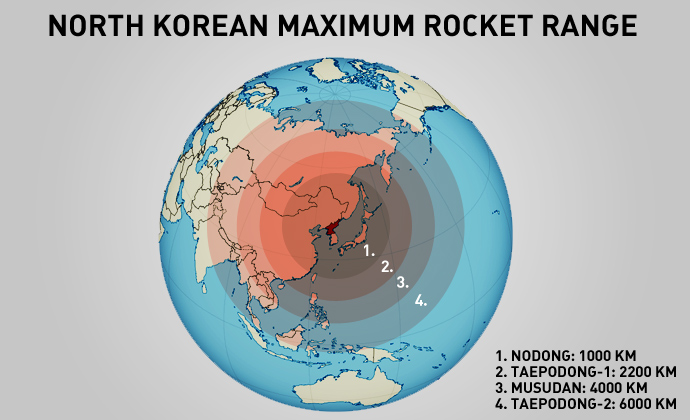
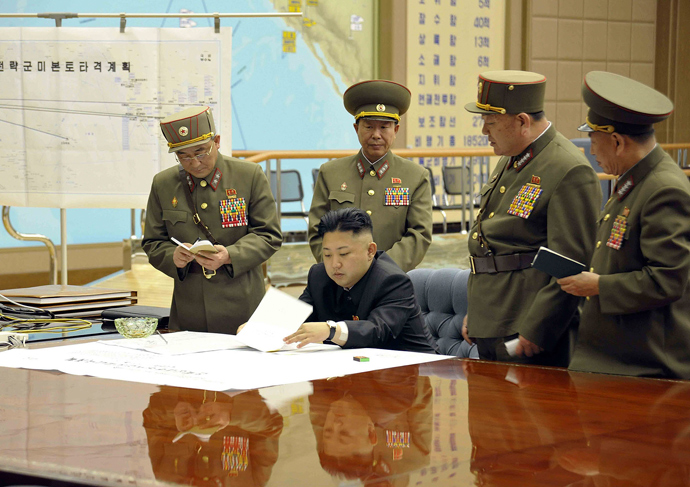
Recent warnings of instability on the Korean peninsula by Russia’s foreign minister Sergey Lavrov come at a most appropriate time – and indeed, there is a frightening possibility that the situation could spin out of control. Since the North was heavily penalized by UN sanctions following its recent satellite launch and nuclear test, Pyongyang has embarked on a near-daily onslaught of belligerent threats, some of which include its invalidation of the 1953 armistice agreement that ended the Korean War, threats to nuke the United States, and threats to occupy South Korea and subsequently take all Americans in the country hostage. Military analysts claim that North Korea is at least several years from building a nuclear warhead or a missile capable of reaching the US mainland – but there is no doubt that if the Kim regime oversteps their approach, it could certainly have severe repercussions for civilians in South Korea and Japan, both in range of North Korea’s rockets.
Despite regular threats of destruction and Pyongyang’s recent proclamation that the two Korean states are officially in a state of war, day-to-day life has retained its normality according to sources on the ground. Needless to say, there is no doubt that civilians on both sides are feeling tense in the current scenario, especially those on disputed South Korean islands in the West sea, just a stones throw away from the North Korean maritime border. The four thousands residents of the South’s Baengnyeong Island, which Kim Jong-un personally threatened to “wipe out” in early March, have been severely hindered from carrying out their day-to-day activities such as fishing due to the joint US-ROK military exercises in the area. Despite inter-Korean relations reaching their lowest point in recent times with the entire South on high alert, most South Koreans are adept at brushing off the North’s rhetoric, but they’re still proceeding with caution.Nile Bowie:
In addition to joint US-ROK’s endless barrage of war games on North Korea’s doorstep, the brandishing of B-2 bombers, which carry bombs that can blast through 70 meters of reinforced concrete, is an unnecessary stunt that is both bold and needlessly provocative. In fact, the B-2 flyover helps Kim Jong-un in consolidating his political power at home by rallying domestic support behind the US threat and distracting North Koreans from economic problems. These moves beg the question, is the United States prepared to launch a full-scale war against North Korea? Despite the high public disapproval of overt warfare campaigns launched by the Bush administration, the unholy status North Korea enjoys in American mainstream media – coupled with its threats to nuke the United States and the simple fact that is it a communist state – is likely enough to coax the average American into supporting a war of aggression against Pyongyang.
US Weapons Deliveries to “Terrorists in Syria” a Systematic Violation of the Convention against the Use of Mercenaries
nsnbc international
March 26, 2013
 Christof Lehmann (nsnbc),- A New York Times article reveals CIA involvement in weapons deliveries to the Syrian insurgents. Weapons which among other end up in the hands of the Syrian Al-Qaeda branch Jabhat al-Nusra.
The article reveals that deliveries by planes have taken place since 2012. The USA, Turkey, Qatar, Saudi-Arabia and others however, have directly and indirectly provided weapons for Muslim Brotherhood and Al-Qaeda associated insurgents since early 2011.
Special forces liaisons and special operations combat troops have been on the ground in Syria since 2011, taking among other, part in the spectacular kidnapping of the attorney general of Hama, Adnan Bakkur, in which helicopter gunships were involved.
The financing of the subversion began as early as 2007, when the government of Qatar sent USD 10 billion to the Turkish Foreign Minister Davotoglu. The arming of terrorists is not a one off scandal, but official NATO doctrine and a systematic violation of the Convention against the Use of Mercenaries.
As much as the New York Times (NYT) may want to portray arms shipments by plane as spectacular incident, it hardly touches the surface of the criminal attempt of the USA and NATO allies, Saudi-Arabia, Qatar, Israel, post-coup Libya and other, to systematically manufacture a low intensity conflict with the help of well financed and armed proxies, and with the purposes to prevent the completion of the PARS gas-pipeline, to balkanize Syria and Iraq, create a Kurdish Corridor, and to create the precondition for a war on Iran and other conflicts along the soft, resource rich underbelly of Russia and China.
The New York Times article correctly states, that Turkey and Arab governments, with the help of the CIA, over the recent months have increased their military aid to “Syrian opposition fighters”. The New York Times article further states, that the airlift began on a small scale in early 2012, continued intermittently through last fall, and expanded into a much heavier flow in late 2012. According to the NYT, it has grown to include more than 160 cargo flights by Jordanian, Saudi-Arabian and Qatari military-style cargo planes, landing at Esenboga Airport near Ankara, and, to a lesser degree, other Turkish and Jordanian airports.
The importance of the NYT article lies in the fact, that it is for the first time, that a major US-American newspaper recognizes, and to a degree documents the fact, that a US intelligence service was involved in delivering weapons to insurgents in Syria, albeit US-President Obama publicly refused to provide more than “non-lethal” aid. The NYT also reports, that officers from US-Intelligence Services have used “secret offices” to help Arab governments shop for weapons, including a large procurement from Croatia. The NYT also reports that American officials, on the condition of anonymity, have stated, that US-Intelligence Officers have vetted rebel commanders and groups to determine, who should receive weapons as they arrive (1
The article in the NYT on 25 March was not the first to report about the airlift of arms from Croatia. Already on 8 March The London Telegraph reported about a 3,000 Ton airlift of weapons by Jordan and NATO member Turkey which passed through the Croatian city Zagreb. (2 Subsequently, on 9 March, LandDestroyer and nsnbc published a comprehensive article about the airlift, detailing that the weapons, among other, were being delivered to the Syrian Al-Qaeda militia Jabhat al-Nusra. (3
Reportedly, the CIA has declined to comment about the statements by members of the intelligence community, that the CIA vetted the terrorist groups who received the weapons. However, there are numerous reports which substantiate the direct involvement of the CIA and other NATO member states, Saudi-Arabian, Qatari and other intelligence services, and that, long before March 2013.
US – Special Forces Officer blows the whistle. Already in August 2011 an officer of the United States Special Forces at Ft. Bragg, North Carolina, reports to nsnbc on the condition of anonymity, that US Special Forces had been operating in both Libya and Syria for months already, cooperating with predominantly Muslim Brotherhood and Al-Qaeda associated militia. (4
The same officer also verified that a training circular for special forces and “foreign students” which were trained by US special forces, the TC 18-01, Special Forces, Unconventional Warfare, from 2010, was a genuine document and reflected the model according to which the US Administration, US-Special Forces, US-Intelligence Services and their allies in Syria were organizing the subversion of the country. February 2012, the TC 18-01 was published in full by nsnbc. (5 No western mainstream media reported about the whistle blower or the TC 18-01.
September 2011 – Helicopter Gunships involved in the Kidnapping of Hama Attorney General Adnan Bakkur. In early September 2011 the attorney general of Hama, Syria, Adnan Bakkur was kidnapped. According to western mainstream media, the attorney general had defected. A video with the attorney general reading a statement that he had defected because of the violent crackdown of the Syrian government against peaceful protesters, was aired on several western mainstream media channels or used as evidence for the attorney general´s defection. The video shows clearly, that Adnan Bakkur “read” his statement under duress.
A reporter for nsnbc in Damascus reported, that the attorney general had been kidnapped and added further detail to the evidence, reporting, that eyewitnesses have seen the kidnappers drive in several cars, including a white Toyota pickup with a heavy machine gun mounted on it. The convoy with the kidnapped attorney general was then met by waiting helicopter gunships. Although the whereabouts of Adnan Bakkur were unknown, it was suspected, that he had been taken across the border to Turkey, where NATO Special Operations forces were training and arming Muslim Brotherhood fighters. (6
Although no independent, international investigation into this high profile kidnapping of the Hama attorney general Adnan Bakkur was conducted it was bearing all the signs of being a Military Intelligence Support Operation (MISO), also known as a PSYOP or psychological operation. Moreover, it is very unlikely that the helicopter gunships were not provided by a NATO member states military.
US Troops from Iraq redeployed to Jordan. Recruitment Center and Intelligence Operations Room in Mekka Street, Amman, Jordan. In December 2012 the blog of the US-American whistle blower Sibel Edmonds, Boilingfrogpost, reported that an unspecified number of US troops which had been withdrawn from Iraq, had been redeployed to airbases in Jordan and to the Jordanian border town Al-Mafraq, near the Syrian border. (7
On 17 February nsnbc reported, that the Jordanian military, together with US troops, had established a “buffer zone” at the Jordanian – Syrian border near al-Mafraq and reported that a source close to the former Jordanian Prime Minister Marouf Bakhit had announced the presence of an estimated 43,000 fighters.
At least 20,000 of these fighters, so the former Jordanian prime Minister´s confident, were fighters of the Libyan Al-Qaeda organization, the Libyan Islamic Fighting Group (LIFG), also known under the name “Tripoli Brigades”, under the command of the known Al-Qaeda terrorist Abdelhakim Belhadj and his second in command Harati. The transport of the many NATO mercenaries has reportedly taken place under the cover of medical transports or transports of wounded Libyan “rebels” to Jordan. (8
According to the former Spanish Prime Minister Aznar, who referred to Spanish intelligence services reports, Abdelhakim Belhadj, who also is known under the names Hasadi, Hasidi and other alias, was the mastermind behind the 2004 Madrid train bombings which secured that the Spanish parliament continued deploying Spanish troops to Afghanistan.
After the NATO led conquest of the Libyan capital Tripoli, Belhadj became the military governor of Tripoli, Al-Qaeda´s Libyan Islamic Fighting Groups became the Tripoly Military Council and the Tripoli Brigades. Abdelhakim Belhadj was installed in the position with the knowledge and aid of the US/NATO intelligence services and military, and with the full knowledge of the administration of US President Obama. ( 9
Also from a source close to the former Jordanian Prime Minister Marouf Bakhit, came the information that the Turkish (NATO) military intelligence service had opened an intelligence and operations room and a recruitment center in Mekha Street, in the Jordanian capital Amman. (ibid.)
Shiploads of Weapons including shoulder fired Surface to Air Missiles, arriving in Turkey, are distributed to insurgents in Syria. One fact that makes statements by the US administration, that it only provides non-lethal aid particularly deceitful is the fact that the Obama administration failed to respond to a report, according to which an entire shipload of weapons which had arrived to Turkey from Libya, and which contained large numbers of shoulder fired SAM-7 and Stinger Surface to Air Missiles, which were then distributed to insurgents in Syria by Turkish, that is NATO military officers. In September 2012 The Times, SANA and nsnbc reported about this largest yet documented shipload of weapons delivered to Syrian insurgents. (11
The “non-lethal aid ” will constitute a considerable threat to international air safety for the foreseeable future, and it is neither unlikely that one or more of the surface to air missiles will be used in a genuine terrorist attack by Islamist radicals against a civilian airliner, or that one or more of them will be used by a radical / double agent posing as a radical Islamist in a false flag terror attack.
The re-opening of the old smuggling route at the Saudi – Iraqi border and US Secretary of State´s warning to Iraq´s Prime Minister Nouri al-Malaki. On 26 December 2012 nsnbc international reported about the reopening of an old smuggling route at the border between Saudi-Arabia and Iraq. The smuggling route, was previously being used for transporting various types of weapons, ammunition bombs,military equipment and not least drugs to Iraq, begins in Al-Nakhib in the western Al-Anbar province, near the Ar´ar border crossing. The smuggling route has been reactivated to provide a variety of terrorist organizations in Syria, including the Jabhat al-Nusra, with weapons and other equipment. (12
Weapons and other equipment from Saudi-Arabia, smuggled along this route however, is not exclusively being funneled to Syria. Iraq has since the last quarter of 2012 again become a target of terrorism and sectarian violence, instigated, financed and armed by Saudi-Arabia. In December 2012 a senior Iraqi legislator issued a warning against plots which are being hatched by Turkey, Qatar and Saudi-Arabia against Iraq, calling on citizens of Iraq to be vigilant. Earlier in 2012 Iraq´s Prime Minister Nouri Malaki warned, that Saudi Arabia and Qatar are attempting to carry out an Syria-style plot against Iraq in an attempt to topple the government by deploying terrorists.
In an interview with the Lebanese al-Mayyadeen satellite network earlier in 2012, P.M. Nouri al-Malaki stated: ” Qatar and Saudi Arabia which are meddling to topple the Syrian government are now doing the same meddling to topple the Iraqi regime. Their goal is overthrowing the Iraqi government. Their goal is overthrowing the Iraqi ruling system and not overthrowing me”.
Earlier in 2012 the prominent Iraqi legislator, Al-Sayhood, issued the warning that much of the strategy which is being financed and carried out by Saudi Arabia and Qatar is in fact masterminded by Israel in an attempt to destabilize the sole Arab nation which so far has stood firm against imperialism and which consequently and consistently has backed the Arab and Palestinian cause. Iraq has over the course of the last four months been subject to several high profile terrorist attacks and assassinations which most likely originated from Saudi-Arabia. (ibid.)
On a surprise visit to Iraq and Iraq´s Prime Minister Nouri al-Malaki by US Secretary of State John Kerry however, Kerry demanded that Iraq stops the flow of arms to the Syrian military and the Syrian government. The demand has widely been discredited as hypocritical and many analysts, the scribe included assess Kerry´s statement as part of preparations for a larger media campaign and a campaign of destabilization and terrorism against Iraq. (14
NATO´s Discount Warfare Strategy, Arms Deliveries to “Terrorist Organizations” or systematic Violations of the Convention against the Use of Mercenaries – The deliveries of weapons and the funding of terrorist organizations, the interface of terrorist organizations with civilian and military intelligence services and western governments attempts to distance themselves as much as possible from terrorism in the view of the western citizens are symptoms of a new NATO military doctrine which was adopted at the 25th NATO Summit in Chicago 2012. (15
Prior to the formal adoption of the doctrine, which could be described as a discount low-intensity warfare model by means of mercenaries, who can be used as either friend or foe, which ideally should result in the procurement of NATO via the UNSC, but which will function as terrorist war of attrition if a UNSC resolution cannot be secured, was first officially endorsed by the two top NATO chiefs Ivo H. Daalder and James G. Stavridis when they called NATO´s intervention in Libya “a teachable moment and model for future intervention”. At NATO´s 25th Summit the model was officially adopted.
The NYT article, although it discloses some of the illegal deliveries of weapons is problematic and misleading to the extend that a correct name for the arms deliveries would be “Arms Deliveries to NATO mercenaries”.
The “terrorist” narrative is no longer viable and it eventually prevents the general public from understanding that the USA/NATO, Qatar, Turkey, Saudi-Arabia, EU and other “Friends of Syria” are systematically violating the Convention Against the Use of Mercenaries.
Christof Lehmann 26.03.2013
Notes:
Arms Airlift to Syria Rebels Expands, With Aid from C.I.A., New York Times, 25. March 2013 published online at http://www.nytimes.com/2013/03/25/world/middleeast/arms-air-lift-to-syrian-rebels-expands-with-cis-aid.html?pagewanted=all&_r=1&
2) US and Europe in ‘major airlift of arms to Syrian rebels through Zagreb’. The London Telegraph, 08 March 2013, published online at http://www.telegraph.co.uk/news/worldnews/middleeast/syria/9918785/US-and-Europe-in-major-airlift-of-arms-to-Syrian-rebels-through-Zagreb.html
3) US-British Al Qaeda Airlift: 3,000 Tons of Weapons Fuel Syria’s Destruction , LandDestroyer, 09 March 2013, also published online by nsnbc international at http://nsnbc.me/2013/03/09/us-british-al-qaeda-airlift-3000-tons-of-weapons-fuel-syrias-destruction/
4) Arabian Summer or NATO´s Fall, Christof Lehmann, 29. August 2011, published online at nsnbc at http://nsnbc.me/2011/08/29/arabian-summer-or-nato%C2%B4s-fall/
5) SPECIAL FORCES UNCONVENTIONAL WARFARE – TC 18-01, published by nsnbc online at http://nsnbc.files.wordpress.com/2011/10/special-forces-uw-tc-18-01.pdf
6) Syria – Hama: Driver and Bodyguard of Kidnapped General Attorney Confirm Kidnapping. Christof Lehmann, 05 September 2011, published on nsnbc, online at http://nsnbc.me/2011/09/05/syria-hama-driver-and-bodyguard-of-kidnapped-general-attorney-confirm-kidnapping/
7) Foreign Troops Begin to Spread Near the Villages of Al-Mafraq. Sibel Edmonds, Boilingfrogspost, published in nsnbc on 13 December 2011 online at http://nsnbc.me/2011/12/13/foreign-troops-begin-to-spread-in-syria/
8) Attack on Syria likely before March? Christof Lehmann, nsnbc, 17 February 2012, published online at http://nsnbc.me/2012/02/17/attack-on-syria-likely-before-march/
9) Abdelhakim Belhadj The Mask Behind The Many Men, Christof Lehmann, nsnbc, 25 September 2011, published online at http://nsnbc.me/2011/09/25/abdelhakim-belhadj-the-mask-behind-the-many-men/
10) ibid.
11) Largest Shipload of Libyan Weapons Heading to Armed Groups in Syria, SANA, published on nsnbc on 15 September 2012, online at http://nsnbc.me/2012/09/15/largest-shipload-of-libyan-weapons-heading-to-armed-groups-in-syria/
12) Saudi Smuggling Route to Syria Disclosed. Christof Lehmann, nsnbc, 26. December 2012, published online at http://nsnbc.me/2012/12/26/saudi-smuggling-route-to-syria-disclosed-2/
13) ibid.
14) Kerry Demands Iraq Stop “Arms Flow” to Syria even as US Arms/Funds Al Qaeda, LandDestroyer, 25 March 2013, published on nsnbc international at http://nsnbc.me/2013/03/25/kerry-demands-iraq-stop-arms-flow-to-syria-even-as-us-armsfunds-al-qaeda/
15) NATO`s 25th Summit in Chicago in Preparation of Global Full Spectrum Dominance Christof Lehmann, nsnbc, 20 May 2012, published online at http://nsnbc.me/2012/05/20/natos-25th-summit-in-chicago-in-preparation-of-global-full-spectrum-dominance-interventionism-possible-preparations-for-a-regional-war-directed-against-russia-and-china-and-developments-in-global/
About the Author

Boris Berezovsky is dead! Syrian ‘rebels’ falling apart. Gilad Atzmon in Japan [video]
Ryan Dawson
March 25, 2013
Nuclear War Through North Korean Eyes
Nile Bowie
March 13, 2013
There is little doubt that civilians on both sides of the Korean Demilitarized Zone (DMZ) are weighed down with anxiety as both countries carry out provocative large-scale military drills amid threats of nuclear war. North Korea has recently announced that it will no longer abide by the UN-brokered armistice that ended the Korean War with a ceasefire in 1953 and authorities have severed its communications hotline with the South, the only diplomatic channel of contact between the two countries. Pyongyang has imposed no-fly and no-sail zones off both its coasts as part of comprehensive military drills that may see the test firing of short-to-medium range missiles. The US-South Korea joint command forces have launched their Foal Eagle field training exercises that will be ongoing until end of April. 200,000 South Korean troops and 10,000 US troops will take part in the exercise, which will include land, air, sea, and special operation drills. North Korea’s state newspaper, Rodong Sinmun, has reported that the North’s army, navy, air force, and anti-aircraft units were “just waiting for the final order to attack.”
Following Pyongyang’s recent threats that it would engage preemptive nuclear strikes against any aggressor, Seoul shot back with its strongest rhetoric yet, stating, “If North Korea attacks South Korea with a nuclear weapon, then by the will of the Republic of Korea and humanity, the Kim Jong-un regime will perish from the Earth.” South Korea’s newly inaugurated President Park Geun-hye has been in office for less than one month and in the current scenario, it has become politically impossible for her to stick to her campaign pledges of taking a softer line on North Korea. Most of the time, the substance of North Korea’s threats do not materialize, much like last month’s pledge to take an immediate “physical response” to a barrage of UN sanctions. While talk of taking “second and third countermeasures” are thrown around pretty liberally in North Korean state media, the North Korean foreign ministry has not announced any specific actions – such as a nuclear weapons test or rocket launch – in response to harsh UN resolutions or the ongoing US-ROK drill offensive.
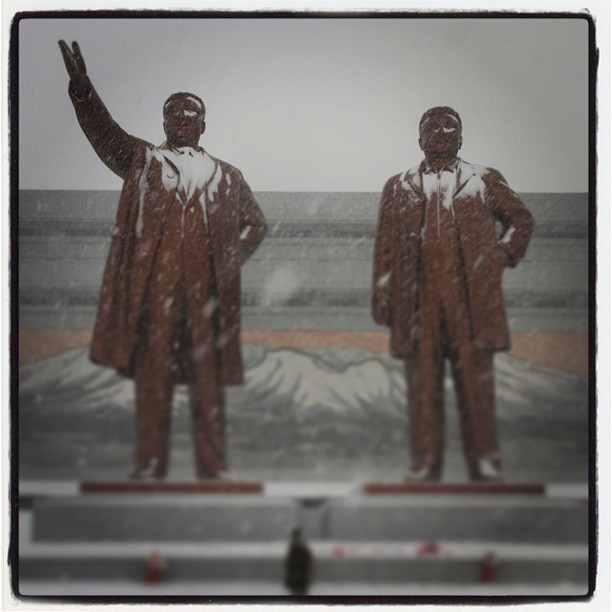
North Korea invokes a brutal historical narrative of war with the United States to legitimize its conduct in the present day – and indeed, North Korea is a victim of war crimes. Washington and its allies rained napalm over North Korea, destroying nearly all its cities and thousands of villages. A staggering four million Koreans and one million Chinese soldiers were killed – US military sources confirm that 20 percent of North Korea’s population was killed off, even that being a highly conservative figure. In the fallout of North Korea’s third nuclear test, state media has invoked several English-language editorials that reflect on the overlooked historical back-story of the US stockpiling nuclear weapons in South Korea. The statement released by the Rodong Sinmun reads:
“In the 1980s the U.S. spurred the modernization of the nuclear hardware of its forces in south Korea. Member of the U.S. House of Representatives Ronald, speaking at a parliament, confessed that the U.S. shipped more than 1,000 nuclear weapons to south Korea and deployed 54 airplanes for carrying nuclear bombs. South Korea turned into the world’s biggest nuclear outpost with the stockpile of nuclear weapons such as bombs, shells, warheads, land mines and carrier means as well as nuclear bases and arsenals. The U.S. nuclear threats were vividly manifested in its open declaration to use nuclear weapons in Korea.”
For all intents and purposes, this is an accurate account. If we fast-forward toward the present-day, the Bush administration’s Doctrine for Joint Nuclear Operations issued in 2005 established the circumstances under which the US could preemptively invoke the use of nuclear weapons. The document states:
“The lessons of military history remain clear: unpredictable, irrational conflicts occur. Military forces must prepare to counter weapons and capabilities that exist in the near term even if no immediate likely scenarios for war are at hand. To maximize deterrence of WMD use, it is essential US forces prepare to use nuclear weapons effectively and that US forces are determined to employ nuclear weapons if necessary to prevent or retaliate against WMD use.”
The North Korean Foreign Ministry’s recent statement, “Second Korean War Is Unavoidable”, argues that the DPRK reserves the right to a preemptive nuclear attack and the Foal Eagle joint military exercises are akin to Washington lighting a fuse for a nuclear war. The document also acknowledges the Obama administration’s pivot to the Asia-Pacific region, and that the US “seeks a way out of a serious economic crisis at home in unleashing the second Korean War.” Many analysts throughout the alternative media have acknowledged North Korea’s history as a victim and have defended their acquisition of a nuclear deterrent. While the historical context of abuse warrants one to be empathetic toward Pyongyang in this respect, many of these commentators fail to necessitate the primacy that inter-Korean dialogue should hold in their writings. It should also be noted that when official figures, such as Jon Yong-nam of the Kim Il-sung Socialist Youth League, utter phrases like, “We vow to plant the flag of the central military command and the North Korean flag on Halla Mountain on Jeju Island [South Korea]”, it makes the deterrent argument far less convincing.
In recent times, the North has provided slight openings for foreign media to enter the country and speak to its citizens, and undercover testimony has been smuggled out. Recent reports published by Radio Free Asia (RFA) detail the intellectual insecurity of North Korean civilians, who in consuming copious amounts of state media in the absence of any other source, deeply fear the threat of strikes or an invasion from foreign powers. RFA quotes a resident of North Korea’s Yanggang Province who has allegedly said, “The authorities said if we have nuclear weapons, we can scare off anyone we meet, but on the contrary even though we have nuclear weapons and we’re shouting that we might launch a preemptive strike, I’m worried it seems we might receive a preemptive strike.” Another resident in resident in Hamgyong Pronvince said, “If we shoot off a nuclear weapon, are the Americans going to stay motionless? In any case, if nuclear weapon is launched everyone dies, so I feel there’s no use for training or anything.”
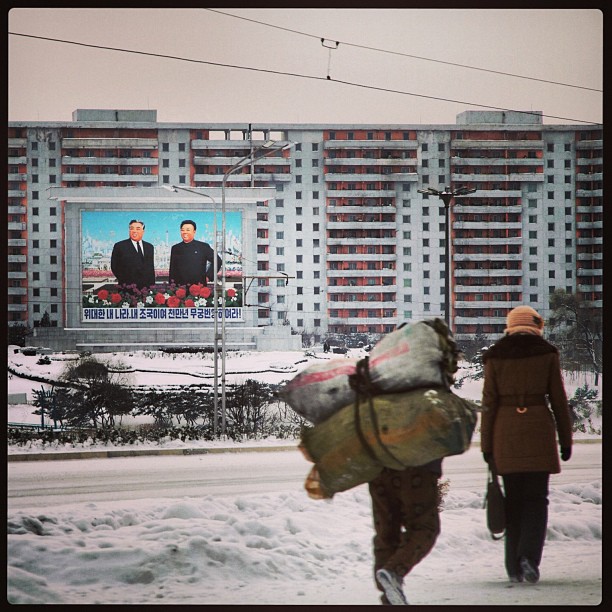
Although these anonymous testimonies, appearing on the US State Department-run RFA, likely serve as some form of propaganda, it highly plausible that a percentage of the North Korean population feels quite uneasy about the current state of affairs. One could offer their rhetorical support for North Korea’s acquisition of nuclear weapons as a deterrent, but what will become of some 10.5 million innocent civilians in Seoul if the North attempts to proliferate its nuclear arsenal? Likewise, 3.2 million souls in Pyongyang would be extinguished if the US employed its preemptive nuclear doctrine. The potential death toll should not be limited to those in capital cities, the reemergence of conflict on the Korean Peninsula immediately endangers the 70 million people living there. For all the firery rhetoric exchanged between the two Koreas, the fact that the hardline Lee Myung-bak regime, incumbent President Park’s predecessor, did not retaliate when the North shelled Yeonpyeong island in 2010 demonstrates the extent to which restraint has been exercised for the sake of stability.
The only thing keeping the situation from deteriorating is the fact that North would probably not come out victorious if it went to war with South Korea and the United States. While the North boasts larger manpower, more submarines, and more fighter jets, the South possesses highly sophisticated weaponry and modern defense technology by comparison – for this reason, Pyongyang has put more focus on the development of ICBMs and nuclear warheads. Military experts say North Korea is years away from developing a long-range missile and a nuclear warhead to attack the US mainland; however the damage it could do to South Korea and Japan has the potential to amass high civilian causalities and shouldn’t be under-estimated. One could argue that the case has never been stronger for the withdrawal of the 28,500 US troops stationed in South Korea. Such a move that would satisfy civilians in both Koreas and yield higher chances of provoking a positive response from Pyongyang during this tense period; however, that simply isn’t going to happen. As the Pentagon pivots to the Asia-Pacific, North Korea is a godsend in its ability to provide Washington with a legitimate pretext to bolster its forces in China’s backyard.
As tensions increase on the Korean Peninsula, the only power that has any influence to broker an agreement that could de-escalate hostilities is China. Following North Korea’s third nuclear test, many Chinese citizens took part in a historically unprecedented outbreak of anti-North Korea protests, and both China’s state-run media and various policy experts are becoming more vocal in their criticism of Beijing’s North Korean policy. China partnered with the United States to co-author recent UN resolutions against Pyongyang, exhibiting new heights of Beijing’s disapproval with the Kim dynasty. An editorial in China’s Global Times newspaper reads, “If North Korea engages in further nuclear tests, China will not hesitate to reduce its assistance to North Korea.” The editorial went on to say that if the US, Japan and South Korea “promote extreme U.N. sanctions on North Korea, China will resolutely stop them and force them to amend these draft resolutions.”
Kim Jong-un has demonstrated his willingness to go against the wishes of his main allies in Beijing, which has visibly frustrated those on the Chinese side, who have for years attempted to nudge Pyongyang into implementing meaningful economic reform. China should do more to denounce unnecessary and provocative military drills that have the potential to lead to fire exchange and inter-Korean turbulence. More likely than not, these threats will not materialize and tensions will deescalate in time. China hosted tri-lateral talks in Beijing with Pyongyang and Washington in attendance a decade ago in April 2003 – at the time North Korea withdrew from the nuclear Non-Proliferation Treaty, fired a short-range missile into the Sea of Japan, violated South Korean airspace with a fighter jet, and threatened to abandon the 1953 Armistice Agreement. The present day scenario is highly unpredictable and it’s clear that Beijing must take the initiative to deescalate this situation and bring all parties together to the negotiating table to work out a new agreement – one that establishes meaningful inter-Korean security assurances that lead to both sides scaling back military drills and provocative muscle flexing – such is a prerequisite for any kind of normalization of relations.
This article appeared on Counterpunch.
Nile Bowie is an independent political analyst and photographer based in Kuala Lumpur, Malaysia. He has travelled extensively to North and South Korea and can be reached at nilebowie@gmail.com.
Cyber Boogeymen, NK Nukes, Fukushima Health – Asia-Pacific Perspective [video]
Asia-Pacific Perspective
February 24, 2013
James Corbett of corbettreport.com and Broc West of apperspective.net are pleased to bring you the latest edition of their monthly video series, “The Asia-Pacific Perspective.” In this episode, we cover:
STORY #1:
The Great Cyber-Warfare Scam
http://ap-perspective.blogspot.com.au…
Anonymous Thrown Into China-US Cyberwar Scandal
http://rt.com/usa/anonymous-thrown-in…
Despite Lack Of Proof, US To Attack Chinese Hackers In Retaliation
http://news.antiwar.com/2013/02/20/de…
STORY #2:
North Korean Test Shows U.S. Policy Failings
http://ap-perspective.blogspot.com.au…
Russia Opposes New North Korea Economic Sanctions
http://www.reuters.com/article/2013/0…
U.S. & South Korea Plan Joint Military Exercises
http://timesofindia.indiatimes.com/wo…
What Will Follow Pyongyang’s Atomic Gambit?
http://www.nilebowie.blogspot.com.au/…
STORY #3:
Fukushima Health-Survey Chief To Quit Post
http://fukushimaupdate.com/fukushima-…
Two More Fukushima Youths Diagnosed With Thyroid Cancer
http://fukushimaupdate.com/two-more-f…
Fukushima Victims Required To Pay Back TEPCO Compensation
http://fukushimaupdate.com/fukushima-…

 PN
PN 