
Atomic industry bankrolls Japan’s nuclear watchdog
 Fukushima Update
November 4, 2012
via RT.com
Members of Japan’s nuclear watchdog who are charged with drafting nuclear safety rules have received sizable funds from the atomic industry. The reports raise concerns that regulations may be diluted after last year’s Fukushima nuclear disaster.
The Japanese Nuclear Regulation Authority (NRA) said that four of the six members of the panel had been in receipt of over $500,000 that took the form of grants, donations and compensation over the past three to four years.
The panel members are required to declare their financial records and income, but there is no condition for their removal should previously withheld data come to light. The NRA pointed out that all of the transactions were legal and above board.
The NRA defended the panel, saying that the members were “selected in line with rules, and there should be no problem.” They dismissed critics that the on-going financial support by the atomic industry would wield any influence over the forthcoming nuclear safety regulations being drafted by the panel.
Of the four members of the watchdog, Akio Yamamoto, a professor from the University of Negoya was granted over $300,000 by Mitsubishi Heavy Industries Ltd which produces equipment for reactors in Japan, while Akira Yamaguchi, a professor at Osaka University totted up over $120,000 in funds from Japan Atomic Power Co.
In addition, University of Tsukuba professor Yutaka Abe received a combined $62,000 from a number of bodies affiliated with the Japanese atomic industry. The fourth member of the watchdog, researcher Tomoyuki Sugiyama got around $37,000 in grants from state-run Japan Atomic Energy Agency.
Japanese newspaper publication the Tokyo Shimbun said on Saturday that the funding may see the panel dampen measures “to reflect the utilities’ wishes.”
The NRA was formed in the wake of protests calling for a more independent safety watchdog for the nuclear power industry, following the Fukushima nuclear disaster caused by the earthquake and tsunami on March 11 of last year.
The former body charged with imposing nuclear safety standards was the Nuclear and Industrial Safety Agency (NISA) industry watchdog which was part of the Ministry of Economy, Trade and Industry. It came under fire following the Fukushima meltdown, condemned as a “nuclear village” with overly close economic ties.
A large part of the newly-formed NRA is made up of ex-members of NISA.
Currently, the only one of Japan’s 50 nuclear reactors functioning is under inspection to see if earthquake faults close to the plant threaten its safety. The plant in question, located in Ohi on Japan’s West coast was turned on again in July.
Japan deactivated all of its nuclear reactors which previously accounted for over 30 per cent of the nation’s energy demands in May. Japan has pledged to increase its use of renewable energy in order to compensate for the shortfall left by atomic energy.
Massive Cover-Up of Risks from Flooding to Numerous U.S. Nuclear Facilities
nsnbc
October 21, 2012
“And U.S. officials are apparently a primary reason behind Japan’s cover-up of the severity of the Fukushima accident … to prevent Americans from questioning our similarly-vulnerable reactors.”
Numerous American nuclear reactors are built within flood zones:
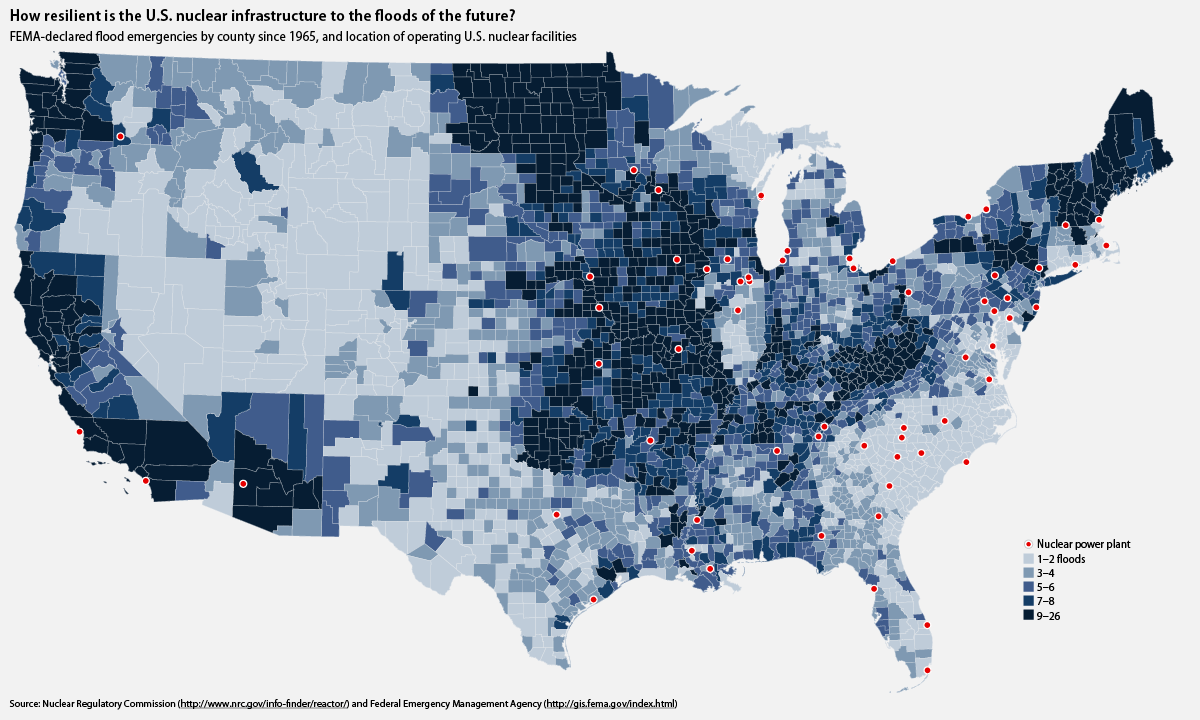
As one example, on the following map (showing U.S. nuclear power plants built within earthquake zones), the red lines indicate the Mississippi and Missouri rivers:

Numerous dam failures have occurred within the U.S.:

Reactors in Nebraska and elsewhere were flooded by swollen rivers and almost melted down. See this, this, this and this.
The Huntsville Times wrote in an editorial last year:
A tornado or a ravaging flood could just as easily be like the tsunami that unleashed the final blow [at Fukushima as an earthquake].
An engineer with the NRC says that a reactor meltdown is an “absolute certainty” if a dam upstream of a nuclear plant fails … and that such a scenario is hundreds of times more likely than the tsunami that hit Fukushima :
An engineer with the Nuclear Regulatory Commission (NRC) … Richard Perkins, an NRC reliability and risk engineer, was the lead author on a July 2011 NRC report detailing flood preparedness. He said the NRC blocked information from the public regarding the potential for upstream dam failures to damage nuclear sites.
Perkins, in a letter submitted Friday with the NRC Office of Inspector General, said that the NRC “intentionally mischaracterized relevant and noteworthy safety information as sensitive, security information in an effort to conceal the information from the public.” The Huffington Post first obtained the letter.
***
The report in question was completed four months after … Fukushima.
The report concluded that, “Failure of one or more dams upstream from a nuclear power plant may result in flood levels at a site that render essential safety systems inoperable.”
Huffington Post reported last month:
These charges were echoed in separate conversations with another risk engineer inside the agencywho suggested that the vulnerability at one plant in particular — the three-reactor Oconee Nuclear Station near Seneca, S.C. — put it at risk of a flood and subsequent systems failure, should an upstream dam completely fail, that would be similar to the tsunami that hobbled the Fukushima Daiichi nuclear facility in Japan last year.***
The engineer is among several nuclear experts who remain particularly concerned about the Oconee plant in South Carolina, which sits on Lake Keowee, 11 miles downstream from the Jocassee Reservoir. Among the redacted findings in the July 2011 report — and what has been known at the NRC for years, the engineer said — is that the Oconee facility, which is operated by Duke Energy, would suffer almost certain core damage if the Jocassee dam were to fail. And the odds of it failing sometime over the next 20 years, the engineer said, are far greater than the odds of a freak tsunami taking out the defenses of a nuclear plant in Japan.
“The probability of Jocassee Dam catastrophically failing is hundreds of times greater than a 51 foot wall of water hitting Fukushima Daiichi,” the engineer said. “And, like the tsunami in Japan, the man‐made ‘tsunami’ resulting from the failure of the Jocassee Dam will –- with absolute certainty –- result in the failure of three reactor plants along with their containment structures.
“Although it is not a given that Jocassee Dam will fail in the next 20 years,” the engineer added, “it is a given that if it does fail, the three reactor plants will melt down and release their radionuclides into the environment.”
***
In the letter, a copy of which was obtained by The Huffington Post, Richard H. Perkins, a reliability and risk engineer with the agency’s division of risk analysis, alleged that NRC officials falsely invoked security concerns in redacting large portions of a report detailing the agency’s preliminary investigation into the potential for dangerous and damaging flooding at U.S. nuclear power plants due to upstream dam failure.
Perkins, along with at least one other employee inside NRC, also an engineer, suggested that the real motive for redacting certain information was to prevent the public from learning the full extent of these vulnerabilities, and to obscure just how much the NRC has known about the problem, and for how long.
Huffington Post notes today:
An un-redacted version of a recently released Nuclear Regulatory Commission report highlights the threat that flooding poses to nuclear power plants located near large dams — and suggests that the NRC has misled the public for years about the severity of the threat, according to engineers and nuclear safety advocates.
“The redacted information shows that the NRC is lying to the American public about the safety of U.S. reactors,” said David Lochbaum, a nuclear engineer and safety advocate with the Union of Concerned Scientists.
***
According to the NRC’s own calculations, which were also withheld in the version of the report released in March, the odds of the dam near the Oconee plant failing at some point over the next 22 years are far higher than were the odds of an earthquake-induced tsunami causing a meltdown at the Fukushima plant.
The NRC report identifies flood threats from upstream dams at nearly three dozen other nuclear facilities in the United States, including the Fort Calhoun Station in Nebraska, the Prairie Island facility in Minnesota and the Watts Bar plant in Tennessee, among others.
***
Larry Criscione, a risk engineer at the Nuclear Regulatory Commission who is one of two NRC employees who have now publicly raised questions about both the flood risk at Oconee and the agency’s withholding of related information, said assertions that the plant is “currently able to mitigate flooding events,” amounted to double-speak.
Criscione said this is because current regulations don’t include the failure of the Jocassee Dam — 11 miles upriver from Oconee — in the universe of potential flooding events that might threaten the plant. “I think they’re being dishonest,” Criscione said in a telephone interview. “I think that we currently intend to have Duke Energy improve their flooding protection and to say that the current standard is adequate is incorrect.”
According to the leaked report, NRC stated unequivocally in a 2009 letter to Duke that it believed that “a Jocassee Dam failure is a credible event” and that Duke had “not demonstrated that the Oconee Nuclear Station units will be adequately protected.” These statements — along with Duke’s own flood timeline associated with a Jocassee Dam failure and NRC’s calculated odds of such a failure — were among many details that were blacked out of the earlier, publicly released report.
***
Richard H. Perkins, a risk engineer with the NRC and the lead author of the leaked report, pointed to the analysis by the Association of Dam Safety Officials in an email message to The Huffington Post. “I felt it made a significant point that large, fatal, dam failures occur from time to time,” he said. “They are generally unexpected and they can kill lots of people. It’s not credible to say ‘dam failures are not credible.’”
Dave Lochbaum, the Union of Concerned Scientists engineer who reviewed a copy of the un-redacted report, says these revelations directly contradict the NRC’s assertions that Oconee is currently safe. “Fukushima operated just under 40 years before their luck ran out,” Lochbaum, who worked briefly for the NRC himself between 2009 and 2010, and who now heads the Nuclear Safety Project at UCS, said in a phone call. “If it ever does occur here, the consequences would be very, very high.
“Japan is now building higher sea walls at other plants along its coasts. That’s great for those plants, but it’s too late for Fukushima. If in hindsight you think you should have put the wall in,” Lochbaum said, “then in foresight you should do it now.”
Other Comparisons Between Dangers In U.S. and Fukushima
There are, in fact, numerous parallels between Fukushima and vulnerable U.S. plants.
A Japanese government commission found that the Fukushima accident occurred because Tepco and the Japanese government were negligent, corrupt and in collusion. See this, this and this. The U.S. NRC is similarly corrupt.
The operator of the Fukushima complex admitted earlier this month that it knew of the extreme vulnerability of its plants, but:
If the company were to implement a severe-accident response plan, it would spur anxiety throughout the country and in the community where the plant is sited, and lend momentum to the antinuclear movement ….
The U.S. has 23 reactors which are virtually identical to Fukushima.
Most American nuclear reactors are old. They are aging poorly, and are in very real danger of melting down.
And yet the NRC is relaxing safety standards at the old plants. Indeed, while many of the plants are already past the service life that the engineers built them for, the NRC is considering extending licenses another 80 years, which former chairman of the Tennessee Valley Authority and now senior adviser with Friends of the Earth’s nuclear campaign David Freeman calls “committing suicide”:
You’re not just rolling the dice, you’re practically committing suicide … everyone living within a 50 mile radius is a guinea pig.
Indeed, the Fukushima reactors were damaged by earthquake even before the tsunami hit(confirmed here). And the American reactors may be even more vulnerable to earthquakes than Fukushima.
Moreover, the top threat from Fukushima are the spent fuel pools. And American nuclear plants have fuel pool problems which could dwarf the problems at Fukushima.
And neither government is spending the small amounts it would take to harden their reactors against a power outage.
The parallels run even deeper. Specifically, the American government has largely been responsible for Japan’s nuclear policy for decades. And U.S. officials are apparently a primary reason behind Japan’s cover-up of the severity of the Fukushima accident … to prevent Americans from questioning our similarly-vulnerable reactors.
Globalresearch – via The 4th Media
Ground under Fukushima Unit 4 sinking, structure on verge of complete collapse [video included]
 by Ethan A. Huff, staff writer
Natural News
October 16, 2012
(NaturalNews) Though the mainstream media has long since abandoned the issue, the precarious situation at the Fukushima Daiichi nuclear power facility in Japan is only continuing to worsen, according to a prominent Japanese official. During a recent interview, Mitsuhei Murata, the former Japanese Ambassador to both Switzerland and Senegal, explained that the ground beneath the plant’s Unit 4 is gradually sinking, and that the entire structure is very likely on the verge of complete collapse.
This is highly concerning, as Unit 4 currently holds more than 1,500 spent nuclear fuel rods, and a collective 37 million curies of deadly radiation that, if released, could make much of the world completely uninhabitable. As some Natural News readers will recall, Unit 4 contains the infamous elevated cooling pool that was severely damaged following the catastrophic earthquake and tsunami that struck on March 11, 2011.
According to the Secretary of former Japanese Prime Minister Naoto Kan, the ground beneath Unit 4 has already sunk by about 31.5 inches since the disaster, and this sinking has taken place unevenly. If the ground continues to sink, which it is expected to, or if another earthquake of even as low as a magnitude six occurs in the region, the entire structure could collapse, which would fully drain the cooling pool and cause a catastrophic meltdown.
“If Unit 4 collapses, the worse case scenario will be a meltdown, and a resultant fire in the atmosphere. That will be the most unprecedented crisis that man has ever experienced. Nobody will be able to approach the plants … as all will have melted down and caused a big fire,” said Murata during the interview. “Many scientists say if Unit 4 collapses, not only will Japan lie in ruin, but the entire world will also face serious damages.”
Because there are 31 nuclear units of a similar type to Unit 4 in the U.S., the American government has been downplaying the disaster to protect its own reputation, alleges Murata. This is, in fact, the primary reason why so little has been reported on the severity of Fukushima following the disaster. The American empire, in other words, does not want the world, nor the American people, to know that there is the possibility of literally dozens of Fukushima situations occurring on American soil, should the right disaster situations arise.
You can watch the full 3:51 minute translated interview with Murata at the following link:
http://youtu.be/-LCTv65aqgA
Sources for this article include:
http://www.naturalnews.com/035789_Fukushima_Cesium-137_Plume-Gate.html
Radiation Alert: Common Household Items We All Use Found to be Contaminated [videos included]
Governments Have Raised Acceptable Radiation Levels Worldwide to Dupe the Populace
 By Shepard Ambellas
theintelhub.com
October 14, 2012
A study by the Journal for Environmental Science and Technology details how dangerous radiation from Fukushima contacted the United States heavy in California “with greatest exposure in central and southern California”.
In fact the study determined that seaweed off the coast of California had been tested for radiation contamination and that radiation levels within the seaweed were 500% higher than safe levels.
You never know what might be contaminated with radiation these days, it’s all over the world. From nuclear bomb tests to failed nuclear reactors like Russia’s Chernobyl or Japan’s Fukushima Diachi power plant, radioactive isotopes are everywhere.
Some researchers have even found extremely high levels of Radiation in parts of the mainland US using a HEPA filter anylisis method tracking accumulative radiation.
A test of a HEPA air filter stationed in California recorded radiation levels at 351% and 538% above normal background levels.
The tests, conducted by the Enviroreporter, show levels much higher than normal background levels that are most likely coming from the Fukushima nuclear disaster.
It is clear that, despite a large scale misinformation campaign conducted by various governments and sock puppets throughout the internet, an increase in radiation has been seen in the United States after the Japan Fukushima nuclear disaster.
But what if ordinary household items that you use everyday are radiated and you just didn’t know it?
According to the CBSA they have sustained an increase in radioactive packages coming from Asia since 2011. This is a red flag in the shipping world as not all ports have radiation detection and monitoring equipment.
Recently kitchenware shipped to a port in Canada from India was found to be contaminated with radiation common for use in the medical field. This is alarming as radioactive materials are now being melted down and added to products that humans use to eat with or have very close contact to.
Thus further contributing to worldwide depopulation efforts.
CBC.ca reported;
The Canadian Nuclear Safety Commission (CNSC) ordered that a small shipment of radioactive kitchenware, that found its way to the Port of Montreal, be taken out of the country.
The CNSC issued an order on Oct. 5, demanding that the contaminated container be sent back to India by Hanjin Shipping Canada — the company that delivered the cargo to Montreal’s port last May.
André Régimbald, the director of nuclear substance regulations for the Canadian Nuclear Safety Commission, said “this was a relatively low-risk package or container and therefore, there was no need at that time to take immediate strong measures to get the container out of the port.”
According to the order issued to Hanjin Shipping Canada, the utensils inside the two-cubic-foot box are contaminated with Cobalt-60, a radioactive isotope often used for medical radiation.
The Canadian Borders Services Agency (CBSA) found the merchandise during routine scans performed on incoming cargo.
Does it scare you that any household item could be contaminated with deadly radiation?
At one point about 4 months after the Fukushima disaster I personally witnessed radiation levels on a rubber doormat above 135 CPM.
A rubber doormat! How much of this radiation got tracked through that residence from human foot traffic?
You might now be asking yourself, what other products do I use that might be contaminated? What foods do I eat that might be contaminated?
Lisa Garber reported for theintelhub.com;
The mainstream media is finished with Fukushima, but it seems Fukushima isn’t finished with us. A couple of irradiated fish captured near the inoperative nuclear plant showed 25,800 becquerels of caesium per kilo—258 times the level determined ‘safe’ by the government.
The plant ceased operations following a meltdown involving three reactors after the devastating earthquake and tsunami in March of 2011.
Radiation Spike in Fish
Since June, officials have allowed fishing outside a 31-mile radius from the plant while being purportedly stunned by the record radiation levels of the fish. Until the recently captured pair of greenlings, record radiation levels had been at 18,700 becquerels per kilo as found in cherry salmons.
The Tokyo Electric Power Company (TEPCO) is intent on capturing more of and researching the fish, their food sources, as well as their habitats to explain the 7,100 becquerels jump.
Of course there is no ‘safe’ level of radiation, and food contaminated with high amounts of radiation can be especially dangerous.
Not too long ago, it was found that radioactive food (food contaminated with radiation from Fukushima or others sources), is actually comparable to receiving hundreds of X-rays.
However, Fox News reported that Japan’s government said the seafood is safe to eat early on demonstration how governments worldwide are willing to lie even if there populations are at risk.
Do you trust your government?
According to Washington’s Blog;
Nuclear expert Arnie Gundersen says that high-level friends in the State Department told him that Hillary Clinton signed a pact with her counterpart in Japan agreeing that the U.S. will continue buying seafood from Japan, despite that food not being tested for radioactive materials.
Shepard Ambellas is the founder & director of theintelhub.com (a popular alternative news website), researcher, investigative journalist, radio talk show host, and filmmaker. Follow Shepard on Twitter/NotForSale2NWO and on Youtube.com/user/NotForSale2NWO, please feel free to checkout SHADEtheMotionPicture.com (An Ambellas & Bermas Film).
Japan-China Island Dispute: Conflict or Politics? [video]
Russia Today
September 24, 2012
China plans to use unmanned drones to increase its presence around the islands that are at the center of a volatile dispute with Japan. They will conduct marine surveillance of the area.
Three Chinese patrol vessels still remain very close to the uninhabited – but strategic – archipelago; and have briefly entered waters which Japan considers its territory. The conflict’s seen large-scale protests in both countries turn ugly. The row could be further complicated as Taiwanese boats are now heading to the islands to reassert their fishing rights in the area while all around, the US is increasing its military activity in the region. RT talks to James Corbett, editor of the Corbett Report website, from Japan.
RT LIVE http://rt.com/on-air
Underwater Crop Circles Mystery Solved? [video]
YouTube — StephenHannardADGUK
September 21, 2012
[Potent News Editor’s note: Upon thinking about this more, I’m not sure how much I buy the fish explanation. It would be very nice to see a video of this fish creating this circle. I looked all over the place and couldn’t find one.]
[hat tip: Disclose.tv]
Japan Backpedals on “No Nukes” Policy [video]
Global Research TV
September 19, 2012
Last week, Japan surprised the world by announcing that it plans to abandon atomic energy completely by the 2030s. But now in an abrupt turnaround, the Japanese Cabinet appears to be backpedaling on that decision, dropping any mention of the 2030s deadline in its approval of Japan’s new energy policy.
Find out more in this edition of “Behind The Headlines” from GRTV.

 PN
PN 