HIGHLY POTENT NEWS THAT MIGHT CHANGE YOUR VIEWS

Malaysia

Malaysia Invaded – 100’s of Terrorists Land on Beaches, Western Media Mute

by Tony Cartalucci
Land Destroyer

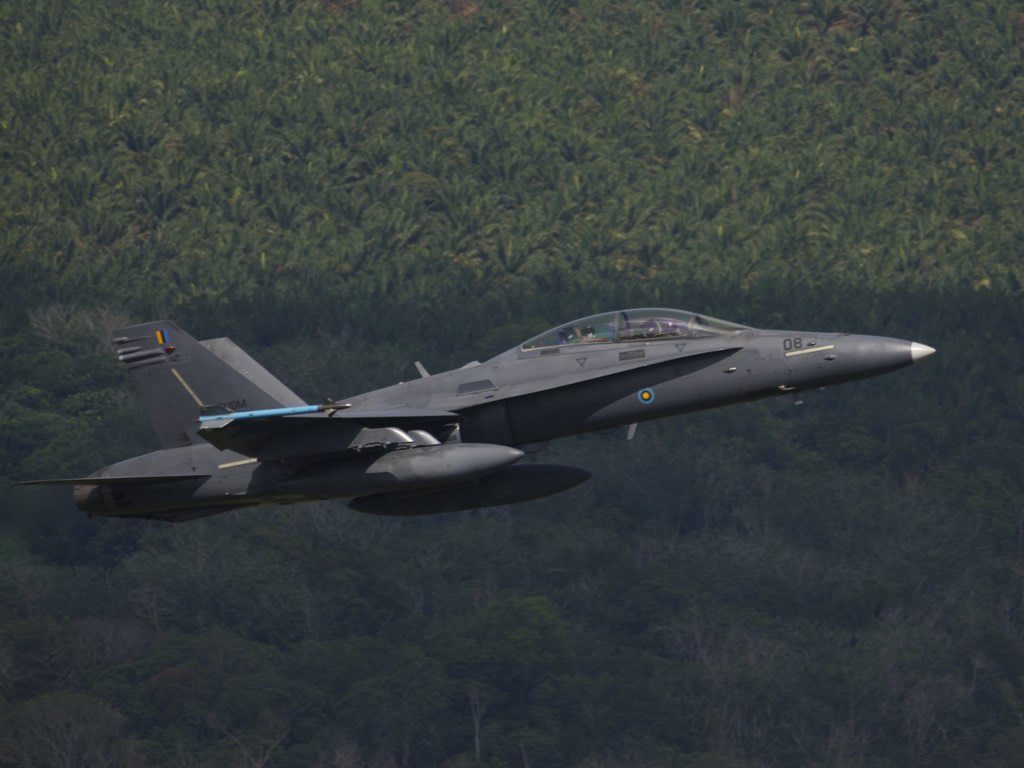
March 7, 2013 (LD) – Hundreds of heavily armed terrorists have crossed from the Philippines and landed in the eastern Malaysian state of Sabah. Dozens are already dead, and the Malaysian military has brought in aircraft and armor to confront the audacious, bizarre invasion, scattering militants into the jungles of Borneo island. A seemingly headline news event, the invasion has been downplayed and spun by the Western media, many calling militant Al Qaeda-linked terrorists, an “armed Filipino clan.”

Image: Malaysia has called in air support and armor to confront a bizarre terrorist invasion in its eastern state of Sabah.

….

The West’s woeful, irresponsible coverage of a burgeoning region-wide destabilization, fits in nicely with its coverage of US-Saudi funded/armed terrorism around the world, including in Syria where US-funded terrorists of the so-called “Free Syrian Army” have just taken dozens of UN peacekeepers hostage in the Golan Heights – just days after the US announced it would fund the terrorists further, to the tune of $60 million and the West’s Arab partners have just granted the terrorist faction Syria’s seat at the “Arab League.”

Terrorists are US-Saudi Funded Extremists – Part of Engineered Destabilization.

While the West pleads ignorance over the identity of the militants held up in the jungles of Malaysia’s Sabah state, the militant organizations themselves have declared thousands more in reinforcements are being arranged in the Philippines to join and exasperate the conflict. The Free Malaysia Today newspaper reported in its article, “10,000 Tausugs to sail to Sabah,” that :

Thousands of Tausug from Basilan, Sulu and Tawi-Tawi have sailed to Sabah to reinforce members of the so-called royal army of the sultanate of Sulu who are fighting it out with Malaysian security forces, a Moro National Liberation Front official said Tuesday.

The Moro National Liberation Front (MNLF) of course, is one of several of Al Qaeda’s franchises in Southeast Asia, and spun off the notorious terrorist organization, Abu Sayyaf, a US State Department-listed foreign terrorist organization with direct ties to Al Qaeda.

The Philippines’ terrorist organizations, located amongst the country’s southern islands have long held ties to Al Qaeda and receive funding and support from Saudi Arabia. AFP reported in their 2010 article, “WikiLeaks: US suspected Saudi ambassador to the Philippines of terror link,” that:

The United States suspected a Saudi Arabian ambassador to the Philippines of potential involvement in funding terrorists, according to US diplomatic cables released by WikiLeaks this week.

The report would also state:

Francis Townsend cited Waly’s intervention to secure the release of two members of an Islamic charity detained in the Philippines, the cable showed.

The group was suspected of funnelling funds to Al-Qaeda-linked groups based in the southern Philippines.

It continued stating:

The February 24, 2007, US embassy cable named the charity suspected of terror financing in the Philippines as IIRO, which stands for the International Islamic Relief Organisation.
Intelligence agencies have said IIRO was set up by Muhammad Jamal Khalifa, a brother-in-law of Al-Qaeda chief Osama bin Laden.

The report concluded by stating:

Overall, the WikiLeaks cables singled out Saudi Arabia as the key source of funding for radical Islamist groups including Al-Qaeda, the Taliban, Lashkar-e-Taiba and Hamas.

Saudi Arabia is of course is the chief financier of Al Qaeda, and is currently leading efforts to fund, arm, and fill the ranks of Al Qaeda’s franchises from Mali and Libya, to Syria and Iraq. A multitude of reports from across the West have identified Saudi Arabia as the lynch pin in Al Qaeda’s global terror campaign, including the US Army West Point Combating Terrorism Center.

Its reports “Al-Qa’ida’s Foreign Fighters in Iraq” and “Bombers, Bank Accounts and Bleedout: al-Qa’ida’s Road In and Out of Iraq,” identify a vast terrorist network maintained by the Saudis that recruits, arms, and funds terrorists from across the Muslim World, and can funnel a mercenary army into any desired nation. At the time, the desired nation was Iraq. In 2011, it was Libya. Today it is Syria. The same network that US soldiers fought in Iraq is verifiably in use today, in support of US regime-change operations in Syria.
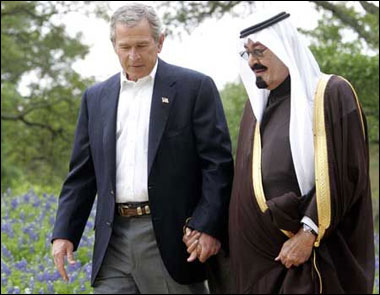
And while it is acknowledged across even the Western mainstream media that Saudi Arabia is a notorious state-sponsor of terrorism, including the terrorists allegedly behind the September 11, 2001 attacks that left 3,000 Americans dead, the US has had a decades-long, deep economic and military relationship with the despotic Arabian autocracy.

The US maintains permanent military bases inside Saudi Arabia, funds the Saudi military, and has recently concluded the largest arms deal in US history with the Saudis. Additionally, Saudi Arabia’s brutally repressive internal security apparatus is a creation of US advisers and operators.

The Saudi royal family and the elite amongst the US corporate-financier Fortune 500, have maintained deep financial and political ties as well. Saudi Arabian corporate-financier interests (run by the royal family) are tied directly to Wall Street and London via conglomerations like the US-Saudi Arabian Business Council and representation upon the JP Morgan International Council (Khalid Al-Falih of Saudi Aramco, amongst the highest valued companies on Earth).

This also includes the Bin Laden family, whose multi-billion dollar Saudi Binladin Group is an active member of the US-Saudi Arabian Business Council and plays a central role in deciding bilateral policy for the benefit of collective US-Saudi corporate-financier and corresponding geopolitical interests. At one point, the Bin Ladens and the Bush family sat around the same table, as both families were involved in the equity firm, Carlyle. In fact, Bush and Bin Laden family members were clicking champagne glasses together in Washington on 9/11, an event that would make both families immensely rich in the coming decade.

It is clear, most acutely in Libya and Syria, that the use of Saudi Arabia’s global Al Qaeda mercenary army serves both Saudi Arabia’s interests as well as Western geopolitical ambitions, including to exact regime change around the world. And it just so happens that the West and Saudi Arabia both seek regime change in currently Russo-Iranian-Chinese friendly Malaysia.

West Attempts to Install Client Regime in Malaysia

The West has been propping up Malaysian opposition candidate Anwar Ibrahim for years.

Anwar Ibrahim, head of Malaysia’s opposition coalition, which includes the Malaysian Islamic Party (PAS), has spent a lifetime in the service of Western interests. Anwar Ibrahim was Chairman of the Development Committee of the World Bank and International Monetary Fund (IMF) in 1998, held lecturing positions at the School of Advanced International Studies at Johns Hopkins University, was a consultant to the World Bank, and a panelist at the Neo-Con lined National Endowment for Democracy’s “Democracy Award” and a panelist at a NED donation ceremony – the very same US organization whose subsidiaries are funding and supporting Bersih, a faux-pro-democracy Western-funded street movement that in fact was created by, and in the service of Anwar Ibrahim’s political ambitions.

Bersih’s street activism fits into a global pattern of Western-backed “color revolutions,” where meddling in sovereign nation’s political processes to install Western-client regimes is disguised as “democracy promotion.”

Anwar Ibrahim’s affiliations with Malaysian “Islamists,” the already active political subversion his US State Department-funded Bersih movement is sowing in Malaysia’s streets, and his Western backers’ habitual support for terrorism internationally as a geopolitical tool, raises the possibility that his opposition movement is complicit in the conveniently timed militant destabilization Malaysia now faces, only months before 2013’s general elections.

This may be why the Western media refuses to properly cover an otherwise very noteworthy conflict. The fact that these militants are emanating from long-time US ally, the Philippines, and the Philippines’ current role in assisting the US “pivot” towards Asia, and more specifically facilitating a proxy confrontation with China, illustrates the greater regional implications at play. The US intends to install client regimes in Myanmar led by Aung San Suu Kyi, Thailand led by Thaksin Shinawatra’s despotic political dynasty, and in Malaysia led by Anwar Ibrahim. Together, this front will then be turned against Chinese interests as part of a long-planned desire to encircle and contain China.

It will be done so under ASEAN and at the cost of Asia’s stability and prosperity.

The future of Asia hangs in the balance, and therefore conflicts like Malaysia’s battle against armed extremists in Sabah may not be covered by the Western press, but it must be covered by the alternative press. The unhinged insanity that is now spilling blood on Malaysia’s shores, also represented by the West’s proxy Anwar Ibrahim and his attempts to provoke street protests against the ruling government, illustrates just how dangerous the current Anglo-American international order is, and how far its reach extends.

We must  identify the corporate-financier interests driving this agenda, – interests we most likely patronize on a daily basis, and both boycott and permanently replace them to erode the unwarranted influence they have used, and will continue to use against people the world over.

Hacks Expose Chemical Weapons False Flag [video]

Syrian Girl
January 28, 2013

Links and articles to Britam Hacks:
http://www.cyberwarnews.info/reports/a-look-into-the-britam-defence-data-leak…
http://www.infowars.com/hack-reveals-washington-approved-plan-to-stage-chemic…
http://landdestroyer.blogspot.co.uk/2013/01/is-uk-defense-contractor-planning…
My original Chem weapons video :
https://www.youtube.com/watch?v=DbMdll58lis


Middle East Update with Nile Bowie [audio/video]

Corbett Report
November 30, 2012

Nile Bowie of NileBowie.blogspot.com joins us tonight to go over some news headlines from across the Middle East, including the UN General Assembly vote on Palestinian statehood, western double standards in the “Arab Spring” and the American-ization of Saudi Arabia. We also talk about the recent 9/11 conference in Kuala Lumpur and Nile’s upcoming trip to China and North Korea.

SHOW NOTES AND MP3: http://www.corbettreport.com/?p=6273

Corbett Report Radio #262

[hat tip: Land Destroyer]


Cynthia McKinney presents to the 9/11 Revisited conference in Kuala Lumpur [video]

CorbettReport
November 26, 2012

Cynthia McKinney, peace activist and former U.S. Congresswoman, presents to the “9/11 Revisted: Seeking the Truth” conference in Kuala Lumpur on November 19, 2012.


Corbett Report Radio – Spotlight: Malaysia with Nile Bowie [audio/video]

Nile Bowie
August 27, 2012


Tonight we talk to Nile Bowie about the latest developments in Malaysia. From the Trans-Pacific Partnership to the foreign-funded political opposition to the latest activities in the South-China Sea, we explore the stories that are making news across the country and around the Asia-Pacific region.

Nile Bowie is an independent writer and photojournalist based in Kuala Lumpur, Malaysia; he regularly contributes to Tony Cartalucci’s Land Destroyer Report and Professor Michel Chossudovsky’s Global Research Twitter: @NileBowie


The South China Sea: Flashpoint of the Asia-Pacific [video]

Boiling Frogs Video
August 21, 2012

If the Asia-Pacific region is becoming, in the words of Hillary “We came, we saw, he died” Clinton, “the strategic and economic center of gravity,” then the South China Sea may just be the strategic center of that strategic center.

At first glance, there is nothing particularly remarkable about this area of the Pacific. Stretching from the southern shores of the People’s Republic of China and Taiwan in the north to Malaysia and Indonesia in the south, it covers about 3.5 million square kilometers and contains three archipelagos containing over 250 islands, reefs, shoals, atolls and sandbars, most of them containing no indigenous population, and many of them submerged for part or all of the year.

Upon closer inspection, however, the waters comprising the South China Sea are of central importance to the region. It is the second busiest sea lane in the world, and contains proven oil reserves of over 7 billion barrels, with an estimated 28 billion barrels total and 266 trillion cubic feet of natural gas.

As the sea’s importance becomes more and more pronounced, and as the region itself sees its major players asserting themselves more aggressively on the world stage, the area has become a flashpoint for disputes between China, Vietnam, and the Philippines. Now, tensions in the area are threatening to spill over into armed confrontation.

Find out more in this week’s Eyeopener report.

CONTINUE WATCHING: http://ur1.ca/a090p
TRANSCRIPT AND SOURCES: http://www.corbettreport.com/?p=5427


Using the TPP to Renegotiate and Expand NAFTA

by Dana Gabriel
Be Your Own Leader
June 25, 2012

Both Canada and Mexico have been invited to join the U.S., along with other countries already engaged in negotiations which will deepen trade and economic ties within the Asia-Pacific region. Such a deal would surpass NAFTA in size and scope. The U.S. led talks which have been criticized for their secretive nature, could be used to update aspects of existing trade pacts among member nations. This would provide the perfect opportunity for a backdoor renegotiation of NAFTA without officially having to open it back up.

After expressing interest in joining trade talks back in November 2011, NAFTA partners have been invited to join the U.S. backed Trans-Pacific Partnership (TPP) which also includes Australia, Brunei, Chile, Malaysia, New Zealand, Peru, Singapore and Vietnam. U.S. Trade Representative Ron Kirk welcomed both Mexico and Canada into the TPP fold. He noted that, “Mexico has assured the United States that it is prepared to conclude a high-standard agreement that will include issues that were not covered in the North American Free Trade Agreement (NAFTA).” He added, “Inviting Canada to join the TPP negotiations presents a unique opportunity for the United States to build upon this already dynamic trading relationship. Through TPP, we are bringing the relationship with our largest trading partner into the 21st century.” A joint statement by the U.S. and Canada acknowledged that, “The TPP presents an opportunity to conclude a high standard agreement that will build on the commitments of NAFTA.”

The Council of Canadians who continue to be vocal opponents of NAFTA and other trade deals that follow the same flawed template, are strongly against Canada’s entry into the TPP. Its national chairperson, Maude Barlow warned that this, “could force Canada to change its drug policies, its copyright policies, its environmental and public health rules – all without going through the normal parliamentary process.” The organization cautioned how, “TPP negotiations could mean up-front concessions in a number of areas, including intellectual property rights, where the U.S. is making considerable demands on TPP member countries that will undermine access to essential medicines so that its multinational drug firms can increase profits.” They also emphasized that, “Supply management, which guarantees fair wages and stable prices for farmers in non-exporting sectors, is too valuable to Canada to sacrifice on a negotiating table.” Others have pointed out that it is important as a buy-local program, as well as key to Canada’s food security and food sovereignty. The Council of Canadians maintains that, “the TPP is by and large a NAFTA renegotiation but on U.S. President Obama’s terms.”

Not surprisingly, the Canadian Council of Chief Executives, an organization that lobbies the government on behalf of the country’s largest corporations, welcomed the announcement that Canada has been invited to join the TPP talks. Its President and CEO John Manley stated that, “By signing on to the TPP, the federal government has taken an historic leap toward securing Canada’s long-term strategic interests in the Asia-Pacific region.” The U.S. Chamber of Commerce have also applauded Canada and Mexico’s entry into the TPP. Its President and CEO Thomas Donohue argued that, “negotiating the TPP together is an excellent strategic decision for North America.” Back in January, the Council of the Americas explained how, “it makes little sense for the United States to enter into potentially significant trade arrangements with countries in the Pacific region without our NAFTA partners.” They view the TPP as a “promising vehicle to support the updating of our bilateral and trilateral trading relationships within North America to the high standards of twenty-first century free-trade agreements.”

In his article, Will invitation to join TPP talks lead to NAFTA 2.0?, Peter Clark one of Canada’s leading international trade strategists concluded that, “A successful TPP would allow NAFTA to essentially be re-opened without the optics of it actually being re-opened.” He went on to say, “The business leaders in all three NAFTA countries, as strong supporters of TPP invitations to Canada and Mexico, understand that after nearly 20 years, modernization of NAFTA is needed. For rules of origin, supply chain management and manufacturing integration.” Clark stressed that, “All Canadians should be clear about this – TPP is the negotiation of NAFTA 2.0 and it could have major implications for Canada-USA trade relations.” Meanwhile, both countries are implementing the Beyond the Border Perimeter Security and Economic Competitiveness Action Plan which has been described as the most significant steps forward in U.S.-Canada cooperation since NAFTA. Christopher Sands of the Hudson Institute observed how, “The TPP negotiating agenda is at once similar to the bilateral agenda that Canada and the United States are pursuing, and also more ambitious and multilateral.”

In May, the TPP held its twelfth round of negotiations with the next set of talks scheduled to take place in San Diego, California from July 2-10. So far, there has been a real lack of transparency, but what is clear is that the TPP seeks to go beyond other trade agreements. According to a leaked text by Public Citizen, it would expand on the investor privileges found in NAFTA, granting corporations more power and further threatening the sovereign rights of member nations. In the meantime, the U.S. continues to spearhead TPP negotiations as a way of countering growing Chinese influence. The door is open for other countries to join which is why it is considered to be a stepping stone to a larger free trade area of the Asia-Pacific and an important part of the international corporate globalization agenda.

Trade deals such as NAFTA and now the TPP are being used to smuggle through a new set of transnational corporate rights, trapping nations in a web of treaties that further trump their own laws. All too often, these agreements fail to deliver on the promise of prosperity and only serve to accelerate the path towards economic enslavement. Globalization has meant sacrificing self-sufficiency and sovereignty for foreign dependency which is a sure path to world government.

Related Articles By Dana Gabriel
Canada and Mexico to Join U.S. in NAFTA of the Pacific
Building Blocks Towards an Asia-Pacific Union
NAFTA Partners Take Steps to Boost Trilateral Relationship
U.S. Economic, Political and Military Expansion in Asia-Pacific

Dana Gabriel is an activist and independent researcher. He writes about trade, globalization, sovereignty, security, as well as other issues. Contact: beyourownleader@hotmail.com Visit his blog at beyourownleader.blogspot.com

[hat tip: Activist Post]