
Canada and Mexico to Join U.S. in NAFTA of the Pacific
By Dana Gabriel
BE YOUR OWN LEADER
November 28, 2011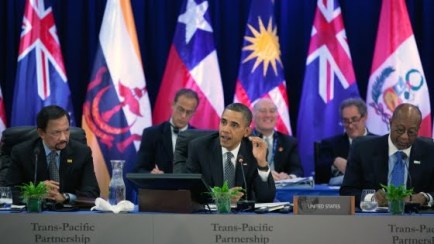
At the recent APEC meetings, Canada and Mexico announced their interest in joining the U.S., along with other countries already engaged in negotiations to establish what has been referred to as the NAFTA of the Pacific.
The leaders of the nine countries that are part of the Trans-Pacific Partnership (TPP) met at the Asia-Pacific Economic Cooperation (APEC) summit in Hawaii and agreed on the broad outlines of a free trade agreement. The current members include the U.S., Australia, New Zealand, Malaysia, Vietnam, Singapore, Brunei, Peru and Chile. The TPP has been hailed as a, “landmark, 21st-century trade agreement, setting a new standard for global trade and incorporating next-generation issues.” Key features of the TPP are that it would provide comprehensive market access and be a fully regional agreement designed to facilitate the development of production and supply chains. Various working groups have been discussing issues such as financial services, government procurement, intellectual property, investment, rules of origin, telecommunications and trade remedies. The next round of talks will take place in December and there are hopes of concluding negotiations before the end of 2012. Apart from Canada and Mexico, Japan has also expressed interest in being part of the TPP. The door is also open for other countries to join which is why many consider it to be a building block for an Asia-Pacific free trade zone.
Following the APEC forum, President Barack Obama held a bilateral meeting with Canadian Prime Minister Stephen Harper. Originally, it was scheduled to be a North American Leaders Summit, but Mexican President Felipe Calderon could not attend due to the death of Interior Minister Francisco Blake Mora. According to a Readout by the Press Secretary, the leaders look forward to a rescheduled trilateral summit. During his meeting with Prime Minister Harper, President Obama, “noted the important progress being made on the Beyond the Border and Regulatory Cooperation initiatives.” He invited Harper to Washington in early December where an action plan that would work towards a North American security perimeter could finally be released. Both leaders also discussed the announcement by the State Department to seek additional information regarding the Keystone XL Pipeline project. A final ruling on the pipeline which would carry oil from western Canada to the gulf coast of Texas will not be made until after the November 2012 presidential election. The move has prompted Canada to further diversify its trade ties and shift its focus on the Asia-Pacific region.
North American Integration and the Ties That Bind
Dana Gabriel
BE YOUR OWN LEADER
November 7, 2011
After a two year hiatus, the leaders of the U.S., Canada and Mexico are set to meet for a trilateral summit. While the push for further North American integration continues incrementally, at this time, it is unlikely that discussions will yield any grand new initiatives that involve the participation of all three NAFTA partners. Instead, the meeting could be used to build off of bilateral discussions already underway. This includes negotiations between the U.S. and Canada on a North American Security perimeter deal designed to accelerate the flow of people and goods across the border.
In an article from several months back, Robert Pastor, who has been a leading proponent of continental integration, emphasized that Obama’s jobs strategy should be a North American one. He explained how the U.S. can expand trade faster by focusing on its neighbours and also pointed out that few Americans realize just how dependent the U.S. is on Canada and Mexico. In order to facilitate this approach, Pastor recommended, “We should eliminate restrictive ‘rules of origin,’ which add a tax as high as the tariff that was eliminated by NAFTA, and combine, rather than duplicate, customs’ forms, personnel and frequent-traveler programs.” He also called on President Obama to, “expand his infrastructure fund to be a North American one, with contributions from all three countries.” Pastor went on to say, “The leaders of each nation should then instruct their transportation ministers to develop a North American plan for transportation and infrastructure that would include another trade corridor from the busiest transit point in Windsor, Ontario, to southern Mexico.” This sounds a lot like plans for a NAFTA superhighway.

 PN
PN 