
Tensions Mount as North Korea Cozies Up to China [video]
Russia Today
June 26, 2012
South Korea has announced plans to build a new naval base near its border with North Korea. The base will include barracks and a training ground to accommodate around 100 troops. The base will be located on one of five South Korean islands established by the UN in the 1950s, but Pyongyang refuses to accept Seoul’s ownership of the island. The border’s been the scene of several clashes between the neighbors – the most recent attack happened in 2010, when the North shelled one of the Yellow Sea islands, killing 4 South Koreans. For more on this RT talks to James Corbett, Editor of News and Information site, The Corbett Report, from Osaka, Japan.
Interview w/ Nile Bowie on the ‘Pacific Century’ [audio]
 Media Monarchy
May 11, 2012
This special interview episode features a conversation with Malaysian-based journalist and photographer Nile Bowie. After a long day at the Iraq War Crimes Tribunal in Kuala Lumpur, Nile helps break down the destabilization and ‘institutional agitation’ surrounding the Bersih movement in Malaysia. We also get an Asian update on China, coup rumors and the blind activist + ‘Understanding North Korea‘, Kony and the AFRICOM resource wars, the ‘War Photographer‘, Malay music by KRU and so much more…
Previous Interview Episode:
Morgan Lesko of WikiWorldOrder.com
Nuclear “Security” and Nuclear Hypocrisy [video]
Global Research TV
May 1, 2012
As the so-called “international community” once again meets to mouth political platitudes about stopping nuclear proliferation, many are now pointing to the numerous pieces of evidence demonstrating that, contrary to their official position, these very governments are invested in the proliferation of nuclear materials and nuclear weapons around the globe.
This is the Global Research backgrounder from GRTV.ca
‘Cannibalism looms for N. Korea due to food aid cut’ [video]
Russia Today
March 29, 2012
The US has suspended food aid to North Korea after the country refused to cancel a scheduled rocket launch. Washington says this breaks the deal in which North Korea agreed to suspend its uranium enrichment program and nuclear missile tests in exchange for humanitarian support. Pyongyang says the launch is merely intended to send a satellite into space.For more, lets’ talk to James Corbett, editor of The Corbett Report, who joins us from Osaka, Japan.
Understanding North Korea
Analyzing social engineering through domestic propaganda & official mythology
Written and Photographed by Nile Bowie
Editor’s note by Nile Bowie: After years of fascination, I had the opportunity to spend eight days in North Korea in September 2011. At the moment, it is only possible to visit North Korea through a highly organized government-sanctioned tour. Perhaps the most incredible thing about my time there was the genuine authenticity of the emotions displayed in ordinary people towards their leaders, who are viewed with the utmost piety. The degree to which the Korean people are motivated and inspired by the State’s official media and mythology is unparalleled in contrast to any other country. I wrote this article in an attempt to define their worldview as I have come to understand it, because it remains one of the world’s least understood (and most fascinating) societies.
by Nile Bowie
NileBowie.blogspot.com
December 28, 2011
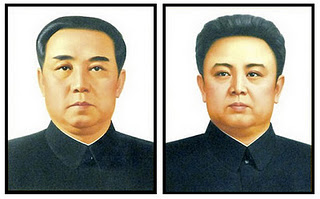
These portraits of the Great Leader, Kim il Sung and the Dear Leader, Kim Jung il are required to be hung in the home of every Korean by law.
The recent political transition in North Korea has once again focused the world’s attention towards the least accessible society on earth. Its epitaphic spectacle of mourning for the Father Leader, the Great General Kim Jung il, has invited a torrent of conjecture and analysis from the peering spectators of the outside world. While the majority of experts speak of issues such as the possibility of a failed succession, followed by a military coup d’état or a “Pyongyang Spring”, it becomes apparent that so few outlets take the domestic North Korean worldview into account. While all parties exchange wild rhetoric, Washington’s insistent stance on denuclearization is a clear demonstration of its incoherency in diffusing tension, reaching a common resolution with Pyongyang and most importantly, understanding how the regime views itself.
While the country is referred to as the twenty first century’s last bastion of Stalinism, the internal propaganda to which the domestic population is exposed suggests an antipodal ideology intrinsically irreconcilable with the worldview of Karl Marx and Vladimir Lenin. Under the surface of immense concrete monuments espousing Communism and the rambling doctrine of Juche Thought, North Korea’s domestic propaganda suggests that its identity is derived from a staunchly race-based brand of nationalism, at times channeling a rhetoric of ethnic superiority, similar to that claimed by the Nazis. While the propaganda designated to foreign scrutiny dryly champion’ principles of self-reliance in vague humanistic themes, as found within the Juche doctrine, the least accessible propaganda intended for internal consumption is a uniquely Korean brand of racist orthodoxy.
 |
|
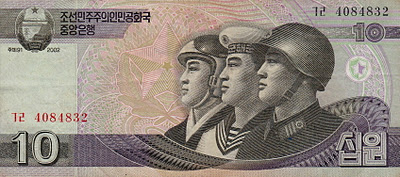
Image: “The Korean people are too pure-blooded and therefore too virtuous, to survive in this evil world without a great parental leader.”The servicemen depicted on this Korean banknote share identical physical characteristics; great pride is taken in the homogenous & mono-ethnic features of the Korean race.
|
CLICK HERE TO READ THE FULL ARTICLE…
————————
(hat tip: Land Destroyer Report)
Korean War, Manning Up, Funding Terror – New World Next Week (video)
New World Next Week
December 22, 2011
to http://NewWorldNextWeek.com — the video series from Corbett Report and Media Monarchy that covers some of the most important developments in open source intelligence news. This week:
Story #1: The Changing Face of Pyongyang — Hereditary Succession Under
Close Scrutiny of Elite US Policy Makers
http://ur1.ca/6vbpr
Related: Kim Jong-il Is Dead, Long Live Kim Jong-un!
http://ur1.ca/6vbpx
Update: South Korean Intelligence Disputes Circumstances of Kim Jong-il’s Death
http://ur1.ca/6vbq3
NWNW Flashback: 2010 Prediction of Kim Jong Il’s Death
http://ur1.ca/6vbq6
Story #2: Manning Opts Not to Testify In WikiLeaks Hearing
http://ur1.ca/6vbro
Related: Investigators Show Evidence of WikiLeaks Link
http://ur1.ca/6vbrz
Sibel Edmonds — Revisiting My Silence on WikiLeaks
http://ur1.ca/6vbsb
Story #3: US Troops Guarded Terrorist Camp in Iraq
http://ur1.ca/6vbsc
Video Flashback: Anti-Iran Terrorist Confession — Jundollah Leader
Abdolmalek Rigi
http://ur1.ca/6vbsv
Video Update: The Manas Question — Drugs, Revolution & Terrorism on the Road to Afghanistan
http://ur1.ca/6vbt0
Visit http://NewWorldNextWeek.com to get previous episodes in various formats to download, burn & share. And as always, stay up-to-date by
subscribing to the feeds from Corbett Report http://ur1.ca/39obd and Media Monarchy http://ur1.ca/kuec Thank you.
Previous Episode: Drone Detention, Canada Kyoto, Teen Toking
http://ur1.ca/6vbtf
West Poised to Exploit Potential Korean Crisis
US prepared for “Sudden Change” in North Korea since 2009.
by Tony Cartalucci
Land Destroyer Report
December 19, 2011
The Council on Foreign Relations, a corporate-financier funded think-tank that represents the collective interests and agenda of Wall Street and London, had in 2009 published an extensive, 52 page report titled, “Preparing for Sudden Change in North Korea.”

The report covered “Scenarios for Change in North Korea” and included “managed,” “contested,” and “failed successions.” The report makes no secret of US foreign policy toward North Korea and the desire to see the nation “integrated” with the South, a nation whose political system has long been co-opted by the United States, kept a watchful eye on by USPACOM’s regional presence, and only saved by the nationalism of the South Korean people themselves.
On page 36 of the report, it is stated that chaos within a “changing” North Korea would raise concerns including, “maintaining security and stability in the North, locating and securing Pyongyang’s weapons of mass destruction, dealing with potentially serious humanitarian problems such as large-scale refugee flows or starvation, managing the political and legal issues relating to the formation of a transitional government, and addressing the economic challenges posed by the demise of the North and its possible integration with the South.”
Of course, these are “concerns” the “international order” led by Wall Street and London would deal with, not the people actually living on the Korean Peninsula. And to address these concerns the report actually suggests deploying 115,000 to 230,000 foreign troops along with tens of thousands of “police” to support them in establishing “security and stability.”
Noting that foreign troops may spur an armed reaction from the North Korean military, the report states:
“If former elements of the North Korean military, its security and intelligence forces, or its large special operations force were to resist the presence of foreign forces, the size of the needed stabilization force would escalate dramatically. Indeed, experience has shown that special operations forces are the most likely candidates to mount such resistance. Given the large number of such units in the North, the challenge could be considerable. In an insurgency, according to one Defense Science Board study, as many as twenty occupying troops are needed for every thousand persons, implying a force of 460,000 troops, more than three times the number of American troops in Iraq. Coping with such a contingency would likely be impossible for the South Korean and American forces to manage alone.” –page 37 (.pdf)
On the rebuilding of North Korea’s economy, the report feverishly preaches market liberalization, privatization, and integration with South Korea who is currently on the verge of entering into expansive “free trade” with the United States. In the case of “reunification,” the United States will have just doubled the market its parasitic corporate-financier interests were already preparing to despoil.
“The second economic issue is the transition from planned to market economic mechanisms. This task requires genuine price liberalization, establishing a carefully managed foreign exchange regime, developing new policies and institutional capacities in public finance and expenditure, banking, and both a legal system and ownership rights over productive assets (especially land). Dealing with the state enterprise system may require liquidating unviable firms, improving management, privatizing, and creating a level playing field with the emerging private sector. Institutional change would be much faster and simpler if developed with former North Korean authorities in a framework that might lead to eventual reunification. In any case, a short-term drop in economic output should be expected before the economy can be stabilized and put on a growth path.” –page 41 (.pdf)
Recommendations for US policy are made, beginning on page 44, and include the suggestion that the US continue promoting “behavioral change within the current regime rather than actively seek to overthrow it,” that is … “unless extreme circumstances dictate otherwise.” The report also suggests that working closely with the European Union, who has diplomatic representation in North Korea, will help the US understand better, any sign of coming “sudden change” to refine the regime of exploitation outlined in the CFR report. Other schemes of re-approaching North Korea are discussed, such as using the excuse of recovering the remains of missing American soldiers lost during the Korean War to improve contacts and provide useful information on unfolding events within North Korea (page 46 & 47).
A “common vision” between the US and South Korea for a reunified Korea is also discussed at length as are the military, economic, and social preparations that would be necessary to carry out this “vision.” Such a common vision begs one to wonder what say the United States, separated by an entire ocean from Korea, actually has in the future of the Korean people. The preparation of a NATO-style military alliance referred to as a “regional security cooperation in northeast Asia” is also recommended to help in “legitimating” the West’s attempts to exploit and fill the void created in a possible collapse of North Korean society.
The thought of a reunified Korea, militarily occupied by the United States and its collective economy opened to unmitigated exploitation via the pending US-FTA must alarm Beijing to a certain degree, especially with the recently unveiled “American Pacific Century” policy that enumerates a strategy of encircling and containing China’s tactical and economic rise while maintaining a century of American hegemony over Asia. And surely it must North Koreans that the United States has prepared their future and destiny in such minute detail and are prepared to lead North Korea’s transformation, at the barrel of a gun if need be.
It should be noted that North Korea’s unraveling, and the door it would open to a reunified Korea under American military and economic occupation needs not necessarily be organic. The United States is on record training North Korean activists to sow “Arab Spring-style” chaos just as it has throughout the Middle East. In Foreign Policy’s article “Revolution U,” where the story of US-funded CANVAS is told, North Korean activists are mentioned several times as recipients of the same US-funded training offered by CANVAS and used by activists to help overthrow the governments of Tunisia, Libya, and Egypt. With a heavy US military presence just over the border, and with several suspicious provocations already attributed to the US presence on the peninsula, all the ingredients are available to coax North Korea’s destabilization along and justify the execution of CFR’s 2009 machinations.
Whether they exist there in the right measurements or will find a well prepared, Chinese-backed North Korea ready to balk them instead remains a question only time will tell.

 PN
PN 