
In Thailand, A New Kind of Protest
Protesters put down placards and pick up pragmatism as they begin solving the problems created and/or neglected by the regime they oppose.
by Tony Cartalucci
Activist Post
Since late October, 2013, protesters across Thailand have taken to the streets, occupied rally sites, seized government buildings and made their grievances known to the world. They stand in opposition of the regime of Thaksin Shinawatra – a Wall Street-backed billionaire autocrat, convicted criminal, accused mass murderer, and fugitive who is openly running the country from abroad via his nepotist appointed proxy, his sister, Yingluck Shinawatra.
Not entirely unlike other protests seen unfolding around the world, large mobilizations have periodically flooded the streets of Thailand’s capital city of Bangkok, at times attracting over a million protesters.
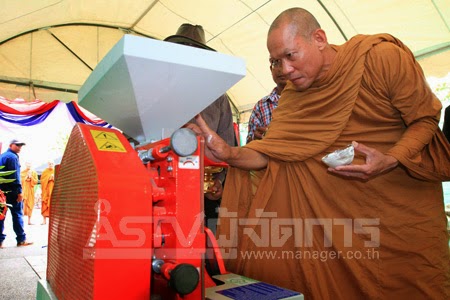
Image: One protest leader, Buddha Issara, traded in placards for pragmatism, purchasing a rice mill and operating it at his rally site in northern Bangkok. The mill is processing rice from destitute, desperate farmers and creating an ad hoc farm-to-city market to put cash from consumers directly into the hands of farmers as opposed to the corrupt middlemen and regime warehouses overflowing with unsold, rancid rice. If Thailand’s political future is decided by actions rather than words, anti-regime protesters like Buddha Issara and his followers are well on their way to victory. Others would be wise to follow his sage example not just in Thailand, but around the world. Find more images via ASTV’s Manager.co.th.
However, unlike many protests, particularly those promoted heavily by the Western media, including the so-called “Arab Spring” and the recent “Euromaidan” protests in Ukraine later found out to have been led by Neo-Nazis and ultra-nationalist parties with Hitleresque names like the “Fatherland Party,” hollow slogans such as “democracy” and “freedom” in Thailand are overshadowed by more specific, better articulated, and enumerated demands.
Also unlike many protests promoted by the West where regime change in favor of a pro-Western client is the one and only true objective, protesters in Thailand have begun turning their placards in for pragmatism to solve the problems that have brought them out into the streets to begin with. Rather than empower others to speak and act on their behalf, they have elected instead to circumvent the dysfunctional electoral process and empower themselves through a series of direct action campaigns.
What To Do While the Regime Clings to Power?
While much progress has been made regarding many of the protesters’ demands – the fact remains that Thaksin Shinawatra through his proxy regime is still clinging to power. The collapse of the regime is inevitable, but for Thaksin and his foreign backers – completely removed from any risk of continuing on in vain – they believe there is nothing to lose in search of even the faintest chance of political survival.
As long as the regime clings to power, the effects of its corruption, incompetence, and criminality will continue to reverberate across Thai society. Most acutely felt is the damage it has exacted across Thailand’s agricultural industry upon which much of Thailand’s workforce depends. Mobilizing the resources of the State to solve this problem is not only untenable because the regime continues to hover above the levers of power, but also because more handouts – which created the problem in the first place – will ultimately not solve the plight of Thailand’s farmers, only compound them.
The real solution to this problem is to undermine entirely the edifice on which the regime is clinging. Instead of prying its claws from the ledge, the entire edifice should be separated from the cliff’s face and sent tumbling down into the ravine below, regime and all. This requires the parallel creation of a new model for Thai agriculture – side-by-side with the dysfunctional ruins left behind by the regime. The successful creation of a parallel agricultural system could serve as a model for solving other social problems, and the first tentative steps toward accomplishing this have already been taken by Thailand’s innovative and resourceful protesters.
Farmers Facing Ruin Given Second Chance at Protest Site
The plight of Thailand’s farmers began in 2011 with the fantastical vote-buying promise of over-market prices per ton for rice delivered to government warehouses. Almost immediately, Thailand’s traditional trade partners avoided the overpriced grain and turned toward neighboring Asian nations. As rice sat in government warehouses long past what industry standards allow for, fumigation, fungus, and rot rendered the rice unfit for human consumption.
By the summer of 2013, promised subsidy prices were first slashed before payments to farmers were altogether halted. Many farmers have now gone without compensation for rice they have already turned in, and that has long since turned rancid, for well over half a year. Compounding the farmers’ dilemma was the cancellation of the subsidy program in conjunction with intentionally delayed delivery of irrigation water for farmers to begin planting their next crop. The regime feared another deluge of rice deliveries on top of the overflowing warehouses they already have failed to sell – the delay of irrigation water was a means of buying more time at the farmers’ expense.
Even as farmers now begin receiving water Thailand’s rice industry lies in such ruins, few know to whom they will be able to sell their rice and at what price. For a segment of the population already struggling against the constant fear of insurmountable debt and lacking any means to diversify their economic activity, they are facing destitution and desperation unlike anything they have seen in decades.

Image: Buddha Issara prepares rice milled at his rally site for sale.
Enter Buddhist monk and activist Luang Pu Buddha Issara, who has led the permanent occupation of northern Bangkok’s Government Complex for months. Between leading protesters and coordinating with the larger anti-regime movement, Buddha Issara has also done something novel, innovative, and rare – added pragmatism to the sea of placards found among his followers.
Money raised by the various fundraising activities has gone into the purchase of a modest rice mill. The mill processes about 1 ton of rice per day, brought in by desperate farmers unable to receive compensation from the regime. The milled rice is then sealed in bags and sold to Bangkok’s city goers. The proceeds are given back to the farmers. Buddha Issara has also asked farmers to bring other forms of produce – fruits and vegetables – to the protest site to likewise be sold. It is the first step toward a farm-to-city market, short-circuiting the corrupt middlemen and rancid warehouses that constitute the failed rice scheme the regime has created.
VIDEO — Rebels reportedly seize Syria’s Kessab, 2k flee, Armenia accuses Turkey
RT
Apr 1, 2014
The Syrian Army is trying to retake the Christian majority town of Kessab reportedly seized by al-Qaeda-linked forces. The attack made hundreds of ethnic Armenians flee and caused international outcry with Armenia blaming Turkey for supporting extremists. READ MORE: http://on.rt.com/bru2un
RT LIVE http://rt.com/on-air
Subscribe to RT! http://www.youtube.com/subscription_c…
Like us on Facebook http://www.facebook.com/RTnews
Follow us on Twitter http://twitter.com/RT_com
Follow us on Instagram http://instagram.com/rt
Follow us on Google+ http://plus.google.com/+RT
RT (Russia Today) is a global news network broadcasting from Moscow and Washington studios. RT is the first news channel to break the 1 billion YouTube views benchmark.
7.6 aftershock hits same area of northern Chile as Tuesday’s 8.2 quake
RT News
Published time: April 03, 2014 03:02
Edited time: April 03, 2014 04:31

A cameraman records near cars caught under rubble after an earthquake and tsunami hit the northern port of Iquique April 2, 2014. (Reuters / Ivan Alvarado)
A 7.6-magnitude aftershock has rocked the same area of northern Chile where a massive 8.2 earthquake struck on Tuesday. The earlier quake, which caused a tsunami, killed six people and forced almost one million others to evacuate.
[UPDATE: A 5.0-magnitude aftershock also happened after the 7.6-magnitude aftershock.]
The Wednesday quake occurred just before 02:43 GMT off the northern coast of Chile, 19 km (14 miles) south of Iquique, according to the US Geological Survey (USGS). The epicenter of the latest quake was located at a shallow depth of 40 km (24.9 miles).
Chile’s emergency ministry has ordered a preventative evacuation along the northern Chilean coastline.
However there have been no official reports of damage or injury in Chile or Peru, according to Reuters.
A tsunami warning issued for Chile and Peru has been canceled, according to the Pacific Tsunami Warning Center.
“Based on all available data a destructive Pacific-wide tsunami is not expected,” it said earlier. However minor tsunami waves did hit the northern coast of the country.
Chilean President Michelle Bachelet has been evacuated from the Arica coast, local media has reported.
Aftershocks measuring magnitudes of 5.6 and 5.8 occurred after the 7.6 quake, according to the USGS. Both were located around 70 to 75 km (43 to 46 miles) southwest of Inquique.

Image from maps.google.com
Another strong aftershock, measured at magnitude 6.4, also struck 47 km (29 miles) west of Iquique at around 01:58 GMT Wednesday evening.
This comes one day after an 8.2 magnitude quake hit 95 km (59 miles) northwest of the same area, around Iquique.
After Tuesday’s quake, tsunami warnings spurred the evacuation of 900,000 people and 11 hospitals along the coastline, government officials said.
At least six people died following the quake, Chile’s Interior Minister Rodrigo Penailillo said. Many of the victims died from heart attacks or falling debris.
[related: 4/2/2014 — Tsunami Animation Wave Propagation of the Chile 8.2M Earthquake]
VIDEO — NATO vs Russia and Tradition – The Real End Game – Joaquin Flores
108morris108
Apr 2, 2013
NATO’s resolve against Russia has little to do with Crimea or Ukraine.
Shooter among 4 dead in Fort Hood spree, multiple people injured
RT USA
Published time: April 02, 2014 22:13
Edited time: April 03, 2014 02:20

Reuters / III Corps Public Affairs/U.S. Army
A shooting took place at the US military base at Fort Hood in Killeen, Texas on Wednesday afternoon. Four people were confirmed dead including the gunman of a self-inflicted wound.
Sources told CBS News that the shooter was a 34-year-old soldier named Ivan Lopez. While little is known about Spc. Lopez, sources told CBS the Wednesday shooting may have been motivated by a conflict with another soldier.
The Fort Hood gunman was found wearing combat fatigues and used a semi-automatic handgun, according to CNN. There had been earlier reports of a second shooter, though a US military official confirmed to KCEN-TV that the shooter had acted alone.
As many as fourteen people have reportedly been hospitalized. Three of the wounded have suffered critical injuries and were transported to Carl R. Darnall Medical Center and other area hospitals.
Ottawa council could name spot near city hall after Nelson Mandela
by Lucy Scholey
Metro
Mar 31, 2014

Former South African president Nelson Mandela waves to the crowd during a ceremony in Hull, Quebec, where he was presented with an Honourary Canadian Citizenship Monday November 19, 2001. [image credit: Fred Chartrand/The Canadian Press]
On Tuesday, the city’s financial and economic development committee (FEDCO) will review a motion to name the front yard of the heritage building portion of city hall “Nelson Mandela Square.” That area also includes the Human Rights Monument.
Mayor Jim Watson put forward the motion in February and it went to a 30-day public consultation.
Out of the 40 total email and letter submissions, only three opposed the suggestion. All three said the space should be named after a Canadian and not the late South African leader.
“Nelson Mandela has been honoured enough by Canada; afterall (sic) one must remember that he is from another country,” the city report about the motion quotes Gary Odell, as writing. “Ottawa is Canada’s Capital: not South Africa’s! I propose; that a Canadian Soldier who served and died for this city and country should have that honour, not a foreigner.”
[…CONTINUE READING THIS ARTICLE]
[related: MUST SEE — The Truth About Nelson Mandela]
8.2 earthquake hits Chile, killing 5 and displacing 80,000
RT News
Published time: April 02, 2014 00:07
Edited time: April 02, 2014 05:24

Locals gather on the street following a tsunami alert after a powerful 8.0-magnitude earthquake hit off Chile’s Pacific coast, on April 1, 2014 in Antofagasta. (AFP Photo / Francesco Degasperi)
A massive 8.2 magnitude quake has struck off the coast of northern Chile, killing 5 people and displacing around 80,000. Damages and fires have been reported throughout the region and many have lost power because of the quake.
The quake occurred Tuesday, 95 km (59 miles) northwest of the mining area of Iquique near the Peruvian border. The epicenter was located at a shallow depth of about 20 km (12 miles) below the seabed.
The Chilean navy said the first sign of the tsunami hitting the coast was within 45 minutes of the quake. The US Pacific Tsunami Warning Center (PTWC) said a tsunami measuring almost two meters had been generated.
Chile’s emergency ministry ONEMI said there have been reports of landslides causing some blockage on roads and highways.
At least five people have died following the quake, Chile’s Interior Minister Rodrigo Penailillo said. In Iquique, four men reportedly died of heart attacks and in the municipality of Alto Hospicio one woman was crushed to death when a wall collapsed.

 PN
PN 