
Attention fliers: Canada’s electronic spy agency is following you
End the Lie – Independent News
Jan 31, 2014

A United Airlines plane takes off at the Calgary International Airport in Calgary. (Reuters / Todd Korol)
Documents released by US whistleblower Edward Snowden show the Communications Security Establishment Canada (CSEC) used airport Wi-Fi to track passengers from around the world.
Travelers passing through a major Canadian airport were potentially caught up in a vast electronic surveillance net, which allowed the nation’s electronic spy agency to track the wireless devices of thousands of airline passengers – even for days after they had departed the terminal, a document obtained by CBC News revealed.
The document shows the spy agency was then able to track travelers for a week or more as the unwitting passengers, together with their wireless devices, visited other Wi-Fi “hot spots” in locations across Canada – and even across the border at American airports.
The CBS report said any place that offered Wi-Fi internet access, including “airports, hotels, coffee shops and restaurants, libraries, ground transportation hubs” was vulnerable to the surveillance operation.
After reviewing details of the leaked information, one of Canada’s leading authorities on internet security says the secret operation was almost certainly illegal.
“I can’t see any circumstance in which this would not be unlawful, under current Canadian law, under our Charter, under CSEC’s mandates,” Professor Ronald Deibert, an internet security expert at the University of Toronto, told CBC News.
It remains unclear from the leaked data how CSEC was able to infiltrate so many wireless devices to see who was using them — both on Canadian territory and beyond.
VIDEO — CrossTalk: Syria – Talking The Talk?
RT
Jan 31, 2014
Where does the Geneva process stand? How did the disinvitation of Iran affect the talks? What are the interests of all the participants? And at what point will both sides realize that the bloodshed in Syria is unacceptable? CrossTalking with Dan Arbell and Joe Lauria.
RT LIVE http://rt.com/on-air
Subscribe to RT! http://www.youtube.com/subscription_c…
Ontario To Raise Minimum Wage
 by Terry Wilson
Canadian Awareness Network
January 28, 2014
am980.ca
Ontario’s lowest paid workers will likely get a raise this year when the $10.25 an hour minimum wage is hiked for the first time in four years.
Sources say a special panel set up to look at ways of adjusting the minimum wage will recommend it be tied to the inflation rate, and that businesses get four months warning of any increases.
The panel did not say what the new rate should be, but sources say the minimum wage will be increased retroactively back to 2010 based on the rate of inflation since then.
Business groups warn a hike in the minimum wage will only hurt the very people it’s supposed to help by driving up costs, resulting in fewer jobs. However, the Ontario Chamber of Commerce last year called for future changes in the minimum wage to be tied to the rate of inflation.
Premier Kathleen Wynne says businesses and individuals should be pleased at having a more predictable system in place.
Continue Reading
Raising the minimum wage in Ontario has been a top priority amongst the political “left” for the last few years and has been heavily scrutinized by economists and business owners. Below is an example of why they oppose the move. (it is an American video but does highlight the issues of raising minimum wages)
The move is more likely to hurt the workforce in Ontario rather than helping workers. In fact many see that this move will only encourage businesses to replace workers with computerized stations.
This move is also coming on the heels of a huge spike in hydro costs for the province. Media has been reporting a 46% increase on hydro prices over the next five years, and the Ontario NDP is stating the increase will be in the 74% range.
A move that is driving the remains of Ontario’s manufacturing base out of the province. Why would a manufacturer set up shop in Ontario, when they can do so in another province or country while having less power charges?
It seems that every move this provincial government makes is just another nail in the Ontario job market’s coffin.
VIDEO — RT first TV crew at besieged Syria town after alleged atrocity by Islamists
RT
Jan 30, 2014
It’s been more than a month since Islamist rebels seized the industrial Syrian town of Adra, and allegedly massacred dozens of civilians there. Heavy fighting left thousands displaced, and militants still hold large parts of the city, making it impossible to go in and verify the details of any atrocities. Yet RT became the first foreign TV crew to get to the area since the start of the siege – and spoke to some of the survivors.
RT LIVE http://rt.com/on-air
Thailand: Thaksin Regime Turns on its Own Supporters
by Tony Cartalucci
Alt Thai News Network ATNN
Jan 29, 2014
Regime sends “red shirt” enforcers to threaten farmers and their families for protesting 6 months of unpaid subsidies – smashing the myth of “rural support.”
January 30, 2014 (ATN) – While the US, UK, and others across the West attempt to sell upcoming sham elections in Thailand as upholding “democratic values,” the regime overseeing the one-party self-mandate in a climate of regime-sanctioned terrorism, political intimidation, and a “state of emergency,” has begun turning on its own supporters – mainly farmers.
Farmers began blocking roads across the country in response to unpaid rice subsidies that are now half a year late. Thaksin Shinawatra promised 40% + over-market prices for rice as part of vote-buying populist policies that propelled his nepotist appointed sister into power in 2011. Since then, the rice-buying scheme has collapsed in scandal, corruption, and bankruptcy with government warehouses literally collapsing from the weight of rotting rice left unsold for months.
Unable to sell the rice to nations that have turned to other rice-producers over concerns of downward spiraling quality, the regime attempted to sell bonds. The sale failed to raise even half the cash necessary to pay farmers who already had promised rates slashed and delayed.
As protests began to spread across the north and northeast of Thailand, considered Thaksin Shinawatra and his regime’s stronghold, and with other farmers headed to Bangkok to join the “Occupy Bangkok” campaign, the regime has begun turning its notoriously violent “red shirt” enforcers on the farmers – most of whom, according to the BBC, AFP, Reuters, and others constituted the regime’s support base.
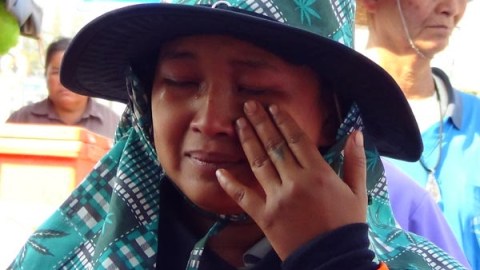
Image: Rice farmers in Phitsanulok province were threatened by regime “red shirts” to end their protest. Often cited by the Western media in their “class divide” narrative, it is now clear the nation’s farmers were simply used to get Thaksin Shinawtra back into power, and that the violence and intimidation usually reserved for his political opponents is now being turned on them in the wake of being cheated by his vote-buying rice subsidy scam. Rice farmers have already turned in their rice, but have not been paid for it for half a year – in other words – they were robbed. (Photo by Chinnawat Singha)
NAFTA and the Next Phase of North American Integration
BE YOUR OWN LEADER
Jan 27, 2014
By Dana Gabriel

In preparation for the upcoming North American Leaders Summit which will be held in Toluca, Mexico on February 19, U.S. Secretary of State John Kerry recently held a meeting with his Canadian and Mexican counterparts. Over the last number of years, not as much attention has been given to the trilateral relationship. Instead, the U.S. has essentially pursued a dual-bilateral approach with both Canada and Mexico on key issues including border and continental perimeter security, as well as regulatory and energy cooperation. On the heels of its 20th anniversary, there once again appears to be renewed interest in broadening and deepening the NAFTA partnership as part of the next phase of North American integration.
On January 17, U.S. Secretary of State John Kerry hosted the North American Ministerial with Canadian Foreign Minister John Baird and Mexican Foreign Secretary Jose Antonio Meade. The discussions centered around topics such as regulatory, energy and trade relations, along with border infrastructure and management. The meeting was used to lay the groundwork for next month’s North American Leaders Summit which will include the participation of U.S. President Barack Obama, Canadian Prime Minister Stephen Harper and Mexican President Enrique Pena Nieto. During a press conference, a reporter asked about reopening NAFTA in order to update it. Secretary Kerry answered, “the TPP, is a very critical component of sort of moving to the next tier, post-NAFTA. So I don’t think you have to open up NAFTA, per se, in order to achieve what we’re trying to achieve.” Minister Baird added, “we believe that NAFTA’s been an unqualified success, the Trans-Pacific Partnership (TPP) trade negotiations, which all three of us are in, offer us the opportunity to strengthen the trilateral partnership.” Secretary Meade also chimed in, “We do not think it is necessary to reopen NAFTA, but we think we have to build on it to construct and revitalize the idea of a dynamic North America.”
In December 2013, the Miami Herald reported that the Obama administration, “is exploring a regional trade plan for the Americas that would be the most ambitious hemispheric initiative in years.” It went on to say that Secretary of State John Kerry, “would like to first seek an agreement to deepen the existing North American Free Trade Agreement (NAFTA) with Mexico and Canada, and to expand it afterward to the rest of Latin America.” According to some of Kerry’s top aides, “the plan to relaunch NAFTA could come as early as February, when President Barack Obama is scheduled to meet with his Mexican and Canadian counterparts at a North American Leaders’ Summit in Mexico.” The recent article, U.S. lays out goals for NAFTA cautioned that, “the shared goal of a NAFTA 2.0 that wins fresh, sustainable gains for Canada, Mexico and the U.S., the Americans warn, is unlikely to come in a single, dramatic and easily digestible sound byte.” It further noted that, “Instead, the Americans are urging a more realistic approach aimed at reviving trilateral momentum, with a dogged diplomatic effort that aggressively fine-tunes, streamlines and expands the trade pact.”
Last year, business leaders from across North America released a set of policy recommendations designed to increase continental economic integration and competitiveness. In a letter issued to President Barack Obama, Prime Minister Stephen Harper and President Enrique Pena Nieto, the Business Roundtable, the Canadian Council of Chief Executives and the Consejo Mexicano de Hombres de Negocios called for greater trilateral government action in the areas of intelligent border systems, regulatory standards and practices, as well as North American energy security and sustainability. The business organizations explained that, “More can and should be done to promote regulatory cooperation between our three countries, to facilitate the legitimate movement of people, goods and services.” They emphasized that the time to act was now and that their specific proposals would, “help deepen our economic ties, strengthen the international competitiveness of Canadian, Mexican, and U.S. companies and their workers, and realize North American energy self-reliance.” Their goal is to create a seamless North American market.
VIDEO — Bursting Bubbles – Dan Dicks interviews Peter Schiff
Press For Truth
Jan 28, 2014
While attending the Resource Investment Conference in Vancouver Dan Dicks of Press For Truth interviewed Peter Schiff of Euro Pacific about the Canadian housing bubble as well as the current state of the US economy and how it may effect Canadians in the very near future!
Support Press For Truth and help us to continue by contributing at https://www.paypal.com/cgi-bin/webscr…

 PN
PN 