
‘US becoming increasingly isolated’ [video]
Russia Today
August 29, 2012
The United Nations Secretary General Ban Ki-moon has arrived in Tehran to take part in the Summit of the Non-Aligned movement… that’s a bloc of countries that don’t consider themselves in union with the U.S.
Washington has voiced criticism of the UN chief’s visit to Iran and of the gathering in general.
Despite Iran’s willingness and ability to help find a solution to the Syria crisis, any ideas put forward by Tehran could be met with resistance, says author and journalist Afshin Rattansi.
Ry and Pepe Escobar talk Syria [audio]
Rys2sense
August 29, 2012
boy I cut the beginning when we were really shooting the shite but the whole thing in one part will be up on Vimeo RyLiberty same as my twitter RyLiberty
From the Houla Hoax to Chemical Weapons – Deceptions in Syria [video]
Global Research TV
August 29, 2012
Over the course of the Syrian crisis, a number of events have been used to portray Assad as a genocidal madman and military intervention as a necessary step. As things come to a head in the terrorist-torn nation, the lies, half-truths and exaggerations behind this “red line” thesis are gradually being exposed. Find out more in this week’s GRTV Backgrounder on Global Research TV.
TRANSCRIPT AND SOURCES: http://www.corbettreport.com/?p=5508
Tampa RNC Cop Gets In Trouble For Being Nice [video]
We Are Change
August 29, 2012
To get more videos and information from the RNC dont forget to subscribe to this channel and follow us oh http://www.twitter.com/LukeWeAreChange
Western Commando’s Tasked to Disable Syria’s Anti Aircraft Missiles – Ziad Fadel [video]
108morris108
August 29, 2012
Ziad Fadel, a Lawyer and Political Commentator suggests it is time to ask for Russian Troops as a counter measure to NATO’s forces.
Growing Opposition to the Canada-EU Trade Agreement
by Dana Gabriel
BE YOUR OWN LEADER
August 29, 2012
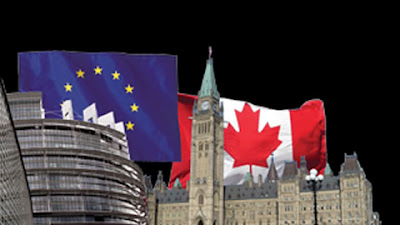
With the final rounds of negotiations sessions planned for September and October, Canada and the EU are closing in on a free trade deal that would go far beyond the reach of NAFTA. Meanwhile, there is growing opposition to the agreement as the whole process has lacked openness, transparency and any public consultations. In Canada, there are concerns over the threat it poses to local democracy. This includes fears of deregulation and privatization, as well the expansion of corporate investor rights. There are also warnings that the deal could be used as a backdoor means to implement ACTA which was rejected by the European Parliament in July.
As the Canada-European Union (EU) Comprehensive Economic and Trade Agreement (CETA) talks near their end, the Council of Canadians continue to voice their opposition to the deal. While I don’t agree with their position on some different issues, they have been championing the fight against CETA. In an effort to counter misleading statements made by the Conservative government regarding the trade pact, they have released the report, the CETA Deception. Trade campaigner, Stuart Trew explained how this is an effort to, “challenge the government’s reassurances that its EU trade deal will not affect public health or environmental regulations, will not allow foreign corporations to challenge public policy, will not undermine public services or municipal democracy, will not increase drug prices or hurt Canada’s supports for arts and culture. In each case, the government’s position is either misleading or demonstrably false.” As a result of the threat CETA poses to local sovereignty, a growing number of Canadian municipalities have passed resolutions seeking more information and a greater say in negotiations with some also requesting to be excluded from the agreement.
In her recent visit to Canada, German Chancellor Angela Merkel pledged support for the Canada-EU free-trade pact and promised to see to it that talks come to a speedy conclusion. The endorsement was seen as a much needed boost for Prime Minister Stephen Harper who is eager to get a deal signed before the end of the year. The Conservative government maintains that deeper trade with the EU will create jobs, economic growth and long-term prosperity. They have also tried to convince the public that CETA has been one of the most transparent trade negotiations in Canadian history. In an article for iPolitics, Stuart Trew stressed that, “If CETA and agreements like it are supposed to be 21st century or ‘next-generation’ free trade deals, they should be negotiated in 21st century ways ― openly, transparently, and with broad public input. Failure to do so in the ACTA negotiations led to that agreement’s demise in the European Parliament. The same fate could easily await CETA on both sides of the Atlantic.”
Last month, after mounting public pressure, the European Parliament rejected the Anti-Counterfeiting Trade Agreement (ACTA). The vote was the result of, “unprecedented direct lobbying by thousands of EU citizens who called on it to reject ACTA, in street demonstrations, e-mails to MEPs and calls to their offices. Parliament also received a petition, signed by 2.8 million citizens worldwide.” The U.S., Canada, Australia, Japan and New Zealand, as well as other countries have also signed on to ACTA, but have yet to ratify the deal. ACTA poses a serious risk to internet freedom and privacy. It would also give an unfair advantage to patented medicines and limit access to affordable generic options. Academic researcher and law professor Michael Geist warned that, “In the coming weeks and months, we can expect new efforts to revive the agreement within Europe and to find alternative means to implement its provisions.” It now appears that EU negotiators are trying to use CETA to sneak in ACTA.
Just days after ACTA was defeated, Michael Geist reported that leaked documents show the, “EU plans to use the Canada-EU Trade Agreement (CETA), which is nearing its final stages of negotiation, as a backdoor mechanism to implement the ACTA provisions.” He noted that, “The European Commission strategy appears to be to use CETA as the new ACTA, burying its provisions in a broader Canadian trade agreement with the hope that the European Parliament accepts the same provisions it just rejected with the ACTA framework.” After initially refusing to comment on the leak, the European Commission issued the statement, CETA is not ACTA in which they claimed that, “The accusations are unfounded since they rely on outdated and incomplete information.” In a recent update, Geist reaffirmed that the, “concerns that CETA may replicate ACTA appear to be very real despite the denials from the European Commission.” This whole issue has caused an uproar across Europe and in Canada and has brought much needed attention to CETA.
In their article, A trade deal that sets a bad precedent, Stuart Trew and Blair Redlin emphasized other CETA dangers besides ACTA which may threaten European policy and interests. They pointed out that CETA will be the first EU-wide investor-rights treaty covering all member states. Trew and Redlin posed the question, “What difference would a new treaty with Canada make? It is important to keep in mind the deep integration of the North American economy. The same U.S. firms that have taken Canada before investor-state panels under the North American free-trade agreement (NAFTA) 17 times will be able to challenge EU policy through their Canadian investments.” As far as NAFTA rules go, any rights granted to EU corporations as part of CETA would also apply to North American companies. CETA is being used to bridge the NAFTA and EU trade models. Ultimately, what happens with CETA will affect how the U.S. and EU move forward with their own future free trade plans.
According to legal analysis by international trade and public interest lawyer, Steven Shrybman, CETA would expand NAFTA investor rights and protections. He acknowledged that, “With CETA, Canada is proposing to accord EU investors and services providers far more expansive rights than those accorded (to) their U.S. and Mexican counterparts. Canada would therefore be required to provide this ‘most-favoured’ treatment to its NAFTA partners, even though neither is making reciprocal commitments.” Shrybman also described how the trade deal will give European corporations new rights at the expense of provincial powers. He cautioned that, “CETA represents a dramatic expansion of the application of international rules to spheres of provincial and local governance.” He went on to say, “policy and regulatory options of provincial, territorial and municipal governments will be curtailed to a much greater extent than has been the case under these earlier free trade agreements.” Modeled in the same fashion as NAFTA’s Chapter 11, the investor-state dispute process in CETA would give EU corporations the right to challenge government policies that restrict their profits.
As negotiations enter their final stretch, it is imperative to get the word out on how CETA could further jeopardize our political and economic sovereignty. A NAFTA-style free trade agreement with Europe that gives corporations further powers to influence Canadian laws would be dangerous and destructive. Considering the deepening economic crisis in Europe and the real possibility that the Eurozone could break up, this is also the wrong time for Canada to be entering into this trade deal with the EU.
Related articles by Dana Gabriel
Advancing the Transatlantic Agenda
Using the TPP to Renegotiate and Expand NAFTA
From NAFTA to CETA: Canada-EU Deep Economic Integration
Spreading NAFTA’s Love Across the Atlantic
Dana Gabriel is an activist and independent researcher. He writes about trade, globalization, sovereignty, security, as well as other issues. Contact: beyourownleader@hotmail.com Visit his blog at Be Your Own Leader
NATO Terrorists Target Syria & Algeria
NATO’s Pan-Arab Terrorist Blitzkrieg.
by Tony Cartalucci
August 29, 2012 – Western policy makers admit that NATO’s operations in Libya have played the primary role in emboldening Al Qaeda’s AQIM faction (Al Qaeda in the Islamic Maghreb). The Fortune 500-funded Brookings Institution’s Bruce Riedel in his article, “The New Al Qaeda Menace,” admits that AQIM is now heavily armed thanks to NATO’s intervention in Libya, and that AQIM’s base in Mali, North Africa, serves as a staging ground for terrorist activities across the region.
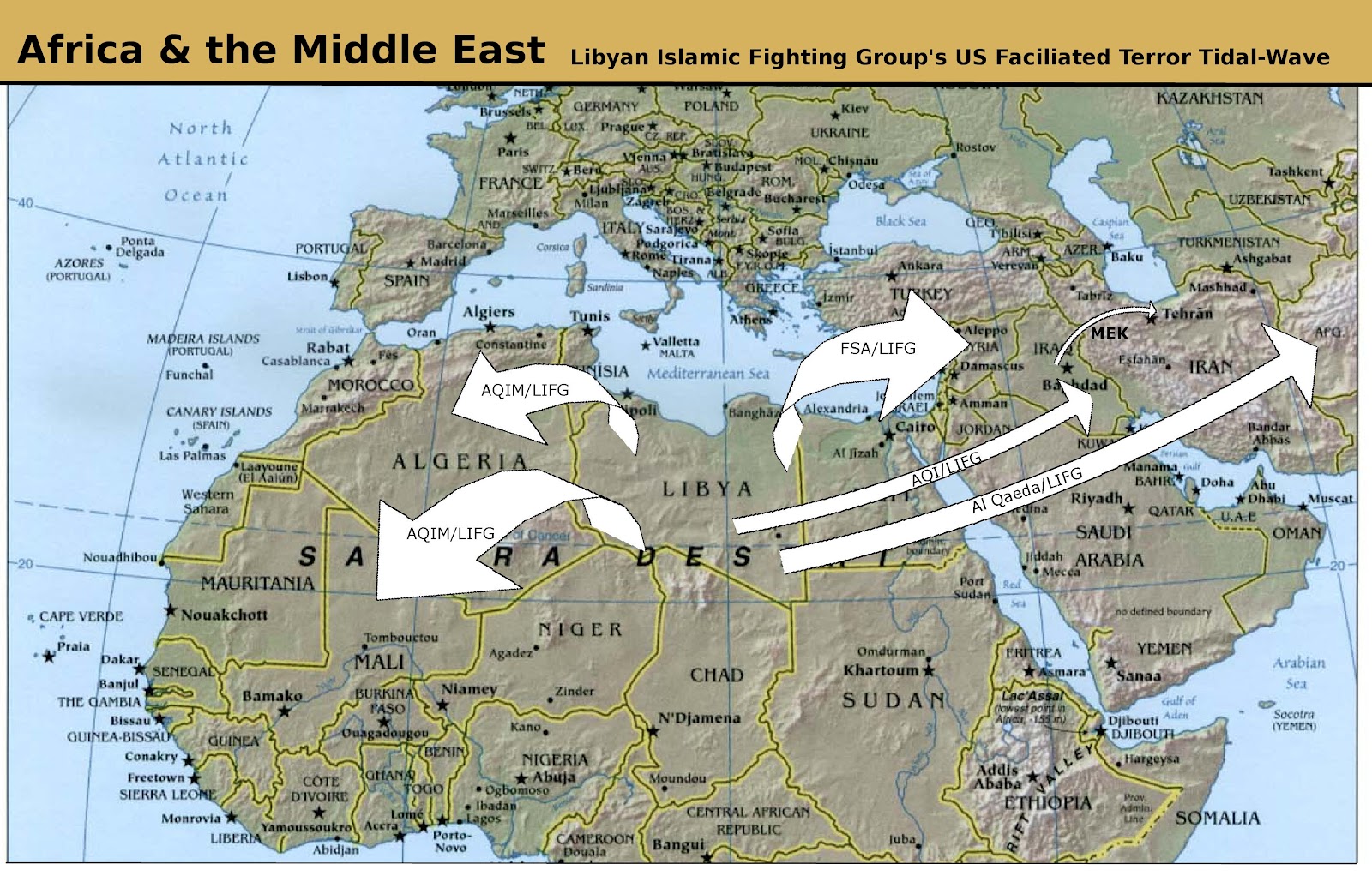
Image: NATO’s intervention in Libya has resurrected listed-terrorist organization and Al Qaeda affiliate, LIFG. It had previously fought in Iraq and Afghanistan, and now has fighters, cash and weapons, all courtesy of NATO, spreading as far west as Mali, and as far east as Syria. The feared “global Caliphate” Neo-Cons have been scaring Western children with for a decade is now taking shape via US-Saudi, Israeli, and Qatari machinations, not “Islam.” In fact, real Muslims have paid the highest price in fighting this real “war against Western-funded terrorism.”
AQIM, like their Libyan counterparts, the Libyan Islamic Fighting Group (LIFG) are both listed by the US State Department as “Foreign Terrorist Organizations.” Likewise, both the UK Home Office (.pdf, listed as GSPC) and the UN recognize both organizations as terrorists.
Despite this, military intervention in Libya was pursued by the West and condoned by the UN with full knowledge that the militants leading so-called “pro-democracy uprisings” were in fact merely the continuation of decades of violent terrorism carried out by Al Qaeda affiliates. The West had full knowledge of this, primarily because it was Western intelligence agencies arming and supporting these militants for the last 30 years, in Libya’s case, while coddling their leaders in Washington and London.
Additionally, the US Army itself meticulously documented foreign terrorists fighting in Iraq and Afghanistan, noting that the highest percentage per capita emanated from Libya’s cities of Benghazi and Darnah, the so-called “cradle” of 2011’s “pro-democracy uprisings” in Libya.

What unfolded was a premeditated lie – where placard waving “activists” overnight turned into battle-hardened heavily armed, tank driving, jet flying militants waging a nationwide battle against Libyan leader, Muammar Qaddafi. In reality, it was the fruition of 30 years of covert support the West has poured into militant groups across the region – support that would not end with the fall of Qaddafi.

LIFG terrorists promptly turned both east to Syria and west to Mali beyond their borders – a logistical matter they had perfected during their operations in Iraq and Afghanistan over the past decade. LIFG commander Abdul Hakim Belhaj, as early as November 2011, arrived on the Turkish-Syrian border to provide cash, weapons, and LIFG terrorist fighters, overseen by Western intelligence along with US funding and arms laundered through Gulf Cooperative Council (GCC) members such as Qatar and Saudi Arabia. Since then Libyan militants have been confirmed to be leading entire brigades of foreign fighters inside Syria.
And as Bruce Riedel of Brookings concedes, these weapons went west to Mali as well. Algeria had feared just such a scenario unfolding with NATO’s intervention in Libya – a fear now fully realized. Ironically, Riedel, in August 2011, had tried to make a case for Algeria being “next to fall” in an article titled literally, “Algeria Will Be Next to Fall.”
A year ago, Riedel attempted to argue that it would be the so-called “Arab Spring” that would spread into Algeria after having taken root in neighboring Libya. He had eluded to, and it has now become abundantly clear, that by “Arab Spring,” Riedel meant, US-backed subversion, and more specifically NATO-armed Al Qaeda-brand militancy and terrorism.
With the US now openly arming, supporting, and literally “cheering” Al Qaeda in Syria, it is clear that the “War on Terror” is an unprecedented geopolitical fraud perpetuated at the cost of millions of lives destroyed and an incalculable social and economic toll. NATO, with full knowledge of the consequences is literally carving out of North Africa and the Middle East, the so-called “Caliphate” Western leaders had held over their impressionable people’s heads as the impetus to perpetually wage global war. Torn from the pages of Orwell’s 1984, an artificial war has been created to carry forward corporate-financier machinations both abroad and domestically. The so-called threat to Western civilization is in fact a foreign legion of Western corporate-financier interests, executing Wall Street and London’s foreign policy on a global scale where and in a manner traditional Western forces cannot.
NATO’s terrorist blitzkrieg across the Arab World will not end in Syria. It will continue, if allowed, into Iran, through the Caucasus Mountains and into Russia, across China’s western borders, and even across Southeast Asia. The price for ignorance, apathy, and complicity in supporting the West’s so-called “War on Terror” will ironically reap all the horrors and then some in reality, that were promised to us if we didn’t fight this “Long War.”
Our support of both the political gambits of our politicians, as well as our daily patronage of the corporate-financier interests driving this agenda have already reaped an unprecedented and still growing regional safe haven for terrorists – and as moderate secular governments continue to be undermined and toppled, we can only imagine the blowback, retaliation, and other consequences as this destructive foreign policy unfolds. To imagine that such meddling will not end up being visited back upon us, even if in the form of a false flag attack dwarfing 9/11, would be folly.
Already, we are suffering economic devastation and an increasingly stifling security apparatus at home, and as long as we capitulate to this current agenda instead of asserting a more rational one of our own, it will only get worse.


