
Why Is Canada Bombing Iraq?
by Christopher Black
New Eastern Outlook
Nov 11, 2014
 Canadians are bombing Iraqis and no one outside the deeply unpopular government of Stephen Harper really knows why. The propaganda system that controls the Canadian media succeeds in sowing confusion upon mystery and all we are allowed to understand is that Canada has once again revealed itself as a country without any existential existence. It is a regional backwater of the United States of America, the remaining vestiges of sovereignty and independence submerged in the swamp of American imperialism and culture.
Long gone are the glory days when a Canadian actually felt distinct in North America, when Canada tried to maintain an independent foreign policy and a national culture born out of the richness of the three founding peoples, the First Nations, the French and the English. Too many have forgotten that the Canadian provinces of the British Empire in North America refused to join the rebellion of the rising bourgeoisie in the 13 colonies along the Atlantic coast. Many Americans who were persecuted by the rebels for staying loyal to the British Crown fled to Canada in the aftermath and never returned. They had a name, the United Empire Loyalists, and the Americans never forgave them or the Canadians for refusing to join in their grand project of the conquest of North America and, consequently, the first of the American wars of conquest was the invasion of Canada in the War of 1812, the primary objective of which was the takeover of all the remaining British territories on the continent.
The American propaganda then was the same as it is now. The invading American forces posted notices in towns and villages announcing that they were bringing the people of Canada “democracy and liberty.” But no one wanted what they were offering and after many battles fought by British regulars, native forces and local militias the Americans were kicked out and put that objective on the back burner while they plundered the lands of the peoples of the interior and then turned on Mexico. They didn’t attempt it again until President Grant contemplated using the Union Armies to invade just after the American Civil War but the idea was abandoned aside from support for Irish Fenian guerrilla raids into Canada in the late 1860s. After that a physical invasion was not necessary since the invasion of finance capital got them all they wanted without a shot fired.
Canada remained a formal colony of British capital until 1867 when it was finally organised as a self governing state within the British empire after a series of internal struggles for more self rule by the growing mercantile and industrial elites but it only achieved any real independence as a country in the 1930’s as Britain’s power rapidly declined after its huge losses of the First World War. But the establishment of a country more independent of Britain did not result in an independent nation. Canada relied on foreign capital to build its infrastructure, its continental railway systems, its hydro-electric projects, its factories, its cities and where British capital could not supply the need it was quickly replaced by American capital.
The domination of the country by the Americans accelerated after the Second World War but it was countered by a rising nationalist feeling generated in part by Canada’s disproportionately large contribution to fighting the fascists in Europe. A nation of eleven million people fielded military forces of almost a million and in 1945 Canada had the third largest navy in the world. After the war the working classes, many of whom viewed the Soviet Union as the most progressive nation in the world, despite the elites’ anti-Russian and anti-socialist propaganda, supported socialist ideals that resulted in the establishment of free national health care and low cost education, affordable housing and were enthusiastic about Canadian artists and writers. They saw how a nation like Russia had rapidly developed its industrial and societal resources in a landmass that was very similar to Canada and realised that they could do the same. But it was not to be. Soon the American dominance began to be felt, with the forced dumping of Hollywood films in Canadian theatres, the take over of oil and gas exploration and pipeline construction, the stifling of any really independent steps to national development and of course the fateful decision under US pressure to join the Nato alliance.
VIDEO — The Protection Of Canada From Terrorists Act (Canadian NDAA)
Press For Truth
Nov 6, 2014
In this video Dan Dicks of Press For Truth breaks down some of the Draconian pieces of legislation that have been presented in the house of commons which seek to restrict the rights of the Canadian people in the wake of the Ottawa shooting. Dan also addresses recent allegations that he is a paid government shill who is acting as a gatekeeper of the truth movement.
Building a New North American Partnership for the Future
 BE YOUR OWN LEADER
Nov 6, 2014
By Dana Gabriel
The globalist controlled Council on Foreign Relations (CFR) have called on the U.S. to work more closely with Canada and Mexico to build a new North American partnership for the future. The pivot to North America would focus on greater trilateral cooperation in areas such as energy, economic competitiveness, border management, law enforcement and continental perimeter security. Throughout the years, the incremental steps towards a North American Union have been used to further chip away at the sovereignty of all three NAFTA countries.
The CFR-sponsored Independent Task Force on North America, co-chaired by retired General David Petraeus and former president of the World Bank Robert Zoellick, recently released their report, North America: Time for a New Focus. The Task Force maintained that, “Now is the moment for the United States to break free from old foreign policy biases to recognize that a stronger, more dynamic, resilient continental base will increase U.S. power globally.” They explained that, “If the three North American countries deepen their integration and cooperation, they have the potential to again shape world affairs for generations to come.” The Task Force also described how, “Recent developments have created opportunities for the North American countries to build on past work and to advance their partnership to a new stage.” The move by Mexico to open up its energy sector to private investment, along with increased oil and natural gas production in Canada and the U.S. are some of the driving forces behind the renewed push for deeper North American integration.
The Task Force report highlighted the need to expand the North American energy relationship. This includes developing a regional energy strategy and strengthening continental energy infrastructure. The approval of Keystone XL pipeline, which would link Canada’s oil sands to U.S. Gulf Coast refineries was also at the top of Task Force to-do list. They acknowledged that, “delays have damaged U.S.-Canada relations and have the potential to slow, at the very least, greater North American energy integration.” As part of efforts to move beyond the dispute, both countries have signed a Memorandum of Understanding on Energy Cooperation in areas such as research, regulation and trade. In an example of the importance that energy issues could play in the upcoming 2016 election, New Jersey Governor Chris Christie, a possible candidate for the Republican presidential nomination gave a speech in September, where he detailed North America’s Energy Opportunity. Not surprisingly, the majority of his policy ideas were in sync with the CFR’s Task Force recommendations.
The 2014 North American Leaders Summit also identified energy as a trilateral priority. In a joint statement, the leaders announced that the energy ministers from all three countries will meet later this year, “to discuss opportunities to promote common strategies on energy efficiency, infrastructure, innovation, renewable energy, unconventional energy sources, energy trade, and responsible resource development, including the development of relevant technical studies.” To help build on the trilateral energy meetings, the Task Force suggested, “the creation of a North American Energy Council to provide advice to federal policymakers and highlight issues that the three independent legislative branches could address.” The council’s responsibilities would include, “identifying improvements to the safety and security of cross-border energy infrastructure; areas for cooperation on environmental and safety standards; energy-efficient technologies and practices; and barriers to collaboration.” Although it has since been disbanded, the North American Energy Working Group has already laid some of the groundwork with regards to trilateral energy integration.
In order to further establish an overall continental agenda, the Task Force argued for the restructuring of the U.S. federal government by, “creating new North American offices within the National Security Council staff and U.S. State Department.” This includes, “designating a senior U.S. official as the North American ‘champion’ who will press for consistent policies across agencies and topics.” The Task Force also encouraged, “greater U.S. congressional engagement with the Mexican congress and Canadian parliament.” In addition, they proposed that, “the U.S. government support interactions and possible cooperation among governors, premiers, mayors, legislators, and other officials.” Throughout the report, the Task Force emphasized that, “The goal should be trilateral where possible, bilateral where necessary.” While they praised the progress that separate U.S.-Canada and U.S.-Mexico initiatives have made, they also pointed out that the continued reliance on some of these bilateral efforts has in many ways, “inhibited the development of a broader vision of North America.”
The Elections: Déjà Vu All Over Again
nsnbc
Nov 8, 2014
Shamus Cooke (WC) : Eventually the tired game will exhaust itself. Beneath the billions of dollars, U.S. elections are lifeless events. The predictable flopping from Democrat to Republican and back again, with voters given no real choice but to punish the party in power — by electing the party that was punished previously. This endless, irrational dynamic is the foundation of the U.S. electoral system.
 The motor force pushing this logic is money, billions worth per cycle. The richest 1% threw nearly $4 billion to influence voters and to prepay for political favors from the winning candidates.
Elections have become corporate PR campaigns, with corporations doling money out equally to both parties. This bi-partisan vote buying guarantees that, aside from a couple of fervently debated social issues, a consistent, core economic agenda is firmly in place that favors the 1%.
This is why voters always punish the party in power. The ruling party earns the hatred of working-class voters by proving their love for the corporations and billionaires. The economy — and specifically jobs — has always been a priority for voters, but the economy is used by politicians to enrich the already-rich, who under Obama have received 98 percent of wealth created since he began as president. Such brazen inequality doesn’t happen by accident, but by policy, and no politicians are complaining about it.
During the “heated” debates of the midterm election, there was virtually no discussion of the economy. The two parties have nothing to debate about on this issue; they’re in total agreement. The same is true about foreign policy and the $700 billion dollars annually spent on the military.
Neither party complains that U.S. taxpayers have spent, according to a reputable study, $4-6 trillion dollars on the ongoing wars of Afghanistan and Iraq. Bi-partisan consensus prevented the topic from reaching the campaign trail, while guaranteeing that the insane and completely futile war policy continues.
Most Americans understand that U.S. politics equals legalized corruption. And consequently voter turnout sank to a new historic low of 38 percent. But even this number is highly misleading. One need only imagine if national congressional elections were voted on separately, instead of sharing the ballot with state elections and local ballot initiatives that voters actually care about. If this happened voter turnout would plummet to the teens, or lower, and could not be mislabeled “democracy.” The popularity of the U.S. Congress hovers around 10 percent, which means that 90 percent of the population consistently views this body as an alien entity, serving the interests of the parasitic super-rich.
Ontario to ban smoking on patios and playgrounds
Metro
Nov 7, 2014
 TORONTO – Ontario will ban smoking on all restaurant and bar patios as well as at playgrounds and publicly owned sports fields starting Jan. 1, 2015, the Liberal government announced Friday.
Associate Health Minister Dipika Dameria said regulations will also be amended to ban the sale of tobacco on college and university campuses.
The changes to the Smoke Free Ontario Act will replace a patchwork of municipal regulations governing smoking on restaurant and bar patios, and will not hurt their businesses, she added.
Facebook boosted US election turnout via psychology experiment, company reveals
RT USA
Published time: November 04, 2014 05:54
Edited time: November 04, 2014 07:36

Reuters/Dado Ruvic
Facebook manipulated the news feeds of almost 2 million American users during the 2012 presidential election without telling them. The manipulation led to a 3 percent increase in voter turnout, according to the company’s own data scientist.
In a stunning revelation, the three months prior to Election Day in 2012 saw Facebook “tweak” the feeds of 1.9 million Americans by sharing their friends’ hard news posts rather than the usual personal posts. The effect was felt most by occasional Facebook users who reported in a survey they paid more attention to the government because of their friends’ hard news feeds. Facebook didn’t tell users about this psychology experiment, but it boosted voter turnout by 3 percent.
The experiment was first shared with the public in two talks given by Facebook’s data scientist, Lada Adamic, in the fall of 2012, and more details were disclosed recently by Mother Jones. In those talks, Adamic said a colleague at Facebook, Solomon Messing, “tweaked” the feeds. Afterwards, Messing surveyed the group and found that voter turnout and political engagement grew from a self-reported 64 percent to more than 67 percent.
FBI pretended to be Seattle newspaper in order to hack suspect’s computer
End the Lie
Oct 28, 2014
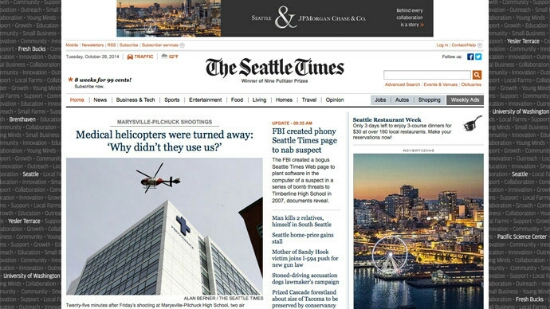
Screenshot from http://seattletimes.com
The editor of the Pulitzer Prize-winning Seattle Times newspaper says she’s “outraged” to learn only this week that the FBI made a mock-up of the publication’s website in 2007 in order to spread spyware onto the computer of a suspect.
When agents with the Seattle division of the FBI swarmed the home of a 15-year-old high school student that year and charged him with making bomb threats, media reports noted that the arrest was made possible with the use of a so-called “Computer & Internet Protocol Address Verifier” program, or CIPAV, that had been remotely installed on the individual’s machine to collect and then communicate to the authorities the user-specific information that eventually identified the suspect. The student later pleaded guilty to emailing repeated bomb threats to Timberline High School and was sentenced to 90 days in juvenile detention.
Until this week, how the FBI actually went about sneaking the CIPAV program onto the student’s computer was a matter that went unreported. After digging through a trove of emails previously obtained through a Freedom of Information Act request, however, American Civil Liberties Union technologist Chris Soghoian stumbled upon details this week showing that authorities accomplished the installation by sending a malicious link disguised as a Seattle Times news article to a social media account used by their suspect.

 PN
PN 