
Do Grains Deserve a Spot in any Food Pyramid?
 by Elizabeth Renter
Natural Society
March 30, 2013
We live in a society that takes extreme turns in regards to popular food opinions. We go from embracing whole grain everything to vilifying all grains. We go from no one even knowing what celiac disease is to everyone claiming a gluten sensitivity. Ten years ago, finding a product labeled “gluten free” on your grocery store shelf would be an exercise in futility. Now, they are everywhere. There are countless books on the dangers of wheat and grains in general, but is this fear of grains justified or is it just another trend?
Currently, the USDA recommends several servings of grains each day. Back when they had a food pyramid, the daily serving amount to aim for was 6 to 11. Now, it’s customized to gender and age. But we have to look at what’s motivating this end-all recommendation (it’s not just your health). The government functions, in part, on the backs of industry funds. Ag-lobbyists work tirelessly to ensure the grain producers benefit as much as possible from government funding and recommendations. To believe that bias plays no role in these recommendations would be remiss.
In the arguments for and against grains, we have many who are of the belief that grains are a necessary component of the modern diet. But the human diet has only included grains as a mainstay for an estimated 10,000 years. Before that, we were largely hunter-gatherers and though we may have munched on grain-like plants, we didn’t produce them on a large scale and therefore the consumption was limited.
Many of those who argue that grains are bad say the human body has not evolved to digest these substances properly. That because modern agriculture only arose 10,000 years ago, our bodies are still optimized for the digestion of meats and natural plant-parts (leaves, roots, nuts, etc.).
There is little arguing that grains do have negative points. They can increase blood sugar and potentially lead to insulin resistance. Over-consumption of grains has also been linked to obesity and leptin resistance. And for those who say grains provide necessary fiber—soluble plant fiber like that found in fruits and vegetables is far superior to the insoluble type in grains.
A word of caution: anything with a “gluten-free” label should be closely scrutinized. Any label indicates processing and the ingredients used in place of wheat gluten are often no better.
As with most things in this age of information, you will find legitimate arguments for grains and legitimate arguments against. As a conscientious consumer of this information (and food), it’s up to you to make the healthiest decision for yourself. Generally, those who turn away from grains in favor of more vegetables and fruit experience benefits like lowered blood sugar, increased mental clarity, improved digestion, and even weight loss. But for some, omitting grains completely can be a difficult challenge.
For our readers, have you bought into the gluten-free craze or have you given up on grains in favor of other foods? What’s your take on the grain-free movement?
Rally and March for Kimani Grey [video]
We Are Change
April 1, 2013
On March 24, 2013, residents of Flatbush, Brooklyn came out for a rally in remembrance of Kimani Grey who was murdered at the age of 16 by the NYPD.
Credit for this video go to Robert Strype
Check out his channel: http://www.youtube.com/user/blazedroo…
Follow Robert: http://wwww.twitter.com/blazedroots
Support us by subscribing here http://bit.ly/P05Kqb
http;//www.facebook.com/wearechange.org
Check out our merchandise: http://wearechange.org/store/
Become a member of The Sponsor Lounge and get exclusive behind the scenes content while helping us grow! Join us today! http:///www.wearechange.org/donate
5 of 10 Top Economies in the World Drop the Dollar [video included]
 Activist Post
April 1, 2013
The U.S Dollar is quickly losing its status as the world reserve currency. Five of the top ten economies in the world, plus a few others, no longer use the dollar as an intermediary currency for trade. This trend poses a huge risk to the dollar and the United States along with it.
ZeroHedge points out today that Australia, the world’s 12th-ranked economy, has now joined a growing list of nations that have agreed to bypass the dollar in bilateral trade with China. China, ranked 2nd behind the U.S., also has similar agreements with Japan (3rd), Brazil (6th), India (9th), and Russia (10th).
Although unilateral agreements have been in place for some time between China and the countries listed above, last week the BRICS (Brazil, Russia, India, China and South Africa) agreed to set up a development bank to compete with the IMF, indicating it’s gearing up to compete in a post-dollar world.
Additionally, Brazil, who agreed in principle to drop the dollar with bilateral trade with China some time ago, just made it official with $30 billion in annual currency swaps which will facilitate around 50% of all trade between them.
VIDEO: http://www.bizu.tv/economies-china-and-brazil-ink-bilateral-trade-deal-45549
Besides those agreements with China, some of these nations have made other similar agreements with each other. India and Japan began swapping $15 billion in each other’s currency in 2011 to handle their bilateral trade. And the sanctions against Iran haven’t stopped them from trading oil with China, Russia, and India in anything but the dollar.
Here’s how the current reign of the US dollar compares to previous world reserve currency:
 |
| Source |
It appears that the dollar is certainly nearing the end of its reign, which could lead to severe economic hardship for the United States.
Dave Hodges writes:
The United States’ good economic fortune is due solely to the fact that world must use the dollar, the Petrodollar if you will, in order to make their nation’s individual oil purchases; this provides the only source of backing for the U.S. dollar that the Federal Reserve requires in order to somewhat sustain our back-breaking debt that the banker-occupied United States government has passed along to the American taxpayer in the form of bailouts.
And Marin Katusa of Casey Research writes:
If the US dollar loses its position as the global reserve currency, the consequences for America are dire. A major portion of the dollar’s valuation stems from its lock on the oil industry – if that monopoly fades, so too will the value of the dollar. Such a major transition in global fiat currency relationships will bode well for some currencies and not so well for others, and the outcomes will be challenging to predict. But there is one outcome that we foresee with certainty: Gold will rise. Uncertainty around paper money always bodes well for gold, and these are uncertain days indeed.
America’s imperialism, combined with its ultra-fiat status of unending debt creation, appears to have created a final downward spiral that has caused many of the top economies to abandon a sinking ship. It might not be too much longer before the rest follow suit. Now might be a great time to consider diversifying into other currencies, and even digital currencies, to mitigate growing losses in the U.S. dollar.
Read other articles by Activist Post Here
US F-22 jets join S. Korea war games, ‘situation on knife’s-edge’ [video]
Russia Today
April 1, 2013
The United States has sent F-22 stealth fighter jets, to participate in ongoing military drills with South Korea. Pyongyang earlier said it was in a ‘state of war’ with the South following the latest round of sanctions over its nuclear test two months ago. In turn Seoul warned that its ready to carry out a pre-emptive strike on its neighbour, in case of imminent attack. James Corbett, host of the Corbett Report – believes that the U.S. is playing a dangerous game by trying to benefit financially from the tension which could spill over at any moment.
RT LIVE http://rt.com/on-air
Subscribe to RT! http://www.youtube.com/subscription_c…
Like us on Facebook http://www.facebook.com/RTnews
Follow us on Twitter http://twitter.com/RT_com
Follow us on Google+ http://plus.google.com/+RT
RT (Russia Today) is a global news network broadcasting from Moscow and Washington studios. RT is the first news channel to break the 500 million YouTube views benchmark.
Ex- CNN Reporter: I Received Orders to Manipulate News to Demonize Syria and Iran
LiveLeak.com
March 30, 2013

Ex- CNN Reporter: I Received Orders to Manipulate News to Demonize Syria and Iran
PRAGUE, (SANA)- Ex-CNN reporter Amber Lyon revealed that during her work for the channel she received orders to send false news and exclude some others which the US administration did not favor with the aim to create a public opinion in favor of launching an aggression on Iran and Syria.
Korean War 2.0: Deescalate Now
by Nile Bowie
Nile Bowie.blogspot.ca
March 30, 2013
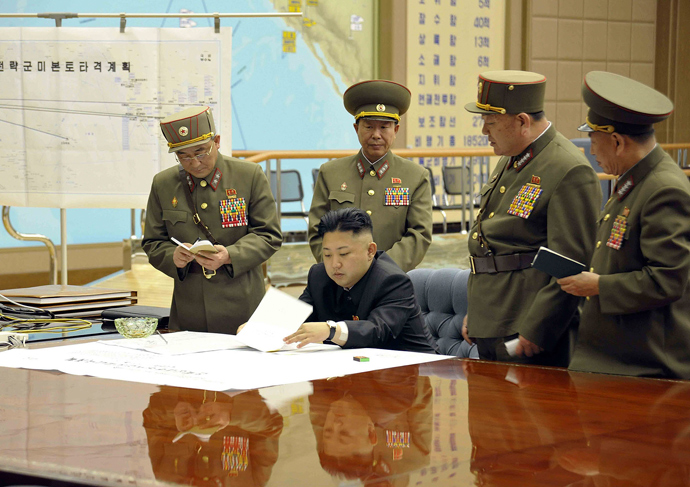
Recent warnings of instability on the Korean peninsula by Russia’s foreign minister Sergey Lavrov come at a most appropriate time – and indeed, there is a frightening possibility that the situation could spin out of control. Since the North was heavily penalized by UN sanctions following its recent satellite launch and nuclear test, Pyongyang has embarked on a near-daily onslaught of belligerent threats, some of which include its invalidation of the 1953 armistice agreement that ended the Korean War, threats to nuke the United States, and threats to occupy South Korea and subsequently take all Americans in the country hostage. Military analysts claim that North Korea is at least several years from building a nuclear warhead or a missile capable of reaching the US mainland – but there is no doubt that if the Kim regime oversteps their approach, it could certainly have severe repercussions for civilians in South Korea and Japan, both in range of North Korea’s rockets.
Despite regular threats of destruction and Pyongyang’s recent proclamation that the two Korean states are officially in a state of war, day-to-day life has retained its normality according to sources on the ground. Needless to say, there is no doubt that civilians on both sides are feeling tense in the current scenario, especially those on disputed South Korean islands in the West sea, just a stones throw away from the North Korean maritime border. The four thousands residents of the South’s Baengnyeong Island, which Kim Jong-un personally threatened to “wipe out” in early March, have been severely hindered from carrying out their day-to-day activities such as fishing due to the joint US-ROK military exercises in the area. Despite inter-Korean relations reaching their lowest point in recent times with the entire South on high alert, most South Koreans are adept at brushing off the North’s rhetoric, but they’re still proceeding with caution.Nile Bowie:
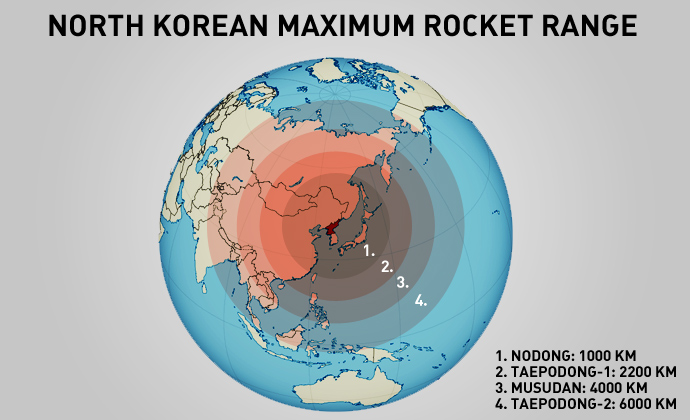
In addition to joint US-ROK’s endless barrage of war games on North Korea’s doorstep, the brandishing of B-2 bombers, which carry bombs that can blast through 70 meters of reinforced concrete, is an unnecessary stunt that is both bold and needlessly provocative. In fact, the B-2 flyover helps Kim Jong-un in consolidating his political power at home by rallying domestic support behind the US threat and distracting North Koreans from economic problems. These moves beg the question, is the United States prepared to launch a full-scale war against North Korea? Despite the high public disapproval of overt warfare campaigns launched by the Bush administration, the unholy status North Korea enjoys in American mainstream media – coupled with its threats to nuke the United States and the simple fact that is it a communist state – is likely enough to coax the average American into supporting a war of aggression against Pyongyang.

 PN
PN 