
VIDEO — CrossTalk: Yemen’s Turn (pre-recorded)
RT
Apr 3, 2015
Now it’s Yemen’s turn: Saudi Arabia – the richest petro-kingdom – is militarily assaulting the Arab world’s poorest state – and it has Washington’s full backing. Riyadh has made it clear it wants its man back in power in Yemen and the surrender of the Houthis. Neither is likely to happen. But a regional war is. CrossTalking with Sami Ramadani, Ali al-Ahmed, and Ervand Abrahamian.
US-Saudi Blitz in Yemen: Naked Aggression, Absolute Desperation
March 27, 2015 (Tony Cartalucci – NEO) – The “proxy war” model the US has been employing throughout the Middle East, Eastern Europe, and even in parts of Asia appears to have failed yet again, this time in the Persian Gulf state of Yemen.
Overcoming the US-Saudi backed regime in Yemen, and a coalition of sectarian extremists including Al Qaeda and its rebrand, the “Islamic State,” pro-Iranian Yemeni Houthi militias have turned the tide against American “soft power” and has necessitated a more direct military intervention. While US military forces themselves are not involved allegedly, Saudi warplanes and a possible ground force are.
Though Saudi Arabia claims “10 countries” have joined its coalition to intervene in Yemen, like the US invasion and occupation of Iraq hid behind a “coalition,” it is overwhelmingly a Saudi operation with “coalition partners” added in a vain attempt to generate diplomatic legitimacy.
Saudi Arabia bombs Yemen, launches coalition op against Houthi rebels — videos included
RT
Published time: March 25, 2015 23:49
Edited time: March 26, 2015 05:25
Saudi Arabian forces, joined by nine other countries, have launched a military operation in Yemen against Shiite Houthi rebels, the Saudi ambassador to the US said. The offensive, which started with airstrikes, will also involve “other military assets.”
According to Ambassador Adel bin Ahmed Al-Jubeir, the military operation in Yemen started at 7 p.m. EST (11 p.m. GMT). The US is not participating in the operation, the envoy stressed.
Al Arabiya reported that warplanes of the Royal Saudi Air Force bombed positions of Yemen’s Houthi militia, targeting their air defenses.
The Saudi-led coalition has declared Yemeni airspace a “restricted zone.” Ships in the region have also been urged not to approach Yemen’s ports due to the ongoing military operation.
More than 20 people have reportedly died and over 30 others were injured following Saudi Arabia-led airstrikes in Yemen, Sputnik news agency cited local security and medical sources as saying.
The majority of the strikes around Sanaa hit residential areas located near the capital’s international airport. Government buildings and the airport were also hit during the offensive.
Reports from the ground indicate that Saudi forces have bombed an office belonging to Houthi rebels in Sanaa’s Jiraf area. A Houthi-run TV channel reported dozens of civilian casualties following airstrikes north of Sanaa.
Residents said that warplanes targeted the capital’s airport, according to Reuters.
Houthis used heavy anti-aircraft fire to respond to the bombing.
Another warplane attack was said to have been launched on Sanaa’s Dulaimi military airbase. Al-Jubair told Al Jazeera that Houthi fighters are in control of Yemeni’s ballistic and heavy weaponry and could be taking over the country’s air force.
Reports citing Yemeni security services said four Sukhoi jets stationed at the Dulaimi military airbase were destroyed in airstrikes. Meanwhile, an Al Arabiya report claimed that Saudi-led strikes destroyed the airbase along with several arsenals, as well as taking out most of the rebels’ air defenses.
Meanwhile, Saudi Arabia, the United Arab Emirates, Bahrain, Qatar, and Kuwait issued a joint statement saying that they “decided to repel Houthi militias, Al-Qaeda and ISIS (Islamic State) in the country.” The Gulf states said they were responding to a “major threat” to the stability of the region, saying that their cause is to “repel Houthi aggression” in Yemen.
ISIL attacked Saudi Arabia
by Viktor Titov
New Eastern Outlook
11.11.2014
 Saudi Arabia has recently witnessed the aggression that should have happened sooner or later due to its short-sighted policy in Syria, Iraq and Iran. As an old saying goes: “If you dig a hole for others, you’re sure to fall in it yourself.”
A few days ago the Saudi town of al-Dalwa, situated in the oil-rich Eastern Province, suffered an attack of a group of armed Sunni terrorists, which resulted in seven civilian deaths. Most of the attackers were citizens of the kingdom. The prompt response of the local security forces allowed the servicemen to detain 20 members of an underground terrorist group, consisting mainly of those who had previously fought under the black banner of ISIL in Iraq and Syria. Law enforcement agencies of Saudi Arabia have managed to capture the head of the armed group, his name is kept secret. The only information that has become available to journalists is that this commander has recently returned from Syria where he was fighting against the pro-Assad forces.
Riyadh is now facing a harsh dilemma: on the one hand, the House of Saud is actively oppressing its Shia citizens, on the pretext of their disloyalty and their alleged attempts to undermine the national security of the kingdom due to the “evil Iranian influence.” On the other – Sunni terrorists, that Saudi Arabia is fighting today alongside with its closest ally – the US, have assaulted Shia civilians on the Saudi soil, and the latter were virtually enjoying the same rights as the rest of the population, including the right for protection. It is now official: Saudi citizens motivated by religious hatred are commiting manslaughter of their fellow citizens.
The only question is how Riyadh may react when the Sunni terrorists that it had trained and funded will unleash a wave of terror against the Shia population of KSA (Kingdom Saudi Arabia)? A similar course of events has already taken place in the neighboring Bahrain back in 2011, but Saudi regular troops were fast to cross the border in an attempt to prevent the violence from spreading.
It is no coincidence that the events in the city of al-Dalwa are completely ignored by the international media. Should this fact become widely known then the Saudi authorities will be forced to recognize the threat ISIL poses to Saudi Arabia along with acknowledging the underlying instability of Saudi society that can endanger the ruling Wahhabi regime.
Now that the Shia population of the Eastern Province is buzzing with discontent, the House of Saud has found itself in a tight corner. Should the authorities fail to prosecute terrorists, a violent unrest of the Shia population, similar the one that shook Saudi Arabia in 2011 -2012, in the wake of the above mentioned events in Bahrain, will be quick to follow. But if the terrorists are to be punished to the fullest extent of the Sharia law, then the Wahhabis and Salafis will accuse the royal family of “betrayal” of the Sunnis. This course of events will end no better, with a massive wave of violent terrorist attacks, carried out by ISIL militants all across Saudi Arabia. Now that ISIL thugs have faced harsh resistance in Syria and Iraq, they will be eager to move south to start a “sacred struggle against the corrupt pro-American reign of Al Saud family“. As for the Iraqi Shia population, they can only welcome this U-turn in their ongoing struggle against Islamists. Moreover, it is possible that the indignation of the Saudi Shia population of the Eastern Province will find some form of support in Tehran and Baghdad. This means that the fate of the kingdom’s territorial integrity will be put to the test. The nightmares of the Saudi ruling family seems to be coming true — Saudi Arabia can be split into several parts, which were joined together to create the kingdom back in 1929. This trend can be accelerated by the fact that a couple of weeks ago the Shia Houthis rebels seized power in Yemen, on the south-western borders of KSA.
MUST READ — America’s Covert Re-Invasion of Iraq
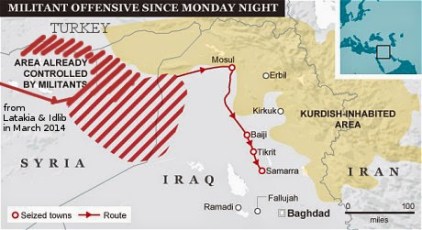
Image: ISIS clearly did not materialize spontaneously within Iraq, it has clearly redeployed from its NATO-sponsored destruction of Syria to northern Iraq, perhaps in an attempt to justify a NATO incursion and the creation of a buffer zone straddling Syrian, Iraqi, and even possibly Iranian territory with the goal of targeting Iran directly with ISIS.
June 13, 2014 (Tony Cartalucci – LD) – Heavily armed, well funded, and organized as a professional, standing army, the forces of the Islamic State of Iraq and Syria (ISIS) swept southward into Iraq from Turkey and northeastern Syria, taking the cities of Mosul and Tikrit, and now threaten the Iraqi capital city of Baghdad itself. The United States was sure to prop up two unfounded narratives – the first being that US intelligence agencies, despite assets in Iraq and above it in the form of surveillance drones, failed to give warning of the invasion, and that ISIS is some sort of self-sustaining terror organization carving out a “state” by “robbing banks” and collecting “donations” on Twitter.
The Wall Street Journal in its report, “Iraqi Drama Catches U.S. Off Guard,” stated:
The quickly unfolding drama prompted a White House meeting Wednesday of top policy makers and military leaders who were caught off guard by the swift collapse of Iraqi security forces, officials acknowledged.
In another WSJ post, “U.S. Secretly Flying Drones Over Iraq,” it claimed:
A senior U.S. official said the intelligence collected under the small [secret US drone] program was shared with Iraqi forces, but added: “It’s not like it did any good.” The rapid territorial gains by the Islamist forces loyal to Islamic State of Iraq and al-Sham, or ISIS, an al Qaeda offshoot, caught the U.S. by surprise, the officials said.
 |
| Image: ISIS has convoys of brand new matching Toyota’s the same vehicles seen among admittedly NATO-armed terrorists operating everywhere from Libya to Syria, and now Iraq. It is a synthetic, state- sponsored regional mercenary expeditionary force. |
Despite drone flights collecting intelligence, and a 3-year ongoing CIA program (here, here, and here) all along the Turkish-Syrian border to “monitor” and “arm” “moderate” militants fighting the Syrian government, the US claims it was caught “by surprise.” If drones and CIA operatives operating in ISIS territory weren’t enough to detect the impending invasion, perhaps the CIA should have just picked up a newspaper.
Indeed, the Lebanon Daily Start in March 2014 reported that ISIS openly withdrew its forces from Latakia and Idlib provinces in western Syria, and redeployed them in Syria’s east – along the Syrian-Iraqi border. The article titled, “Al-Qaeda splinter group in Syria leaves two provinces: activists,” stated explicitly that:
On Friday, ISIS – which alienated many rebels by seizing territory and killing rival commanders – finished withdrawing from the Idlib and Latakia provinces and moved its forces toward the eastern Raqqa province and the eastern outskirts of the northern city of Aleppo, activists said.
The question remains, if a Lebanese newspaper knew ISIS was on the move eastward, why didn’t the CIA? The obvious answer is the CIA did know, and is simply feigning ignorance at the expense of their reputation to bait its enemies into suspecting the agency of incompetency rather than complicity in the horrific terroristic swath ISIS is now carving through northern Iraq.
Described extensively in the full New Eastern Outlook Journal (NEO) report, “NATO’s Terror Hordes in Iraq a Pretext for Syria Invasion,” the United States, Turkey, Saudi Arabia, and Qatar, have funded and armed terrorists operating in Syria for the past 3 years to the tune of hundreds of millions of dollars – coincidentally the same amount that ISIS would require to gain primacy among militant groups fighting in Syria and to mobilize forces capable of crossing into Iraq and overwhelming Baghdad’s national defenses.
 |
| Image: The most prominent routes into Syria for foreign fighters is depicted, with the inset graph describing the most widely used routes by foreign fighters on their way to Iraq, as determined by West Point’s 2007 Combating Terrorism Center report “Al-Qa’ida’s Foreign Fighters in Iraq” (page 20). These same networks were then used to invade and attempt to overthrow the Syrian government itself in 2011, with the addition of a more prominent role for Turkey, and today in 2014, to re-invade Iraq once again. |
The NEO report includes links to the US Army’s West Point Countering Terrorism Center reports, “Bombers, Bank Accounts and Bleedout: al-Qa’ida’s Road In and Out of Iraq,” and “Al-Qa’ida’s Foreign Fighters in Iraq,” which detail extensively the terror network used to flood Iraq with foreign terrorists, weapons, and cash to fuel an artificial “sectarian war” during the US occupation, and then turned over to flood Syria with terrorists in the West’s bid to overthrow the government in Damascus.
What’s ISIS Doing in Iraq?
The NEO report would also post Seymour Hersh’s 2007 article, “The Redirection,” documenting over the course of 9 pages US, Saudi, and Israeli intentions to create and deploy sectarian extremists region-wide to confront Iran, Syria, and Hezbollah in Lebanon. Hersh would note that these “sectarian extremists” were either tied to Al Qaeda, or Al Qaeda itself. The ISIS army moving toward Baghdad is the final manifestation of this conspiracy, a standing army operating with impunity, threatening to topple the Syrian government, purge pro-Iranian forces in Iraq, and even threatening Iran itself by building a bridge from Al Qaeda’s NATO safe havens in Turkey, across northern Iraq, and up to Iran’s borders directly. Labeled “terrorists” by the West, grants the West plausible deniability in its creation, deployment, and across the broad spectrum of atrocities it is now carrying out.
 |
| Image: ISIS’s alleged territory spans across both Iraqi and Syrian territory. If it is able to establish a NATO-backed buffer zone, it will be able to launch attacks with impunity into Syria, Iraq, and Iran – in a region-wide sectarian war the West has been engineering for years. |
It is a defacto re-invasion of Iraq by Western interests – but this time without Western forces directly participating – rather a proxy force the West is desperately attempting to disavow any knowledge of or any connection to. However, no other explanation can account for the size and prowess of ISIS beyond state sponsorship. And since ISIS is the clear benefactor of state sponsorship, the question is, which states are sponsoring it? With Iraq, Syria, and Iran along with Lebanese-based Hezbollah locked in armed struggle with ISIS and other Al Qaeda franchises across the region, the only blocs left are NATO and the GCC (Saudi Arabia and Qatar in particular).
With the West declaring ISIS fully villainous in an attempt to intervene more directly in northern Iraq and eastern Syria, creating a long desired “buffer zone” within which to harbor, arm, and fund an even larger terrorist expeditionary force, Syria, Iraq, Iran, and others are offered an opportunity to preempt Western involvement and to crush the ISIS – cornering and eliminating NATO-GCC’s expeditionary force while scoring geopolitical points of vanquishing Washington’s latest “villain.” Joint Iraq-Iranian operations in the north and south of ISIS’s locations, and just along Turkey’s borders could envelop and trap ISIS to then be whittled down and destroyed – just as Syria has been doing to NATO’s proxy terrorist forces within its own borders.
Whatever the regional outcome may be, the fact is the West has re-invaded Iraq, with a force as brutal, if not worse than the “shock and awe” doctrine of 2003. Iraq faces another difficult occupation if it cannot summon a response from within, and among its allies abroad, to counter and crush this threat with utmost expediency.
——————————————————–
[related:
VIDEO — Hearts & Minds? Al-Qaeda aims to win over Yemenis with…. light bulbs
RT
Jan 3, 2014
Al-Qaeda-affiliated assassins have reportedly gunned down a senior Yemeni intelligence officer, in a broad daylight drive-by shooting. The terror network has been increasingly cornered in recent years by both government forces and US drone strikes. Lucy Kafanov reports on how it’s forced Al-Qaeda to adapt and evolve its strategy.
RT LIVE http://rt.com/on-air
Subscribe to RT! http://www.youtube.com/subscription_c…
Like us on Facebook http://www.facebook.com/RTnews
Follow us on Twitter http://twitter.com/RT_com
Follow us on Instagram http://instagram.com/rt
Follow us on Google+ http://plus.google.com/+RT
RT (Russia Today) is a global news network broadcasting from Moscow and Washington studios. RT is the first news channel to break the 1 billion YouTube views benchmark.

 PN
PN 