
Brain Chips, Downloadable Memories, and Micro Chips in The Swine Flu Vaccine [video]
YouTube — ExposeTheDark
November 5, 2009
nano chip inside swine flu vaccine
[hat tip: Elisabeth Nyström Barringer]
Massive Cover-Up of Risks from Flooding to Numerous U.S. Nuclear Facilities
nsnbc
October 21, 2012
“And U.S. officials are apparently a primary reason behind Japan’s cover-up of the severity of the Fukushima accident … to prevent Americans from questioning our similarly-vulnerable reactors.”
Numerous American nuclear reactors are built within flood zones:
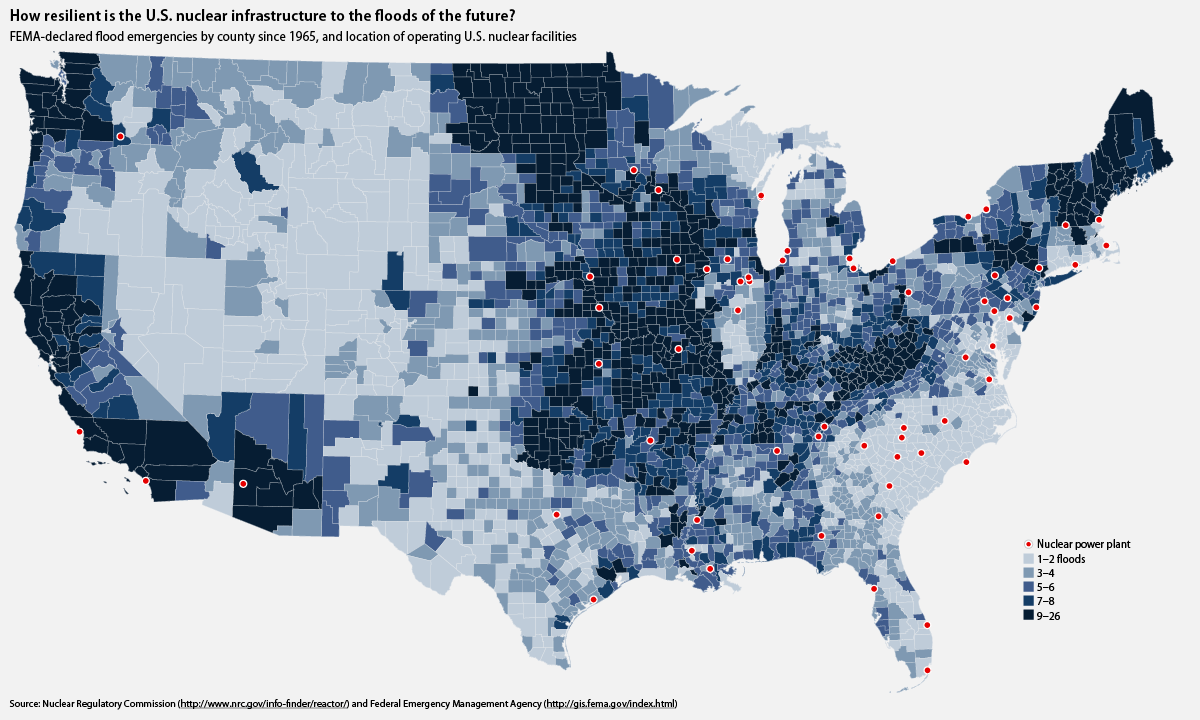
As one example, on the following map (showing U.S. nuclear power plants built within earthquake zones), the red lines indicate the Mississippi and Missouri rivers:

Numerous dam failures have occurred within the U.S.:

Reactors in Nebraska and elsewhere were flooded by swollen rivers and almost melted down. See this, this, this and this.
The Huntsville Times wrote in an editorial last year:
A tornado or a ravaging flood could just as easily be like the tsunami that unleashed the final blow [at Fukushima as an earthquake].
An engineer with the NRC says that a reactor meltdown is an “absolute certainty” if a dam upstream of a nuclear plant fails … and that such a scenario is hundreds of times more likely than the tsunami that hit Fukushima :
An engineer with the Nuclear Regulatory Commission (NRC) … Richard Perkins, an NRC reliability and risk engineer, was the lead author on a July 2011 NRC report detailing flood preparedness. He said the NRC blocked information from the public regarding the potential for upstream dam failures to damage nuclear sites.
Perkins, in a letter submitted Friday with the NRC Office of Inspector General, said that the NRC “intentionally mischaracterized relevant and noteworthy safety information as sensitive, security information in an effort to conceal the information from the public.” The Huffington Post first obtained the letter.
***
The report in question was completed four months after … Fukushima.
The report concluded that, “Failure of one or more dams upstream from a nuclear power plant may result in flood levels at a site that render essential safety systems inoperable.”
Huffington Post reported last month:
These charges were echoed in separate conversations with another risk engineer inside the agencywho suggested that the vulnerability at one plant in particular — the three-reactor Oconee Nuclear Station near Seneca, S.C. — put it at risk of a flood and subsequent systems failure, should an upstream dam completely fail, that would be similar to the tsunami that hobbled the Fukushima Daiichi nuclear facility in Japan last year.***
The engineer is among several nuclear experts who remain particularly concerned about the Oconee plant in South Carolina, which sits on Lake Keowee, 11 miles downstream from the Jocassee Reservoir. Among the redacted findings in the July 2011 report — and what has been known at the NRC for years, the engineer said — is that the Oconee facility, which is operated by Duke Energy, would suffer almost certain core damage if the Jocassee dam were to fail. And the odds of it failing sometime over the next 20 years, the engineer said, are far greater than the odds of a freak tsunami taking out the defenses of a nuclear plant in Japan.
“The probability of Jocassee Dam catastrophically failing is hundreds of times greater than a 51 foot wall of water hitting Fukushima Daiichi,” the engineer said. “And, like the tsunami in Japan, the man‐made ‘tsunami’ resulting from the failure of the Jocassee Dam will –- with absolute certainty –- result in the failure of three reactor plants along with their containment structures.
“Although it is not a given that Jocassee Dam will fail in the next 20 years,” the engineer added, “it is a given that if it does fail, the three reactor plants will melt down and release their radionuclides into the environment.”
***
In the letter, a copy of which was obtained by The Huffington Post, Richard H. Perkins, a reliability and risk engineer with the agency’s division of risk analysis, alleged that NRC officials falsely invoked security concerns in redacting large portions of a report detailing the agency’s preliminary investigation into the potential for dangerous and damaging flooding at U.S. nuclear power plants due to upstream dam failure.
Perkins, along with at least one other employee inside NRC, also an engineer, suggested that the real motive for redacting certain information was to prevent the public from learning the full extent of these vulnerabilities, and to obscure just how much the NRC has known about the problem, and for how long.
Huffington Post notes today:
An un-redacted version of a recently released Nuclear Regulatory Commission report highlights the threat that flooding poses to nuclear power plants located near large dams — and suggests that the NRC has misled the public for years about the severity of the threat, according to engineers and nuclear safety advocates.
“The redacted information shows that the NRC is lying to the American public about the safety of U.S. reactors,” said David Lochbaum, a nuclear engineer and safety advocate with the Union of Concerned Scientists.
***
According to the NRC’s own calculations, which were also withheld in the version of the report released in March, the odds of the dam near the Oconee plant failing at some point over the next 22 years are far higher than were the odds of an earthquake-induced tsunami causing a meltdown at the Fukushima plant.
The NRC report identifies flood threats from upstream dams at nearly three dozen other nuclear facilities in the United States, including the Fort Calhoun Station in Nebraska, the Prairie Island facility in Minnesota and the Watts Bar plant in Tennessee, among others.
***
Larry Criscione, a risk engineer at the Nuclear Regulatory Commission who is one of two NRC employees who have now publicly raised questions about both the flood risk at Oconee and the agency’s withholding of related information, said assertions that the plant is “currently able to mitigate flooding events,” amounted to double-speak.
Criscione said this is because current regulations don’t include the failure of the Jocassee Dam — 11 miles upriver from Oconee — in the universe of potential flooding events that might threaten the plant. “I think they’re being dishonest,” Criscione said in a telephone interview. “I think that we currently intend to have Duke Energy improve their flooding protection and to say that the current standard is adequate is incorrect.”
According to the leaked report, NRC stated unequivocally in a 2009 letter to Duke that it believed that “a Jocassee Dam failure is a credible event” and that Duke had “not demonstrated that the Oconee Nuclear Station units will be adequately protected.” These statements — along with Duke’s own flood timeline associated with a Jocassee Dam failure and NRC’s calculated odds of such a failure — were among many details that were blacked out of the earlier, publicly released report.
***
Richard H. Perkins, a risk engineer with the NRC and the lead author of the leaked report, pointed to the analysis by the Association of Dam Safety Officials in an email message to The Huffington Post. “I felt it made a significant point that large, fatal, dam failures occur from time to time,” he said. “They are generally unexpected and they can kill lots of people. It’s not credible to say ‘dam failures are not credible.’”
Dave Lochbaum, the Union of Concerned Scientists engineer who reviewed a copy of the un-redacted report, says these revelations directly contradict the NRC’s assertions that Oconee is currently safe. “Fukushima operated just under 40 years before their luck ran out,” Lochbaum, who worked briefly for the NRC himself between 2009 and 2010, and who now heads the Nuclear Safety Project at UCS, said in a phone call. “If it ever does occur here, the consequences would be very, very high.
“Japan is now building higher sea walls at other plants along its coasts. That’s great for those plants, but it’s too late for Fukushima. If in hindsight you think you should have put the wall in,” Lochbaum said, “then in foresight you should do it now.”
Other Comparisons Between Dangers In U.S. and Fukushima
There are, in fact, numerous parallels between Fukushima and vulnerable U.S. plants.
A Japanese government commission found that the Fukushima accident occurred because Tepco and the Japanese government were negligent, corrupt and in collusion. See this, this and this. The U.S. NRC is similarly corrupt.
The operator of the Fukushima complex admitted earlier this month that it knew of the extreme vulnerability of its plants, but:
If the company were to implement a severe-accident response plan, it would spur anxiety throughout the country and in the community where the plant is sited, and lend momentum to the antinuclear movement ….
The U.S. has 23 reactors which are virtually identical to Fukushima.
Most American nuclear reactors are old. They are aging poorly, and are in very real danger of melting down.
And yet the NRC is relaxing safety standards at the old plants. Indeed, while many of the plants are already past the service life that the engineers built them for, the NRC is considering extending licenses another 80 years, which former chairman of the Tennessee Valley Authority and now senior adviser with Friends of the Earth’s nuclear campaign David Freeman calls “committing suicide”:
You’re not just rolling the dice, you’re practically committing suicide … everyone living within a 50 mile radius is a guinea pig.
Indeed, the Fukushima reactors were damaged by earthquake even before the tsunami hit(confirmed here). And the American reactors may be even more vulnerable to earthquakes than Fukushima.
Moreover, the top threat from Fukushima are the spent fuel pools. And American nuclear plants have fuel pool problems which could dwarf the problems at Fukushima.
And neither government is spending the small amounts it would take to harden their reactors against a power outage.
The parallels run even deeper. Specifically, the American government has largely been responsible for Japan’s nuclear policy for decades. And U.S. officials are apparently a primary reason behind Japan’s cover-up of the severity of the Fukushima accident … to prevent Americans from questioning our similarly-vulnerable reactors.
Globalresearch – via The 4th Media
10/21/2012 — 5.3M Earthquake – Central California – Fresno [video]
Dutchsinse
October 21, 2012
use the links here to monitor earthquakes nationally, and internationally:
http://sincedutch.wordpress.com/2011/11/30/11302011-list-of-earthquake-links-…
monitor volcanoes here:
http://sincedutch.wordpress.com/2012/01/02/112012-all-the-volcano-webcams-of-…
earthquake stats here:
http://earthquake.usgs.gov/earthquakes/recenteqsww/Quakes/nc71863625.php
Earthquake Details This event has been reviewed by a seismologist.
Magnitude 5.3
Date-Time Sunday, October 21, 2012 at 06:55:09 UTC Saturday, October 20, 2012 at 11:55:09 PM at epicenter
Location 36.311°N, 120.856°W
Depth 9.4 km (5.8 miles)
Region CENTRAL CALIFORNIA
Distances 20 km (12 miles) SW (234°) from New Idria, CA 25 km (16 miles) NE (36°) from San Lucas, CA 27 km (17 miles) ENE (65°) from King City, CA 147 km (91 miles) SE (141°) from San Jose City Hall, CA
3MIN News October 21, 2012: M9 Flare, 6.6 Quake, Magnetic Instability [video]
Suspicious0bservers
October 21, 2012
HUMANS into ROBOTS with Chem Trails, Smart Meters, HAARP, Reproducing in CANDIDA [video]
YouTube — Bill Otinger
April 19, 2012
[See the youtube video description for more info.]
Worlds Largest Geoengineering Test Conducted Off Canadian West Coast
 by Terry Wilson
Canadian Awareness Network
October 19, 2012
In July 2012 a private businessman named Russ George, or as the Vancouver Sun has dubbed him the “rogue climate hacker”. Dumped over 100 tonnes of iron into the pacific ocean, just off the coast of British Columbia in the largest ever geoengineering experiment.
The iron is meant to spawn artificial plankton that absorbs carbon dioxide and then sink to the ocean bed. A geoengineering technique known as ocean fertilization. George hopes that this will be lucrative in carbon credits. But even the strongest of man made climate change proponents agree that he has gone too far, and some are outraged. According to the main stream news outlets.
When George and his former company Planktos Inc. attempted this very same project in the canary islands, the company boats where banned from ports by the Spanish and Ecuadorean governments. This is because many scientists believe that ocean fertilization can lead to toxic tides, lifeless waters, and increase ocean acidification.
In the above Vancouver Sun article Ken Denman is quoted:
It’s the ocean this time, and the experiment will likely do no serious damage, says Ken Denman, an oceanographer at the University of Victoria. Next time, he says, it could be some multimillionaire or “rogue” country shooting sulfate aerosols into the atmosphere to block incoming solar radiation in a bid to slow global warming.
Continue Reading
When in fact the aerosol spraying campaign are already, and have been running for some time. This is greatly illustrated in a report titled case orange, which can be read about HERE.
The part that is most troubling to me in this story is how a private business man can just go out into the ocean and dump 100 tonnes of iron into the ocean. Many of you have probably read about Bill gates and Richard Branson funding these types of projects. Which are usually comprised of experts from Universities and Governments.
This is new territory now. A blatant display of private companies getting into geoengineering, raises even further questions about the practice (as if we needed more). Is weather manipulation not only for governments, but for private companies (for their own profit) as well? Will this bring public private partnerships into the field? Are private companies being used, so that governments have “plausible deniability”? Is it simply a display of the corporate world trying to but in to make a profit? Etc.
But looking past all of those questions, is this one. How long are people going to ignore these projects that are killing us and our planet off? How long are they simply going to be labeled as conspiracy theory? I can only hope that we do not wait until it is to late!
Morgellons Research Discussion – Carnicom Institute – Oct 19 2012 [video]
Carnicom Institute
October 19, 2012
Research discussion on the most recent advances by the Carnicom Institute on the Morgellons condition, with Mark Kilcoyne and Clifford E Carnicom


