
PODCAST/VIDEO — #96 The Trivium Method & Transhumanism with Jan Irvin | The Bulletproof Executive
The Bulletproof Executive
Feb 13, 2014
“Most of what people know is BS.” Jan Irvin of Gnostic Media joins Bulletproof Radio to talk The Trivium Method and Transhumanism – amongst other things. To say that Jan constitutes a wealth of information would be a gross understatement. Well known for fact checking and principled verification, Irvin shares his insights on critical thinking, common sense, and psychedelics. Enjoy!
Jan Irvin is an independent researcher, author, and lecturer. He hosts the popular Gnostic Media podcast, and has done much to expose ongoing CIA programs, such as Operation MKULTRA – the reality of which is only now coming to light – 40 years on. Jan has done over 200 radio interviews (on other programs), has been featured in several documentaries, and has produced many documentaries and videos himself. He also authored the book The Holy Mushroom: Evidence of Mushrooms in Judeo-Christianity; A critical re-evaluation of the schism between John M. Allegro and R. Gordon Wasson over the theory on the entheogenic origins of Christianity presented in The Sacred Mushroom and the Cross, 2008.

Click here to download the mp3 of Podcast #96 The Trivium Method & Transhumanism with Jan Irvin
Enter your email address in the box on the right to receive a free copy of the Bulletproof Diet, the Bulletproof Shopping Guide, and much more!
What You’ll Hear
- 0:00 – Cool Fact of the Day!
- 0:20 – Dave talks about how Bulletproof Coffee is bagged
- 1:30 – Welcome Jan Irvin of Gnostic Media
- 3:00 – What is The Trivium Method?
- 12:00 – Where to begin Trivium
- 14:00 – Dave’s logic meter goes off
- 18:00 – The bitterness of stevia
- 24:00 – Identifying fallacies of logic
- 28:00 – Verify. Verify. Verify!
- 30:00 – Critical thinking is very Bulletproof
- 32:00 – Fat is good. Fat is wise.
- 34:00 – Psychedelics and MKUltra
- 45:00 – Transhumanism
- 50:00 – Having canary genes and a heavy metal stomach?
- 55:30 – Top 3 recommendations for kicking ass and being Bulletproof
Featured
Resources
Bulletproof
Questions for the podcast?
Leave your questions and responses in the comments section below. If you want your question to be featured on the next Q&A episode, submit it in the Podcast Question form! You can also ask your questions and engage with other listeners through The Bulletproof Forum, Twitter, and Facebook!
Medical Nanobots Will Connect Brain to Cloud Computing – Ray Kurzweil
Update on the emergence of DNA nanobots and nanocomputers.
by Nicholas West
Activist Post
Feb 6, 2014
The Human Body Version 2.0 project features none other than arch-Transhumanist Ray Kurzweil as its main proponent. The goals have been openly stated for some time:
In the coming decades, a radical upgrading of our body’s physical and mental systems, already underway, will use nanobots to augment and ultimately replace our organs. We already know how to prevent most degenerative disease through nutrition and supplementation; this will be a bridge to the emerging biotechnology revolution, which in turn will be a bridge to the nanotechnology revolution. By 2030, reverse-engineering of the human brain will have been completed and nonbiological intelligence will merge with our biological brains.
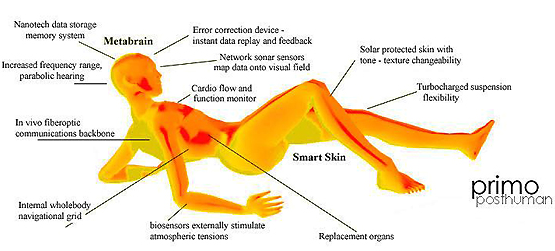 |
| Working toward the first Posthuman: courtesy of Ray Kurzweil and the Lifeboat Foundation |
In fact, the reverse engineering of the human brain has already been announced to be well under way via new microchips and accompanying software. And, while full nanobot rewiring of the brain is not expected before 2020, Phys.org has reported that our DNA has been successfully targeted by nanobots “for drug therapy or destruction.”
Taking this even one step further, Ray Kurzweil said in a new interview with The Wall Street Journal (see below) that our extension into non-biological realms will include nanobot computers that will enter our brain and connect us to Cloud computing.
From science fiction horror, directly to the human body, the nanobots are no longer speculation. Also unlike science fiction, they won’t arrive via immediate worldwide takeover — they are already here, and will be introduced incrementally, as Kurzweil has previously stated:
It will be an incremental process, one already well under way. Although version 2.0 is a grand project, ultimately resulting in the radical upgrading of all our physical and mental systems, we will implement it one benign step at a time. Based on our current knowledge, we can already touch and feel the means for accomplishing each aspect of this vision. (emphasis added)
Researchers from Columbia University have developed a fleet of molecular nanorobots that can deliver drugs to specific cells and also identify certain genetic markers by using fluorescent labeling. After such identification, a chain reaction can be initiated:
On cells where all three components are attached, a robot is functional and a fourth component (labeled 0 below) initiates a chain reaction among the DNA strands. Each component swaps a strand of DNA with another, until the end of the swap, when the last antibody obtains a strand of DNA that is fluorescently labeled.
At the end of the chain reaction—which takes less than 15 minutes in a sample of human blood—only cells with the three surface proteins are labeled with the fluorescent marker.
Naturally, this type of targeted therapeutic approach could prove beneficial, as the researchers highlight — especially for cancer treatment which sweeps up healthy cells along with malignant ones, very often doing more harm than good (if one were to choose the establishment medical route).
This is always how new technologies are sold to the public, however, and it would be naive not to consider the darker applications as well.
Direct brain modification already has been packaged as “neuroengineering.” A Wired article from early 2009 highlighted that direct brain manipulation via fiber optics is a bit messy, but once installed “it could make someone happy with the press of a button.” Nanobots take the process to an automated level, rewiring the brain molecule by molecule. Worse, these mini droids can autonomously self-replicate, forcing one to wonder how this genie would ever be put back in the bottle once unleashed.
Here is one scenario offered by Kurzweil for how these nanobots could enter our bodies:
A significant benefit of nanobot technology is that unlike mere drugs and nutritional supplements, nanobots have a measure of intelligence. They can keep track of their own inventories, and intelligently slip in and out of our bodies in clever ways. One scenario is that we would wear a special “nutrient garment” such as a belt or undershirt. This garment would be loaded with nutrient bearing nanobots, which would make their way in and out of our bodies through the skin or other body cavities. (emphasis added)
That might seem to offer a level of participatory choice — to wear or not to wear the garment — but Kurzweil reveals that the nanobots will eventually be everywhere:
Ultimately we won’t need to bother with special garments or explicit nutritional resources. Just as computation will eventually be ubiquitous and available everywhere, so too will basic metabolic nanobot resources be embedded everywhere in our environment.
In a recent interview with The Wall Street Journal, Kurzweil highlights why Google has taken an interest in nanotechnology and the possibilities he sees for humans as they increasingly become non-biological and form direct connections with computers, augmenting and/or supplanting our natural processes as we head into the era of cyborgs and beyond:
And of course once our neocortex is uploaded to the Cloud, it positions Google perfectly for searching our every thought and pre-thought. While this might sound like an impossible amount of information to upload, let alone interconnect and search, it is being announced that researchers have designed the first nanocomputer that can push beyond the concept of Moore’s Law, which imposes a theoretical limitation on the expansion of computer processing power.
The team designed and assembled, from the bottom up, a functioning, ultra-tiny control computer that is the densest nanoelectronic system ever built.
A technical paper has been published online in the Proceedings of the National Academy of Sciences on the research.
The ultra-small, ultra-low-power control processor—termed a nanoelectronic finite-state machine or “nanoFSM”—is smaller than a human nerve cell.
[…]
In their recent collaboration they combined several tiles on a single chip to produce a first-of-its-kind complex, programmable nanocomputer. (Source)
It shouldn’t be seen as coincidence that these developments are happening simultaneously. What appears on the surface to be discoveries in entirely different fields are coalescing rapidly as we approach the theoretical date of The Singularity – the full merger of human and machine – estimated to occur between 2029-2045.
Despite the benign language of futurists, we know that a concerted effort is already underway to manage and predict human behavior for a whole range of potentially anti-human applications. As our free will is also targeted like the cells of our body — for drug therapy or elimination — ethical concerns must be voiced loud and clear. Scientists seem content with opening Pandora’s Box, then worrying about negative consequences later … and that is only if we assume that their intentions are benign from the beginning. One should take time to examine the history of military experimentation on human populations to see all of this through a very different lens.
At the very least, instead of the fully realized vision of Human Body 2.0, this might be Big Pharma 2.0 — a new phase where conventional drugs are incrementally replaced by nanodrugs and nano-fleet delivery systems. Coupled with applications that directly enter our brain to connect us to the computer matrix, we are rapidly entering an entirely new human paradigm.
The funding is already there, and a massive amount of money is waiting to be made by companies like Google. Here again, for those who might only see the bright side to this technology, we ought to question who is really in control of it.
Sources:
http://phys.org/news/2013-08-dna-nanorobots-tag-cellular.html
http://www.nature.com/nnano/focus/dna-nanotechnology/index.html
http://www.nature.com/nnano/journal/v8/n8/index.html
http://blogs.wsj.com/cio/2014/02/04/googles-ray-kurzweil-envisions-new-era-of-search/
Recently by Nicholas West:
- Robots to Breed with Each Other and Humans by 2045
- Robots to Get Internet Cloud Brain: “Wikipedia For Robots”
- Amazon Patents The Use Of Predictive Behavior Technology For Future Shipments
Updated: 2/6/2014
Over 500 Lantern Fish & Deep Sea Squid Found Dead on Hawaii Shores

Image by Susan Scott. Modified.
by Christina Sarich
Natural Society
Feb 12, 2014
Mainstream media in Hawaii, via the Star Advertiser, has reported that between 500 and 800 squid and lantern fish were found dead or close to dead in the Nawiliwili Harbor area of Hawaii on Monday, January 27, prompting both state and federal officials to investigate the cause of their die off. What they won’t come right out and tell you is that this is just one of the many species possibly dying from the radioactive fallout of Fukushima. The Department of Land and Natural Resources (DLNR) says that lantern fish are typically found in the very deep ocean, and they ‘aren’t sure’ why they are showing up dead on Hawaii’s shores.
The public is being asked to look for more dying lantern fish and squid on nearby beaches and to report it to the Eyes of the Reef Network.
Scientists have already linked seal deaths in Alaska with Fukushima radiation – they suffered skim lesions, hair loss, and lethargy, and many just didn’t make it at all. Bald eagles, sea stars, small fish and even plankton are showing up dead and dying too.
Melatonin could inhibit breast cancer growth: study
 by Reuben Chow
Natural News
Feb 6, 2014
(NaturalNews) A recent study carried out by researchers from Henry Ford Hospital in Detroit and Foundation for Research Support of the State of Sao Paulo has revealed that melatonin, a hormone which regulates the body’s sleep-wake cycle, could help slow the growth of certain types of breast cancer tumors.
Published online in PLoS One, the study suggested that melatonin could inhibit tumor growth and cell production plus block new blood vessels in ER-negative breast cancer models from forming.
Melatonin is a hormone naturally made by the pineal gland, an endocrine gland in the brain. Production of melatonin takes place in the dark and is inhibited by light. Melatonin is also available in supplemental form.
Angiogenesis is the formation of new blood vessels, and one strategy used in slowing the spread of cancer is by blocking this process. For the study, the researchers looked at how melatonin affected angiogenesis in ER-negative breast cancer – they analyzed the association both in vitro and in vivo using mice.
The study team found that the tumors in the mice which were given melatonin for three weeks became significantly smaller and had less vascular growth, while the average tumor volume of the mice not given melatonin increased significantly. The in vitro studies revealed similar findings. In addition, the treated mice displayed excessive movement but neither aggressive behavior nor irritability. They also did not experience lethargy or weight loss.
BBC Propaganda: “Why I Want A Microchip Implant”
 by Michael Snyder
Activist Post
Feb 12, 2014
Would you like to have an RFID microchip implanted under your skin? If you are anything like me, you would never allow such a thing to be done. But many others, especially among the younger generations, see things very differently. RFID microchip implants and other forms of “wearable technology” are increasingly being viewed as “cool”, “trendy” and “cutting edge” by young people that wish to “enhance” themselves. And of course the mainstream media is all in favor of these “technological advancements”.
For example, the BBC just published a piece entitled “Why I Want A Microchip Implant“. We are told that such implants could solve a whole host of societal problems. Identity theft and credit card fraud would be nearly eliminated, many other forms of crime would be significantly reduced, children would never go missing and we wouldn’t have to remember a vast array of passwords and PIN numbers like we do now. We are told that if we just adopted such technology that our lives would be so much better. But is that really the case?
As our society becomes “digitally integrated”, technologists tell us that it is “inevitable” that wearable technology will become as common as smart phones are today. And the BBC article that I just mentioned is very eager for that day to arrive…
Ultimately, implanted microchips offer a way to make your physical body machine-readable. Currently, there is no single standard of communicating with the machines that underpin society – from building access panels to ATMs – but an endless diversity of identification systems: magnetic strips, passwords, PIN numbers, security questions, and dongles. All of these are attempts to bridge the divide between your digital and physical identity, and if you forget or lose them, you are suddenly cut off from your bank account, your gym, your ride home, your proof of ID, and more. An implanted chip, by contrast, could act as our universal identity token for navigating the machine-regulated world.
And for some people, that day is already here. In fact, at some technology conferences people actually line up to get chipped…
This month at the Transhuman Visions conference in San Francisco, Graafstra set up an “implantation station” offering attendees the chance to be chipped at $50 a time. Using a large needle designed for microchipping pets, Graafstra injected a glass-coated RFID tag the size of a rice grain into each volunteer. By the end of the day Graafstra had created 15 new cyborgs.
How creepy is that?
In addition, scientists have now developed batteries that are powered by the human body that could be used to provide a permanent power source for implantable technology. The following is a brief excerpt from a recent article by Kristan Harris entitled “Scientists Develop Human-Powered Battery For RFID Implantable Chips“…
A group of United States and Chinese researchers have collaborated to created a tiny implantable batteries that feed off of human energy. These thin, flexible mechanical energy harvesters have had been successfully tested on cows. The process uses what is known as conformal piezoelectric energy harvesting and storage from motions of the heart, lung, and diaphragm.
It the future, they say, it could be used to power a range of gadgets. Will it be long until you will charge your I-phone by plugging into your own body?
Of course RFID microchips don’t actually have to be implanted to be useful. In fact, they are already being used to track schoolchildren all over the United States…
Upon arriving in the morning, according to the Associated Press, each student at the CCC-George Miller preschool will don a jersey with a stitched in RFID chip. As the kids go about the business of learning, sensors in the school will record their movements, collecting attendance for both classes and meals. Officials from the school have claimed they’re only recording information they’re required to provide while receiving federal funds for their Headstart program.
And over in the UK, RFID microchips are being used to track children wherever they go all day long…
For those who think the NSA the worst invader of privacy, I invite you to share an afternoon with Aiden and Foster, two 11-year-old boys, as they wrap up a Friday at school. Aiden invites his friend home to hang out and they text their parents, who agree to the plan.
As they ride on the bus Foster’s phone and a sensor on a wristband alert the school and his parents of a deviation from his normal route. The school has been notified that he is heading to Aiden’s house so the police are not called.
As they enter the house, the integrated home network recognizes Aiden and pings an advisory to his parents, both out at work, who receive the messages on phones and tablets.
We are rapidly entering a dystopian future in which it will be “normal” for technology to monitor our movements 24 hours a day. Most people will probably welcome this change, but it also opens up the door for an oppressive government to someday greatly abuse this technology.
Another type of “wearable technology” that is rapidly gaining acceptance is “smart tattoos”.
Normally, we are accustomed to thinking of tattoos as body art. But that is about to change. Just check out this excerpt from a recent Gizmodo article…
Everyone from neurologists to biohackers is reinventing the very idea of the tattoo. With the right technology, tattoos can do a lot more than just look beautiful or badass. They can become digital devices as useful and complex as the smartphone that bounces around in your pocket. It sounds wildly futuristic, but the technology already exists.
In fact, a company called MC10 is working on a wide range of “smart tattoos” that will be able to do some pretty wild things…
Materials scientist John Rogers is doing some pretty incredible work with flexible electronics that stick to your skin like a temporary tattoo. These so-called “epidural electronics” can do anything from monitoring your body’s vital signs to alerting you when you’re starting to get a sunburn. Rogers and his company MC10 are currently trying to figure out ways to get the electronics to communicate with other devices like smartphones so that they can start building apps.
And Motorola actually has a patent for a tattoo that will take commands from unvocalized words in your throat…
The tattoo they have in mind is actually one that will be emblazoned over your vocal cords to intercept subtle voice commands — perhaps even subvocal commands, or even the fully internal whisperings that fail to pluck the vocal cords when not given full cerebral approval. One might even conclude that they are not just patenting device communications from a patch of smartskin, but communications from your soul.
They are calling it “wearable computing”, and what we are witnessing now is just the tip of the iceberg.
What we will see in the future is probably far beyond anything that any of us could imagine right now. The following is from a recent Computer World article…
But imagine a future where anything you might want to know simply appears to you without any action or effort on your part. You could be eating in a restaurant, and Google Glass could, for example, tell you that it’s the spot where your father proposed to your mother. Or that your friend will be late because of traffic, the salmon got bad reviews online, your parking meter will expire in 20 minutes, or the bathroom is through the bar and up the stairs to the right. Imagine that such knowledge could simply appear into your field of vision at the exact moment when you want to know it.
That’s where wearable computing is going.
All of this may sound very “cool” to a lot of people.
But what happens if we are all required to have “electronic identity tattoos” someday?
What happens if an oppressive government uses this technology to watch, track, monitor and control all of us 24 hours a day with this technology?
What happens if you are not able to get a job, have a bank account or buy anything without “proper identification”?
I think that you can see where I am going with this.
Technology is truly a double-edged sword. It can do great good, but it can also be used for great evil.
So what do you think about all of this? Please feel free to share your thoughts by posting a comment below…
About the author: Michael T. Snyder is a former Washington D.C. attorney who now publishes The Truth. His new thriller entitled “The Beginning Of The End” is now available on Amazon.com.
VIDEO — Weird But True! Netflix, Skype, Kindle Predicted in 1965!
Infowars
Feb 3, 2014
An article in a 1965 edition of Eagle, a British comic book, predicted the arrival of the Internet with stunning accuracy, including services similar to Skype, Netflix, Kindle and Google years before the very first rudimentary ARPANET links were even established and decades before the first incarnation of the world wide web became available to the general public.
Read the full article here – http://static.prisonplanet.com/p/imag…

 PN
PN 