
 Postscript: Turkey now claims that Syria has shot at a second plane, which was “only” in Syrian airspace for 5 minutes.Note: The Turkish jet might not have been flying at its top speed. Even so, it is likely that Syria had no time to take other action.
Syrian Rebel Terrorists Ransack Christian Churches As Corporate Media Silent
CorporateMediaExposed.com
June 27, 2012
A series of shocking images have been released that show NATO backed Syrian rebels ransacking Christian churches and, sadly, the corporate controlled media wants nothing of it.
The pictures provide even more evidence that many of the opposition members in Syria are actually al Qaeda, on top of the proof provided by a video released last year that showed, what CNN has dubbed as activists, flying the al Qaeda flag.
Remember, these are the so called activists and opposition groups that the corporate media has jammed down our throats for the last few months as they continue their propaganda push for yet another takeover of a sovereign country by NATO and the new world order.

The picture above shows a Syria “activist” (corporate media doublespeak for terrorist) posing with a Catholic cross, a gun and in a priests robe all of which are acts considered extremely disrespectful and a sin by the church.
Paul Joseph Watson, in the article that originally exposed these pictures, published a quote from the women who sent them:
“Everyone knows simply removing these garments from the church is a sin. The priest is the only one who wears them too. They even pray before putting them on. Him posing in front of the funeral car as well is disgusting to the max,” our source told us.
“They destroyed the church and went in to film it. I know this for a fact.”
“The Robes can only be worn by Deacons or Priests or Sub-Deacons, and they a Christian man wouldn’t hold a Cross in one hand and a gun in another,” the woman adds
The next picture shows the scene shortly after the terrorists looted and destroyed a church in Bustan al-Diwan (Old Homs).

The last picture again shows the destruction of yet another place of worship:

As the Syrian Opposition Groups continue to gain ground in Syria amid a huge influx of foreign weapons, scenes such as the one depicted in the pictures above may become all too commonplace.
It is also important to point out that many of the statistics that have been released as to how many civilians have been killed by Syrian government forces have actually been released by the leaders of these opposition groups and then spread by the corporate propaganda machine.
The reality on the ground is that there are clear indications that the opposition groups and possibly a third party are the ones carrying out many of the atrocities.
Assad to Turkey: Sorry about the downed jet, it could have been Israeli

Wiki Commons Image
Russia Today
June 3, 2012
Syrian President Bashar al-Assad has told a Turkish newspaper he regretted the downing of the Turkish military plane, which escalated tensions between the two countries.
“We learned that it (the plane) belonged to Turkey after shooting it down. I say 100 per cent ‘I wish we had not shot it down’,” the Cumhuriyet newspaper quoted Assad as saying in an exclusive interview published on Tuesday.
“The plane was using a corridor which Israeli planes have used three times before. Soldiers shot it down because we did not see it on our radar and because information was not given,” the Syrian president explained.
“Of course I might have been happy if this had been an Israeli plane,” Assad said.
Syrian troops shot down a Turkish RF-4E reconnaissance jet after it crossed into Syrian airspace on July 22. The incident sparked high tension between the two countries, with both building up forces in border areas.
Ankara says the plane was doing a test flight and was downed after it went back into international airspace. It says it was an act of aggression against Turkey. Damascus insists that the aircraft was engaged by air defense forces while still over Syria proper. It sees the downing as an act of self-defense.
Assad assured the newspaper that if Turkey is right about where the incident took place, Syria would not hesitate to apologize accordingly.
“We will not allow (the tensions) to turn into open combat between the two countries, which would harm them both,” he assured.
Cumhuriyet did not specify exactly when the interview took place, but in it Assad mentions Saturday’s international conference on Syria, where a new plan for transition in the country was proposed by leading world powers.
Scenarios for Syria: War & Stabilization
By Nile Bowie
theintelhub.com
July 2, 2012
Diplomatic attempts to solve the Syrian crisis have been rejected by both members of the Syrian government and the opposition.
As Ankara laments bold rhetoric and militarizes its border with Syria, this article attempts to foresee three possible outcomes to the ongoing crisis.
From the start of the crisis in Syria, the possibility of open foreign military intervention has loomed uncomfortably over the series of diplomatic measures taken in an attempt to diffuse the situation.
While earlier attempts to implement the Peace Plan have failed to materialize, Kofi Annan has proposed a new Syrian solution, mandating the creation of a transitional national unity government consisting of both representatives of Assad’s administration and members of the opposition, insinuating that Assad would not have a place in the new government [1].
Although Russian Foreign Minister Sergey Lavrov would categorically oppose the idea of foreign powers dictating the future of Syria, stating, “We will not support and cannot support any meddling from outside or any imposition of recipes.
This also concerns the fate of the president of the country, Bashar al-Assad,” a recent meeting of the “Syrian Action Group” (excluding Riyadh, Tehran and Damascus) in Geneva saw world powers agree to a basic roadmap for a Syrian-led power transition.
On June 28, 2012, two large bomb explosions targeting a government building rocked Damascus, prompting President Assad to reassert the Syrian government’s duty to “annihilate terrorists in any corner of the country,” adding, “We will not accept any non-Syrian, non-national model, whether it comes from big countries or friendly countries.
No one knows how to solve Syria’s problems as well as we do” [2]. In response to the meeting, both Syrian state media and opposition groups condemned the UN-brokered peace plan for the formation of a unity government, amid ceaseless violence across the country.
Burhan Ghalioun, a senior member and former head of the opposition Syrian National Council, offered, “this is the worst international statement yet to emerge from talks on Syria”. Ghalioun would call the UN-backed transitional plan a “mockery,” insinuating that Syrians should not have to negotiate with “their executioner, who has not stopped killing, torturing… and raping women for 16 months” [3].
From the imposition of the ceasefire, the Syrian government would claim that rebel fighters regularly ignored the Kofi Annan Peace Plan by committing various ceasefire violations, employing the use of bombing, kidnapping, murder, and arson as corroborated by Reuters in their article, “Outgunned Syria rebels make shift to bombs,” confirming that rebels had adopted tactics of suicide bombing, car bombing and the use of roadside explosions [4].
While outside elements provided arms and assistance to the militant Syrian opposition in full violation of the proposed ceasefire, the mainstream media would disproportionately lay the blame on the Syrian government for failing to meet its obligations as it attempted to restore order.
On June 21, 2012, The New York Times would confirm what alternative media outlets and numerous geopolitical analysts had been reporting since the first months of the uprising in 2011, that outside forces, including the American CIA, were supplying Syria’s rebels with weapons and material assistance from Southern Turkey.
In their article, “C.I.A. Said to Aid in Steering Arms to Syrian Opposition,” the New York Times would state:
“A small number of C.I.A. officers are operating secretly in southern Turkey, helping allies decide which Syrian opposition fighters across the border will receive arms to fight the Syrian government, according to American officials and Arab intelligence officers. The weapons, including automatic rifles, rocket-propelled grenades, ammunition and some antitank weapons, are being funneled mostly across the Turkish border by way of a shadowy network of intermediaries including Syria’s Muslim Brotherhood and paid for by Turkey, Saudi Arabia and Qatar, the officials said. The C.I.A. officers have been in southern Turkey for several weeks, in part to help keep weapons out of the hands of fighters allied with Al Qaeda or other terrorist groups, one senior American official said. The Obama administration has said it is not providing arms to the rebels, but it has also acknowledged that Syria’s neighbors would do so.
By helping to vet rebel groups, American intelligence operatives in Turkey hope to learn more about a growing, changing opposition network inside of Syria and to establish new ties. ‘C.I.A. officers are there and they are trying to make new sources and recruit people,’ said one Arab intelligence official who is briefed regularly by American counterparts. American officials and retired C.I.A. officials said the administration was also weighing additional assistance to rebels, like providing satellite imagery and other detailed intelligence on Syrian troop locations and movements. The administration is also considering whether to help the opposition set up a rudimentary intelligence service. But no decisions have been made on those measures or even more aggressive steps, like sending C.I.A. officers into Syria itself, they said” [5].
Undeniably, this confirms that the West, led by the US and its Gulf State proxies, has been undermining the Kofi Annan Peace Plan by arming insurgent fighters, particularly those of the Muslim Brotherhood, while concurrently berating the Syrian government for “violating” a UN mandated cease-fire and for “failing to protect” its population.
The implications of these mainstream admissions of state sponsored terrorism and illicit arms smuggling cast shadows of doubt over any serious implementation of the Kofi Annan Peace Plan coming to fruition.
The Brookings Institution, a US think-tank noted for its influence on American foreign policy, would release a publication in March 2012 titled, “Saving Syria: Assessing Options for Regime Change,” which called for using the UN-brokered ceasefire and the Kofi Annan Peace Plan to rearm the militant opposition to secure the toppling of the Syrian government in a bid to further Washington’s geopolitical objectives in the region [6].
Additionally, TIME Magazine’s June 25, 2012 article “A War on Two Fronts,” would describe how the US State Department budgeted over $72 million to train armed Syrian dissidents in encryption, hacking, and video production:
“Washington has said it will not actively support the Syrian opposition in its bid to oust Assad. Officially, the U.S. says it abides by the U.N process led by Kofi Annan and does not condone arms sales to opposition groups as long as there are U.N. Observers in Syria.
Nevertheless, as U.S. officials have revealed to TIME, the Obama Administration has been providing media-technology training and support to Syrian dissidents by way of small nonprofits like the Institute for War & Peace Reporting and Freedom House.
Viral videos of alleged atrocities, like the footage Abu Ghassan produced, have made Assad one of the most reviled men on the planet, helping turn the Arab League against him and embarrassing his few remaining allies almost daily. ‘If the [U.S.] government is involved in Syria, the government isn’t going to take direct responsibility for it,’ says Lawrence Lessig, director of Harvard’s Edmond J. Safra Center for Ethics. ‘The tools that you deploy in Internet freedom interfere with tools deployed by an existing government, and that can be perceived as an act of aggression.’
The program actually began four years ago with a different target: China. In 2008, Michael Horowitz, a longtime religious-liberty advocate, went to his friend Representative Frank Wolf, a Virginia Republican, and suggested setting aside funds to help Falun Gong, a religious group that Beijing has labeled a dangerous cult.
The money was supposed to help the dissident distribute software to jump China’s massive firewall and organize online as well as communicate freely with the outside world. Wolf succeeded in appropriating $15 million.
But U.S. diplomats feared that move would derail relations with Beijing, and little money was spent. Then in 2009 – 10 Iranian protests and last year’s Arab Spring made Internet freedom a much more fashionable term in Washington. Congress soon forked over an additional $57 million to State to spend in the next three years.
The money is spilt among three areas: education and training; anonymization, which masks users’ identities, usually through encryption; and circumvention technology, which allows users to overcome government censors so that their work – and that of repressive regimes – can be see worldwide.
An ongoing challenge is that the flow of software goes to both sides. The regime has imported technology from the U.S. to track people online. ‘A lot of these technologies can be used for great good,’ says Sascha Meinrath, who is leading the Internet-in-a-suitcase project, ‘but they are also a Faustian bargain.’
The Obama Administration last month issued an Executive Order imposing sanctions on any company helping Syrian or Iran commit human-rights abuses. Washington’s high-tech campaign will not dethrone Assad. But is has given Syrian dissidents a measure of confidence as they face the regime’s advantage in firepower.
In the months since finishing his training, Abu Ghassan has shot dozens of videos. Asked whether his AK-47 or his video camera is the more powerful weapon, Abu Ghassan laughs. ‘My AK!’ he says. He pauses for a few seconds. ‘Actually if there is an Internet connection, my camera is more powerful’” [7].
TIME’s report reflects the seemingly limitless degree of outside interference in the Syrian conflict, with foreign entities attempting to meticulously cultivate and shape every dimension of the situation to the detriment of the legitimate government in Syria. TIME’s report also mentions the Obama administration’s executive order imposing sanctions on any company “helping Syria or Iran commit human-rights abuses.”
Unsurprisingly, this would not include the American companies that sold the Syrian government the internet technology it uses to filter its internet services – the very services the US government has allotted substantial public funds towards to train dissidents to bypass.
The downing of a Turkish F-4 jet in late June further enflamed the situation, prompting Turkish Prime Minister Recep Erdogan to vow “proportionate” retaliation for its downed jet, pledging “all possible support to liberate the Syrians from dictatorship” of Bashar al-Assad’s government by offering support for Syrian rebels, while warning that any Syrian troops approaching Turkish borders would be considered a threat and dealt with as a military target [8].
On June 27th, 2012, Turkey sent a heavily guarded convoy of 15 long-distance guns and other military vehicles to the Syrian border, amid belligerent threats of retaliation [9].
While the situation on the Turkish-Syrian border remains tense as Turkish officials deploy 30 anti-aircraft batteries, the Turkish Defense Procurement Agency has recently announced its plans to seek a $4 billion contract for a long-range air-defense missile system [10].
Documents released by The Brookings Institution and The Council on Foreign Relations indicate that Turkey is the nation elected to lead the charge against Assad if the situation continues to deteriorate, ostensibly to annex regions of northern Syria to establish a series of long proposed “humanitarian corridors,” from which Syria’s militant opposition fighters would base their operations [11]. In reflection of the current situation, several scenarios can be proposed in an attempt to foresee how the crisis can be either diffused, or further enflamed:
• Assad ignores UN calls for an interim government and attempts to quell the insurgency by force, reflecting the conduct of nations such as Algeria, who have successfully suppressed insurgents affiliated with AQIM.
This course of action may work to further enflame the situation if outside forces increase their use of foreign mercenaries and continue to provide rebel fighters with more dangerous armaments, including chemical or biological weapons.
If Syrian security forces were unable to immediately restore order and crush the insurgency, any authentic or manufactured atrocity or incursion into Turkish territory may be enough to tip the scale in favor of open military intervention (with or without the approval of the UNSC).
If that occurred, the Turkish-Syrian border would see open exchanges of fire, with Ankara attempting to capture territory in northern Syria. Russia, Iran, and China would condemn Turkey and other allied NATO member states, with the potential of those nations opposed to regime change in Damascus offering military support to Assad. From that point, the potential for a wider regional conflict is plausible.
• Assad ignores UN calls for an interim government and succeeds in quelling the insurgency by force, causing rebel militants to disperse, surrender and take refuge in rural areas and neighboring countries. Syrian security forces would increase their operations and attempt to maintain order in population centers.
The military would secure tense areas and some form of normality would resume, although bombings and other attacks could persist on a smaller scale. Assad would step up internal security, and be portrayed as an international pariah in the international media. Syria would continue suffering under heavy economic sanctions.
If Assad continues to hold onto power, failing to deliver reforms and political pluralism, internal dissent could again become problematic, potentially shifting moderates to embrace factions of the opposition. Political turmoil would ensue, but the security situation could be stabilized if insurgent activity is successfully subdued.
• Assad accepts the interim government solution and submits his resignation, potentially encouraging insurgents to take advantage of the sensitive transitional period by increasing their operations against security forces, continuing the months of belligerent violence and killing.
If insurgents pushed forward with their campaign and were able to maintain an upper hand amid political transition, rebels would attempt to capture territory in and around population centers. Armed gangs would persecute Assad loyalists, Alawites, Shi’a, and other religious minorities such as Christians and Druze if they successfully captured territory, reflecting the conduct of Libyan LIFG fighters toward ethnic minorities and loyalists.
The interim government would struggle to maintain the security situation and likely be unable to implement coherent policy amid divisions in leadership. Political turmoil would ensue, and armed gangs could continue their campaign, amid increasing sectarian tensions.
Civilian casualties could inevitably result from all these potential scenarios, as an unintended consequence of infighting between Syrian security forces and militants in populated areas, or as an intentional act of sectarian belligerence as demonstrated by extremists in Houla and elsewhere.
The ongoing perpetuation of violence in Syria is not attributable to the dominant media narrative of Assad “butchering his own people,” but to the calculated and meticulous formation of a violent Salafist-front, directed by foreign powers to overwhelm and topple the government of Syria.
Journalist Seymour Hersh’s 2007 exposé published in the New Yorker titled, “The Redirection,” exposed a joint US-Israeli-Saudi operation to create a violent extremist Sunni-front to direct at the Shi’a leadership of Hezbollah in Lebanon, President Bashar al-Assad in Syria, and the Iranian government, using extremist forces with direct ties to Al Qaeda in proxy. The New Yorker would report the testimony of a former senior intelligence official and US government consultant:
“We are in a program to enhance the Sunni capability to resist Shiite influence, and we’re spreading the money around as much as we can,” the former senior intelligence official said. The problem was that such money “always gets in more pockets than you think it will,” he said. “In this process, we’re financing a lot of bad guys with some serious potential unintended consequences. We don’t have the ability to determine and get pay vouchers signed by the people we like and avoid the people we don’t like. It’s a very high-risk venture” [12].
While Kofi Annan’s original Peace Plan – if honestly implemented with both sides respecting the cease-fire – would have defused the situation, it is Annan and the member nations of NATO and the Gulf Cooperation Council that disproportionately laid the blame for increasing violence solely on the Syrian government, while those nations took every measure possible to further enflame the situation by providing material assistance to sectarian extremists.
Considering the level of subversion and deceit demonstrated by foreign powers operating in Syria, Bashar al-Assad’s ambitions to crush sectarian fighters by force may well be warranted.
As with many other Western-backed uprisings operating under the cover of “democratic” jargon, the use of violence, snipers, mercenaries, and other armed provocateurs is part of a long established pattern of national destabilization through the barrel of a gun. Undoubtedly, there will come a time when those responsible individuals answer for their crimes against the nation of Syria, and it’s people.
Note
[1] Kofi Annan proposes Syria ‘unity government,’ Al Jazeera, June 28, 2012
[2] Annan ‘optimistic’ about Syria talks, Tehran Times, June 29, 2012
[3] Syria transition plan denounced by both sides, Al Jazeera, July 1, 2012
[4] Outgunned Syria rebels make shift to bombs, Reuters, April 30, 2012
[5] C.I.A. Said to Aid in Steering Arms to Syrian Opposition, The New York Times, June 21, 2012
[6] Saving Syria: Assessing Options for Regime Change, The Brookings Institution, March 2012
[7] Hillary’s Little Startup: How the U.S. Is Using Technology to Aid Syria’s Rebels, TIME Magazine, June 13, 2012
[8] Turkish PM vows to help ‘liberate Syria from dictatorship,’ Russia Today, June 26, 2012
[9] Ankara deploys military convoy to Syrian border: Turkish media, PressTV, June 28, 2012
[10] Missile shopping: Turkey to buy long-range missile system, Russia Today, June 29, 2012
[11] U.S.-Turkey Relations: A New Partnership, The Council on Foreign Relations, May 9, 2012
[12] The Redirection, The New Yorker, March 5, 2007
Nile Bowie is an independent writer and photojournalist based in Kuala Lumpur, Malaysia; he regularly contributes to Tony Cartalucci’s Land Destroyer Report and Professor Michel Chossudovsky’s Global Research Twitter: @NileBowie
‘Terrorist attack’ on Syrian TV headquarters kills seven
PressTV
June 27, 2012
Three staff members of the Al-Ikhbariya satellite television channel in Syria and four guards have been killed in a “terrorist attack” on the headquarters of the television in the capital Damascus.
The official Syrian news agency, SANA, said the assailants also ransacked the offices of the television station in the attack that was carried out during the early hours of Wednesday.
Syrian Information Minister Omran al-Zohbi told SANA TV in a live interview that the “terrorist groups stormed the offices of Al-Ikhbariya, planted explosives in the studios and blew them up along with the equipment.”
SYRIA: Cold War II, Edging Closer to a “Hot War”? [video included]
Turkish Jet Flying 100 Meters above the Water 1 Mile from Syrian Coast
Washington’s Blog
June 26, 2012
Syria Had 2.5 Seconds to React to Turkish Jet Flying Only 100 Meters Above the Water Just One Mile from Syrian Land
Syria Had No Time to Take Any Other Action
The world is already in Cold War 2.0 in Syria. Now we are edging closer to a hot war.
Self-defense has been a recognized legal right for thousands of years.
But when empires wish to go to war against a country, self-defense is seen as a criminal causus belli. For example, Turkey admits that its fighter jet was in Syrian territory when it was shot down.
Indeed, the Turkish fighter jet was flying very low and very close to the Syrian shoreline:
“The plane disappeared and then reappeared in Syrian airspace, flying at 100 meters altitude and about 1-2kms (0.6-1.2 miles) from the Syrian coast,” Syrian Foreign Ministry spokesman Jihad Makdissi told a Damascus news conference.
“We had to react immediately, even if the plane was Syrian we would have shot it down,” he said. “The Syrian response was an act of defense of our sovereignty carried out by anti-aircraft machinegun which has a maximum range of 2.5 km.”
And yet Turkey is calling Syria the aggressor:
In a letter to the U.N. Security Council, Turkey condemned the “hostile act by the Syrian authorities against Turkey’s national security”, saying it posed “a serious threat to peace and security in the region”.
Specifically, the Turkish president:
Put the onus on Syria to explain why its army chose to shoot first, rather than try to establish radio contact, fire warning shots or even send up aircraft when the F4 crossed into Syrian territory.
However, the Turkish jet – a McDonnel Douglas F4 Phantom – had a top speed of 1,485 miles per hour.
If the Syrians spotted the jet one mile away, that means that they would have had 2.5 seconds to react (1,425 mph ÷ 60 minutes in an hour ÷ 60 seconds in a minute equals .4 miles per second; so it would take 2.5 seconds to travel 1 mile).
2.5 seconds is not long enough to try to establish radio contact, fire warning shots or send up aircraft. Therefore, Syria had only 2 choices: shoot the jet down, or let it fly over Syrian land.
This is allegedly footage shot with an iPhone of the actual shootdown of the Turkish jet:
|
Here is a still from that video, purportedly showing the jet crashing into the ocean:
Postscript: Turkey now claims that Syria has shot at a second plane, which was “only” in Syrian airspace for 5 minutes.Note: The Turkish jet might not have been flying at its top speed. Even so, it is likely that Syria had no time to take other action. |
|
| Global Research Articles by Washington’s Blog | |
The Crusade for Syria: A Big Lie
COLOR REVOLUTIONS AND GEOPOLITICS

The Neocon Propaganda Machine Pushing “Regime Change” In Syria: A Torrent of Disinformation
By Aisling Byrne
Originally published in Counterpunch
January 6-8, 2012
Images and captions added by Color Revolutions and Geopolitics
“War with Iran is already here,” wrote a leading Israeli commentator recently, describing “the combination of covert warfare and international pressure” being applied to Iran.
Although not mentioned, the “strategic prize” of the first stage of this war on Iran is Syria; the first campaign in a much wider sectarian power-bid. “Other than the collapse of the Islamic Republic itself,” Saudi King Abdullah was reported to have said last summer, “nothing would weaken Iran more than losing Syria.”
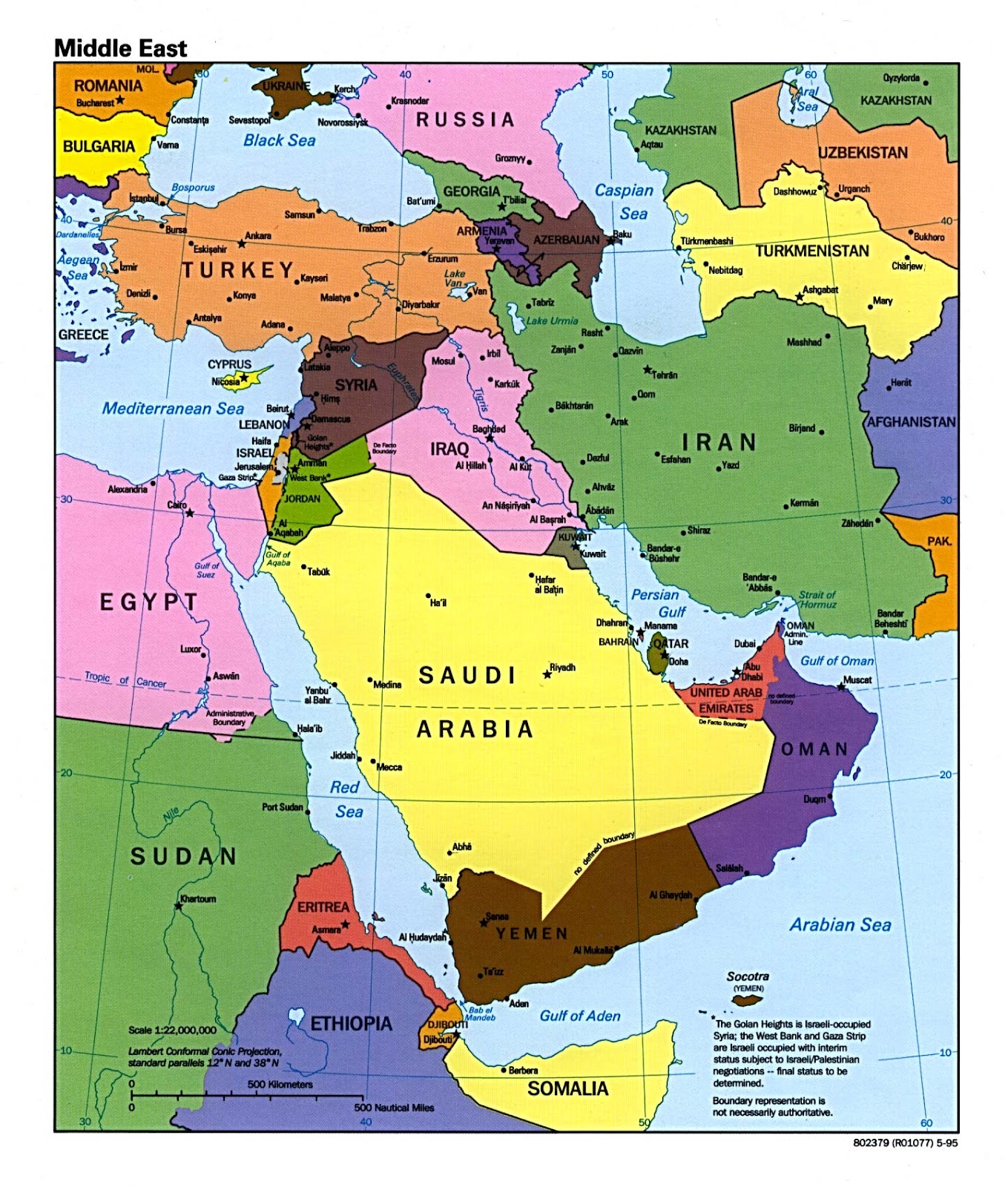 |
| Click on map to enlarge |
By December, senior United States officials were explicit about their regime change agenda for Syria: Tom Donilon, the US National Security Adviser, explained that the “end of the [President Bashar al-] Assad regime would constitute Iran’s greatest setback in the region yet – a strategic blow that will further shift the balance of power in the region against Iran.”
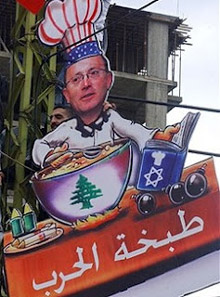 |
| Feltman servin’ “regime change” |
Shortly before, a key official in terms of operationalizing this policy, Under Secretary of State for the Near East Jeffrey Feltman, had stated at a congressional hearing that the US would “relentlessly pursue our two-track strategy of supporting the opposition and diplomatically and financially strangling the [Syrian] regime until that outcome is achieved”.
What we are seeing in Syria is a deliberate and calculated campaign to bring down the Assad government so as to replace it with a regime “more compatible” with US interests in the region.
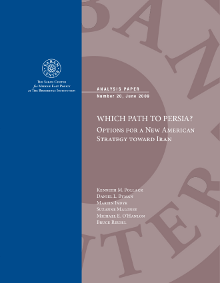 |
| Which Path to Persia? (PDF) |
The blueprint for this project is essentially a report produced by the neo-conservative Brookings Institute for regime change in Iran in 2009. The report – “Which Path to Persia?” – continues to be the generic strategic approach for US-led regime change in the region.
A rereading of it, together with the more recent “Towards a Post-Assad Syria” (which adopts the same language and perspective, but focuses on Syria, and was recently produced by two US neo-conservative think-tanks) illustrates how developments in Syria have been shaped according to the step-by-step approach detailed in the “Paths to Persia” report with the same key objective: regime change.
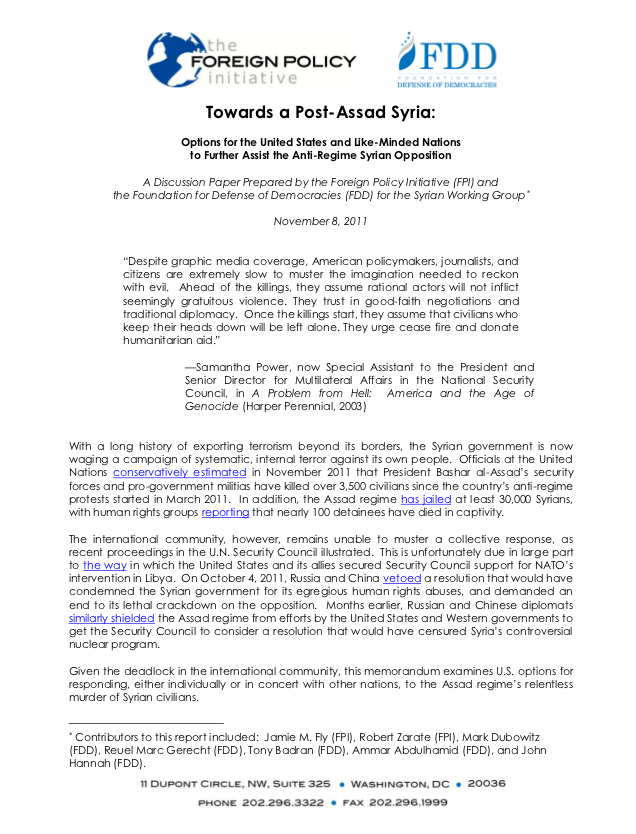 |
| “Toward a Post-Assad Syria” (PDF) |
The authors of these reports include, among others, John Hannah and Martin Indyk, both former senior neo-conservative officials from the George W Bush/Dick Cheney administration, and both advocates for regime change in Syria. Not for the first time are we seeing a close alliance between US/British neo-cons with Islamists (including, reports show, some with links to al-Qaeda) working together to bring about regime change in an “enemy” state.
Arguably, the most important component in this struggle for the “strategic prize” has been the deliberate construction of a largely false narrative that pits unarmed democracy demonstrators being killed in their hundreds and thousands as they protest peacefully against an oppressive, violent regime, a “killing machine” led by the “monster” Assad.
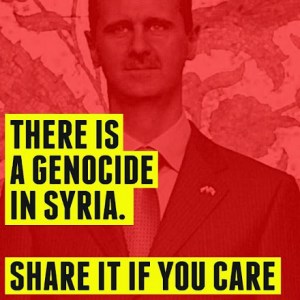

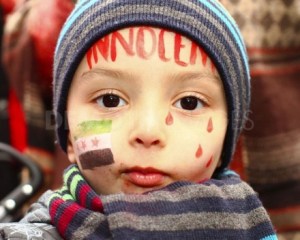
Whereas in Libya, the North Atlantic Treaty Organization (NATO) claimed it had “no confirmed reports of civilian casualties” because, as the New York Times wrote recently, “the alliance had created its own definition for ‘confirmed’: only a death that NATO itself investigated and corroborated could be called confirmed”.
“But because the alliance declined to investigate allegations,” the Times wrote, “its casualty tally by definition could not budge – from zero”.
In Syria, we see the exact opposite: the majority of Western mainstream media outlets, along with the media of the US’s allies in the region, particularly al-Jazeera and the Saudi-owned al-Arabiya TV channels, are effectively collaborating with the “regime change” narrative and agenda with a near-complete lack of questioning or investigation of statistics and information put out by organizations and media outlets that are either funded or owned by the US/European/Gulf alliance – the very same countries instigating the regime change project in the first place.
Claims of “massacres”, “campaigns of rape targeting women and girls in predominantly Sunni towns” ”torture” and even “child-rape” are reported by the international press based largely on two sources – the British-based Syrian Observatory of Human Rights and the Local Co-ordination Committees (LCCs) – with minimal additional checking or verification.
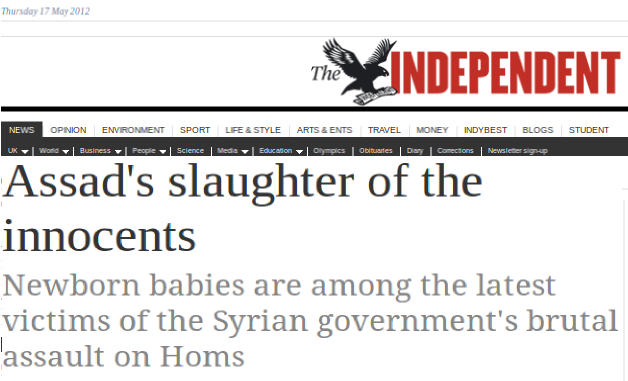
Hiding behind the rubric – “we are not able to verify these statistics” – the lack of integrity in reporting by the Western mainstream media has been starkly apparent since the onset of events in Syria. A decade after the Iraq war, it would seem that no lessons from 2003 – from the demonization of Saddam Hussein and his purported weapons of mass destruction – have been learnt.
Of the three main sources for all data on numbers of protesters killed and numbers of people attending demonstrations – the pillars of the narrative – all are part of the “regime change” alliance.
The Syrian Observatory of Human Rights, in particular, is reportedly funded through a Dubai-based fund with pooled (and therefore deniable) Western-Gulf money (Saudi Arabia alone has, according to Elliot Abrams allocated US$130 billion to “palliate the masses” of the Arab Spring).
What appears to be a nondescript British-based organization, the Observatory has been pivotal in sustaining the claims of the mass killing of thousands of peaceful protesters using inflated figures, “facts”, and often exaggerated claims of “massacres” and even recently “genocide”.
Although it claims to be based in its director’s house, the Observatory has been described as the “front office” of a large media propaganda set-up run by the Syrian opposition and its backers. The Russian Foreign Ministry stated starkly:
 |
| At the Syrian Observatory for Human Rights headquarters: “No! I told you, I don’t eat pepperoni! Give me 30 larges…all of them veggie…with artichoke, spinach, and tomato! And get them here quick! I’ve got a whole night of regime change ahead of me!” |
The agenda of the [Syrian] transitional council [is] composed in London by the Syrian Observatory [for] Human Rights … It is also there where pictures of ‘horror’ in Syria are made to stir up hatred towards Assad’s regime.
The Observatory is not legally registered either as a company or charity in the United Kingdom, but operates informally; it has no office, no staff and its director is reportedly awash with funding.
It receives its information, it says, from a network of “activists” inside Syria; its English-language website is a single page with al-Jazeera instead hosting a minute-by-minute live blog page for it since the outset of protests.
 |
| Local Coordination Committees |
The second, the LCCs, are a more overt part of the opposition’s media infrastructure, and their figures and reporting is similarly encompassed only [16] within the context of this main narrative: in an analysis of their daily reports, I couldn’t find a single reference to any armed insurgents being killed: reported deaths are of “martyrs”, “defector soldiers”, people killed in “peaceful demonstrations” and similar descriptions.
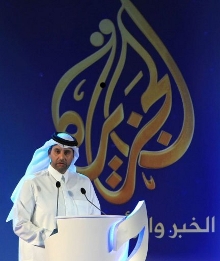
The third is al-Jazeera, whose biased role in “reporting” the Awakenings has been well documented. Described by one seasoned media analyst as the “sophisticated mouthpiece of the state of Qatar and its ambitious emir”, al-Jazeera is integral to Qatar’s “foreign-policy aspirations”.
 |
| Sheikh Hamad bin Thamer Al Thani |
Al-Jazeera has, and continues, to provide technical support, equipment, hosting and “credibility” to Syrian opposition activists and organizations. Reports show that as early as March 2011, al-Jazeera was providing messaging and technical support to exiled Syrian opposition activists , who even by January 2010 were co-ordinating their messaging activities from Doha.
Nearly 10 months on, however, and despite the daily international media onslaught, the project isn’t exactly going to plan: a YouGov poll commissioned by the Qatar Foundation showed last week that 55 per cent of Syrians do not want Assad to resign and 68 per cent of Syrians disapprove of the Arab League sanctions imposed on their country.
According to the poll, Assad’s support has effectively increased since the onset of current events – 46 per cent of Syrians felt Assad was a “good” president for Syria prior to current events in the country – something that certainly doesn’t fit with the false narrative being peddled.
As if trumpeting the success of their own propaganda campaign, the poll summary concludes:
“The majority of Arabs believe Syria’s President Basher al-Assad should resign in the wake of the regime’s brutal treatment of protesters … 81% of Arabs [want] President Assad to step down. They believe Syria would be better off if free democratic elections were held under the supervision of a transitional government.”
One is left wondering who exactly is Assad accountable to – the Syrian people or the Arab public? A blurring of lines that might perhaps be useful as two main Syrian opposition groups have just announced that while they are against foreign military intervention, they do not consider “Arab intervention” to be foreign.
Unsurprisingly, not a single mainstream major newspaper or news outlet reported the YouGov poll results – it doesn’t fit their line.
In the UK, the volunteer-run Muslim News was the only newspaper to report the findings; yet only two weeks before in the immediate aftermath of the suicide explosions in Damascus, both the Guardian, like other outlets, within hours of the explosions were publishing sensational, unsubstantiated reports from bloggers, including one who was “sure that some of the bodies … were those of demonstrators”.
“They have planted bodies before,” he said; “they took dead people from Dera’a [in the south] and showed the media bodies in Jisr al-Shughour [near the Turkish border.]”
Recent reports have cast serious doubt on the accuracy of the false scenario peddled daily by the mainstream international press, in particular information put out by the Syrian Observatory for Human Rights and the LCCs.
In December, the mainstream US intelligence group Stratfor cautioned:
Most of the [Syrian] opposition’s more serious claims have turned out to be grossly exaggerated or simply untrue … revealing more about the opposition’s weaknesses than the level of instability inside the Syrian regime.

Throughout the nine-month uprising, Stratfor has advised caution on accuracy of the mainstream story on Syria: in September it commented that “with two sides to every war … the war of perceptions in Syria is no exception”.
Syrian Observatory for Human Rights and LCC reports, “like those from the regime, should be viewed with skepticism”, argues Stratfor; “the opposition understands that it needs external support, specifically financial support, if it is to be a more robust movement than it is now. To that end, it has every reason to present the facts on the ground in a way that makes the case for foreign backing.”
 |
| Sergey Lavrov |
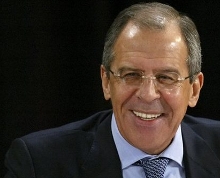
As Russian Foreign Minister Sergey Lavrov observed: “It is clear that the purpose is to provoke a humanitarian catastrophe, to get a pretext to demand external interference into this conflict.” Similarly, in mid-December, American Conservative reported:
“CIA [Central Intelligence Agency] analysts are skeptical regarding the march to war. The frequently cited United Nations report that more than 3,500 civilians have been killed by Assad’s soldiers is based largely on rebel sources and is uncorroborated. The Agency has refused to sign off on the claims.
“Likewise, accounts of mass defections from the Syrian army and pitched battles between deserters and loyal soldiers appear to be a fabrication, with few defections being confirmed independently. Syrian government claims that it is being assaulted by rebels who are armed, trained and financed by foreign governments are more true than false.”
As recently as November, the Free Syria Army implied their numbers would be larger, but, as they explained to one analyst, they are “advising sympathizers to delay their defection” until regional conditions improve.
A guide to regime change
In relation to Syria, section three of the “Paths to Persia” report is particularly relevant – it is essentially a step-by-step guide detailing options for instigating and supporting a popular uprising, inspiring an insurgency and/or instigating a coup. The report comes complete with a “Pros and Cons” section:
“An insurgency is often easier to instigate and support from abroad … Insurgencies are famously cheap to support … covert support to an insurgency would provide the United States with “plausibility deniability” … [with less] diplomatic and political backlash … than if the United States were to mount a direct military action … Once the regime suffers some major setback [this] provides an opportunity to act.”
Military action, the report argues, would only be taken once other options had been tried and shown to have failed as the “international community” would then conclude of any attack that the government “brought it on themselves” by refusing a very good deal.
Key aspects for instigating a popular uprising and building a “full-fledged insurgency” are evident in relation to developments in Syria.
These include:
“Funding and helping organize domestic rivals of the regime” including using “unhappy” ethnic groups;
“Building the capacity of ‘effective oppositions’ with whom to work” in order to “create an alternative leadership to seize power”;
Provision of equipment and covert backing to groups, including arms – either directly or indirectly, as well as “fax machines … Internet access, funds” (on Iran the report noted that the “CIA could take care of most of the supplies and training for these groups, as it has for decades all over the world”);
Training and facilitation of messaging by opposition activists;
Constructing a narrative “with the support of US-backed media outlets could highlight regime shortcomings and make otherwise obscure critics more prominent” – “having the regime discredited among key ‘opinion shapers’ is critical to its collapse”;
The creation of a large funding budget to fund a wide array of civil-society-led initiatives (a so-called “$75 million fund” created under former US secretary of state Condoleezza Rice-funded civil society groups, including “a handful of Beltway-based think-tanks and institutions [which] announced new Iran desks)” ;
The need for an adjacent land corridor in a neighboring country “to help develop an infrastructure to support operations”.
“Beyond this,” continues the report, “US economic pressure (and perhaps military pressure as well) can discredit the regime, making the population hungry for a rival leadership.” The US and its allies, particularly Britain and France, have funded and helped “shape” the opposition from the outset – building both on attempts started by the US in 2006 to construct a unified front against the Assad government, and the perceived “success” of the Libyan Transitional National Council model.
Despite months of attempts – predominately by the West – at cajoling the various groups into a unified, proficient opposition movement, they remain “a diverse group, representing the country’s ideological, sectarian and generational divides”. ”There neither has been nor is [there] now any natural tendency towards unity between these groups, since they belong to totally different ideological backgrounds and have antagonistic political views,” one analyst concluded. At a recent meeting with the British foreign secretary, the different groups would not even meet with William Hague together, instead meeting him separately.
 |
Nevertheless, despite a lack of cohesion, internal credibility and legitimacy, the opposition, predominately under the umbrella of the Syrian National Council (SNC), is being groomed for office. This includes capacity-building, as confirmed by the former Syrian ambassador to the US, Rafiq Juajati, now part of the opposition. At a closed briefing in Washington DC in mid-December 2011, he confirmed that the US State Department and the SWP-German Institute for International and Security Affairs (a think-tank that provides foreign policy analysis to the German government) were funding a project that is managed by the US Institute for Peace and SWP, working in partnership with the SNC, to prepare the SNC for the takeover and running of Syria.
 |
| Burhan Ghaliyoun: failed attempt at “unity” |
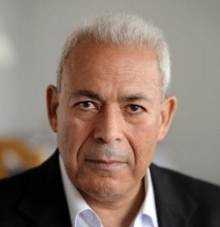
In a recent interview, SNC leader Burhan Ghaliyoun disclosed (so as to “speed up the process” of Assad’s fall) the credentials expected of him: “There will be no special relationship with Iran,” he said. “Breaking the exceptional relationship means breaking the strategic, military alliance,” adding that “after the fall of the Syrian regime, [Hezbollah] won’t be the same.” Described in Slate magazine as the “most liberal and Western-friendly of the Arab Spring uprisings”, Syrian opposition groups sound as compliant as their Libyan counterparts prior to the demise of Muammar Gaddafi, whom the New York Times described as “secular-minded professionals – lawyers, academics, businesspeople – who talk about democracy, transparency, human rights and the rule of law”; that was, until reality transitioned to former leader of the Libyan Islamist Fighting Group Abdulhakim Belhaj and his jihadi colleagues. The import of weapons, equipment, manpower (predominantly from Libya) and training by governments and other groups linked to the US, NATO and their regional allies began in April-May 2011, according to various reports and is co-ordinated out of the US air force base at Incirlik in southern Turkey. From Incirlik, an information warfare division also directs communications to Syria via the Free Syria Army. This covert support continues, as American Conservative reported in mid-December:
“Unmarked NATO warplanes are arriving at Turkish military bases close to Iskenderum on the Syrian border, delivering weapons … as well as volunteers from the Libyan Transitional National Council … Iskenderum is also the seat of the Free Syrian Army, the armed wing of the Syrian National Council. French and British special forces trainers are on the ground, assisting the Syrian rebels while the CIA and US Spec Ops are providing communications equipment and intelligence to assist the rebel cause, enabling the fighters to avoid concentrations of Syrian soldiers.”
The Washington Post exposed in April 2011 that recent WikiLeaks showed that the US State Department had been giving millions of dollars to various Syrian exile groups (including the Muslim Brotherhood-affiliated Movement for Justice and Development in London) and individuals since 2006 via its “Middle East Partnership Initiative” administered by a US foundation, the Democracy Council.
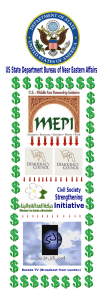
WikiLeaks cables confirmed that well into 2010, this funding was continuing, a trend that not only continues today but which has expanded in light of the shift to the “soft power” option aimed at regime change in Syria. As this neo-con-led call for regime change in Syria gains strength within the US administration, so too has this policy been institutionalized among leading US foreign policy think-tanks, many of whom have “Syria desks” or “Syria working groups” which collaborate closely with Syrian opposition groups and individuals (for example USIP and the Foundation for the Defense of Democracy) and which have published a range of policy documents making the case for regime change. In the UK, the similarly neo-con Henry Jackson Society (which “supports the maintenance of a strong military, by the United States, the countries of the European Union and other democratic powers, armed with expeditionary capabilities with a global reach” and which believes that “only modern liberal democratic states are truly legitimate”) is similarly pushing the agenda for regime change in Syria. This is in partnership with Syrian opposition figures including Ausama Monajed, a former leader of the Syrian exile group, the Movement for Justice & Development, linked to the Muslim Brotherhood, which was funded by the US State Department from 2006, as we know from WikiLeaks. Monajed, a member of the SNC, currently directs a public relations firm recently established in London and incidentally was the first to use the term “genocide” in relation to events in Syria in a recent SNC press release.
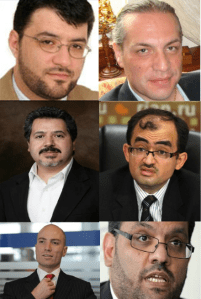 |
| The well-paid Syrian exile community (clockwise from top left): Malik Al Abdah, Ammar Abdulhamid, Radwan Ziadeh, Anas Al Abdah, Ausama Monajed, and Najib Ghadbian. We provide selected biographies of these individuals in an addendum below. |
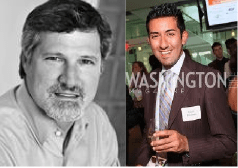 |
| As one Wikileaks cable shows, the visits to Syria of Democracy Council founder James Prince (Left) and U.S. State Department Foreign Affairs Officer Joseph Barghout (Right) were of concern to the Syrian government, due in part to the financing of oppositional exile groups based in London and Washington and their development of organizational links within the country. |
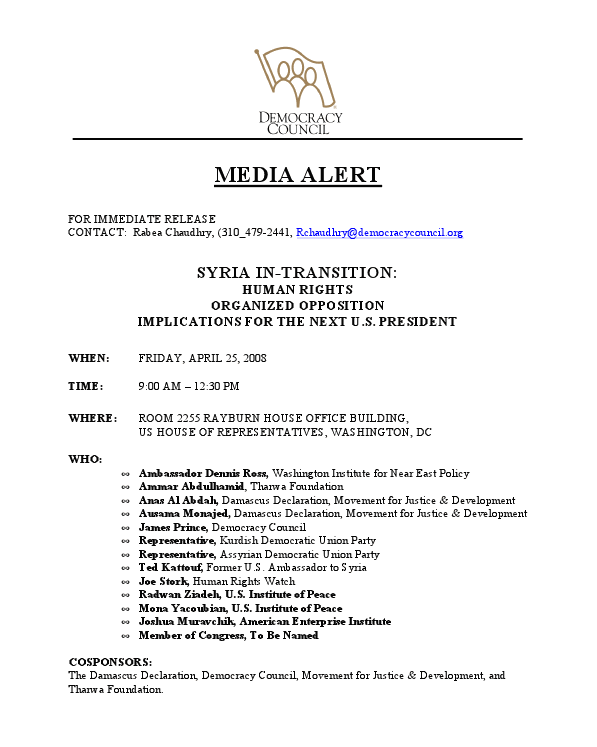 |
| Syria In-Transition conference at the United States Congress, Washington D.C., April 25, 2008, sponsored by recipients of U.S. State Department (Middle East Partnership Initiative) grants, including the Democracy Council and the Movement for Justice and Development. Click on image to enlarge. |
Since the outset, significant pressure has been brought to bear on Turkey to establish a “humanitarian corridor” along its southern border with Syria. The main aim of this, as the “Paths to Persia” report outlines, is to provide a base from which the externally-backed insurgency can be launched and based. The objective of this “humanitarian corridor” is about as humanitarian as the four-week NATO bombing of Sirte when NATO exercised its “responsibility to protect” mandate, as approved by the UN Security Council.
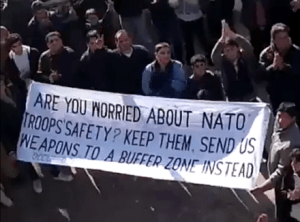 |
| More detailed instructions from “democracy activists” about what the “international community” needs to do. |
All this is not to say that there isn’t a genuine popular demand for change in Syria against the repressive security-dominated infrastructure that dominates every aspect of people’s lives, nor that gross human-rights violations have not been committed, both by the Syrian security forces, armed opposition insurgents, as well as mysterious third force characters operating since the onset of the crisis in Syria, including insurgents, mostly jihadis from neighboring Iraq and Lebanon, as well as more recently Libya, among others.
Such abuses are inevitable in low-intensity conflict. Leading critics of this US-France-UK-Gulf-led regime change project have, from the outset, called for full accountability and punishment for any security or other official “however senior”, found to have committed any human-rights abuses.
Ibrahim al-Amine writes that some in the regime have conceded “that the security remedy was damaging in many cases and regions [and] that the response to the popular protests was mistaken … it would have been possible to contain the situation via clear and firm practical measures – such as arresting those responsible for torturing children in Deraa”. And it argues that the demand for political pluralism and an end to the all-encompassing repression is both vital and urgent.
But what may have began as popular protests, initially focused on local issues and incidents (including the case of the torture of young boys in Dera’a by security forces) were rapidly hijacked by this wider strategic plan for regime change. Five years ago, I worked in northern Syria with the United Nations managing a large community development project.
After evening community meetings, it wasn’t uncommon to find the mukhabarat (military intelligence) waiting for us to vacate the room so they could scan flipcharts posted on the walls. That almost every aspect of people’s daily lives was regulated by a sclerotic dysfunctional Ba’ath party/security bureaucracy, devoid of any ideology apart from the inevitable corruption and nepotism that comes with authoritarian power, was apparent in every feature of people’s lives.
Tuesday, December 20 was reportedly the “deadliest day of the nine-month [Syrian] uprising “with the “organized massacre” of a “mass defection” of army deserters widely reported by the international press in Idlib, northern Syria. Claiming that areas of Syria were now “exposed to large-scale genocide”, the SNC lamented the “250 fallen heroes during a 48-hour period”, citing figures provided by the Syrian Observatory for Human Rights. Quoting the same source, the Guardian reported that the Syrian army was:
“… hunt[ing] down deserters after troops … killed close to 150 men who had fled their base”. A picture has emerged … of a mass defection … that went badly wrong … with loyalist forces positioned to mow down large numbers of defectors as they fled a military base. Those who managed to escape were later hunted down in hideouts in nearby mountains, multiple sources have reported. The Syrian Observatory for Human Rights estimated that 100 deserters were besieged, then killed or wounded. Regular troops allegedly also hunted down residents who had given shelter to the deserters.”
The Guardian’s live blog-quoted AVAAZ, the citizen political advocacy/public relations group, which “claimed 269 people had been killed in the clashes”, and cited AVAAZ’s precise breakdown of casualties: “163 armed revolutionaries, 97 government troops and 9 civilians”. They noted that AVAAZ “provided nothing to corroborate the claim.”
The Washington Post reported only that they had spoken to “an activist with the rights group AVAAZ [who] said he had spoken to local activists and medical groups who put the death toll in that area Tuesday at 269.”
A day after initial reports of the massacre of fleeing deserters, however, the story had changed. On December 23, the Telegraph reported:
“At first they were said to be army deserters attempting to break into Turkey to join the FSA [Free Syrian Army], but they are now said to be unarmed civilians and activists attempting to escape the army’s attempts to bring the province back under control. They were surrounded by troops and tanks and gunned down until there were no survivors, according to reports.”
The New York Times had, on December 21, reported that the “massacre”, citing the Syrian Observatory of Human Rights, was of “unarmed civilians and activists, with no armed military defectors among them, the rights groups said.”
It quoted the head of the Observatory who described it as “an organized massacre” and said his account corroborated a Kfar Owaid witness’ account: “The security forces had lists of names of those who organized massive anti-regime protests … the troops then opened fire with tanks, rockets and heavy machine guns [and], bombs filled with nails to increase the number of casualties.”
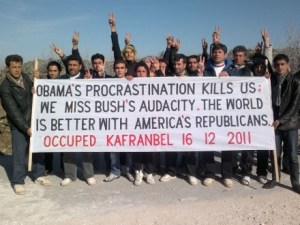 |
| How do you say “procrastination” in Arabic? |
The LA Times quoted an activist it had spoken to via satellite connection who, from his position “sheltering in the woods” commented: “The word ‘massacre’ seems like too small a word to describe what happened.” Meanwhile, the Syrian government reported that on December 19 and 20, it had killed “tens” of members of “armed terrorist gangs” in both Homs and Idlib, and had arrested many wanted individuals.
The truth of these two “deadly” days will probably never be known – the figures cited above (between 10-163 armed insurgents, 9-111 unarmed civilians and 0-97 government forces) differ so significantly in both numbers reported killed and who they were, that the “truth” is impossible to establish.
In relation to an earlier purported “massacre” in Homs, a Stratfor investigation found “no signs of a massacre”, concluding that “opposition forces have an interest in portraying an impending massacre, hoping to mimic the conditions that propelled a foreign military intervention in Libya”.
Nevertheless, the “massacre” of December 19-20 in Idlib was reported as fact, and was etched into the narrative of Assad’s “killing machine.”
Both the recent UN Human Rights Commissioner’s report and a recent data blog report on reported deaths in “Syria’s bloody uprising” by the Guardian (published December 13) – two examples of attempts to establish the truth about numbers killed in the Syrian conflict – rely almost exclusively on opposition-provided data: interviews with 233 alleged “army defectors” in the case of the UN report, and on reports from the Syrian Human Rights Observatory, the LCCs and al-Jazeera in the case of the Guardian’s data blog.
The Guardian reports a total of 1,414.5 people (sic) killed – including 144 Syrian security personnel – between January and November 21, 2011. Based solely on press reports, the report contains a number of basic inaccuracies (eg sources not matching numbers killed with places cited in original sources): their total includes 23 Syrians killed by the Israeli army in June on the Golan Heights; 25 people reported “wounded” are included in total figures for those killed, as are many people reported shot.
The report makes no reference to any killings of armed insurgents during the entire 10-month period – all victims are “protesters”, “civilians” or “people” – apart from the 144 security personnel.
Seventy percent of the report’s data sources are from the Syrian Observatory for Human Rights, the LCCs and “activists”; 38 per cent of press reports are from al-Jazeera, 3 per cent from Amnesty International and 1.5 per cent from official Syrian sources.
In response to the UN Commissioner’s report, Syria’s ambassador to the UN commented: “How could defectors give positive testimonies on the Syrian government? Of course they will give negative testimonies against the Syrian government. They are defectors.”
In the effort to inflate figures of casualties, the public relations-activist group AVAAZ has consistently outstripped even the UN. AVAAZ has publicly stated it is involved in “smuggling activists … out of the country”, running “secret safe houses to shelter … top activists from regime thugs” and that one “AVAAZ citizen journalist” “discover[ed] a mass grave”.
It states proudly that the BBC and CNN have said that AVAAZ data amounts to some 30 per cent of their news coverage of Syria. The Guardian reported AVAAZ’s latest claim to have “evidence” of killings of some 6,200 people (including security forces and including 400 children), claiming 617 of whom died under torture – their justification to have verified each single death with confirmation by three people, “including a relative and a cleric who handled the body” is improbable in the extreme.
The killing of one brigadier-general and his children in April last year in Homs illustrates how near impossible it is, particularly during sectarian conflict, to verify even one killing – in this case, a man and his children:
The general, believed to be Abdu Tallawi, was killed with his children and nephew while passing through an agitated neighborhood. There are two accounts of what happened to him and his family, and they differ about the victim’s sect.
Regime loyalists say that he was killed by takfiris – hardline Islamists who accuse other Muslims of apostasy – because he belonged to the Alawite sect. The protesters insist that he is a member of the Tallawi family from Homs and that he was killed by security forces to accuse the opposition and destroy their reputation. Some even claim that he was shot because he refused to fire at protesters.
The third account is ignored due to the extreme polarization of opinions in the city [Homs]. The brigadier-general was killed because he was in a military vehicle, even though he had his kids with him. Whoever killed him was not concerned with his sect but with directing a blow to the regime, thus provoking an even harsher crackdown, which, in turn, would drag the protest movement into a cycle of violence with the state.
Editors’ Addendum (The Syrian Exiles):
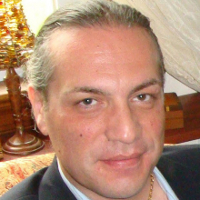
Ammar Abdulhamid (born 1966)
- Currently lives in Washington D.C.
- Formerly a Visiting Fellow at the Saban Center for Near East Policy at the Brookings Institution, 2004-2006
- Fellow at the Foundation for Defense of Democracies
- Co-founder, Tharwa Foundation
- Co-founder, DarEmar
- Co-founder, Hands Across the Mideast Support Alliance (HAMSA)
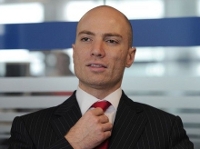
Ausama Monajed (Born 1980)
- Currently lives in London (UK)
- Member, Syrian National Council (advisor to the Secretary General)
- Founder and Director of UK-based opposition TV channel, Barada Television
- Executive Board member of Movement for Justice and Development
- Economist and Project Manager for the European Commission and the United Nations Development Program
- Executive Director of London-based Strategic Research and Communication Centre
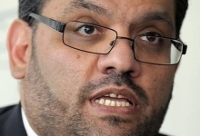
Anas al-Abdeh (born 1967)
- Currently lives in London (UK)
- Founder of the Movement for Justice and Development
- Member of “The Damascus Declaration”
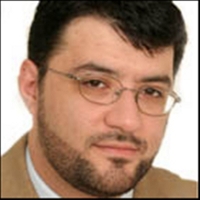
Malik al-Abdeh
- Co-founder of the Movement for Justice and Development
- Founder and director of Barada Television, a London-based satellite network
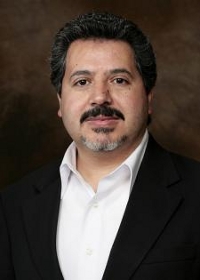
Najib Ghadbian (born 1962)
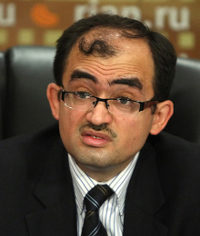
- Professor of Political Science at the University of Arkansas
- Founding member, Democratic Network in the Arab World
- Author of Democratization and the Islamists Challenge in the Arab World (English 1997 & Arabic 2002)
- Author of The Second Asad Regime: Bashar of Lost Opportunities (2006)
- Founding member of the Syrian Salvation Front (London, UK)
Radwan Ziadeh (born 1976)
- Senior Fellow at the U.S. Institute of Peace (USIP)
- Visiting Scholar at the Institute for Middle East Studies (IMES) at Elliot School for International Affairs, George Washington University
- Fellow at the Institute for Social Policy and Understanding (ISPU)
- Director of foreign relations office for the Syrian National Council (SNC)
- Formerly a Visiting Scholar at Dubai Initiative at the Kennedy School of Government at Harvard University
- Former Reagan-Fascell Fellow at the National Endowment for Democracy (NED)
- Former Visiting Fellow at Chatham House (The Royal Institute for International Affairs)
- Former Visiting Scholar at the Carr Center for Human Rights at Harvard University
- Founder of the Damascus Center for Human Rights Studies in Syria
- Co-founder and executive director of the Syrian Center for Political and Strategic Studies, Washington D.C.


