
We Told You So
by Ghassan Kadi
Friends of Syria
May 21, 2012

So… the Syrian events are spilling into Lebanon. I hate to say the I/we who know about the region, have told you that it would. I hate to also say that when we said it would, we were not talking about a so-called Arab-Spring spilling into Lebanon, the like of which we saw in Egypt, and which called for reform and freedom. Our fear was purely about a bloody sectarian conflict. Yes, we told you so.
In Syria now, the calls for freedom and democracy have all but gone silence. We also told you so. And they have been replaced by Allah Akbar and pure sectarian calls to turn Syria into a Sunni fundamentalist state. We also told you so.
A Sunni Sheikh, Ahmed Abdel Wahed gets killed in Lebanon, and Lebanon is on the brink of yet another sectarian war.
No rational person condones killing in any given situation, but a rational analysis of the killing of the Sheikh can perhaps give a possible explanation of how and why it happened.
To begin with, Abdel Wahed was an outspoken supporter of Hariri, the core of Sunni fundamentalism in Lebanon. The Hariri camp refers to Abdel Wahed as a martyr and a man of God. His opponents describe him as a sectarian rascal spreading sectarian anti-Alawite hatred in the hearts and minds of young Sunni Lebanese youth as well as a militarised arms trader. No one seems to be able to pin point what he really was with clear evidence.
But why would a Lebanese army checkpoint shoot to kill?
If there was truly a Lebanese Army conspiracy to kill Abdel Wahed as his mourners claim, the Army intelligence would have found a way to do so in a manner that does not overtly implicate it. Would it not?
Even during the ugly Lebanese Civil War when all sorts of militia groups were in control of the streets and check points, the “rule” for passing traffic was to stop at checkpoints and accept being searched. Shots were fired only and only when the travelling car did not stop. And when they did not stop, they did so for good reasons because they had something or someone to hide.
So if the rogue combatant militia run and led by thugs stuck to this rule, it is only rational to think that the regular Lebanese army would also stick to this rue. There is no reason as to why it would not.
The most likely scenario is that the Sheikh and his companion driver had some “thing” to hide, not some “one” to hide. Most likely, they were hiding weapons that they were couriering from some point A to another point B.
In any which way one looks at the situation, outsiders are not in a position to understand the complexity of the situation in the Middle East.
The uprising in Syria is not about reform. It is not about democracy. It is about sectarianism, sponsored by the Sunni Arab funds (Saudi Arabia and Qatar) under the blessing of the USA with a political objective to maintain Israel’s military superiority in the region and a financial objective to keep in control of the oil.
Targeting Syria is for “good” reasons, because it is the only Arab state left that opposes Israel, and the only one in which Moslems and Christians live under a law that gives equal rights to all.
This tragedy can spill into Iraq, Jordan, Turkey, Saudi Arabia…. and sees Sunnis and Shiites engaging into a blood bath the likes of which has not been seen for centuries anywhere in the world. Nothing can serve Israel better.
I just hope that I won’t have to find myself in a situation in the future to say to the pundits and cynics, those who support the Syrian uprising; I told you so.
US Officially Arming Extremists in Syria
Denied no longer, US officials admit US-Saudi cash & logistical support arming terrorists in Syria.
by Tony Cartalucci
May 16, 2012 – Recently reported in “Brookings Announces Next Move in Syria: War,” it was stated that “by the US policy think-tank Brookings Institution’s own admission, the Kofi Annan six-point peace plan in Syria was merely a ploy to buy time to reorganize NATO’s ineffective terrorist proxies and provide them the pretext necessary for establishing NATO protected safe havens from which to carry out their terrorism from.” It was also examined in detail, how in 2007, US, Saudi, and Israeli officials admitted they were creating a militant front of extremists for the sole purpose of causing the destabilization of Syria we see today, and ultimately overthrowing the Syrian government. It was noted how these extremist militants had direct ties to Al Qaeda.
Now it is fully admitted that weapons, cash, and logistical support is indeed being provided to terrorist forces in Syria by the United States, Saudi Arabia, Qatar, and other Gulf States. This, despite a current UN ceasefire the West has continuously berated the Syrian government for violating, indicates that indeed reorganizing, rearming, and redeploying NATO’s terrorist proxies is complete, and another round of destructive violence has begun.
In the Washington Post’s article, “Syrian rebels get influx of arms with gulf neighbors’ money, U.S. coordination,” not only is this admitted, but claims made by Syrian President Bashar al-Assad have been confirmed that Syria’s historically violent Muslim Brotherhood, stated in 2007 by Seymour Hersh as being a direct proxy of US-Saudi-Israeli funding and support, is also directly arming and funding contingents of extremists committing acts of terror across Syria.
Areas across Syria that have until now been portrayed as centers for “pro-democracy” protests, racked by violence depicted as “repression” by Syrian troops, are now admitted by the Washington Post to be areas where “material is being stockpiled.” This includes the flashpoint city of Idlib on the Turkish-Syrian border, in the suburbs of Damascus, and along Syria’s border with Lebanon. And again, in 2007, Seymour Hersh revealed that the US, Israel, and Saudi Arabia had planned to array extremists along Syria’s border to commit the very violence now being admitted by the Post today.
The Washington Post openly admits that these weapons, supplies, cash and support, provided by the US and Saudi Arabia are directly responsible for the increased violence in Syria, in the midst of a ceasefire the West has attempted to disingenuously use to defame the Syrian government, hamper its ability to restore order, and indeed, rearm, reorganize, and redeploy their terrorist proxies to begin another attempt at violent foreign-backed regime change:
“The effect of the new arms appeared evident in Monday’s clash between opposition and government forces over control of the rebel-held city of Rastan, near Homs. The Britain-based Syrian Observatory for Human Rights said rebel forces who overran a government base had killed 23 Syrian soldiers.” -Washington Post, May 16, 2012
The Post also admitted that Washington, again, in the midst of a UN ceasefire, was attempting to trigger yet more violence, this time in areas controlled by Syria’s Kurds who have remained out of the predominately foreign-backed conflict.
Paradoxically, the US and Gulf State military support being funneled into Syria to purposefully flare violence in the midst of a UN ceasefire, is continuing even after the Pentagon has admitted Al Qaeda is present and active in Syria, this after terrorist groups claimed responsibility for a series of bombings that have killed mostly civilians.
And in the midst of this admitted attempt to increase violence and chaos, the Washington Post also declared that NATO-member Turkey would be pressured to invoke Article IV of the NATO Charter, allowing NATO to militarily intervene to “stop” violence they openly admit they are creating. Unlike previous conflicts – the US’ admission is not a hamhanded obfuscation of the their intentions, but an open declaration of intent to provoke a war of aggression – a Nuremberg offense for all involved. In fact, direct parallels between Adolf Hitler’s September 1938 campaign of destabilization in Czechoslovakia, and NATO’s current destabilization of Syria have been made by noted geopolitical analysts.

Images: The “Henry Jackson Society” and the “Brookings Institution” are just two of many similar “think-tanks” with identical members and identical corporate sponsors. These are the authors of NATO’s increasingly long list of war crimes, including those authorized by US President George W. Bush, now officially a convicted war criminal. While Bush’s conviction currently lacks a realistic means of arresting and sentencing him, if we know the corporations and institutions that craft the policies used by Bush to commit his crimes, we the people, ourselves, can start by “imposing sanctions” on these special interests with boycotts. (click images to enlarge)
A historical conviction handed down by the Kuala Lumpur War Crimes Commission, finding former-US President George W. Bush guilty of war crimes, sets a precedent to be used against those committing war crimes today, and of course a model to be expanded upon, including methods and official calls to impose sanctions on organizations and institutions supporting leaders committing war crimes, including both the policy think tanks engineering the war crimes and boycotting and banning the corporations and institutions funding these think-tanks. This does not require an act by the UN, or your national government. You can begin boycotting these corporations today and thus begin undermining the authority and impunity from which they operate.
The Smell of War Wherever You Go – Hawazen Iraqi Refugee – Reports on Lebanon [video]
108morris108
May 18, 2012
The Imperialist plans to change the borders of Arab countries is playing out. Sectarian divide is a tool.
Hawazen informs us of many details on the fighting in Northern Lebanon. It is in fact a spill over from Syria.
Terrorists creating buffer zone in Lebanon: Syria UN envoy [video]
Press TV
May 20, 2012
Late last month a ship loaded with arms was intercepted in the Northern Lebanese city of Tripoli. Following this, several other cases of attempted arms smuggling in Lebanon and specifically near the border with Syria have been uncovered. This has been accompanied by the emergence of armed Salafists in Northern Lebanon, together with the arrest of individuals charged with affiliation to armed terrorist groups.
Carnage & Crisis Aversion in the Sudan
by Nile Bowie
TheIntelHub.com
May 8, 2102
Following the United Nations’ recent approval of Resolution 2046 threatening the nations of Sudan and South Sudan with sanctions [1], the success of international attempts at conflict aversion in the region appear to be in question.
Hostilities between the two nations have climaxed since South Sudanese forces captured the region of Heglig, an oil-producing site 70 kilometers into Sudanese territory [2]. South Sudanese forces have also maintained a presence in the long disputed border region of Abyei in Southern Kordofan, where Juba has recently vowed to withdraw its personnel from [3].
Although Khartoum has agreed to comply with the United Nations resolution, it has vowed to continue military operations against South Sudan’s troops as long as they remain within the territory of Sudan, “Sudan has declared its commitment to a United Nations resolution calling for an end to military operations, but the other side’s troops still remain on our territory; they have occupied two districts and have not stopped their hostile actions” [4].
Juba denies Khartoum’s claims of occupying Sudanese territory, South Sudan’s newly released official map includes the Heglig region and six areas that are “contested and occupied” by Khartoum [5].
Amid the escalating regional tension, China has recently offered South Sudan an $8 billion development package set to allocate funds for road construction, hydropower, infrastructure and agricultural projects following South Sudanese President Salva Kiir’s visit to Beijing [6]. China has traditionally been a key partner to the government in Khartoum, but has steadily increased its influence in South Sudan since its independence in 2011, primarily through investments via state-owned Chinese oil companies China National Petroleum and Sinopec.
As inflation rates in Sudan reportedly rise to 21% following increased military expenditure since clashes erupted with Juba in late March 2012 [7], China’s extensive economic engagement in the region offers the leverage needed to potentially play the role of a mediator in the Sudanese conflict.
The emergence of South Sudan as an independent state came at a heavy price for Khartoum, as an estimated 85% of the country’s oil production came under Juba’s control.
Although South Sudan holds a majority of oil reserves, Juba has relied on the Greater Nile Oil Pipeline for its oil exports, a pipeline operated by the China National Petroleum Corporation (CNPC) extending to Port Sudan on the Red Sea via Khartoum [8].
Under a barrage of economic sanctions, Khartoum sought to implement oil transit fees for the use of theGreater Nile Oil Pipeline, by charging Juba around $36 per barrel; Juba holds over $11 billion in oil transit debt and has refused the figures proposed by Khartoum, prompting Juba to suspend its oil production [9]. Juba has accused its northern neighbor of launching air strikes on its territories, while both sides also accuse each other of backing rebel militia, claims that Khartoum has denied [10].
Following the fiery rhetoric espoused by Sudanese President Omar al-Bashir describing Juba’s ruling Sudan People’s Liberation Movement as “insects,” Bashir now concedes, “We look with wisdom and foresight to well-established relations between us and the people of South Sudan” [11].
As a climate of uncertainty persists beneath irresponsibly bellicose exchanges, the implementation of a campaign to unseat Omar al-Bashir and bring down the government in Khartoum has long been underway.
A recent Op-Ed published in The New York Times by Dr. Gérard Prunier entitled “In Sudan, Give War a Chance” reflects a predominately Western political school of thought which favors the prospect of full scale war to bring about regime change in Sudan. Prunier laments, “The international community has called for a cease-fire and peace talks, but the return of violence is not necessarily a bad thing,” before concluding “an all-out civil war in Sudan may be the best way to permanently oust Mr. Bashir and minimize casualties” [12].
Sudan’s Omar al-Bashir is the first sitting head of state to be charged with genocide by the International Criminal Court (ICC) for crimes against humanity conducted in Sudan’s western Darfur region; ICC prosecutor Luis Moreno-Ocampo accuses Bashir of keeping millions of refugees in an environment resembling a “gigantic Auschwitz” [13].
Violence and infighting in Sudan has traditionally been a product of tension along ethnic lines, more so than religious differences. Although the modern Sudanese state has been divided along ethno-religious lines with the religiously Islamic and ethnically Arab government in Khartoum split from the ethnically African and religiously Christian government in Juba, tribal minorities such as the ethnically African and religiously Islamic Fur and Zaghawa groups in Sudan’s western Darfur region have long demanded reparations for the marginalization they’ve experienced from Khartoum [14].
In a recent report issued by Amnesty International entitled “Sudan: No End to Violence in Darfur,” the organization attributes China, former Soviet Union countries and Belarus for selling arms to the Government of Sudan. Amnesty International’s report omits any mention of Israel, who has reportedly provided heavy military logistical support to the Justice and Equality Movement (JEM), Darfur’s most powerful armed rebel group [15].
Although the United Nations does not recognize the conduct of the Sudanese government in Darfur as “genocide” [16], mass media campaigns publicizing the alleged violence in Sudan have been embraced by celebrity personalities such as George Clooney.
TIME magazine warns of the increased prospects for genocide in South Kordofan’s Nuba Mountains region, as rebels affiliated with South Sudan’s ex-rebel militia, the Sudan People’s Liberation Army (SPLA) take up arms against Khartoum once again [17]. Clooney has recently partnered with John Prendergast of The Enough Project to produce a promotional video depicting ethnic Nuba villagers displaying English language placards calling for the establishment of a “No-Fly Zone” and the prosecution of Omar al-Bashir by the International Criminal Court [18].
The Enough Project was co-founded by US State Department Distinguished Service Award recipient John Prendergast and launched in 2007 under the Center for American Progress [19], an organization sponsored by billionaire investor George Soros and Peter Lewis of Progressive, a Fortune 500 insurance company, among others [20]. John Podesta, who heads the Podesta Group, a Washington lobbying firm representing the interests of weapon-manufacturers Lockheed Martin and oil conglomerates such as British Petroleum [21], also chairs the Center for American Progress [22].
In 2006, the Sudanese government barred 20,000 UN troops from running peacekeeping operations in Darfur, as then-Presidential Advisor Mustafa Osman Ismail argued that the UN mandate’s goal was the implementation of “regime change” in Khartoum [23].
The sources of weaponry and covert assistance received by rebel groups in Sudan are rarely a subject of speculation among religious and political organizations who have long supported the international campaign to pressure Sudan. In 2007, the American Jewish World Service and the U.S. Holocaust Memorial Museum launched a “Save Darfur” coalition, which gained the support of adherents to intervention in Iraq, such as right-wing evangelical Christian groups and major organizational affiliates of the American Israel Public Affairs Committee (AIPAC) [24].
According to The Jerusalem Post, the Save Darfur coalition launched a high-profile advertising campaign that included full-page newspaper ads, television spots and billboards calling for the imposition of a no-fly zone over Darfur with financial assistance the Jewish Community Center in Manhattan, United Jewish Communities, UJA-Federation of New York and the Jewish Council for Public Affairs [25].
While the blame for violence in Sudan is laid squarely on Khartoum’s shoulders, Israeli-led foreign elements have contributed to the training, financing, and arming of rebel militias and forces opposed to the Sudanese government within Sudan.
Since 1969, Israel has reportedly trained recruits, shipped weapons, and offered support to South Sudanese SPLA rebels [26]. Prior to South Sudan’s independence, Israel relied primarily on a flight route to Entebbe, Uganda to supply SPLA with weapons [27], however Tel Aviv nowtransfers missiles, military equipment, and even mercenaries to Juba quite openly [28].
As Israel covertly operates in East Africa immune from international criticism following their bombing of Sudanese convoys in 2009 [29], the influence of Israeli think tanks such as The Institute for Advanced Strategic and Political Studies (IASPS) toward the creation of AFRICOM, the US Africa Command, remains a significant indication of the foreign policy directives being taken by Tel Aviv and Washington in Africa [30].
The Sudan exists as sub-Saharan Africa’s third largest oil producer with over 6.6 billion barrels of proven oil reserves [31]; an estimated 85% of those reserves have been ordained to Juba, in the Republic of South Sudan [32].
As China exists as Sudan’s largest trading partner by purchasing 40% of Sudan’s oil with the excess majority largely designated to Asian markets [33], reordering and monopolizing Sudan’s vast oil fields and mineral wealth is the capital incentive behind the unwavering support for the secession of South Sudan shown by US, EU, and Israeli officials.
Members of the Sudanese opposition and various rebel separatist groups often visit Tel Aviv, Sudan’s main SPLA opposition even opened an office in Israel to promote its “policies and vision” in the region [34]. In reflection of Israel’s active support for the Southern opposition, South Sudanese citizens were seen waving Israeli flags during their Independence celebrations in July 2011 [35]. For the likely guarantee of support, the South Sudanese government in Juba applied for IMF membership in April 2011 before it had even officially gained independence from Sudan [36].
As Israel and Washington offer their support to the Justice and Equality Movement (JEM) in Darfur and various rebel militias opposed to the Sudanese government, China’s interests in the region come under direct attack from these very rebel groups, most prominently in JEM’s October 2007 attack on the Greater Nile Petroleum Company in Defra, Kordofan [37].
The World Bank has recently warned that South Sudan may collapse by its two-year anniversary, due to the ramifications of halting production of at least 75% of the regional oil in frustration with Khartoum’s claims on oil-transit debt and revenue [38]. Apparently, authorities in Juba are either unprepared politically for independence or lacking the appropriate guidance to effectively manage its internal affairs.
In a recent meeting between Chinese Vice-President Xi Jinping and Sudanese Foreign Minister Ali Ahmed Karti, China urged the warring neighbors to settle their differences and negotiate [39].
As China would prefer to align with its traditional approach of non-interventionist diplomacy, Beijing has an opportunity to exploit its influence in the region to not only further its own interests, but to defer criticism from parties loyal to Washington who credit China with sponsoring bloodshed through its business interests [40] and political positions [41].
By pursuing the role of a mediator, China can preserve its interests by overseeing negotiations on trade regulations, citizens rights, demarcation and territory status between the neighboring Sudans’.
As Juba depends on oil exports for 98% of its income [42], it must negotiate with Khartoum to settle its debts and agree on a mutual per-barrel fee for its use of the Greater Nile Oil Pipeline, as construction of a new pipeline from oil fields in South Sudan to a theoretical end point at the Kenyan port of Mombasa would take years to construct.
While the current US Vice President Joseph Biden once called on the US to exert military force against Sudan [43], it remains crucial for the leaders of both Sudanese nation states to come to an agreement regarding the status of the Heglig region and other disputed areas claimed by both sides, lest peacekeeping forces internationally administer these contested zones.
Any attempts at imposing an arms embargo throughout the Sudan would be entirely disregarded by both sides, which are already adequately armed.
While attempts to rally public support behind Western intervention in Sudan rely on emphasizing the human rights violations of Khartoum, claims of 6,000 people being slaughtered by Gaddafi used to justify NATO intervention in Libya remain unverified [44]. Given the distinct ethno-religious differences of South Sudanese society and long history of striving for autonomy, their existence as a nation state is warranted.
It is irresponsible to deny both Khartoum’s unwarranted and brutal treatment of civilians within its territory and the US-Israeli policy of inflaming national and regional antagonisms in Sudan by arming rebel militias, to the benefit of corporations seeking to control and develop oil fields and mineral deposits.
While the allied powers in Washington and Tel Aviv would prefer to advocate aggressive policy to ensure against the survival of the regime in Khartoum, the institutional influence of Russia and China in the UNSC provides an opportunity for emerging powers to exert an alternative model of non-aggressive crisis aversion.
China may thinly support future economic sanctions on the Sudans in hesitation to involve itself in the domestic issues of other nations, however Beijing could best exercise its influence by urging Khartoum to meet with tribal leaders to guarantee a ceasefire and develop a true federal system that would allow for local autonomy. As the Sudanese leadership in Khartoum projects itself as an Islamic nation, it should recall the final great address of the Islamic Prophet at Mount Arafat, who called for the rejection of social distinctions based on ethnicity and color.
Notes
[1] U.N. Resolution Threatens Sanctions Against Sudan and South Sudan, The New York Times, May 3, 2012
[2] Sudan mobilises army over seizure of oilfield by South Sudan, The Guardian, April 11, 2012
[3] South Sudan police to withdraw from Abyei, Sudan Tribune, April 29, 2012
[4] Sudan refuses to stop fighting with South Sudan, Russia Today, May 5, 2012
[5] New official S. Sudan map to include disputed border region, Russia Today, May 5, 2012
[6] China ‘offers South Sudan $8bn for projects’, Al Jazeera, April 29, 2012
[7] Sudan inflation up by 21% in Q1 2012, Sudan Tribune, May 4, 2012
[8] Focus on diplomacy and Sudan, APS Diplomat News Service, August 15, 2008
[9] Sudan inflation up by 21% in Q1 2012, Sudan Tribune, May 4, 2012
[10] Bashir says wants warm relations with South Sudanese, Chicago Tribune, May 6, 2012
[11] Ibid
[12] In Sudan, Give War a Chance, The New York Times, May 4, 2012
[13] Omar al-Bashir charged with Darfur genocide, The Guardian, July 10, 2010
[14] The Peoples of Darfur, Cultural Survival, 2010
[15] Sudan: Israel arming Darfur rebels, PressTV, February 2, 2009
[16] U.N. report: Darfur not genocide, CNN, February 1, 2005
[17] Darfur Redux: Is ‘Ethnic Cleansing’ Occurring in Sudan’s Nuba Mountains? TIME, June 14, 2011
[18] George Clooney Witnesses War Crimes in Sudan’s Nuba Mountains, Enough Project, March 14, 2012
[19] About Us, Enough Project, 2012
[20] John Podesta, Shepherd of a Government in Exile, The New York Times, November 6, 2008
[21] Hired Guns: The City’s 50 Top Lobbyists, Washingtonian, June 1, 2007
[22] John Podesta, Center for American Progress, 2012
[23] Sudan says AU can stay in Darfur but not under UN, Sudan Tribune, September 4, 2006
[24] Darfur Advocacy Group Undergoes a Shake-Up, The New York Times, June 2, 2007
[25] US Jews leading Darfur rally planning, The Jerusalem Post, April 27, 2006
[26] Sudan People’s Liberation Army (SPLA), Global Security, 2012
[27] Israeli weapons ‘bound for rebels’ in southern Sudan: Arms may be destined for SPLA fight against Khartoum, The Independent, March 19, 1994
[28] Report: Israelis arming South Sudan with missiles, YNet News, April 5, 2012
[29] U.S. Officials say Israel Struck Sudan, The New York Times, March 26, 2009
[30] AFRICOM: Control of Africa, VoltaireNet, 2012
[31] BP Statistical Review of World Energy, British Petroleum, June, 2008
[32] The secession of South Sudan, Tehran Times, July 11, 2011
[33] Oil for China, Guns for Darfur, BusinessWeek, March 14, 2008
[34] Sudan’s SPLM reportedly opens an office in Israel – statement, Sudan Tribune, March 5, 2008
[35] Israeli Flags at South Sudan Independence Celebrations, Al Jazeera, July 9, 2011
[36] South Sudan formally applies for IMF membership, Sudan Tribune, April 21, 2011
[37] Darfur rebels spurn Chinese force, BBC, November 2007
[38] South Sudan Experiment Headed Toward Failure, OilPrice, May 08, 2012
[39] China / Politics Xi pushes for Sudanese talks, China Daily, February 29, 2012
[40] China defends arms sales to Sudan, BBC, February 22, 2008
[41] Hillary Clinton lambastes ‘travesty’ of UN veto on Syria, MSNBC, February 5, 2012
[42] Juba could face blackout in days – minister, Sudan Tribune, March 29, 2012
[43] Biden calls for military force in Darfur, MSNBC, April 11, 2007
[44] Israel and Libya: Preparing Africa for the “Clash of Civilizations,” Centre for Research on Globalization, October 11, 2011
Nile Bowie is an independent writer and photojournalist based in Kuala Lumpur, Malaysia; he regularly contributes to Tony Cartalucci’s Land Destroyer Report and Professor Michel Chossudovsky’s Global Research Twitter: @NileBowie
UN Syria Narrative Blind of Terrorist Death Squads [video]
PressTV / Tarpley.net
May 14, 2012
Video: Via PressTV – “In Syria, the fragile cease-fire brokered by the UN-Arab League envoy Kofi Annan was broken again: A roadside bomb struck a Syrian military truck, wounding six soldiers. But what was different was that the explosion happened just seconds after a convoy carrying the head of the U.N. observer mission passed by, which has put into speculation that perhaps the UN convoy was the target. If so, this comes just one day after US UN ambassador Susan Rice said the Kofi Annan ceasefire plan was ineffective on all fronts: Syria, its elections, its ceasefire: Subject of this edition of the Press TV News Analysis.”
For more news and analysis from Dr. Webster Tarpley, visit his website, Tarpley.net or listen to his weekly radio show, “World Crisis Radio.”
Fighting Erupts in Lebanon
Land Destroyer Report
May 15, 2012
US, Israeli, and Saudi-funded terrorists destabilizing Syria now under fire in Lebanon.
by Tony Cartalucci
May 15, 2012 – According to a 2007 New Yorker article by Seymour Hersh, “The Redirection,” the US, Israel, and Saudi Arabia had been assembling a region-wide army of extremist-mercenaries to battle Hezbollah in Lebanon, destabilize and overthrow Syria, and create a united front against Iran. The forces recruited for this effort would come from the ranks of the CIA-created “Arab foreign legion,” Al Qaeda itself – extremist groups fresh back from fighting US troops in Iraq and Afghanistan, including listed terror organizations like the Libyan Islamic Fighting Group (LIFG) from Libya.
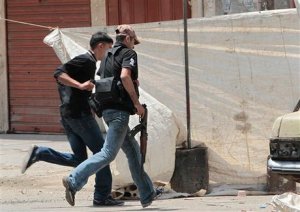
Hersh’s 2007 report exposed the groundwork for the very violence unfolding in Syria today, and now Lebanon. Forces to destabilize Syria were primarily to be staged in northern Lebanon, as explained in the article, and indeed the heaviest fighting over the last year has been seen in the Syrian city of Homs, just across the border from northern Lebanon. Syria’s President Bashar al-Assad and his government have been, since the beginning of the violence, attempting to illustrate just this – explained in detail in 2007, and demonstratively being carried out today, with responsibility for deadly bombings being claimed by terrorists, the Pentagon itself admitting Al Qaeda is present in Syria, and reports indicating foreign fighters, weapons, and cash are flowing over Syria’s borders.
Lebanon’s Turn?
Now, the very staging ground in northern Lebanon being used to destabilize neighboring Syria has erupted into violence. Not by Syrian troops crossing the border, but by indigenous Lebanese factions facing off against each other. News is trickling out slowly and the Western media appears intent on keeping the violence as nebulous and confused as possible, but initial information indicates that extremist groups backed by the US, Israel, and Saudi Arabia are fighting factions connected to Hezbollah. Extremist leaders across the region are attempting to frame the violence as “Sunni verses Shi’ia,” a ploy Hezbollah leader Hassan Nasrallah warned against back in 2007:
“Nasrallah accused the Bush Administration of working with Israel to deliberately instigate fitna, an Arabic word that is used to mean “insurrection and fragmentation within Islam.” “In my opinion, there is a huge campaign through the media throughout the world to put each side up against the other,” he said. “I believe that all this is being run by American and Israeli intelligence.” (He did not provide any specific evidence for this.) He said that the U.S. war in Iraq had increased sectarian tensions, but argued that Hezbollah had tried to prevent them from spreading into Lebanon. (Sunni-Shiite confrontations increased, along with violence, in the weeks after we talked.)” –The Redirection, Seymour Hersh
Far from genuine sectarian violence, it was planned since 2007, to use terrorist proxies in a battle stretching from Lebanon to Iran with Arab nations from North Africa to the Middle East aiding the effort, dominated by freshly installed US proxies (Tunisia & Libya) and the Muslim Brotherhood, stated in Hersh’s 2007 article to be wards of the West.
Violence has raged for nearly a week, in and around Lebanon’s northern port city of Tripoli. While being depicted as violence “spilling over” from Syria, it is clear that the violence is indigenous, sectarian in nature, and directly related to the larger conflict envisioned by US-Israeli-Saudi machinations in 2007 – pitting Sunnis against Shi’ia. An editorial from NOW Lebanon reveals the “sectarian” nature of the violence in Lebanon and how both sides identify as either supporters or opponents of the neighboring Syrian government.
This prevailing “sectarian” aspect reveals what has been stated by geopolitical analysts since the beginning of unrest in Syria – that the violence was driven not by “pro-democratic” aspirations, but by sectarian violence exploited for the sole purpose of advancing the agenda of foreign meddlers – sectarian violence that has now manifested itself in attacks on Christians, Druze, and Alawites, as well as moderate Sunnis across Syria in the midst of this so-called “democratic revolution.”
The sectarian violence now unfolding in Tripoli is not unheard of in Lebanon. The Lebanese military has already been reportedly deployed but is sitting on the sidelines as factions war in the streets. The violence may ebb, as it has in the past, but with the Syrian unrest reaching a critical point and foreign powers desperate to change momentum that’s been working against them, foreign-backed terrorist forces could try to ignite a wider sectarian battle in Lebanon. This could be to paralyze Hezbollah ahead of either a coup de grâce delivered to Syria by Turkey, or to simply inflame the entire region in conflict, making the movement of weapons, cash, and foreign support to proxy forces easier to move around, as well as grease the skids for introducing a Kosovo-style intervention.
Regardless, “sectarian” differences between Sunni and Shi’ia Muslims were planned for exploitation since at least as early as 2007 by the US, Israel, and Saudi Arabia, for the sole purpose of advancing their self-serving hegemonic agendas throughout the region. The violence that both sides are playing into will deprive their communities of the security and stability needed for all to prosper and progress, and ultimately leave them at the mercy of foreign dominion.


