
Love Bombs for Syria? – Syrian Girl on Intervention and Hypocrisy [video]
The Corbett Report
April 15, 2012
Syrian commentator “Syrian Girl” joins us to discuss the latest news on the moves toward outside intervention in Syria.
Download audio: http://www.corbettreport.com/interview-495-syrian-girl-on-the-syrian-interven…
Syrian Girl’s recommended websites on Syria:
Website: http://www.syrianews.cc/
Real Friends of Syria blog http://friendsofsyria.wordpress.com/
Youtube channel exposing media lies: http://www.youtube.com/user/SyriansWorldWide
UN approves monitors’ deployment to Syria [video]
Russia Today
April 14, 2012
The UN Security Council has voted unanimously on a resolution to send a team of observers to Syria. The group of up to 30 monitors will help oversee the country’s fragile ceasefire. This, amid reports of fresh shelling and more bloodshed in the country, despite the truce. RT’s Marina Portnaya is following the events in New York.
RT on Twitter: http://twitter.com/RT_com
RT on Facebook: http://www.facebook.com/RTnews
Faux-Feminist’s Ridiculous “Women Under Siege” Syria Map
CIA Asset Gloria Steinem’s “Women Under Siege” Joins Syrian Propaganda Campaign.
by Tony Cartalucci
April 14, 2012 – Ironically, faux-feminist Gloria Steinem’s “Women Under Siege’s” latest campaign to demonize the Syrian government in tandem with the US State Department and its vast stable of media and intelligence assets, stands to set the stage for extremist ideologues to overrun Syria, ending its secular society and entirely stripping away the “women’s rights” Steinem claims to have spent a lifetime fighting for.
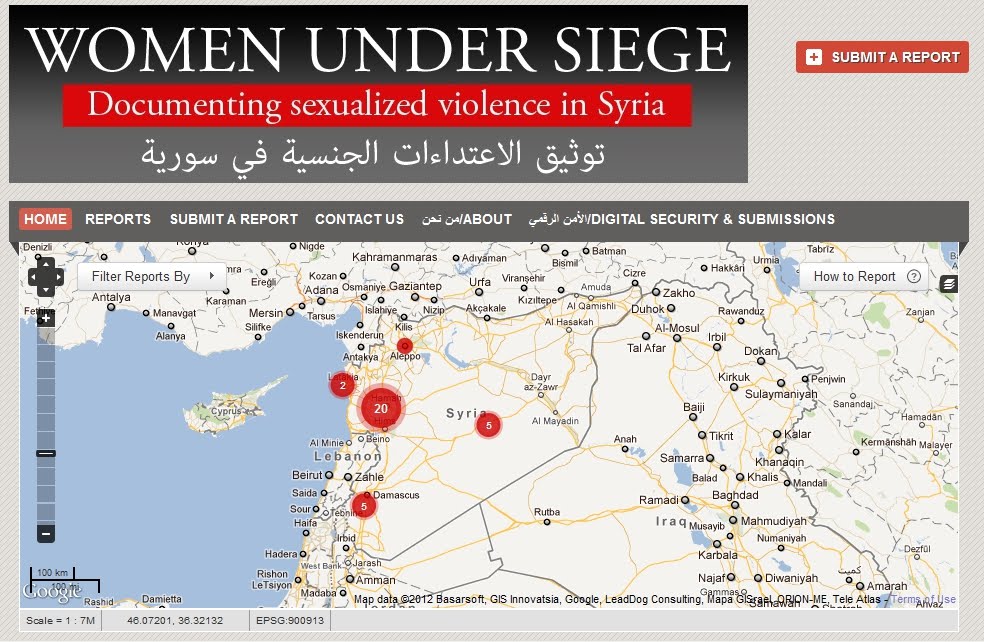 Image: “Women Under Siege – Documenting Sexualized Violence in Syria” attempts to demonize the Syrian government and raise the level of feigned humanitarian-hysteria ahead of NATO maneuvering to rearm and redeploy militant extremists sure to end all human rights in currently secular Syrian society – just as they’ve done in Libya.
Of course, when one understands that Steinem is an establishment asset merely leveraging/perverting legitimate concerns regarding women to manipulate, divide, and control people for a corporate-financier agenda, such hypocrisy makes perfect sense.
Women Under Siege is a project of Steinem’s “Women’s Media Center,” which is itself a spinoff of its umbrella organization, Ms Foundation. Steinem’s Ms Foundation is funded by convicted criminal and Wall Street speculator George Soros‘ Open Society Foundations, the Ford Foundation, Tides Foundation, New York Life, Google, the United Nations, AT&T, Lifetime, the ACLU, and many others featured in their 2011 Annual Report starting on page 27. So what appears to be a feminist crusade turns out to be yet another facade of Wall Street and London’s (ironically very male-dominated) charade of manipulating, exploiting, dividing, and controlling the population.
Further evidence exposing Steinem and her expansive propaganda empire as nothing more than a tool of special interests is the documented fact that she was at least for a time, an asset of the Central Intelligence Agency (CIA) as described in the New York Times article “CIA Subsidized Festival Trips; Hundreds of Students Were Sent to World Gatherings” (full text can be found here). Steinem’s “Independent Research Service” was anything but “independent,” as it was bankrolled by the CIA. While Steinem claims the CIA did nothing to influence her organization’s policy, a tenuous defense used by many operatives caught receiving dubious funding, it is clear that her activities dovetailed with the CIA’s agenda, making her at best what is called a “useful idiot.”
Now Steinem is once again conveniently co-facilitating the agenda of the establishment though the US State Department, the National Endowment for Democracy, and the various intelligence and military agencies involved in destabilizing Syria and overthrowing President Bashar al-Assad. She does so with her “Women Under Siege – Documenting Sexualized Violence in Syria” project, featuring a map of unverified, hearsay reports of atrocities carried out allegedly on “women.” Clearly, considering the corporate-financier backing Steinem’s Ms Foundation receives, this is not merely a convenient convergence of interests – rather more manipulative propaganda abusing and ultimately undermining real human rights – as the very term “women’s rights” is indicative of bigotry in and of itself.

Image: Pictured is “Gay Girl in Damascus.” Far from an editorial oversight, “Gay Girl in Damascus” was in reality a 40 year-old American man living in the UK. The Western media shamelessly exploited his narrative until it unraveled, and simply moved on to other actors, like “Danny” who directs fake gunfire off-camera while giving casualty reports to CNN. CIA asset Gloria Steinem’s new “Women Under Siege – Documenting Sexualized Violence in Syria” map makes a nice fit for the constant din of lies and fabrications coming out of the West in its pursuit of dividing and destroying Syria.
However, Steinem’s efforts find good company amongst the constant din of unverified reports fabricated by London-based NGOs like the Syrian Observatory for Human Rights, exposed frauds like CNN’s “Syrian Danny,” and “Gay Girl in Damascus” who turned out to be a middle-aged American man living in the UK.
[hat tip: End the Lie]
Syria: Another “Humanitarian War” Based on Lies & Deceit
Mini-Documentary Exposes Imperial Expansion Through “Humanitarian Interventionism”
by Tony Cartalucci
April 13, 2012 – The Paris-based Centre for the Study of Interventionism (CSI) and Julien Teil, director of “Lies behind the “Humanitarian War” in Libya: There is no evidence!” has recently released a short documentary exposing how a cartel of Western nations and their Arab proxies are purposefully creating chaos inside targeted nations and then using it as a pretext to invade, topple governments, and replace them with preselected client regimes, and in effect threatening the very concept of national sovereignty.
The documentary particularly focuses on Syria and features video of Syrian opposition members sitting at the US State Department-funded National Endowment for Democracy (NED) “round-table” having praise heaped upon them, and in particular Washington-based Syrian “activist” Radwn Ziadeh, for their complicity in betraying their nation and people for the corporate-financier interests that constitute NED’s board of directors.
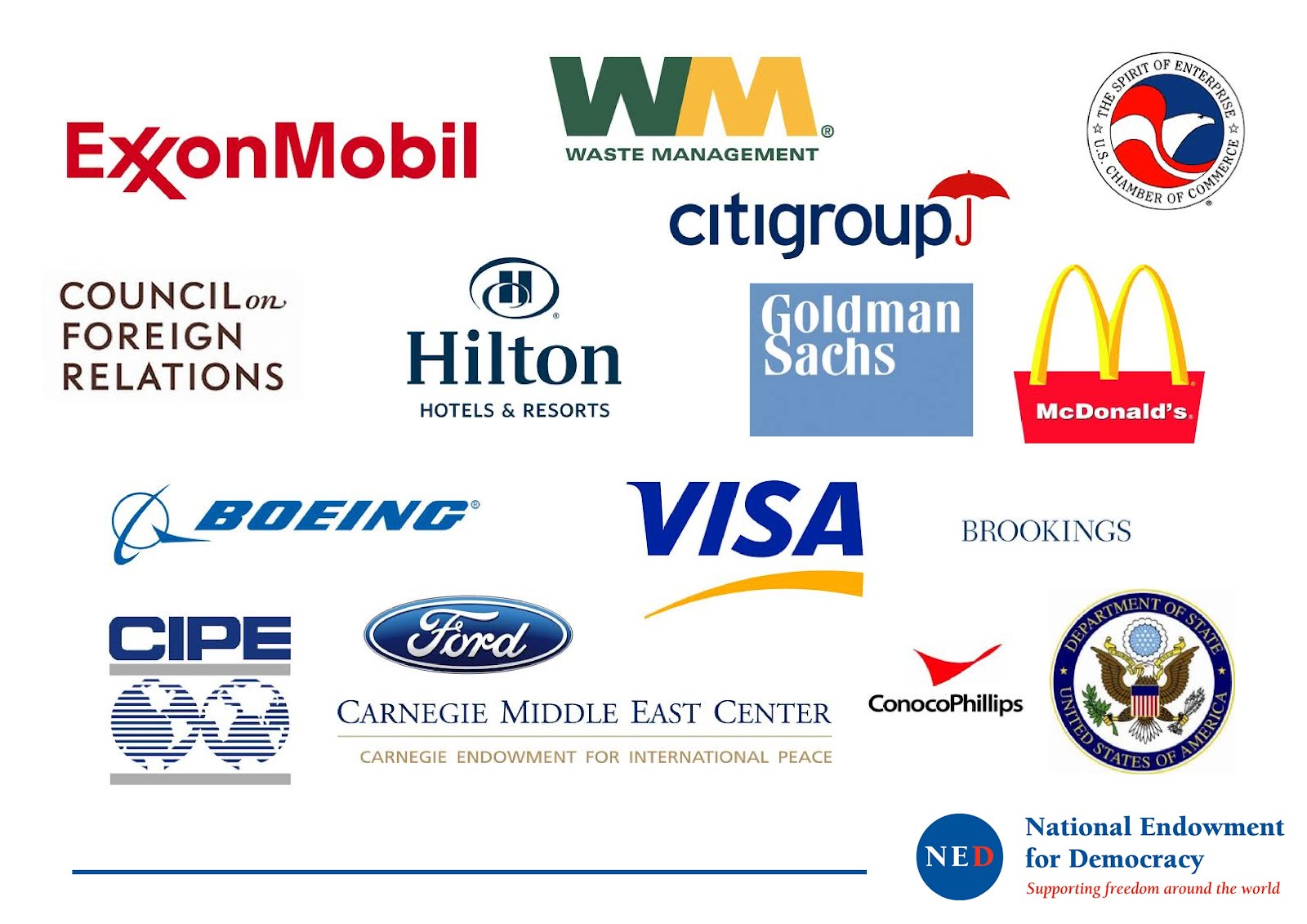 Image: Just some of the corporate-financier interests represented by the National Endowment for Democracy’s (NED) Board of Directors. NED’s mission statement of “supporting freedom around the world” is exposed as a ludicrous cover for what is obviously an organization dedicated to expanding the corporate-financier hegemony of its membership and sponsors – merely using the cover of “democracy promotion” to justify what is in fact global imperial conquest. (click on image to enlarge)
Mention is made of how this very same gambit, featuring very similar characters working with the very same Western organizations and “institutions” similarly ravaged Libya, toppled the government, and installed a proxy client regime using this fraudulent model of “Responsibility to Protect.” It is stated multiple times, that the West’s self-evident desire to see “regime change” in Syria and its decision to “pick sides” in regards to backing Syrian opposition terrorist clearly violates the not only Syria’s national sovereignty, but endangers the very concept of national sovereignty all together.
It is important to understand that this agenda of neo-imperialism is being driven by converging corporate-financier interests centered around Wall Street and London and seeks to create a global “open society” which they can dominate without the hindrance of borders or national institutions opposing them. The distinction is made in the documentary between Western-educated opposition members helping facilitate the West’s global blitzkrieg who hold the “global worldview of the West” verses the classical view of international law and diplomacy held by the rest of the world.
Humanitarian interventionism is simply the institutionalization of modern global imperial conquest.
Please be sure to support the makers of this documentary by rating their video on YouTube. Please also visit Julien Teil’s “The Humanitarian War” website.
[hat tip: Global Research TV]
Libyan scenario for Syria?
by Dmitry Babich
Voice of Russia
April 5, 2012
The recent statement of Russian Foreign Minister Sergei Lavrov on the inability of NATO and its allies to replace Gaddafi’s regime in Libya with a viable modern state gets some worrisome confirmations every day. A military coup in Mali, another African country, where the black African majority is facing a rebellion of the local Tuareg minority with simultaneous attacks from the aggressive Islamist group named Al-Qaeda in Islamic Maghreb (AQMI), was another ominous sign of the destabilization in the region. It is a commonly held opinion of a number of experts in Algeria, Morocco, France and other countries that the events in Mali were a consequence of Colonel Gaddafi’s violent removal from power in 2011, in which NATO members and Persian Gulf monarchies took part. During his recent visit to Baku, Sergei Lavrov let it be understood that he shared that opinion.
“The people, who abused the UN Security Council’s mandate, who defeated Gaddafi’s army killing dozens of civilians in the process of doing this, these people left in Libya something that cannot really be called a state,” Lavrov said in Baku. Lavrov added that the Libyan tragedy, whose damage to civilians still needs to be assessed and investigated, is far from over. “Right now the state of Mali is being destroyed,” Lavrov said.
There are surprisingly few reports in the Western press on the dangerous instability in Libya and the military action in Mali, which indeed was a direct consequence of the West-supported eviction of Tuaregs from Libya. The anti-Gaddafi rebels summarily suspected Tuaregs of helping the government forces, so they made short work of them after Mr. Gaddafi’s defeat. So, the lack of interest that the Western media showed for their fate was particularly strange after many months of hysterical reports demonizing Gaddafi and predicting an eventual massacre which Gaddafi’s forces might presumably have inflicted on the Libyan opposition in Benghazi. This media circus served to justify the Western intervention and stopped immediately after the insurgents took over Tripoli. The massacre inflicted on Gaddafi’s supporters in the city of Sirte, Gaddafi’s stronghold, which lost up to 30 percent of its population, was not presumed, but quite real. However, only the French daily Le Figaro dwelled on the plight of the victims.
On Monday, another show of force which even the Western media could not ignore left at least 22 people in an area west of Tripoli, where Berber fighters from the town of Zuwarah clashed with their neighbors from the mostly Arab town of Ragdalein. Similar clashes had been recorded earlier in the Libyan desert oasis of Sabha, where at least 150 people were killed.
“Hopes in the Western press for a glorious end to the war in Libya, which were widespread in the wake of Mr. Gaddafi’s killing at the end of 2011, were somewhat shortsighted,” said Nikolai Surkov, an analyst on Middle East politics writing for the Moscow-based Nezavisimaya Gazeta. “The war in fact goes on – without Gaddafi.”
The refusal of the new Libyan authorities to hand Gaddafi’s son Seif al-Islam to international justice in the Hague and the recently started trial in Tripoli of 20 Ukrainian citizens accused of doing “hardware repairs” for Gaddafi’s forces do not make the humanitarian credentials of Libya’s new masters any better. In fact, the amount of violence in the country forced even the liberal New York Times to admit that Libya’s ruling Transitional National Council “was weak and disorganized.”
As for Mali, another terrible revelation of the New York Times to the Western public is that fighting in this country and its recent coup (“a major blow to democracy in Africa”) “are among the unexpected consequences of the fall of Muammar Gaddafi in Libya.” So much for the months-in-a-row media chatter about the Western intervention in Libya being a boon to Africa’s democracy.
If Mr. Lavrov’s pessimism proves to be right on Libya, there is no reason to expect him to be wrong on Syria, where events are developing according to the Libyan scenario. Michel Kilo, a respected Syrian human rights activist and opposition leader, recently blasted the penchant of the Istanbul-based Syrian National Council and its Western “friends” for the military solution to the problem and their ties to militant Islamists inside and outside Syria. He also urged the West to cooperate with other Syrian opposition groups, not just with the SNC. Right now only Russia is inviting these groups to Moscow and taking their ideas seriously. In Mr. Kilo’s opinion, it is high time for all Syrian opposition groups to cooperate with Russia.
In April, Michel Kilo is planning to convene a founding session of his organization, Democratic Forum of Syria, in Cairo, Egypt. Now there are two alternatives open for the Western press: we shall either hear less from the “Friends of Syria” or we shall not hear at all from Mr. Kilo and his Democratic Forum. The latter option, unfortunately, has a much bigger chance to be chosen.
——————————————————————————-
Source – http://english.ruvr.ru/2012_04_05/Libya-Syria/
[hat tip: STOP NATO]
‘Free Syrian Army foot-soldiers of Western military alliance’ [video]
Russia Today
April 2, 2012
The international envoy to Syria tells the UN Security Council there’s no progress in implementing a ceasefire – while the ‘Friends of Syria’ group is criticised for undermining the UN-backed peace efforts. To discuss the different approaches for settling the year-long conflict in Syria, RT joined live by Michel Chossudovsky, who’s director at the Centre for Research on Globalization
From Bosnia to Syria: Is History Repeating Itself?
 by Benjamin Schett
Global Research
March 28, 2012
Anyone closely following the ongoing crisis in Syria will notice that the desire for reforms is coming from a large part of the Syrian population which has no ties to the armed insurgency supported by foreign powers. These groups, many of them Wahhabi or Salafi terrorists, constitute a serious threat to the unity of Sunni, Shia, Alawite, Christian and Druze living together in a sovereign secular state.
In fact, reports suggest that in places where the armed insurgents have managed to gain control, the actions being carried are tantamount to “ethnic cleansing”. However, as long as those allegedly responsible are acting in a way which serves US-NATO interests, their various undertakings go unreported and media attention is strategically diverted.
(See: http://www.globalresearch.ca/index.php?context=va&aid=29842
In reality, many Syrians who are demanding reforms are not opposed to President Al Assad, and in fact believe in his commitment to implement change. Such reforms, however, require time to be carried out in the face of certain obstacles. Indeed, after decades of Baath rule, certain factions within the current regime have a vested interest in maintaining the status quo rather than having their privileges threatened by major changes brought about through reforms.
Moreover, there is also a peaceful opposition within the country that stands for change through dialogue with the government, knowing that sudden provocations could plunge the country into chaos. In an interview with “Syria Comment” from October 2011, writer Louay Hussein, an outspoken and longstanding opponent of the Syrian government, warned of further escalation:
“I believe there are two reasons why demonstrations will significantly diminish; first, the violent oppression by the authorities recently and second, the increase in the number of armed operations by groups opposed to the authorities such as ‘The Free Syrian Army’. This is why I expect more bloodshed in Syria. Moreover, I worry that if we fail to reach a homegrown settlement of the conflict very quickly, we will clearly witness different aspects of a civil war in the near future.”
(See: http://www.joshualandis.com/blog/?p=12507&cp=all)
The mainstream media has dismissed this assessment and ignored these basic facts. Media attention has focussed on the exiled “opposition” group, the “Syrian National Council” (which is already breaking apart thanks to the domineering role of the Muslim Brotherhood) and the “Free Syrian Army”, supported covertly by the West. In addition, one of Western media’s favourite sources of information is the small, London-based organization called the Syrian Observatory for Human Rights, whose claims, though unverified, have nevertheless been broadly quoted.
All this bears a striking resemblance to events leading up to last year’s NATO attacks on Libya, in which tens of thousands of Libyan civilians were killed. But there are two key differences:
1. This time Russia and China have been playing a more decisive role. They have expressed their opposition to actions which might lead to aggression against Syria.
2. The so-called Libyan “rebels” had some kind of a stronghold in the city of Benghazi in the East of the country, from where NATO could bomb their way into Tripoli. Comparable conditions do not prevail in Syria.
Might this be a reason for the Syrian insurgents to increase violence by carrying out bomb attacks and provoking shootings, in order to cause severe reactions from government troops and destabilize the country, and thereby reinforce sectarian conflicts? Namely, until the situation escalates to the point that Western powers feel they can “justify” the need for intervention?
The efforts for a peaceful solution made by former UN Secretary General Kofi Annan would only stand a chance if Western countries and their Saudi and Qatari allies stopped their unilateral support for anti-Assad armed insurgency.
The Lessons of History: Yugoslavia
Historically, this situation is not unique and prompts us to consider how similar events have played out in the past, particularly during the civil war in Yugoslavia in the 1990s which set a historical precedent for armed Western intervention. These tragic conflicts, especially in Croatia, Bosnia and Kosovo, served as a playground for exercising the destabilization of an entire region, manipulating public opinion in order to start a war of aggression, and carrying out regime change and economic (and partly territorial) colonization. (See: Michael Parenti’s incisive speech on the destruction of Yugoslavia: http://www.youtube.com/watch?v=GEzOgpMWnVs)
Given the extent to which insurgents in Syria can count on full support from the outside, some parallels to the outbreak of the Bosnian civil war (1992 – 1995) are worth emphasizing. Consider the following: during the war, the leader of the Bosnian Muslims, Alija Izetbegovic, supported covertly by the West, set as a priority the creation of an independent Bosnian state under Muslim rule. However, he had to deal with the problem that his vision did not represent the will of Bosnia’s majority population: according to a 1991 census, 44% of the population considered themselves Muslim/Bosniak, 32.5% Serb and 17% Croat.
While quite accurately all of Bosnia’s Serb population (one of the three constitutional nations within the republic) did not wish to leave the Yugoslav federation, the Croat side did support the holding of a referendum on an independent Bosnia. However, anyone familiar with the political aspirations of Croatia’s then president Franjo Tudjman and his Bosnian Croat allies will understand that the Croatian side certainly did not favour Bosnia’s independence because they wanted to live in such a state; rather, breaking Bosnia apart from Yugoslavia was supposed to be the first step in amalgamating the Bosnian territories having a Croatian majority population within the Croatian “motherland”.
Facing these facts and knowing that civil war had already broken out in Croatia in 1991, the only reasonable way to prevent a catastrophe in Bosnia would have been through sincere negotiations on all sides. This, in fact, was the goal of the most popular Bosnian Muslim politician at the time, Fikret Abdic, who considered himself pro-Yugoslav and received the most votes in Bosnia’s 1990 elections. Nevertheless, Izetbegovic – the candidate favoured and supported by U.S. officials – seized the Bosnian presidency instead. (Incidentally, the fact that Izetbegovic had been in prison for having disturbed the order of the Yugoslav state by stating there could be “no peace or coexistence between the Islamic faith and non-Islamic social and political institutions” in a text called the “Islamic Declaration” did not seem to pose a problem to Washington.)
In March 1992, a peaceful solution for Bosnia finally seemed to be within reach. All three Bosnian leaders (Alija Izetbegovic/Muslim, Radovan Karadzic/Serb and Mate Boban/Croat) signed the so-called Lisbon Agreement, which proposed ethnic power-sharing on all administrative levels and the delegation of central government to local ethnic communities. However Izetbegovic withdrew his signature only ten days later, after having met with the U.S. ambassador to Yugoslavia, Warren Zimmermann. It has been widely confirmed that the U.S. was pushing for an immediate recognition of Bosnia at that time. (See short clip from “Yugoslavia – An Avoidable War”: http://www.youtube.com/watch?v=-Iobb8xMFRc)
A few weeks later, war broke out, and the West was one step closer to achieving its goal of nationwide destabilization. Could the same fate be in store for Syria given the parallel involvement of the West in Syria?
In Syria as in Bosnia, efforts to find a compromise would mean putting pressure on both sides to reach an agreement. But if one side already has full support from the West, what incentive is there in pursuing a compromise with the government? In Syria, the insurgents had foreign support from the outset, automatically sabotaging the possibility of real negotiations.
Further exacerbating the situation, the mainstream media has been aggressively building the case for intervention in Syria. Several statements made by Syrian government opponents and some Western media blame the Syrian government of being responsible for the bloody terrorist bomb attacks in Damascus and Aleppo that took place on the weekend of March 17 and 18. But they were stuck for an answer regarding why it would be in President Al Assad’s interest to cause an escalation in the two largest cities of the country where he is still enjoying the support of a majority of the population.
If we go back to the Bosnian example, we can see who has historically taken advantage of such events. On May 27, 1992, a massacre took place in the Bosnian capital Sarajevo, killing many innocent people waiting in line to get some bread. The terrible event was immediately and repeatedly broadcast across the world. Just four days later, on May 31, harsh UN sanctions were imposed on the Federal Republic of Yugoslavia. For Western decision-makers, it was clear that the Serbs were responsible for the crime. Many experts disagreed with the finger-pointing, and reference should be made particularly to Major-General Lewis MacKenzie, then Commander of the Bosnia UN troops:
“The streets had been blocked off just before the incident. Once the crowd was let in and lined up, the media appeared but kept their distance. The attack took place, and the media were immediately on the scene. The majority of the people killed are alleged to be ‘tame Serbs’.” (http://www.srpska-mreza.com/Bosnia/Sarajevo/breadline.html)
Similar events took place in 1994 and 1995 (See for example “Yugoslavia – An Avoidable War”, in its entirety: http://video.google.de/videoplay?docid=5860186121153047571#
This finally caused the NATO bombing campaign against Bosnian Serbs, carried out between August 30 and September 20, 1995, as justified by Western calls for “humanitarian intervention”. Following from the Damascus and Aleppo attacks, could a similar “justification” be around the corner for Syria?
A great irony, of course is the hypocritical stance taken by the U.S. government, which calls for peace on the one hand and is a leading global supplier of weapons on the other. While the Obama administration might have called on the Syrian rebels to lay down their arms, there is a vast difference between official statements and what is being carried out on the ground. Indeed, there is currently a multi-billion dollar deal underway between the U.S. and Saudi Arabia (a leading arms supplier for the Syrian rebels) for the sale of US advanced weapons. (See: http://rt.com/news/saudi-arabia-protests-piety-514/)
This double standard was certainly applied in Bosnia, where the CIA was secretly smuggling weapons into the area despite an arms embargo officially being in place. (See: “Wie der Dschihad nach Europa kam: Gotteskrieger und Geheimdienste auf dem Balkan” [“How Jihad Came to Europe: Holy Warriors and Secret Services in the Balkans”] by Jürgen Elsässer, 2008)
It is worth noting that in the cases of both Syria and Bosnia (among other examples), Al Qaeda-affiliated mercenaries from several Arab countries were involved. In Syria, they integrated the “opposition”, heralded by the Western mainstream media as the victims of the government crackdown.
This should come as no surprise. Those who operate under the “Al Qaeda” label are often serving the interests of Washington. In Bosnia, where Mujahideen fighters trained Bosnian soldiers and fought against Serbs and Croats, the Al Qaeda leadership had to approve military actions by the Bosnian Muslim Army. (See: Balkan Investigative Reporting Network, http://www.bim.ba/en/79/10/4113)
One of the Bosnian Muslims who refused to fight against the Serbs, the previously mentioned Fikret Abdic, created his own safe haven by making a peace agreement with the Serbian side and by forming the “Autonomous Province of Western Bosnia”, located in the area of Velika Kladusa. British diplomat David Owen described him as “forthright, confident and different from the Sarajevan Muslims. He was in favour of negotiating and compromising with Croats and Serbs to achieve a settlement, and scathing about those Muslims who wanted to block any such settlement.” (David Owen, “Balkan Odyssey”, 1995, S. 82)
In August 1995, under a joint attack carried out by Izetbegovic’s troops and the Croatian army (both Western allies), Abdic’s peaceful, autonomous province collapsed.
Often in the media, conflicts are portrayed with reference to “good guys versus bad guys”, peacekeepers versus terrorists, us versus them. As this example from Bosnia shows, the full story cannot be accurately conveyed using these stylized concepts; not all Muslims were automatically against the Serbs, and certainly not all were interested in having Izetbegovic as president.
And in Syria, it is clear that not all of those who are demanding democracy are enemies of the Al Assad government. However, delving into the “grey area” of the good/evil dichotomy puts into question the clear-cut “justification” for intervention, and casting such doubts is certainly not in the interest of the mainstream media and the Western interests they serve.
In order to avoid misunderstanding, the people on all sides suffered terribly in the Bosnian civil war. But as in Syria, it is important to establish who has an interest in triggering increased social chaos and violence.
Throughout the entire Yugoslav civil war, separatist forces served the Western agenda which consisted in destabilizing and destroying an entire country. Yugoslavia had free education, an equitable distribution of income. It preserved its independence by being a key player within the Non-aligned Movement. In turn, this historical stance by Yugoslavia served as an example for other countries of the Non-aligned Movement which refused to accept the neoliberal diktats of the IMF.
In the context of the Balkans, the Serbian people bore the brunt of the blame from the West, and were vilified largely because they firmly opposed the disintegration of Yugoslavia. Serbia was the largest Yugoslav nation and suffered heavily during World War Two, when the Croatian fascist Ustasa movement systematically slaughtered Croatia’s and Bosnia’s Serb population. It was largely this trauma that made the idea of living in the independent states of Croatia and Bosnia, both led by extremists, unbearable for most Serbs. A realistic image of Serbia’s role in the Yugoslav wars was given by then Yugoslav president Slobodan Milosevic, in an interview made during the Kosovo war:
“We are not angels. Nor are we the devils you have made us out to be. Our regular forces are highly disciplined. The paramilitary irregular forces are a different story. Bad things happened, as they did with both sides during the Vietnam War, or any war for that matter.” (See: http://emperors-clothes.com/articles/jared/MiloInt.html)
All facts considered, the same could easily be said of the Syrian army and other groups fighting on Al Assad’s side. But maintaining an ambivalent position on current events in Syria, as is the trend among many mainstream liberal-leftist circles, means giving in to the neo-colonial and imperialist agenda of Western powers and their pseudo-humanitarian justification. And this despite the fact that they have actively stirred up ethnic and/or religious hatred and ignored reasonable voices, in Yugoslavia as well as in Syria, in order to follow the old Latin concept of “divide et impera”.
Author’s Note: According to the latest reports, Syria’s government has accepted Kofi Annan’s 6-point peace plan. On April 1, the “Friends of Syria” will be meeting in Istanbul, bringing together mostly Arab and Western countries favouring stronger action against President Bashar al-Assad’s government. Time will tell how these developments will impact the Syrian crisis and the potential effectiveness of the peace plan, knowing that so many outside players are acting in the background.
Benjamin Schett is an independent Swiss-based researcher and student of East European History at the University of Vienna. He can be reached at schettb@gmail.com
Benjamin Schett is a frequent contributor to Global Research. Global Research Articles by Benjamin Schett
————————————————————————–
Source – http://www.globalresearch.ca/index.php?context=va&aid=30001


