
Facebook boosted US election turnout via psychology experiment, company reveals
RT USA
Published time: November 04, 2014 05:54
Edited time: November 04, 2014 07:36

Reuters/Dado Ruvic
Facebook manipulated the news feeds of almost 2 million American users during the 2012 presidential election without telling them. The manipulation led to a 3 percent increase in voter turnout, according to the company’s own data scientist.
In a stunning revelation, the three months prior to Election Day in 2012 saw Facebook “tweak” the feeds of 1.9 million Americans by sharing their friends’ hard news posts rather than the usual personal posts. The effect was felt most by occasional Facebook users who reported in a survey they paid more attention to the government because of their friends’ hard news feeds. Facebook didn’t tell users about this psychology experiment, but it boosted voter turnout by 3 percent.
The experiment was first shared with the public in two talks given by Facebook’s data scientist, Lada Adamic, in the fall of 2012, and more details were disclosed recently by Mother Jones. In those talks, Adamic said a colleague at Facebook, Solomon Messing, “tweaked” the feeds. Afterwards, Messing surveyed the group and found that voter turnout and political engagement grew from a self-reported 64 percent to more than 67 percent.
Ello -The Facebook Killer?
 September 26, 2014 (Tony Cartalucci – LocalOrg) – Ello, a social network alternative to Facebook is expanding its user base immensely, even as it remains in beta testing. Market watchers and tech trend analysts attribute the influx of users indicative of Facebook’s waning popularity due to its invasive, profit-driven, monopolistic, and downright creepy conduct.
 Facebook’s incremental, manipulative policy and terms of use have been described as everything from a greedy business practice, to a government sanctioned means of mass manipulation and soft censorship.
It was inevitable that start-ups and activists would seek to offer Facebook users an alternative that allowed social media to be used as a tool of empowerment, not insidious manipulation and censorship. Ello appears to be tapping into that with its manifesto which states:
Your social network is owned by advertisers.
Every post you share, every friend you make and every link you follow is tracked, recorded and converted into data. Advertisers buy your data so they can show you more ads. You are the product that’s bought and sold.
We believe there is a better way. We believe in audacity. We believe in beauty, simplicity and transparency. We believe that the people who make things and the people who use them should be in partnership.
We believe a social network can be a tool for empowerment. Not a tool to deceive, coerce and manipulate — but a place to connect, create and celebrate life.
You are not a product.
In theory, not only does Ello’s manifesto sound ideal, it is likely to attract a multitude of disillusioned Facebook users fed up with the big-tech’s monopoly, but who have stayed aboard for a lack of a better alternative.
Market Watch in an article titled, “Facebook killer called Ello gets the timing right,” reported:
There has been a lot of chatter on social media this week about a new social network called Ello, which is getting buzz for its anti-Facebook Inc. stance. But is the start-up, which accepts no advertising and does no data mining, ready for prime time?
Ello has apparently been gaining such a huge influx of new users that its servers were having problems in the past two days, despite the requirement that you need an invitation to join.
Market Watch notes that Ello’s popularity is due more to Facebook’s shortcomings than Ello’s superior performance – Ello which is admittedly still in beta testing and with features still being incrementally added.
I’m terrified of my new TV: Why I’m scared to turn this thing on — and you’d be, too
by Michael Price
Salon.com
Oct 30, 2014

(Credit: cobalt88 via Shutterstock)
From facial recognition to personal data collection, this thing is downright scary — and so are the implications
I just bought a new TV. The old one had a good run, but after the volume got stuck on 63, I decided it was time to replace it. I am now the owner of a new “smart” TV, which promises to deliver streaming multimedia content, games, apps, social media and Internet browsing. Oh, and TV too.
The only problem is that I’m now afraid to use it. You would be too — if you read through the 46-page privacy policy.
The amount of data this thing collects is staggering. It logs where, when, how and for how long you use the TV. It sets tracking cookies and beacons designed to detect “when you have viewed particular content or a particular email message.” It records “the apps you use, the websites you visit, and how you interact with content.” It ignores “do-not-track” requests as a considered matter of policy.
It also has a built-in camera — with facial recognition. The purpose is to provide “gesture control” for the TV and enable you to log in to a personalized account using your face. On the upside, the images are saved on the TV instead of uploaded to a corporate server. On the downside, the Internet connection makes the whole TV vulnerable to hackers who have demonstrated the ability to take complete control of the machine.
More troubling is the microphone. The TV boasts a “voice recognition” feature that allows viewers to control the screen with voice commands. But the service comes with a rather ominous warning: “Please be aware that if your spoken words include personal or other sensitive information, that information will be among the data captured and transmitted to a third party.” Got that? Don’t say personal or sensitive stuff in front of the TV.
You may not be watching, but the telescreen is listening.
I do not doubt that this data is important to providing customized content and convenience, but it is also incredibly personal, constitutionally protected information that should not be for sale to advertisers and should require a warrant for law enforcement to access.
Unfortunately, current law affords little privacy protection to so-called “third party records,” including email, telephone records, and data stored in “the cloud.” Much of the data captured and transmitted by my new TV would likely fall into this category. Although one federal court of appeals has found this rule unconstitutional with respect to email, the principle remains a bedrock of modern electronic surveillance.
According to retired Gen. David Petraeus, former head of the CIA, Internet-enabled “smart” devices can be exploited to reveal a wealth of personal data. “Items of interest will be located, identified, monitored, and remotely controlled through technologies such as radio-frequency identification, sensor networks, tiny embedded servers, and energy harvester,” he reportedly told a venture capital firm in 2012. “We’ll spy on you through your dishwasher,” read one headline. Indeed, as the “Internet of Things” matures, household appliances and physical objects will become more networked. Your ceiling lights, thermostat and washing machine — even your socks — may be wired to interact online. The FBI will not have to bug your living room; you will do it yourself.
FBI pretended to be Seattle newspaper in order to hack suspect’s computer
End the Lie
Oct 28, 2014
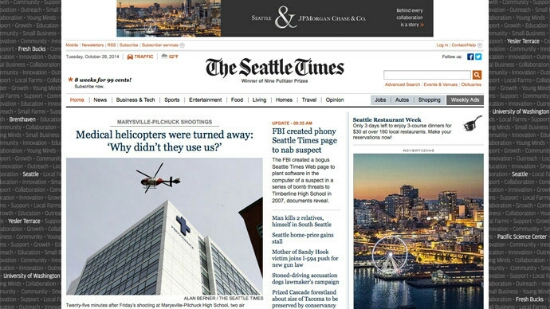
Screenshot from http://seattletimes.com
The editor of the Pulitzer Prize-winning Seattle Times newspaper says she’s “outraged” to learn only this week that the FBI made a mock-up of the publication’s website in 2007 in order to spread spyware onto the computer of a suspect.
When agents with the Seattle division of the FBI swarmed the home of a 15-year-old high school student that year and charged him with making bomb threats, media reports noted that the arrest was made possible with the use of a so-called “Computer & Internet Protocol Address Verifier” program, or CIPAV, that had been remotely installed on the individual’s machine to collect and then communicate to the authorities the user-specific information that eventually identified the suspect. The student later pleaded guilty to emailing repeated bomb threats to Timberline High School and was sentenced to 90 days in juvenile detention.
Until this week, how the FBI actually went about sneaking the CIPAV program onto the student’s computer was a matter that went unreported. After digging through a trove of emails previously obtained through a Freedom of Information Act request, however, American Civil Liberties Union technologist Chris Soghoian stumbled upon details this week showing that authorities accomplished the installation by sending a malicious link disguised as a Seattle Times news article to a social media account used by their suspect.
VIDEO — Cody Wilson, Defense Distributed, “The Bitcoin Community Has Sold Out”
The Conscious Resistance
Oct 28, 2014
On Saturday October 25 Derrick Broze caught up with Cody Wilson of Defense Distributed. Cody produced the controversial 3D printed gun, The Liberator. Cody discusses the failures of the bitcoin community, the optimism of libertarians, and Dark Wallet.
Find more videos like this at: http://www.theconsciousresistance.com
A ‘No Social Media List’ For Extremists And Potential Terrorists?
by Michael Snyder
End Of The American Dream
Sept 30, 2014
 You have heard of the “No Fly List”, right? Well, now the Tories are pledging that if they win the next election in the UK they will establish a list of “extremists” that will have to have their social media posts “approved in advance by the police” before they post them. There are also plans to ban “extremists” from broadcasting and speaking at public events. The stated goal of these proposals is to crack down on terrorism, but in the process the civil liberties of the British people are going to be flushed down the toilet. And the American people need to pay close attention to what is going on in the UK, because whatever police state measures are implemented over there usually also get implemented over here eventually. For those that believe that we need to do “whatever it takes” to fight terrorism, there is a very important question that you need to ask yourself. What if the government decides that you are an “extremist” because of what you believe? What will you do then?
When I saw a report in the Telegraph today entitled “Extremists to have Facebook and Twitter vetted by anti-terror police“, I could hardly believe it.
Do the British people actually want a “no social media list” that will essentially ban people from using Facebook and Twitter even though they haven’t actually been convicted of doing anything wrong?
The following is a brief excerpt from that article…
Extremists will have to get posts on Facebook and Twitter approved in advance by the police under sweeping rules planned by the Conservatives.
They will also be barred from speaking at public events if they represent a threat to “the functioning of democracy”, under the new Extremist Disruption Orders.
Theresa May, the Home Secretary, will lay out plans to allow judges to ban people from broadcasting or protesting in certain places, as well as associating with specific people.
The plans — to be brought in if the Conservatives win the election in May — are part of a wide-ranging set of rules to strengthen the Government’s counter-terrorism strategy.
This sounds like an Orwellian nightmare for the British people.
And who is an “extremist” anyway?
We are being told that those that belong to ISIS are extremists, and nobody would argue that.
But the article in the Telegraph makes it sound like any group “that spreads or promotes hatred” would be considered extremist. And under these new proposals, even belonging to such a group could get you thrown into prison for up to 10 years…
The Home Secretary will also introduce “banning orders” for extremist groups, which would make it a criminal offence to be a member of or raise funds for a group that spreads or promotes hatred. The maximum sentence could be up to 10 years in prison.
So what does all of that exactly mean?
Would anti-abortion groups be considered “extremist”?
Would groups promoting traditional values be considered “extremist”?
Would groups protesting against the abuses of the British government be considered “extremist”?
Would Christian churches ultimately be considered “extremist” because they don’t agree with the radical liberal agenda of the central government?
Essentially what the Tories propose to do is to tightly regulate all speech. And there is no way to do that without turning the entire United Kingdom into a totalitarian hellhole.
Meanwhile, the United States continues to march down a similar road.
VIDEO — Bitcoin vs. Political Power: The Cryptocurrency Revolution – Stefan Molyneux at TNW Conference
Stefan Molyneux
Apr 25, 2014
Historically, politicians have always fought for the power to create money out of thin air, so they can increase their spending without having to directly increase taxes. The staggering growth of political power throughout the twentieth century — the century of war — was largely made possible by replacing money limited by gold with paper currencies, which can be printed at will by government-controlled banks.
Cryptocurrencies are the first self-limiting monetary systems in the history of mankind, and could be our greatest chance to check the growth of political power since the Magna Carta. Join Stefan Molyneux, the host of Freedomain Radio – the most popular philosophy show in the world – as he reveals the hidden political and military power of government currencies, and shows how cryptocurrencies could be greatest revolution in human history, and the foundation of a truly free and prosperous planet.
The Next Web Europe Conference – April 25th, 2014
Freedomain Radio is 100% funded by viewers like you. Please support the show by signing up for a monthly subscription or making a one time donation at: http://www.fdrurl.com/donate
Bitcoin Address: 1Fd8RuZqJNG4v56rPD1v6rgYptwnHeJRWs
Litecoin Address: Lbxr3M8oezWaguEBc35MoyvQT88C85Sqpi
Get more from Stefan Molyneux and Freedomain Radio including books, podcasts and other info at: http://www.freedomainradio.com

 PN
PN 