
Syria’s Internet Outage & the Future of Information Warfare
by Tony Cartalucci
Land Destroyer
December 1, 2012
December 1, 2012 (LD) – It’s not that Syria’s government didn’t prepare for war. They perhaps, simply prepared for the wrong kind of war.
This week when sweeping outages in Syria’s communication networks were reported, the Western media immediately accused the Syrian government of being behind the move. However, it should be noted that NATO-backed terrorists operating inside of Syria have been openly given advanced communication equipment (also here and here) by Western nations, including the United States, allowing militants to create their own, independent communication networks. This includes radio, satellite, and cell networks, as well as the under-reported existence of “suitcase Internets” (also here and here).
The reason a communications blackout in Syria would not effect NATO’s primary proxy forces is because any node or bottleneck in Syria controlled by the government has already long since been circumvented, either through independent networks, or satellite links.
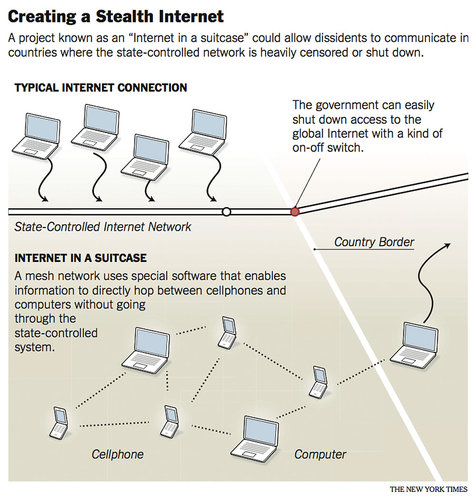
Image: New York Times depicts what is called a “mesh network,” or an independent internet that uses computers and phones not only as interfaces, but as actual nodes to create the network Imagine in this case, that the “country border” is that of Turkey and Syria. Such networks can be set up virtually anywhere, and the development of methods and software to do so have been the subject of US State Department funding and implementation.
The New York Times in their article, “U.S. Underwrites Internet Detour Around Censors,” stated in June, 2011 that:
The Obama administration is leading a global effort to deploy “shadow” Internet and mobile phone systems that dissidents can use to undermine repressive governments that seek to silence them by censoring or shutting down telecommunications networks.
The effort includes secretive projects to create independent cellphone networks inside foreign countries, as well as one operation out of a spy novel in a fifth-floor shop on L Street in Washington, where a group of young entrepreneurs who look as if they could be in a garage band are fitting deceptively innocent-looking hardware into a prototype “Internet in a suitcase.”
Therefore, the Syrian government would gain very little by shutting off the Internet to neutralize networks working entirely independent of infrastructure within state control. Conversely, if NATO has shut the Internet off at nodes leading into Syria, as appears to be the case, NATO and their proxies operating inside of Syria can begin spreading false information, uncontested, via radio, SMS, and even ad hoc WiFi networks.
With NATO’s proxies possessing their own communication networks, their own ability to co-opt and control signals in and near their areas of operation, in particular along the borders where NATO forces themselves are directly involved in disrupting and controlling communications, according to Reuters, a disruption in Syria’s communication networks would only serve to blind, hinder, and disrupt the government and the vast majority of Syria’s civilians.
The control of information, the ability to communicate and coordinate one’s forces, whether they are forces of a military or economic nature, is essential to the survival and prosperity of any nation. The neglect of improving and protecting the means of communication and the control of information within one’s borders is the modern equivalent of letting a castle’s walls crumble, its moat dry up, and to leave its towers without archers.
Syria is not entirely unprepared, however, and its ally Iran is actively building a model that could serve as an example for other nations to follow in securing their information and communication networks. Additionally, the measures used by NATO to subvert sovereign nations in their pursuit of corporate-financier motivated regime change across the planet, can just as easily boomerang back at these very corporations and financial institutions, slaying them with their own sword.
Countermeasures and Defensive Initiatives.
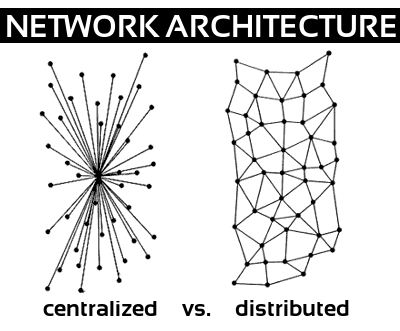
One of the many considerations and motivations behind the very creation of the Internet was its decentralized nature, and its ability to survive catastrophic attacks and still function. A subject of study by the RAND Corporation, the distributed nature of the Internet was seen as being superior to that of conventional, centralized communication architectures. However, the utility of such a network is still determined by who controls the flow of information at nodes and bottlenecks within the system.
Iran has been working on the creation of a nationwide intranet, independent of the Internet, in a bid to break the monopoly the West has been increasingly building over the years. By developing an indigenous network, Iran has the ability to isolate the country from attempts to use the Internet to undermine the nation politically and economically and control the nodes and bottlenecks within its borders.
While the Western media portrays Iran’s move as unreasonable, Western tech-firms are confirmed to be openly collaborating with Western governments in their bid to manipulate, undermine, and overthrow targeted nations, especially Iran. When we consider the disingenuous reasons behind the West’s confrontation with Iran, best articulated in Washington’s own policy think-tank, the Brookings Institution and their “Which Path to Persia?” report, the danger Iran truly faces becomes all the more obvious.

Image: Movements.org’s 2011 sponsor page. Since then, Google and the US State Department have since removed mention of their involvement, but Movements’ own annual reports (2008, 2009, 2010) still retain mention their sponsorship and role over the years.
Internet giant Google, for instance, has been openly working with the US State Department in their corporate-financier motivated interventions around the world, from Egypt to Tunisia, from Libya to Syria. It was revealed that as early as 2008, Google, along with AT&T, Howcast, and Facebook were collaborating with the US State Department via Movements.org to train, equip, and organize protesters ahead of the “Arab Spring” in 2011. The West’s governments and media would feign ignorance and surprise when widespread unrest finally swept the Arab World, when in reality it had been meticulously planned for years.
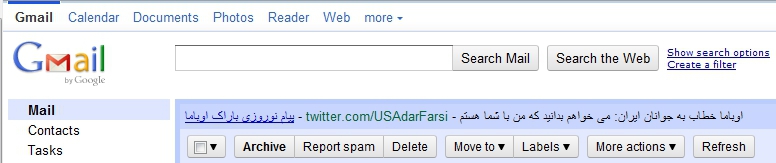
Image: The US State Department has used Google Ads to spread propaganda. This ad featured (in Farsi) the Twitter account @USAdarFarsi of the “Virtual Embassy of the United States” and reads, “Obama to the Iranian youth: I want you to know that I’m with you.” (click image to enlarge)
The US State Department regularly uses Google Ads to target Farsi speaking readers with messages to undermine the Iranian government – the modern equivalent of US Army Psychological Operations broadcasting propaganda over loudspeakers in a US theater of war, or the US State Department’s Voice of America for decades broadcasting propaganda via radio.
Additionally, Israel has openly admitted to waging “consistent and relentless” cyber warfare, just days after accusations were leveled against it regarding attacks on Iran’s infrastructure, both physical and digital.
Iran’s move, seen in this context, is not only reasonable, but would indicate negligence on the Iranian government’s part had it not begun taking more drastic measures to secure, defend, and isolate networks under constant, verifiable attack.
While Iran works to build technical solutions to adapt and overcome Western efforts to use the Internet as a weapon against them, Syria appears to be fighting with a much more hastily assembled defense, the Syrian Electric Army, to counteract torrents of propaganda emanating from similar organizations put together by the Pentagon, the Israeli IDF, as well as Saudi and Qatari propaganda machines.
The true story behind the Internet blackout in Syria may never be known, but simply countering propaganda online may not be enough to combat the full-spectrum warfare waged by NATO upon Syria, including cyber warfare. And surely such measures will not win the wars of the future. Iran’s approach, involving infrastructure as well as countering Western propaganda with their own professional, international news agency PressTV, provides nation-states with a model for confronting foreign hegemonic ambitions on and within their borders.
US State Department’s “Suitcase Internet” – a Double Edged Sword.
It is difficult to say what sort of people were actually behind the US State Department’s “Suitcase Internet.” There is Sascha Meinrath of the corporate-financier foundation-funded New America Foundation, who despite his affiliations and his role in facilitating American hegemonic ambitions across the Arab World, claims to promote “community wireless networks.” In this case, his deeds and the company he keeps, certainly don’t match his alleged desires. (read Meinrath’s US State Department RFERL interview here)
It is clear by now, with the so-called revolutions in Libya, Egypt, and Syria turning out to be textbook cases of “color revolutions” premeditated and carried out by and exclusively for a myriad of Western organizations, corporations, and institutions for the sole purpose of installing more obedient (not more democratic nor more humane) client regimes, that all those involved, along with their good intentions, were simply exploited.
Most likely, this technology will be outlawed or regulated into extinction across the West, even as it is used to overrun nations across the rest of the world.
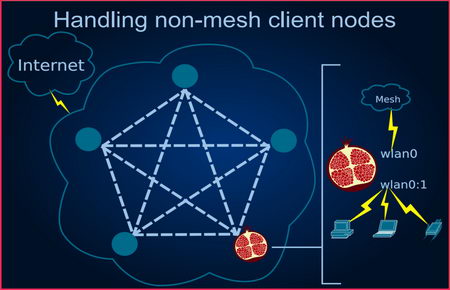
Image: A visual depiction of Project Byzantium’s ad-hoc wireless mesh network. More information can be found on their website here. Such networks have been used by corporate-financier interests, acting through the US State Department and couching their intentions behind “democracy” and “freedom” to execute the so-called “Arab Spring.” By doing so, they have managed to co-opt the talent and intentions of people to accomplish the very opposite of their stated goal. Instead of freeing nations, they’ve only been burdened with worse oppressors with infinitely stronger backers – Wall Street and London.
Software similar to what is described as being used for the “Internet Suitcase,” also known as an ad-hoc wireless mesh network, can be found at Project Byzantium, and was produced by Washington D.C.-based hackerspace, HacDC. It is described as being made specifically with “activists” in mind. While hackerspaces and local innovation stand the greatest chance at leveling the playing field, reducing both disparity and the exploitation it invites, it appears that in this case, special interests have leveraged this phenomenon to its advantage.
But the concept of mesh networks themselves, along with the work of HacDC are like any tool or weapon – everything depends on whose hands it is in, and how it is used.
Across the Arab World, these mesh networks have allowed proxies of US corporate-financier interests (wittingly and unwittingly) to undermine and overthrow the governments of sovereign nation-states and have lead to the ascent of tyrannies not only many magnitudes worse, but their true nature concealed by a complicit Western media and diplomatic corps. But what if these mesh networks (combined with locally implemented broadband lines to guard against threats like these) were used to set up permanent networks in local communities, with permanent links between communities – and other locally produced and maintained solutions for connecting groups of communities in one country, with those in another?
The potential for upsetting telecommunications monopolies with open source, local networks, independent of both corporate and government control, rules and regulations is precisely how this sword cuts the other way. Local telephone networks, like those created and deployed by the US State Department against targeted and occupied nations could also likewise be deployed against the very corporate-financier interests using these tools today to achieve their geopolitical objectives.
Localizing these networks, and connecting them as local initiatives would not only supplant large, centralized corporate-financier interests, but in the process of supplanting them, would distribute the vast amounts of unwarranted wealth and influence they’ve accumulated, across thousands, perhaps millions of local entrepreneurs – in other words, wealth redistribution through innovation and local entrepreneurship – the eradication of monopolizing special-interests by globally boycotting them, and locally replacing them.
Syria and 4th Generation Warfare.
In Syria’s case, and any sovereign nation-state wishing to stave off the threats wars of the future will bring, a careful study of today’s technology and how it can be implemented as weapons tomorrow should form the driving force behind the formation of defense strategies – not just past successes and today’s current threats. Having both electronic armies and professional international media agencies communicating a nation’s interests to the world, as well as developing and deploying indigenous communications, manufacturing, and defense infrastructure are, and will continue to be, the keys to successfully defending a nation against 4th generation warfare.
Conventional armies and nuclear forces both still serve a valuable role as deterrents, but large contingents of counter-terrorism/counterinsurgency special forces in combination with serious telecommunication and information warfare strategies are essential. The forces of Wall Street-London corporate-financier capital have made it clear they favor 4th generation warfare to build their modern empire. Those that are being targeted must then prepare to fight 4th generation wars.
FBI uses Facebook “likes” and “shares” to build terrorism case
via Refreshing News
by pooja
November 30, 2012
Cyber Warfare And The Invasion Of Syria [video]
Press For Truth
November 29, 2012
In what can be described as cyber warfare nearly every resident of Syria is currently without internet access and the Syrian government has blamed “terrorists” for the disconnection. According to activists on the grounds, similar communication cuts have occurred in isolated areas before military operations. NATO and allied forces have been preparing for an invasion and by blocking access to the internet they have taken this conflict to a whole new level.
Syria: Internet and mobile communication ‘cut off’:
http://www.bbc.co.uk/news/technology-20546302
Dan Dicks on Press TV:
http://www.pressfortruth.ca/?p=1304
Get updates like this everyday and support independent media by joining Press For Truth TV: http://pressfortruth.tv/register/
We rely on you the viewer to help us continue to do this work. With your help I can continue to make videos and documentary films for youtube in an effort to raise awareness all over the world. Please support independent media by joining Press For Truth TV!
As a Press For Truth TV subscriber you’ll have full access to the site’s features and content including Daily Video Blogs on current news from the PFT perspective and High Quality Downloads of all Press For Truth Films, Music and Special Reports! Subscribe to Press For Truth TV:
http://pressfortruth.tv/register/
For more information visit:
http://pressfortruth.tv/
You can also support Press For Truth and help us continue to do this work by donating or becoming a sponsor at pressfortruth.ca
http://www.pressfortruth.ca/donatebecome-a-sponsor/
http://www.facebook.com/PressForTruth
http://www.youtube.com/weavingspider
https://twitter.com/PressForTruth
http://twitter.com/#!/DanDicksPFT
11/19/2012 — Sheilaaliens channel shut down — NEW channel linked below [video]
Dutchsinse
November 19, 2012
So lame ! All her content gone! She covered SO many good topics… geology, volcanology, geo-engineering, UFO’s, space anomalies (meteors etc…)
Hope youtube removes their heads from their posteriors on this one…
Here is Sheilas backup channel: http://www.youtube.com/sheilaalien
song used is the “troll song”… Trololo dubstep remix
Twitter Warzone: Israel losing battle of words on social media [video]
Russia Today
November 20, 2012
Israel’s bombardment of Gaza has intensified overnight despite talk of a pending ceasefire.
The number of Palestinians killed in the week-long offensive now exceeds 140, with more than a thousand people wounded.
Violence on the ground and diplomatic wrangles are not the only battlefields in the Middle East – they’re also online, and they’re proving decisive. Aleksey Yaroshevsky explains.
RT LIVE http://rt.com/on-air
Subscribe to RT! http://www.youtube.com/subscription_center?add_user=RussiaToday
Like us on Facebook http://www.facebook.com/RTnews
Follow us on Twitter http://twitter.com/RT_com
Follow us on Google+ http://plus.google.com/+RT
RT (Russia Today) is a global news network broadcasting from Moscow and Washington studios. RT is the first news channel to break the 500 million YouTube views benchmark.
[hat tip: What Really Happened]
Kim Dotcom Announces 400 Million Dollar Plan to Provide New Zealand With Free Internet
 By JG Vibes
theintelhub.com
November 4, 2012
The raid on the mega upload headquarters earlier this year seems to have awakened the rebel spirit within Kim Dotcom, Megaupload’s infamous founder.
Since his release from jail he has made repeat promises to put “the dinosaur record industry out of business for good” and has announced the release of a website that will provide free music while paying the artists at the same time.
Now he’s taken his radical activism a step further and proposed a 400 million dollar plan that could provide free broadband to everyone in New Zealand.
Unfortunately, there is a small roadblock in his way, that being the government regulation and cartelization of internet service providers, which works the same in almost every country.
Thanks to the way that the laws are set up, Dotcom is not legally allowed to provide people with internet directly.
Instead he is forced to go through the ISP middlemen who have special government granted privileges to sell and distribute internet services.
“Kim Dotcom is proposing free broadband to all New Zealanders as he tries to resurrect the ill-fated Pacific Fibre cable connecting New Zealand to the United States.
Dotcom last night revealed his ambitious plans to build the $400m cable – which would double New Zealand’s bandwidth – set up his new Mega company, creating jobs and a data centre to service the rest of the world.
He would provide New Zealand internet service providers such as Telecom and Vodafone with free access for individual customers and charge a fee to business and central government.”
Pacific Fibre hoped to build a 12,950km cable between Auckland, Sydney and Los Angeles but cancelled the project in August after failing to raise the funds that were needed.
So even though Dotcom plans to resurrect this project and run a 400 million dollar cable under the ocean, it is illegal for him to give away the fruits of his labor to anyone without going through a licensed ISP first.
To no one’s surprise the ISP’s won’t just give away internet for free, even if they don’t have to pay for it.
Instead of giving up on the plan Dotcom has reluctantly discussed deals with the countries ISP’s and has come to somewhat of a compromise.
Dotcom will provide the ISP’s with the internet for free, who then have agreed to give the average people of New Zealand access to this connection for a very small fee.
To make the usage fee even lower for the average person, Dotcom is insisting that government and corporate organizations pay an extra surcharge.
Unfortunately, thanks to the cartelization of internet services which is made possible by government regulation, people in New Zealand will still have to pay for the service.
However, considering that New Zealand is in desperate need of this project and people would see a drastic decline on their internet bill, Dotcom’s proposal is being taken very seriously.
In the end people would pay roughly one-fifth of what they are paying now and the bandwidth would be three to five times faster with no transfer limits.
Dotcom commented on the project saying that:
“You have clean and cheap energy here. Power is becoming the biggest cost factor for data centres around the world.
With its own cable, cheap power and connectivity New Zealand could attract foreign internet business. Unfortunately the current Government wants to invest into more tarmac roads. In 10-15 years most people will work and shop from home. You don’t need tarmac, you need fibre!”
Although Dotcom is wealthy due to his internet entrepreneurship, a vast majority of this money will be coming from silent investors.
He said that he expects to get his share of the money from suing Hollywood and the US government, but if that falls through he still has no problem forking over his share out of his own pocket.
Dotcom has also been fighting back legally, accusing the record industry of lobbying the government for his arrest, illegal spying and wiretapping and other charges of police misconduct.
In New Zealand Prime Minister John Key and the Inspector-General of Security and Intelligence, Justice Paul Neazor, have both acknowledged the illegal spying.
As of now Dotcom is awaiting his extradition hearing in March.
*****
Read more articles by this author HERE.
J.G. Vibes is the author of an 87 chapter counter culture textbook called Alchemy of the Modern Renaissance, a staff writer and reporter for The Intel Hub and host of a show called Voluntary Hippie Radio.
You can keep up with his work, which includes free podcasts, free e-books & free audiobooks at his website www.aotmr.com
U.S.-Canada Integrated Cybersecurity Agenda
by Dana Gabriel
BE YOUR OWN LEADER
November 12, 2012
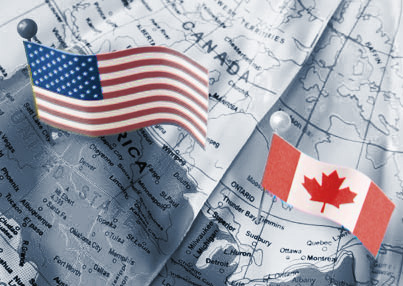
As part of the Beyond the Border initiative, the U.S. and Canada are strengthening cybersecurity cooperation. In a move that received little attention, both countries recently announced a joint cybersecurity action plan. Cyber threats know no national borders which has made the issue an important security concern. A fully integrated North American security perimeter would be entrusted with preventing and responding to any such attacks.
One of the key priorities identified in the November 2011 Beyond the Border Action Plan is cybersecurity. The agreement lays the framework for enhancing U.S.-Canada, “bilateral cyber-security cooperation to better protect vital government and critical digital infrastructure and increase both countries’ ability to respond jointly and effectively to cyber incidents. This will be achieved through joint projects and operational efforts, including joint briefings with the private sector and other stakeholders, and the enhancement of real-time information sharing between operation centres.” The deal will also work towards strengthening, “cooperation on international cyber-security and Internet governance issues to promote prosperity, enhance security and preserve openness in our networked world.” Merging cyber threat strategies would force Canada to further bring its security practices in line with American ones and under the reach of the Department of Homeland Security (DHS).
On October 26, Public Safety Canada and the DHS released a Cybersecurity Action Plan which represents a key commitment under the Beyond the Border agreement. A press release explained that the specific goals include, “enhancing collaboration on cyber incident management between each country’s cyber security operations centres, improving information sharing and engagement with the private sector, and continuing the ongoing collaboration between Canada and the U.S. on the promotion of cyber security awareness to the public.” The new joint action plan promotes a shared approach to cybersecurity and digital critical infrastructure protection. Building on these initiatives, both countries also seek to further integrate cyber capabilities into military command structures.
Earlier this year, Defense Secretary Leon Panetta authorized the creation of the Joint Cyber Center (JCC) run by the North American Aerospace Defense Command (NORAD) and U.S. Northern Command. The JCC will bring together personnel from the intelligence, operations and command control systems divisions. The aim is, “To better integrate cyber into the headquarters missions by improving situational awareness in the cyber domain, improving the defense of the commands’ networks and providing cyber consequence response and recovery support to civil authorities.” In June, DefenseNews reported that Secretary Panetta, “approved a new organizational framework, a plan designed as a ‘first step’ towards standardized cyber operations.” This includes having a JCC at each geographic combatant command which is part of ongoing efforts to not only boost U.S., but continental cyber defense capabilities. In the near future, the U.S. and Canada could create a binational “cyber-NORAD” to protect North America from shared threats.
The North Atlantic Treaty Organization (NATO) released an updated Policy on Cyber Defence in June 2011. According to NATO’s website, “This revised policy offers a coordinated approach to cyber defence across the Alliance with a focus on preventing cyber attacks and building resilience.” It will act as the framework, “for how NATO will assist Allies, upon request, in their own cyber defence efforts, with the aim to optimise information sharing and situational awareness, collaboration and secure interoperability.” The new policy also, “sets the principles on NATO’s cyber defence cooperation with partner countries, international organisations, the private sector and academia.” In May of this year, the Chicago Summit Declaration, “committed to provide the resources and complete the necessary reforms to bring all NATO bodies under centralised cyber protection.” It also pledged to, “further integrate cyber defence measures into Alliance structures and procedures.” U.S.-Canadian military cooperation also extends through NATO and this includes in the realm of cybersecurity.
There are reports that President Barack Obama may be close to issuing a cybersecurity executive order as a means of bypassing Congress. Under the guise of cybersecurity, the U.S. and Canada have been individually pushing draconian legislation domestically which would grant government agencies sweeping new powers. The implications would be far reaching and pose a risk to privacy and civil liberties. Through the Beyond the Border initiative both countries are pursuing an integrated cybersecurity agenda. As they move forward and address common threats to North America, cyber and perimeter security will be further defined and dominated by U.S. interests.
Related articles by Dana Gabriel
Taking the U.S.-Canada Partnership to the Next Level
Pretext for a North American Homeland Security Perimeter
Strengthening U.S.-Canada Security Interests in North America
Perimeter Security and an Integrated North American Command
Dana Gabriel is an activist and independent researcher. He writes about trade, globalization, sovereignty, security, as well as other issues. Contact: beyourownleader@hotmail.com Visit his blog at Be Your Own Leader
[hat tip: Activist Post]

 PN
PN 