In the 1970s, a strange psychological phenomenon was identified: in traumatic abduction situations, a certain percentage of the population is prone to falling in love with their abductors. But if we are living in a societal prison of the mind, then are there those who have fallen in love with their mental jailers? Find out more about societal Stockholm syndrome in this week’s edition of The Corbett Report.
Do you still keep a hefty portion of your savings in a U.S. bank?
If so you may want to reconsider your options. Because if the following report from the Institute of Justice is any indication, nothing you hold in private bank account is safe anymore.
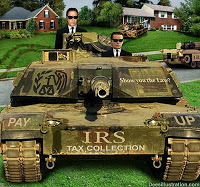
Can the government use civil forfeiture to take your money when you have done nothing wrong—and then pocket the proceeds?
The IRS thinks so.
For over 30 years, Terry Dehko has successfully run a grocery store in Fraser, Mich., with his daughter Sandy. In January 2013, without warning,the federal government used civil forfeiture to seize all of the money from the Dehkos’ store bank account (more than $35,000) even though they’ve done absolutely nothing wrong.
Their American Dream is now a nightmare.
Federal civil forfeiture law features an appalling lack of due process: It empowers the government to seize private property from Americans without ever charging, let alone convicting, them of a crime. Perversely, the government then pockets the proceeds while providing no prompt way to get a court to review the seizure.
On September 25, 2013, Terry and Sandy teamed up with the Institute for Justice to fight back in federal court. A victory will vindicate not just their right to be free from abusive forfeiture tactics, but the right of every American not to have their property wrongfully seized by government.
Every year the government of the United States seizes tens of billions of dollars in taxpayer money and redistributes these funds to “black” projects which are often unaccounted for. On September 10th, 2001, for example, Sec. of Defense Donald Rumsfeld admitted that the D.O.D. had lost around $2.3 Trillion. The funds were unaccounted for and any investigation into where they went ended the following day when the office holding the records in question was reportedly destroyed in the Pentagon attack.
No one was held to account. No one went to jail. No one was punished.
Make a suspicious transaction or can’t account for your money as a private citizen, however, and they will seize everything you own and treat you like a financial terrorist.
There are no warrants, no charges, no court proceedings. They just take it. And if you don’t comply, they’ll send an IRS SWAT team through your front door and imprison you.
What’s frightening about the experience of Terry and Sandy Dehko is that just months prior to their seizure of their assets the Internal Revenue Service completed an audit indicating that all of their records were legitimate, and their small business was operating within the guidelines of Federal tax law.
We have been covering the Mintchip story since April of 2012 when the Royal Canadian Mint made a commercial advertising it and challenging software programmers to make an app that will be used in conjunction with it. The commercial portrays Mintchip as the ‘evolution of currency’, tries to portray it as our inevitable future. The commercial describes Mintchip as a digital form of currency. Value is recorded on MicroSD cards in smart phones, tablets or laptop/desktop computers because it can also be loaded onto chips found in USB sticks. In the commercial it also states that some future devices might also be compatible with it that are not even invented yet. Click HERE for Mintchip commercial mentioned above.
Jan Hannemann, an app developer, along with many other recipients entered the Mintchip challenge that was portrayed in the commercial. Hannemann’s idea, MintWallet, made him win the grand prize of $50,000 for best application. His goal was to make virtual currency to be “like instant messaging for your wallet.” Using cloud technology and push notifications, users could use MintChips for payments, for literally pretty much anything.
“Winning app MintWallet allows users to send money, or requests for money to other users. It relies on a peer-to-peer network to connect users and allow the transfer of digital cash. It ties in QR codes so every payment request will have a QR code automatically generated. That allows payment usages such as scanning the code at a parking meter to pay for your time at a spot. There’s also a “split the bill” feature so a group eating out together at a restaurant can quickly pay their share without any hassle.”
~ SOURCE
MiniCheckout is another popular choice winner for the MintChip Challenge which allows users with Mintchip technology to scan items they are purchasing from a grocery store (or other place) by taking a picture of the barcode and paying for everything they buy digitally through the smart phone. This kind of correlates to IBM’s commercialwhere it portrays a man just shoving grocery items into his pockets and he just walks out of the store because everything is automatically deducted from his chip.
So what’s the difference between debit cards and mintchip?

 Gnostic Media
 We have been covering the Mintchip story since April of 2012 when the Royal Canadian Mint made a commercial advertising it and challenging software programmers to make an app that will be used in conjunction with it. The commercial portrays Mintchip as the ‘evolution of currency’, tries to portray it as our inevitable future. The commercial describes Mintchip as a digital form of currency. Value is recorded on MicroSD cards in smart phones, tablets or laptop/desktop computers because it can also be loaded onto chips found in USB sticks. In the commercial it also states that some future devices might also be compatible with it that are not even invented yet.

