
Canada Being Assimilated Into a U.S. Dominated North American Security Perimeter
by Dana Gabriel
BE YOUR OWN LEADER
June 17, 2013
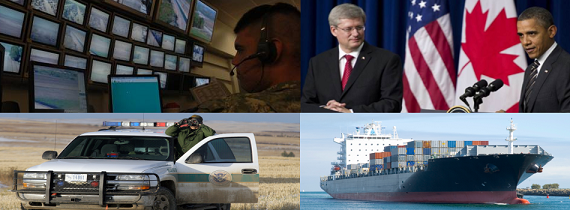
Canada’s prime minister recently addressed the CFR, a globalist think tank who have been a driving force behind the push towards deeper North American integration. The U.S. and Canada are now further advancing this agenda through the Beyond the Border agreement. Both countries are increasing bilateral border transportation and infrastructure coordination. This includes a common approach to border management, security and control. They are also integrating an information sharing system that would be used to track everyone crossing the U.S.-Canada border and entering or leaving the continent. Without much fanfare and seemingly little resistance, Canada is being assimilated into a U.S. dominated North American security perimeter.
In May, the Conservative government highlighted the benefits of the U.S.-Canada Beyond the Border action plan which was announced back in 2011. The deal, “focuses on addressing security threats at the earliest point possible and facilitating the lawful movement of people, goods, and services into Canada and the United States, and creates a long-term partnership to improve the management of our shared border.” The goal is to further increase, “security, economic competitiveness and prosperity through numerous measures, including reducing border wait times and improving infrastructure at key crossings to speed up legitimate trade and travel.” The Beyond the Border Executive Steering Committee recently met to discuss the objectives that have already been achieved and the work that still needs to be done. Another important facet of the economic and security perimeter agreement is the Regulatory Cooperation Council action plan. A stakeholder dialogue session is planned for June 20, which will review its implementation progress and will seek further input regarding the next stage of U.S.-Canada regulatory integration.
Last month, the Canada Border Services Agency (CBSA) and the Department of Homeland Security (DHS) released a joint report on the findings of Phase I of the Entry/Exit Information System. The program included collecting and exchanging biographic information at four selected land border ports of entry. In a news release, U.S. Customs and Border Protection (CBP) Acting Commissioner Thomas Winkowski stated that, “The results of Phase I demonstrate the capacity of the United States and Canada to increase information sharing capabilities.” He added, “This kind of cooperation epitomizes the Beyond the Border Action Plan.” The next phase of the entry/exit initiative is set to begin at the end of this month. It will involve exchanging the data collected from third-country nationals and permanent residents of Canada and the U. S. at all common ports of entry. Both countries are further merging databases and are expanding surveillance and intelligence gathering operations. In 2014, they will also start sharing biometric information at the border. This will further advance the creation of a North America security perimeter where all travellers will be tracked and traced in real time.
As part of the commitment made under the Beyond the Border deal, both countries have announced the Border Infrastructure Investment Plan which was, “developed to establish a mutual understanding of recent, ongoing and potential border infrastructure investments. It outlines the approach that Canada and the United States will take to coordinate plans for physical infrastructure upgrades.” In June 2012, Canada reached an agreement with the State of Michigan to build a second bridge between Detroit and Windsor, Ontario. This was followed by a presidential permit issued in April of this year that officially paved the way for construction of the project. A U.S. State Department press release explained that, “Consistent with the bilateral Beyond the Border Initiative, this permit contributes to ensuring that our border infrastructure supports increased competitiveness, job creation, and broad-based prosperity in the United States and Canada.” It went on to say that the new bridge, “will help to meet future capacity requirements in a critical travel corridor, promote cross-border trade and commerce, and advance our vital bilateral relationship with Canada.”
In March, DHS Secretary Janet Napolitano and Canada’s Minister of Public Safety Vic Toews signed a memorandum of understanding which established a truck cargo pre-inspection pilot project. The joint undertaking is another component of the Beyond the Border agreement and would shift inspections and clearances away from the actual border crossing. The first phase, “will test the concept of conducting U.S. CBP primary cargo inspection in Canada, and will be implemented at the Pacific Highway crossing between Surrey, British Columbia and Blaine, Washington.” The second phase, “will further test how pre-inspection could enhance border efficiency and reduce wait times to facilitate legitimate trade and travel, and will be implemented at the Peace Bridge crossing between Fort Erie, Ontario and Buffalo, New York.” The perimeter security deal is laying the foundation for a future U.S.-Canada binational organization that would jointly manage and control the border.
The CBSA is also testing additional technology at the Morses Line, Quebec and Piney, Manitoba ports of entry. Under the remote traveller pilot project, people entering either location after regular hours of service, “will be processed by a border services officer located at a remote processing centre through a two-way audio and one-way video kiosk. Cameras will be installed to provide the officer with the ability to see the traveller and the vehicle.” The program which could later be expanded to other areas , “is part of the Small and Remote Ports of Entry Initiative, one of the deliverables under the Beyond the Border Action Plan.” NAUNEWZ pointed out that, “Although a lot of this technology is already installed and being utilized in limited ways at most of the main Canada-U.S. border crossing points, these smaller border crossings are ideal testing grounds for their ‘no borders’/NAU agenda.”
On May 16, Canadian Prime Minister Stephen Harper participated in question and answer session before the Council on Foreign Relations (CFR). The conversation centered around economic growth, foreign investment and the role of the G20 with regards to global governance. Other issues focused on Canada-U.S. relations. Harper lobbied for approval of the controversial Keystone XL pipeline which would carry oil from western Canada to the Texas gulf coast. He dismissed environmental issues associated with the project and argued that it would be a step towards North American energy independence. The Obama administration is expected to make a final decision on the pipeline sometime this year. Harper also acknowledged the Beyond the Border and the Regulatory Cooperation Council action plans. He blamed sovereignty concerns and the continued negativity surrounding NAFTA as the main obstacles to even deeper continental integration. Prime Minister Harper used his audition in front of the CFR as an opportunity to demonstrate to the U.S. political and corporate elite that he is committed to defending the interests of big business and further pushing plans for a North American Union (NAU).
The Beyond the Border action plan is the most significant step forward in U.S.-Canada cooperation since NAFTA. It provides the framework for future North American integration. When fully implemented, the agreement can be expanded and updated. So far, the agenda has quietly slipped under the radar. By incrementally incorporating various pilot projects and excluding Mexico from the process, it has managed to avoid the controversy of past initiatives. The perimeter security deal is being sold as vital to improving the flow of trade and travel across the border. In order to appease U.S. fears, Canada has made numerous concessions with no guarantees that it will lessen border restrictions. As part of a North American security perimeter, Canada will always be at the mercy of any new U.S. security measures, regardless of the dangers they may pose to privacy and civil liberties.
Related articles by Dana Gabriel:
U.S.-Canada Harmonizing Border Security and Immigration Measures
Taking the U.S.-Canada Partnership to the Next Level
Merging U.S.-Canada Arctic Foreign Policy
The Return of ACTA: U.S. Dictating Canada’s Intellectual Property Laws
Dana Gabriel is an activist and independent researcher. He writes about trade, globalization, sovereignty, security, as well as other issues. Contact: beyourownleader@hotmail.com Visit his blog at Be Your Own Leader
West committed atrocities not Syria government: Chossudovsky
CounterPsyOps
June 10, 2013
Press TV has conducted an interview with Michel Chossudovsky, Center for Research on Globalization, Montreal, on the back of UN concern for the Syrian war spilling over into other countries.
The following is an approximate transcript of the interview.
Press TV: The UN is warning of an explosion in the Middle East if the war on Syria continues. The question is what has the UN itself done to prevent the war from exacerbating?
Chossudovsky: First of all, that statement was made by the head of the United Nations High Commission for Refugees. And the statement says that if the fighting doesn’t stop… the fighting is going to stop because the terrorists have been defeated
And essentially if Western powers put a moratorium on their support to these al-Qaeda affiliated rebels, the war is over – at least, the ground war is over. Recent developments suggest and confirm that the country is under the control of the Syrian government. The rebel forces have been defeated in al-Qusayr and they’ve also been defeated in other parts of the country.
The question of humanitarian aid has to be, from my standpoint, addressed because, who are the protagonists for humanitarian aid, so-called humanitarian aid? Precisely the countries, which supported these rebel terrorists.
And I think what we should be raising at this stage is that it is well established that this war was waged by the United States, NATO and Israel with the support of the [Persian] Gulf states Qatar and Saudi Arabia in particular and that under international law what is now required is war reparations.
So I would say let us put the humanitarian dimension aside and focus on the billions and billions of dollars of war reparations, which are due to the Syrian government as a result of the legal support of these terrorist formations in Syria, which constitute essentially the ground forces – the foot soldiers of the Western military alliance.
Press TV: The recent victory in Qusayr and the recent revelation that Israeli-made weapons were seized from Syrian insurgents – What impact will this have on the dynamics of the conflict?
Chossudovsky: We’ve known from day one that Israel has supported al-Qaeda. And we also know that Israel has channeled weapons and logistic support to the rebels in the areas surrounding the occupied areas of the Golan Heights and in fact Israel even established a hospital facility for the al-Qaeda rebels and was bussing them back and forth, taking the wounded to the hospital and then sending them back to the war theatre.
Israel was involved in acts of aggression against a sovereign state together with NATO, particularly Turkey, Britain, France, the United States. French and British Special Forces, SAS forces, MI6 and CIA agents were involved – We know it because it’s documented. Who is training the rebels in chemical weapons? The Western military alliance.
Minister Laurent Fabius of France comes out – and it’s the typical sort of weapons of mass destruction saga accusing the government of using chemical weapons against civilians when in fact CNN confirms that Western forces are training the rebels in the use of chemical weapons; when the Turkish police arrests al-Qaeda rebels – it just happened a week or so ago.
So we know that all this is fabrications whereby the Western military alliance is accusing the government of committing atrocities, which they themselves have committed.
What we must now tackle at an intentional level is war reparations. The war is over unless of course the West decides to continue this war e.g. with a no-fly zone. That would be an extremely dangerous option at this stage because Syria has an advanced air defense system.
The S-300 is in place; it has been building up over the past 18 months; there are other elements of air defense; and it would be very unwise for the Western military alliance to impose a no-fly zone, which would immediately be subject to some kind of response.
So that is the background. This war has reached a point of transition if there is no intervention on the part of the Western military alliance, the war is over.
SC / HGH
VIDEO — Turkey And Morsi Fanning The Flames – Morris
108morris108
June 15, 2013
Has Morsi betrayed Iran by cutting ties with Syria on the day that Iran was busy with its presidential elections.
Turkey appears to have had more than a million people demonstrating for and against Erdogan.
VIDEO — Obama’s Lies About Chemical Weapons In Syria
Syrian Girl
June 14, 2013
We heard all these lies before during the Iraq war.
AUDIO — Madison Ruppert discusses NSA surveillance on Flow of Wisdom with Sean Anthony
End the Lie
June 10, 2013
Madison Ruppert and Sean Anthony discuss the government’s massive surveillance of the American people and how it relates to the Fourth Amendment, the NSA’s PRISM and Boundless Informant programs, whistleblowers and much more.
End the Lie Radio airs from 10:00 PM ET/7:00 PM PM PT every Monday evening at http://UCY.TV/EndtheLie.
Website: http://EndtheLie.com
Show page: http://UCY.TV/EndtheLie
Support us: http://EndtheLie.com/Store
Facebook: http://Facebook.com/EndtheLie
Network: http://UCY.TV
All material(s) used in this video that are not original or are under copyright are used under Fair Use under the Copyright Act of 1976, 17 U.S.C. § 107.
VIDEO — Escobar: Obama starts Syria war to deviate from Snowden scandal
RT
June 14, 2013
[Potent News editor’s note: via Pepe Escobar: For those who haven’t seen it yet. RT’s title is misleading; I meant “start” metaphorically; Obama’s Syria decision is a diversion from PRISMgate. At least for 24 hours it worked, bumping Snowden off the headlines.]
CIA whistle blower Edward Snowden has reportedly been stopped from flying to the UK. The man who lifted the lid on America’s secret surveillance activities is being pursued by Washington. For his latest revelation, he told a Hong Kong newspaper that the U.S. repeatedly hacks into Chinese computer networks. For more about the leaks and Snowden’s future we’re now joined live by Pepe Escobar, a roving correspondent for the Asia Times.
RT LIVE http://rt.com/on-air
Subscribe to RT! http://www.youtube.com/subscription_c…
Like us on Facebook http://www.facebook.com/RTnews
Follow us on Twitter http://twitter.com/RT_com
Follow us on Google+ http://plus.google.com/+RT
RT (Russia Today) is a global news network broadcasting from Moscow and Washington studios. RT is the first news channel to break the 1 billion YouTube views benchmark.
VIDEO — WeAreChange Vlog #7: End of Bilderberg, Inside the Grove!
WeAreChange
June 13, 2013
In this video, Luke Rudkowski documents the end of the Bilderberg protest, gets inside the Grove hotel, interviews Mark Anderson of AFP and Jon Scoby of WRC Birmingham. The next vlogs will be taking place from the G8 summit in Northern Ireland so stay tuned.
Support us by subscribing here http://bit.ly/P05Kqb
http://www.facebook.com/wearechange.org
Check out our merchandise: http://wearechange.org/store/
Become a member of The Sponsor Lounge and get exclusive behind the scenes content while helping us grow! Join us today! http:///www.wearechange.org/donate


