
Preparations For A War – Voice Over
108morris108
April 19, 2012
A Subscriber sent in some military observations – from the Gulf to Europe – the menace of military build-up is everywhere.
…
PREPARATIONS FOR A WAR
The US, Israel and Greece launched an air naval exercise in the Mediterranean Thursday, March 29. Codenamed “Noble Dina,” within Crete and including the waters off of Turkey, Cyprus, and Israeli Navy bases in Haifa and Ashdod. American, Israeli and Greek fleets are being supported by the British Royal Navy flotilla cruising around the Straits of Gibraltar. Rumours have it that the exercise is led by the US Sixth Fleet . As soon as it is over, possibly at the end of April, this aircraft carrier and strike group will head through the Suez Canal to the Red Sea and Persian Gulf, raising the number of US aircraft carriers facing Iran to three. Israel contributed missile ships, submarines, fighter jets and assault helicopters to the drill.
As this drill is launched Russia has started to surround Syria with it’s warships to prevent any attack on Syria . Also in the recent US-backed “Friends of Syria” meeting in Istanbul Saudi Arabia and Qatar confirmed they will financially assist the rebels. Russia has viewed it as a further step towards Arab meddling in the region.
Meanwhile 200 American and Arab Gulf fighter-bombers thundered overhead Sunday, April 8 at the outset of the biggest air force exercise ever conducted in the Gulf region. An operation for reopening the strategic Straits of Hormuz if it is closed by Iran which is busy building a naval base there. 100 of the warplanes took off from the USS Enterprise and USS Abraham Lincoln, training was also with Saudi, UAE, Kuwaiti and Bahraini air forces. The drill was conducted mainly around the US Fifth Fleet High Command base in Bahrain and around the Gulf.
Russia is building a radar station in the Armenian mountains to counter the US radar set up at the Turkish Kurecik air base. This system sends a warning to the US not to strike Iran. The Turkish station will trade data on incoming Iranian missiles with the US station in the Israeli Negev, the Russian station in Armenia will share input with Tehran. The Russian army has deployed S-400 surface-to-air missiles into Kaliningrad, the Baltic enclave bordered by Poland and Lithuania as a response to US plans for an anti-Iran missile shield system in Europe and the Middle East. Looks like the future is going to be not peaceful and will get worse.
Separate explosions kill 21 security forces, civilians in Syria
PressTV
April 18, 2012
At least 13 security forces and eight civilians have been killed in two separate bomb attacks in the northwestern Syrian city of Aleppo.
On Tuesday, a car bomb targeted a bus transporting Syrian law enforcement members near a gas station in Aleppo’s al-Shaar neighborhood.
The attack left at least four security forces and one civilian dead.
The second bomb exploded under a bridge in the city as a bus, which was also carrying troops, passed by. At least 16 people, including seven civilians, were killed in the assault.
Saudi and Qatari security officials are reportedly accused of being involved in such bombings in Syria. Both Arab states have openly expressed support for an armed insurgency campaign to overthrow the government of President Bashar al-Assad.
[CLICK HERE TO READ THE FULL ARTICLE]
[hat tip: Friends of Syria]
NAFTA Partners Take Steps to Boost Trilateral Relationship
by Dana Gabriel
BE YOUR OWN LEADER
April 9, 2012

While bilateral initiatives have dominated North American issues over the last couple of years, the trilateral relationship has suffered. With a series of high-level meetings, the U.S., Canada and Mexico are taking steps to boost the NAFTA partnership. First, the defense ministers met to discuss shared continental security threats. This was followed by a leaders summit which pledged to deepen trade, regulatory, energy and security cooperation. The recent meetings have caused some to once again take notice of the incremental efforts to merge all three countries into a North American Union.
In what was hailed as an historic event, U.S. Secretary of Defense Leon Panetta, Canadian Defense Minister Peter MacKay, Mexican Secretary of National Defense Guillermo Galvan, and Mexican Secretary of the Navy Mariano Mendoza recently held the Inaugural Meeting of North American Defense Ministers. As part of a framework they agreed to, “ Develop a joint trilateral defense threat assessment for North America to deepen our common understanding of the threats and challenges we face. Explore ways to improve our support to the efforts of civilian public security agencies in countering illicit activities in our respective countries and the hemisphere, such as narcotics trafficking. Explore how we can collaborate to increase the speed and efficiency with which our armed forces support civilian-led responses to disasters. Continue to work together to strengthen hemispheric defense forums.” The ministers also committed to enhancing cooperation in the fight against transnational criminal organizations. The trilateral defense meeting is part of the ongoing efforts to establish a fully integrated North American security perimeter.
On April 2, President Barack Obama hosted Canadian Prime Minister Stephen Harper and Mexican President Felipe Calderon for the sixth North American Leaders Summit. In a joint statement they reaffirmed their, “commitment to further develop our thriving political and economic partnership with a consistent and strategic long-term vision.” The leaders acknowledged that, “continued North American competitiveness requires secure supply chains and efficient borders. We remain committed to achieving this through co-operative approaches.” With respect to regulatory initiatives, they agreed to move forward trilaterally in areas such as “vehicle emission standards, railroad safety, the Globally Harmonized System of Classification and Labeling of Workplace Chemicals, and aligning principles of our regulatory approaches to nanomaterials.” They also announced the creation of the North American Plan for Animal and Pandemic Influenza. Following the leaders summit, U.S. Trade Representative Ron Kirk engaged in discussions with Canadian Trade Minister Ed Fast and Mexico’s Secretary of the Economy Bruno Ferrari, as part of the NAFTA Commission Meeting.
In their joint communique, the leaders recognized, “the growing regional and federal cooperation in the area of continental energy, including electricity generation and interconnection and welcome increasing North American energy trade.” They emphasized the need to deepen, “cooperation to enhance our collective energy security, including the safe and efficient exploration and exploitation of resources.” There was no mention of the Keystone XL Pipeline Project which would carry oil from western Canada to the Texas gulf coast. President Obama has blocked the plan pending further environmental review. While speaking at the Woodrow Wilson Center following the leaders summit, Prime Minister Harper made it clear that even if the pipeline is approved, Canadian oil will be heading for Asian markets. Meanwhile, the U.S. has been pushing Mexico to further open up its oil sector to private investment. In February, they signed an agreement regarding, “the development of oil and gas reservoirs that cross the international maritime boundary between the two countries in the Gulf of Mexico.”
The leaders joint statement also noted that, “The Trans-Pacific Partnership (TPP) provides an opportunity to further deepen our trade relationship and create jobs. The United States welcomes Canada’s and Mexico’s interest in joining the TPP.” During a press conference with his NAFTA counterparts, Obama confirmed that, “Consultations with our TPP partners are now underway on how new members can meet the high standards of this trade agreement, which could be a real model for the world.” The U.S. is spearheading TPP negotiations which also include Australia, Brunei, Chile, Malaysia, New Zealand, Peru, Singapore and Vietnam. Japan has also expressed interest in being part of the TPP process. The door is also open for other countries to join which is why many consider it to be a building block for an Asia-Pacific free trade zone.
Robert Pastor who has been a leading advocate for deeper North American integration described the TPP as a flawed strategy. He explained Canada and Mexico’s decision to join, “as a defensive measure to ensure that they protect what they gained from NAFTA.” Pastor warned how, “the TPP will divert scarce political capital and attention from North America.” In contrast, the Council of the Americas are of the opinion that it would boost the integrated North American economy. They view the TPP as a “promising vehicle to support the updating of our bilateral and trilateral trading relationships within North America to the high standards of twenty-first century free-trade agreements.” While on a visit to the U.S. in March, Canadian Trade Minister Ed Fast proclaimed that, “As neighbours and friends, we can and should build the TPP together. As like-minded allies, we can ensure that high standards are included in the TPP on such issues as investment, regulatory cooperation, state-owned enterprises and labour provisions.” If Canada and Mexico are accepted into the TPP fold, it could be used to renegotiate and expand NAFTA.
The U.S., Canada and Mexico have also agreed to launch a consolidated Central America Integration System-North America Security Dialogue to deepen regional coordination and cooperation. This includes working closer together in the fight against transnational organized crime, arms trafficking and money laundering. During the leaders joint news conference, President Obama praised Mexico’s courage in standing up to the drug cartels, and added, “today each of us reaffirmed our commitment to meeting this challenge together — because that’s the only way that we’re going to succeed.” President Calderon went on to say, “The security of North America is absolutely tied to each of its member states.” The Merida Initiative has expanded the U.S.-Mexico security partnership. It has provided military equipment, training, infrastructure development, along with border security and information technology enhancement. At the 2009 North American Leaders Summit, Prime Minister Harper announced Canadian support for Mexico’s fight against drug trafficking and transnational organized crime.
Mexico’s drug war is increasingly being seen as a continental problem that requires continental solutions which is further pushing the NAFTA partnership into a common security front. This is escalating the militarization of the borders, integration in areas of law enforcement and the military, as well as advancing the development of a North American security perimeter.
Related articles by Dana Gabriel
Canada and Mexico to Join U.S. in NAFTA of the Pacific
Pretext for a North American Homeland Security Perimeter
Indoctrinating a New Generation to Think North American
The North American Leaders Summit and Reviving Trilateral Integration
Dana Gabriel is an activist and independent researcher. He writes about trade, globalization, sovereignty, security, as well as other issues. Contact: beyourownleader@hotmail.com Visit his blog at beyourownleader.blogspot.com
Desperate Syrians in Aleppo
Friends of Syria
April 18, 2012
Yesterday there were terrorist attacks in Aleppo, but the International Media today showed bombings in Homs which never happened. Innocent people and armed forces where blown up by terrorist bombs, but that is not worthy as news in the west, because it does not fit in with their agenda of war.
This is the voice of the real Syrian people like Syrian Girl.
Obama’s Friday Afternoon Document Dump for this Week: US Begins Overt Aid to Syrian Death Squads After 13 Months of Covert Support [video]
Webster G. Tarpley, Ph. D.
TARPLEY.net
April 14, 2012
FROM LIBYA TO SYRIA: “WAR IS A RACKET. IT ALWAYS HAS BEEN”
by James Corbett
Global Research
April 14, 2012
“War is a racket. It always has been.” These words are as true now as they were when Major General Smedley Butler first delivered them in a series of speeches in the 1930s. And he should have known. As one of the most decorated and celebrated marines in the history of the Corps, Butler drew on his own experiences around the globe to rail against the business interests that use the U.S. military as muscle men to protect their racket from perceived threats. From National City Bank interests in Haiti to United Fruit plantations in Honduras, from Standard Oil access to China to Brown Brothers operations in Nicaragua, Butler pointed out how intervention after intervention served the business interests of the well-connected even as American taxpayer money went to foot the bill for these adventures. The names and places may have changed, but the old adage holds: the more things change, the more they stay the same.
The National Transitional Council that is nominally in charge of what is left of Libya announced this week that they’re beginning a probe of foreign oil contracts brokered during Gaddafi’s reign by his son, Saif al-Islam. Libya is sitting on the largest oil reserves in Africa, and it is no coincidence that within weeks of the start of the NATO campaign last year the rebels had already secured the country’s oil ports and refineries on the Gulf of Sidra and established their own national oil company for negotiating contracts with the invading forces. Although the oil contract probes are supposedly meant to show the transparency of the new “government” and their willingness to root out the graft and kickbacks inherent in the old regime, it’s quietly acknowledged that the process will be used to reward the nations that most visibly supported last year’s invasions and punish those who were more reticent.
Surprising, then, that the first companies on the block are Italy’s Eni and France’s Total. Both countries fostered close ties with the NTC last year and France was the first country to officially recognize them as the government of Libya. But now Libya’s general prosecutor is reviewing documents related to these companies for possible financial irregularities. The SEC is getting in on the act, too, requesting documents relating to both companies’ Libyan operations to check for suspected violations of the Foreign Corrupt Practices Act. The potential blow to the European giants’ share in the Libyan market is especially painful in light of the upcoming Iranian oil embargo that threatens to squeeze the crude imports of Greece, Italy and Spain. Now, as Libya ramps up oil production to pre-war levels the obvious potential winners in the probe are the American and British majors, who could end up eating up some of Eni and Total’s share in Libya’s oil production should the investigation lead to charges.
China may also have reason to be wary of their standing with the new government. Chinese-Libyan ties were increasingly close in the years leading up to Gaddafi’s ouster, with trade volume having reached $6.6 billion in 2010. In 2007, as the US was beginning to put AFRICOM together and the competitive scramble for African resources was heating up, Gaddafi delivered an address to the students of Oxford University where he praised China’s hands-off approach to investment in Africa. At the time, Gaddafi suggested that Beijing was winning the hearts and minds of Africans with its reluctance to interfere in local politics, while Washington was alienating the population with their heavy-handed interventions. In the wake of the NATO bombing the would-be government of Libya is singing a different tune and relations with China have cooled down. Last August a senior NTC official suggested that China would be punished when it came time to award reconstruction contracts in Libya because of their initial reluctance to support the rebels. Although the statement was downplayed, it was revealed earlier this month that Chinese companies are still waiting to begin negotiations on losses to frozen and outstanding contracts worth $18.8 billion. Relations are still cordial, though, and the Libyan government is assuring China that the contracting companies will be in a better position to resume negotiations after national elections in June.
These latest moves from Tripoli may be as much about projecting the idea that the NTC is actually functioning as a government than anything else, though. Armed militias are still waging violent turf wars throughout the country, with 26 people dying in fighting between rivals in the western town of Zwara earlier this month and 150 dying in skirmishes last month in the southern city of Sabha. One militia stormed a hotel in Tripoli and opened fire, then beat and kidnapped the manager after he told a militia member to pay an outstanding room bill. Last week hundreds marched in Benghazi to call for an end to the violence between the armed gangs. The country is deeply divided along tribal lines and armed militias still occupy government buildings and openly flaunt the pronouncements of the erstwhile government. The idea that the NTC is actually functioning as a government is a pipe dream at this point, but as long as they keep the oil pumping and the victors of last year’s humanitarian love bombing get their spoils, there’s hardly a peep out of Washington, Paris, or London. Smedley Butler wouldn’t be surprised.
Meanwhile in Syria, the racketeers’ plans for a Libyan repeat are proceeding apace. Last week we reported on the so-called “Friends of Syria” and their agreement to begin openly funding the rebels to the tune of millions of dollars. This week we have been watching the inevitable, pre-scripted “break down” in Annan’s UN-brokered ceasefire. Exactly on cue, unverified reports from unnamed activists have begun rolling in to the usual media mouthpieces via foreign-based NGOs proclaiming so many people have died in continued fighting. The unacknowledged elephant in the room, however, is that, exactly as Russian Foreign Minister Sergei Lavrov has been attempting to point out all month, it’s impossible to expect a cessation in fighting when you are openly arming, training and funding an insurgent proxy army that is hell-bent on toppling the government. However, Lavrov is banging his head against a brick wall. The ceasefire was never meant to be a ceasefire and it’s all political theater at this point anyway. Any and every unverified rumor of fighting or violence in the country will now be taken as a sign that Assad has broken the agreement and the pressure to get Beijing and Moscow to acquiesce to the toppling of the Syrian government will intensify.
In the end, this will not be a carbon copy of Libya. There will be no NATO-led bombardment or large-scale military intervention, because Russia couldn’t allow that to happen. Besides, Syria has Russian supplied surface-to-air missiles and no compunction about using them. Instead, political pressure will increase for Assad to step down and the funds and arms to the rent-a-rebel force will continue increasing until the government is toppled. The dangerous factor in this equation is that neither the west nor China/Russia have blinked yet and there is a significant amount of face to lose for one side or the other in this proxy struggle. The one with the most to lose is clearly Iran, which all things being equal would be a dominant power player in regional politics. All things, however, are not equal. With their oil increasingly embargoed, the sanctions getting progressively tighter, and one of their key allies in the region threatening to topple in favor of a hostile Sunni insurgency, Iran has to know that when and if the Syrian domino falls, it falls on them.
At the same time, attention is turning once again to another of the war racketeers’ key interests: Pakistan. There has been newfound congressional interest in the so-called “Free Baluchistan” movement seeking independence for Pakistan’s Baluchi nationals. Citing human rights violations, Rep. Rohrbacher (R-California) has introduced a resolution calling on Pakistan to recognize Balochi self-determination. He has even written an op-ed in the Washington Post where he begins his argument with recourse to human rights and switches seamlessly in the fourth paragraph into noting with evident glee the region’s natural gas, gold, uranium, and copper reserves.
Interestingly, Russia agreed last week to pony up $1.5 billion in financing and technical assistance for a proposed Iran-Pakistan gas pipeline. The projected course of the pipeline? It would start in Iran’s southern Assalouyeh Energy Zone and enter Pakistan from the west, crossing straight through Baluchistan. Coincidence, surely. The IP pipeline has had a tumultuous history, complete with plans to run the pipeline all the way to India (an idea from which India has distanced itself but never completely abandoned) and the potential involvement of China, which has flirted with the idea of incorporating the pipeline into a planned logistical network running from the port of Gwadar in Pakistan’s southwest all the way to Xinjiang province. Now, with a proposal for Russian funding on the table the pipeline looks closer than ever to becoming a reality.
From the outset, the US has used every bit of leverage it has to get the parties involved to scrap the idea. Diplomatic pressure has been brought to bear on China, Pakistan, and India, with Beijing and New Delhi both appearing to buckle under the pressure and pull out of the project. The US has backed its own alternative pipeline, a Turkmenistan-Afghanistan-Pakistan-India route, but that idea is looking less feasible by the day. Iran has nearly completed its share of the proposed IP pipeline, but Pakistan has been hesitant. Now along come the racketeers to fund yet another rebel movement in another geostrategically vital corridor, and before you know it “Free Baluchistan” might derail the project altogether. Look for US pressure on the Pakistani government regarding Baluchistan to increase as the pipeline comes closer to completion.
Butler was right. War is a racket, after all. These days the muscle men are rent-a-mobs and insurgents more so than the U.S. military, but the idea is the same: fund, arm and train the fighters to secure the resources and control the strategic areas. In Libya the NATO-backed rebels wrested the oil spigot from the unpredictable Gaddafi. In Syria the “Friends of Syria” are overthrowing a key Iranian ally and taking over an important square on the geopolitical chessboard. In Pakistan, American-backed rebels may succeed in driving a wedge through a key Iran-Pakistan pipeline. And the racket continues. One would do well to remember the grand finale of Butler’s speech: “To hell with war!”
|
In order to access the Corbett Report: http://www.corbettreport.com
|
|
| James Corbett is a frequent contributor to Global Research. Global Research Articles by James Corbett |
Executive Order: Feds To Take Control of Domestic Natural Gas Production

EPA Set To Move Within One Week
by Mac Slavo
SHTFPlan.com
April 16, 2012
While Americans focused their attention on the Colombian controversy involving U.S. Secret Service agents, prostitutes and excessive drinking, President Obama quietly signed his latest Presidential Executive Order.
The Supporting Safe and Responsible Development of Unconventional Domestic Natural Gas Resources Executive Order seeks to create what amounts to a Presidential super committee that will oversee the regulation and development of the ‘unconventional’ natural gas industry for the purpose of ensuring a long-term natural gas supply for the United States, as well as to do so in a safe and environmentally responsible manner.
Excerpts (Read the complete E.O.):
While natural gas production is carried out by private firms, and States are the primary regulators of onshore oil and gas activities, the Federal Government has an important role to play by regulating oil and gas activities on public and Indian trust lands, encouraging greater use of natural gas in transportation, supporting research and development aimed at improving the safety of natural gas development and transportation activities, and setting sensible, cost-effective public health and environmental standards to implement Federal law and augment State safeguards.
Because efforts to promote safe, responsible, and efficient development of unconventional domestic natural gas resources are underway at a number of executive departments and agencies (agencies), close interagency coordination is important for effective implementation of these programs and activities. To formalize and promote ongoing interagency coordination, this order establishes a high-level, interagency working group that will facilitate coordinated Administration policy efforts to support safe and responsible unconventional domestic natural gas development.
The target of the legislation is what many believe is the unrestricted and out-of-control drilling practices of hydraulic fracturing, or fracking, a process which blasts water, sand and chemicals underground to stimulate the release of natural gas.
Fracking has led to health concerns from environmentalists and others for its potential to pollute the air and contaminate drinking water.
Some theories also suggest that fracturing may raise the likelihood of earthquakes in areas like the central United States, an argument that many scientists agree is plausible.
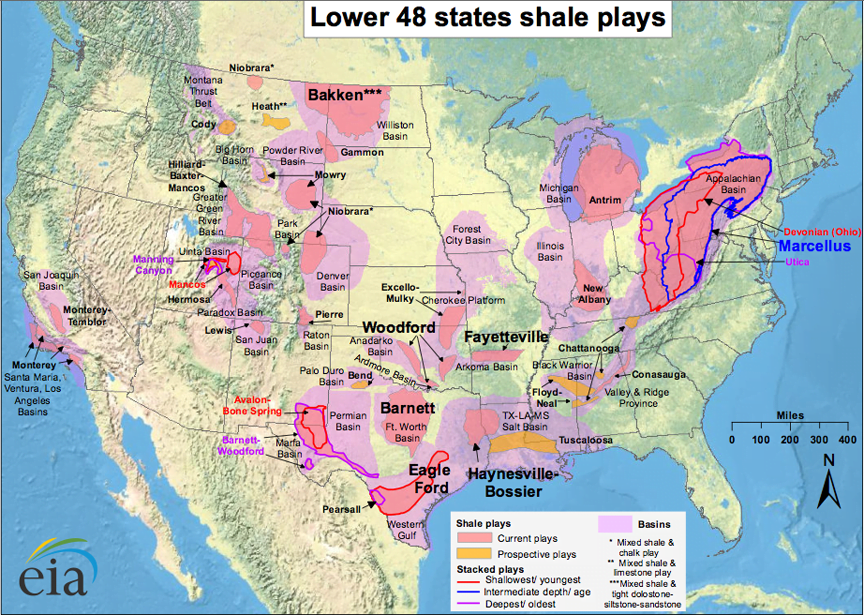 Domestic Fracking Intensity via Gasland
Several industry groups have applauded the President’s move to curtail the industry, with American Petroleum Institute head Jack Gerard saying his organization is “pleased that the White House recognizes the need to coordinate the efforts of the federal agencies that are reviewing, studying or proposing new regulations.”
The President’s order establishes an ”Interagency Working Group” to be composed of deputy level or higher representatives from federal agencies that include the Defense Department, Transportation, Agriculture, Health and Human Services, Energy, Homeland Security, and the Environmental Protection Agency.
The working group has been tasked with supporting the safe, responsible and efficient development of unconventional domestic natural gas resources.
Now that the President has given the go ahead, there’s nothing holding the government back. The fracking industry stands to be impacted almost immediately, with federal agencies prepared to tear into operations nationwide in short order:
The Obama administration is taking new steps to increase federal oversight of hydraulic fracturing, or fracking, a drilling method that has helped usher in a natural-gas boom but brought with it environmental concerns.
The Environmental Protection Agency is slated to unveil final oil-and-gas air pollution regulations next week that would cut smog-forming and toxic emissions from wells developed with fracking. Separately, the Interior Department will soon float rules for fracking on public lands.
Source: The Hill
But not everyone agrees with what is considered by many to be a further expansion of the federal government into industries traditionally reserved for State regulatory agencies. “We don’t need another working group, or any more bureaucracy, ” responded republican Congressman John Boehner through a spokesman.
According to opponents of the legislation, by Presidential decree the federal government can now coordinate action through thirteen core federal agencies against any domestic natural gas production facility and according to standards determined to be appropriate not by law, but because of political agenda.
Moreover, because a key stated purpose of the Executive Order is to ensure long-term supplies, the President’s decree gives the federal government the ability to shut down gas production operations as they see fit, potentially leading to government price fixing and centralized control of an essential natural energy resource.
While the President’s Executive Order aims to curtail the unsafe and environmentally dangerous practices of the fracking industry, it further expands government control over our lives through more centralization of power and bureaucracy.
[hat tip: The Intel Hub]


