
Chossudovsky: “War on Iran would mean World War III” [video]
Global Research TV
January 30, 2012
The military build-up and economic sanctions against Iran are designed to unleash a global war from the Mediterranean to China with unpredictable consequences, warns Michel Chossudovsky, Director of the Centre for Research on Globalization.
Tensions between Iran and the West are close to crisis level. With massive help from the western media, Iran has firmly become embedded as the root of all evil in the minds of many westerners.
The author of the book Towards a World War Three Scenario, The Dangers of Nuclear War told RT that “The issue of Iran’s nuclear weapons is a red herring, but this red herring could lead us to a WWIII scenario.” He also recalled all the American military bases with nuclear weapons close to Iran’s borders.
Michel Chossudovsky recalled that a couple of weeks ago, America’s Secretary of Defense Leon Panetta quite categorically stated to CBS that Iran neither possesses, nor is developing nuclear weapons. Panetta did not rule out that there are still diplomatic means to cut Iran’s Gordian knot.
But considering the US military preparations around Iran, this statement rather looks like a deceptive maneuver.
Last week, EU nations adopted an unprecedented set of sanctions against the Islamic Republic..
These include a complete embargo on oil supplies from Iran, and are expected to come into force in July.
“What we are witnessing here is a build-up towards a military confrontation. These sanctions constitute the staging of a military agenda,” feels Michel Chossudovsky. “In turn, we have massive deployment of US military hardware, troops going to Israel to be stationed in Israel, more troops go to Kuwait, [American] naval forces are entering the Persian Gulf.”
Michel Chossudovsky believes that “What the United States wants now, including its allies, is some kind of a green light which will give a human face to a war.”
On Monday, the UN nuclear inspectors started a three-day mission to examine Iran’s atomic activities.
Tehran says the talks with the International Atomic Energy Agency, the first in more than three years, will prove its nuclear program is purely peaceful.
With the visit of the IAEA inspectors, Iran is playing a diplomatic card, believes Chossudovsky. The IAEA is not politically controlled, so once it confirms Iran’s nuclear program has peaceful purposes, this should undermine the aggressive intentions of the West.
The US needs a contrary statement from the IAEA to use this for transition to a new — military — stage in the Iran drama.
“This war has already started. There are drone attacks, there are special [American] forces inside Iran and there is financial warfare,” considers Michel Chossudovsky.
Plans to invade Iran emerged immediately after the invasion of Iraq, Chossudovsky informs, with military preparations begun around 2005, so by now everything should be ready and in place for a full-scale military conflict.
“The WWIII scenario is unthinkable. This war would extend from the Meditarranean to the Chinese border. It could possibly include Russia and China,” Michel Chossudovsky concluded. “We could find ourselves at a very critical crossroads.”
Originally aired on RT, January 29, 2012
http://rt.com/news/us-iran-ww3-chossudovsky-025/
‘Hysteria’ over Russia veto after West jumps the gun at UN [video]
Russia Today
February 7, 2012
Russia and China are facing a barrage of criticism from some Western and Arab states for their decision to block the latest UN resolution on Syria. Moscow has already dubbed the reaction ‘hysterical’, saying the resolution took a biased approach to resolving the civil conflict. RT’s Sara Firth was in Syria when the diplomatic showdown began.
RT on Twitter http://twitter.com/RT_com
RT on Facebook http://www.facebook.com/RTnews
Video: Huge crowds welcome Russia FM Lavrov in Syria
Russia Today
February 7, 2012
Syria could get another chance at a diplomatic escape route from its continuing political crisis, as it hosts a Russian delegation. A last-ditch delegation to Damascus bearing a personal message for Bashar al-Assad from President Medvedev has been welcomed by thousands of people lining the streets of the Syrian capital.
RT on Twitter http://twitter.com/RT_com
RT on Facebook http://www.facebook.com/RTnews
Destination dialogue: Russia eager for negotiations in Syria [video included]
Russia Today
February 7, 2012
The visit of a Russian delegation to Damascus has raised hopes of talks between the Assad government and the opposition. Experts say Moscow is eager for negotiations in Syria, while the West is only interested in toppling the government.
Richard Heydarian, a Manila-based foreign affairs analyst, has told RT that Russia will put a lot of pressure on the Assad regime for any kind of resolution of the problem. He believes the Russians feared that the UN draft resolution, if accepted, could become a pretext for some sort of military intervention. Moscow, he said, will do its best to solve the crisis.
“What Russia will try to do right now is use all kinds of leverage and influence it has on Bashar Assad and the Syrian regime, to make sure there will be a political process which will [ensure] a smooth transition, perhaps, towards a post-authoritarian scenario,” Heydarian concluded.
Jeremy Salt, associate professor of Middle Eastern history and politics at Bilkent University in Turkey, thinks that the interests of many countries are intersecting in Syria at the moment.
“Part of the problem in Syria is that there are too many different agendas: the Western agenda, the Saudi agenda which is shared by Qatar.”
“But they all converge at one point,” he explained. “They want to remove the Syrian government. Their cause is bringing down the Syrian government. It is not really reform – it is about destroying the Assad government.”
Salt says the Western powers are interested not in promoting dialogue but in prolonging the crisis in the country, while Russia and China are pushing diplomacy in Syria because they cannot allow a Libyan or Iraqi scenario to take place.
At the same time China’s and Russia’s interests in Syria are different, Professor Simon Shen from the Chinese University of Hong Kong explained to RT.
“Unlike Russia, China doesn’t have any particular interest in [Syria]. However, as for the region on the whole, China is very concerned with the regular supply of oil. That, basically, is number one priority in Chinese foreign policy,” he told RT.
“But Syria is not just Syria. From a Chinese prospective, [the situation around this country creates problems] for Iran, because if Syria falls, then probably, the next target will be Iran – and China had expressed very clearly that it doesn’t want any new hurdles to be placed upon Iran in terms of its oil export,” Shen explained.
source: http://rt.com/news/russia-promotes-dialogue-syria-727/
Strengthening U.S.-Canada Security Interests in North America and Around the Globe
By Dana Gabriel
Be Your Own Leader
February 6, 2012
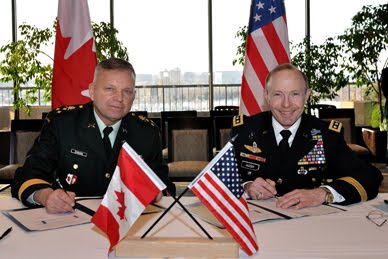 The U.S. and Canada recently signed several bilateral agreements that will further strengthen continental security and defense cooperation. Deeper military integration between both countries is part of efforts to establish a North American security perimeter and better address common global threats.
Following the recent Permanent Joint Board on Defense (PJBD) meeting which took place in Ottawa, the Commander of Canada Command, Lt.-Gen Walter Semianiw and the Commander of North American Aerospace Defense Command (NORAD) and United States Northern Command (USNORTHCOM), Gen. Charles Jacoby, Jr. signed three military documents. The first was the Combined Defense Plan which a backgrounder described as a, “planning framework between Canada Command, its counterpart USNORTHCOM, and NORAD for enhanced defense cooperation between Canada and the U.S. should governments require each other’s assistance.” The second is the Information Sharing Memorandum of Understanding, “an arrangement between Canada Command, its counterpart USNORTHCOM and NORAD to identify and provide for ease of sharing information amongst the three organizations.” The Civil Assistance Plan, which was originally signed in 2008 and allows the armed forces of one nation to support the other during an emergency was also renewed for two years.
Lee Berthiaume of Postmedia News reported that, “The Combined Defense Plan has been under discussion for several years and would further integrate cross-border military co-operation at a time when the Harper government is trying to reassure Washington it has a reliable partner in Canada when it comes to security.” Defense Minister Peter MacKay is quoted as saying, “This agreement provides a framework for the combined defense of Canada and the U.S. during peace, contingencies, and war.” He added, “The plan describes the authorities and means by which the two governments would approve homeland military operations in the event of a mutually agreed threat, and how our two militaries would collaborate and share information.” In his speech in front of the PJBD, Minister MacKay also called for, “increased military involvement implementing the Beyond the Border strategy, saying the Canadian Forces and its American counterparts should be supporting civilian agencies monitoring the cross-border security.” Also on the agenda at the defense forum was security cooperation in the Arctic, along with Canadian and U.S. engagement in the Western Hemisphere.
In an article for iPolitics, Colin Horgan wrote that at the recent bilateral defense meeting, “MacKay noted that such initiatives as Beyond the Border and the Regulatory Cooperation Council Action Plan will work to ensure that the vital economic partnership that joins our two countries continues to be the cornerstone of our economic competitiveness and security.” Defense Minister MacKay emphasized that security is linked to the economy and called for even greater cooperation to support the dual action plans. He stated, “We need to increasingly focus our military forces in support of those civilian departments and agencies that have the lead.” MacKay also explained, “We need to all work together to mitigate capability gaps, share best practices and co-operate on new approaches.” He went on to say, “there is still room for more integrated collaboration – domestically and bi-nationally.”
The latest military agreements further promote a perimeter approach to security. They are part of the Tri Command Vision efforts to merge NORAD, USNORTHCOM and Canada Command into one. As for the PJBD, it has once again become more relevant as a venue for bilateral security and military dialogue. Created in 1940 the panel, “is the senior advisory body on continental defense. It is composed of military and diplomatic representatives from both nations.” Over the years, it has, “served as a strategic-level military board charged with considering, in a broad sense, land, sea, air and space issues.” This includes areas concerning, “policy, operations, financial, logistics and other aspects of Canada-U.S. defense relations.” The PJBD is well positioned to play a significant role in plans for a fully integrated North American security perimeter, as well as in other facets of the evolving Canada-U.S. partnership.
On January 6, the Obama administration released the new document, Sustaining U.S. Global Leadership: Priorities for 21st Century Defense. The new strategy calls for maintaining a strong presence in the Middle East, as well as an expanding role in the Asia-Pacific region. Much of the focus will be on countering China’s rising power. This will include supporting large bases in Japan and South Korea, along with stationing troops in Australia. The U.S. will also continue efforts to forge stronger military alliances with the Philippines, Indonesia, Vietnam and Burma. While the plan envisions a leaner military force, there is little doubt that Washington will continue to police the world. How does Canada fit into this new realignment of American strategic priorities? It is clear that the U.S. will rely more on its allies during international missions. Canada may gain a greater voice in future military operations, but it will also mean that they will have to bear more of the burden. In the coming years, as NATO members begin cutting defense spending, Canada will be counted on to play an even bigger role in any possible overseas conflicts.
Whether it’s the perimeter security deal, the ongoing mission in Afghanistan or the bombing campaign that took place in Libya, the U.S. and Canada continue to enhance security and military cooperation. Under Prime Minister Stephen Harper, both countries have further deepened their defense relationship. In addition, Canada has pursued a more U.S.-style foreign policy. This includes imposing tougher sanctions on Iran, along with further expanding sanctions against Syria. Much like the U.S., Harper has singled out Iran as a threat to international peace and security. He has echoed the same sentiments that the regime is seeking a nuclear weapon and would be prepared to use it. Defense Minister Peter MacKay has also indicated that if necessary, Canada’s armed forces are ready to offer assistance in Syria. More than ever, the U.S, and Canada share a more common approach to advancing security interests in not only North America, but around the globe.
Related articles by Dana Gabriel
Pretext for a North American Homeland Security Perimeter
Canada Pursues U.S.-Style Security and Foreign Policy
Deepening Canada-U.S. Security and Military Ties
Perimeter Security and an Integrated North American Command
Dana Gabriel is an activist and independent researcher. He writes about trade, globalization, sovereignty, security, as well as other issues. Contact: beyourownleader@hotmail.com Visit his blog at beyourownleader.blogspot.com
CrossTalk: Syrious Rebels [video]
Russia Today
February 1, 2012
Will the international community resort to force in Syria? What if Assad stays in power for much longer than most experts predict? And will Syrians be able to topple the Assad government without foreign interference? Is Syria the next Libya or will it follow its own unique path? CrossTalking with Marwa Daoudy, Maximilian Forte and David Pollock on Feb. 1.
CT on FB: http://www.facebook.com/crosstalkrulez
‘Assad, you’ll die like Gaddafi’: Rebels want off with Syria head [video]
Russia Today
January 31, 2012
Syria’s opposition have made a chilling pledge to the country’s leader. They have vowed President Bashar Al Assad and his family will be killed like Libyan leader Colonel Gaddafi, saying he’s lost the chance of a peaceful exit. Fierce battles between government forces and rebel fighters are raging on the outskirts of the capital Damascus. RT’s Sara Firth is in the city now.
RT on Twitter http://twitter.com/RT_com
RT on Facebook http://www.facebook.com/RTnews


