
Brain decoder can eavesdrop on your inner voice
 Intellihub.com
Oct 30, 2014
As you read this, your neurons are firing – that brain activity can now be decoded to reveal the silent words in your head
New Scientist
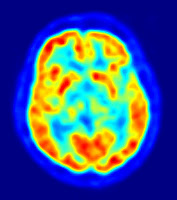
TALKING to yourself used to be a strictly private pastime. That’s no longer the case – researchers have eavesdropped on our internal monologue for the first time. The achievement is a step towards helping people who cannot physically speak communicate with the outside world.
“If you’re reading text in a newspaper or a book, you hear a voice in your own head,” says Brian Pasley at the University of California, Berkeley. “We’re trying to decode the brain activity related to that voice to create a medical prosthesis that can allow someone who is paralysed or locked in to speak.”
When you hear someone speak, sound waves activate sensory neurons in your inner ear. These neurons pass information to areas of the brain where different aspects of the sound are extracted and interpreted as words.
Ello -The Facebook Killer?
 September 26, 2014 (Tony Cartalucci – LocalOrg) – Ello, a social network alternative to Facebook is expanding its user base immensely, even as it remains in beta testing. Market watchers and tech trend analysts attribute the influx of users indicative of Facebook’s waning popularity due to its invasive, profit-driven, monopolistic, and downright creepy conduct.
 Facebook’s incremental, manipulative policy and terms of use have been described as everything from a greedy business practice, to a government sanctioned means of mass manipulation and soft censorship.
It was inevitable that start-ups and activists would seek to offer Facebook users an alternative that allowed social media to be used as a tool of empowerment, not insidious manipulation and censorship. Ello appears to be tapping into that with its manifesto which states:
Your social network is owned by advertisers.
Every post you share, every friend you make and every link you follow is tracked, recorded and converted into data. Advertisers buy your data so they can show you more ads. You are the product that’s bought and sold.
We believe there is a better way. We believe in audacity. We believe in beauty, simplicity and transparency. We believe that the people who make things and the people who use them should be in partnership.
We believe a social network can be a tool for empowerment. Not a tool to deceive, coerce and manipulate — but a place to connect, create and celebrate life.
You are not a product.
In theory, not only does Ello’s manifesto sound ideal, it is likely to attract a multitude of disillusioned Facebook users fed up with the big-tech’s monopoly, but who have stayed aboard for a lack of a better alternative.
Market Watch in an article titled, “Facebook killer called Ello gets the timing right,” reported:
There has been a lot of chatter on social media this week about a new social network called Ello, which is getting buzz for its anti-Facebook Inc. stance. But is the start-up, which accepts no advertising and does no data mining, ready for prime time?
Ello has apparently been gaining such a huge influx of new users that its servers were having problems in the past two days, despite the requirement that you need an invitation to join.
Market Watch notes that Ello’s popularity is due more to Facebook’s shortcomings than Ello’s superior performance – Ello which is admittedly still in beta testing and with features still being incrementally added.
I’m terrified of my new TV: Why I’m scared to turn this thing on — and you’d be, too
by Michael Price
Salon.com
Oct 30, 2014

(Credit: cobalt88 via Shutterstock)
From facial recognition to personal data collection, this thing is downright scary — and so are the implications
I just bought a new TV. The old one had a good run, but after the volume got stuck on 63, I decided it was time to replace it. I am now the owner of a new “smart” TV, which promises to deliver streaming multimedia content, games, apps, social media and Internet browsing. Oh, and TV too.
The only problem is that I’m now afraid to use it. You would be too — if you read through the 46-page privacy policy.
The amount of data this thing collects is staggering. It logs where, when, how and for how long you use the TV. It sets tracking cookies and beacons designed to detect “when you have viewed particular content or a particular email message.” It records “the apps you use, the websites you visit, and how you interact with content.” It ignores “do-not-track” requests as a considered matter of policy.
It also has a built-in camera — with facial recognition. The purpose is to provide “gesture control” for the TV and enable you to log in to a personalized account using your face. On the upside, the images are saved on the TV instead of uploaded to a corporate server. On the downside, the Internet connection makes the whole TV vulnerable to hackers who have demonstrated the ability to take complete control of the machine.
More troubling is the microphone. The TV boasts a “voice recognition” feature that allows viewers to control the screen with voice commands. But the service comes with a rather ominous warning: “Please be aware that if your spoken words include personal or other sensitive information, that information will be among the data captured and transmitted to a third party.” Got that? Don’t say personal or sensitive stuff in front of the TV.
You may not be watching, but the telescreen is listening.
I do not doubt that this data is important to providing customized content and convenience, but it is also incredibly personal, constitutionally protected information that should not be for sale to advertisers and should require a warrant for law enforcement to access.
Unfortunately, current law affords little privacy protection to so-called “third party records,” including email, telephone records, and data stored in “the cloud.” Much of the data captured and transmitted by my new TV would likely fall into this category. Although one federal court of appeals has found this rule unconstitutional with respect to email, the principle remains a bedrock of modern electronic surveillance.
According to retired Gen. David Petraeus, former head of the CIA, Internet-enabled “smart” devices can be exploited to reveal a wealth of personal data. “Items of interest will be located, identified, monitored, and remotely controlled through technologies such as radio-frequency identification, sensor networks, tiny embedded servers, and energy harvester,” he reportedly told a venture capital firm in 2012. “We’ll spy on you through your dishwasher,” read one headline. Indeed, as the “Internet of Things” matures, household appliances and physical objects will become more networked. Your ceiling lights, thermostat and washing machine — even your socks — may be wired to interact online. The FBI will not have to bug your living room; you will do it yourself.
FBI pretended to be Seattle newspaper in order to hack suspect’s computer
End the Lie
Oct 28, 2014
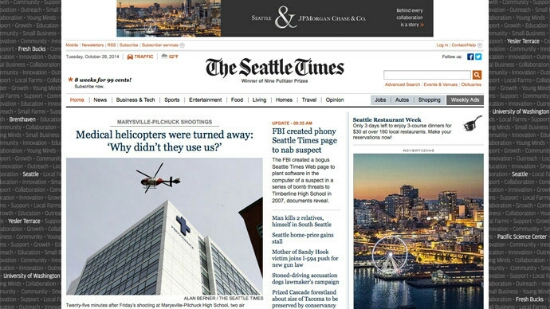
Screenshot from http://seattletimes.com
The editor of the Pulitzer Prize-winning Seattle Times newspaper says she’s “outraged” to learn only this week that the FBI made a mock-up of the publication’s website in 2007 in order to spread spyware onto the computer of a suspect.
When agents with the Seattle division of the FBI swarmed the home of a 15-year-old high school student that year and charged him with making bomb threats, media reports noted that the arrest was made possible with the use of a so-called “Computer & Internet Protocol Address Verifier” program, or CIPAV, that had been remotely installed on the individual’s machine to collect and then communicate to the authorities the user-specific information that eventually identified the suspect. The student later pleaded guilty to emailing repeated bomb threats to Timberline High School and was sentenced to 90 days in juvenile detention.
Until this week, how the FBI actually went about sneaking the CIPAV program onto the student’s computer was a matter that went unreported. After digging through a trove of emails previously obtained through a Freedom of Information Act request, however, American Civil Liberties Union technologist Chris Soghoian stumbled upon details this week showing that authorities accomplished the installation by sending a malicious link disguised as a Seattle Times news article to a social media account used by their suspect.
VIDEO — What Happened In Ottawa?
Press For Truth
Oct 22, 2014
“Despite the mass surveillance and increased police powers – all for our safety of course – the authorities have not only been unable to prevent terrorist attacks, they’re actions have actually ensured these attacks occur in Canada!”
Follow Dan Dicks:
on Facebook ➜ http://www.facebook.com/PressForTruth
on Instagram ➜ http://instagram.com/dandickspft
on Twitter ➜ http://twitter.com/#!/DanDicksPFT ➜ https://twitter.com/PressForTruth
Subscribe:
Youtube ➜ http://www.youtube.com/weavingspider
Press For Truth TV ➜ http://www.patreon.com/PressForTruth
Support Press For Truth:
Patreon ➜ http://www.patreon.com/PressForTruth
Donate ➜ https://www.paypal.com/cgi-bin/webscr…
Get PFT Gear ➜ http://www.pressfortruth.ca/category/…
If you do not use PayPal or credit cards you can still donate! You can send an etransfer to dan@pressfortruth.ca. We also accept checks, money orders, cash and equipment.With good old fashion mail you can send Dan stuff to:
Press For Truth
2574 St. Clair Ave West
Unit 1 Suite #181
Toronto On, M6N 1L8
Canada
Visit http://pressfortruth.ca/
VIDEO — Magnus Olsson: Transhumanist Agenda are mind stealers! Conference to feature NSA whistleblower
Alfred Lambremont Webre
Oct 9, 2014
Magnus Olsson: Transhumanist Agenda are mind-stealers! Brussels conference to feature NSA whistleblower William Binney
http://exopolitics.blogs.com/peaceins…
MADA: Over 80% of Palestinian Journalists Self-Censor
nsnbc international
Oct 17, 2014
IMEMC : The Palestinian Center for Development and Media Freedoms (MADA) released a report, on Thursday, estimating that over 80 percent of Palestinian journalists were engaged in self-censorship.
The group released a report of its findings following two studies, along with a meeting on self-censorship and its impact on freedom of expression and media in Palestine, according to Ma’an News Agency.
 Mousa Rimawi, general director of MADA, said that self-censorship is the most “serious and dangerous kind of censorship” journalists face, noting that the practice began during the Israeli occupation prior to the establishment of the Palestinian Authority.
Mr. Rimawi said that direct censorship by Israeli authorities during the First Intifada, in the late eighties, led to self-censorship among Palestinian journalists as media outlets used different methods of skirting Israeli restrictions on media output.
Self-censorship continued after the creation of the PA, Rimawi said, and has escalated “concretely and dangerously” since the 2007 split between Hamas and Fateh.
Ma’an further reports that, during a meeting entitled “Self-censorship: Is there a way to get rid of it?”, dozens of journalists and media students were presented with the results of two studies by MADA which revealed that some 80 percent of journalists surveyed practiced self-censorship on some or all of the material which they had written or produced.
Over 68 percent of journalists claim that their work, or their colleagues’ work, had been banned from being published, at one time or another, by their employer.
They also explained that the practice of self-censorship was related not only to official institutions, but also to fears that society and publishers are not willing to discuss taboo subjects.
MADA released a statement, in December of 2013, which documented “worrying violations” against media freedoms in the occupied West Bank and the Gaza Strip.
The report noted several arbitrary arrests of journalists by PA forces in the West Bank, as well as Hamas security forces in Gaza.

 PN
PN 