
Minority Report Is Here: Chicago Residents Get Police Visit Based on Pre-Crime Surveillance List
by Nicholas West
Activist Post
Feb 19, 2014

Chicago’s “Heat List” – image source
As we look around at the Police State being built across the world, combined with enhanced mind control techniques, it is easy to draw direct parallels with books like 1984 and Brave New World. It’s almost as if these books formed a clear blueprint for anyone seeking control over large populations.
With the quickening pace of technological advancement it is no surprise to see “ideas” become reality quicker than ever before. Philip K. Dick explored the concept of pre-crime in his short story “The Minority Report” in 1956, but it wasn’t until Steven Spielberg offered it on the big screen as Minority Report in 2002 that the audience got a true look at a potential day-to-day existence under corporate and government data management and control.
We are now at the point where “Minority Report” is being used as a sound description of current technological applications, even in mainstream news, which means that the future is actually the present. Below you will find 10 signs that we have now entered the world depicted in fiction.
The latest news from Chicago only adds to this list, as police are moving beyond simply possessing the technology and are now putting it into effect.
Chicago’s “Heat List” is an index of approximately 400 people who have been identified by a computer algorithm as being future threats to commit violent crime. Without having actually committed a crime, some of those on the list are beginning to get visits from Chicago police warning them that they are already being watched:
When the Chicago Police Department sent one of its commanders to Robert McDaniel’s home last summer, the 22-year-old high school dropout was surprised. Though he lived in a neighborhood well-known for bloodshed on its streets, he hadn’t committed a crime or interacted with a police officer recently. And he didn’t have a violent criminal record, nor any gun violations. In August, he incredulously told the Chicago Tribune, “I haven’t done nothing that the next kid growing up hadn’t done.” Yet, there stood the female police commander at his front door with a stern message: if you commit any crimes, there will be major consequences. We’re watching you.
Chicago is apparently considering this to be part of “policing in the 21st century.” A report from The Verge explains how Chicago has taken the lead in predictive behavior police tech:
In 2009, the National Institute of Justice (NIJ) made millions of dollars in grants available for any police department with a burgeoning predictive program. Police all over the country applied to tap into those NIJ dollars. The big winner was Chicago; its combination of headline-making homicide rates and already established data- and tech-focused policing made it a perfect fit. The CPD received more than $2 million to test two phases of its experimental program.
Though it took awhile to get started in earnest (staff turnover and internal politics in 2011 and 2012 stalled the project), last year the CPD’s predictive program picked up steam. One man behind that progress was Miles Wernick.
Wernick is the Motorola professor and director of the Medical Imaging Research Center at Illinois Institute of Technology (IIT) in Chicago. He says he’s been doing predictive analysis work since the 1980s, when he worked with the US military to recognize potential targets in the battlefield. From there he proceeded to medical imaging. A lot of his current work focuses on analysing data and brain scans to make automated diagnoses of dementias in elderly patients — not exactly police work.
These paragraphs encapsulate two of the major warnings that the alternative media has been shouting for years: namely that military tech always trickles down into local law enforcement; and, secondly, that Big Data initiatives which are heralded by the establishment as solutions in the computing and medical fields have a range of privacy-killing additional applications that affect people far beyond the initially stated reach.
Also highlighted are the same concerns that are cropping up in the area of NSA spying – association is an assumption of tendency toward eventual guilt. Miles Wernick goes on to say:
“It’s not just shooting somebody, or being shot,” he says. “It has to do with the person’s relationships to other violent people.”
This is in line with what Andrew Papachristos, a Yale sociologist and Chicago native, calls a social networking theory. When it comes to violence, Papachristos recently told Chicago Magazine, “It’s not just about your friends and who you’re hanging out with, it’s actually the structure of these networks that matter.”
So while Wernick acknowledges that sometimes people such as Robert McDaniel — who haven’t been convicted of a violent crime — may find themselves in the wrong social networks, their presence on the list is not random.
A commander of the program stated it even more simply:
If you end up on that list, there’s a reason you’re there.
This indicates a fundamental shift in the way policing will be done in the future of America. Until now, we have been reporting on this type of technology and have been forced to speculate about its coming implementation. Well, now there is no doubt. And lest anyone believe that this is just an outcropping of Chicago’s notoriously Police State-happy mentality, Police Commander Jonathan Lewin matter-of-factly states the following:
This [program] will become a national best practice. This will inform police departments around the country and around the world on how best to utilize predictive policing to solve problems. This is about saving lives. [emphasis added]
Whether it will actually save lives is debatable. Has the No-Fly List saved lives? Have any of the other of the many lists one can be added to these days actually saved any lives? These lists are secretive and have become nearly impossible to independently verify as to how someone got on the list, if they deserve to be there; and, if not, how to get off the list … or if the lists are effective.
The Verge article linked below highlights the potential racial profiling of such policies – and indeed this has happened in the case of New York’s own low-tech Stop-and-Frisk policy.
So the verdict is out on saving lives. But one thing is for certain: the arrival of the high-tech Police State is certainly not about saving freedom, nor is it about preserving a Constitution designed to protect us from a Minority Report society.
Source:
http://www.theverge.com/2014/2/19/5419854/the-minority-report-this-computer-predicts-crime-but-is-it-racist
____________________________________________________________________________
10 Signs We Live In a “Minority Report” World
Individual pieces of news often get lost or forgotten rather easily in today’s fast-paced news cycle, so let’s look at an aggregate of 10 mainstream news items that offer a comprehensive picture of where we are and where we are likely to be headed both from a government surveillance standpoint, as well as targeted advertising.
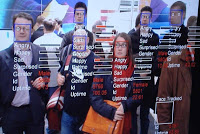
1. They’re watching … Japanese electronics company NEC develops ‘Minority Report’ style billboard, The Telegraph, 3/10/2010: “Engineers have developed the billboard, similar to one used in the Tom Cruise blockbuster, that uses built in cameras to instantly identify a shopper’s age and gender as they walk past. The facial-recognition system, called the Next Generation Digital Signage Solution, then offers consumers a product it thinks is suited to their demographic.”
2. Microsoft Kinect Learns to Read Hand Gestures, Minority Report-Style Interface Now Possible, IEEE Spectrum, 3/10/2013:
3. The Long Eye of the Law: So Who’s Ready for a ‘Minority Report’-Style Future? Motherboard, 3/20/2013: On Monday, Japanese tech developers Fujitsu announced they had created . . . a bit of technology that can measure a person’s pulse using a camera or a computer webcam, just by analyzing that person’s face . . . It’s Minority Report-style technology, to be sure—another in a burgeoning list of tech-driven ways police could prevent crimes before they happen.”
*Also see New York’s Domain Awareness System helped along by Microsoft.
4. Minority Report moves step closer as Lord Sugar launches face recognition adverts, The Telegraph, 7/9/2013: “The media company has launched OptimEyes, which will be used in more than 6,000 of its screens to target over 50m people in the UK, Germany, Poland, Switzerland, UAE, Oman, Kenya, Angola and South Africa. However, the majority of the screens, some 3,561, are in the UK in doctors’ surgeries, hospitals, convenience stores, petrol forecourts, Halifax banks, airports and train stations . . . The product comes less than a week after Sky Deutschland revealed it has developed technology to transfer adverts from train windows directly and silently into commuters’ heads.
5. Brain scans of inmates could lead to ‘Minority Report’ style ability to predict if they will re-offend, The Daily Mail, 7/15/2013: “Groundbreaking new research could allow scientists to predict if prisoners will re-offend – potentially condemning those convicted of serious crimes to a lifetime behind bars . . . It could also be used to the benefit of society in using brain imaging in deciding parole.”
6. Gesture Through News Minority Report-Style With New York Times’ Leap Motion App, Fast Company, 7/18/2013: Rather than having to flick through headlines on a touch-screen device or scroll through articles using a mouse — how antiquated! — the company’s new app allows readers to navigate through stories by motioning their hands in mid-air, with Leap Motion sensors interpreting the signals . . . The New York Times has also suggested it will give the company an opportunity to implement new advertising capabilities ‘that [will] allow brands to connect with readers using motion-controlled ad units.'”
7. Minority Report finally becomes a reality: new hi-tech video wall will let law enforcement agencies sift through data with a wave of their hand, The Daily Mail, 7/23/2013: “The hi-tech computer system behind the film Minority Report – where Tom Cruise speeds through video on a large screen using only hand gestures – is making its way into the real world. American computer experts have revealed the software has become a reality – and they hope to sell it to law enforcement agencies around the world. The interface developed by scientist John Underkoffler has been commercialized by the Los Angeles firm Oblong Industries as a way to sift through massive amounts of video and other data.”
*Also see this report on Big Data and pre-crime software.
8. Control Google Earth with Minority Report-style gestures, via Leap Motion, TNooz, 8/5/2013:
9. Minority Report-style Advertising Coming to NYC, 247Sports, 8/8/2013: “Recycling bins data mine your smartphone when you are in proximity to tailor ads when you walk by the screen and stuff. Already in London, looking to expand to NYC and other World cities soon.”
10. Google Submits Patent For Minority Report Style Eye Tracking Device, Prison Planet, 8/15/2013: “The patent filing describes a “head mounted device”, for example hi-tech glasses, that would have the ability to track eye movement, effectively monitoring reactions to external stimuli, including changes in emotion.” From The Verge: “Google could be betting that advertisers will pay to know whether consumers are actually looking at their billboards, magazine spreads, and online ads.”
From the patent application, which was filed in May 2011:
Pay per gaze advertising need not be limited to on-line advertisements, but rather can be extended to conventional advertisement media including billboards, magazines, newspapers, and other forms of conventional print media. Thus, the gaze tracking system described herein offers a mechanism to track and bill offline advertisements in the manner similar to popular online advertisement schemes.
***********
The ways that we are tracked, traced, and databased are increasing every day. Some of it is arriving without our agreement and is being utilized by private corporations and governments without our explicit approval, as the recent revelations of data spying have exposed. If we have learned one thing it is that information is knowledge and knowledge is power. The power of data collection in the hands of those who wish to exert more control is not likely to halt. And all indications show that it is not enough to have logged and charted where we have been; the surveillance state wants to know where we are going.
Our Orwellian world is beginning to look nostalgic compared to what is in production. Neuroscientists in 2010 stated that they know you better than you know yourself. Meanwhile, it is being estimated that computers know to a 93% accuracy where you will be, before you make your first move. The recent major global funding of neuroscience and narrative control indicates that the final target is the human brain and every thought that resides there.
However, we ought to be aware that much of our data is willingly being given via social media and the gadgets we choose to buy. As technology continues to march forward at an exponential rate, we might do well to consider how much of this we are comfortable buying into. And if we must, should we be seeking ways to subvert the information stream?
Recently From Nicholas West:
Nanobiometrics Will Track You By Smell
by Nicholas West
Activist Post
Feb 8, 2014

image source: Sayo Studios
In a few short years, we already have become accustomed to drone surveillance and an array of biometric ID tracking technology that has formed a pervasive matrix of identification and personal data retention.
As discussed in How Close Are We to a Nano-Based Surveillance State? back in February of 2011, the next phase of ID will be on the nano scale. DARPA and their contractors have been working for quite a while on making you, not just your personal data, the tracking mechanism. Through a matrix of biological sensors and biometrics, the individual is now set to be tracked, traced and databased with greater frequency and much greater ease.
A new announcement from a Spanish engineering firm highlights the direction that is being taken in extracting the most innate personally identifying information possible. We already have iris scans, biometric fingerprinting, facial recognition, voice recognition, payment with vein scans, and proposals for brain scan databases. Now our unique smell is being researched as the ultimate tool for providing one’s ID authentication.
BBC Propaganda: “Why I Want A Microchip Implant”
 by Michael Snyder
Activist Post
Feb 12, 2014
Would you like to have an RFID microchip implanted under your skin? If you are anything like me, you would never allow such a thing to be done. But many others, especially among the younger generations, see things very differently. RFID microchip implants and other forms of “wearable technology” are increasingly being viewed as “cool”, “trendy” and “cutting edge” by young people that wish to “enhance” themselves. And of course the mainstream media is all in favor of these “technological advancements”.
For example, the BBC just published a piece entitled “Why I Want A Microchip Implant“. We are told that such implants could solve a whole host of societal problems. Identity theft and credit card fraud would be nearly eliminated, many other forms of crime would be significantly reduced, children would never go missing and we wouldn’t have to remember a vast array of passwords and PIN numbers like we do now. We are told that if we just adopted such technology that our lives would be so much better. But is that really the case?
As our society becomes “digitally integrated”, technologists tell us that it is “inevitable” that wearable technology will become as common as smart phones are today. And the BBC article that I just mentioned is very eager for that day to arrive…
Ultimately, implanted microchips offer a way to make your physical body machine-readable. Currently, there is no single standard of communicating with the machines that underpin society – from building access panels to ATMs – but an endless diversity of identification systems: magnetic strips, passwords, PIN numbers, security questions, and dongles. All of these are attempts to bridge the divide between your digital and physical identity, and if you forget or lose them, you are suddenly cut off from your bank account, your gym, your ride home, your proof of ID, and more. An implanted chip, by contrast, could act as our universal identity token for navigating the machine-regulated world.
And for some people, that day is already here. In fact, at some technology conferences people actually line up to get chipped…
This month at the Transhuman Visions conference in San Francisco, Graafstra set up an “implantation station” offering attendees the chance to be chipped at $50 a time. Using a large needle designed for microchipping pets, Graafstra injected a glass-coated RFID tag the size of a rice grain into each volunteer. By the end of the day Graafstra had created 15 new cyborgs.
How creepy is that?
In addition, scientists have now developed batteries that are powered by the human body that could be used to provide a permanent power source for implantable technology. The following is a brief excerpt from a recent article by Kristan Harris entitled “Scientists Develop Human-Powered Battery For RFID Implantable Chips“…
A group of United States and Chinese researchers have collaborated to created a tiny implantable batteries that feed off of human energy. These thin, flexible mechanical energy harvesters have had been successfully tested on cows. The process uses what is known as conformal piezoelectric energy harvesting and storage from motions of the heart, lung, and diaphragm.
It the future, they say, it could be used to power a range of gadgets. Will it be long until you will charge your I-phone by plugging into your own body?
Of course RFID microchips don’t actually have to be implanted to be useful. In fact, they are already being used to track schoolchildren all over the United States…
Upon arriving in the morning, according to the Associated Press, each student at the CCC-George Miller preschool will don a jersey with a stitched in RFID chip. As the kids go about the business of learning, sensors in the school will record their movements, collecting attendance for both classes and meals. Officials from the school have claimed they’re only recording information they’re required to provide while receiving federal funds for their Headstart program.
And over in the UK, RFID microchips are being used to track children wherever they go all day long…
For those who think the NSA the worst invader of privacy, I invite you to share an afternoon with Aiden and Foster, two 11-year-old boys, as they wrap up a Friday at school. Aiden invites his friend home to hang out and they text their parents, who agree to the plan.
As they ride on the bus Foster’s phone and a sensor on a wristband alert the school and his parents of a deviation from his normal route. The school has been notified that he is heading to Aiden’s house so the police are not called.
As they enter the house, the integrated home network recognizes Aiden and pings an advisory to his parents, both out at work, who receive the messages on phones and tablets.
We are rapidly entering a dystopian future in which it will be “normal” for technology to monitor our movements 24 hours a day. Most people will probably welcome this change, but it also opens up the door for an oppressive government to someday greatly abuse this technology.
Another type of “wearable technology” that is rapidly gaining acceptance is “smart tattoos”.
Normally, we are accustomed to thinking of tattoos as body art. But that is about to change. Just check out this excerpt from a recent Gizmodo article…
Everyone from neurologists to biohackers is reinventing the very idea of the tattoo. With the right technology, tattoos can do a lot more than just look beautiful or badass. They can become digital devices as useful and complex as the smartphone that bounces around in your pocket. It sounds wildly futuristic, but the technology already exists.
In fact, a company called MC10 is working on a wide range of “smart tattoos” that will be able to do some pretty wild things…
Materials scientist John Rogers is doing some pretty incredible work with flexible electronics that stick to your skin like a temporary tattoo. These so-called “epidural electronics” can do anything from monitoring your body’s vital signs to alerting you when you’re starting to get a sunburn. Rogers and his company MC10 are currently trying to figure out ways to get the electronics to communicate with other devices like smartphones so that they can start building apps.
And Motorola actually has a patent for a tattoo that will take commands from unvocalized words in your throat…
The tattoo they have in mind is actually one that will be emblazoned over your vocal cords to intercept subtle voice commands — perhaps even subvocal commands, or even the fully internal whisperings that fail to pluck the vocal cords when not given full cerebral approval. One might even conclude that they are not just patenting device communications from a patch of smartskin, but communications from your soul.
They are calling it “wearable computing”, and what we are witnessing now is just the tip of the iceberg.
What we will see in the future is probably far beyond anything that any of us could imagine right now. The following is from a recent Computer World article…
But imagine a future where anything you might want to know simply appears to you without any action or effort on your part. You could be eating in a restaurant, and Google Glass could, for example, tell you that it’s the spot where your father proposed to your mother. Or that your friend will be late because of traffic, the salmon got bad reviews online, your parking meter will expire in 20 minutes, or the bathroom is through the bar and up the stairs to the right. Imagine that such knowledge could simply appear into your field of vision at the exact moment when you want to know it.
That’s where wearable computing is going.
All of this may sound very “cool” to a lot of people.
But what happens if we are all required to have “electronic identity tattoos” someday?
What happens if an oppressive government uses this technology to watch, track, monitor and control all of us 24 hours a day with this technology?
What happens if you are not able to get a job, have a bank account or buy anything without “proper identification”?
I think that you can see where I am going with this.
Technology is truly a double-edged sword. It can do great good, but it can also be used for great evil.
So what do you think about all of this? Please feel free to share your thoughts by posting a comment below…
About the author: Michael T. Snyder is a former Washington D.C. attorney who now publishes The Truth. His new thriller entitled “The Beginning Of The End” is now available on Amazon.com.
VIDEO — Sochi Sour Grapes: Western MSM wins gold medal for buzz killing
RT
Feb 8, 2014
In the days, weeks and even months leading up to the Sochi Winter Olympics of 2014, the Western mainstream media have been trying to ruin the excitement by picking apart every tiny – often made-up – flaw they could lay their hands on – from strange toilets to hiking up paranoia over explosives being brought in in tooth paste tubes. RT’s Anastasia Churkina takes a look at the hysteria – READ MORE http://on.rt.com/y1xc94
RT LIVE http://rt.com/on-air
Subscribe to RT! http://www.youtube.com/subscription_c…
Like us on Facebook http://www.facebook.com/RTnews
Follow us on Twitter http://twitter.com/RT_com
Follow us on Instagram http://instagram.com/rt
Follow us on Google+ http://plus.google.com/+RT
RT (Russia Today) is a global news network broadcasting from Moscow and Washington studios. RT is the first news channel to break the 1 billion YouTube views benchmark.
[related: Russian Officials Defend Decrepit Facilities By Citing Surveillance Footage Inside Hotel Showers]
MUST SEE — Mind Control – Remote Neural Monitoring: Daniel Estulin and Magnus Olsson on Russia Today
Magnus Olsson
July 13, 2013
Russia Today have broadcasted this, the best documentary of mind control,
produced by Daniel Estulin, Deste La Sombra (From the Shadows)…
[mirror of the video above]
[another mirror with a few minutes cut off]
With the original title “Control mental. El sueño dorado de los dueños del mundo” (Mind control. The golden dream of the world’s masters) — broadcasted to some 10 million people — was one of the biggest victories for victims of implant technologies so far. Thanks to Magnus Olsson, who, despite being victimized himself, worked hard for several years to expose one the biggest human rights abuses of our times – connecting people against their will and knowledge to computers via implants of the size of a few nanometers – leading to a complete destruction of not only their lives and health, but also personalities and identities.
Very few people are aware of the actual link between neuroscience, cybernetics, artificial intelligence, neuro-chips, transhumanism, the science fiction’s cyborg, robotics, somatic surveillance, behavior control, the thought police and human enhancement.
They all go hand in hand, and never in our history before, has this issue been as important as it is now.
One reason is that this technology, that begun to develop in the early 1950s is by now very advanced but the public is unaware of it and it goes completely unregulated. There is also a complete amnesia about its early development. The CIA funded experiments on people without consent through leading universities and by hiring prominent neuroscientists of that time. These experiments have since the 50s been brutal, destroying every aspect of a person’s life, while hiding behind curtains of National Security and secrecy but also behind psychiatry diagnosis.
The second is that its backside –mind reading, thought police, surveillance, pre-crime, behavior modification, control of citizen’s behavior; tastes, dreams, feelings and wishes; identities; personalities and not to mention the ability to torture and kill anyone from a distance — is completely ignored. All the important ethical issues dealing with the most special aspects of being a free human being living a full human life are completely dismissed. The praise of the machine in these discourses dealing with not only transhumanism ideals but also neuroscience today has a cost and that is complete disrespect, despise and underestimation of human beings, at least when it comes to their bodies, abilities and biological functions. The brain is though seen as the only valuable thing; not just because of its complexity and mysteries, but also because it can create consciousness and awareness. We’re prone to diseases, we die, we make irrational decisions, we’re inconsistent, and we need someone to look up to. In a radio interview on Swedish “Filosofiska rummet” entitled “Me and my new brain” (Jag och min nya hjärna), neuroscientist Martin Ingvar referred to the human body as a “bad frame for the brain”. Questions about individual free will and personal identity were discussed and the point of view of Martin Ingvar was very much in line with José Delgado’s some 60 years ago, and its buried history of mind control: we don’t really have any choice, we’re not really having a free will or for that matter any consistent personality. This would be enough reason to change humans to whatever someone else wishes. For example, an elite.
Another reason for why this issue dealing with brain implants is important of course is the fact that both the US and the EU pour billions of dollars and euros in brain research every single year, a brain research very focused on not only understanding the brain, but also highly focused on merging human beings with machines; using neuro-implants to correct behavior and enhance intelligence; creating robots and other machines that think and make autonomous intelligent decisions — just like humans do.
Ray Kurzweil, who’s predictions about future technological developments have been correct at least until now, claims that in 20 years, implant-technology has advanced that far that humanity has been completely transformed by it. We cannot know right now whether he’s prediction is right or wrong, but we have the right to decide on the kind of future we want. I do not know if eradicating humanity as we know it is the best future or the only alternative. Today, we might still have a choice.
Something to think about: Can you research the depths of the human brain on mice?
EUCACH.org
Swedish: Jag och min nya hjärna. Filosofiska Rummet (Me and my new brain)
http://sverigesradio.se/sida/artikel….
Physical Control of the Mind: Toward a Psychocivilized Society by Jose M. Delgado
http://www.biotele.com/delgado_%20ebook/
Attention fliers: Canada’s electronic spy agency is following you
End the Lie – Independent News
Jan 31, 2014

A United Airlines plane takes off at the Calgary International Airport in Calgary. (Reuters / Todd Korol)
Documents released by US whistleblower Edward Snowden show the Communications Security Establishment Canada (CSEC) used airport Wi-Fi to track passengers from around the world.
Travelers passing through a major Canadian airport were potentially caught up in a vast electronic surveillance net, which allowed the nation’s electronic spy agency to track the wireless devices of thousands of airline passengers – even for days after they had departed the terminal, a document obtained by CBC News revealed.
The document shows the spy agency was then able to track travelers for a week or more as the unwitting passengers, together with their wireless devices, visited other Wi-Fi “hot spots” in locations across Canada – and even across the border at American airports.
The CBS report said any place that offered Wi-Fi internet access, including “airports, hotels, coffee shops and restaurants, libraries, ground transportation hubs” was vulnerable to the surveillance operation.
After reviewing details of the leaked information, one of Canada’s leading authorities on internet security says the secret operation was almost certainly illegal.
“I can’t see any circumstance in which this would not be unlawful, under current Canadian law, under our Charter, under CSEC’s mandates,” Professor Ronald Deibert, an internet security expert at the University of Toronto, told CBC News.
It remains unclear from the leaked data how CSEC was able to infiltrate so many wireless devices to see who was using them — both on Canadian territory and beyond.

 PN
PN 