
Syrian opposition elects US-educated tech exec as interim PM
End the Lie – Independent News
March 18, 2013

Syria’s opposition coalition meeting on March 18, 2013 in istanbul to choose their first prime minister. (AFP Photo / Ozan Kose)
The Syrian opposition coalition has elected Western-educated former businessman Ghassan Hitto as provisional prime minister in a vote in Istanbul on Tuesday.
Hitto received 35 votes out of 49 ballots cast during the Syrian National Coalition meeting in the Turkish city. He is now in charge of forming a new cabinet that the opposition hopes will replace the government of Bashar Assad.
Opposition spokesmen called him a “consensus candidate” who commands both respect from the insurgency’s Islamists as well as its liberals.
Forty-nine-year-old Hitto was born in Damascus but has lived for decades in the United States, mostly in Texas. He is described as being heavily involved in various Islamic causes. He holds a bachelors in mathematics and computer science from Purdue University in Indiana, earning an MBA from the same school in 1994.
His election means that he will effectively serve as prime minister of the parts of Syria controlled by the anti-Assad insurgency.
The long-time tech executive’s resume includes 25 years with technology and telecommunications firms, with 16 of those as an executive manager.
Hitto left the corporate world in November 2012 “to join the ranks of the Syrian revolution.”
He is known for his involvement in public service causes, including the organization of a series of fundraising initiatives such as the Walk for Children of Syria Day. Hitto has also been a director of the Brighter Horizons Academy, a Texas school billing itself as “an educational institution conducive to an Islamic learning environment,” for more than ten years.
“Hope… comes from Allah. Our brothers and sisters inside Syria came to this realization way back,” Hitto said in public comments at a 2012 fundraiser for Syrian children.
“He loves us and will take care of us… (he) will bring relief, will take care of the people of Syria, will feed the people of Syria, will defend the people of Syria, and he alone can do that… but we must take action today,” he said at that event.
The year before that Hitto founded the Coalition of Free Syria, becoming a national board member of the Syrian American Council in 2012.
He heads the Turkey-based Assistance Coordination Unit, the aid wing of the Syrian National Coalition, the country’s opposition bloc.
Hitto’s backers say he is a gifted diplomat, with a keen ability to secure financial aid for Syrians who have been displaced by the country’s two-year-long civil conflict.
Source: RT
Corbett Predicts The Future! [video]
Corbett Report
March 17, 2013
Once again the alternative media brings you the news 15 months in advance…although the lamestream media would never admit it.
SHOW NOTES: http://www.corbettreport.com/?p=7121
Las Vegas to Introduce Anti-NDAA Resolution
P.A.N.D.A. People Against The NDAA
March 17, 2013

FOR IMMEDIATE RELEASE
Contact:
Chris Corbett
PANDA Nevada
Las Vegas to Introduce Anti-NDAA Resolution
The fight against indefinite military detention continues. Yesterday, the Las Vegas City Council and the Clark County Commission drafted anti-NDAA legislation to protect the Constitutional rights of their constituents.
City Councilman Bob Beers and County Commissioner Chris Giunchliani put forth the draft.
Afterward, Daphne Lee, the Clark County Chapter Head of PANDA, and Christopher Corbett, Nevada Executive Director of PANDA, expressed their gratitude to Beers and Giunchliani. Corbett said:
“This initiative will help raise awareness of the NDAA and encourage other municipalities and our state legislators to do the same.”
Specifically, sub-sections 1021 and 1022 of the NDAA allow the indefinite arrest, imprisonment and/or transport to foreign prisons of anyone on U.S. soil whom the federal government declares is a terrorist suspect. In short, the2012 NDAA enables the government to make any person on U.S. soil a prisoner of war.
Currently making its way to committee in the Nevada State Legislature is a related bill, Don Gustavson’s BDR 728, the Nevada Liberty Preservation Act.
You can help stop this violation of our Constitutional rights. You can help stop the NDAA. Encourage your representative to support this legislation, or thank them for doing so:
If you live in Las Vegas, go to http://www.lasvegasnevada.gov/Government/council.htm
If you live in Clark County, go to http://www.clarkcountynv.gov/depts/countycommissioners/pages/default.aspx
Join us in the battle to stop the NDAA nationwide: http://pandaunite.org/join-us/
Edited by Ed R. Green
Egypt is Waking Up [video included]
Friends of Syria
March 17, 2013
Port Said: A message of solidarity to the Syrian Arab Army and President Assad, from Egyptian protesters. Their leader says Syria is under attack by the US backed Muslim Brotherhood militias who bomb mosques and chant Allah w Akbar.
They chant; “For you Assad, we’re Shabiha for ever”…
US help might see Syrian rebels form alternate govt
by Nile Bowie
NileBowie.blogspot.ca
March 7, 2013
The long-term US funding of anti-government programs in Syria has raised questions about the types of groups being supported, and the benefits and arms supplied to militant groups; establishing political stability requires considered dialogue.
It appears that the US State Department under John Kerry will soon shift its focus to helping the rebels establish a full-fledged alternative government on Syrian territory and recognize it as the legal government of Syria. Such a move would legitimize the transfer of heavy weaponry and would allow the US to directly employ air strikes or Patriot anti-missile batteries against Assad’s forces.
Some would argue that these moves could help to marginalize the notable al-Qaeda presence among rebel forces. Pumping more arms and heavier weapons into Syria is unconscionable at this point, and continuing to do so will inevitably bolster the muscle and reach of jihadi and Salafist fighters. The argument that the US and its allies have only armed the “moderate” rebels is a deeply flawed one; weapons are in high demand by all rebel factions and there is little means to effectively prevent arms from gravitating toward hardcore Al-Qaeda fighters.
In his famous 1962 description of irregular warfare operations, US President John F. Kennedy alluded to “another type of warfare,” one that is “new in its intensity, ancient in its origin—war by guerrillas, subversives, insurgents, assassins; war by ambush instead of by combat, by infiltration instead of aggression, seeking victory by eroding and exhausting the enemy instead of engaging him. It preys on unrest.”
After two harrowing years of division, senseless killing and civil war, the scared Syrian nation and its people are well acquainted with these unconventional methods of warfare denounced over 50 years ago.
Yet Western and Gulf states have proven their double standards by enabling radicals elsewhere – lest we forget the presence of Libyan military commander Abdulhakim Belhadj, former leader of the militant Libyan Islamic Fighting Group (officially designated as a terrorist organization by the US State Department), who was sent to Syria to aid the Free Syrian Army on orders of the entity formerly known as the Libyan National Transition Council (NTC). The track record of allied Western and Gulf states shows that they are more interested in enabling terrorism for their own purposes rather than preventing it.
Since the eruption of violence in March 2011, Syria has endured targeted assassination campaigns, ceaseless suicide bombings and shelling, and massacres where infants have had their throats slit to the spine – the time has come for the opposition to engage the Assad government in dialogue and finally bring about a ceasefire and the total cessation of violence and insurgency.
From the reports of third-party sniper-fire targeting both protesters and security personnel in the southern city of Daraa at the very onset of the conflict, to the horrendous attacks on the students of Aleppo University in January 2013 – those who have critically monitored the situation from the beginning are under no illusions – the influx of armament and mercenary elements from abroad into Syria has brought the situation to where it is today. Western capitals have provided logistics, coordination, political support, and non-lethal aid, Gulf states such as Saudi Arabia and Qatar have openly provided weapons and monthly salaries for rebel fighters, and Turkey has allowed rebel fighters to receive training and arms from the US Central Intelligence Agency (CIA) in the southeastern part of the country, allowing militants to pass into Syria freely.
There are those who say that Syria is the subject of an internal revolution that is brutally repressed by a malicious dictator, and those who say instead that Syria is being attacked by foreign powers who have deployed mercenaries and extremist fighters from abroad to engage in the destruction of infrastructure and conduct targeted assassinations to bring about an end to the Assad regime. Despite Washington’s concerns of heavy weapons falling into the hands of Al-Qaeda-linked militants, the US-backed campaign to coax regime change in Damascus has from the very onset enabled militants who justify their acts of terror in the name of a perverted interpretation of Islam. Reports in the Washington Post indicate that US support for anti-government groups in Syria began in 2005, transcending two presidential administrations:
“The U.S. money for Syrian opposition figures began flowing under President George W. Bush after he effectively froze political ties with Damascus in 2005. The financial backing has continued under President Obama, even as his administration sought to rebuild relations with Assad. Syrian authorities ‘would undoubtedly view any U.S. funds going to illegal political groups as tantamount to supporting regime change,’ read an April 2009 cable signed by the top-ranking U.S. diplomat in Damascus at the time. ‘A reassessment of current U.S.-sponsored programming that supports anti-[government] factions, both inside and outside Syria, may prove productive,’ the cable said. The cables report persistent fears among U.S. diplomats that Syrian state security agents had uncovered the money trail from Washington.”The article describes how Washington funnelled about $12 million to anti-government programs in Syria between 2005 and 2010 to recipients affiliated with the Syrian Muslim Brotherhood. Israel, which is now illegally conducting exploratory drilling in the occupied Golan Heights, and the US view the toppling of Damascus as a means of extinguishing the critical conduit between Iran and Hezbollah, the political and militant Shi’a organization centered in Southern Lebanon, in addition to helping isolate the Palestinian resistance.
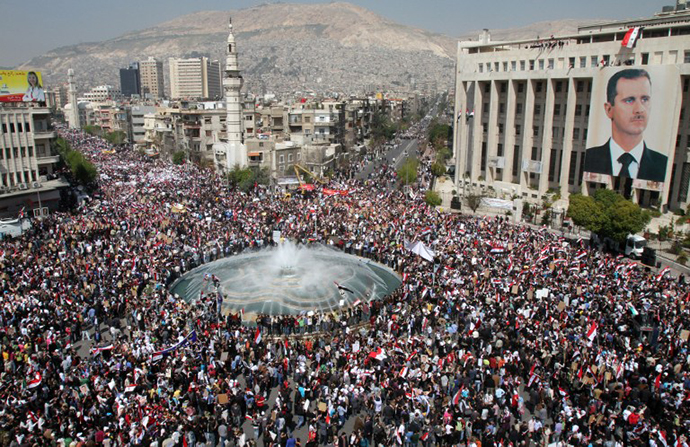
The non-violent route: Laying aside differences
Both the incumbent Syrian authorities and the opposition must find strength to come to a mutually acceptable compromise. These parties have no other option than to search for a solution, lay down an agreeable constitutional basis for elections, and face each other in international monitored polls once the situation stabilizes. The Syrian people must not have democracy imposed on them, and the victor of this war should not be decided on the battlefield, but by the ballot box.
To gain the confidence of the electorate, election observers from the US, Qatar, Russia, and Iran could be sent to monitor the transition process – if the people of Syria want Assad to remain in power, then the rule of majority must be honored. Militant groups comprised of mostly hard line foreign fighters such as Jabhat al-Nusra and the Islamist Ahrar al-Sham cannot be expected to participate in a ceasefire, so the true test of a short-term alliance between Assad and the SNC would be in its ability to cooperate in quelling radical militants and restoring stability – such is a perquisite for any kind of transition.
Former US Secretary of State Hilary Clinton once threatened Russia and China that they would “pay a price” for their position on the Syrian issue. It should be noted that these powers maintained a balanced approach throughout and advocated dialogue from the start, in addition to stringently adhering to former UN Envoy Kofi Annan’s six point peace plan. Iran should also be given due credit for hosting an International Consultative Conference in August 2012, which brought together representatives of thirty nations to call for ending the flow of foreign arms into terrorist hands inside Syria, proposals to broker a meaningful ceasefire, the coordination of humanitarian aid, and support for Syrian people’s right to reform without foreign interference.
Accommodating diversity in Syrian society
Iranian Foreign Minister Ali Akbar Salehi was quoted in the Washington Post stating,“Syrian society is a beautiful mosaic of ethnicities, faiths and cultures, and it will be smashed to pieces should President Bashar Assad abruptly fall. The idea that, in that event, there would be an orderly transition of power is an illusion. Abrupt political change without a roadmap for managed political transition will lead only to a precarious situation that would destabilize one of the world’s most sensitive regions.” It is clear that the Assad government is more stable than many Western states anticipated, and it continues to enjoy popular support.
Hezbollah leader Sheikh Hassan Nasrallah recently warned against sectarian infighting in Lebanon related to the Syrian civil war, arguing that outsiders are pushing Lebanon “toward civil and religious strife, and specifically Sunni-Shia strife.” Iraqi PM Nouri al-Maliki also warned that a victory for rebels would “create a new extremist haven and destabilize the wider Middle East.” The Syrian regime will not imminently collapse but if it is brought down by military intervention, the consequences could lead to a highly unpredictable situation where match and tinder can meet at any moment with debilitating consequences for the region. It is time for both parties to convene. It is time to end this war.
Selective support
Reports published in 2007 in the New Yorker by veteran journalist Seymour Hersh detail how the US, Israel and Saudi Arabia supported a regional network of extremist fighters and terrorists affiliated with al-Qaeda with the aim of stomping out Hezbollah and Syria’s Assad in a bid to isolate Iran, who is viewed as an existential threat to the US and its allies in the region. A principal component of this policy shift was the bolstering of Sunni extremist groups, hence the ever-deepening sectarian nature of the Syrian conflict:“To undermine Iran, which is predominantly Shiite, the Bush Administration has decided, in effect, to reconfigure its priorities in the Middle East. In Lebanon, the Administration has cooperated with Saudi Arabia’s government, which is Sunni, in clandestine operations that are intended to weaken Hezbollah, the Shiite organization that is backed by Iran. The U.S. has also taken part in clandestine operations aimed at Iran and its ally Syria. A by-product of these activities has been the bolstering of Sunni extremist groups that espouse a militant vision of Islam and are hostile to America and sympathetic to Al Qaeda.”
While the CIA has purportedly claimed to distribute arms only to “secular” and “moderate”rebel forces, Washington insiders from various academic and think-tank circles have openly endorsed bizarre positions in favor of integrating terrorists into Syria’s rebel forces. “Al-Qaeda’s Specter in Syria,” penned by Council on Foreign Relations senior fellow Ed Husain, argues in favor of Al-Qaeda terrorists and their inclusion in the Free Syrian Army, stating, “The influx of jihadis brings discipline, religious fervour, battle experience from Iraq, funding from Sunni sympathizers in the Gulf, and most importantly, deadly results. In short, the FSA needs al-Qaeda now.” Foreign Policy’s, “Two Cheers for Syrian Islamists,” penned by Gary Gambill of the heavily neo-conservative Middle East Forum, argues in favor of Al-Qaeda, “Islamists — many of them hardened by years of fighting U.S. forces in Iraq — are simply more effective fighters than their secular counterparts. Assad has had extraordinary difficulty countering tactics perfected by his former jihadist allies, particularly suicide bombings and roadside bombs.”
While many Western media outlets once likened Syria’s rebels to pro-democracy freedom fighters, it has become more challenging to view them as anything other than Salafist radicals – the former’s existence was amplified specifically to provide cover and legitimacy for the violence and subversion of the latter. As a result of a foreign-backed insurgency, the Assad regime resorted to tactics of shelling and conducing air strikes on rebel strongholds, which were mostly in densely populated urban areas. It should not be denied that these heavy-handed tactics have also led to a substantial and regrettable loss of life.
The Friends of Syria group recently convened in Rome, where the US State Department has pledged $60 million to help the opposition maintain “the institutions of the state” in areas under their control, such as establishing terms of governance, the rule of law, and police forces. Reports have also claimed that the US is also deliberating more open engagement in Syria under newly appointed US Secretary of State John Kerry, however Washington has stopped short of openly providing arms and military training. American and western officials have told the New York Times that Saudi Arabia has recently financed a large purchase of infantry weapons from Croatia and funnelled them to Syrian rebel groups. Although the United States is not credited with providing arms to rebel forces, the New York Times has reported the presence of CIA operatives in southern Turkey since June 2012, who are distributing weapons with the Obama administration’s blessing. US spokesperson Jay Carney was quoted as saying, “We will continue to provide assistance to the Syrian people, to the Syrian opposition, we will continue to increase our assistance in the effort to bring about a post-Assad Syria.”
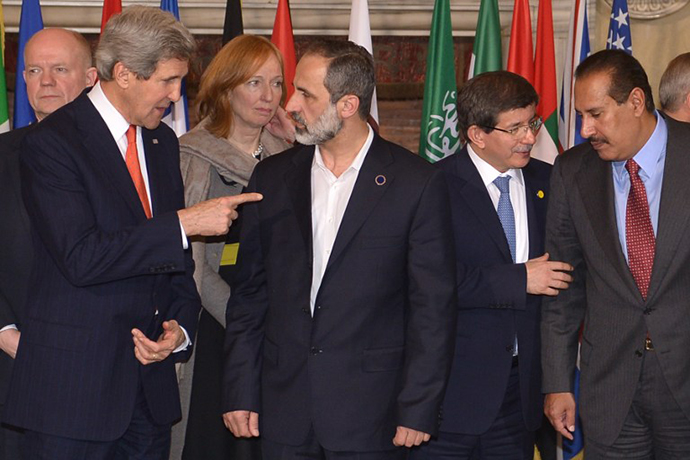
The Syrian Ambassador to the UN Bashar al-Jaafari has urged the Friends of Syria states to convince the Syrian opposition to sit down for an unconditional national dialogue, which al-Khatib has expressed his willingness to take part in. One could surmise that al-Khatib’s shift toward dialogue indicates that the SNC is feeling less secure and more wary of a possible military defeat or rivalry with radical factions. Such a dialogue would undoubtedly represent a step in the right direction. Despite political differences and two years of deep conflict, these two parties must establish a genuine ceasefire and partnership to restore a climate of normality throughout the country. In this context, both parties must be able to agree on coordinating aid distribution to all parts of the country.
International recognition of a provisional SNC government would only create further divisions at a time when national unity is most needed. Although rebel-held areas are badly isolated and in need of humanitarian supplies, the delivery of aid must be facilitated through direct talks and partnership between Moaz al-Khatib’s Syrian National Council and Bashar Al-Assad’s government.
Fredericton postal worker’s trip to Palestine smeared by Conservative MP
by Tracy Glynn
Halifax Media Co-op
March 15, 2013
Fredericton – Conservative MP Mark Adler for the Toronto riding of York Centre accused Fredericton postal worker Ruth Breen and her union, the Canadian Union of Postal Workers (CUPW), of using public funds to pay for her trip to the occupied West Bank in Parliament’s Question Period on March 5th. A brief account of Breen’s trip appeared in the union’s newsletter, The Rose.
Adler said, “Mr. Speaker, constituents from my riding have brought to my attention the latest propagandist newsletter issued by the radical Canadian Union of Postal Workers to its members. This radical political pamphlet outlines Fredericton local member Ruth Breen’s trip to Israel using public funds, while at the same time accusing Canada of committing war crimes through its support for Israel.”
Adler then asked the Minister responsible for Canada Post, Steven Fletcher, to respond. Minister Fletcher’s response: “Mr. Speaker, what the member has raised is awful. Using public funds for radical political trips is wrong. CUPW should apologize for this misuse of public funds and its anti-Israeli rhetoric. Will the Leader of the Opposition continue to support his big union bosses and their radical political views, or will he stand with taxpayers and demand an apology for the misuse of these public funds and to the state of Israel?” The Leader of the Opposition did not respond.
According to Breen, Adler is ill-informed. “I traveled to the West Bank on Atlantic Regional I International Solidarity Funds. I did not travel to the West Bank with public funds as Adler is alleging,” says Breen.
Breen says she is perplexed by Adler’s strong reaction to the use of “war crime” to describe Israel’s actions. She points to information found on federal government websites that support her assertion that Israel is committing war crimes.
[hat tip: Little Sis Media]
State of Syria: Bloody sectarian war threat after 2 yrs of fighting [video]
Russia Today
March 15, 2013
The bloody conflict in Syria has reached a third year – and yet some European nations want to pour more weapons into the crisis-torn country. EU Foreign Ministers will look at the possibility of lifting an arms embargo on Syria next week, after France and Britain made a major push to put more guns into the hands of anti-Assad forces. The civil war has already claimed an estimated 70 thousand lives. RT’s Maria Finoshina has followed the nation’s plight from the beginning.
RT LIVE http://rt.com/on-air
Subscribe to RT! http://www.youtube.com/subscription_c…
Like us on Facebook http://www.facebook.com/RTnews
Follow us on Twitter http://twitter.com/RT_com
Follow us on Google+ http://plus.google.com/+RT
RT (Russia Today) is a global news network broadcasting from Moscow and Washington studios. RT is the first news channel to break the 500 million YouTube views benchmark.

 PN
PN 