
Iran’s Ahmadinejad on Holocaust [video]
YouTube — ravenise00
June 22, 2012
Iranian President Mahmoud Ahmadinejad is asked by MSNBC anchor Brian Williams to clarify his statements about the Holocaust. (September 2006)
America’s Pacific Century: Containing China [video]
Chandra Muzaffar – Nile Bowie
GRTV – NileBowie.blogspot.com
June 20, 2012
Interview: Syrian Intervention Could Cause 100,000 Deaths [audio]
Voice of Russia
June 15, 2012
Alexei Pushkov: “humanitarian” intervention to Syria will lead to chaos
Tom Hedegard
Audio: Download
====
Russia is ready to look for answers together with Western countries. And we don’t accept this kind of criticism. And we don’t accept this kind of mythology that the insurgents are pro-reform people. Because we know very well that they have been financed and armed by monarchies of the Persian Gulf. They don’t even hide this fact and I hardly see a situation where democracy in Syria will be established with the help of Saudi Arabia and Qatar.
=====
Alexei Pushkov, the Chairman of the Russian Duma’s International Affairs Committee, offers his assessment of the conflict unfolding in Syria in an exclusive interview with the Voice of Russia.
I think that what we have been hearing from the US is very partial. Somehow the US thinks that the only source of civil war in Syria is the government, which is not the case. There are 33 thousand people who are fighting the Syrian government, and they’re fighting the Syrian government with heavy weapons, not just Kalashnikovs and pistols.
It’s heavy machine guns, it’s anti-tank guns and all of these armaments were on display when a ship coming from Libya full of US weapons was arrested in Lebanon. On the photos you can see what kind of armament was sent to the insurgents. It’s Syrian force which has been trained outside of Syria. Some of them are really professional fighters. There’s some information about people who have been fighting in Libya, now are fighting on the side of the insurgents. I think that the US had better look at what kind of people they try to support there and what these people will bring to Damascus.
Until now Syria was a secular country where different ethnicities and different religious factions were living in peace and for many years – that’s very valuable. You have Christians, Sunnis, Alawis, Druze, Kurds and quite a few other groups. And if all of this explodes, I don’t think that we’ll have 10 thousand victims, we’ll have maybe 100 thousand victims. Russia wants to prevent this explosion. What we hear from our Western partners is that Assad should go and they are willing to support the insurgency. But supporting the insurgency, they are basically throwing oil into the flame. That is why Russia suggested having international conference where we can try to find the solution that would be proposed to both sides in the Syrian conflict. The key Russian position is that we are ready to influence Assad’s government, but the West should influence the insurgents. Otherwise it will not work out.
Do you think that the Western media was unfairly portraying Russia?
I think one of the reasons the West has been so critical about Russia in the Syrian issue is that the West doesn’t have a policy at all towards Syria. I’m not pretending that Russia has the answers, but Russia fulfills a very important role for the Western media. By this could not criticize their own governments for not having any kind of solutions. Because the only political program the West has is that Assad should go. OK, what happens after Assad goes? How the regime falls? Who will come in its place?
Is Russia prepared for that situation?
Russia is ready to look for answers together with Western countries. And we don’t accept this kind of criticism. And we don’t accept this kind of mythology that the insurgents are pro-reform people. Because we know very well that they have been financed and armed by monarchies of the Persian Gulf. They don’t even hide this fact and I hardly see a situation where democracy in Syria will be established with the help of Saudi Arabia and Qatar.
And finally there have been some accusation that Russian foreign policy towards Syria is driven by its business interests. How do you respond to that?
I think that the most important thing is not business. Syria doesn’t play such a huge role in Russian foreign trade. The key factor in the Russian position is a very clear stand against so-called regime change, against so-called humanitarian intervention. We think that the Libyan example showed that these kinds of interventions lead to chaos and to the creation of a parallel international law: when you have a UN charter and at the same time you have some kind of parallel law which is being conducted by either friends of Syria or the Coalition of the Willing, something which goes around the UN rules and charter. We don’t want to accept a world where there would be another international law instead of the internationally accepted one. Syria is just a very serious example of the Russian desire to fight for international law which is universally accepted.
CrossTalk: Exceptional Empire [video]
Russia Today
June 18, 2012
Can the US be considered an empire? Is it a global force for stability or instability? How much does it cost to be an empire? And do Americans regard their homeland as an empire? CrossTalking with John Walsh, George Szamuely and Herbert London.
Watch all CrossTalk shows here:
http://www.youtube.com/playlist?list=PL1F38BDDE9861D9A6 (Season 2010/11)
http://www.youtube.com/playlist?list=PLF5410DB7CFDE2246 (Season 2011/12)
CrossTalk’s Facebook page http://www.facebook.com/crosstalkrulez
Follow Peter Lavelle on Twitter http://twitter.com/PLCROSSTALK
Hidden US-Israeli Military Agenda: “Break Syria into Pieces”
by Prof. Michel Chossudovsky
Global Research
June 16, 2012
Detailed analysis on Syria.
Over 30 chapters, available from Global Research at no charge
 |
SYRIA: NATO’s Next “Humanitarian” War?
ONLINE INTERACTIVE I-BOOK
– by Prof. Michel Chossudovsky – 2012-07-15
|
A timely article in the Jerusalem Post last month brings to the forefront the unspoken objective of US foreign policy, namely the breaking up of Syria as a sovereign nation state –along ethnic and religious lines– into several separate and “independent” political entities. The article also confirms the role of Israel in the process of political destabilization of Syria. The JP article is titled: “Veteran Kurdish politician calls on Israel to support the break-up of Syria‘ (by Jonathan Spyer) (The Jerusalem Post (May 16, 2012)
The objective of the US sponsored armed insurgency is –with the help of Israel– to “Break Syria into Pieces”.
The “balkanisation of the Syrian Arab Republic” is to be carried out by fostering sectarian divisions, which will eventually lead to a “civil war” modelled on the former Yugoslavia. Last month, Syrian “opposition militants” were dispatched to Kosovo to organize training sessions using the “terrorist expertise” of the US sponsored Kosovo Liberation Army (KLA) in fighting the Yugoslav armed forces.
Sherkoh Abbas, President of the US based Kurdistan National Assembly of Syria (KNA) has “called on Israel to support the break-up of Syria into a series of federal structures based on the country’s various ethnicities.” (Ibid)
One possible “break-up scenario” pertaining to Syria, which constitutes a secular multi-ethnic society, would be the formation of separate and “independent” Sunni, Alawite-Shiite, Kurdish and Druze states: “We need to break Syria into pieces,” Abbas said. (Quoted in JP, op. cit., emphasis added).
“The Syrian Kurdish dissident argued that a federal Syria, separated into four or five regions on an ethnic basis, would also serve as a natural “buffer” for Israel against both Sunni and Shi’ite Islamist forces.” (Ibid.).
Ironically, while Islamist forces are said to constitute the main threat to the Jewish State, Tel Aviv is providing covert support to the Islamist Free Syrian Army (FSA).

Map 1
Meeting behind Closed Doors at the US State Department
A top level US State Department meeting was held in May with members of the Syrian Kurdish opposition. In attendance were representatives of the Kurdish National Council (KNC), Robert Stephen Ford, the outgoing US ambassador to Syria (who has played a key role in channelling support to the rebels) as well as Frederic C. Hof, a former business partner of Richard Armitage, who currently serves as the administration’s “special coordinator on Syria”. (Ibid). The delegation also met with Assistant Secretary of State for Near Eastern Affairs Jeffrey Feltman.
Frederic C. Hof, Robert Stephen Ford and Jeffrey Feltman are the State Department’s key Syria policy-makers, with close links to the Syrian Free Army (SFA) and the Syrian National Council (SNC).
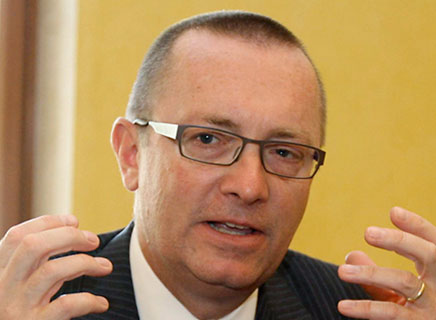
Assistant Secretary of State for Near Eastern Affairs Jeffrey Feltman

Frederic C. Hof, The Administration’s “special coordinator on Syria”

Robert S. Ford, outgoing US Ambassador to Syria
The public statements of KNA leader Sherkoh Abbas in the wake of the State Department meeting suggest that the political fracturing of the Syrian Arab Republic along ethnic and religious lines as well as the creation of an “independent Kurdistan” were discussed. “State Department Deputy Spokesman Mark Toner described [the meeting’s] purpose as part of ‘ongoing efforts… to help the Syrian [Kurdish] opposition build a more cohesive opposition to Assad.’” (Ibid).
The KNA leader called upon Washington to support the creation of a separate Kurdish State consisting of “an autonomous region in Syria; joining the Kurdistan Regional Government in Iraq – which borders the Kurdish region in Syria; or perhaps an even larger Kurdish state” [Greater Kurdistan].
“The Kurdish people, in all parts of Kurdistan, seek the right to form an independent Kurdish state. We can only achieve this cherished goal with the help of the western democracies, and first and foremost the U.S.” said Sherkoh Abbas. (Syria: An Alternative, Choice, Ekurd.net, May 22, 2012)
It is worth noting, in this regard, that the creation of a “Greater Kurdistan” has been envisaged for several years by the Pentagon as part of a broader “Plan for Redrawing the Middle East”.(See map 2 below)
This option, which appears unlikely in the near future, would go against the interests of Turkey, a staunch ally of both the US and Israel. Another scenario, which is contemplated by Ankara would consist in the annexation to Turkey of parts of Syrian Kurdistan. (See map above).
“Greater Kurdistan” would include portions of Iran, Syria, Iraq and Turkey as conveyed in Coronel Ralph Peters (ret) celebrated map of “The New Middle East” (see below). (For Further details see Mahdi Nazemroaya’s November 2006 Global Research article).
Colonel Peters taught at the US Military Academy.


The following map was prepared by Lieutenant-Colonel Ralph Peters. It was published in the Armed Forces Journal in June 2006,
Peters is a retired colonel of the U.S. National War Academy. (Map Copyright Lieutenant-Colonel Ralph Peters 2006).
Although the map does not officially reflect Pentagon doctrine, it has been used in a training program at NATO’s Defense College for senior military officers.
This map, as well as other similar maps, has most probably been used at the National War Academy as well as in military planning circles.
Stuxnet: Anatomy of a Computer Virus [video]
YouTube — bluehaus
June 18, 2012
by Patrick Clair (http://vimeo.com/patrickclair)
(http://vimeo.com/25118844)
An infographic dissecting the nature and ramifications of Stuxnet, the first weapon made entirely out of code. This was produced for Australian TV program HungryBeast on Australia’s ABC1
Direction and Motion Graphics: Patrick Clair patrickclair.com
Written by: Scott Mitchell
Production Company: Zapruder’s Other Films.
[hat tip: Activist Post]


