
‘We Are Preparing For Massive Civil War’ Says DHS Informant
by Dominique de Kevelioc de Bailleul
Before It’s News
May 4, 2012
In a riveting interview on TruNews Radio, Wednesday, private investigator Doug Hagmann said high-level, reliable sources told him the U.S. Department of Homeland Security (DHS) is preparing for “massive civil war” in America.
“We have problems . . . The federal government is preparing for civil uprising,” he added, “so every time you hear about troop movements, every time you hear about movements of military equipment, the militarization of the police, the buying of the ammunition, all of this is . . . they (DHS) are preparing for a massive uprising.”
Hagmann goes on to say that his sources tell him the concerns of the DHS stem from a collapse of the U.S. dollar and the hyperinflation a collapse in the value of the world’s primary reserve currency implies to a nation of 311 million Americans, who, for the significant portion of the population, is armed.
Uprisings in Greece is, indeed, a problem, but an uprising of armed Americans becomes a matter of serious national security, a point addressed in a recent report by the Pentagon and highlighted as a vulnerability and threat to the U.S. during war-game exercises at the Department of Defense last year, according to one of the DoD’s war-game participants, Jim Rickards, author of Currency Wars: The Making of the Next Global Crisis.
Through his sources, Hagmann confirmed Rickards’ ongoing thesis of a fear of a U.S. dollar collapse at the hands of the Chinese (U.S. treasury bond holders of approximately $1 trillion) and, possibly, the Russians (threatening to launch a gold-backed ruble as an attractive alternative to the U.S. dollar) in retaliation for aggressive U.S. foreign policy initiatives against China’s and Russia’s strategic allies Iran and Syria.
“The one source that we have I’ve known since 1979,” Hagmann continued. “He started out as a patrol officer and currently he is now working for a federal agency under the umbrella of the Department of Homeland Security; he’s in a position to know what policies are being initiated, what policies are being planned at this point, and he’s telling us right now—look, what you’re seeing is just the tip of the iceberg.
We are preparing, we, meaning the government, we are preparing for a massive civil war in this country.”
“There’s no hyperbole here,” he added, echoing Trends Research Institute’s Founder Gerald Celente’s forecast of last year. Celente expects a collapse of the U.S. dollar and riots in America some time this year.
Since Celente’s ‘Civil War’ prediction of last year, executive orders NDAA and National Defense Resources Preparedness were signed into law by President Obama, which are both politically damaging actions taken by a sitting president.
And most recently, requests made by the DHS for the procurement of 450 million rounds of hollow-point ammunition only fuels speculation of an upcoming tragic event expected on American soil.
These major events, as shocking to the American people as they are, have taken place during an election year.
Escalating preparatory activities by the executive branch and DHS throughout the last decade—from the Patriot Act, to countless executive orders drafted to suspend (or strip) American civil liberties “are just the beginning” of the nightmare to come, Hagmann said.
He added, “It’s going to get so much worse toward the election, and I’m not even sure we’re going to have an election in this country. It’s going to be that bad, and this, as well, is coming from my sources. But one source in particular said, ‘look, you don’t understand how bad it is.’
This stuff is real; these people, the Department of Homeland Security (DHS), they are ready to fight the American people.”
TruNews‘ Wiles asked Hagmann: who does the DHS expect to fight, in particular? Another North versus South, the Yankees against the Confederates?
Hagmann stated the situation is far worse than a struggle between any two factions within the U.S.; it’s an anticipated nationwide emergency event centered on the nation’s currency.
“What they [DHS] are expecting, and again, this is according to my sources, what they’re expecting is the un-sustainability of the American dollar,” Hagmann said.
“And we know for a fact that we can no longer service our debt. There’s going to be a period of hyperinflation . . . the dollar will be worthless . . . The economic collapse will be so severe, people won’t be ready for this.”
Source: Full TruNews interview, May 2, 2012.
—————————————————
[hat tip: TheIntelHub.com]
Fukushima: A Nuclear War without a War: The Unspoken Crisis of Worldwide Nuclear Radiation
by Prof. Michel Chossudovsky
Global Research
May 28, 2012
Note to Readers: Remember to bookmark this page for future reference.
Please Forward the GR I-Book far and wide. Post it on Facebook.
[scroll down for I-BOOK Table of Contents]
GLOBAL RESEARCH ONLINE INTERACTIVE READER SERIES
Fukushima: A Nuclear War without a War
The Unspoken Crisis of Worldwide Nuclear Radiation
Michel Chossudovsky (Editor)
I-Book No. 3, January 25 2012
Global Research’s Online Interactive I-Book Reader brings together, in the form of chapters, a collection of Global Research feature articles and videos, including debate and analysis, on a broad theme or subject matter.
In this Interactive Online I-Book we bring to the attention of our readers an important collection of articles, reports and video material on the Fukushima nuclear catastrophe and its impacts (scroll down for the Table of Contents).
To consult our Online Interactive I-Book Reader Series, click here.
INTRODUCTION 
The World is at a critical crossroads. The Fukushima disaster in Japan has brought to the forefront the dangers of Worldwide nuclear radiation.
The crisis in Japan has been described as “a nuclear war without a war”. In the words of renowned novelist Haruki Murakami:
“This time no one dropped a bomb on us … We set the stage, we committed the crime with our own hands, we are destroying our own lands, and we are destroying our own lives.”
Nuclear radiation –which threatens life on planet earth– is not front page news in comparison to the most insignificant issues of public concern, including the local level crime scene or the tabloid gossip reports on Hollywood celebrities.
While the long-term repercussions of the Fukushima Daiichi nuclear disaster are yet to be fully assessed, they are far more serious than those pertaining to the 1986 Chernobyl disaster in the Ukraine, which resulted in almost one million deaths (New Book Concludes – Chernobyl death toll: 985,000, mostly from cancer Global Research, September 10, 2010, See also Matthew Penney and Mark Selden The Severity of the Fukushima Daiichi Nuclear Disaster: Comparing Chernobyl and Fukushima, Global Research, May 25, 2011)
Moreover, while all eyes were riveted on the Fukushima Daiichi plant, news coverage both in Japan and internationally failed to fully acknowledge the impacts of a second catastrophe at TEPCO’s (Tokyo Electric Power Co Inc) Fukushima Daini nuclear power plant.
The shaky political consensus both in Japan, the U.S. and Western Europe is that the crisis at Fukushima has been contained.
The realties, however, are otherwise. Fukushima 3 was leaking unconfirmed amounts of plutonium. According to Dr. Helen Caldicott, “one millionth of a gram of plutonium, if inhaled can cause cancer”.
An opinion poll in May 2011 confirmed that more than 80 per cent of the Japanese population do not believe the government’s information regarding the nuclear crisis. (quoted in Sherwood Ross, Fukushima: Japan’s Second Nuclear Disaster, Global Research, November 10, 2011)
The Impacts in Japan
The Japanese government has been obliged to acknowledge that “the severity rating of its nuclear crisis … matches that of the 1986 Chernobyl disaster”. In a bitter irony, however, this tacit admission by the Japanese authorities has proven to been part of the cover-up of a significantly larger catastrophe, resulting in a process of global nuclear radiation and contamination:
“While Chernobyl was an enormous unprecedented disaster, it only occurred at one reactor and rapidly melted down. Once cooled, it was able to be covered with a concrete sarcophagus that was constructed with 100,000 workers. There are a staggering 4400 tons of nuclear fuel rods at Fukushima, which greatly dwarfs the total size of radiation sources at Chernobyl.” ( Extremely High Radiation Levels in Japan: University Researchers Challenge Official Data, Global Research, April 11, 2011)
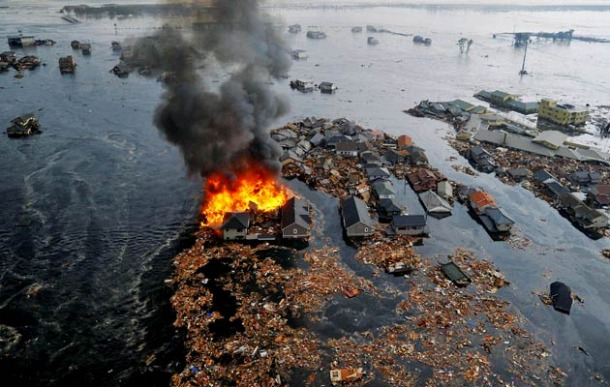
Fukushima in the wake of the Tsunami, March 2011
Worldwide Contamination
The dumping of highly radioactive water into the Pacific Ocean constitutes a potential trigger to a process of global radioactive contamination. Radioactive elements have not only been detected in the food chain in Japan, radioactive rain water has been recorded in California:
“Hazardous radioactive elements being released in the sea and air around Fukushima accumulate at each step of various food chains (for example, into algae, crustaceans, small fish, bigger fish, then humans; or soil, grass, cow’s meat and milk, then humans). Entering the body, these elements – called internal emitters – migrate to specific organs such as the thyroid, liver, bone, and brain, continuously irradiating small volumes of cells with high doses of alpha, beta and/or gamma radiation, and over many years often induce cancer”. (Helen Caldicott, Fukushima: Nuclear Apologists Play Shoot the Messenger on Radiation, The Age, April 26, 2011)
While the spread of radiation to the West Coast of North America was casually acknowledged, the early press reports (AP and Reuters) “quoting diplomatic sources” stated that only “tiny amounts of radioactive particles have arrived in California but do not pose a threat to human health.”
“According to the news agencies, the unnamed sources have access to data from a network of measuring stations run by the United Nations’ Comprehensive Test Ban Treaty Organization. …
… Greg Jaczko, chair of the U.S. Nuclear Regulatory Commission, told White House reporters on Thursday (March 17) that his experts “don’t see any concern from radiation levels that could be harmful here in the United States or any of the U.S. territories”.


The spread of radiation. March 2011
Public Health Disaster. Economic Impacts
What prevails is a well organized camouflage. The public health disaster in Japan, the contamination of water, agricultural land and the food chain, not to mention the broader economic and social implications, have neither been fully acknowledged nor addressed in a comprehensive and meaningful fashion by the Japanese authorities.
[CLICK HERE TO READ THE FULL ARTICLE AND I-BOOK]
Source – http://www.globalresearch.ca/index.php?context=viewArticle&code=CHO20120125&articleId=28870
Iranian Ambassador to the IAEA speaks on NPT [video]
Press TV
May 4, 2012
Iranian Ambassador to the IAEA, Ali Asghar Soltanieh, delivered a hard hitting statement to the NPT Review Preparatory Committee, saying developments in the area of nuclear disarmament have been grim.
Press TV’s Fabian Pierre reports from Vienna.
Syria and Annan’s plan (Middle East Today – 05-04-2012) [video]
Press TV
May 5, 2012
With the wave of bombings still engulfing Syria, many fear that the job of UN observers to the country will not be as effective as it should. The UN peace keeping chief has accused both the government and armed groups in Syria of violation the UN-Arab League peace plan. In this edition of the show we ask: Was Kofi Annan’s plan dead upon arrival?
Syrian Girl Makes a TV proposal [video]
108morris108
May 5, 2012
Syrian girl on Civil War, Donnes Headscarf for a TV Proposal
Syrian Girl on the Global Agenda [video]
CorbettReport.com
May 5, 2012
Syrian Girl joins us once again to go over the latest in Syria, including the (predicted) breakdown in the Annan peace deal and the likely next steps in the escalation of the conflict. We also discuss the larger agenda of global conflict and global government and what the average person can do in the face of these geopolitical nightmares.
Interview w/ Rick Rozoff: NATO Missile Shield Has Potential As First Strike System
Press TV
May 5, 2012
NATO missile shield has potential as first strike system: Analyst
Interview with Rick Rozoff, Manager of Stop NATO, Chicago
“…the US/NATO missile shield, which is not to be construed as a defensive project whatsoever, has the potential of being a first strike system that is able to knock out missiles that withstand a potential first strike by the US and NATO against other countries. Russia would seem to be the chief target for that.”
NATO’s Rasmussen has said that the US global missile defense shield poses no threat to Russia after Russia reserved the right to make a preemptive strike against the facility.
Press TV has interviewed Rick Rozoff, manager of Stop NATO in Chicago, about the expansion of NATO partnerships over the past two decades to see it emerge as a global power and he discusses the merit in Russia’s trepidations. What follows is an approximate transcript of the interview.
Press TV: How global is NATO becoming?
Rozoff: In its own assessment, the current U.S. ambassador to NATO, permanent representative Ivo Daalder, is somebody who seven years co-wrote a major article entitled ‘Global NATO’ and others that have used a similar title, so global NATO – I invite people to visit the NATO website and look up the category of NATO partnerships.
That is, not only does NATO itself have 28 full members – and that’s a 75 percent increase in its membership from 1999 to 2009 – 12 new countries in Eastern Europe were absorbed as full members, but NATO openly acknowledges, in fact boasts of, a series of international military partnerships that exceed 40 different nations.
That is, combined, the 28 NATO members and the 40 partnership countries are well over a third of the nations in the world and these include four partners in the Persian Gulf, they include seven partners in North Africa and the Middle East, they include a brand new category, incidentally, that NATO calls openly – I’m not making this up – Partners across the globe, which includes such diverse nations as Japan, Australia, South Korea, New Zealand, Mongolia, Iraq, Afghanistan, Pakistan.
So, in fact, the US-led military bloc has become international in scope; it certainly has so in terms of missions where it has now as of last year waged wars in three continents, in Europe, Asia and Africa.
Press TV: Western and European countries express concern about the proliferation of weapons around the world yet we see NATO installing and setting up different military command centers around the world deploying more and more missiles. If that’s not called proliferation then what is it?
Rozoff: You’re absolutely correct. The NATO summit declarations that are issued after each summit, and there will be one after May 21st here in Chicago where I’m speaking, will reiterate the point that NATO remains a nuclear alliance. They’ll say something to the effect that as long as there are nuclear weapons in the world NATO will remain a nuclear force.
I should inform your listeners who may not know this, in the early 1980s we had a reform administration in Chicago, Mayor Harold Washington and during his time in office the City Council of Chicago introduced a resolution that was passed, making Chicago the first major city in the United States that declared itself a nuclear-free zone.
So the fact that a nuclear alliance like NATO is convening in Chicago on May 20th and 21st is a violation of that ordinance and is a violation of the status of this city, the third largest in the United States, which has affirmed that it is a nuclear-free zone.
What you’re alluding to of course, I heard in the lead-in the comment by the NATO Chief Anders Fogh Rasmussen, that the US/NATO interceptor missile system in Europe has achieved interim capability, initial operational capability.
He talked about tests that had been conducted in Europe that suggested the first of four phases of the US/NATO missile shield, which is not to be construed as a defensive project whatsoever, it has potential of being a first strike system that is able to knock out missiles that withstand a potential first strike by the United States and NATO against other countries. Russia would seem to be the chief target for that.
And last November as a matter of fact, in Germany, NATO conducted its first live-fire test of its own branch of the missile shield in Europe, something called Active Layered Theatre Ballistic Missile Defence, and that was announced to have achieved interim capabilities.
So Rasmussen’s comment that at the NATO summit here in Chicago later this month NATO will announce the fact that it has activated the first phase of the most ambitious interceptor missile system in history and one that is really the logical extension of the Ronald Reagan administration’s so-called Strategic Defense Initiative, popularly known as Star Wars, is a very alarming fact and I think the world as well as Russia should take note of this.


