
Destination dialogue: Russia eager for negotiations in Syria [video included]
Russia Today
February 7, 2012
The visit of a Russian delegation to Damascus has raised hopes of talks between the Assad government and the opposition. Experts say Moscow is eager for negotiations in Syria, while the West is only interested in toppling the government.
Richard Heydarian, a Manila-based foreign affairs analyst, has told RT that Russia will put a lot of pressure on the Assad regime for any kind of resolution of the problem. He believes the Russians feared that the UN draft resolution, if accepted, could become a pretext for some sort of military intervention. Moscow, he said, will do its best to solve the crisis.
“What Russia will try to do right now is use all kinds of leverage and influence it has on Bashar Assad and the Syrian regime, to make sure there will be a political process which will [ensure] a smooth transition, perhaps, towards a post-authoritarian scenario,” Heydarian concluded.
Jeremy Salt, associate professor of Middle Eastern history and politics at Bilkent University in Turkey, thinks that the interests of many countries are intersecting in Syria at the moment.
“Part of the problem in Syria is that there are too many different agendas: the Western agenda, the Saudi agenda which is shared by Qatar.”
“But they all converge at one point,” he explained. “They want to remove the Syrian government. Their cause is bringing down the Syrian government. It is not really reform – it is about destroying the Assad government.”
Salt says the Western powers are interested not in promoting dialogue but in prolonging the crisis in the country, while Russia and China are pushing diplomacy in Syria because they cannot allow a Libyan or Iraqi scenario to take place.
At the same time China’s and Russia’s interests in Syria are different, Professor Simon Shen from the Chinese University of Hong Kong explained to RT.
“Unlike Russia, China doesn’t have any particular interest in [Syria]. However, as for the region on the whole, China is very concerned with the regular supply of oil. That, basically, is number one priority in Chinese foreign policy,” he told RT.
“But Syria is not just Syria. From a Chinese prospective, [the situation around this country creates problems] for Iran, because if Syria falls, then probably, the next target will be Iran – and China had expressed very clearly that it doesn’t want any new hurdles to be placed upon Iran in terms of its oil export,” Shen explained.
source: http://rt.com/news/russia-promotes-dialogue-syria-727/
Strengthening U.S.-Canada Security Interests in North America and Around the Globe
By Dana Gabriel
Be Your Own Leader
February 6, 2012
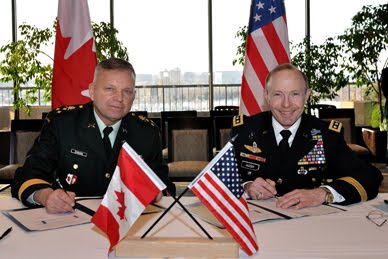 The U.S. and Canada recently signed several bilateral agreements that will further strengthen continental security and defense cooperation. Deeper military integration between both countries is part of efforts to establish a North American security perimeter and better address common global threats.
Following the recent Permanent Joint Board on Defense (PJBD) meeting which took place in Ottawa, the Commander of Canada Command, Lt.-Gen Walter Semianiw and the Commander of North American Aerospace Defense Command (NORAD) and United States Northern Command (USNORTHCOM), Gen. Charles Jacoby, Jr. signed three military documents. The first was the Combined Defense Plan which a backgrounder described as a, “planning framework between Canada Command, its counterpart USNORTHCOM, and NORAD for enhanced defense cooperation between Canada and the U.S. should governments require each other’s assistance.” The second is the Information Sharing Memorandum of Understanding, “an arrangement between Canada Command, its counterpart USNORTHCOM and NORAD to identify and provide for ease of sharing information amongst the three organizations.” The Civil Assistance Plan, which was originally signed in 2008 and allows the armed forces of one nation to support the other during an emergency was also renewed for two years.
Lee Berthiaume of Postmedia News reported that, “The Combined Defense Plan has been under discussion for several years and would further integrate cross-border military co-operation at a time when the Harper government is trying to reassure Washington it has a reliable partner in Canada when it comes to security.” Defense Minister Peter MacKay is quoted as saying, “This agreement provides a framework for the combined defense of Canada and the U.S. during peace, contingencies, and war.” He added, “The plan describes the authorities and means by which the two governments would approve homeland military operations in the event of a mutually agreed threat, and how our two militaries would collaborate and share information.” In his speech in front of the PJBD, Minister MacKay also called for, “increased military involvement implementing the Beyond the Border strategy, saying the Canadian Forces and its American counterparts should be supporting civilian agencies monitoring the cross-border security.” Also on the agenda at the defense forum was security cooperation in the Arctic, along with Canadian and U.S. engagement in the Western Hemisphere.
In an article for iPolitics, Colin Horgan wrote that at the recent bilateral defense meeting, “MacKay noted that such initiatives as Beyond the Border and the Regulatory Cooperation Council Action Plan will work to ensure that the vital economic partnership that joins our two countries continues to be the cornerstone of our economic competitiveness and security.” Defense Minister MacKay emphasized that security is linked to the economy and called for even greater cooperation to support the dual action plans. He stated, “We need to increasingly focus our military forces in support of those civilian departments and agencies that have the lead.” MacKay also explained, “We need to all work together to mitigate capability gaps, share best practices and co-operate on new approaches.” He went on to say, “there is still room for more integrated collaboration – domestically and bi-nationally.”
The latest military agreements further promote a perimeter approach to security. They are part of the Tri Command Vision efforts to merge NORAD, USNORTHCOM and Canada Command into one. As for the PJBD, it has once again become more relevant as a venue for bilateral security and military dialogue. Created in 1940 the panel, “is the senior advisory body on continental defense. It is composed of military and diplomatic representatives from both nations.” Over the years, it has, “served as a strategic-level military board charged with considering, in a broad sense, land, sea, air and space issues.” This includes areas concerning, “policy, operations, financial, logistics and other aspects of Canada-U.S. defense relations.” The PJBD is well positioned to play a significant role in plans for a fully integrated North American security perimeter, as well as in other facets of the evolving Canada-U.S. partnership.
On January 6, the Obama administration released the new document, Sustaining U.S. Global Leadership: Priorities for 21st Century Defense. The new strategy calls for maintaining a strong presence in the Middle East, as well as an expanding role in the Asia-Pacific region. Much of the focus will be on countering China’s rising power. This will include supporting large bases in Japan and South Korea, along with stationing troops in Australia. The U.S. will also continue efforts to forge stronger military alliances with the Philippines, Indonesia, Vietnam and Burma. While the plan envisions a leaner military force, there is little doubt that Washington will continue to police the world. How does Canada fit into this new realignment of American strategic priorities? It is clear that the U.S. will rely more on its allies during international missions. Canada may gain a greater voice in future military operations, but it will also mean that they will have to bear more of the burden. In the coming years, as NATO members begin cutting defense spending, Canada will be counted on to play an even bigger role in any possible overseas conflicts.
Whether it’s the perimeter security deal, the ongoing mission in Afghanistan or the bombing campaign that took place in Libya, the U.S. and Canada continue to enhance security and military cooperation. Under Prime Minister Stephen Harper, both countries have further deepened their defense relationship. In addition, Canada has pursued a more U.S.-style foreign policy. This includes imposing tougher sanctions on Iran, along with further expanding sanctions against Syria. Much like the U.S., Harper has singled out Iran as a threat to international peace and security. He has echoed the same sentiments that the regime is seeking a nuclear weapon and would be prepared to use it. Defense Minister Peter MacKay has also indicated that if necessary, Canada’s armed forces are ready to offer assistance in Syria. More than ever, the U.S, and Canada share a more common approach to advancing security interests in not only North America, but around the globe.
Related articles by Dana Gabriel
Pretext for a North American Homeland Security Perimeter
Canada Pursues U.S.-Style Security and Foreign Policy
Deepening Canada-U.S. Security and Military Ties
Perimeter Security and an Integrated North American Command
Dana Gabriel is an activist and independent researcher. He writes about trade, globalization, sovereignty, security, as well as other issues. Contact: beyourownleader@hotmail.com Visit his blog at beyourownleader.blogspot.com
Corbett Report – Episode 216 – Who’s Gaming Who?
The Corbett Report
January 28, 2012
Science-fiction fantasy is becoming mundane reality and video games are increasingly merging with 21st century combat. The DoD recruits youth through traveling arcade exhibitions and new recruits are just as likely to end up behind a keyboard as behind enemy lines. What does this mean for the future of our predicatively programmed world, and should we be worried. Find out more in this week’s edition of The Corbett Report.
[hat tip: Media Monarchy]
CrossTalk: Syrious Rebels [video]
Russia Today
February 1, 2012
Will the international community resort to force in Syria? What if Assad stays in power for much longer than most experts predict? And will Syrians be able to topple the Assad government without foreign interference? Is Syria the next Libya or will it follow its own unique path? CrossTalking with Marwa Daoudy, Maximilian Forte and David Pollock on Feb. 1.
CT on FB: http://www.facebook.com/crosstalkrulez
‘Assad, you’ll die like Gaddafi’: Rebels want off with Syria head [video]
Russia Today
January 31, 2012
Syria’s opposition have made a chilling pledge to the country’s leader. They have vowed President Bashar Al Assad and his family will be killed like Libyan leader Colonel Gaddafi, saying he’s lost the chance of a peaceful exit. Fierce battles between government forces and rebel fighters are raging on the outskirts of the capital Damascus. RT’s Sara Firth is in the city now.
RT on Twitter http://twitter.com/RT_com
RT on Facebook http://www.facebook.com/RTnews
Project Camelot Interviews Benjamin Fulford [video]
Project Camelot
February 2008
If you need a bodyguard, it’s too late. You have to make them not want to shoot you.
Benjamin Fulford
The son of a Canadian diplomat, Benjamin Fulford rebelled against his upbringing and at the age of 17 made his way by boat into the heart of the Amazon to live with a tribe of former cannibals. Continuing to seek answers and better understand Western society, he spent time in a self-sufficient community in Argentina before heading to attend university in Japan.
Principled, brave, and still a diehard idealist after all these years, he resigned as Asia-Pacific Bureau Chief of Forbes Magazine after investigating a scandal which the editor refused to report. As he researched global affairs further in his own time, he uncovered for himself the complex web which is global financial control at the hands of the Rockefellers and the Rothschilds – and also the existence of racially targeted bioweapons such as SARS.
It was these plans for global depopulation that upset some important and powerful factions in Japan, Taiwan and China. After being approached by a real-life, present-day Ninja, matters came to a head in 2007 when Benjamin became the first Westerner for 500 years to be admitted into the ranks of the Eastern Secret Societies, a vast group with six million members. Acting as their spokesman, he stepped up to the plate to deliver a simple message to the Illuminati:
Recognize that your time is over, step down without a fight, and allow the world to thrive as it should – or face the consequences from up to 100,000 professional assassins for whom no love is lost towards the self-styled ruling elite of the planet.
[Potent News Editor’s note: I find these videos to be very fascinating however I can’t resist mentioning that when Fulford briefly talks of wanting to find the secret to immortality and being able to live forever (somewhere in part 3) I am reminded of trans-humanism. For a different perspective on trans-humanism, watch this presentation.]
Possible False Flag on the USS Enterprise
How real is the possibility of a false flag attack on the USS Enterprise? A navy combat veteran who served in the Persian Gulf provides his perspective…
By Mario Andrade
DeadlineLive.info
January 30, 2012
The USS Enterprise -perhaps one of the most well-known aircraft carriers in modern history- is scheduled to be decommissioned in one year.
Nevertheless, it is still being deployed to the Persian Gulf, which has caused a lot of speculation about how the U.S. Government might provoke an attack (whether real or manufactured) to sink it and blame Iran to start a war.
The possibility of this event was first discussed a few days ago by talkshow host Mike Rivero.
Given the long track record of false flag attacks throughout U.S. Naval History, this is a scenario that cannot and should not be ruled out.
It is a well-known fact that the U.S. Government blew up the USS Maine in 1898 in order to blame Spain during the Cuban revolt, which led to the Spanish-American War. On June 8 of 1967, Israeli aircraft bombed the USS Liberty so the U.S. Government could blame the attack on Egypt.
More recently, Journalist and writer Seymour Hersh stated in public that during the Bush administration, Vice President Dick Cheney wanted to ‘trigger’ a war against Iran by using Navy SEALs disguised as Iranians attacking one of our own ships. These are only a few examples.
Possible scenarios for the false flag attack on the USS Enterprise…
An aircraft carrier is very difficult, but not impossible, to sink. An attack on the USS Enterprise can be coordinated so surface-to-surface missiles, combined with torpedo-attacks possibly launched from submarines as Rivero’s video suggests, and perhaps mine warfare would cause significant damage for it to sink.
If a submarine is involved in the attack, then this scenario would likely occur in the Gulf of Oman because the water there is deep enough to conduct submarine warfare.
The possible sinking scenario can also be achieved by using saboteurs or traitors among the crew to inflict damage to one or more of the EIGHT nuclear reactors on board the Enterprise.
Unfortunately, the possibilities of this scenario to happen are very likely, given how easy it is to have access to the nuclear propulsion machinery rooms.
The nuclear reactor sabotage, along with bombing from an outside vessel or aircraft could inflict enough damage in which nuclear radiation can be released to the crew’s living and working compartments.
The nuclear contamination and the damage to the ship’s structure could very well force the captain to issue the order to abandon ship.
A sabotage can also be coordinated and carried out by intelligence assets and special operations forces. One can only read one of Richard Marcinko’s book to realize how easy it would be for one or two Navy SEAL teams to take over an aircraft carrier.
The Dick Cheney scenario also comes to mind, in which special forces (disguised as Iranians) can use one or more gun boats, or torpedo boats to attack the carrier, while getting air support bombing, or placing high grade explosives under the ship’s keel. After all, that’s one of the Navy SEAL’s main specialty –underwater demolition operations.
One last possible scenario would actually involve the Iranian navy. The U.S. Government might provoke the Iranians in order for them to attack the USS Enterprise.
The Enterprise’s battlegroup, which may include a submarine, two frigates (now being replaced with Littoral Combat Ships), two destroyers and one guided missile cruiser may (intentionally or unintentionally) leave the carrier vulnerable to an attack.
To sink, or not to sink…
The possible false flag attack on the USS Enterprise may not necessarily be significant enough for the ship to sink. It can be engineered to cause a spectacular –made for television- explosion or hull damage like the attack on the USS Cole.
The ship can sustain significant damage and casualties and still stay afloat, which in fact can be spinned as a symbol of endurance or survival by the government and the media.
The Persian Gulf has very shallow water, with an average of 70 or 80 feet in depth. Therefore, a large aircraft carrier like the USS Enterprise would not fully sink. However, in the Gulf of Oman (which is where most carriers operate), the depth can reach over one thousand feet.

Possible area where the water would be deep enough for an aircraft carrier to sink.
However, the possibility for an aircraft carrier like the USS Enterprise to sink is still remote, given its massive size and how well the damage control teams can isolate the affected compartments.
Nevertheless, an attack that involves significant amount of damage can be sufficient enough to cause a psychological reaction that may change public opinion to favor a war against Iran.
One can only visualize the images on television of a damaged aircraft carrier being towed to a shipyard to be decommissioned because of the ‘evil-doers’ in Iran.
The irony of an attack on the USS Enterprise would be that this was the first U.S. Navy aircraft carrier that began using nuclear propulsion, and the false flag attack would be made to look like it was carried out by Iran – a country which is trying to develop nuclear reactors for the first time.
Undoubtedly, this would also be reported by the media if the attack takes place.
* Mario Andrade is a U.S. Navy veteran who served in the first Gulf War. His specialization was mine warfare, mine clearance maneuvers, navigation, shipboard damage control and underwater explosives neutralization, among many other duties.
[hat tip: The Intel Hub]


