
MUST SEE — NASA Future Warfare DOCUMENT – Deborah Tavares interview with Trevor Coppola (Conspiracy Con 2013)
YouTube — BoostinR31
June 25, 2013
http://www.youtube.com/watch?v=tk4hfI…
A rcoones video. Deborah Tavares explores some of the ways depopulation may occur and everyday things we are exposed to may be used as weapons against the people. If Depopulation is the objective these may be the tools to do just that. Filmed at Conspiracy Con 2013
Mirrored from Anthony J. Hilder
http://www.youtube.com/user/mranthony…
VIEW THE DOCUMENT HERE
http://www.youtube.com/watch?v=tk4hfI…
Links provided in description of above video
FAIR USE NOTICE: This video may contain copyrighted material the use of which has not always been specifically authorized by the copyright owner. ITISTIMEN0W is making such material available in an effort to advance understanding of environmental, political, human rights, economic, democracy, scientific, and social justice issues, etc. We believe this constitutes a ‘fair use’ of any such copyrighted material as provided for in section 107 of the US Copyright Law. In accordance with Title 17 U.S.C. Section 107, the material in this video is distributed without profit to those who have expressed a prior interest in receiving the included information for research and educational purposes. For more information go to: http://www.law.cornell.edu/uscode/tex…
VIDEO — Massive Syrian ammo depot explosion, 40 dead
RT
July 2, 2013
Courtesy of youtube user: yousuf916
At least 40 people have been killed and over 120 injured after an ammunition depot exploded in the battle-torn Syrian city of Homs. The blast happened shortly after a spate of rebel rocket fire.
Read More: http://on.rt.com/m3tm7d
RT LIVE http://rt.com/on-air
Subscribe to RT! http://www.youtube.com/subscription_c…
Like us on Facebook http://www.facebook.com/RTnews
Follow us on Twitter http://twitter.com/RT_com
Follow us on Instagram http://instagram.com/rt
Follow us on Google+ http://plus.google.com/+RT
RT (Russia Today) is a global news network broadcasting from Moscow and Washington studios. RT is the first news channel to break the 1 billion YouTube views benchmark.
VIDEO — Scenarios for Syria
PressTV
July 22, 2013
Crisis in Syria is getting more complex. Kurdish fighters have been fighting al-Nusra and they have also fought the Syrian military earlier.
VIDEO — Obama Pays Al Qaeda $150 Per Month In Syria
Syrian Girl
July 28, 2013
The US openly admits it gives the Syrian insurgents 150 USD per month, interestingly the exact same wage Al Qaeda is getting.
VIDEO — Egypt army launches counter-extremist operation in Sinai
RT
July 27, 2013
The Egyptian army has started a large-scale anti-terrorist operation in the Sinai peninsula bordering Israel. Heavy weapons are being deployed to the area, where extremist attacks on the military have been increasingly frequent. READ MORE: http://on.rt.com/wfjzkw
RT LIVE http://rt.com/on-air
Subscribe to RT! http://www.youtube.com/subscription_c…
Like us on Facebook http://www.facebook.com/RTnews
Follow us on Twitter http://twitter.com/RT_com
Follow us on Instagram http://instagram.com/rt
Follow us on Google+ http://plus.google.com/+RT
RT (Russia Today) is a global news network broadcasting from Moscow and Washington studios. RT is the first news channel to break the 1 billion YouTube views benchmark.
U.S. Arctic Ambitions and the Militarization of the High North
Be Your Own Leader
July 22, 2013
By Dana Gabriel
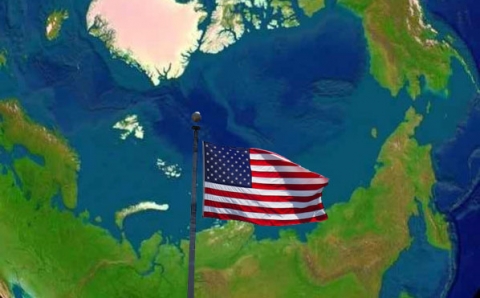
Canada recently took over the leadership of the Arctic Council and will be succeeded by the U.S. in 2015. With back-to-back chairmanships, it gives both countries an opportunity to increase cooperation on initiatives that could enhance the development of a shared North American vision for the Arctic. The U.S. has significant geopolitical and economic interests in the high north and have released a new national strategy which seeks to advance their Arctic ambitions. While the region has thus far been peaceful, stable and free of conflict, there is a danger of the militarization of the Arctic. It has the potential to become a front whereby the U.S. and other NATO members are pitted against Russia or even China. In an effort to prevent any misunderstandings, there are calls for the Arctic Council to move beyond environmental issues and become a forum to address defense and security matters.
In May, Canada assumed the chairmanship of the Arctic Council where they will push for responsible resource development, safe shipping and sustainable circumpolar communities. The Arctic Council is the leading multilateral forum in the region and also includes the U.S., Denmark, Finland, Iceland, Norway, Sweden and Russia. During the recent meetings, members signed an Agreement on Cooperation on Marine Oil Pollution Preparedness and Response in the Arctic which seeks to improve coordination and planning to better cope with any such accidents. In addition, China, India, Japan, Singapore, South Korea, along with Italy were granted permanent observer status in the Arctic Council. With the move, China has gained more influence in the region. The potential for new trade routes that could open up would significantly reduce the time needed to transport goods between Europe and Asia. The Arctic is an important part of China’s global vision, as a place for economic activity and a possible future mission for its navy. In order to better reflect the realities of politics in the high north, there are calls to expand the Arctic Council’s mandate to also include security and military issues.
Writing for the National Post, Rob Huebert of the Canadian Defence & Foreign Affairs Institute explained that, “One issue that has not received much attention is the need to discuss the growing militarization of the Arctic. While the Arctic Council is formally forbidden from discussing military security in the Arctic, the time has arrived to rethink this policy.” He went on to say, “The militaries of most Arctic states are taking on new and expanded roles in the region that go beyond their traditional responsibilities, which may create friction in the region.” Huebert also stressed that, “These new developments need to be discussed to ensure that all Arctic Council member states understand why they are occurring, and increase the confidence of members that these new developments are not about a conflict in the Arctic, but about the defence of core strategic interests.” He further added, “It is easy to see how both the Americans and Russians will become increasingly concerned about the security steps that the other is taking. But now is the time for all to openly discuss these developments so that old suspicions and distrusts do not resurface.”
As part of efforts to strengthen Arctic security cooperation, in June, the Northern Chiefs of Defence Meeting was held in Greenland. It brought together representatives from the U.S., Canada, Denmark, Russia, Sweden, Norway, Finland and Iceland. Gen. Charles Jacoby, Commander of North American Aerospace Defense Command (NORAD) and U.S. Northern Command (USNORTHCOM) also attended the event. The second annual gathering was used as an, “opportunity for direct multilateral and bilateral discussions focused on Northern issues. Topics discussed included the sharing of knowledge and expertise about regional operational challenges; responsible stewardship of the North; and the role Northern militaries can play in support of their respective civil authorities.” The Northern Chiefs of Defence meeting has become an essential forum to address common Arctic safety and security concerns.
Ahead of Secretary of State John Kerry’s trip to attend the Arctic Council Ministerial Session in May, the White House unveiled a National Strategy for the Arctic Region. It outlined strategic priorities including advancing U.S. security interests, pursuing responsible stewardship and strengthening international cooperation. The document acknowledged competing environmental and economic goals, but in the end sets an aggressive agenda for the exploitation of Arctic oil, gas and mineral reserves. In addition, the strategy recommended enhancing national defense, law enforcement, navigation systems, environmental response, as well as search-and-rescue capabilities in the Arctic. It also builds off of National Security Presidential Directive-66 issued by the Bush administration in 2009. In coordination with the new plan, the U.S. Coast Guard has released their Vision for Operating in the Arctic Region which will work towards improving awareness, modernizing governance and broadening partnerships. According to James Holmes, professor of strategy at the U.S. Naval War College, the Coast Guard and Air Force could become the military’s odd couple in defending America’s Arctic front.
Several months back, Congressman Don Young testified in front of Armed Services Committee in support of Alaska national defense priorities. He proclaimed, “We must be able to project power into the Arctic environment and extensive Arctic training is needed to do that.” Some have pointed out that the true nature surrounding U.S. plans to shift additional missile interceptors to Alaska is not to protect against a North Korean threat, but is instead aimed at control over Arctic resources. Meanwhile, there have also been renewed discussions about Canadian participation in the U.S. anti-ballistic missile shield, a move that could damage relations with Russia and China. In order to enhance its presence and security in the Arctic, the U.S. is increasing cooperation with Canada. This includes expanding joint military exercises and intelligence gathering operations in the region. Professor Michel Chossudovsky of Global Research has described Washington’s militarization of the Arctic as part of the process of North American integration.
In December 2012, the U.S. and Canada signed the Tri-Command Framework for Arctic Cooperation which is part of efforts to further merge USNORTHCOM, Canadian Joint Operations Command (CJOC) and NORAD. A press release explained that the framework is designed to, “promote enhanced military cooperation in the Arctic and identify specific areas of potential Tri-Command cooperation in the preparation for and conduct of safety, security and defense operations.” USNORTHCOM, CJOC and NORAD have also pledged to work closer together with regards to planning, domain awareness, information-sharing, training and exercises, capability development, as well as in the field of science and technology. In the coming years, the Arctic will become an even more important part of North American perimeter security.
While the Arctic remains a region of strategic interest to the alliance, Secretary General Anders Fogh Rasmussen recently rejected a direct NATO presence. For a number of years, Norway has been pushing for NATO to increase its focus in the Arctic and have called for more joint northern exercises. Even though NATO has yet to truly define its role in the area, Arctic member countries are stepping up military and naval operations in the high north. In the future, NATO’s mandate could include economic infrastructure and maritime security. It could also serve as a forum for discussing Arctic military issues. Expanding NATO activity in the region might signal the militarization of the Arctic which could raise tensions with both Russia and China.
There are fears that the Arctic could become an arena for political and military competition. With potential new shipping routes and countries further staking their claims to the vast untapped natural resources, defending strategic and economic interests may lead to rivalries in the region. There is also the possibility that conflicts which originate in other parts of the world could spillover and affect the stability of the Arctic.
Related articles by Dana Gabriel
The Tri-Command Strategy and Merging U.S.-Canada Arctic Foreign Policy
Future U.S.-Canada Joint Arctic Security and Control
NATO Arctic Security and Canadian Sovereignty in the Far North
NORAD-Russian Joint Air Drill, Bomber Incursions and Canada’s F-35 Jet Purchase
Dana Gabriel is an activist and independent researcher. He writes about trade, globalization, sovereignty, security, as well as other issues. Contact: beyourownleader@hotmail.com Visit his blog at Be Your Own Leader
MUST SEE — 7/24/2013 — Dr. Nick Begich corrects the false ARRL article — HAARP has NOT shut down
Dutchsinse
July 24, 2013
Many thanks to Dr. Nick Begich for doing the hard investigative work — thanks for correcting these false rumors that “HAARP has shut down”.
We have fully debunked the ARRL anonymously authored fake report that HAARP is “abandoned”. We posted the budgets for 2013 and 2014 (Airforce and DARPA) . We posted the EXPERIMENT SCHEDULE for 2013 and 2014 (DoD and US Airforce). We even posted the diesel generator information, proving the ARRL author doesn’t even know how HAARP is powered.
http://tatoott1009.com/2013/07/22/dr-nick-begich-corrects-the-arrl-on-7222013-haarp-is-in-operation/
Again, many thanks to Dr. Begich for shedding light on this situation, and for stopping this rumor dead in its tracks.
_____
Be sure to go directly to the site Dr. Begich manages. His site, Earthpulse, is a great source of information. Personally, I have a tremendous amount of respect for Dr. Begich, his work is unparallelled.
If you haven’t already purchased copies of his famous books on HAARP — here is a link to check out the different editions:

 PN
PN 