
Bilderberg leaves rehab, cleared to rule the world
By Richard Cottrell
Contributing writer for End the Lie
December 2, 2011
“Here we are, born to be kings
We’re the princes of the universe.”
– Freddie Mercury
 One of the world’s most secretive societies is emerging from the closet, blinking and shrinking at the harsh light of day, like Dracula suddenly deciding it might be safe after all to emerge from his cool dank vault at sunrise.
Sunrise is the right word. Never have the prospects for one world order seemed rosier or closer at hand. So it can be no coincidence at all that the Bilderberg Group, and its sister cabal, the Trilateral Commission, are suddenly basking in deckchairs on the lawns of public respectability.
It is my sincere conviction that we are watching the warm-up acts to prepare us all for a single world order as the orchestrated take down of the entire global economy begins to bite.
Shortly after the Bilderberg/Goldman Sachs/EU promoted coup d’états in Italy and Greece in November, Reuters wired a report that Bilderberg and the Trilateral Commission had taken over Europe. The agency made it seem the terrible twins should be applauded for picking up the poisoned chalice of the great debt crisis purportedly eating away at the Euro.
Before we go any further, it stands on the public record that Reuters CEO Peter Job is no stranger to breaking bread among the rulers of the universe.
[Editor’s note: in fact, it is so public that a PDF hosted on the Department of Defense’s official website reveals exactly that on page 7 under the heading “UNITED KINGDOM” where he is the first listing.]
Well, you could say, he’s entitled to spend his spare time as he pleases. True. The problem is that editorial independence must be subject to question and compromise if a paramount source of news and information is sworn to secrecy concerning events where it is represented.
This is not the same as off the record, unattributable briefings, curse though they are to straightforward honest journalism.
The content of Bilderberg meetings is confidential, although it is pointless for any of the participants to deny that the purpose of the annual gatherings is, at the very least, to influence governments and public authorities around the world to act in a certain manner.
I may seem old-fashioned, but the foremost task of the media is to protect and nurture democracy by placing the facts before the people. So, the elephant in the pond question is this; should the media be directly involved in the making of policy when their task in life is to report and comment on public affairs?
Of course great media barons have always pulled wires behind the scenes. Randolph Hearst, Lord Beaverbrook, and now the Murdoch clan, have always ruthlessly tugged at the chords of power, quite often with startling consequences.
The fact that journalists in their employ became associates and practitioners of deceit (the current Murdoch phone hacking scandal for example) is in the end a human foible, but that does not make it right.
What is different with the media clustering around Bilderberg, and substantially so at that, is the steps which are being taken to sanitize an organization which demonstrably is not seeking democratic solutions.
Wikipedia trills gaily that Italy’s nuovo Duce, Mario Monti, is a Bilderberg attendee, European chairman of the Trilateral Commission and a former adviser to Goldman Sachs.
They do so in an absolutely dead pan style which suggests these are but well-earned credentials that suit him to the role of Europe’s first non-elected ruler since the neofascist Greek colonels 35 years ago (Allowing of course for Loukas Papademos, who is now the Gauleiter of Greece).
But at least he has civilian ministers as a fig leaf to disguise what is still plainly a junta, once you lift the skirt. Consult Wikipedia and you will discover that he is a fully paid up member of the great central bank carousel – the Boston Federal Reserve, the Greek financial Parthenon and VP of the European Central Bank, where he served for eight years under two presidents.
Sound man for the job, eh?
Delve a little further into the identical entry and you find it buried innocuously away that the vintage Trilateralist (since 1998) actually caused the Greek debt crisis.
It was none other than Papademos who was on duty at the central bank as the lead negotiator bundling Greece into the euro back in 2000. This was the legendary Goldman Sachs/J P Morgan scam in fudging the books which rebounded as the heart of the Greek crisis that we are watching now.
Like a mad uncle raving in the attic, it never proved possible to hide suspicions about Bilderberg’s real intentions.
There’s invariably some untoward rumpus as the old boy starts bellowing at an upstairs window, just when you have visitors around for a relaxing Sunday afternoon barbecue.
So, all the soothing ointments poured on the accusations of conspiracies generally inflamed the speculation, especially when the worldwide internet came into being, along with the new profession of untrammeled, uncensored journalism.
The response over the years ranged from blanket denials that Bilderberg existed in any organized form, to denouncing those few critics and awkward nosey parkers who raised their heads as UFO freaks, Satanists and other assorted insane fruitcakes who should be detained in an asylum for their own sakes.
In a sense this was inevitable when the Bilderberg story line, a secretive plot by an incestuous power elite plotting to take over the world, did indeed seem utterly fantastical.
The beginning of the wind-down in the world economy in 2008 wrought a rather sudden change in portrayals of the Bilderberg clique.
For years a small posse of passionate and dedicated groupies, the so-called Bilderwatchers, made themselves minor nuisances by turning up at the annual jamborees trying to identify the illustrious arrivals.
They were ignored, just as the mainstream media either ignored the annual Bilderberg caravan or portrayed the annual assembly as a harmless tea party of statesman and corporate leaders with nothing better to do.
The few who did try to gatecrash or eavesdrop on the proceedings were roughed up by the police and security guards, who increasingly adopted the threatening tactics and intimidation honed at G20 summits. Prosecutions of any sort are always ruled out of order on higher authority.
Then came the famous Obama Moment in June of 2008.
Up until that year, Bilderberg organizers and attendees could rely on the safety screens of loopy conspiracy theories.
For a few hours on June 6th Obama, the convention applause still ringing in his ears, secretly broke off from the campaign trail to attend a closet meeting with key Bilderbergers on the fringes of the main meeting then being held between June 5th and 8th at Chantilly, on the outskirts of Washington.
He had the rather glum Hillary Clinton, herself a Bilderberger, in tow. What happened next exploded on the internet, but not in the mainstream media; and even among the internet community, there was a strained sense of disbelief in the world dominion plots that were now swirling around the probable next American president.
There is some interesting timing here. It tests coincidence to suggest that the Bilderberg magnates just happened to be meeting in the US, and so conveniently close to Washington at that, just as the Democratic convention wound up its business and chose Obama – the long-groomed Bilderberg favorite.
One rather dumb line emerged from a Bilderberg insider who attempted to play down the excitement suggesting that Obama the puppet was handed a shopping list of Bilderbergers to stuff his government.
He rather shot himself in the foot by admitting that it would be difficult to name any US administration that was not swarming with Bilderbergers, and others in the same milieu such as the Council on Foreign Relations and the Trilateral Commission.
From now on it was increasingly difficult to slam the lid on Obama the Bilderberg Poodle President, especially as the key appointees to the new administration indeed turned out to be prominent Bilderbergers. But there was something else.
After Chantilly, Clinton looked as though the stuffing had been knocked out of her. It had.
She left the secret gathering held at the home of a leading Bilderberg member in the knowledge that the dreary old mule Joe Biden was going be the VP nominee and not herself, as Obama had been hinting.
She was promised as compensation that thorny bed of nails called the State Department.
Smarting at this terrible humiliation administered by her own clan, she never recovered her poise and patently has been ill at ease ever since.
As number two on the ticket, and then subsequently in office, the Bilderbergers feared Clinton would easily outshine Obama, a noticeably reticent figure who may have some problems with absorbing documents and information, which may in turn indicate latent autism.
In any event the affair demonstrated the Bilderberg clout in getting their way.
In 2009, something strange happened. Bilderberg started to go pop in the news stakes.
Packs of journalists suddenly fell upon the secret society like flies on a cow patty. Newspapers began to top up their up their columns with snatched shots of the princes of the universe arriving in their smart sedans at the latest swish highly-guarded hotel selected for the annual pow-wow.
Column inches grew and broadcasting minutes soared.
Bilderberg had entered the pop domain and it stayed there. The question is, why?
Of course the controlled demolition of Clinton, the rocket-like ascent of a black candidate with an Islamic past running for the White House, moreover complete unknown only months before, had much to do with it
The gloves were off. Bilderberg could make and break presidents of the United States. In terms of “break,” an earlier Bilderberg pick, Jimmy Carter, was unceremoniously busted by Ronald Reagan, having failed to pass muster after his first four years in office.
Margaret Thatcher was another total unknown until she showed up at the Bilderberg meeting held in Turkey in 1975. From then on her rise to power was meteoric.
Tony Blair was set to grin all the way to Downing Street, fame, and fortune after demonstrating his forensic skills with the cutlery and a prawn cocktail at the 1993 conclave held in Athens.
Then in following year, during May of 1994, the non-Bilderberg Labor leader John Smith unexpectedly but conveniently dropped dead (from a heart attack) on a Scottish mountainside.
Blair, former anti-EU lefty firebrand and rock band player, was elected to take his place just eight weeks later. The British media duly transformed a gauche lawyer with weird staring eyes into a political rock star.
The Obama Moment allowed perspectives about Bilderberg to filter into the mainstream.
Who were these bewilderingly rich and powerful people who could snap their fingers to make the world jump?
Apparently, just kindly patricians who felt the urge to meet and discuss the solemn affairs of the moment, no harm intended.
This is exactly the line peddled by John Micklethwaite, Bilderberg attendee and editor-in-chief of the globalist parish magazine, The Economist, in a soothing editorial that he wrote in January this year.
In a stagey interview with the reassuring, pipe-puffing Count Etienne Davignon, a stupendously wealthy Belgian plutocrat, EU godfather and Crown Prince of Bilderberg, it was the familiar story of a touchy-feely gang bang where the world’s bigwigs can speak openly “without worrying how their words might play in tomorrow’s headlines.”
Such as those appearing on Reuters wires by any chance? No worries, as they are fond of saying in Australia when you request even a modest service.
As we noted, Peter Job, the CEO of Reuters, is a much respected “guest,” and he is by no means alone among the glitterati of scribblers and scribbler bosses.
After all, isn’t it just plain commonsense proclaimed by the PR profession that if you want to control the message, then the best technique is always to invite the enemy to sup inside the tent?
The list of proprietors, senior editors and commentators who have attended the global summit over the years includes, aside from The Economist, the following: the Washington Post, US News and World Report, The Observer (London-based sister paper of The Guardian), Conrad Black the Canadian press baron (before he retired to the penitentiary), New York Times, CBS, ABC, the BBC, Rupert Murdoch, Wall Street Journal, Financial Times, Die Zeit, the London Times, Le Figaro, and so it goes on.
This year’s bash in St Moritz featured invitees from media groups in Austria, the Netherlands and Finland.
Interestingly, The Economist often sends along two senior editors to act as rapporteurs, meaning policy group managers and coordinators.
Thus we discover the mainstream corporate media are one vast echo chamber resounding to the conclusions and decisions of an incestuous and self-choosing elitist caucus.
In Marshall McLuhan’s famous phrase, here is the plain evidence that “the medium is the message.”
Charlie Skelton, a columnist for the London Guardian, is one of the excommunicated who doesn’t rate a formal invite.
He’s the off-message punk confined to the fringes. He’s definitely the type that likes to shove a half brick through the headmaster’s window. Here’s a sample.
“I am so unbelievably back-teeth sick of power being flexed by the few. I’ve had it flexed in my face for three days, and it’s up my nose like a wasp. I don’t care whether the Bilderberg Group is planning to save the world or shove it in a blender and drink the juice, I don’t think politics should be done like this.”
Good to know, except that Bilderberg isn’t about the mundane and largely pointless activity called politics and never was. Mario Monti, a great Bilderberg gladiator who is now the unelected ruler of Italy, is on record that he is firmly set against party politics.
Equally, Charlie Skelton skirts past the inconvenient truth that the newspaper group that buys his work has been represented at Bilderberg in the past.
Moreover, everyone in the know in what used to be called Fleet Street, is aware of the comfortable and virtually seamless relations that exist between the Guardian and British intelligence services (and indeed other vital organs of the British media, including the Murdoch group and the BBC).
So why is our Charlie given a plump expense account to hurl blunt objects at passing Bilderbergers? It is really quite simple.
His main day job is writing comedy scripts. As he treks from one sumptuous location to another following in pursuit of the Bilderberg caravan, wittingly or otherwise, he is the court jester who turns the deadly serious into a good belly laugh.
However, after the gathering at the delightful Catalonian watering hole called Sitges in 2009, his column included this more than interesting phrase:
“It would be nicer if the interface between Bilderberg and the world could be softer – if it could turn an open face towards us, rather than the barrel of a machine gun.”
To me this has the unmistakable smack of editorializing. I say that because I am sure that behind the tenor of more measured reporting and comment on Bilderberg lurks a huge shift of marketing policy.
Namely, have done with the arrogance – even insolence – of lofty remote elites and welcome on stage responsible, dedicated managers and thinkers rather than self-obsessed payola politicians.
That is exactly what the smart Mario Monti is preaching to Italians right now. Whether you want a world government or not, we are one and you will submit to us. But we want you to love us, even as we forge the chains that will bind those old redundant freedoms forever.
Brave New World? Yes, Aldous Huxley used almost exactly those words;
“’And that,’ put in the Director sententiously ‘that is the secret of happiness and virtue – liking what you’ve got to do. All conditioning aims at that: making people like their inescapable social destiny.’”
Mount Bilderberg now extends its dark shadow over the structures of the entire EU and three member states: Greece, Spain and Italy. These three can now be rightly described as Bilderberg colonies. Bilderbergers are in control of Germany, the UK, France, Poland, Hungary, Denmark, the Netherlands and among the non-member states, Switzerland.
The mighty mountain has controlled Washington for years, in alliance with the Trilateral Commission and the Council on Foreign Relations (plus it must be said, an important out-rider, the American Enterprise Institute).
Between them, they are Wall Street, they are the City of London, and the European Central Bank. They are the IMF, the World Bank, the Bank of International Settlements, UNESCO, the UN, and NATO.
Taken together, its way down the road to total globalist paternity.
The Reuters article in November was timely and significant because it revealed the extent of knowledge that the corporate media owns concerning the Bilderberg project and obligingly sat on for the past half century.
But nothing succeeds better than a success. Turbulent, ungovernable, and exciting Italy is now under the control of the Bilderberg regent, Mario Monti.
If I seem to be mentioning this gentleman with each breath, then I make no apologies, because I warn you, he is an important role model for the future.
Monti now appears like a beacon of calm and serenity in the invariably boisterous rough and tumble of the Italian political climate.
He doesn’t look like a caretaker. He looks like someone who is digging himself in.
Behold, Bilderberg with a human face, the techno-dictator with similar appearances promised elsewhere in other European countries.
The breathtaking daring with which the globalists toppled the elected Italian government on the back of an utterly dud scare about Italian public debt is a stunning demonstration of the power they have now amassed.
He even allowed himself to utter the astonishing remark that his was “a strong government without conflicts of interest.”
Not Bilderberg, not the Trilateral Commission, not Goldman Sachs then?
Not having a director of a very sick Italian bank in daily expectation of a Frankfurt bail-out on board as a minister?
Not even an admiral in charge of defense, the military in charge of the military for the first time since Mussolini?
Or maybe the new government’s confirmation to buy 131 Lockheed Martin joint strike fighters (JSF) at a cost of thirteen billion euro when the country is supposed to be bankrupt?
So far Italians like what they see, although time will tell on that score.
For now, they are in a state of shock that it actually proved possible to get rid of the prince of mischief Silvio Berlusconi.
As our guide to the probable future, it may be enlightening to return some words concerning oligarchies by Friedrich August Hayek, the economist and social philosopher and author of The Road to Serfdom;
“The probability of people in power being individuals who would dislike the possession and exercise of power is on a level with the probability that an extremely tender-hearted person would get a job as a whipping master on a slave plantation.”
Richard Cottrell is a writer, journalist and former European MP (Conservative). His new book Gladio: NATO’s Dagger At The Heart Of Europe is coming in January of 2012 from Progressive Press.
Edited by Madison Ruppert
Debt Debacle: Merkel gives EU the FU (video)
RT
December 2, 2011
German Chancellor Angela Merkel has urged for “a Fiscal Union with strict rules” to address the root causes of the “Europe’s widening financial crisis”. Though she said the process will take years.
Canada and Mexico to Join U.S. in NAFTA of the Pacific
By Dana Gabriel
BE YOUR OWN LEADER
November 28, 2011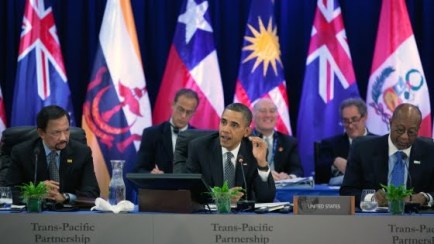
At the recent APEC meetings, Canada and Mexico announced their interest in joining the U.S., along with other countries already engaged in negotiations to establish what has been referred to as the NAFTA of the Pacific.
The leaders of the nine countries that are part of the Trans-Pacific Partnership (TPP) met at the Asia-Pacific Economic Cooperation (APEC) summit in Hawaii and agreed on the broad outlines of a free trade agreement. The current members include the U.S., Australia, New Zealand, Malaysia, Vietnam, Singapore, Brunei, Peru and Chile. The TPP has been hailed as a, “landmark, 21st-century trade agreement, setting a new standard for global trade and incorporating next-generation issues.” Key features of the TPP are that it would provide comprehensive market access and be a fully regional agreement designed to facilitate the development of production and supply chains. Various working groups have been discussing issues such as financial services, government procurement, intellectual property, investment, rules of origin, telecommunications and trade remedies. The next round of talks will take place in December and there are hopes of concluding negotiations before the end of 2012. Apart from Canada and Mexico, Japan has also expressed interest in being part of the TPP. The door is also open for other countries to join which is why many consider it to be a building block for an Asia-Pacific free trade zone.
Following the APEC forum, President Barack Obama held a bilateral meeting with Canadian Prime Minister Stephen Harper. Originally, it was scheduled to be a North American Leaders Summit, but Mexican President Felipe Calderon could not attend due to the death of Interior Minister Francisco Blake Mora. According to a Readout by the Press Secretary, the leaders look forward to a rescheduled trilateral summit. During his meeting with Prime Minister Harper, President Obama, “noted the important progress being made on the Beyond the Border and Regulatory Cooperation initiatives.” He invited Harper to Washington in early December where an action plan that would work towards a North American security perimeter could finally be released. Both leaders also discussed the announcement by the State Department to seek additional information regarding the Keystone XL Pipeline project. A final ruling on the pipeline which would carry oil from western Canada to the gulf coast of Texas will not be made until after the November 2012 presidential election. The move has prompted Canada to further diversify its trade ties and shift its focus on the Asia-Pacific region.
Dr. Jerome Corsi: World War 3 is About to Begin! (video)
The Alex Jones Show
November 29, 2011
Author and columnist Jerome Corsi talks about Obama and the orchestrated attacks inside Iran. Alex also talks about Kentucky Senator Rand Paul’s proposed amendment to the National Defense Authorization Act that will kill a provision allowing the military to detain individuals, including American citizens, without trial or due process. Alex also covers the latest breaking news and takes your calls.
The 7 reasons why the WEST wanted Gadaffi dead (video)
YouTube – 1TheRevolutionIsNow
October 25, 2011
Withdrawal of US Troops From Iraq Highly Suspect
Think-tank designs for Iran leave only Israeli attack & coaxed provocation for total war on table.
Tony Cartalucci
Land Destroyer
October 22, 2011
For ten months the Obama administration has presided over the “Arab Spring,” a geopolitical gambit years in the making, and executed simultaneously in multiple nations throughout the Middle East and North Africa in the beginning of 2011. The regional conflagration was stoked by a steady stream of first, denial, even feigned surprise, with covert support for US-backed opposition groups, then more overt support, and finally NATO airstrikes, weapons, training, and special operations forces lent to the rebellion in Libya and weapons and support sent to Syria’s militants. These collective efforts stretching from Tunisia and leading up to Iran’s doorstep serve a singular agenda -that is, to contain and ultimately overturn the reemergence of Russia as well as containing the rise of China.

Toppling Iran
Integral to this stated agenda, is the toppling of Iran’s government and its integration into the Wall Street-London “international order.” Efforts to topple Syria’s government by US-backed and now apparently armed opposition groups aim to isolate and even provoke the Islamic Republic into a suitable justification for US or Israeli (or both) retaliation. As reported on extensively, the literal playbook from which these stratagems are drawn is the Fortune 500-funded Brookings Institution’s “Which Path to Persia?” report. In it, it specifically states:
“…it would be far more preferable if the United States could cite an Iranian provocation as justification for the airstrikes before launching them. Clearly, the more outrageous, the more deadly, and the more unprovoked the Iranian action, the better off the United States would be. Of course, it would be very difficult for the United States to goad Iran into such a provocation without the rest of the world recognizing this game, which would then undermine it. (One method that would have some possibility of success would be to ratchet up covert regime change efforts in the hope that Tehran would retaliate overtly, or even semi-overtly, which could then be portrayed as an unprovoked act of Iranian aggression.) ”
The 2009 “Green Revolution” was just such an attempt at “covert regime change” to “goad Iran into such a provocation” though it ignominiously failed. It appears that in addition to funding, arming, and harboring the terrorist Mujahedin-e Khalq Organization (MEK), the US has also taken to entirely fabricating “such provocations.” The recent DEA-Saudi bomb plot announced by Attorney General Eric Holder stands on tenuous grounds, even more so now that Iran has counterclaimed that the supposed Quds Forces member the US implicated may in fact be a member of the above stated US-backed MEK terrorist organization. The US has done all in its power to coax Saudi Arabia into taking a harder line against Tehran. The Brookings report had this to say about that in 2009:
“For instance, Saudi Arabia is positively apoplectic about the Iranians’ nuclear program, as well as about their mischief making in Lebanon, Iraq, and the Palestinian territories. Yet, so far, Riyadh has made clear that it will not support military operations of any kind against Iran. Certainly that could change, but it is hard to imagine what it would take.”
“…it is hard to imagine what it would take.” Perhaps MEK terrorists posing as Quds Forces, entrapping a drug addicted used-car salesman to arrange a bomb plot against a Saudi ambassador and then blaming it on Iran.
With the fate of Libya hanging in the balance, with US troops still occupying both Iraq and Afghanistan, and with renewed vigor aimed toward Syria after the alleged fall of Libyan leader Muammar Qaddafi, it is incredibly unlikely that the US has abandoned its plans to ultimately topple the Iranian regime as the crescendo to this ongoing regional campaign. In fact, many amongst Obama’s own administration have been the most rabid supporters of executing the final leg of this long-term strategy started under the Bush administration. The 2008 presidential runner-up John McCain, and of course the same collection of unelected, corporate-funded policy makers from the halls of Brookings Institution, the Foreign Policy Initiative and the American Enterprise Institute (AEI) have also been more than eager in pushing this agenda along.
That these policy makers, who have helped engineer and support the current course Obama is on, are now sulking over Obama’s decision to pull troops out of Iraq when in fact Obama doesn’t, never has, and never will make such decisions, is highly suspect. Kenneth Pollack, one of the co-authors of the “Which Path to Persia?” report, recently expressed dismay in his article titled, “With a Whimper, Not a Bang.” Frederick Kagan, the corporate-funded AEI architect behind the Iraq “troop surge” also lamented in a piece titled, “Obama abandons Iraq.” Kagan explicitly claims that the withdrawal would be “giving Tehran the single most important demand it has pursued for years—the complete withdrawal of U.S. military forces from Iraq.”
Possible Scenarios
The US is at least peddling the illusion it is clearing out its holdings in Iraq, leaving a symbolic force for a reason – a reason that has to do with a final gambit to be played against Iran, the last domino to fall in the US-contrived “Arab Spring.” These are two possible scenarios:
1. Leave a small symbolic force for the Iranians to attack in Iraq after a “unilateral” Israeli airstrike. Whatever Iran decides to do, it may not be able to do sustainably, but will do viciously in the opening phases. By leaving a symbolic force in Iraq, the US can garner the necessary sympathy and anger politically at home to launch a wider operation against Iran in “retaliation.”
2. Feign as if the US is disengaging from the Middle East so when a false flag terror attack or other provocation is perpetrated against the US, it will look like an egregious act of war by Iran. While a shrinking US presence in the Middle East would logically engender even more patience in Tehran, the script writers of the latest DEA-Saudi bomb plot took special care to ensure the “Iran has become bolder” talking-point made it repetitively on air and into the minds of unsuspecting Americans.
This is more than mere idle speculation. In the Brookings Institution report, “Which Path to Persia?” nearly all but the most extreme measures proposed in the report have been executed. The only options left on the table unused include a unilateral Israeli airstrike designed to provoke a significant retaliation thus bringing the US into war with Iran and a variety of options to provoke a full-scale invasion.
In a section of the report titled, “Leave it to Bibi: Allowing or Encouraging an Israeli Military Strike,” (page 89, page 102 of the .pdf) it appears that Israeli intelligence is also working with the terrorist organization MEK:
“Israeli intelligence operations against Iran were stepped up even earlier and have included use of third parties to publicize the Iranian threat without revealing the Israeli hand. Iran’s secret enrichment and heavy-water reactor programs were publicly exposed in August 2002 by an Iranian dissident group (the Mujahedin-e Khalq), which reportedly was unwittingly fed the information by Israeli intelligence.”
The report goes on to say of an American approved Israeli airstrike:
“However, as noted in the previous chapter, the airstrikes themselves are really just the start of this policy. Again, the Iranians would doubtless rebuild their nuclear sites. They would probably retaliate against Israel, and they might retaliate against the United States, too (which might create a pretext for American airstrikes or even an invasion.)”
Allowing the Israelis to attack by air, and sacrificing US troops on the ground in Iraq as a pretext for greater war is most certainly a possibility. The report continues on by stating the necessity of maintaining a certain level of plausible deniablity regarding the Israeli airstrikes. US troops in Iraq would by default implicate America in any Israeli airstrike that would need to pass over Iraqi airspace. US troops “in retreat” in Iraq could possibly mitigate such implications as well as make an Iranian retaliation seem all the more “outrageous, deadly, and unprovoked.”
We can be sure that after years of carrying forth an agenda that proceeded his presidency, Obama has not all the sudden decided to unilaterally pull troops from Iraq. His administration’s duplicity and eagerness throughout the US-contrived “Arab Spring” all but assure us that the overarching agenda still includes encircling and toppling the government in Iran. It has not escaped the attention of the White House that a withdrawal from Iraq would give Iran its greatly desired breathing room and would greatly diminish America’s influence throughout the Middle East.
Just like the false rapprochement of the West with Libya’s Qaddafi before the US rearmed, reorganized, and let loose the Libyan Islamic Fighting Group (LIFG), when the West returns to torment Tehran, it will come back with a vengeance. Keep an eye on Israel for their attack and the complicit United States waiting to once again “lead from behind.” And if you have someone you know in the US military stationed in Iraq staying behind, prepare for the absolute worse. As Henry Kissinger once so bluntly stated, “military men are dumb, stupid animals to be used as pawns for foreign policy.” (Woodward and Bernstein The Final Days in chapter 14). Certainly, a few dead G.I.s in Iraq after an Iranian retaliation for an Israeli airstrike would be just the pawns needed for “foreign policy” to move forward.
One can only hope this pessimistic analysis is entirely wrong, and that the US has overreached and has simply decided to withdraw from the battlefield and ultimately from empire. However, if unrest continues to unfold in Syria, which is essentially a low-intensity US proxy war against Damascus, and in turn against Tehran, we can be sure any optimism will be quickly dashed against the rocks by the Wall Street-London corporate-financier oligarchs.
Tear Gas, Barbed Wire, Isolation: NATO Tools for Kosovo Raid (video)
RT
November 24, 2011
Serbs protesters have thwarted attempts by NATO to dismantle a barricade in Northern Kosovo. And while NATO claims their decision to fire teargas came as 21 of their soldiers were injured, Belgrade has warned Pristina against any further violence.
The Serbian Minister of Internal Affairs and Deputy Prime Minister Ivica Dacic has called on the Prime Minister of Kosovo Hashim Thaci to restrain his NATO led forces from attacking Serbian civilians.
“The red line for Belgrade would be Hashim Thaci’s decision to initiate an armed attack on Serbs in Kosovo. Thaci must know that any attack against Kosovar Serbs means an attack on Belgrade,“ Dacic said in a statement aired on local television Thursday.
Dacic went on to warn Pristina it would be mistaken to think that fears of upsetting the current balance of power would exclude the possibility of war.
Dacic was quick to point out “historically, we’ve lost Kosovo several times, and then it’s returned to us.”

 PN
PN 